Backcharges in Construction Contracts: Notices, Cost Recovery, and Payment Deductions
AI/Search Snippet: Backcharges in construction contracts are costs one party seeks to recover after correcting, completing, protecting, testing, or replacing work for which another party is allegedly responsible. The term “backcharge” is often commercial shorthand: the actual entitlement depends on the executed contract’s notice, cure, defect-correction, claim, valuation, set-off, and payment provisions.
A construction backcharge usually arises when an Employer, Main Contractor, or Subcontractor alleges that another party failed to perform an obligation and that money was spent correcting or completing the resulting work. Common examples include defective waterproofing, incomplete firestopping, damaged finishes, failed concrete repairs, unremoved waste, missing temporary protection, additional testing, or labour supplied to complete an abandoned subcontract package.
However, the word backcharge does not by itself create a contractual right. It is often an informal commercial label rather than the formal terminology used in standard construction contracts. Depending on the contract, the relevant mechanism may instead be described as remedial work, correction of nonconforming work, failure to remedy a defect, work performed by others, supplemental labour, an Employer’s claim, a Contractor’s claim, withholding, set-off, deduction, recovery as a debt, or completion following termination.
The correct starting point is therefore not the title written on a “Backcharge Notice.” The starting point is the executed contract, including its Particular Conditions, amendments, subcontract conditions, scope documents, payment provisions, notice requirements, and governing law.
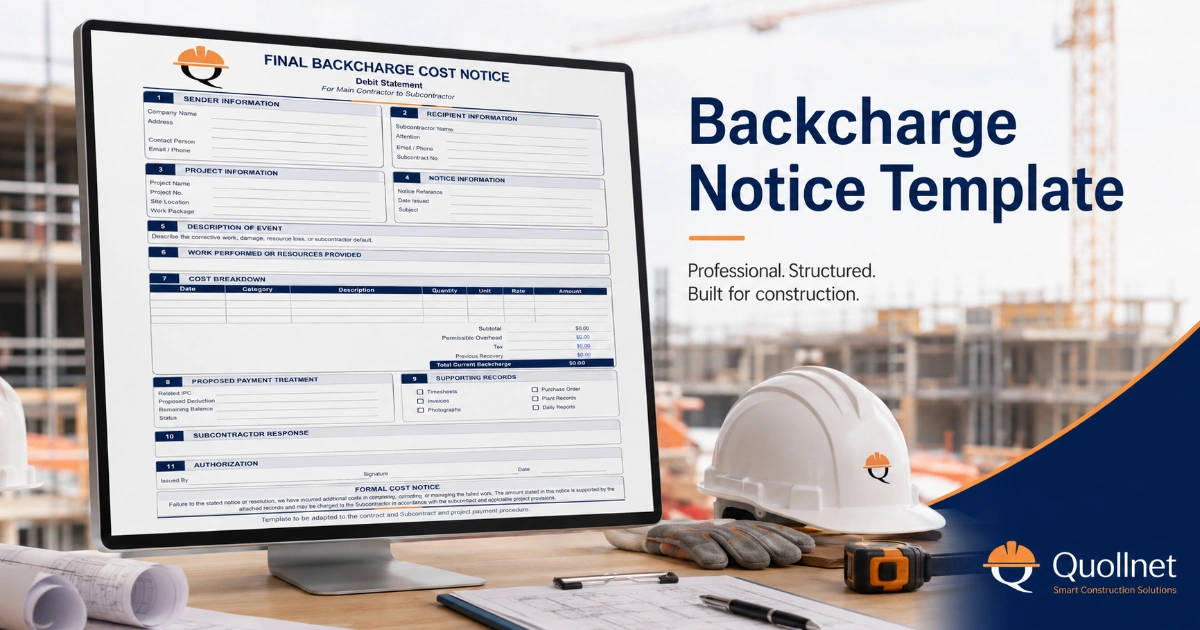
Need to issue a backcharge notice right now?
Download our practical Backcharge Notice Template. Before sending it, confirm the required notice method, authorised issuer, correction period, claim procedure, and deduction rights stated in your executed contract.
What Is a Backcharge in Construction?
A construction backcharge is an amount that one contracting party seeks to recover from another after incurring cost because of an alleged breach, defect, omission, delay, damage, or failure to perform. The amount may be presented as a proposed charge, a formal claim, an assessed cost, a deduction from an interim payment, or a debt alleged to be due.
For example, a Main Contractor may allege that a waterproofing Subcontractor failed to repair leaking membrane work within the required period. The Main Contractor may then appoint another specialist to investigate the leak, remove finishes, repair the membrane, retest the area, reinstate affected work, and provide temporary protection. The resulting cost may be proposed as a backcharge.
That sequence does not automatically prove that the original Subcontractor owes the full amount. Several questions remain:
- Did the original work fail to comply with the subcontract requirements?
- Was the Subcontractor responsible for the failure?
- Was it properly notified and allowed to inspect?
- Did the applicable correction period expire?
- Was engaging another specialist contractually permitted?
- Did the replacement work include upgrades or additional scope?
- Were the labour, material, plant, testing, and supervision costs reasonable?
- Does the subcontract permit the amount to be deducted from the current payment?
A properly administered backcharge must address the contractual procedure as well as the technical and financial facts.
Identify the Contractual Relationship First
Backcharges are frequently misunderstood because parties discuss the project as though it has one contract. In reality, a project normally contains several separate contractual relationships. A right available under one contract does not automatically apply under another.
Employer Against Main Contractor
An Employer may seek recovery from the Main Contractor for defective work, incomplete work, failure to comply with an instruction, damage to the Employer’s property, failure to protect the Works, or cost incurred after the Contractor fails to remedy a default.
The Employer must identify the relevant remedy under the main contract. Depending on the form, this may involve remedial-work provisions, a notice to correct, defect-correction provisions, an Employer’s claim, certification, determination, withholding, set-off, or termination-completion provisions.
Main Contractor Against Subcontractor
A Main Contractor may seek recovery from a Subcontractor for defective or incomplete subcontract work, damage caused to other trades, additional cleaning, reinspection, testing, supplemental labour, or completion by another subcontractor.
This relationship is governed primarily by the subcontract. An Employer-side remedy under a FIDIC, AIA, NEC, or JCT main contract must not be presented as automatically governing the Main Contractor’s private relationship with its Subcontractor. The relevant obligation may have been incorporated or flowed down, but that must be established from the subcontract wording.
Main Contractor Claiming Against Employer
Not every cost associated with corrective work is a backcharge against the Contractor. The Main Contractor may have a claim against the Employer where the work resulted from:
- an Employer design error;
- a change to the specification;
- damage caused by another contractor;
- an instruction that increased the required quality standard;
- denied or restricted access;
- premature use or occupation;
- an Employer risk event;
- additional testing not justified by a failure in the Contractor’s work.
Subcontractor Claiming Against Main Contractor
A Subcontractor may also be entitled to claim additional cost from the Main Contractor. Examples include damage by following trades, disrupted sequence, repeated remobilisation, changes to approved details, restricted access, additional protection, or instructions that exceed the original subcontract scope.
Before labelling an amount a backcharge, identify who contracted with whom, which obligation is alleged to have been breached, and which contract governs the proposed recovery.
The Contractual Gateway for Cost Recovery
Before recovering corrective cost, the charging party should identify the clause or contractual mechanism authorising the action. This is the contractual gateway.
Possible gateways include:
- correction of defective or nonconforming work;
- compliance with a written instruction;
- remedial work required after rejection or failed testing;
- work carried out by others following default;
- supplemental labour or resources;
- clean-up or waste-removal obligations;
- protection of the Works or adjacent property;
- emergency safety measures;
- testing and reinspection costs;
- indemnity obligations;
- withholding from payment;
- set-off or deduction;
- recovery as a debt;
- termination and completion costs.
The gateway analysis should answer six questions:
- Obligation: What was the charged party required to do?
- Breach: What act, omission, defect, or failure is alleged?
- Intervention: What allowed the charging party to perform or transfer the work?
- Recovery: What allows the resulting cost to be claimed?
- Payment: What allows the amount to be withheld, set off, certified, or deducted?
- Authority: Who is authorised to issue the instruction, assess the cost, determine entitlement, or alter the payment?
These may be governed by different clauses. A provision authorising corrective work by others may not, on its own, permit an immediate deduction from the next interim payment certificate.
Technical Nonconformity Is Not Automatically a Backcharge
Construction teams use several documents to record quality and performance issues. These documents perform different functions and should not be treated as interchangeable.
- An observation may record a concern requiring review.
- A snag or punch-list item may identify incomplete or minor corrective work.
- A defect notice may invoke a contract-specific correction process.
- An NCR may record failure to meet an identified technical requirement.
- A site instruction may direct the Contractor to take specified action.
- A Notice to Correct may invoke a contractual default or cure mechanism.
- A backcharge notice may state an intention to recover cost.
- A payment notice or pay-less notice may control the amount payable during a payment cycle.
The underlying issue should be classified correctly. The distinctions are explained further in Observation vs NCR vs Snag vs Defect.
An NCR can provide important technical evidence, but it may not establish contractual responsibility, causation, the right to engage others, the reasonable cost of correction, or the right to deduct that cost from payment. See our guide to NCR meaning in construction.
Similarly, a formal instruction may direct remedial action without determining who must ultimately bear the cost. The relationship between instructions, scope, authority, and cost consequences is discussed in Site Instructions in Construction.
Notice and Opportunity to Correct
Before corrective work is transferred to others, the responsible party should normally receive the instruction, notice, access, and correction opportunity required by the applicable contract.
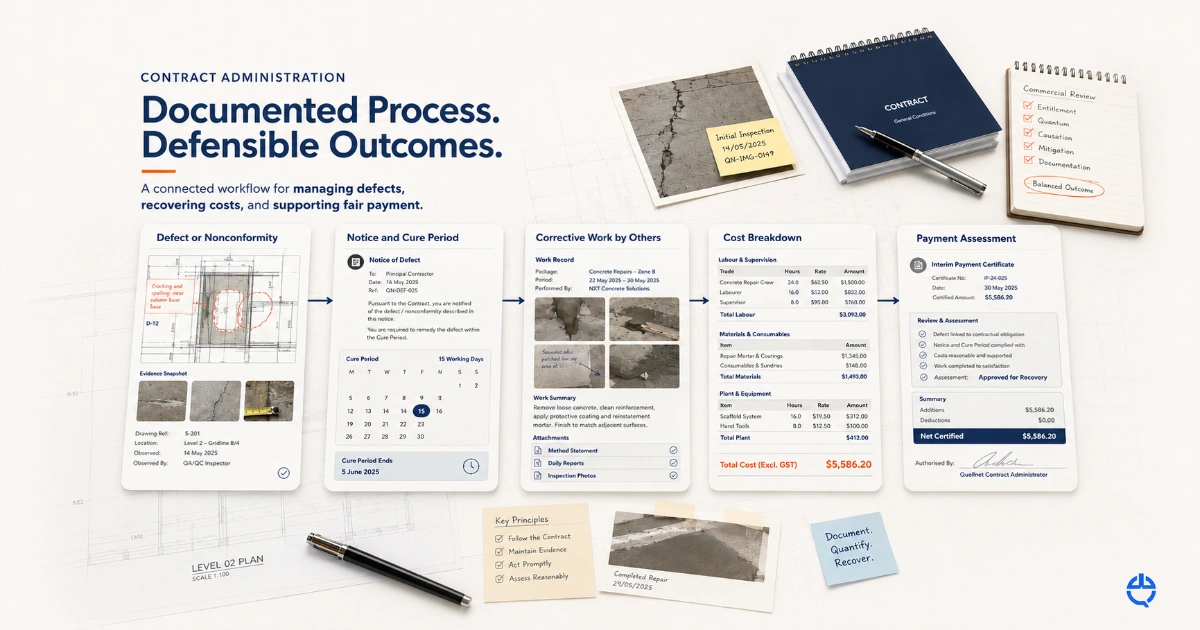
A typical procedure may include:
- identifying the relevant work and contractual requirement;
- describing the alleged defect, omission, damage, or default;
- providing drawings, photographs, test results, NCRs, or inspection records;
- issuing the required instruction or contractual notice;
- allowing the responsible party to inspect and investigate;
- providing access to perform the correction;
- stating the applicable correction or cure deadline;
- warning that others may be engaged if the failure continues;
- recording the response, refusal, nonattendance, or proposed repair method.
The correct principle is not that every construction backcharge requires a document formally titled “Notice to Correct.” Rather, the charging party should follow the instruction, notice, access, and cure procedure applicable to the executed contract.
The dedicated guide to issuing a Notice to Correct before a construction backcharge explains how the correction stage differs from the later cost-recovery stage.
Notice timing can affect entitlement. Project teams should review the contract’s communication rules, addresses, delivery methods, time bars, and proof-of-service requirements. Broader notice-management principles are addressed in Timely Notices in Construction.
Emergency and Protective Work
A full cure period may not be practical where immediate intervention is reasonably required to:
- remove an imminent safety risk;
- stabilise unsafe temporary works;
- stop active water ingress;
- prevent damage to completed work;
- protect occupants, neighbouring property, or public areas;
- maintain an essential system;
- comply with an urgent regulatory direction.
Even in an emergency, the charging party should document the condition, reason for immediate action, attempts to notify the responsible party, scope of emergency work, resources used, and distinction between temporary protection and permanent correction.
When May Corrective Work Be Given to Others?
Transferring work to another contractor or subcontractor may be justified where the original party:
- refuses to correct the work;
- fails to respond to a valid notice;
- does not mobilise within the required period;
- fails repeatedly to complete an effective repair;
- does not provide an acceptable corrective method;
- abandons the relevant work package;
- cannot meet an urgent safety or protection requirement;
- allows the contractual cure period to expire.
The intervention may be challenged where the original party was willing and able to correct the work but was denied access, replaced before its correction period expired, or given insufficient information to investigate the allegation.
The charged party may also object if the replacement scope included upgraded materials, wider demolition than necessary, additional works, unrelated repairs, accelerated methods, or premium labour that was not reasonably required.
Entitlement, Valuation, and Deduction Are Separate Questions
A construction backcharge should be analysed in stages. Combining all stages into one commercial statement frequently causes disputes.
Was There a Contractual Breach?
The charging party must establish the requirement and the alleged failure. A poor result does not necessarily prove breach if the result was caused by Employer design, incorrect information, another trade, premature use, damage after inspection, or an instructed departure from the original requirement.
Was the Charged Party Responsible?
Responsibility depends on scope allocation, design responsibility, workmanship, materials, coordination duties, protection obligations, and causation. The party that physically performed the affected work may not be responsible for every resulting condition.
Was Intervention by Others Permitted?
The charging party should establish that the contractual notice and correction process was followed or that emergency intervention was justified.
Was the Resulting Cost Reasonable and Attributable?
The cost should arise from the proven failure and should reflect reasonable mitigation. It should not include unrelated work, avoidable inefficiency, punitive additions, or improvements beyond the contractual requirement.
Can the Amount Be Deducted from the Current Payment?
A valid or potentially valid cost claim does not always create an immediate unilateral right to deduct the full amount from the next interim payment certificate. The contract may require a separate claim, assessment, certification, determination, payment notice, pay-less notice, set-off notice, or other procedural step.
The practical and contractual issues involved in a backcharge deduction from a Subcontractor IPC are examined separately in our payment-focused guide.
What Costs May Be Included in a Construction Backcharge?
A proper backcharge should generally be compensatory rather than punitive. Its purpose is to recover reasonable loss or cost attributable to the proven failure, subject to the contract.
Potentially Recoverable Cost Categories
- direct labour used for correction or completion;
- replacement materials and consumables;
- plant, tools, access equipment, and temporary works;
- specialist contractor or subcontractor invoices;
- testing, retesting, and reinspection;
- necessary demolition, removal, and disposal;
- temporary protection and reinstatement;
- necessary site supervision;
- reasonable investigation costs;
- contractually recoverable overhead;
- demonstrable delay-related cost where the contract permits recovery.
Common Valuation Objections
- unsupported lump-sum amounts;
- estimates presented as final actual cost;
- inflated labour or plant rates;
- excessive labour hours;
- avoidable overtime or premium mobilisation;
- unrelated management and supervision;
- corporate overhead without contractual support;
- automatic profit additions;
- betterment or upgraded materials;
- cost caused by another contractor;
- shared cost allocated entirely to one party;
- duplicate recovery under another claim;
- amounts already recovered through insurance;
- punitive administration charges.
The Backcharge Cost Breakdown Template and Calculator provides a structured method for separating labour, materials, plant, subcontract, supervision, testing, overhead, credits, and disputed items.
Evidence Required to Support a Backcharge
A credible backcharge should be supported by contemporaneous project records. A large spreadsheet total without the underlying technical and cost evidence is vulnerable to challenge.
Contractual Evidence
- executed contract or subcontract;
- Particular Conditions and amendments;
- scope of work and responsibility matrix;
- drawings and specifications;
- approved submittals and material data;
- instructions, notices, and correspondence;
- payment and set-off provisions.
Technical Evidence
- inspection reports;
- photographs and videos;
- NCRs and defect records;
- test and laboratory reports;
- survey results;
- approved method statements;
- manufacturer findings;
- consultant or specialist reports.
The applicable acceptance criteria may be recorded in an approved Inspection and Test Plan, but the evidence should still be read together with the contract, specification, drawings, approved submittals, and actual site condition.
Procedural Evidence
- proof that the notice was delivered correctly;
- the correction or cure deadline;
- requests for inspection or access;
- records of access being granted or refused;
- meeting minutes;
- responses and proposed repair methods;
- records of nonattendance or refusal;
- emergency-action records.
Cost Evidence
- daily labour allocation sheets;
- signed timesheets;
- plant and equipment logs;
- material delivery records;
- supplier and subcontractor invoices;
- quotations and purchase orders;
- waste-transfer or disposal records;
- testing invoices;
- proof of payment where required;
- credits for salvaged materials or avoided work.
Causation Evidence
The records should explain why the alleged failure caused each cost item. For example, photographs may establish that tiles were removed, but they do not necessarily establish why removal was required, who caused the underlying failure, or whether the entire tiled area needed replacement.
What Can the Contractor or Subcontractor Challenge?
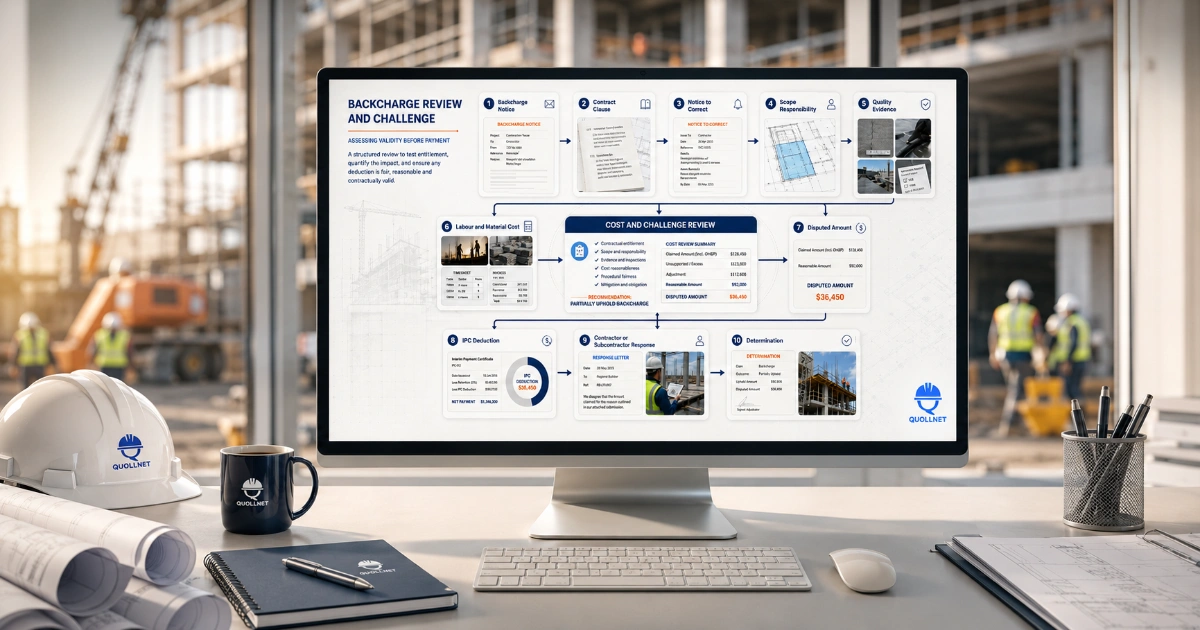
The charged party may challenge more than the price. A proper response should consider entitlement, procedure, responsibility, technical merits, causation, valuation, and payment.
Contractual Entitlement
The recipient may dispute whether the relied-upon clause applies, whether a breach occurred, or whether the contract authorises recovery of the claimed category of cost.
Authority
The recipient may challenge whether the person issuing the instruction, notice, assessment, or deduction had authority under the contract.
Responsibility and Scope Allocation
The alleged failure may fall outside the recipient’s scope or may have been caused by Employer design, another trade, nominated work, incorrect setting-out information, premature loading, unauthorised alteration, or occupant damage.
Technical Standard
The recipient may contend that the work complied with the contract, applicable tolerance, approved submittal, accepted sample, manufacturer requirement, or previously agreed repair method.
Prior Inspection or Acceptance
Prior inspection or approval does not always relieve a Contractor or Subcontractor of responsibility, but it may be relevant to the facts. The recipient may argue that the condition was visible, previously accepted, altered after inspection, or damaged by later operations.
Variation or Betterment
The replacement work may exceed the original requirement. Changing a compliant product, increasing performance criteria, expanding the affected area, or adopting a more expensive detail may constitute additional scope or betterment rather than correction.
Where the disputed work changes the contractual requirement, the issue should be considered under the project’s change procedure. See Managing Variation Orders in Construction Projects.
Access and Cure Period
The recipient may object where it was not notified, was denied access, was not allowed to investigate, offered to correct the work, or was replaced before the applicable correction period expired.
Causation and Mitigation
The recipient may challenge whether the alleged breach caused the whole cost and whether the charging party took reasonable steps to limit its loss.
Valuation
Labour hours, rates, plant charges, supervision, overhead, profit, taxes, disposal, acceleration, and allocation methods may all be disputed even where some responsibility is accepted.
Payment Deduction
The recipient may accept that a cost claim should be reviewed while disputing the right to deduct it from the current payment. A separate objection may be required to the payment notice, pay-less notice, certificate, set-off notice, or assessment.
The detailed response procedure is covered in How to Challenge an Unsupported or Improper Construction Backcharge.
Is the Corrective Work Actually a Variation?
An alleged correction may actually be a change to the contracted scope. This commonly occurs where:
- a compliant material is replaced with a higher-grade product;
- an approved installation detail is changed;
- additional performance requirements are introduced;
- work is altered to accommodate another contractor;
- previously accepted work is removed for revised design;
- the original scope boundary is expanded;
- the Employer elects to replace rather than repair an item;
- the correction includes aesthetic upgrades.
The charging party should separate the reasonable cost of restoring contractual compliance from the cost of upgrades, additional scope, acceleration, redesign, or betterment.
Backcharge Deadlines and Contractual Clocks
There is no universal deadline for issuing or disputing a construction backcharge. Several different contractual clocks may apply to the same event:
- the deadline for complying with an instruction;
- the correction or cure period;
- the response date stated in a proposed backcharge notice;
- the formal claim-notice period;
- the deadline for detailed claim particulars;
- the payment-notice deadline;
- the pay-less or set-off notice deadline;
- the period for objecting to an assessment or determination;
- the adjudication, DAAB, arbitration, or litigation deadline;
- the defects notification, correction, or rectification period;
- the final-account reservation or waiver deadline.
A response deadline inserted into commercial correspondence is not automatically a contractual time bar. Nevertheless, the recipient should respond promptly, reserve its rights, and comply with any applicable contractual notice period rather than waiting for the proposed charge to appear in the next payment assessment.
Backcharges During the Defects Liability Period
Responsibility for defective work may continue after taking-over, substantial completion, or practical completion. Different contracts refer to a Defects Notification Period, correction period, Rectification Period, or similar mechanism.
Continuing responsibility does not necessarily permit the Employer or Main Contractor to engage others immediately at premium rates. The original responsible party may retain an obligation and a practical opportunity to inspect and repair the work.
A charge may be challenged where the responsible party was:
- not notified of the defect;
- denied access to the completed project;
- not allowed to investigate the cause;
- willing and able to correct the work;
- replaced before the correction period expired;
- charged for upgraded or additional work;
- charged for damage caused by occupants or other contractors.
Immediate intervention may be more readily justified where there is an emergency, safety risk, active damage, refusal to attend, repeated repair failure, or expiry of the applicable correction period.
The broader contractual purpose and administration of this stage are explained in Defect Liability Period in Construction. For backcharge-specific analysis, see Backcharges During the Defects Liability Period and the Right to Repair.
How FIDIC, AIA, NEC, and JCT Address Backcharges
The major standard forms do not all use the word “backcharge,” and their procedures should not be treated as interchangeable. The following table provides a high-level translation of the informal term into the relevant contractual mechanisms.
| Standard form | Relevant mechanisms | Main procedural focus | Detailed guide |
|---|---|---|---|
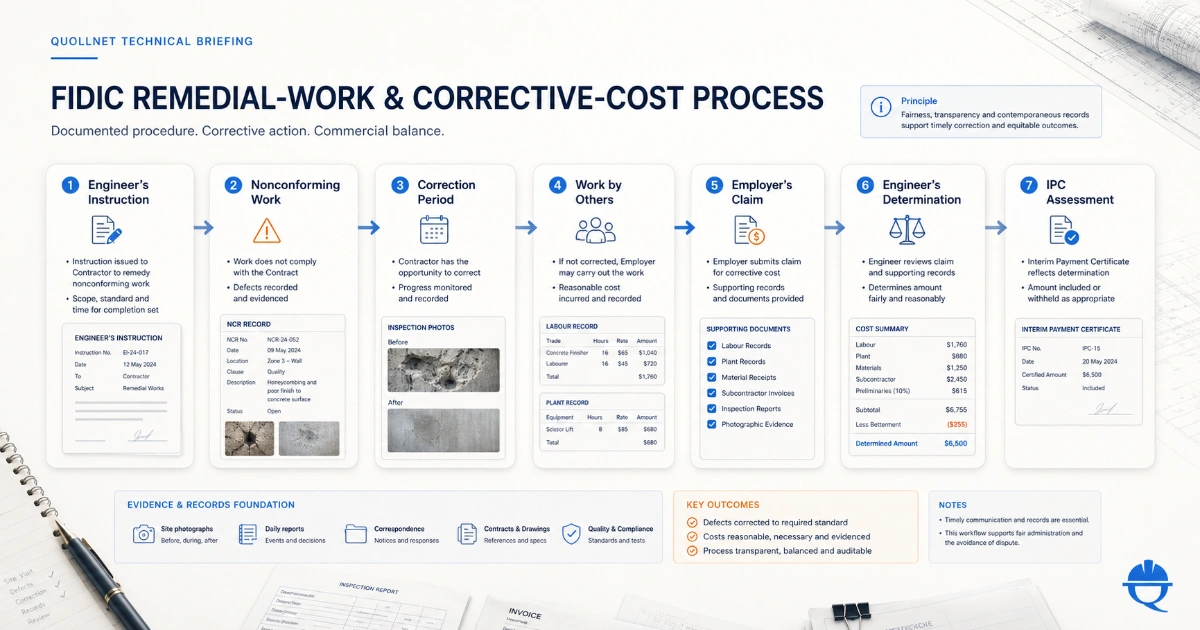
| FIDIC | Remedial work, rejection, testing, failure to remedy defects, Notice to Correct, Employer’s claims, Engineer’s agreement or determination, payment certification, and termination remedies. | Identify the exact FIDIC book and edition, Particular Conditions, required notice, opportunity to remedy, claim procedure, valuation, and basis for any deduction. | FIDIC remedial-work and backcharge procedure |
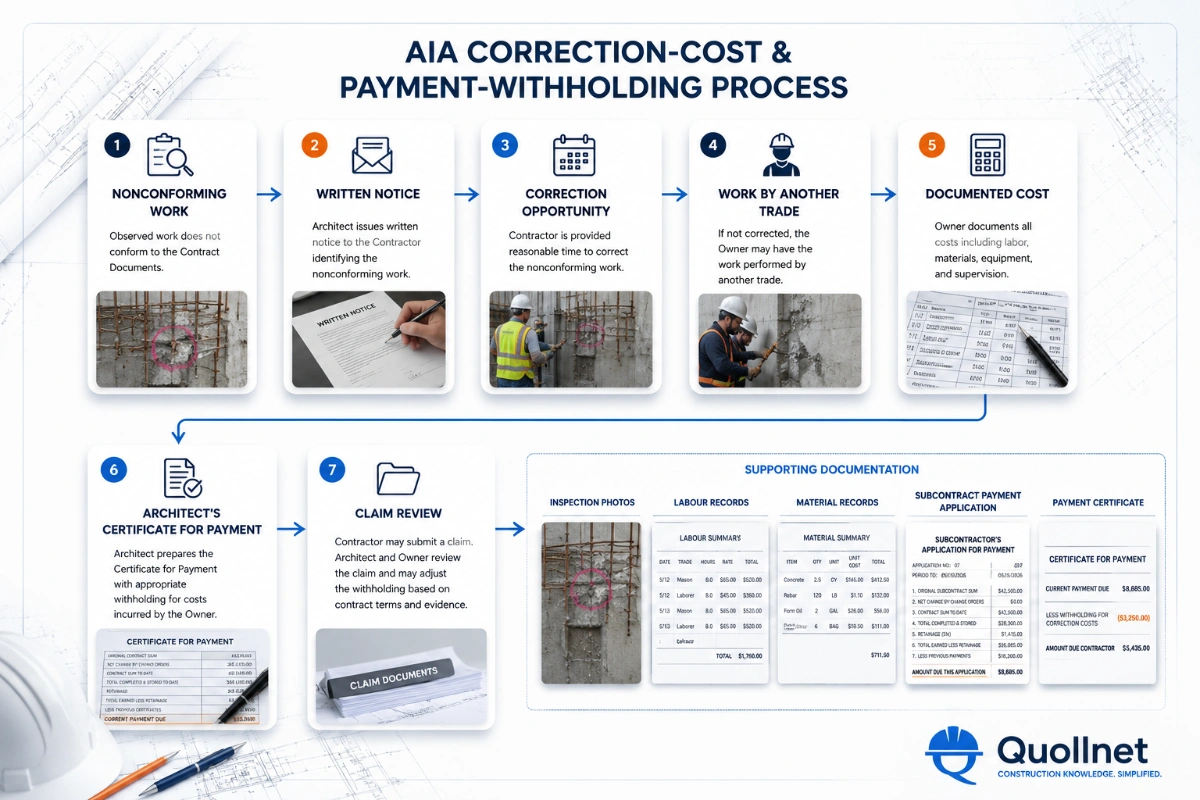
| AIA | Correction of nonconforming work, the Owner’s right to carry out work after the applicable notice period, withholding or nullifying certification, correction costs, and Claims. | Separate the Owner–Contractor procedure under A201 from the Contractor–Subcontractor relationship under A401 or the executed subcontract. | AIA A201 and A401 correction-cost rules |
| NEC | Notification of Defects, access, defect correction periods, acceptance of Defects, assessment of uncorrected Defects, and payment under the selected main option or subcontract form. | Use NEC’s defined processes and distinguish ECC obligations from ECS or ECSS subcontract obligations. | NEC4 uncorrected Defect cost assessment |
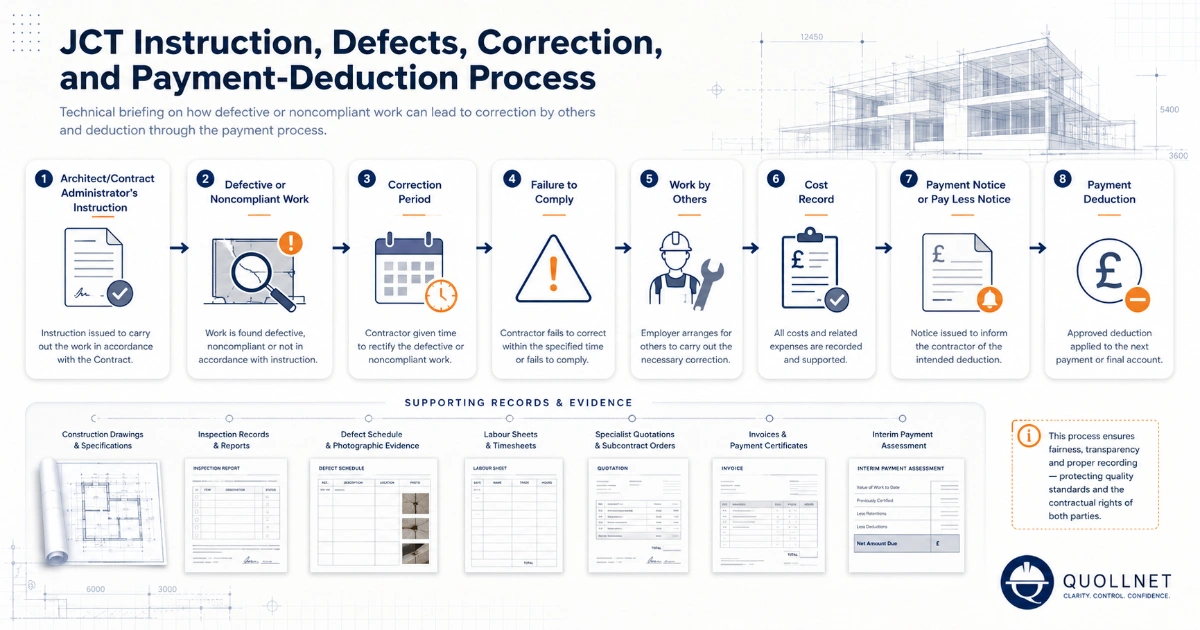
| JCT | Instructions, work not in accordance with the contract, making good defects, appropriate deductions, loss and expense issues, payment notices, and pay-less notices. | Identify the exact JCT form and edition and distinguish substantive cost entitlement from compliance with the applicable payment-notice procedure. | JCT instructions and payment deductions |
FIDIC
FIDIC contracts generally translate the backcharge concept through provisions dealing with remedial work, rejection, tests, defects, failure to remedy, notices, claims, agreement or determination, payment certification, and termination. The exact procedure differs between the 1999 forms, the 2017 second editions reprinted in 2022, the selected book, and any Particular Conditions.
An instruction or NCR should not be assumed to constitute every notice or claim required under the contract. Likewise, an Employer-side remedy against the Main Contractor should not be treated as an automatic Main Contractor remedy against a Subcontractor.
AIA
AIA A201–2017 contains express procedures concerning nonconforming work, correction, the Owner’s right to carry out work following notice, withholding certification to the extent reasonably necessary, and the Contractor’s right to dispute the action or amount through the Claims procedure.
AIA subcontract relationships require separate analysis under A401–2017 or the executed subcontract. The Prime Contract and subcontract may contain flow-down obligations, but the parties should still identify the actual subcontract provision authorising correction, recovery, withholding, or deduction.
NEC
NEC4 uses defined defect-management processes rather than a generic backcharge procedure. The Supervisor and Contractor have roles in notifying Defects, the Contractor is required to correct notified Defects within the applicable defect correction period, and the contract contains mechanisms for dealing with Defects that remain uncorrected.
The payment consequences depend on the selected NEC main option, whether cost is treated as Defined Cost or Disallowed Cost, the relevant ECC or subcontract form, and any amendments. A Defect under the main contract is not automatically a Defect under the subcontract because the Main Contract Scope and Subcontract Scope may differ.
JCT
JCT forms address related issues through instructions, compliance with the Contract Documents, making good defects during the Rectification Period, appropriate deductions, payment notices, and pay-less notices. The exact mechanism varies between the Standard Building Contract, Design and Build Contract, Intermediate Building Contract, Minor Works forms, and their subcontracts.
Where the applicable payment regime requires a valid pay-less notice, an Employer or Contractor may have a substantive cost argument but still fail to reduce the amount payable in a particular payment cycle if the required payment notice was not issued correctly and on time.
A Practical Construction Backcharge Workflow
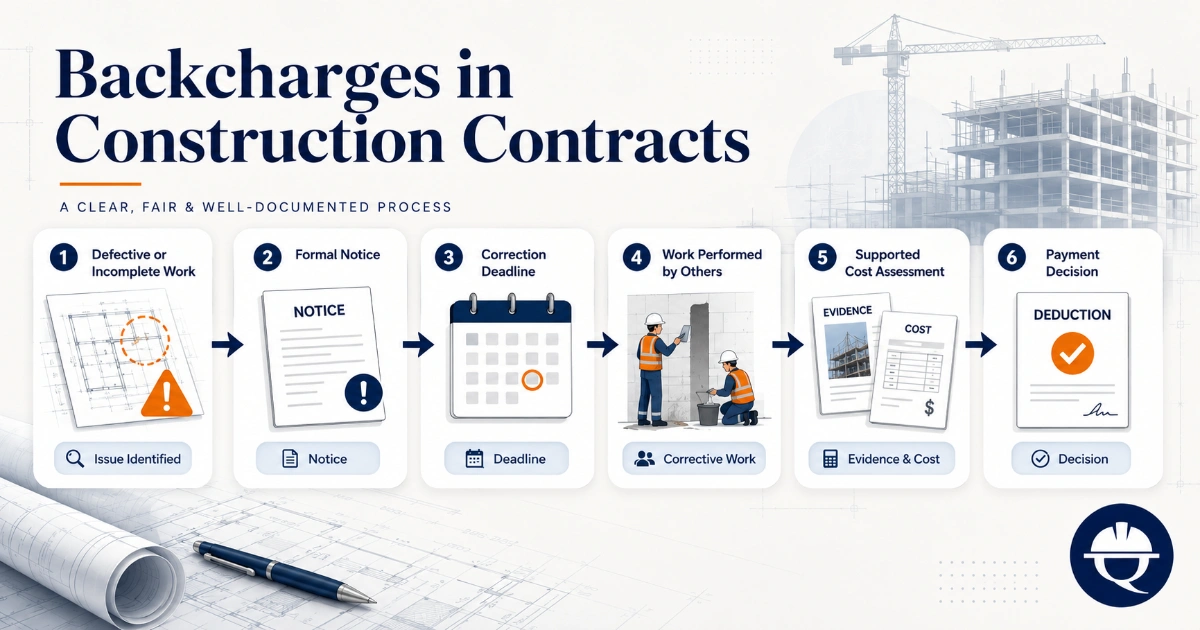
A disciplined backcharge process should separate the technical, contractual, cost, and payment stages.
- Step 1: Confirm the contracting parties and the executed contract.
- Step 2: Identify the alleged obligation, breach, and scope responsibility.
- Step 3: Preserve photographs, inspections, tests, notices, and programme records.
- Step 4: Issue the correct instruction, defect notice, or contractual notice.
- Step 5: Allow inspection, access, and the required opportunity to correct.
- Step 6: Record any refusal, nonattendance, unsuccessful repair, or emergency.
- Step 7: Define the replacement scope and separate correction from improvement.
- Step 8: Obtain reasonable pricing or competitive quotations where practicable.
- Step 9: Record actual labour, plant, material, testing, and subcontract cost.
- Step 10: Assess causation, mitigation, credits, shared responsibility, and betterment.
- Step 11: Issue a detailed proposed or final cost breakdown.
- Step 12: Follow the applicable claim, certification, and payment procedures.
- Step 13: Record whether the amount is proposed, disputed, agreed, assessed, deducted, paid, or referred to dispute resolution.
A structured Construction Backcharge Log helps commercial teams track notices, cure periods, evidence, cost development, objections, payment treatment, and final resolution.
How to Respond to a Proposed Backcharge
The recipient should avoid ignoring the notice, even where it considers the charge invalid. A practical initial response may:
- acknowledge receipt without admitting liability;
- reserve all contractual and legal rights;
- request the relied-upon clause and contractual basis;
- request technical evidence and cost particulars;
- state whether the work will be inspected or corrected;
- request access to the affected area;
- identify scope, causation, or betterment objections;
- challenge an inadequate correction period;
- object separately to any proposed payment deduction;
- issue any required claim, notice of dispute, or payment response.
The response should distinguish between technical cooperation and acceptance of financial responsibility. A party may agree to inspect or protect the work without admitting that the alleged defect or resulting cost is contractually its responsibility.
Backcharges, Retention, and Final Account
Retention and backcharges are separate commercial mechanisms. Retention is an agreed percentage or amount withheld under the payment provisions as security for performance and completion. A backcharge is an asserted recovery of a particular cost.
The existence of retention does not automatically prove that a disputed backcharge can be taken from it. The contract, payment notices, certification process, final-account agreement, and any release or waiver wording should be reviewed. See Retention in Construction for the separate purpose and administration of retention money.
At final-account stage, unresolved backcharges should be listed individually rather than hidden within a single unexplained deduction. Parties should record whether each amount is agreed, withdrawn, reserved, disputed, referred, or settled.
Detailed Backcharge Guides and Tools
This article is the central contract-neutral guide. The following resources address the narrower contractual and practical issues in more detail:
- Backcharges in FIDIC Construction Contracts
- Backcharges under AIA A201 and A401
- Backcharges and Uncorrected Defects under NEC4
- Backcharges, Instructions, and Payment Deductions under JCT
- Backcharge Notice Template for Construction Subcontractors
- Construction Backcharge Log Template
- Backcharge Deduction from a Subcontractor IPC
- How to Challenge an Improper Construction Backcharge
- Notice to Correct Before a Construction Backcharge
- Backcharges During the Defects Liability Period
- Backcharge Cost Breakdown Template and Calculator
Conclusion
A construction backcharge is not established merely by issuing a document with “Backcharge Notice” in the title. The charging party must establish the contractual obligation, the alleged breach, responsibility, causation, compliance with the correction procedure, entitlement to intervene, and the reasonable cost incurred.
The payment question must then be considered separately. Even where a party may have a valid claim for corrective cost, the contract or governing law may require additional certification, determination, notice, set-off, or payment procedures before the amount can be deducted from an interim payment.
Do not begin with the informal word “backcharge.” Begin with the parties, the executed contract, the alleged failure, the correction process, the evidence, the valuation rules, and the payment mechanism.
This article provides general construction contract-administration information and is not legal advice. Executed contracts, Particular Conditions, amendments, mandatory payment legislation, and governing law control each project.
REFERENCES
FIDIC Construction Contract, Second Edition 2017, Reprinted 2022 with Amendments
FIDIC Contracts Guide, Second Edition 2022
AIA Document A201–2017: General Conditions of the Contract for Construction
AIA Contract Documents: Owner’s Right to Carry Out the Work
AIA Contract Documents: Rejection and Correction of Work
NEC Contracts: Defining and Managing Defects in the NEC4 ECC
NEC Contracts: NEC4 ECSS Payment Provisions
JCT: Making Good with Rectification Periods