G
Guest

Observation vs NCR vs Snag vs Defect in Construction: When to Use Each Record

Learn the difference between an Observation (SOR), NCR, Snag/Punch List, and Defect (DLP). Use the right record at the right time, prevent observations from escalating into NCRs, and understand how payment, handover, and contractual notices are affected.

Observation vs NCR vs Snag vs Defect in Construction: When to Use Each Record
English version

Observation vs NCR vs Snag vs Defect in Construction

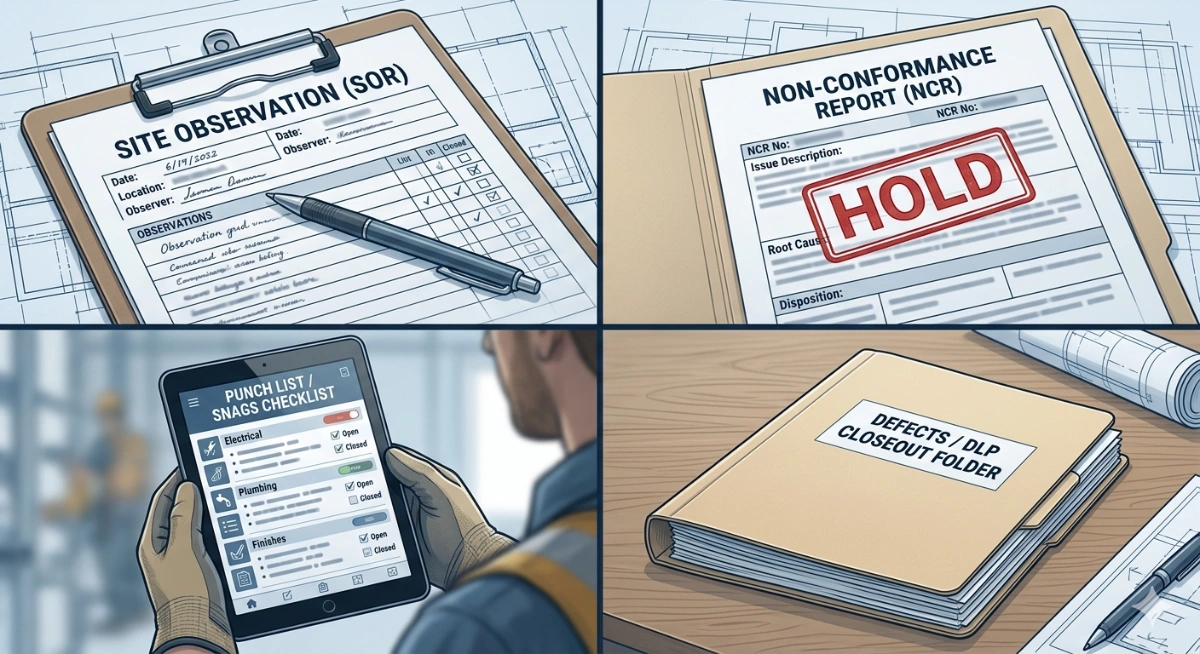
On construction projects, not every issue should become an NCR. Use an Observation (SOR) for early, low-risk issues that need quick correction and evidence. Use an NCR only for confirmed non-compliance (failed test, rejected inspection, missing mandatory record, unauthorized deviation). Use a Snag/Punch List for closeout items, and a Defect (DLP) record for issues managed after taking-over.

Quick definitions (one sentence each)

  • Observation: A documented concern or deviation noted during inspections that should be corrected quickly, often before it becomes a formal nonconpliance.
  • Site Observation Report (SOR): A structured “observation” record (often with photos and a due date) used to track minor or early-stage issues without immediately triggering the NCR system.
  • NCR (Non-Conformance Report): A formal QA/QC record used when non-compliance is confirmed against the contract/specs/drawings/ITP requirements.
  • Snag / Punch List: A closeout list used to complete and polish the works (finishes, missing items, minor defects) before handover.
  • Defect (DLP): A defect managed after taking-over during the Defects Liability Period (or defects correction period) under the contract’s defects regime.

At-a-glance comparison

Record Best for Typical trigger Payment impact How it closes
Observation / SOR Early control Minor deviation, clarification needed Usually none Photo + note + acceptance
NCR Confirmed non-compliance Failed test / rejected inspection / missing record / unapproved deviation Common (holds/deductions) Verified re-inspection / re-test
Snag / Punch List Closeout completion Incomplete/finishing issues Indirect (retention/final payment) Punch closure sign-off
Defect (DLP) Post-handover correction Defect found after taking-over Common (retention/security leverage) Defects correction + confirmation

The simple decision rule (text-based)

Use an NCR only when non-compliance is confirmed and needs formal containment/verification.
Use an Observation (SOR) when the issue is minor, early, or needs clarification—and can be corrected quickly with evidence.
Use a Snag list for closeout completion items.
Use a Defect (DLP) record when the issue is managed after taking-over under the defects regime.
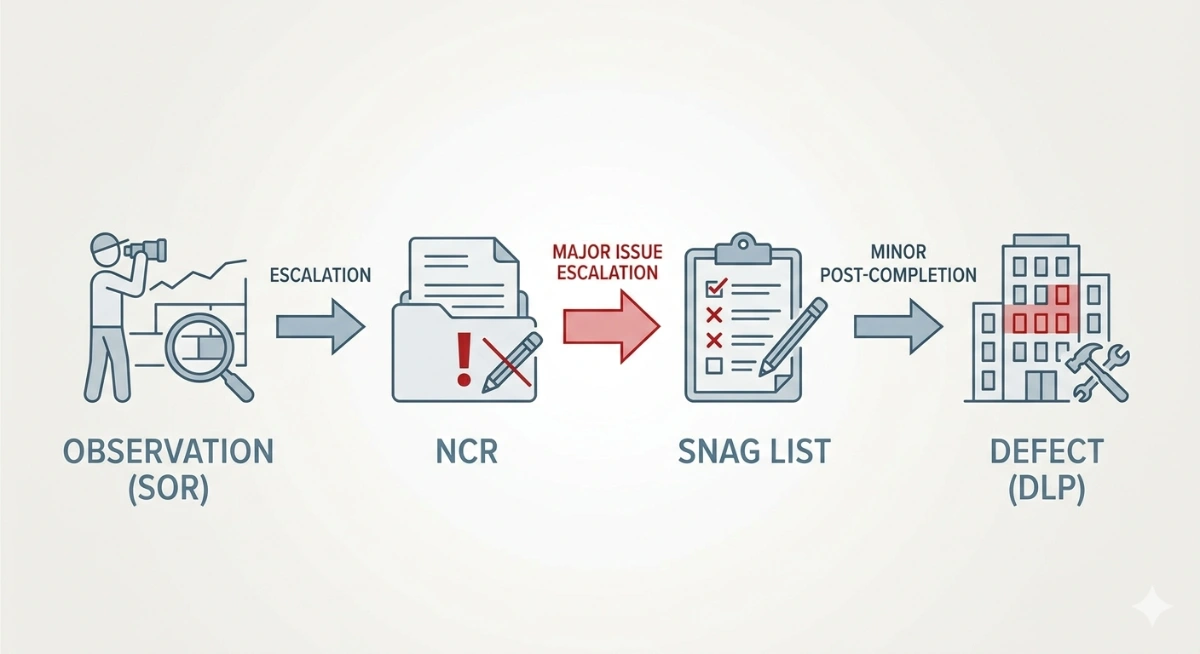
sor to dlp quollnet

1) When to use an Observation (and why SOR matters)

An observation is your best tool for preventing “paper escalation.” It keeps the team aligned on early corrections without turning every issue into a contractual fight. However, observations only work if they are tracked and closed properly.

Site Observation Report (SOR)

A Site Observation Report (SOR) is simply a disciplined version of an observation: it is documented, assigned a due date, and closed with evidence. Without a log, SORs decay into “ignored comments” and later reappear as NCRs.

SOR log (why contractors should take it seriously)

  • Problem: Contractors sometimes ignore SORs because they don’t immediately impact payment.
  • Reality: Ignored SORs often become NCRs once the issue is repeated, concealed, or starts affecting compliance and commissioning.
  • Control: Maintain a simple SOR log and review it weekly (open/overdue/escalate).

Minimum SOR log fields: SOR ID, date, location, photo ref, observation text, due date, status, closure evidence ref, escalated to NCR? (Y/N).

2) When to use an NCR (confirmed non-compliance)

Use an NCR when compliance is no longer “a discussion.” Typical triggers include:

  • Failed tests (e.g., pressure test, NDT, concrete strength).
  • Rejected inspections (work not per drawings/spec, tolerances exceeded).
  • Missing mandatory records (inspection hold point missed; work covered).
  • Unauthorized deviations (unapproved material/subcontractor, unapproved method change).

If you need the full NCR workflow and definition, see NCR Meaning in Construction. If you need the actual form and tracker, see NCR Form Template and NCR Log Template.

3) When to use a Snag / Punch List

Snags are typically used for closeout and handover readiness: incomplete items, cosmetic fixes, minor damage, missing labels, touch-ups, adjustments, and finishing alignment issues. They are essential, but they are not a replacement for NCRs.

Related reading and tools:

4) When to use a Defect record (DLP context)

Defects are issues managed after taking-over under the defects regime (DLP/defects correction period). They often appear during operation or once the building is in use. While some open NCRs can be carried into handover as “outstanding items,” this must be controlled carefully.

5) Advice for Contractors: How to prevent an NCR and keep it an Observation

  • Act immediately on verbal cues: Train foremen to fix issues the moment an engineer points at something, before the camera comes out.
  • Communicate intent proactively: If a minor deviation is necessary due to site conditions, request a field change before proceeding—don’t ask for forgiveness later.
  • Self-correct and document: If an observation is issued, close it out with a photo and a quick note to the engineer within 24 hours. A closed observation is an NCR that never happened.
  • Manage the cash flow risk: It is usually cheaper to spend 2 labor hours fixing an observation immediately than to suffer a long payment delay on a holdback for an open NCR.

6) A note for Engineers and Consultants: the commercial reality of NCRs

  • Project interest vs paper compliance: Creating a cash flow crisis over minor, non-safety-critical issues often leads to delays and claims—rarely in the Employer’s best interest.
  • The “hammer” vs the “nudge”: Use NCRs for safety, structural integrity, statutory compliance, repeated failures, or concealment risk. Use a strongly worded observation/SOR for first-time minor issues and cosmetic deviations.
  • Preserving the relationship: Over-issuing NCRs creates an adversarial environment that reduces communication and early problem-solving.

7) How issues escalate (and how to stop it)

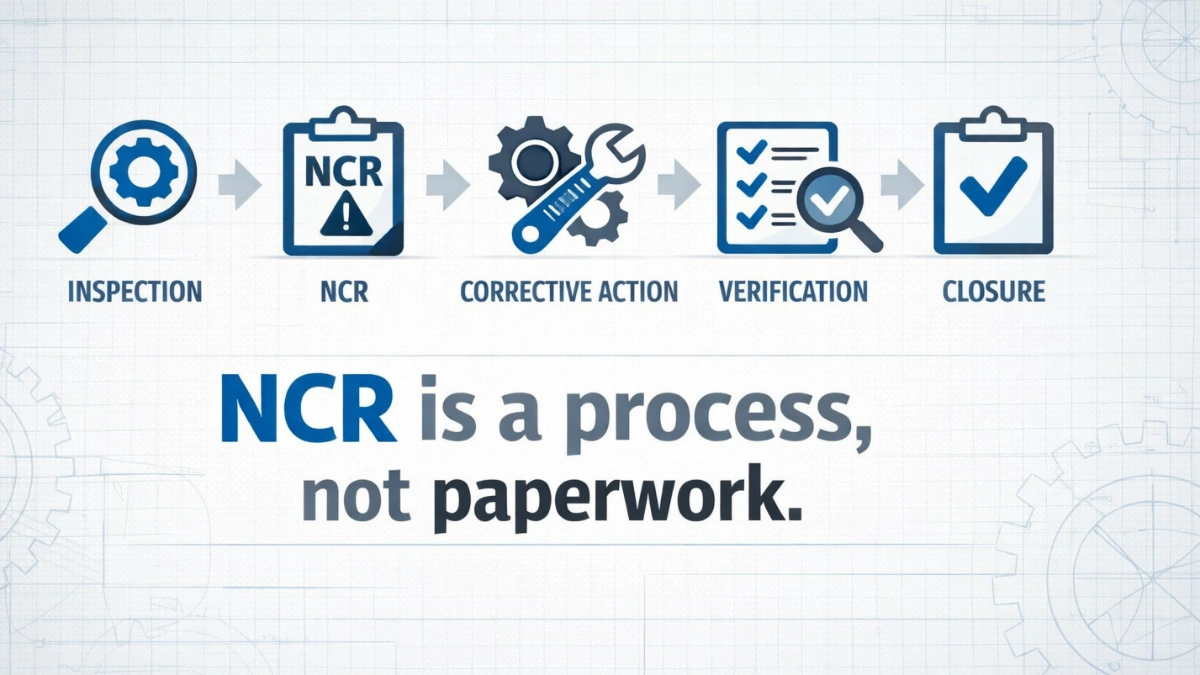
Most escalation happens because of two things: lack of closure evidence and missed timelines. A clean escalation ladder is:

  • Observation (quick fix + photo)
  • SOR (logged + due date + closure evidence)
  • NCR (confirmed non-compliance + containment + verification)
  • Contractual notice (when ignored or repeated) — see Timely Notices in Construction

8) Examples (short and practical)

  • Observation/SOR: Cosmetic sealant gap, small paint defect, missing label, minor alignment issue. Close with photo and short note.
  • NCR: Pressure test failure, unapproved pipe material installed, inspection rejected at hold point, missing mandatory inspection record.
  • Snag: Touch-up paint, chipped tile, missing door stopper, incomplete silicone at handover.
  • Defect (DLP): Post-handover leak, settlement crack that develops over time, operational defect discovered during use.

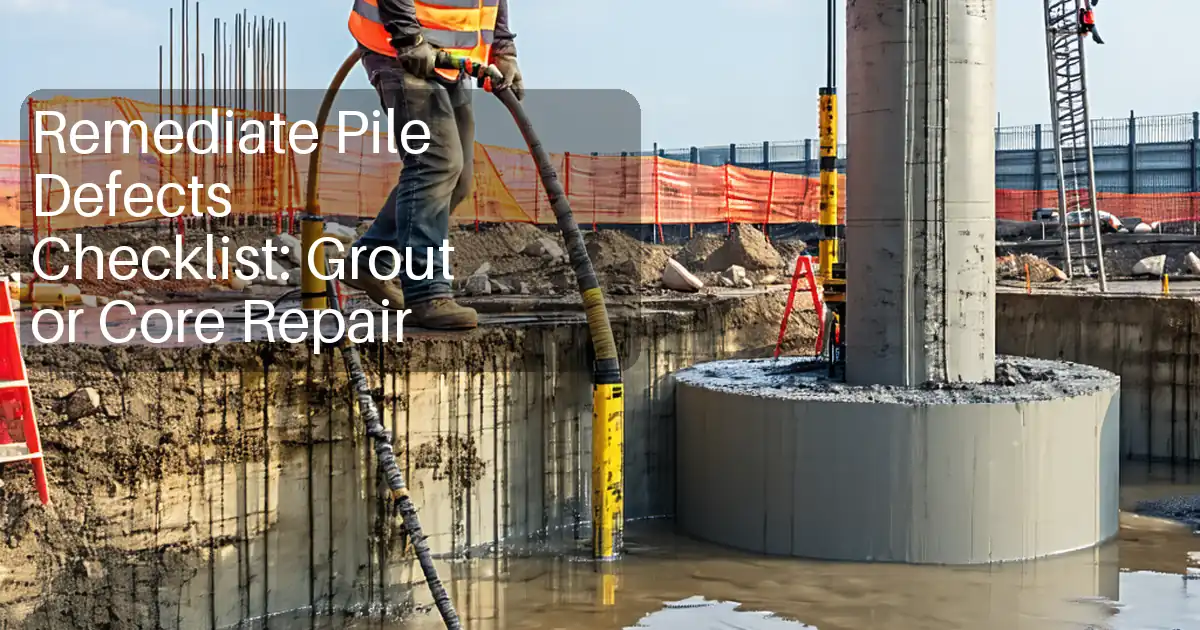
If you need a real remediation workflow example, see the checklist: Remediate Pile Defects Checklist (Grout or Core Repair).

Common mistakes (and how to avoid them)

  • Using NCRs for everything: It inflates paperwork, damages trust, and slows closure.
  • Using snags for compliance issues: A snag list does not replace containment, verification, and evidence-based closure.
  • No SOR log: Untracked observations become repeat findings and then NCRs.
  • Closing without evidence: No photo/test ref = weak closeout and future disputes.
  • Missing ITP/Hold points: Many “surprise NCRs” start with skipped inspections. See Inspection & Test Plan (ITP) in Construction.

Related reading (optional)


Tip: If you want fewer NCRs on your project, invest in two simple habits: (1) a strict SOR log with weekly closure, and (2) fast photo-based closure evidence for minor issues. That is how “observations” stay observations.


Elie Saad's photo
Elie Saad
Apr 18, 2026
0
0
79
497

Observation vs NCR vs Snag vs Defect in Construction: When to Use Each Record

Frequently Asked Questions


FAQ

Q: What’s the difference between an Observation and an NCR?

A: An observation (often recorded as an SOR) is used for early, low-risk issues or clarifications that can be corrected quickly. An NCR is used when non-compliance is confirmed against contract requirements and needs formal containment, corrective action, and verified closure.

FAQ

Q: What is a Site Observation Report (SOR)?

A: An SOR is a structured observation record (often with photos and a due date) used to track minor issues without immediately raising an NCR. It works only if it is logged and closed with evidence.

FAQ

Q: Why do SORs turn into NCRs?

A: Because they are ignored, repeated, concealed, or later proven to be non-compliant. A simple SOR log with due dates and weekly review prevents escalation.

FAQ

Q: When should I use a Snag/Punch List instead of an NCR?

A: Use snags for closeout completion and minor finishing items. Use NCRs for confirmed non-compliance (failed tests, rejected inspections, unapproved deviations, or missing mandatory records).

FAQ

Q: Is a snag the same as a defect?

A: Not always. Snags are typically closeout items before handover. Defects are managed after taking-over under the DLP/defects regime and may appear during operation.

FAQ

Q: Can an NCR become a defect at handover?

A: Yes, some open NCRs may be carried into taking-over as outstanding items and then managed under the defects regime, but only if they do not block safe use and are documented with clear actions and verification.

FAQ

Q: Do observations affect payment?

A: Usually not directly. NCRs are more likely to affect payment through holds/deductions. However, repeated ignored observations often become NCRs—which can then become commercial.

FAQ

Q: What’s the minimum to close an observation properly?

A: A clear “what/where” note, a due date, and closure evidence (typically a photo) acknowledged by the inspector/engineer.

Related Checklists


What to Do When the Contractor Receives an NCR: Action Guide
✅ 22 items
What to do when the contractor receives an NCR is a practical, step-by-step response plan for construction teams facing a nonconformance report, non-compliance notice, or quality deviation. This checklist focuses on immediate containment, factual root cause analysis, corrective and preventive actions, and transparent closeout—without drifting into unrelated scopes. By following a structured approach, you reduce rework, avoid safety incidents, protect delivery dates, and maintain a defensible contractual position. Every step emphasizes objective evidence: calibrated measurements, annotated photos, batch numbers, inspection reports, and signatures. You will find guidance for logging, isolating affected work, coordinating hold points, and aligning with stakeholder expectations per approved project specifications and authority requirements. The result is a clear record demonstrating control of the nonconformance, verification of the fix, and prevention of recurrence. Start in interactive mode to tick items, add comments, attach files, and export your record as PDF/Excel with a QR link for quick field access.
Remediate Pile Defects Checklist: Grout or Core Repair
✅ 26 items
Remediate pile defects with a disciplined, field-proven process focused on pressure grouting or core repair, verification, and closing nonconformance reports. This checklist guides supervisors, QC engineers, and contractors through practical pile repair steps without adding new tests, relying on the approved investigation and method statement. It helps decide between pressure grouting for internal voids or core repair for localized damage, manages materials and equipment, and controls grouting pressures, volumes, and curing. You will capture photo evidence, pressure/volume logs, batch certificates, and as-built sketches to demonstrate that defective piles are restored to intent per approved project specifications and authority requirements. The scope excludes new integrity or load testing; verification depends on process records, dimensional checks, and joint inspections. Outcomes include safe, durable repairs, traceable documentation, and timely NCR closure. Use this interactive checklist to tick off actions, add field comments, and export a QR-secured PDF/Excel package for review and archiving.
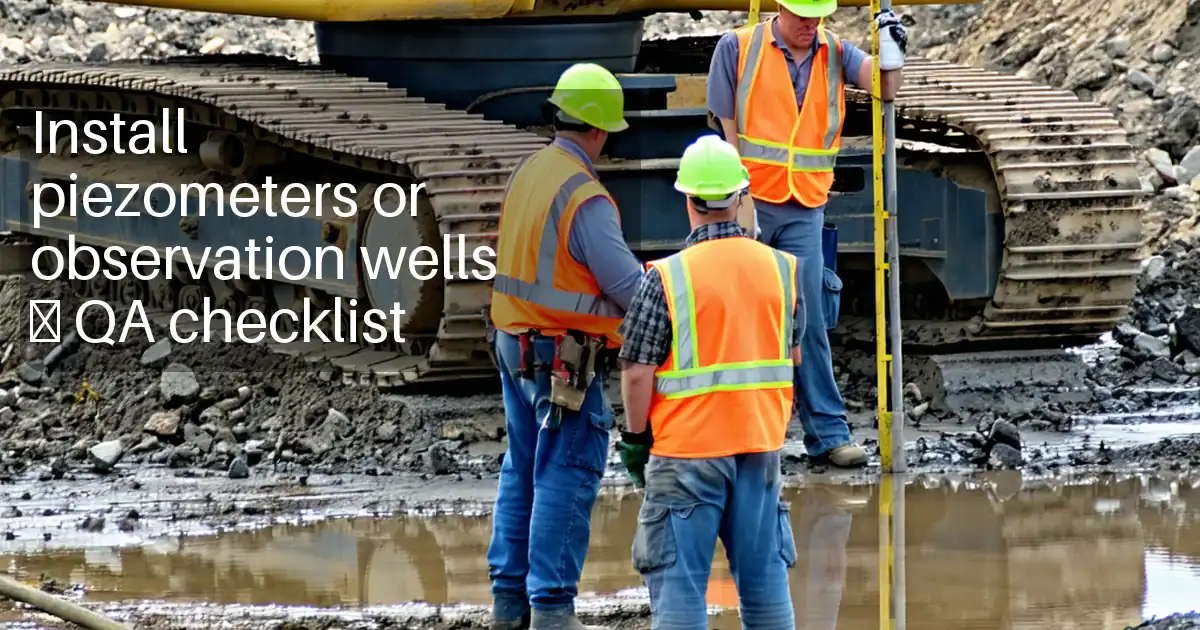
Install piezometers or observation wells – QA checklist
✅ 28 items
Install piezometers or observation wells is a specialized task requiring disciplined drilling, precise installation, proper sealing, and accurate baseline groundwater measurements. This checklist supports groundwater monitoring wells—standpipe piezometers and observation boreholes—ensuring the annulus is sealed, wells are developed effectively, and data quality is defensible. It focuses on construction and commissioning steps only; pump test analysis and long-term aquifer testing are intentionally excluded. By following these steps, teams mitigate risks such as formation collapse, inter-aquifer leakage, clogged screens, contaminated readings, and uncertain datums. You’ll confirm materials against submittals, track borehole conditions, place gravel filter packs and bentonite/grout seals via tremie, develop with surge-and-purge or low-rate pumping, and capture stabilized water levels with a surveyed reference. The outcome is a durable, verifiable installation ready for routine monitoring and compliance reporting per approved project specifications and authority requirements. Use this interactive checklist to tick items, add field comments, and export PDF/Excel—secured by QR.
Compile pile dossier for handover: QA docs checklist
✅ 24 items
Compile pile dossier for handover is your structured process for organizing and validating all pile-related documentation prior to client acceptance. This piling documentation checklist focuses on the pile QA dossier, ensuring verifiable records for installation, testing, calibrations, and as-built deliverables while explicitly excluding general foundation records such as pile caps or ground beams. By curating only pile-specific evidence—installation logs, static and dynamic load test reports, integrity test summaries, instrument calibration certificates, and NCR closures—you reduce disputes, avoid rework, and accelerate taking-over. The outcome is a clean, traceable package that demonstrates compliance per approved project specifications and authority requirements, with consistent file naming, signatures, and revision control. Practical acceptance cues, SI-based tolerances, and geo-referenced evidence help teams close gaps quickly and defend quality under audit. Use this interactive checklist to assign actions, capture photo and file attachments, add comments, and track digital sign-offs. Start ticking items, comment where needed, and export the dossier as PDF/Excel with an embedded QR code.
Repair Driven Pile Heads/Splices: Weld, QA and Coating
✅ 22 items
Repair driven pile heads/splices is a focused jobsite process to restore integrity of driven steel pile heads and welded splices after driving. This checklist addresses pile head repair, pile splice welding, weld rectification, protective coating application, and QA records. It explicitly excludes driving logs and production data, concentrating instead on defect identification, alignment and fit-up, qualified welding, nondestructive testing, and corrosion protection. By following these steps, teams reduce structural risk from crack propagation, misalignment, and coating failure, while creating a defensible audit trail. Each instruction pairs a method or tool with acceptance evidence—measurements in millimetres, temperature readings, NDT reports, coating thicknesses, photos, material heat numbers, and signatures—per approved project specifications and authority requirements. Use this checklist to organize work zones, capture approvals, and prevent rework, ensuring consistent, traceable repairs that stand up to independent review. Start in interactive mode to tick tasks, add comments, and export PDF/Excel with a secure QR for field sign-off.

Related Articles


Ncr At Handover
⏳ 5 min read
Open Ncrs At Taking-over / Dlp: What Happens At Handover And How To Escalate
Can taking-over happen with open NCRs? Learn when handover is allowed, when it must be blocked, how to document outstanding NCRs, and when to escalate to contractual notices (e.g., Notice to Correct) through common contract authorities.
Ncr Meaning Construction
⏳ 3 min read
Ncr Meaning In Construction (qa/qc Non-conformance Report Guide)
NCR meaning in construction: an NCR (Non-Conformance Report) is a QA/QC record issued when work or materials don’t meet project requirements. Learn when to issue an NCR, who issues it, and how it’s closed.
Ncr Log Template E46
⏳ 2 min read
Ncr Log Template (register & Ncr Tracker) – Excel/pdf Download
Download an NCR log template (NCR register) to track non-conformance reports by ID, date, status, location, references, actions, and closure. Includes an empty template and a filled example in Excel and PDF.
Difference Between Rfq Rfp And Tender In Construction Procurement
⏳ 11 min read
Rfq Vs Rfp Vs Tender In Construction Procurement: Key Differences Explained
What is the difference between an RFQ, an RFP and a Tender in construction procurement? Learn how each document works, their legal flavour, risk allocation, and when to use RFQ, RFP or Tender for suppliers, subcontractors and main contractors.
Ncr Form Template
⏳ 4 min read
Ncr Form Template (excel/pdf) – Non-conformance Report Format
Download a practical NCR form template used on construction projects. Includes key fields for QA/QC non-conformance description, specification references, corrective action, verification, and closure.