G
Guest

NCR Form Template (Excel/PDF) – Non-Conformance Report Format

Download a practical NCR form template used on construction projects. Includes key fields for QA/QC non-conformance description, specification references, corrective action, verification, and closure.

Ncr Form Template
Ncr Form Template
English version

NCR Form Template

Use this NCR (Non-Conformance Report) form template to record and close construction non-conformances consistently, with the minimum fields expected by most QA/QC systems.

Best use: site QA/QC teams, consultants, and contractors who need a clean NCR format with clear references and closure evidence.


Download NCR Form Template
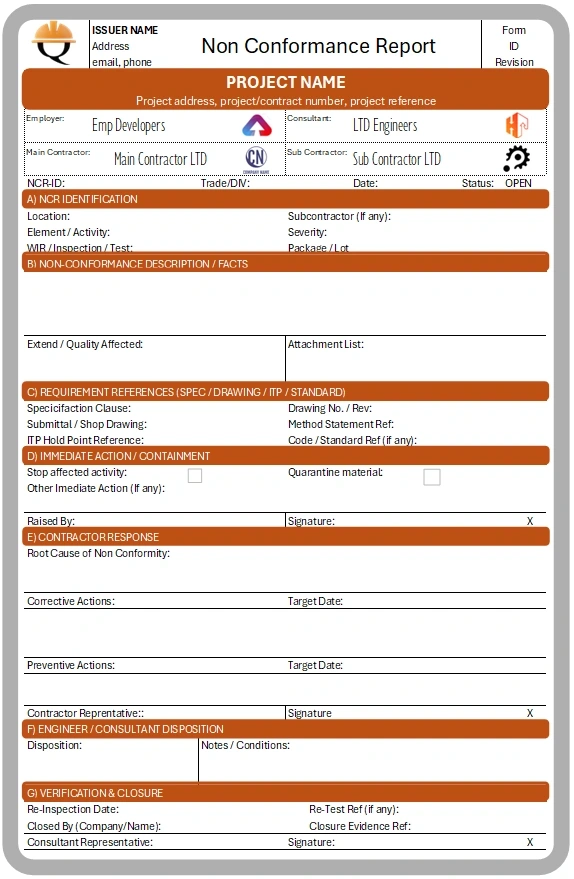

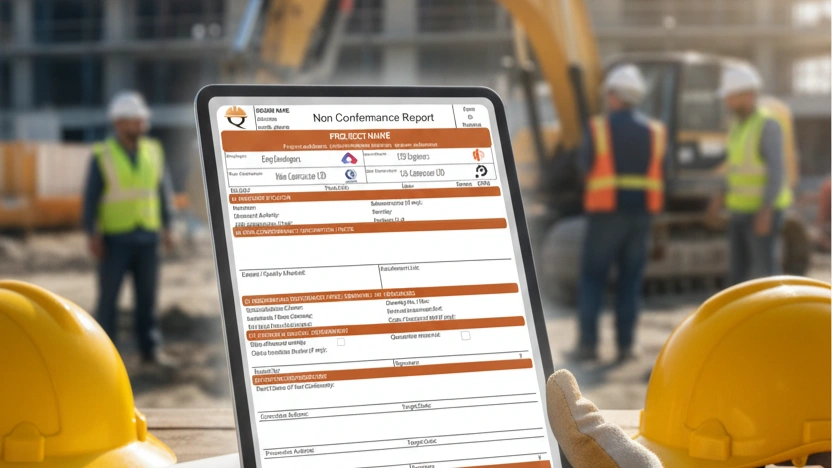
ncr form nonconformance report
Screenshot of the NCR (Non-Conformance Report) form template used for construction QA/QC documentation and closure.

What this NCR form includes (fields)

A) NCR identification

  • Project / package / contract

  • NCR number (unique reference)

  • Date raised

  • Raised by (company + name)

  • Responsible party (main contractor / subcontractor)

B) Location & work description

  • Building / zone / gridline / level / chainage

  • Trade / discipline (civil, architectural, MEP, steel, etc.)

  • Activity / element (slab, column, waterproofing, cable pulling, etc.)

C) Non-conformance description (facts only)

  • What was found (measured/observed/test result)

  • Quantity/extent (how much area affected)

  • Evidence reference (photos, sketches, marked-up drawings)

D) Requirement references (the most important part)

  • Specification section / clause

  • Drawing number + revision

  • Approved shop drawing / method statement reference

  • ITP step / WIR reference (if applicable)

  • Standard/code reference (if applicable)

E) Immediate action / containment

  • Stop affected activity (Yes/No)

  • Quarantine material (Yes/No)

  • Protect from concealment (Yes/No)

  • Temporary measures implemented

F) Contractor response

  • Root cause (why it happened)

  • Corrective action (how it will be fixed)

  • Preventive action (how recurrence is prevented)

  • Target dates

G) Engineer / Consultant disposition

  • Accept as-is (with justification)

  • Repair

  • Remove and replace

  • Accept with concession / technical deviation (if allowed)

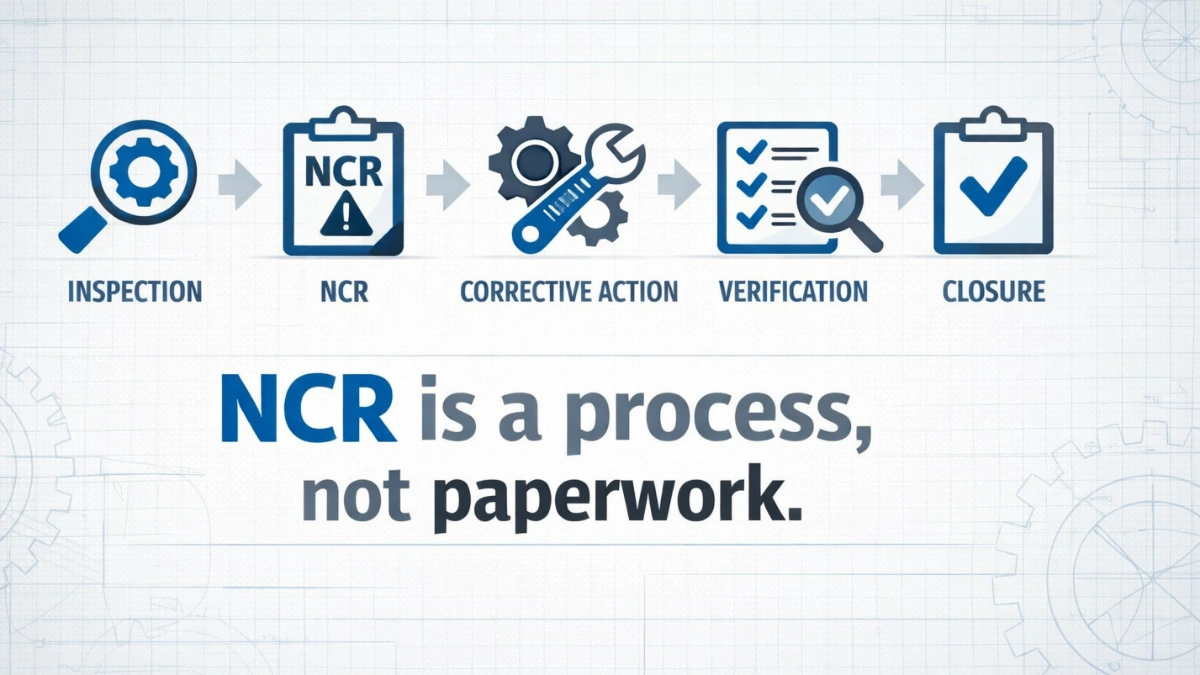
H) Verification & closure

  • Re-inspection date

  • Re-test results reference (if applicable)

  • Closure evidence attached (photos/reports)

  • Closed by + date + signature


How to fill an NCR (quick guidance)

  1. Write the non-conformance as a measurable fact (not an opinion).

  2. Always include at least one hard reference: spec clause or drawing number.

  3. Record containment actions immediately (stop/quarantine/protect).

  4. Require contractor response with root cause + corrective + preventive action.

  5. Close only after verification evidence is submitted and accepted.


Suggested numbering system (simple and scalable)

Use one consistent format, for example:
NCR-Discipline-Year-Sequential

  • NCR-CIV-2026-001

  • NCR-MEP-2026-014

If you manage multiple packages, add package code:

  • NCR-PKG1-CIV-2026-001


Common mistakes (avoid these)

  • No reference to specs/drawings (β€œnot acceptable” is not enough)

  • Closing without evidence

  • Using NCRs for minor snags (creates noise and weakens the system)

  • Not controlling the affected work/material (containment)


Related pages (published separately)

  • NCR Meaning in Construction

  • NCR Log Template (Register)

  • Observation vs NCR vs Snag vs Defect


Filled Example NCR (Concrete Works)

A) NCR identification

  • Project: ABC Residential Towers – Package 01

  • NCR No.: NCR-CIV-2026-003

  • Date raised: 06 Jan 2026

  • Raised by: Consultant QA/QC Engineer

  • Responsible party: Main Contractor / RC Subcontractor

B) Location & work description

  • Location: Tower A, Level 05, Grid B-4 to B-6

  • Discipline / Trade: Civil / Reinforced Concrete

  • Element / Activity: Reinforcement fixing for slab S5 prior to concrete pour

C) Non-conformance description (facts only)

During pre-pour inspection, the top reinforcement spacing in the slab strip at Grid B-4 to B-6 was measured at 250 mm c/c, whereas the approved drawing requires 200 mm c/c. The affected area is approximately 18 mΒ².
Evidence: Photo refs NCR-CIV-2026-003-01 to 05 and marked-up sketch SK-NCR-003.

D) Requirement references

  • Structural drawing: S-105 Rev 04 (Top reinforcement spacing @ slab strip = 200 mm c/c)

  • Specification: Section 03 30 00 – Cast-in-Place Concrete, clause (reinforcement installation per drawings)

  • ITP: ITP-RC-01, Hold Point HP-03 (Pre-pour rebar inspection)

  • WIR: WIR-RC-05-147 (submitted for pre-pour inspection)

E) Immediate action / containment

  • Stop affected activity: YES (pour not permitted in affected zone)

  • Prevent concealment: YES (do not place concrete until clearance)

  • Quarantine material: N/A

  • Temporary measures: Affected area tagged and barricaded; foreman instructed not to proceed.

F) Contractor response (root cause + corrective + preventive)

  • Root cause: Fixing crew used an outdated rebar spacing note from an earlier revision and the supervisor did not verify against the latest approved drawing revision.

  • Corrective action: Remove and re-fix top reinforcement in the affected zone to 200 mm c/c as per S-105 Rev 04. Submit re-inspection request.

  • Preventive action: Toolbox talk for rebar crew; supervisor to verify drawing revision on site before start of fixing; drawing revision list to be posted in the rebar yard.

  • Target date: Corrective action completed by 07 Jan 2026; re-inspection on 07 Jan 2026.

G) Engineer / Consultant disposition

  • Disposition: Repair / Rectify

  • Notes: Works may proceed only after re-inspection and acceptance of corrected spacing. No concrete placement permitted in affected zone prior to clearance.

H) Verification & closure

  • Re-inspection date: 07 Jan 2026

  • Verification outcome: Spacing re-measured at 200 mm c/c; accepted.

  • Closure evidence: Photo refs NCR-CIV-2026-003-C1 to C3; updated marked-up sketch attached.

  • NCR status: CLOSED

  • Closed by: Consultant QA/QC Engineer – 07 Jan 2026

L
Lena Miller
Jan 06, 2026
0
1
418
62

Ncr Form Template

Frequently Asked Questions


FAQ

Q: What is an NCR form in construction?

A: An NCR (Non-Conformance Report) form is a QA/QC record used to document work or materials that don’t meet project requirements, reference the applicable spec/drawing/ITP, and track corrective actions through verification and closure.

FAQ

Q: When should I use an NCR instead of a snag list?

A: Use an NCR for confirmed non-compliance (spec/drawing/ITP breach, failed test, rejected inspection). Use a snag/punch item for minor completion or finishing issues that don’t require formal corrective action tracking.

FAQ

Q: Who fills the NCR form (issuer vs contractor)?

A: The issuer records the non-conformance description and references. The contractor proposes root cause plus corrective/preventive actions. The engineer/consultant confirms disposition and closes the NCR after verification.

FAQ

Q: Do NCR forms need signatures?

A: Many projects require sign-off (raised by, contractor acknowledgement, engineer disposition, closure verification). On digital workflows, names + roles + dates and a PDF export often replace handwritten signatures.

FAQ

Q: What references should be included in an NCR?

A: At minimum, cite the relevant drawing number/revision or specification clause. If applicable, add the ITP step/hold point, WIR number, approved shop drawing, and test report reference.

FAQ

Q: Is an NCR the same as a Corrective Action Request (CAR)?

A: They’re related but not always the same. Many projects use an NCR for the non-compliance record and a CAR for the corrective action process (or for repeated/systemic issues). Some QA systems combine both into one form.

Related Checklists


Drill bored piles ≀ 600 mm checklist – no concreting
βœ… 21 items
Drill bored piles ≀ 600 mm require disciplined verification of verticality, base cleanliness, groundwater control, and diameter to ensure a stable, compliant bore prior to any placement activities. This focused bored pile inspection checklist excludes concreting steps and concentrates on the most risk‑sensitive attributes: verticality checking, sediment thickness confirmation, fluid or casing stability, and borehole geometry. By validating instrument calibration, continuously logging mast inclination, maintaining a safe head above groundwater, and confirming diameter via caliper or template checks, you reduce risks of misalignment, soft toe, underbreak, or wall collapse. Acceptance criteria are referenced per approved project specifications and authority requirements, while practical evidenceβ€”photos, logs, and signaturesβ€”confirms compliance. Use this interactive tool to standardize quality outcomes, avoid rework, and provide transparent, auditable records for stakeholders. Start in interactive mode to tick items, add comments for variances, and export as PDF/Excel with an embedded QR to authenticate field data.
Construct secant pile wallβ€”guide wall sequence checklist
βœ… 22 items
Construct secant pile wallβ€”guide wall and sequence is the focus of this practical, job-ready checklist for site engineers and inspectors. It covers secant bored piles with clear emphasis on guide wall construction, primary and secondary pile offsets, and drilling tolerance control. You will verify alignment using total stations and templates, manage drilling verticality, and sequence primaries then secondaries to achieve the designed overlap. This checklist deliberately excludes diaphragm walls to keep the scope precise and avoid method confusion. Following it helps prevent misaligned guides, inadequate interlock, overbreak, and costly rework while delivering a watertight, dimensionally accurate wall ready for excavation support. Each step calls for tools, acceptance criteria, and evidence such as photos, batch tickets, and survey files. Use the interactive features to tick items, add field comments, and export your records to PDF/Excel with a secure QR for authentication.
Benchmark and Control Point Accuracy Verification Checklist
βœ… 12 items
Benchmark and control point verification is a critical preparatory step in site works, ensuring that all subsequent construction activities are based on accurate reference points. This process involves checking the precision of established benchmarks and control points, which serve as foundational reference levels for all measurements on a construction site. Accurate verification of these points is vital to prevent costly errors and rework, ensuring the structural integrity and alignment of the project. This interactive checklist allows users to tick off tasks, add comments, and export a validated report in PDF or Excel format, complete with a QR code for authenticity.
Install rakers checklist: footings, thrust blocks, alignment
βœ… 24 items
Install rakers correctly to transfer earth-retaining loads safely during excavation support. This checklist guides site engineers and inspectors through verifying raker shoes and footings, thrust blocks, alignment geometry, and continuous compressive load paths. Focused solely on raker braces (excluding walers and horizontal struts), it emphasizes foundation bearing, shoe anchorage, and thrust block capacity so compression members work without slip or eccentricity. You will confirm dimensions, levelness, torque, and angles using calibrated SI tools, document concrete strength and curing, and preload each member to design requirements. By catching misalignment, inadequate bearing, or premature loading, you avoid cracked thrust blocks, wall movement, unsafe conditions, and expensive rework. The outcome is traceable evidence that each raker can accept and sustain predicted loads with minimal deformation and corrosion risk. Use this interactive template to tick items, add comments with photos, and export records to PDF/Excel; a QR code secures shareable packages for supervisors and authority representatives.
Lab Gas and Vacuum Systems Inspection Checklist
βœ… 11 items
Inspecting lab gas and vacuum systems is crucial for maintaining safety and operational efficiency in healthcare and industrial projects. This checklist covers key areas such as equipment performance, safety compliance, and system integrity. By meticulously following this checklist, users can prevent potential hazards, ensure compliance with safety standards, and maintain optimal system performance. The interactive format allows users to tick items, add comments, and export reports in PDF or Excel format, complete with a unique QR code for authenticity.

Related Articles


Ncr Meaning Construction
⏳ 3 min read
Ncr Meaning In Construction (qa/qc Non-conformance Report Guide)
NCR meaning in construction: an NCR (Non-Conformance Report) is a QA/QC record issued when work or materials don’t meet project requirements. Learn when to issue an NCR, who issues it, and how it’s closed.
Request For Inspection For Contractors
⏳ 2 min read
Request For Inspection For Contractors
Download free professional Inspection Request Forms / templates for construction projects in Word, PDF and Excel formats. Perfect for contractors, consultants, and subcontractors, these templates ensure compliance and inspection processes. Free and customizable! You don't need to singup
Daily Construction Delay Report
⏳ 1 min read
Daily Construction Delay Report | Free Pdf, Excel Sample Download
Download a free Daily Site Delay Report sample in PDF format. Document daily delays, causes, site conditions, and corrective actions with this clear, ready-to-use form.
Construction Submittal Form Guide Free Download
⏳ 4 min read
Construction Submittal Form Guide: Free Downloadable Templates In Excel, Word, And Pdf
Learn how to properly complete a construction submittal form with our step-by-step guide. Download free, customizable submittal form templates in Excel, Word, and PDF formats to streamline your project documentation and approval process.
Request For Quotation Rfq Form Template
⏳ 3 min read
Rfq Form Template For Procurement | Free Download (pdf, Excel, Word)
Download a free, customizable Request for Quotation (RFQ) form template. Ideal for small tenders; available in PDF, Excel, Word formats to streamline procurement.