G
Guest

NCR Meaning in Construction (QA/QC Non-Conformance Report Guide)

NCR meaning in construction: an NCR (Non-Conformance Report) is a QA/QC record issued when work or materials don’t meet project requirements. Learn when to issue an NCR, who issues it, and how it’s closed.

Ncr Meaning Construction
English version

NCR Meaning in Construction

Quick meaning (construction QA/QC)

NCR in construction means Non-Conformance Report (also written Nonconformance Report).
It is a formal QA/QC record raised when work, materials, testing, or documentation does not comply with project requirements.

Note: “NCR” has other meanings in other industries. This page is strictly about construction quality (QA/QC). It’s also commonly mistyped as “NRC”.


One-sentence definition

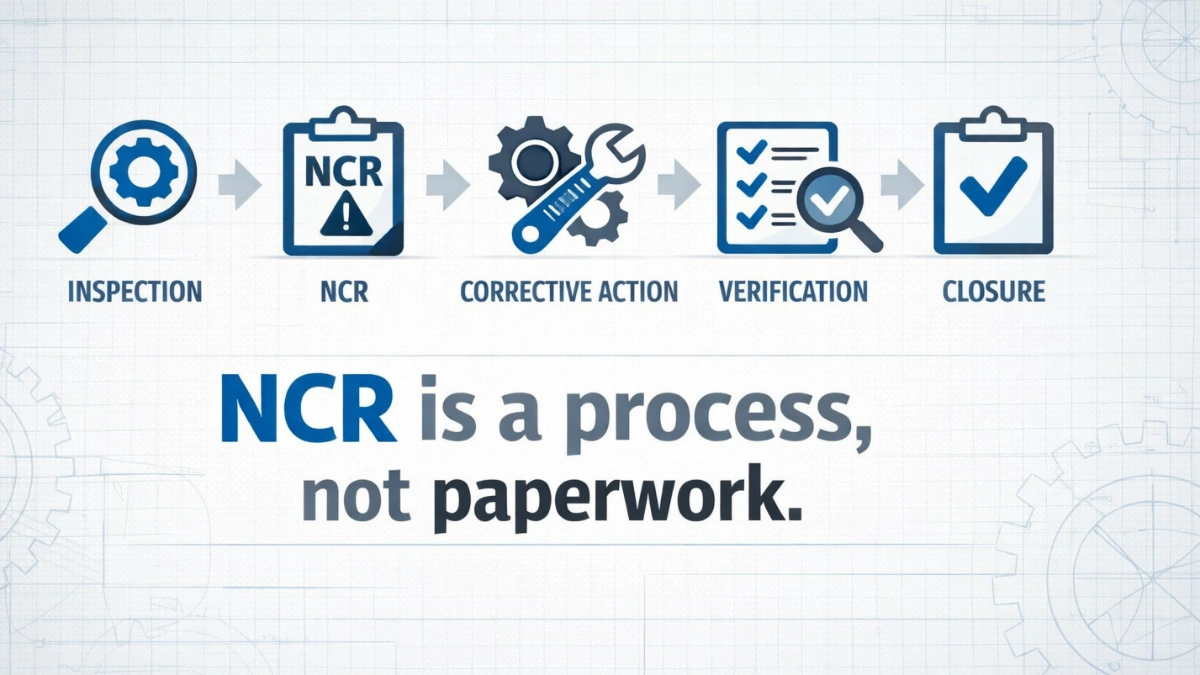
An NCR (Non-Conformance Report) is a controlled QA/QC document used to identify, contain, correct, verify, and close a confirmed case of non-compliance with contract specifications, approved drawings, method statements, ITPs, or applicable standards.


Common alternative names (same concept)

On different projects/clients, NCR may be called:

  • Nonconformance Report

  • Non-Conformity Report

  • Non-Conformance Notice

  • Non-Compliance Notice (NCN)

  • Defect / Defective Work Notice (often contractual wording)

  • Rejection Notice (materials/work rejection)

  • Corrective Action Request (CAR) (sometimes separate, sometimes merged)


What triggers an NCR (typical causes)

An NCR is typically raised after confirmed non-compliance, such as:

1) Failed test

Examples:

  • concrete strength result below requirement

  • weld NDT rejection

  • pressure test failure

  • soil compaction below spec

2) Rejected inspection

Examples:

  • installation not per approved drawing

  • tolerance exceeded

  • wrong material used

  • work executed without required inspection hold point

3) Unauthorized deviation

Examples:

  • change in rebar size/spacing without approval

  • unapproved material substitution

  • method statement not followed in a way that affects compliance

4) Missing mandatory records

Examples:

  • inspection not performed and work is already covered

  • required test missing or invalid

  • traceability certificates not available where required


What an NCR is NOT (to prevent misuse)

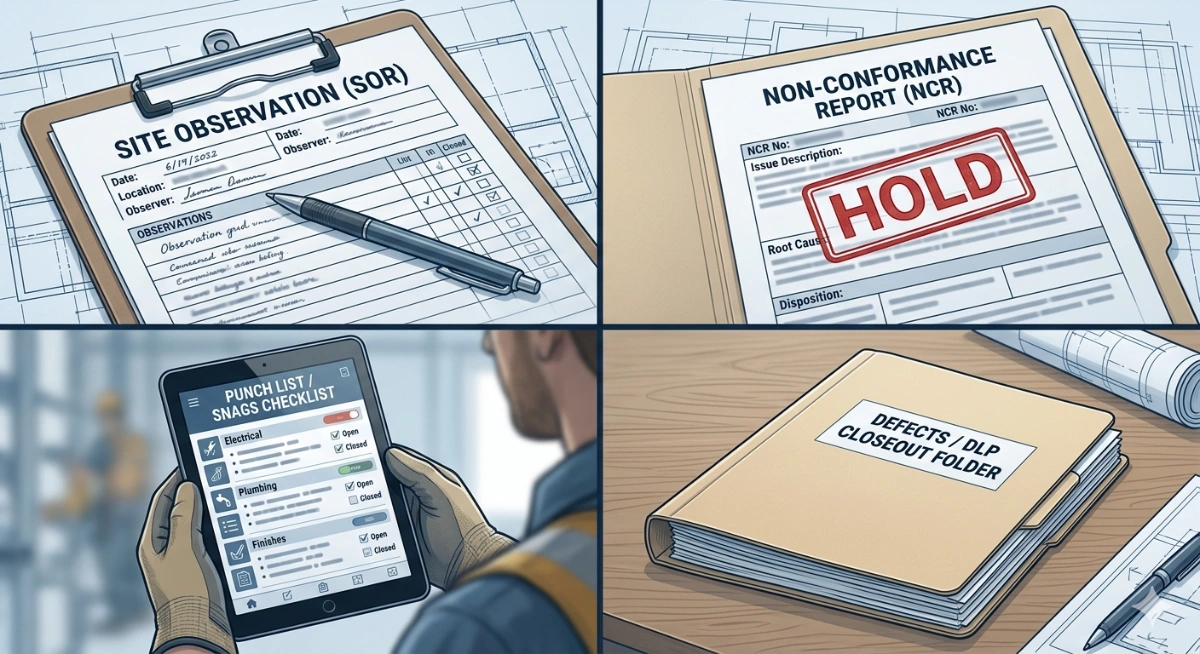
  • Not a snag list / punch list item (usually minor completion/finishing)

  • Not a “general complaint” document

  • Not automatically a dispute or claim

  • Not proof of fault by itself (it’s a record of non-compliance and required actions)


Who issues NCRs on a project

Depending on project structure, NCRs may be issued by:

  • Consultant / Engineer / Supervision team (most common externally)

  • Contractor QA/QC (internal NCRs for control before consultant action)

  • Client representative (less common; often via consultant)

Regardless of issuer, the contractor is typically required to respond, implement corrective action, and provide closure evidence.


Standard NCR workflow (from issue to closure)

A construction NCR generally follows this lifecycle:

  1. Identify non-conformance (inspection/test/audit/site finding)

  2. Record facts + location + references (drawing/spec/ITP)

  3. Containment (stop affected activity, quarantine material, prevent concealment)

  4. Contractor response

    • root cause (why it happened)

    • corrective action (how to fix this case)

    • preventive action (how to prevent recurrence)

  5. Disposition by Engineer/Consultant

    • accept as-is (rare, with justification)

    • repair

    • remove and replace

    • accept with concession/technical deviation (if allowed)

  6. Verification

    • re-inspection / re-test

    • evidence submitted (photos, reports, results)

  7. Close NCR

    • signed, dated, status updated in the register/log


What “good” NCR writing looks like (minimum standard)

A strong NCR statement is:

  • factual (no opinions, no blame language)

  • specific (exact location, element, trade)

  • referenced (spec clause, drawing number, ITP step)

  • verifiable (photos, measurements, test report IDs)

Bad: “Work is not acceptable.”
Good: “Rebar spacing at Grid B-4 measured at 250 mm vs drawing S-103 requirement 200 mm; area inspected on 2026-01-06; photos ref NCR-P-014-01 to 03.”


Why NCRs matter (practical value)

A functioning NCR system:

  • prevents unsafe continuation of works

  • reduces rework through early detection

  • improves quality performance through corrective/preventive action

  • protects handover documentation

  • creates defensible records for disputes (when needed)


Upcoming NCR pages in this series

You’ll publish tool-first pages and focused info pages. Each page will address one intent:

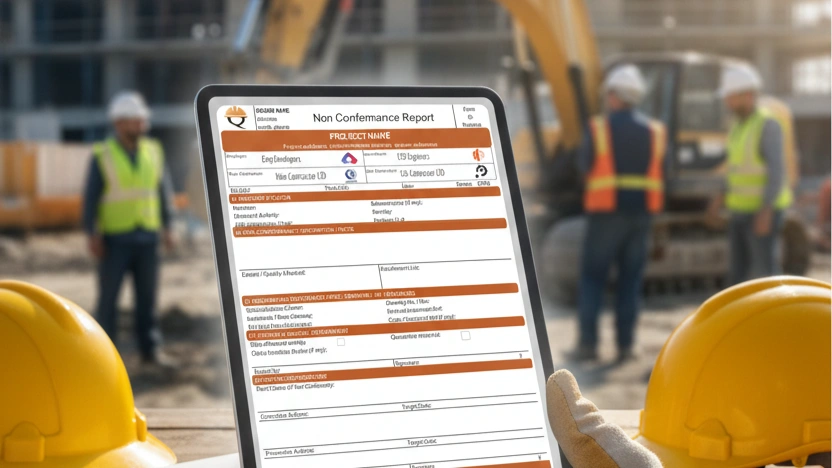
  • NCR Form Template (Tool): a clean, site-ready NCR format

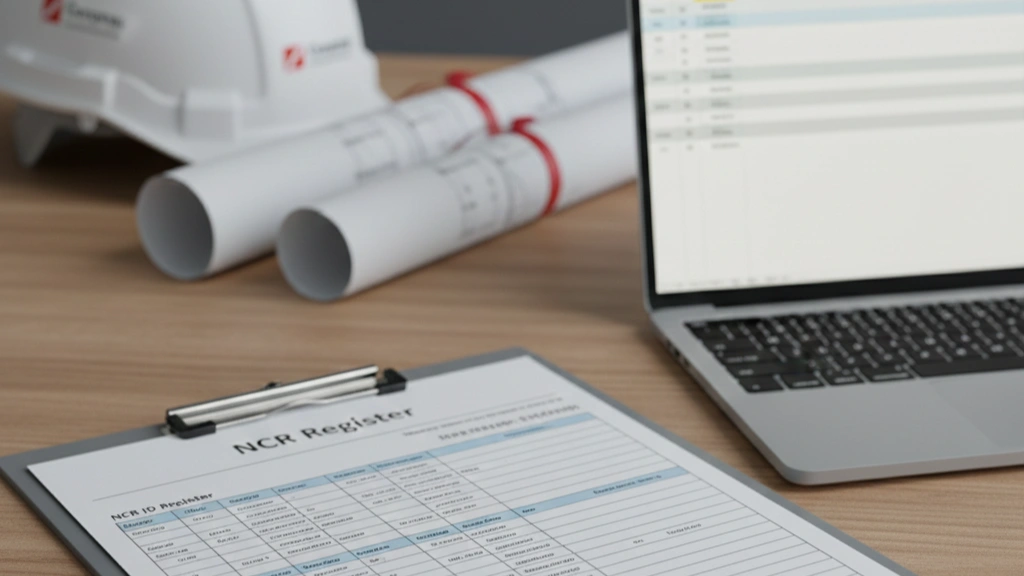
  • NCR Log / Register (Tool): tracking status, ageing, and closure

  • Observation vs NCR vs Snag vs Defect (Info): when to use each record

  • When to Issue an NCR (Info): failed tests, rejected inspections, missing records

  • NCR Severity Matrix (Tool): minor/major/critical classification

  • Notice to Correct Letter (Tool): contractual escalation template

  • Proceed at Contractor’s Risk Letter (Tool): conditional continuation template

  • Continue Work with an Open NCR? (Info): stop-work vs proceed-at-risk logic

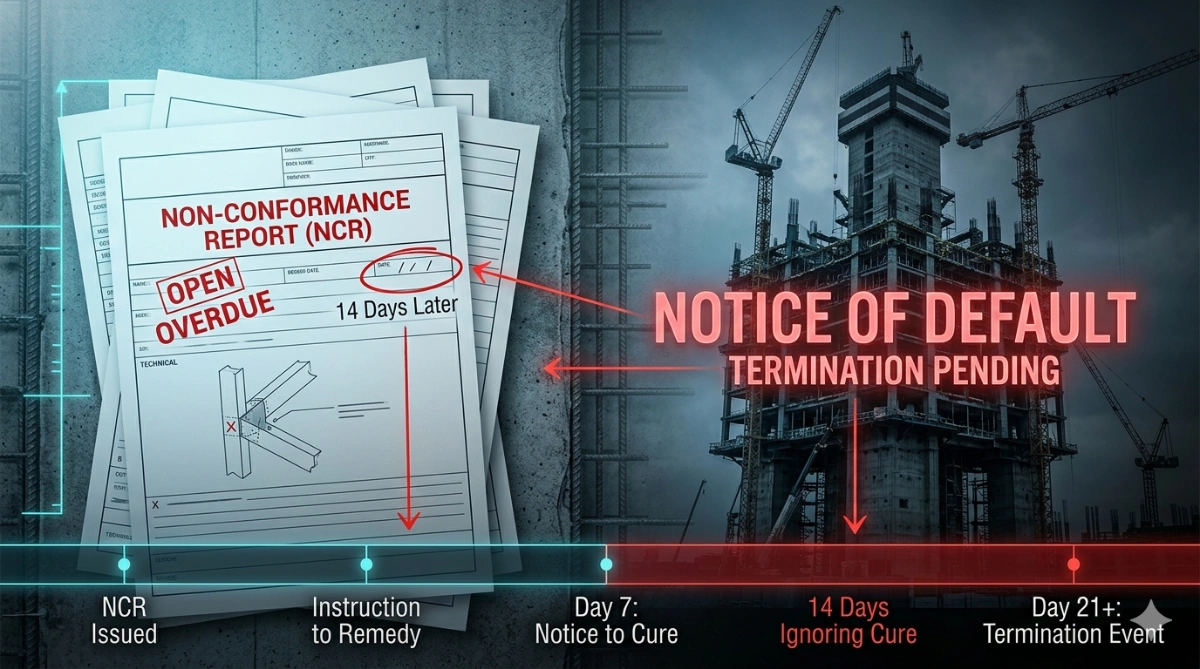
  • Can an NCR Lead to Termination? (Info): default, notices, and time limits

  • Open NCRs at Handover (Info): taking-over and defects implications


Summary

  • Term: NCR

  • Meaning (construction): Non-Conformance Report

  • Purpose: control confirmed non-compliance (identify → correct → verify → close)

  • Triggers: failed test, rejected inspection, unauthorized deviation, missing mandatory record

  • Key fields: description + location + requirement reference + corrective action + verification evidence + closure

  • Not: snag list, generic complaint, automatic claim

L
Lena Miller
Jan 06, 2026
0
2
393
36

Related Checklists


HVAC Ductwork Rough-In Inspection Checklist
✅ 15 items
Inspecting HVAC ductwork rough-in before covering is a critical phase in construction, ensuring that all duct installations meet specified standards and are free from defects. This process involves checking the layout, alignment, and connections of ductwork systems in buildings to ensure efficient air flow and system functionality. This checklist focuses on pre-cover inspections, offering a step-by-step guide to verify the quality and compliance of duct installations. By using this interactive checklist, professionals can tick off completed tasks, add comments, and export their reports, ensuring a thorough and documented inspection process.
Acoustic Performance and Sound Insulation Inspection
✅ 14 items
Acoustic performance and sound insulation are critical components of building design and construction, ensuring sound control and privacy. This inspection checklist covers the evaluation of materials and construction methods used to achieve optimal acoustic performance. It focuses on assessing the effectiveness of sound barriers, insulation materials, and construction techniques used in walls, floors, and ceilings. Ensuring proper acoustic performance mitigates issues such as noise pollution and enhances occupant comfort and privacy. This interactive checklist allows you to tick off items, leave comments, and export your findings as PDF or Excel with a unique QR code for verification.
Trigger/Action Response Plan: Holds, Thresholds, Escalation
✅ 24 items
Trigger/action response plan establishes clear thresholds, hold points, communications, and escalation paths across construction activities. This checklist guides teams to set control limits, build a notification matrix, and formalize an escalation protocol so responses are consistent when readings or events cross boundaries. It organizes trigger definitions, hold-point approvals, and message content without prescribing contractor remedies, keeping the plan focused on governance and decision-making. Coverage includes quality, safety, environmental, and schedule indicators per approved project specifications and authority requirements. Benefits include faster resolution, documented accountability, and fewer disputes because actions, roles, and timeframes are defined in advance. Use it during preconstruction or mobilization, then maintain it through change control as risks evolve. The plan reduces uncontrolled stoppages, near-miss escalation, and nonconformance sprawl by combining measured limits, decision authority, and reliable communication channels. Start in interactive mode to tick items, add project-specific comments, and export the approved plan as PDF/Excel with a QR-secured link for field access.
Pre-condition surveys of adjacent properties checklist
✅ 21 items
Pre-condition surveys of adjacent properties provide a defensible record of visible conditions before construction begins. This baseline property survey, also called a preconstruction condition survey or adjacent building documentation, focuses on photos, crack width measurements, and clear notes that help benchmark potential damage claims. The scope purposefully excludes structural assessment, calculations, and engineering opinions; it captures what is observable and measurable with simple tools. By following a consistent method—wide-to-close photography with a scale, crack comparators in millimetres, clear room-by-room indexing, and consent-backed access—you reduce disputes, protect relationships, and streamline insurance discussions. You will also implement disciplined data control: unique IDs, dated filenames, mapped locations, and digitally signed acknowledgments. Use this interactive checklist to plan access, document exteriors and permitted interiors, install non-invasive tell‑tale crack gauges where allowed, and compile a clean, shareable record. Tick each step, add comments where needed, and export your commentable report as PDF/Excel with a QR-secured link.
Temporary Works Inspection Checklist
✅ 15 items
Inspecting temporary works such as shoring and scaffolding is crucial to ensure safety and structural integrity on construction sites. Temporary works are temporary structures used to support loads during construction, including scaffolding and shoring systems. This checklist covers essential inspection points to verify stability, safety, and compliance before use. Ensuring temporary works are properly inspected helps avoid structural failures, accidents, and legal issues. This interactive checklist allows users to tick items online, leave comments, and export completed reports as PDF or Excel, complete with a unique QR code for authenticity.

Related Articles


Site Handover Accessible Site Letter Checklist
⏳ 5 min read
Construction Site Handover: Legal Meaning, “accessible Site” Clause, Checklist & Free Letter Template
A practical guide to construction site handover: legal meaning, “Accessible Site” clause, risks of informal possession, a step-by-step checklist, and a free handover letter template.
Site Instructions Construction Legal And Forms
⏳ 5 min read
Site Instructions In Construction: Legal Guide & Templates
Learn what site instructions (Engineer’s, Architect’s, PM’s Instructions, ASI, Work/Field Orders) mean legally in FIDIC, JCT, NEC & AIA, with free forms.
Daily Construction Delay Report
⏳ 1 min read
Daily Construction Delay Report | Free Pdf, Excel Sample Download
Download a free Daily Site Delay Report sample in PDF format. Document daily delays, causes, site conditions, and corrective actions with this clear, ready-to-use form.
Ncr Form Template
⏳ 4 min read
Ncr Form Template (excel/pdf) – Non-conformance Report Format
Download a practical NCR form template used on construction projects. Includes key fields for QA/QC non-conformance description, specification references, corrective action, verification, and closure.
Incident Report Review Corrective Actions Construction Safety
⏳ 3 min read
Enhancing Construction Safety: Effective Incident Report Reviews And Corrective Actions
Learn how systematic incident report reviews and corrective actions can improve construction site safety. Download our comprehensive safety checklist to implement best practices.