Contractor NCR: What to Do After Receiving a Report
Definition: What to do when the contractor receives an NCR is a field-ready workflow guiding containment, root cause analysis, corrective and preventive actions, and documented closeout to protect quality, schedule, cost, and contractual position.
- Stabilize the issue fast with safe, auditable containment steps
- Prove root cause using 5-Why, photos, measurements, and batch traceability
- Plan correction and prevention with approvals and verification hold points
- Fully interactive, commentable, export, QR code for authenticated records
What to do when the contractor receives an NCR is a practical, step-by-step response plan for construction teams facing a nonconformance report, non-compliance notice, or quality deviation. This checklist focuses on immediate containment, factual root cause analysis, corrective and preventive actions, and transparent closeout—without drifting into unrelated scopes. By following a structured approach, you reduce rework, avoid safety incidents, protect delivery dates, and maintain a defensible contractual position. Every step emphasizes objective evidence: calibrated measurements, annotated photos, batch numbers, inspection reports, and signatures. You will find guidance for logging, isolating affected work, coordinating hold points, and aligning with stakeholder expectations per approved project specifications and authority requirements. The result is a clear record demonstrating control of the nonconformance, verification of the fix, and prevention of recurrence. Start in interactive mode to tick items, add comments, attach files, and export your record as PDF/Excel with a QR link for quick field access.
- Responding to a nonconformance demands speed and structure. This checklist helps you pause affected work safely, isolate nonconforming materials, quantify impact on schedule and cost, and document facts. It steers teams away from blame and toward measurable evidence that accelerates approvals and minimizes downstream risk.
- Root cause rigor and disciplined corrective actions prevent recurrence. Using 5-Why or fishbone analysis, verified against drawings and specifications, you produce an auditable thread from symptoms to cause to fix. Verification tests, sign-offs, and updated ITPs ensure the solution holds under normal operating conditions.
- Interactive online checklist with tick, comment, and export features secured by QR code.
Receipt & Logging
Containment & Risk Control
Root Cause & Evidence
Correction & Preventive Actions
Communication & Approvals
Verification & Closeout
Containment first: secure, isolate, and stabilize the nonconformance
When an NCR arrives, resist the urge to fix immediately. Containment comes first. Halt only the affected activity and tag it clearly; do not freeze unrelated work. Quarantine suspect materials in a red‑tag zone, record quantities and batch identifiers, and make the area safe with barriers, lockout, and signage. This prevents escalation, preserves evidence, and signals control to the client. Quickly log the NCR in a live register so leadership can see ownership and deadlines. Within hours, confirm the exact scope on drawings and specifications; ambiguous boundaries create scope creep later. Capture initial conditions with timestamped photos and basic readings (dimensions in millimetres, temperatures in °C, humidity in %RH). A short toolbox talk aligns the crew on what stops, what continues, and how to escalate questions. The goal is a stable, traceable situation that buys time for analysis without further risk to people, plant, or programme.
- Stop affected work only; tag and sign the boundary
- Quarantine materials with red tags and inventory log
- Record baseline photos, measurements, and conditions
- Toolbox talk clarifies limits and escalation
- Register entry shows owner and due dates
Prove root cause with data, not opinion
Root cause analysis should be evidence-led and repeatable. Start by mapping symptoms to process steps and verifying each against drawings, specifications, and method statements per approved project specifications and authority requirements. Use 5‑Why or a fishbone diagram to isolate the primary cause, while documenting contributing factors in materials, methods, environment, equipment, and human performance. Pull batch numbers, torque logs, calibration certificates, and inspection records to establish traceability. Quantify impacts objectively: rework hours, material mass (kg), and schedule shifts. Then define corrective options—repair, rework, or replace—with hold points for client verification. In parallel, decide on preventive measures: training refreshers, added ITP checkpoints, supplier controls, or tooling jigs that remove variability. Package the analysis and plans in a concise submission that demonstrates control, feasibility, and measurable acceptance criteria the client can sign.
- Use 5‑Why or fishbone to isolate cause
- Verify against drawings and specifications
- Attach batch, torque, and calibration records
- Define clear acceptance criteria and hold points
- State measurable schedule and cost impacts
Communicate for approvals and close with verified performance
Strong communication keeps momentum. Submit your response through the common data environment with a traceable transmittal, then schedule inspections with at least 24 hours of notice. Be precise about acceptance criteria and test methods so the field team and inspector share expectations. After executing the fix, run verification tests—dimensional checks, NDT, leak, or functional tests—and attach signed reports. Update as‑builts, close the NCR in the register, and hold a short lessons‑learned session to prevent recurrence. Remember the contractual dimension: be professional and timely. An NCR does not terminate a contract by itself—but it can create the grounds for default if a Notice to Correct/Cure is issued and ignored. Keep your correspondence factual, time-stamped, and linked to evidence; this protects your position while showing genuine commitment to quality.
- Use the CDE with transmittal IDs
- Give inspectors ≥24 h notice
- State tests and acceptance thresholds
- Attach signed verification reports
- Capture lessons learned and update ITPs
How to Use This Interactive NCR Response Checklist
- Preparation: Gather NCR document, approved drawings/specifications, ITPs, method statements, calibrated measurement tools, camera/mobile device, barrier tape/signage, red tags, PPE (helmet, gloves, eye protection), and access to the common data environment with permissions.
- Using the Interactive Checklist: Start interactive mode, tick items as completed, add comments with photos, link batch numbers and test reports, tag responsible persons, and track due dates. Export interim status to PDF/Excel for reviews when requested.
- Sign-Off: On completion, capture digital signatures from the NCR Owner, QA Manager, and Client/Engineer. Export the final, commentable record as PDF/Excel and archive it in the CDE. Authenticate the record using the embedded QR code.
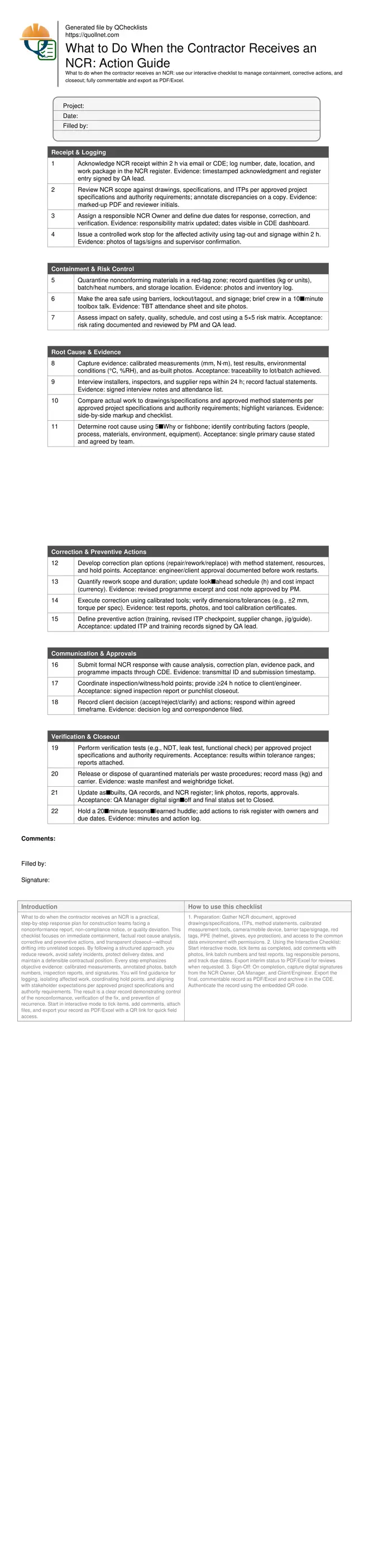
Call to Action
- Start Checklist Tick off tasks, leave comments on items or the whole form, and export your completed report to PDF or Excel—with a built-in QR code for authenticity.
- Download Excel - Contractor NCR Response Actions
- Download PDF - Contractor NCR Response Actions
- View Image - Contractor NCR Response Actions
Cite & Embed
“Contractor NCR Response Actions by Quollnet”
with a link to
this source page.
FAQ
Question: How fast should we respond to an NCR on site?
Question: Does an NCR mean our contract is at risk?
Question: What evidence convinces clients the fix is effective?
Question: How do we prevent recurrence after closing an NCR?
Related Articles
Broader reading and guidance connected to this checklist topic.
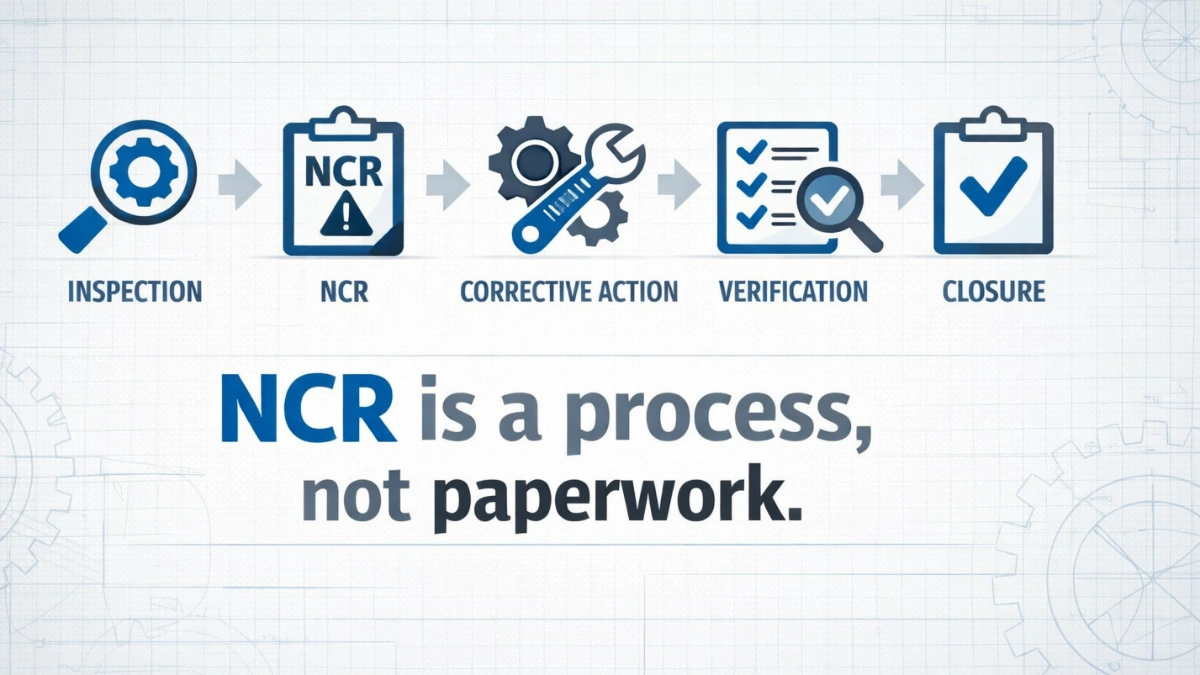
Ncr Meaning In Construction (qa/qc Non-conformance Report Guide)

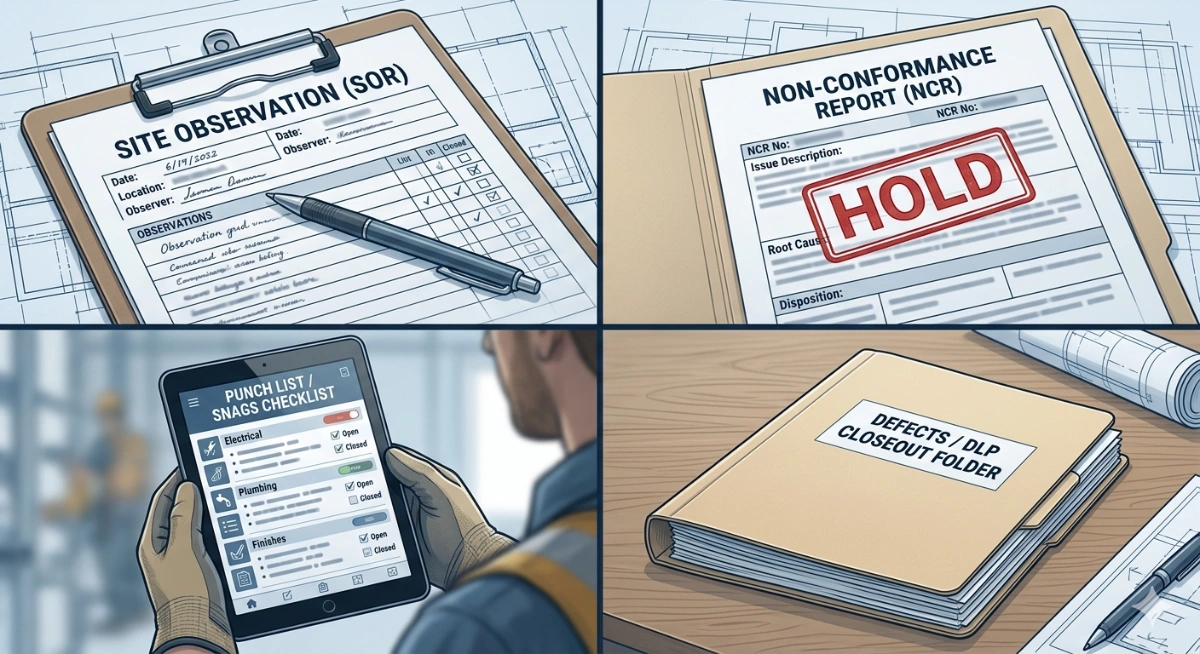

Daily Construction Delay Report | Free Pdf, Excel Sample Download

Related Checklists
Keep the workflow moving with nearby templates chosen from similar checklist content.