RFQ vs RFP vs Tender in Construction: What’s the Difference and When to Use Each?
In construction procurement, people throw around RFQ, RFP, and Tender as if they’re interchangeable. They’re not. Using the wrong one can confuse suppliers, misallocate risk, and make evaluation a nightmare—especially on larger civil and building projects.
Quick definitional snapshot (for readers and search engines)
RFQ (Request for Quotation): Ask for pricing and commercial terms on a clearly defined scope or commodity.
RFP (Request for Proposal): Ask for a solution + methodology + commercial offer, where the contractor helps define how the work will be done.
Tender (Invitation to Tender / ITT): Ask prequalified bidders to submit a fixed price for a fully designed, standardized scope, enabling an apples-to-apples comparison.
The sections below explain each term in a construction context, including basic legal flavour, typical usage, and how they relate to each other in a real procurement workflow.
1. Where RFQ, RFP and Tender sit in the construction procurement process
In a typical construction procurement cycle, a client or main contractor might:
-
Issue an RFI (Request for Information) to understand who is in the market and what they can do.
-
Use an RFQ for standard materials or simple, well-defined works.
-
Use an RFP when they need technical proposals, value engineering, or design input from specialist contractors.
-
Use a Tender / ITT to award a major construction contract based on a final design and bill of quantities (BOQ).
Choosing the right tool keeps construction bidding, supplier evaluation, and contract award clean and defensible.
2. RFQ – Request for Quotation
Related RFQ template
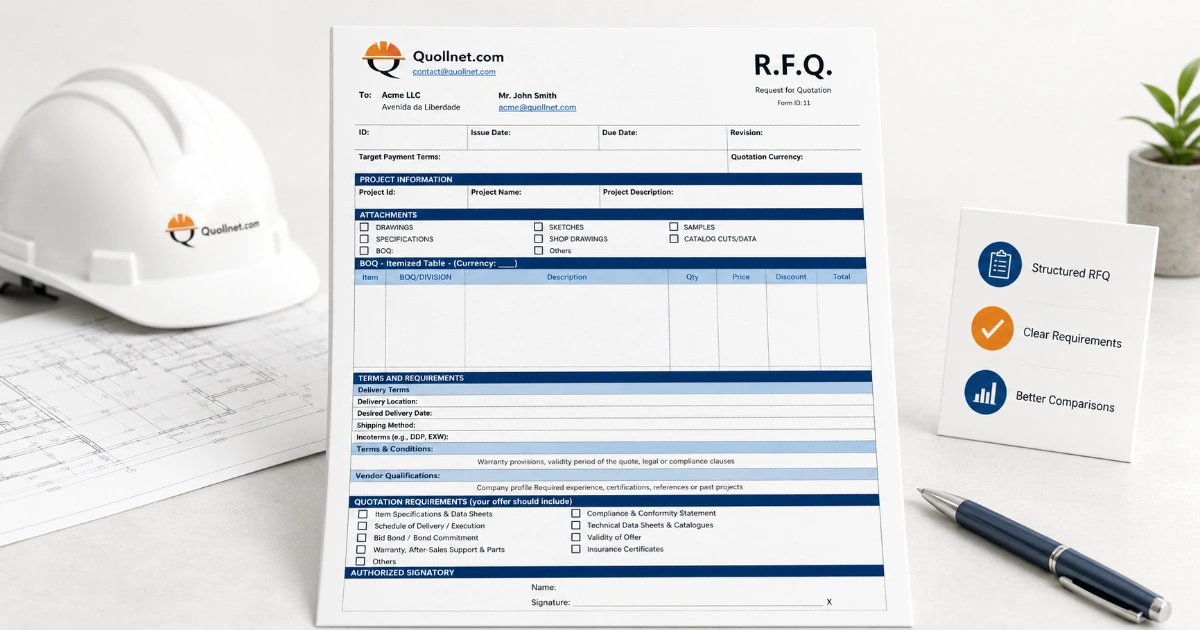
Request for Quotation (RFQ) Form Template for Construction
Need a practical RFQ format after understanding the difference between RFQ, RFP and Tender? Use this construction-ready RFQ form template to request prices, delivery terms, compliance details, attachments and quotation requirements from suppliers or subcontractors.
View the RFQ form template →
2.1 What is an RFQ in construction?
An RFQ (Request for Quotation) is a price-focused procurement document. The buyer sends a clear, fixed scope and asks suppliers or subcontractors to submit:
-
Unit rates or lump sum prices
-
Delivery and lead times
-
Basic commercial terms (incoterms, payment terms, warranties)
-
Confirmation of compliance with the specification
Typical RFQ construction examples:
-
Supply of reinforcing steel, cement, aggregates
-
Ready-mix concrete (e.g. 40 MPa, defined slump and aggregate size)
-
Electrical cables, conduits, switches from known brands
-
Simple labour-only packages (e.g. painting to an approved system)
-
Hiring plant and equipment (e.g. cranes, loaders, generators) at daily / weekly rates
Even a 3M USD steel package can be procured using a simple RFQ if the scope is clear and there is no request for engineering solutions.
2.2 Legal flavour – an “invitation to treat”
In classic contract law, an RFQ is usually treated as an invitation to treat, not a binding offer. It invites suppliers to submit quotations, which are the actual offers. A contract is only formed when the buyer accepts a quotation (typically by issuing a Purchase Order or Subcontract Agreement).
In practice, the legal effect depends on:
-
The wording of the RFQ
-
Any reservation-of-rights clauses
-
Applicable procurement rules (especially for public entities)
But in everyday construction practice:
An RFQ is a non-binding request for prices and terms on a defined scope. No contract exists until a formal PO or contract is issued and accepted.
2.3 Relationship between issuer and responder
-
Issuer: Client, main contractor, or procurement team
-
Responder: Supplier, vendor, or subcontractor
The relationship is primarily commercial and transactional. The supplier is a price provider, not a solution designer.
2.4 When RFQs are particularly appropriate
RFQs are particularly suitable for:
-
Commodity procurement – standard materials with clear specifications
-
Straightforward works – fencing, small paving works, simple demolitions
-
Framework call-offs – pricing against an existing framework or rate contract
-
Emergency procurement – when something breaks on site and speed > process (e.g. urgent crane spare parts, emergency shoring materials, temporary pumps)
If you are essentially asking, “How much, and when can you deliver?”, you are in RFQ territory.
3. RFP – Request for Proposal
3.1 What is an RFP in construction?
An RFP (Request for Proposal) is used when the buyer needs more than a price; they need a technical solution and a methodology.
An RFP invites contractors or specialist subcontractors to submit:
-
A technical solution (system selection, design approach, performance concept)
-
Method statements and construction methodology
-
A programme and phasing plan
-
Team structure and key personnel profiles (project manager, site engineer, HSE, QA/QC, etc.)
-
A commercial offer (lump sum, schedule of rates, or hybrid)
In many design–build or performance-based procurements, the risk profile is actively discussed and shifted. Because the contractor is proposing the solution, they may assume design responsibility and design liability for that portion of the works (for example, a façade system or a waterproofing system).
3.2 Legal flavour – still an invitation, but more structured
Most RFPs are still treated as invitations to treat, but they usually come with more structure and “teeth” than an RFQ:
-
Confidentiality clauses
-
Detailed submission format and mandatory content
-
Technical and commercial evaluation criteria
-
Requirements on bid validity and clarification procedures
The proposal submitted by the contractor is an offer. The client can then accept, reject, negotiate, or shortlist.
3.3 Relationship between issuer and responder
The relationship in an RFP is more collaborative and technical:
-
The issuer expects engineering input, not just a tick-box compliance statement.
-
The responder acts as a solution provider, often taking on design and performance risk.
-
Proposals usually include methodology, interfaces with other trades, risk registers, staging plans, and sometimes life-cycle cost analysis.
This is where you see:
-
Corporate capability statements
-
Similar project references
-
Project team CVs
-
Subcontracting strategy
Exactly the sort of items people expect when evaluating complex packages.
3.4 When RFPs are used in construction
Typical RFP scenarios:
-
Design & Build packages (e.g. design and install a VRF HVAC system)
-
Façade systems (curtain walls, unitised systems, bespoke cladding)
-
Basement or podium waterproofing solutions
-
Security, ICT and BMS systems (CCTV, access control, intelligent building systems)
-
Complex MEP subcontract packages that include coordination and clash resolution
-
Value Engineering (VE): when the client explicitly invites the contractor to propose cost-saving or performance-improving alternatives to the original design
If the question is “How would you do this, and what will it cost?”, you are firmly in RFP territory.
4. Tender – Invitation to Tender (ITT)
4.1 What is a Tender / ITT?
An Invitation to Tender (ITT) or “tender” is a formal, structured bidding procedure where a client invites prequalified contractors to submit competitive bids for a fully defined scope of works.
In construction, this is the classic process for:
-
Main contract awards
-
Major subcontract packages
-
Large infrastructure sections
The tender documents typically include:
-
Issued-for-construction (IFC) drawings
-
Detailed specifications
-
BOQ / Schedule of Prices
-
Conditions of Contract (often based on FIDIC, NEC, etc.)
-
Preliminaries and general requirements
-
Key milestones and completion dates
4.2 Legal flavour – and the “apples-to-apples” objective
Tendering, especially in the public sector, is designed to ensure fair competition, transparency, and value for money. Many jurisdictions regulate it heavily via public procurement laws and guidelines.
The core objective is:
“Apples-to-apples comparison.”
Every bidder prices the same design, same terms and same BOQ, allowing a direct comparison of total price and key qualifications.
Depending on the jurisdiction and wording:
-
Submitting a tender can create a stronger binding commitment, backed by bid bonds and formal tender forms.
-
A contract is generally formed when the client issues a Letter of Acceptance or signs the Contract Agreement referencing the winning tender.
4.3 Relationship and process specifics
-
Issuer: Client, developer, or public entity
-
Responders: Prequalified main contractors or major subcontractors
Process characteristics:
-
Fixed submission deadlines and formats (sealed envelopes, e-tender portals)
-
Bid bonds and later performance bonds
-
Strict rules on clarifications and addenda
-
Sometimes a requirement that bidders attend compulsory site visits or briefings
In many public tenders, there is a public opening of bids, where tender prices are read out or made visible to all participants to demonstrate transparency. This never happens with RFQs or RFPs, which are typically handled more informally or internally.
4.4 When tenders are used
Tenders are appropriate when:
-
The design is complete and coordinated
-
The client wants a contractor to build a defined scope, not design it
-
The project is large, politically sensitive, or subject to public procurement regulations
-
The client needs a formal, auditable competition for main contract or major subcontract awards
If your message to the market is, “Here is the final design; tell me how much to build it,” you are in tender / ITT territory.
5. RFQ vs RFP vs Tender – side-by-side comparison
A quick comparison that works both for humans and for AI/chatbot answers:
| Aspect | RFQ | RFP | Tender / ITT |
|---|---|---|---|
| Core question | “How much?” | “How will you do it, and how much?” | “What’s your price for this final design?” |
| Scope definition | Fixed, commodity-like | Partially open; contractor refines the solution | Fully defined; IFC design + BOQ |
| Contractor’s role | Price taker / supplier | Solution provider + design / method risk | Builder of a defined scope |
| Evaluation focus | Price + basic terms | Technical + commercial scoring | Mostly commercial + compliance |
| Typical legal nature | Invitation to treat | Invitation to treat with more structure | Formal competitive bidding, often regulated |
| Best for | Materials, simple works, emergencies | Design–build, systems, VE, specialist packages | Main contracts and major subcontracts |
This distinction is useful to encode in procurement policies, workflow engines, and even construction procurement chatbots that route internal users to the right form type.
6. Real construction scenarios
Some practical examples to anchor the concepts:
-
40 MPa concrete supply
Mix design handled by supplier; spec is standard; you only want unit rates and delivery → RFQ. -
3M USD reinforcing steel order
Clear bending schedule and bar list, standard codes, no engineering alternatives required → RFQ. -
Basement waterproofing strategy
Client wants the specialist to propose system, detailing, QA testing regime, and interface management → RFP. -
Curtain wall façade package
Performance criteria and concept drawings exist, but the façade contractor must engineer the system and take design liability → RFP. -
Full residential building construction
Architect, structural engineer, and MEP consultants have completed the design; BOQ is issued → Tender / ITT to main contractors. -
Value engineering on an over-budget design
Client asks shortlisted contractors to propose alternatives to reduce cost or improve buildability → often an RFP issued to a limited set of bidders.
7. Common misconceptions (including the RFI confusion)
7.1 “High value means RFP”
False. A high contract value does not automatically require an RFP. A large steel or concrete package is still perfectly suited to an RFQ if the scope is precise and no technical alternative is being requested.
7.2 “A tender is just a big RFQ”
Also false. A tender / ITT is more formal and often regulated, with standardised documents designed for apples-to-apples comparison and sometimes public bid opening. An RFQ is generally lighter, faster, and less procedurally constrained.
7.3 “RFQ and RFP should always ask for company profiles, CVs and governance documents”
This information belongs much more to RFPs and to prequalification stages for tenders. An RFQ can and often should stay lean and fast, especially for commodity procurement and emergency site needs.
7.4 The RFI confusion
Many people confuse RFI (Request for Information) with RFQ, RFP, and Tender.
-
An RFI is used to gather market intelligence and capability information only.
-
RFIs typically do not include pricing and are not bids.
-
They usually precede RFQ/RFP/Tender and help the client decide how to structure the formal procurement.
If you are just asking, “Who can do this, and what options exist?”, you are in RFI, not RFQ/RFP/Tender.
8. How to choose between RFQ, RFP and Tender
A simple logic that works well in construction procurement policies and digital workflows:
-
Is the scope fully defined, with no need for contractor design or methodology?
-
Yes → Use an RFQ for materials / simple works, or a Tender if it’s a full project or major package.
-
-
Do you need the contractor or specialist to design, engineer, or significantly shape the solution?
-
Yes → Use an RFP.
-
-
Is this a formal project award with IFC drawings, BOQ and strong governance requirements (especially in public sector)?
-
Yes → Use a Tender / ITT.
-
If you’re uncertain, you can start with an RFI to explore the market and then choose RFQ, RFP or Tender based on what you learn.
9. Conclusion and next steps
In summary:
-
Use an RFQ (Request for Quotation) when the scope is clearly defined and you mainly care about pricing, delivery and basic terms, whether the value is small or very large.
-
Use an RFP (Request for Proposal) when you need a technical solution, construction methodology, and risk-sharing, not just a number.
-
Use a Tender / Invitation to Tender when you have a complete design and want structured, transparent, apples-to-apples competition for a major package or full project.
Getting this right makes your construction procurement cleaner, improves supplier relationships, and strengthens your audit trail when decisions are challenged.
For deeper reading on tendering and procurement concepts, many practitioners refer to sources such as:
-
FIDIC contract guides (e.g. Red Book, Yellow Book)
-
RICS and CIOB guidance on procurement and tendering
-
World Bank or other multilateral development bank procurement regulations
Call to action
-
Want ready-to-use RFQ templates tailored for construction?