Backcharges Under JCT Contracts: Defects, Instructions, Pay-Less Notices, and Deductions
AI/Search Snippet: A JCT backcharge is an informal description of corrective cost pursued through the actual mechanisms in the applicable JCT contract or subcontract. These may include a valid instruction, failure to comply, making good defects, employment of others, an appropriate deduction, a Pay Less Notice, set-off, debt recovery, or completion following termination.
The word backcharge is common in construction correspondence, but JCT contracts do not generally create one standard procedure formally titled “Backcharge Notice.” The contractual route depends on the exact JCT form, edition, project stage, contractual relationship, and amendments.
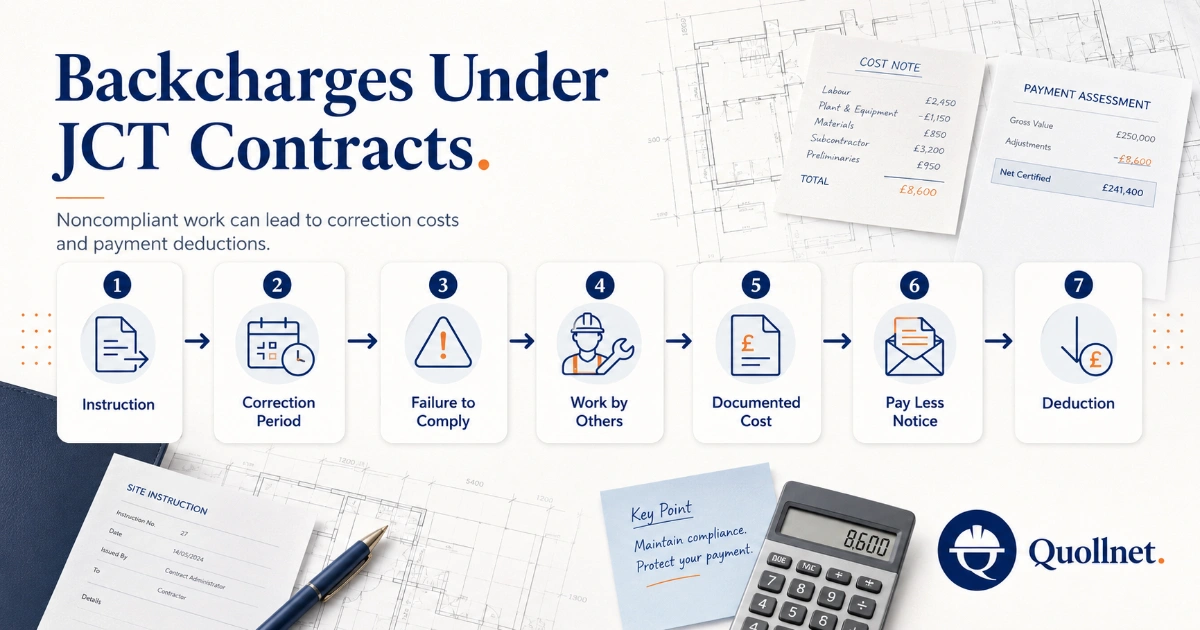
Under a JCT main contract, the practical equivalent may arise from an Architect/Contract Administrator’s instruction, an Employer’s instruction under Design and Build, failure to comply with that instruction, defects during the Rectification Period, employment of others, an appropriate deduction, payment withholding, set-off, recovery as a debt, or completion following termination.
Under a JCT subcontract, the Main Contractor must rely on the executed subcontract. A right available to the Employer under the main contract does not automatically give the Main Contractor the same right against a Subcontractor.
The central distinction is between entitlement to corrective cost and the right to deduct that cost from the current payment. A party may have an underlying claim but still be required to pay the notified sum if it misses the contractual or statutory Pay Less Notice deadline.
For the broader contract-neutral principles, see construction backcharges under standard-form contracts.
Need to issue a notice right now?
Use the practical Backcharge Notice Template, but adapt it to the exact JCT main contract or subcontract. Before sending it, verify the authorised instruction, correction period, right to employ others, contractual payment cycle, and deadline for any Payment Notice or Pay Less Notice. A generic notice cannot create a remedy absent from the executed contract.
What Is the JCT Equivalent of a Backcharge?
A JCT backcharge may correspond to one or more of the following contractual concepts:
- failure to comply with a valid instruction;
- employment of others to carry out instructed work;
- correction of work not in accordance with the Contract;
- making good defects, shrinkages, or other faults;
- acceptance of defective work with an appropriate deduction;
- recovery of cost, expense, loss, or damage;
- withholding through a valid Pay Less Notice;
- set-off or abatement;
- recovery as a debt;
- completion cost following termination.
The exact mechanism differs among the Standard Building Contract, Design and Build Contract, Intermediate Building Contract, Minor Works forms, and the corresponding subcontracts.
Clause numbering also differs. For example, in the JCT Standard Building Contract with Quantities 2024, compliance and noncompliance with instructions appear at Clauses 3.10 and 3.11. Under the JCT Design and Build Contract 2024, the corresponding headings appear at Clauses 3.5 and 3.6.
The correct form and edition must therefore be identified before relying on a clause number. JCT 2016 and JCT 2024 contracts remain in use, and project amendments may alter the standard notice, payment, set-off, and termination provisions.
Instructions and Failure to Comply
Where defective or incomplete work is identified during construction, the contractual process will often begin with an instruction.
Under the Standard Building Contract, the Architect/Contract Administrator issues instructions within the authority given by the Contract. Under the Design and Build Contract, the Employer or Employer’s Agent may issue instructions on the Employer’s behalf. A Contractor dealing with a Subcontractor must use the direction or instruction procedure in the applicable subcontract.
A defensible corrective instruction should identify:
- the relevant drawing, specification, schedule, or other contractual requirement;
- the affected work and precise location;
- the alleged defect, omission, or noncompliance;
- the action required;
- the contractual authority for the instruction;
- the period allowed for compliance;
- access and inspection arrangements;
- the consequences of failing to comply.
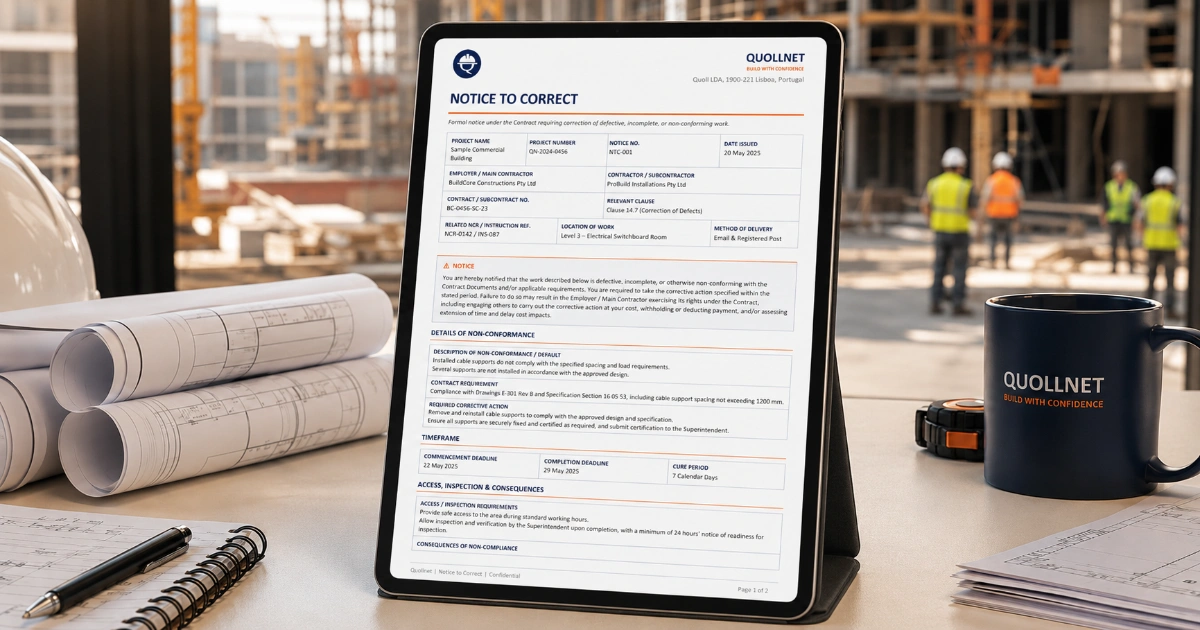
The instruction should be given in the form required by the contract. Oral directions, drawing comments, meeting minutes, emails, inspection rejections, and NCRs may support the factual record but may not perform the contractual function of a valid instruction.
For the broader distinction between technical and contractual directions, see Site Instructions in Construction. An NCR can establish technical nonconformity but does not automatically establish the right to employ others or deduct money.
Can the Contractor Challenge the Instruction?
The Contractor may challenge whether:
- the issuer had authority;
- the instruction is sufficiently clear;
- the required work is within the original Contract;
- the instruction changes design, quality, quantity, or sequence;
- the alleged defect actually exists;
- the work complies with the contractual standard;
- the instruction requires betterment;
- the period allowed for compliance is contractually valid or practically reasonable.
The Contractor should not simply ignore a disputed instruction. It should request clarification, state its contractual position, reserve its rights, and determine whether compliance is required while valuation or entitlement is resolved.
When May the Employer Employ Others?
The Employer’s ability to employ others usually depends on valid noncompliance with the applicable JCT instruction procedure.
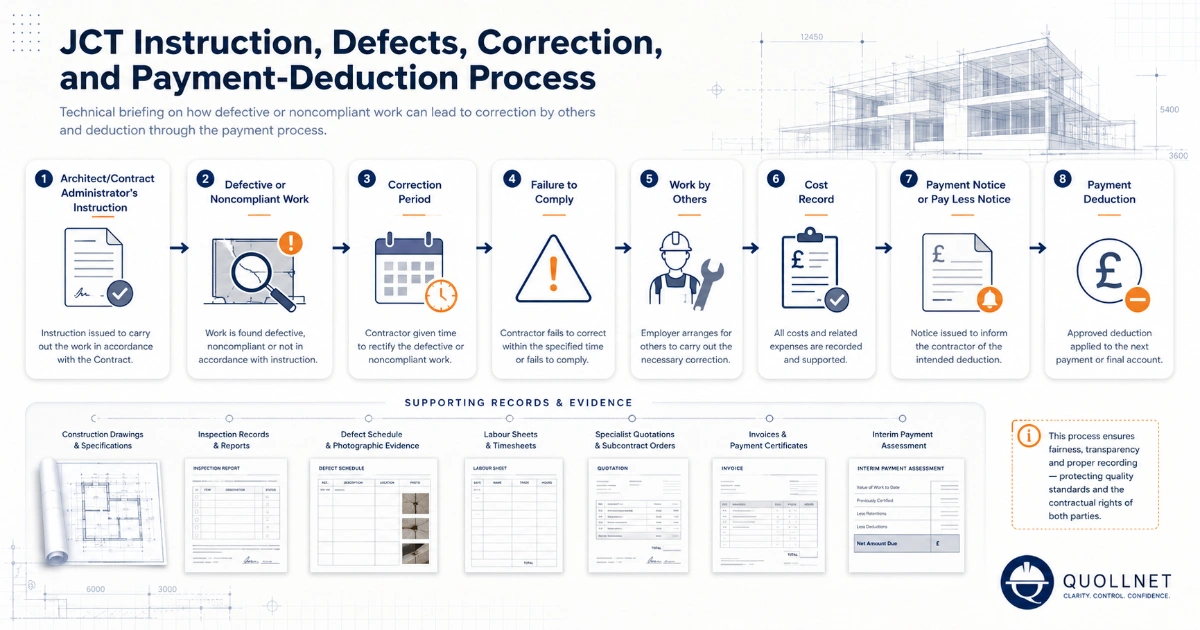
A practical sequence is:
- identify the contractual obligation;
- issue a valid instruction through the authorised contract administrator;
- allow the contractual compliance period;
- record the Contractor’s response or failure to act;
- define the limited corrective scope;
- employ others where the contract permits;
- record actual and reasonable cost;
- apply the contractual payment, debt, or damages mechanism.
The Employer’s position may be weakened where the instruction was invalid, the required work was unclear, the Contractor was denied access, the compliance period had not expired, or the replacement work included unrelated upgrades.
Worked Example: Employer Against Main Contractor
The Contract Documents require tested fire doors with specified certification and ironmongery. The Architect/Contract Administrator identifies several noncompliant installations and issues an instruction requiring replacement or rectification.
The Contractor disputes whether every door needs replacement but does not submit an acceptable corrective proposal or perform the instructed work within the applicable period. The Employer then appoints a specialist after completing the required noncompliance procedure.
The specialist records door replacement, ironmongery, labour, access, testing, disposal, and professional inspection costs. The Employer includes the amount in the payment calculation and issues any required Pay Less Notice before the applicable deadline.
The Contractor may still challenge whether the instruction was valid, whether repair rather than replacement was sufficient, whether the new doors represented betterment, whether the rates were reasonable, and whether the Pay Less Notice adequately stated the calculation.
Main Contractor Backcharges Against a Subcontractor
A Main Contractor’s right to recover corrective cost from a Subcontractor must be found in the executed subcontract.
Relevant documents may include:
- the JCT Standard Building Sub-Contract;
- the JCT Design and Build Sub-Contract;
- a JCT subcontract with Subcontractor design;
- a bespoke domestic subcontract;
- incorporated main-contract terms;
- a schedule of subcontract amendments.
The subcontract should be checked for provisions addressing:
- Contractor directions;
- defective or incomplete Subcontract Works;
- notice and correction periods;
- access to rectify;
- work by others;
- supplementary labour or materials;
- partial transfer of incomplete work;
- reasonable cost recovery;
- attendance, overhead, and administration;
- Payment Notices and Pay Less Notices;
- set-off or debt recovery;
- termination and completion;
- adjudication and other dispute procedures.
A Main Contract clause should not be assumed to apply automatically at subcontract level. Even where obligations are intended to be back-to-back, the subcontract must identify how instructions are issued, who values the work, what notice period applies, and how an amount may be deducted from the Subcontractor’s payment.
Worked Example: Main Contractor Against Subcontractor
A drylining Subcontractor leaves defective wall finishes and incomplete firestopping. The Main Contractor issues a written direction identifying the affected locations, relevant Subcontract Works, supporting photographs, required correction, access dates, and the contractual compliance period.
The Subcontractor fails to attend. Another trade performs the limited correction, and the Main Contractor records labour, materials, access equipment, testing, and disposal. Damage caused by later MEP work is recorded separately rather than charged automatically to the drylining Subcontractor.
The Main Contractor issues a detailed cost breakdown and serves the Pay Less Notice or other payment communication required by the subcontract and applicable law.
The Subcontractor may challenge scope responsibility, excessive labour hours, duplicated supervision, overhead, damage by others, and whether the notice was issued correctly and on time.
Defects During the JCT Rectification Period
After Practical Completion, JCT contracts generally use the term Rectification Period. The period is stated in the Contract Particulars and commonly runs separately for the Works and any Sections.
Under the Standard Building Contract with Quantities 2024, the schedule-of-defects and making-good provisions appear at Clauses 2.38 and 2.39. Under the Design and Build Contract 2024, the corresponding provisions appear at Clauses 2.35 and 2.36.
The normal contractual process includes:
- Practical Completion of the Works or Section;
- identification of defects, shrinkages, or other faults;
- delivery of a schedule or instruction within the contractual period;
- access for the Contractor to make good;
- completion of the required remedial work;
- issue of the applicable Certificate or Notice of Making Good;
- the related retention and final-payment consequences.
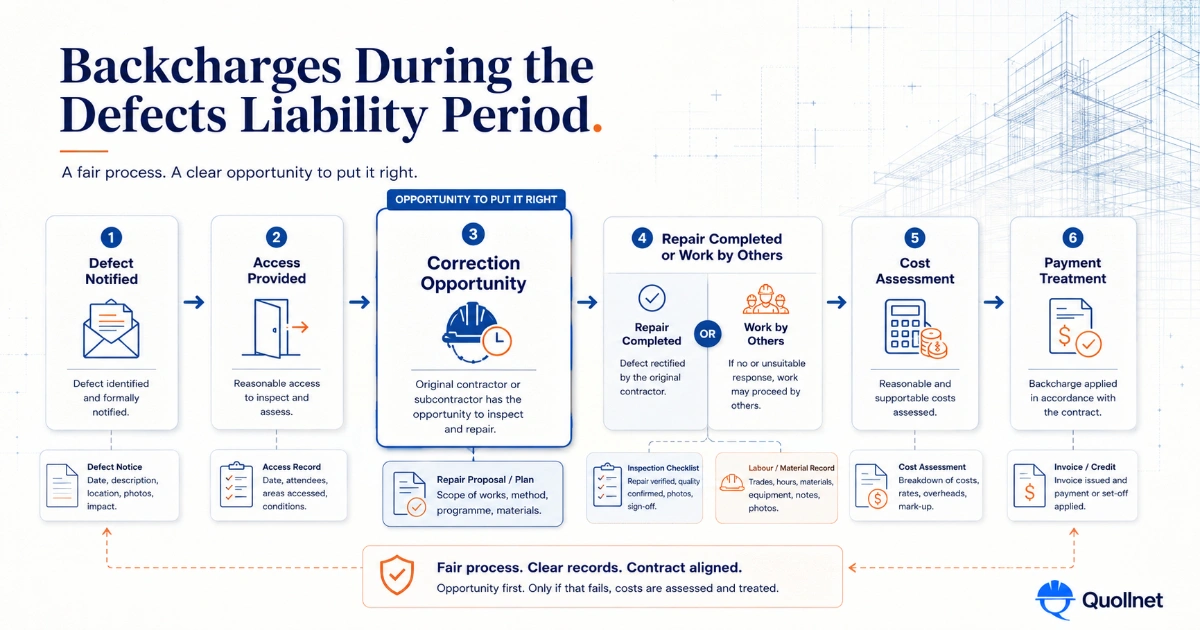
The Contractor should normally receive a genuine opportunity to return and make good. An Employer may face objections where the Contractor was not notified, was denied access, offered to correct, or was replaced before the contractual procedure had run its course.
The Contractor may also dispute defects caused after Practical Completion by occupants, misuse, lack of maintenance, another contractor, or alterations outside its control.
The Rectification Period is not the full legal limitation period for defective work. Liability for some latent defects may continue after the period expires and after a Certificate of Making Good is issued.
For practical post-completion administration, see rights during the JCT Rectification Period.
Appropriate Deduction Versus Correction by Others
JCT contracts may produce different outcomes depending on the Employer’s decision and the Contractor’s response.
- The Contractor returns and makes good the work.
- The Employer instructs that the work need not be made good and applies an appropriate deduction.
- The Employer employs others following contractual noncompliance.
- The resulting cost is recovered through payment, debt, damages, or final account.
- The Contractor’s employment is terminated and others complete the Works.
An appropriate deduction is not automatically identical to the invoice issued by a third-party contractor. It is also not automatically equal to full replacement cost, diminution in value, retention, or a punitive amount.
The appropriate valuation depends on:
- the exact JCT provision;
- the effect of the defect on the Employer;
- whether the work will be corrected or accepted;
- reasonable correction cost;
- betterment;
- the contractual and legal measure of loss.
Where the Employer chooses not to require making good, the contractual deduction should reflect that outcome rather than being presented automatically as the cost of a repair that will never be undertaken.
| Situation | JCT mechanism | Required contractual step | Payment consequence | Main dispute risk |
|---|---|---|---|---|
| Defect during construction | Instruction and noncompliant-work provisions | Valid instruction and compliance opportunity | Corrective cost may be pursued | Invalid or unclear instruction |
| Failure to comply | Employment of others where permitted | Expiry of contractual procedure | Cost, debt, damages, or payment adjustment | Premature intervention |
| Defect during Rectification Period | Schedule or instruction to make good | Notice and access | Correction or appropriate deduction | Loss of repair opportunity |
| Defective work accepted | Appropriate deduction | Contractual decision and valuation | Contract Sum reduced | Incorrect valuation basis |
| Subcontractor default | Subcontract direction and remedy | Follow subcontract procedure | Pay Less Notice or later recovery | Main Contract right assumed to flow down |
| Termination | Section 8 or subcontract termination | Strict default and termination notices | Completion accounting | Wrongful termination |
Can a JCT Backcharge Be Deducted from the Current Payment?
This is a separate question from whether the corrective cost is ultimately recoverable.
The payment analysis should distinguish:
- the underlying contractual liability;
- the valuation of the alleged correction cost;
- the sum stated as due;
- the Payment Notice;
- the Pay Less Notice;
- the final date for payment;
- later adjudication or recovery.
Under the Standard Building Contract with Quantities 2024, interim-payment due dates, certificates, Payment Notices, payment amounts, and Pay Less Notices appear at Clauses 4.8 to 4.12. Under Design and Build 2024, the payment provisions use different numbering.
The Notified Sum
Where the Housing Grants, Construction and Regeneration Act 1996 applies, the payer must generally pay the notified sum by the final date for payment unless a valid notice of intention to pay less has been given.
A Pay Less Notice must state:
- the sum the payer considers due on the date of the notice;
- the basis on which that sum is calculated.
The contractual deadline depends on the selected JCT form, Contract Particulars, subcontract, amendments, and any applicable provisions of the Scheme for Construction Contracts. A common JCT structure requires the Pay Less Notice no later than five days before the final date for payment, but this should not be treated as universal without checking the executed contract.
Missing the Deadline
A party may have a valid underlying correction-cost claim but lose the immediate right to deduct it from that particular payment cycle if it fails to issue a valid Pay Less Notice on time.
The practical result may be:
- pay the notified sum now;
- preserve the underlying claim;
- pursue the true valuation or corrective cost later through adjudication, final account, debt recovery, or proceedings as permitted.
A valid Pay Less Notice does not prove that the backcharge is substantively correct. The charged party may still dispute entitlement, responsibility, causation, valuation, or the stated calculation.
For subcontract payment presentation, see how to show the deduction separately in a Subcontractor payment. Notice deadlines should also be controlled through the procedures described in Timely Notices in Construction.
| Question | Contractual issue | Required evidence or notice |
|---|---|---|
| Was there a breach? | Scope, quality standard, and valid instruction | Contract documents and technical evidence |
| Could others be employed? | Noncompliance and correction procedure | Instruction, service, access, and expiry records |
| What did correction reasonably cost? | Causation and valuation | Labour, materials, plant, invoices, and mitigation |
| May it reduce this payment? | Payment and Pay Less Notice procedure | Valid notice issued by the deadline |
| Is the amount final? | Dispute and true valuation | Agreement, adjudication, judgment, or final account |
| Can it be recovered later? | Debt, damages, set-off, or later valuation | Substantive entitlement and compliance with limitation periods |
Retention, Set-Off, Debt, and Final Account
Several commercial mechanisms may operate on the same project, but they should not be confused.
- Retention: an agreed percentage or amount held as security under the payment provisions.
- Payment withholding: a reduction in the sum paid during a particular payment cycle.
- Set-off: reliance on a cross-claim to reduce another amount otherwise payable.
- Abatement: an argument that the value of the work supplied is lower because of defective or incomplete performance.
- Debt: a sum contractually recoverable as an amount due.
- Damages: compensation for loss caused by breach.
- Appropriate deduction: a contractual adjustment where defective work is accepted without making good.
- Final-account adjustment: inclusion of the agreed or determined amount in the final valuation.
A specific corrective cost should not be hidden by reducing measured quantities for properly completed work. The same cost should not be recovered from both retention and an interim payment or duplicated again in the final account.
Retention remains a separate mechanism, as explained in Retention in Construction.
How Should Corrective Cost Be Valued?
A legitimate JCT corrective-cost claim should be reasonable, attributable, supported, and non-punitive.
Potentially Recoverable Items
- direct labour;
- replacement materials;
- plant and access equipment;
- specialist contractors;
- testing and inspection;
- opening up and making good;
- removal, disposal, and reinstatement;
- temporary protection;
- necessary professional fees;
- necessary site supervision.
Common Valuation Objections
- unsupported lump sums;
- estimated cost represented as actual cost;
- excessive labour hours;
- inflated labour or plant rates;
- premium rates caused by avoidable delay;
- unnecessary replacement rather than repair;
- betterment or upgraded materials;
- unrelated preliminaries or management time;
- duplicated supervision;
- overhead or profit without contractual support;
- work outside the charged party’s scope;
- damage caused by others;
- failure to mitigate;
- insurance or third-party recovery not credited;
- duplicate direct cost and delay damages.
Overhead and profit are not universally recoverable or universally excluded. Their treatment depends on the contract, subcontract, amendments, nature of the loss, and valuation mechanism.
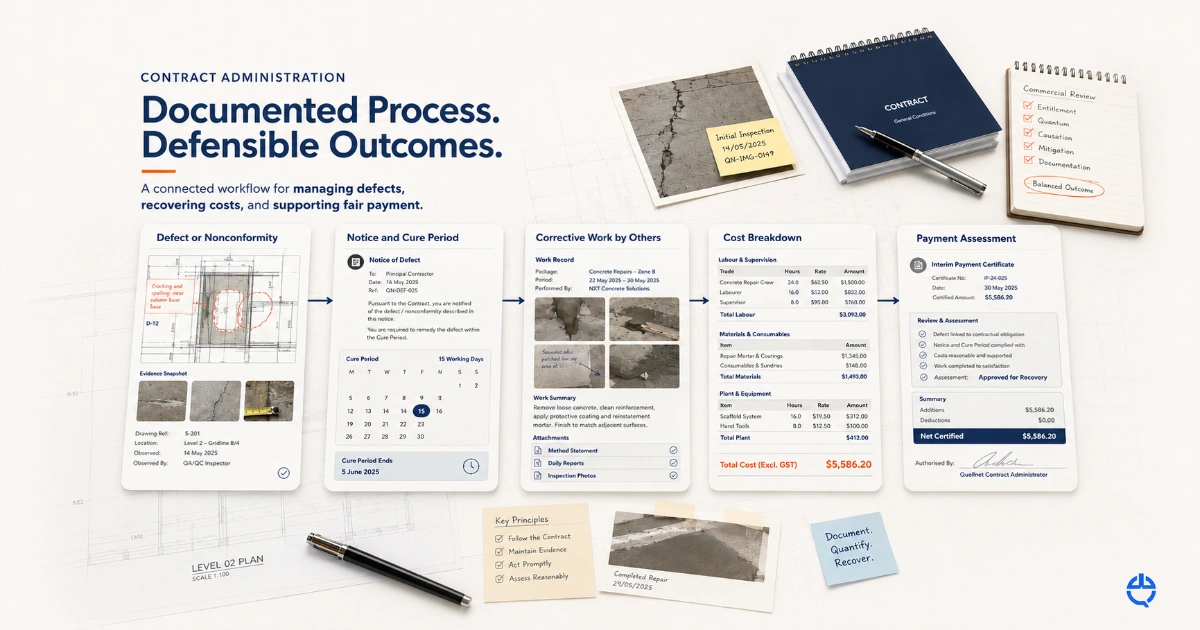
Use the Backcharge Cost Breakdown Template and Calculator to separate labour, materials, plant, specialist invoices, professional fees, overhead, credits, forecasts, and actual cost.
What Can the Contractor or Subcontractor Challenge?
The charged party may challenge more than the amount.
Authority and Procedure
- The instruction was issued by an unauthorised person.
- The required written form was not used.
- The instruction was unclear.
- The applicable compliance period had not expired.
- The wrong JCT form or clause was relied upon.
Technical Responsibility
- The work complied with the Contract Documents.
- The wrong quality criterion was used.
- The defect resulted from Employer design.
- another contractor caused the damage.
- The issue concerned incomplete work rather than defective work.
- Prior inspection, testing, or acceptance supports the Contractor’s factual case.
Access and Opportunity to Correct
- No effective notice was given.
- The Contractor or Subcontractor was denied access.
- It offered to correct but was prevented.
- Others were appointed prematurely.
- The claimed emergency did not justify immediate replacement.
Variation and Betterment
- The required solution changes design or performance.
- Higher-grade materials were used.
- Additional quantities were included.
- The work was accelerated or resequenced.
- The corrective scope extended beyond the original obligation.
Where the direction changes scope, design, quality, material, or sequence, see Managing Variation Orders.
Payment Administration
- The Payment Notice or Pay Less Notice was invalid.
- The notice was late.
- The basis of calculation was unclear.
- The wrong notified sum was used.
- The cost was deducted from both retention and payment.
- The amount was duplicated in the final account.
For a structured contractual response, see how to challenge an unsupported JCT backcharge.
Correction While the Contract Remains Active Versus Termination
Ordinary correction and termination are distinct remedies.
Correction while the contract remains active normally concerns a limited item of defective, incomplete, or noncompliant work. The Contractor remains employed and continues its other obligations.
Termination ends the Contractor’s or Subcontractor’s employment under the relevant contract. It requires compliance with separate grounds, notices, cure periods, and termination procedures. Others may then be employed to complete the remaining Works, and the final financial consequences are addressed through termination accounting.
Under the JCT Standard Building Contract 2024 and Design and Build Contract 2024, termination by the Employer for Contractor default and its consequences are addressed in Section 8. JCT subcontracts contain their own separate default and termination provisions.
Termination is not simply a larger backcharge. Treating routine corrective work as termination, or termination as a convenient cost-recovery shortcut, can create substantial wrongful-termination exposure.
When Must a JCT Backcharge Be Challenged?
There is no universal JCT backcharge objection deadline.
Relevant contractual and statutory clocks may include:
- the compliance period stated in an instruction;
- the making-good period;
- the Rectification Period;
- the deadline for issuing a defect schedule;
- the Payment Notice deadline;
- the Pay Less Notice deadline;
- the final date for payment;
- adjudication timing;
- termination notices;
- final-account review periods;
- contractual or statutory limitation periods.
The Contractor or Subcontractor should:
- object promptly in writing;
- identify the disputed clause, facts, responsibility, and valuation;
- state whether it remains willing to correct;
- request invoices, labour records, rates, and calculations;
- preserve any Variation, extension-of-time, or loss-and-expense entitlement;
- issue the required Payment Notice or Pay Less Notice;
- avoid waiting until final account;
- consider adjudication for an urgent payment dispute.
Conclusion
Under JCT contracts, a backcharge is not established merely by issuing a letter with that title. The charging party must identify the applicable instruction, defects, noncompliance, appropriate-deduction, payment, set-off, debt, or termination mechanism in the exact form and edition.
The Employer or Main Contractor should prove the underlying obligation, issue the required instruction or notice, provide a proper opportunity to correct, establish the right to employ others, and substantiate the reasonable resulting cost.
The payment process must then be addressed separately. A substantive correction-cost claim does not necessarily permit an immediate deduction from the next payment. Where the statutory notified-sum regime applies, a valid and timely Pay Less Notice may be essential.
The Contractor or Subcontractor may challenge authority, procedure, technical responsibility, access, betterment, causation, valuation, the Pay Less Notice, and duplication in retention or final account.
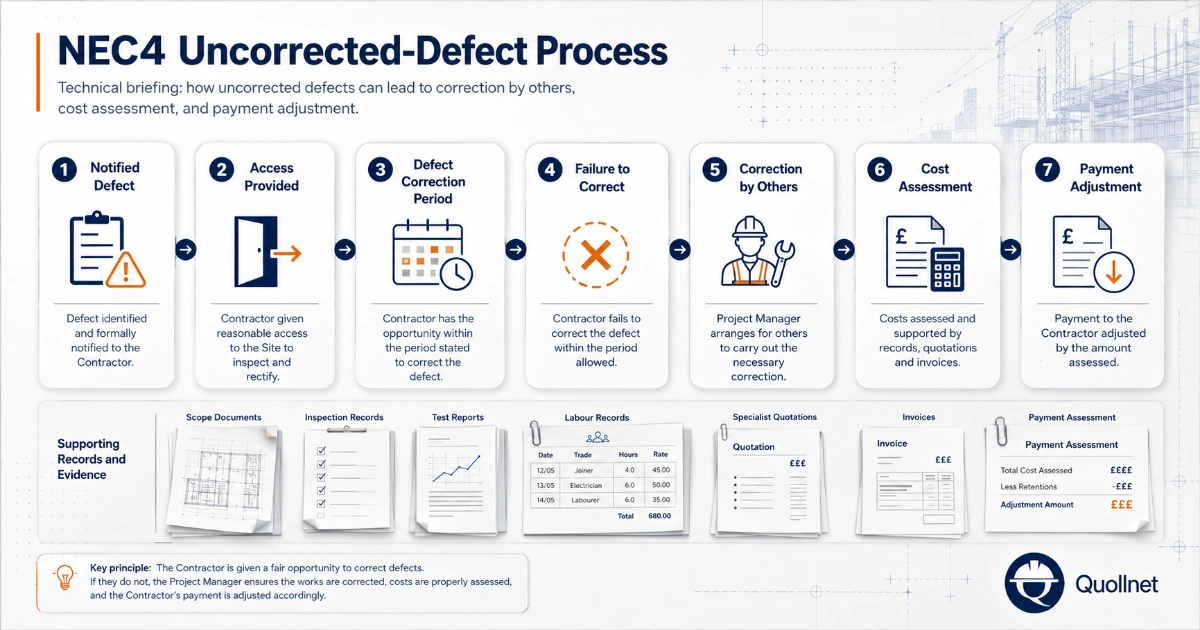
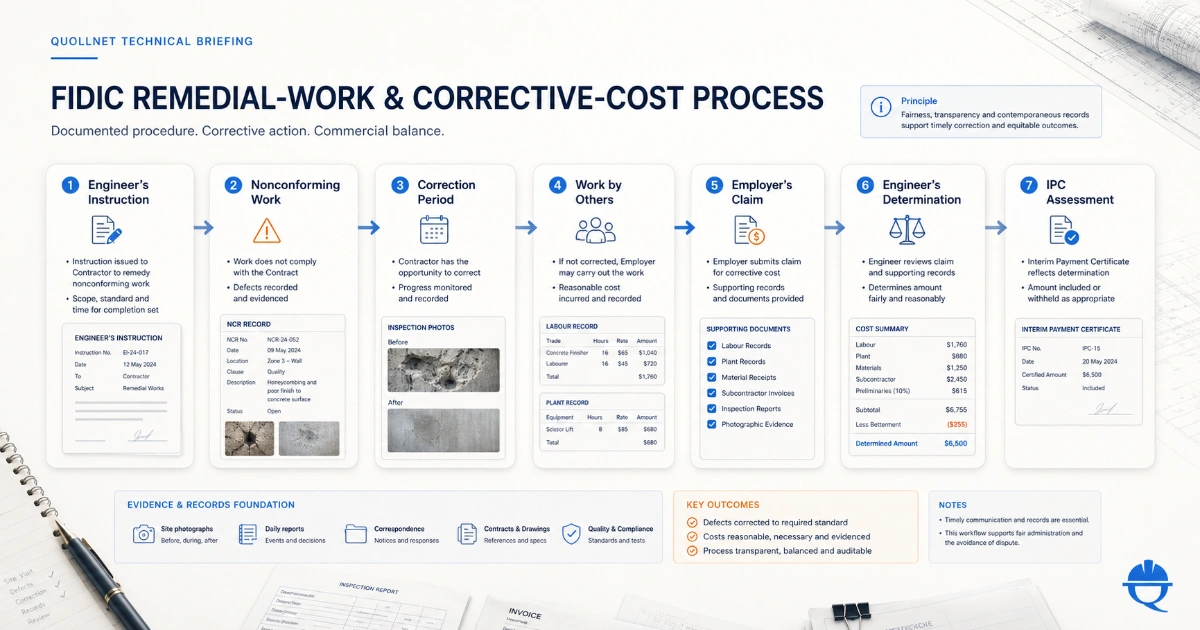
Compare the JCT procedure with the FIDIC remedial-work and backcharge procedure, AIA A201 and A401 correction-cost rules, and NEC4 uncorrected Defect cost assessment.
This article provides general construction contract-administration information and is not legal advice. The exact JCT form and edition, Contract Particulars, amendments, subcontract, governing law, Construction Act, Scheme for Construction Contracts, and project facts control. Significant payment, defect, or termination disputes require project-specific legal advice.
REFERENCES
JCT Standard Building Contract with Quantities 2024 Contents
JCT Design and Build Contract 2024 Contents
JCT Design and Build Sub-Contract Conditions 2024 Contents
JCT Standard Building Contract with Quantities 2016 Contents
JCT Design and Build Contract 2016 Contents
JCT: Making Good with Rectification Periods
JCT Explains: Interim Payments and Pay Less Notices
JCT: Can You Pay Now and Argue Later?
JCT Contract Administration Model Forms
Housing Grants, Construction and Regeneration Act 1996, Part II
Housing Grants, Construction and Regeneration Act 1996, Section 111