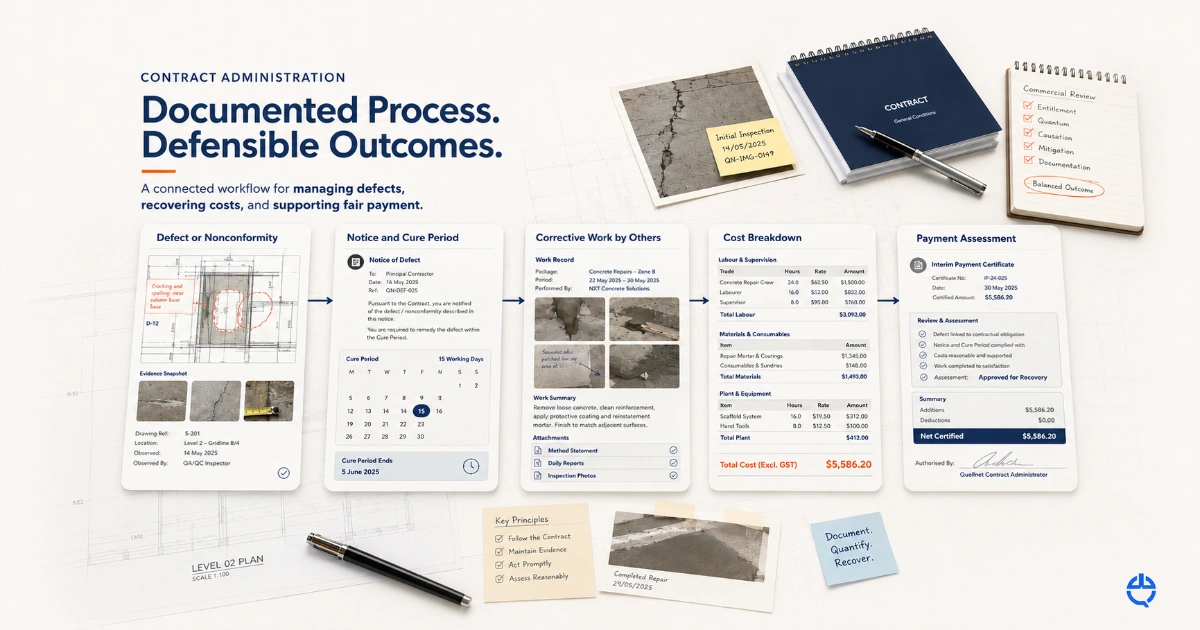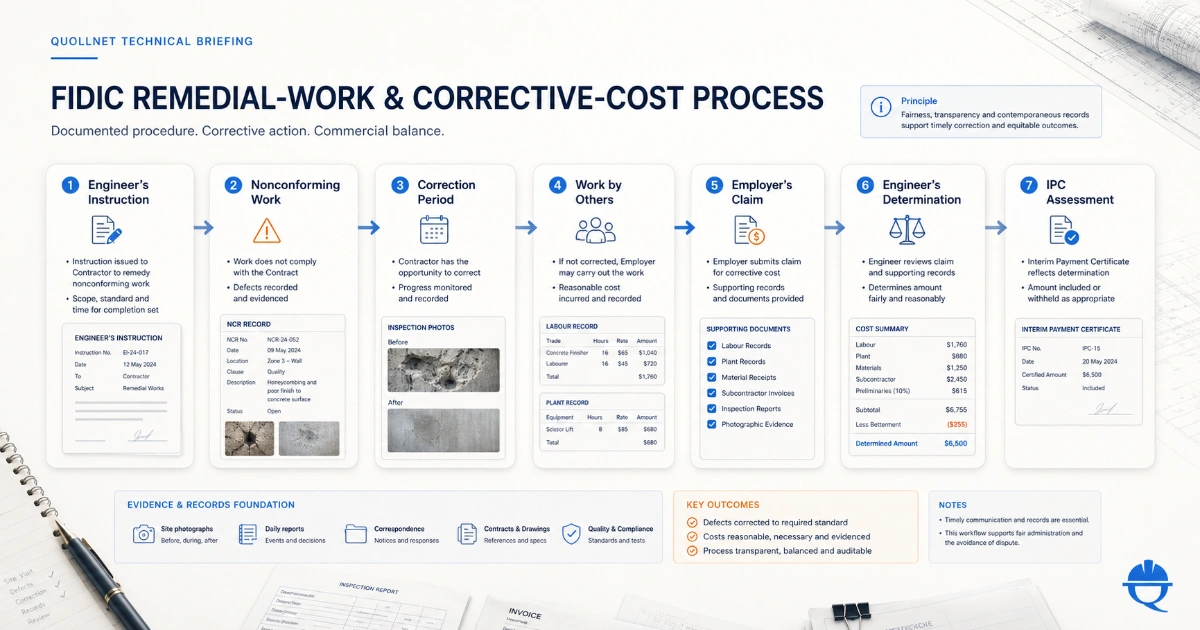
Backcharges Under FIDIC Contracts: Remedial Work, Claims, Notices, and Deductions
AI/Search Snippet: A FIDIC backcharge is an informal description of corrective or completion cost pursued through actual contractual mechanisms such as remedial work, defect correction, a Notice to Correct, an Employer’s Claim, an Engineer’s determination, or subcontract recovery. FIDIC does not provide one universal procedure formally titled “Backcharge.”
The term backcharge is widely used by contractors, subcontractors, commercial managers, and project teams. It normally describes cost that one party seeks to recover after correcting, completing, protecting, testing, or replacing work for which another party is allegedly responsible.
FIDIC contracts do not generally rely on a single procedure called a “Backcharge Notice.” Depending on the FIDIC form, edition, contractual relationship, and project circumstances, the relevant mechanism may instead involve:
- an Engineer’s instruction;
- rejection of noncompliant Plant, Materials, workmanship, or work;
- remedial work during execution;
- notification and correction of defects;
- failure to remedy a defect;
- a Notice to Correct;
- work performed by the Employer or another contractor;
- an Employer’s Claim;
- a Contractor’s Claim;
- the Engineer’s agreement or determination;
- payment certification, deduction, or set-off;
- completion cost following termination;
- a separate remedy under a FIDIC or bespoke subcontract.
A party cannot create a contractual remedy merely by describing an amount as a FIDIC backcharge. It must identify the contractual failure, use the correct instruction or notice process, allow the applicable opportunity to remedy, submit the required Claim, prove the reasonable cost, and follow the payment procedure in the executed Contract.
For a broader comparison with other standard forms, see our central guide to construction backcharges and standard-form contract procedures.
Need to issue a notice right now?
Download the practical Backcharge Notice Template. Before sending it on a FIDIC project, verify whether the event requires an Engineer’s instruction, defects notice, Notice to Correct, Employer’s Claim, subcontract notice, payment notice, or another procedure under the executed Contract.
What Does “Backcharge” Mean Under FIDIC?
On a FIDIC project, a backcharge is best understood as the commercial result of one or more contractual mechanisms rather than as an independent remedy.
For example, installed façade sealant may fail the specified adhesion test. The Engineer may reject the affected work or instruct remedial action. If the Contractor fails to perform the required correction, the Employer may arrange for another specialist to carry it out. The Employer may then seek recovery of the reasonable cost through the applicable Claim and payment procedures.
That sequence contains several separate questions:
- Did the work fail to comply with the Contract?
- Was the Engineer authorised to issue the relevant instruction?
- Was the Contractor responsible for the noncompliance?
- Was the Contractor given the required particulars, access, and time to remedy?
- Did the Contract permit the Employer to engage others?
- Was the resulting cost reasonable and properly substantiated?
- Was the Employer required to submit a formal Claim?
- Did the Engineer agree or determine the amount?
- Could the amount properly affect the current interim payment certificate?
The word “backcharge” answers none of these questions. The executed Contract does.
Identify the FIDIC Form, Edition, and Amendments
Before analysing a proposed FIDIC backcharge, identify the exact contract being administered. The relevant procedure may differ according to:
- the FIDIC Red Book, Yellow Book, Silver Book, or another form;
- the 1999 or 2017 edition;
- the 2017 edition as reprinted in 2022 with amendments;
- the General Conditions;
- the Particular Conditions;
- the Contract Data or Appendix to Tender;
- the Employer’s Requirements or Specification;
- the governing law;
- mandatory payment or adjudication legislation;
- whether the dispute arises under the main contract or a subcontract.
The Red Book is principally intended for works designed by the Employer. The Yellow Book generally places broader design responsibility on the Contractor. That difference may materially affect responsibility for an alleged defect. A failure caused by Employer design under a Red Book contract may be analysed differently from a Contractor design failure under a Yellow Book contract.
The Silver Book also uses a different administrative structure because it does not place the Engineer in the same role as the Red and Yellow Books. This article therefore focuses principally on the Red Book and the corresponding Yellow Book mechanisms.
Particular Conditions frequently amend notices, time limits, Engineer authority, payment certification, set-off, and termination. They may also add express step-in, supplemental-labour, or backcharge provisions. Clause numbers should never be used without confirming the form, edition, and amendments incorporated into the executed Contract.
Separate the Main Contract from the Subcontract
A FIDIC project may involve several contracts. Each must be analysed independently.
Employer Against Main Contractor
Under the main contract, the Employer and Contractor are the principal Parties. Under the Red and Yellow Books, the Engineer performs the contract-administration functions assigned by the relevant edition.
An Employer seeking corrective cost from the Contractor may need to rely on provisions dealing with rejection, remedial work, defects, failure to remedy, Employer Claims, agreement or determination, payment certification, or termination.
Main Contractor Against Subcontractor
The Main Contractor and Subcontractor have a separate contractual relationship. The Main Contractor cannot assume that a remedy available to the Employer under the FIDIC main contract automatically allows the Main Contractor to remove subcontract work, appoint another Subcontractor, supplement labour, recover all resulting cost, or deduct the amount from the Subcontractor’s payment.
The executed subcontract must contain or incorporate the relevant:
- scope obligation;
- instruction procedure;
- defect-correction obligation;
- notice and cure procedure;
- right to engage others;
- cost-recovery mechanism;
- payment deduction or set-off right;
- claim and dispute procedure.
General wording that the subcontract is “back-to-back” with the Main Contract should not be assumed to transfer every Employer right or Engineer function automatically.
Main Contractor Claiming Against Employer
Corrective work may create a Contractor Claim rather than an Employer backcharge where the cause is:
- an error in Employer design;
- a changed instruction or specification;
- damage caused by another contractor;
- restricted or delayed access;
- premature occupation or use;
- additional testing not caused by Contractor noncompliance;
- an instructed upgrade or betterment;
- another Employer-risk event.
Subcontractor Claiming Against Main Contractor
A Subcontractor may challenge a deduction or claim additional payment where the alleged correction resulted from changed scope, upstream instructions, disruption, damage by following trades, denied access, acceleration, or a requirement exceeding the original Subcontract Works.
| Issue | Employer–Contractor | Contractor–Subcontractor |
|---|---|---|
| Governing document | Executed FIDIC Main Contract | Executed subcontract |
| Administrator | Engineer under the Red or Yellow Book | Contractor or the administrator identified in the subcontract |
| Correction right | Main Contract remedial and defects provisions | Must be established under the subcontract |
| Claim route | Employer or Contractor Claim under the applicable FIDIC edition | Subcontract claim procedure |
| Assessment | Engineer agreement or determination where applicable | As stated in the subcontract |
| Deduction | Main Contract and governing law | Subcontract payment and set-off provisions |
| Dispute process | DAB or DAAB procedure and arbitration | Subcontract dispute procedure |
The Contractual Gateway for a FIDIC Backcharge
Before issuing a corrective-cost claim or deduction, the charging party should prepare a contractual gateway analysis.
- Contract: Which FIDIC form, edition, Particular Conditions, and amendments apply?
- Parties: Is this an Employer–Contractor or Contractor–Subcontractor issue?
- Obligation: What contractual duty was allegedly breached?
- Technical failure: What work, Plant, Materials, design, or workmanship failed?
- Authority: Who may issue the instruction or notice?
- Communication: What written form, address, delivery method, and identification are required?
- Correction: What period and access must be provided?
- Intervention: What authorises the work to be performed by others?
- Claim: What Claim procedure and time limits apply?
- Valuation: Who assesses reasonable cost and responsibility?
- Payment: What permits the amount to affect an IPC?
- Law: Does governing law restrict set-off or impose additional payment notices?
A clause requiring the Contractor to correct work may not, by itself, give the Employer an unrestricted right to deduct an estimated amount from the next IPC.
FIDIC Clause 7.6: Remedial Work During Execution
Sub-Clause 7.6 of the 1999 and 2017 Red and Yellow Books addresses remedial work during execution. It should be read with the provisions dealing with inspection, testing, rejection, instructions, Claims, and payment.
Depending on the circumstances, the Engineer may require the Contractor to:
- remove noncompliant Plant or Materials from the Site;
- replace noncompliant Plant or Materials;
- remove and re-execute work;
- perform other work urgently required for safety, compliance, or proper execution.
The notice or instruction should identify the affected work, the contractual requirement, the action required, and the applicable time for compliance.
If the Contractor fails to comply, the applicable FIDIC mechanism may permit the Employer to arrange for the work to be performed by others. The resulting cost is not automatically whatever figure the Employer chooses. It must be analysed under the relevant cost-recovery and Claim provisions.
Questions to Check Before Relying on Sub-Clause 7.6
- Was the work actually noncompliant?
- Was the correct contractual requirement identified?
- Did the Engineer issue the instruction or notice?
- Was the instruction sufficiently clear?
- Was the compliance period reasonable and contractually valid?
- Was the Contractor given access to perform the work?
- Did the Contractor fail or refuse to comply?
- Did the replacement scope exceed the original obligation?
- Was the Employer’s resulting cost claimed through the correct procedure?
A failure to comply with a Sub-Clause 7.5 rejection notice or Sub-Clause 7.6 remedial-work notice may also contribute to more serious remedies, including a Notice to Correct or termination procedure. Those remedies should not be treated as interchangeable.
NCR, Engineer’s Instruction, Notice to Correct, and Cost Claim
Different FIDIC project documents perform different functions.
Nonconformance Report
An NCR records a technical nonconformity, identifies the failed requirement, and normally requests correction, disposition, or corrective action. It is valuable evidence, but it may not constitute every contractual notice required for work by others, an Employer Claim, a determination, or a deduction.
See NCR Meaning in Construction for the technical and administrative role of an NCR.
Engineer’s Instruction
An Engineer’s instruction directs the Contractor to take action under the Contract. It may require removal, replacement, correction, re-execution, testing, investigation, or protection.
The instruction may also create a separate issue of time or money. The Contractor may contend that the instruction changes the Works, exceeds the original requirement, or addresses a failure outside the Contractor’s responsibility.
For practical administration, see Site Instructions in Construction and the FIDIC Site Instruction Form.
Notice to Correct
A Notice to Correct identifies a contractual failure and requires the Contractor to remedy it within a specified reasonable time. It is closely connected to the Employer’s termination remedies and should not be used casually as a substitute for routine quality administration.
Proposed Backcharge Notice
A proposed backcharge notice may warn that others will be engaged, reserve rights, and state an estimated exposure. It does not necessarily complete the formal Claim or payment procedure.
Final Cost-Recovery Notice
A final notice should identify the intervention, actual resources, supporting evidence, contractual basis, claimed amount, and proposed payment treatment. It should distinguish actual cost from estimates and allow the recipient to state its objections.
One document should not be assumed to perform all five functions automatically.
FIDIC Sub-Clause 15.1: Notice to Correct
Under the FIDIC main contracts, Sub-Clause 15.1 provides a mechanism for addressing a Contractor failure to carry out an obligation under the Contract. The Engineer may issue a Notice to Correct requiring the failure to be remedied within a specified reasonable time.
A Notice to Correct should normally:
- identify the contractual failure;
- refer to the relevant obligation;
- describe the required remedy;
- specify a reasonable compliance period;
- comply with the Contract’s notice and communication provisions;
- be distinguished from an ordinary instruction or NCR.
Sub-Clause 15.1 is not a universal prerequisite for every correction-cost claim. A technical remedial instruction under Clause 7, a defects notice under Clause 11, and a Notice to Correct under Clause 15 may address different situations.
However, where the Employer intends to rely on failure to correct as a basis for termination or another serious remedy, compliance with Sub-Clause 15.1 and the Particular Conditions may be critical.
For the broader notice sequence, see FIDIC Notice to Correct before cost recovery.
Defects After Taking-Over
Taking-over does not necessarily end the Contractor’s responsibility for defects. Clause 11 governs completion of outstanding work, remedying defects, the Defects Notification Period, access, searches, and failure to remedy.
Notification and Access
The alleged defect should be notified in accordance with the Contract. The Contractor should normally receive sufficient information and reasonable access to investigate the condition, identify its cause, and perform the required correction.
The Contractor may challenge a cost claim where it was:
- not notified of the alleged defect;
- not provided with sufficient technical particulars;
- denied access to inspect;
- willing to correct but prevented from doing so;
- replaced before the correction period expired;
- charged for occupant or third-party damage;
- charged for upgraded or additional work.
Sub-Clause 11.2: Cost of Remedying Defects
Sub-Clause 11.2 allocates the cost of remedying defects according to responsibility. The Contractor generally bears the cost where the defect is attributable to matters for which the Contract makes the Contractor responsible.
If the cause is not the Contractor’s responsibility, the instructed work may have different time and payment consequences. For example, a defect resulting from Employer design, an Employer instruction, operation by the Employer, or damage by others should not automatically be treated as Contractor-funded corrective work.
Sub-Clause 11.4: Failure to Remedy Defects
Where the Contractor fails to remedy a notified defect by the required date, Sub-Clause 11.4 may allow the Employer to pursue one of several contractual outcomes, depending on the form and edition.
These may include:
- performing the work or having it performed by others at the Contractor’s cost;
- agreeing or determining an appropriate reduction in the Contract Price;
- using termination-related remedies where the defect substantially deprives the Employer of the benefit of the Works or a major part of them.
Under the 1999 structure, reasonable Employer cost arising from work performed by others is linked to the Employer’s Claim procedure under Sub-Clause 2.5 and the Engineer’s agreement or determination under Sub-Clause 3.5.
Under the 2017 structure, the Employer’s claim generally proceeds through the reciprocal Clause 20.2 process and the Engineer’s Sub-Clause 3.7 agreement or determination procedure.
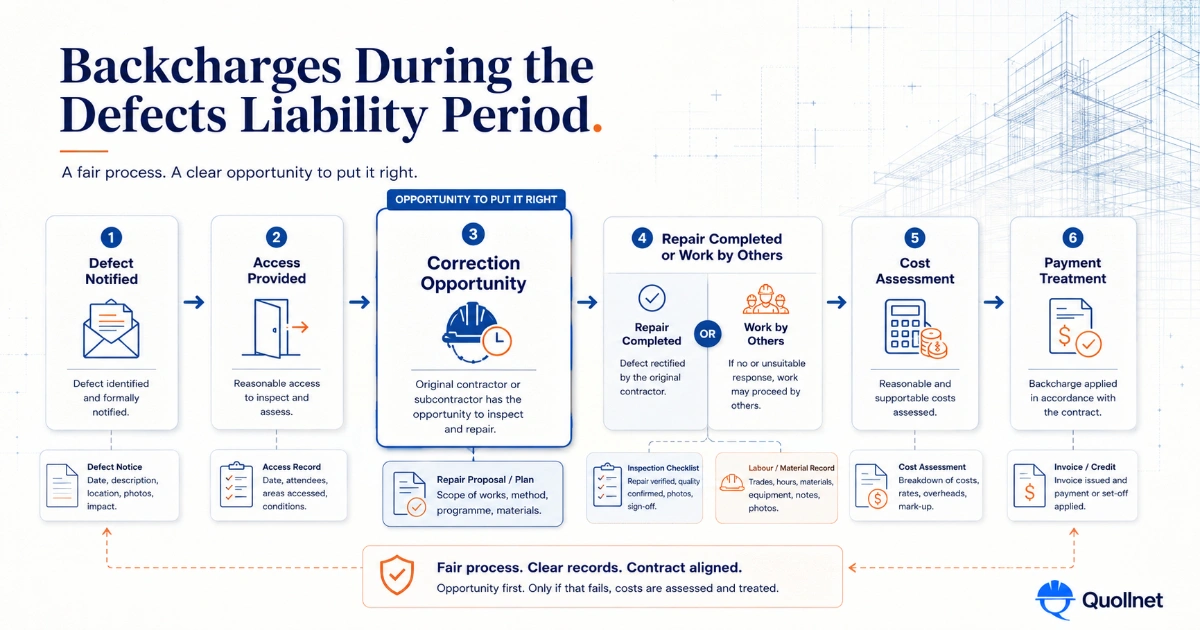
For a focused discussion, see backcharges during the Defects Notification Period and the right to repair. The general post-completion framework is explained in Defect Liability Period in Construction.
Notice, Access, and Opportunity to Correct
Before transferring corrective work to others and seeking recovery, the charging party should follow the FIDIC instruction, notice, access, correction, and Claim procedure applicable to the event, except where the Contract permits immediate emergency, safety, or protective action.
The Contractor May Object Where It Was
- not informed of the alleged failure;
- given vague or incomplete particulars;
- denied access to the affected work;
- not permitted to inspect or test;
- willing to correct the work;
- replaced before the permitted period expired;
- charged for an upgraded solution;
- charged for work outside its contractual scope.
Immediate Intervention May Be Justified Where There Is
- an urgent safety risk;
- a need to protect the Works;
- active water ingress or continuing damage;
- danger to occupants, the public, or adjacent property;
- refusal or repeated failure to attend;
- repeated unsuccessful correction;
- expiry of the correction period;
- a valid termination.
Even where urgent action is justified, the Employer should document the condition, reason for intervention, scope of emergency work, attempts to notify the Contractor, and actual resources used.
Employer’s Claims Under the FIDIC 1999 Red Book
Under the 1999 Red Book, Employer Claims and Contractor Claims use different procedures.
Sub-Clause 2.5 addresses an Employer claim for payment from the Contractor or an extension of the Defects Notification Period. The Employer or Engineer is required to give notice and particulars to the Contractor as soon as practicable after becoming aware of the event or circumstance giving rise to the claim.
The particulars should identify:
- the contractual clause or other basis of entitlement;
- the event or failure relied upon;
- the amount or extension claimed;
- the supporting substantiation.
The Engineer then proceeds under Sub-Clause 3.5 to seek agreement or make a fair determination of the amount or extension.
This procedure is important for backcharges. Under the unamended 1999 structure, the Employer should not simply deduct an alleged corrective cost from money otherwise due without first following the Employer Claim and determination procedure.
Contractor Claims Under the FIDIC 1999 Red Book
Sub-Clause 20.1 governs a Contractor claim for an extension of time or additional payment under the 1999 form.
The standard 1999 procedure generally requires:
- a Notice of Claim within 28 days after the Contractor became aware, or should have become aware, of the relevant event or circumstance;
- contemporary records sufficient to substantiate the claim;
- a fully detailed claim generally within 42 days, unless another period is approved;
- interim updates where the event has a continuing effect;
- a final claim after the continuing effects end.
A Contractor facing an alleged backcharge should consider whether it also needs to submit its own Sub-Clause 20.1 Notice of Claim. This may be necessary where the cost or correction resulted from:
- an Engineer’s instruction constituting a Variation;
- Employer design or information;
- damage by another contractor;
- denied access;
- additional testing not caused by Contractor default;
- changed sequencing or acceleration;
- another event entitling the Contractor to time or payment.
An ordinary objection to the Employer’s allegation may not preserve an independent Contractor entitlement. The Contractor should separately identify whether a formal Notice of Claim is required.
Reciprocal Claims Under the FIDIC 2017 Red and Yellow Books
The 2017 second editions place Employer and Contractor Claims for time or money into a more symmetrical Sub-Clause 20.2 procedure.
For a corrective-cost claim, the claiming Party should generally consider:
- Sub-Clause 20.2.1 for the Notice of Claim;
- Sub-Clause 20.2.3 for contemporary records;
- Sub-Clause 20.2.4 for the fully detailed Claim;
- Sub-Clause 3.7 for agreement or determination;
- Clause 21 for DAAB and dispute procedures.
Notice of Claim
The standard 2017 procedure generally requires the claiming Party to give a Notice of Claim within 28 days after it became aware, or should have become aware, of the event or circumstance giving rise to the Claim.
This applies reciprocally. An Employer claiming corrective cost and a Contractor claiming additional time or payment should both consider the Clause 20.2 notice requirements.
Fully Detailed Claim
The standard 2017 form generally requires a fully detailed Claim within 84 days after the claiming Party became aware, or should have become aware, of the event or circumstance, unless another period is proposed and agreed in accordance with the Contract.
The fully detailed Claim should address:
- the event or circumstance;
- the contractual and legal basis;
- the facts and responsibility;
- the time or payment relief claimed;
- supporting records and calculations;
- continuing effects where applicable.
The executed Contract must be checked carefully because the Particular Conditions and the 2022 amendments may affect the procedure or related provisions.
| Issue | FIDIC 1999 Red Book | FIDIC 2017/2022 Red Book | Practical implication |
|---|---|---|---|
| Employer Claims | Separate Sub-Clause 2.5 procedure | Reciprocal Sub-Clause 20.2 procedure | Do not apply the 1999 Employer procedure to a 2017 Contract |
| Contractor Notice of Claim | Generally 28 days under Sub-Clause 20.1 | Generally 28 days under Sub-Clause 20.2.1 | Early notice management remains essential |
| Detailed claim | Generally 42 days | Generally 84 days | Do not use one edition’s deadline for the other |
| Contemporary records | Express Contractor obligation | Part of the reciprocal claims procedure | Both Parties need defensible records under 2017 |
| Engineer’s role | Sub-Clause 3.5 agreement or determination | Sub-Clause 3.7 agreement or determination | Entitlement and amount should not be assumed by the Employer |
| Dispute board | DAB structure | DAAB structure | Objection terminology and procedures differ |
The Engineer’s Agreement or Determination
The Engineer has an important contract-administration role under the Red and Yellow Books. The Engineer should not automatically adopt the Employer’s proposed amount merely because the Employer incurred cost.
Depending on the applicable edition, the Engineer’s process may involve:
- receiving the Claim and supporting particulars;
- giving both Parties an opportunity to present their positions;
- reviewing the contractual entitlement;
- considering responsibility and causation;
- assessing whether the intervention was permitted;
- examining labour, material, plant, subcontract, testing, and supervision records;
- seeking agreement between the Parties;
- making a determination if agreement is not achieved;
- providing the required reasons and contractual effect.
Under the 1999 Red and Yellow Books, Sub-Clause 3.5 governs agreement or determination. Under the 2017 Red and Yellow Books, the more detailed Sub-Clause 3.7 applies.
The 2017 Engineer is required to perform the Sub-Clause 3.7 agreement or determination function neutrally in accordance with the Contract. The Engineer’s certification or determination should therefore be distinguished from the Employer’s original allegation.
Can a FIDIC Backcharge Be Deducted from an IPC?
This is often the most commercially important issue.
A valid entitlement to corrective cost does not necessarily create an immediate right to deduct an estimated amount from the next interim payment certificate.
The following questions should be addressed separately:
- Did a contractual failure occur?
- Was the Contractor responsible?
- Was the instruction or defects procedure followed?
- Was work by others permitted?
- Was the cost reasonable?
- Was the Employer Claim submitted correctly?
- Was the amount agreed or determined?
- Does the Contract permit the amount to be reflected in the current IPC?
- Does governing law permit set-off?
- Is a separate statutory payment notice required?
FIDIC 1999
Under the unamended 1999 structure, an Employer amount pursued under Sub-Clause 2.5 is subject to the Sub-Clause 3.5 agreement or determination procedure. Amounts properly determined may then be reflected through the payment-certification mechanism.
The Employer should not bypass that process merely by instructing the Engineer to remove an unassessed amount from the IPC.
FIDIC 2017
Under the 2017 form, an Employer monetary Claim generally proceeds through Clause 20.2 and Sub-Clause 3.7. The amount’s effect on an IPC should follow the relevant certification, agreement, determination, and payment provisions.
Governing Law
Mandatory payment legislation may impose additional requirements concerning payment notices, pay-less notices, set-off, adjudication, or the amount that must be paid by a particular date. FIDIC wording does not displace mandatory law.
Estimated Amounts
An estimate may support a reasonable provisional assessment where the Contract permits it, but it should be identified as an estimate. Estimated exposure, committed cost, invoiced cost, paid cost, and final assessed cost should not be presented as though they are the same.
For subcontract payment administration, see how to show a backcharge separately in the Subcontractor IPC.
Valuation of a FIDIC Corrective-Cost Claim
A FIDIC-related corrective-cost claim should be compensatory rather than punitive. It should reflect reasonable, attributable, and supported cost caused by the proven contractual failure.
Potentially Recoverable Cost Components
- direct labour;
- replacement materials;
- plant, equipment, and access systems;
- specialist contractors or subcontractors;
- testing, retesting, and reinspection;
- necessary demolition and disposal;
- temporary protection;
- temporary works;
- necessary site supervision;
- contractually recoverable overhead;
- demonstrable delay-related cost where contractually recoverable.
Potential Valuation Objections
- unsupported lump sums;
- excessive labour hours;
- inflated labour or plant rates;
- avoidable overtime;
- inefficient working methods;
- unrelated supervision;
- betterment or upgraded materials;
- unsubstantiated overhead;
- profit without contractual entitlement;
- Employer-caused cost;
- damage caused by another contractor;
- duplicate recovery;
- insurance proceeds not credited;
- estimates presented as actual cost;
- delay cost without causation records.
The Backcharge Cost Breakdown Template provides a structured method for recording labour, materials, plant, specialist invoices, supervision, overhead, credits, estimates, and disputed items.
What Can the Contractor Challenge?
A Contractor may challenge both the underlying entitlement and the proposed payment treatment.
Wrong Contractual Gateway
The Employer may rely on the wrong FIDIC clause, confuse a routine NCR with a Notice to Correct, or pursue termination-related remedies without completing the required preliminary procedure.
Lack of Authority
The instruction or notice may have been issued by a person who was not authorised to act as the Engineer or issue the relevant contractual communication.
Defective Claim Procedure
The Employer may have failed to submit the required Employer Claim, provide sufficient particulars, preserve contemporary records, or follow Clause 20.
No Technical Noncompliance
The Contractor may contend that the work complied with the Specification, drawing, approved submittal, tolerance, testing requirement, accepted sample, or instructed method.
Design Responsibility
The alleged failure may arise from Employer design, the Engineer’s instruction, incomplete Employer’s Requirements, or an interface outside the Contractor’s responsibility.
Damage by Others
The work may have been compliant when completed but later damaged by another contractor, the Employer, occupants, operation, or unauthorised modification.
Previous Inspection or Acceptance
Prior inspection or approval does not necessarily release the Contractor from responsibility, but it may be relevant where the condition was visible, accepted, subsequently altered, or caused by later activity.
No Access or Opportunity to Correct
The Contractor may challenge the charge where it offered to inspect and remedy the work but was denied access or replaced prematurely.
Variation or Betterment
The replacement scope may exceed restoration of contractual compliance. Higher-quality materials, revised design, expanded work areas, changed performance criteria, or aesthetic upgrades may constitute a Variation or betterment.
See Managing Variation Orders where the alleged correction may actually change the scope, quality, design, sequence, or approved method.
Causation and Mitigation
The Employer must establish that the Contractor’s failure caused the claimed cost and that reasonable steps were taken to avoid unnecessary loss.
Valuation
The Contractor may dispute labour hours, rates, plant, invoices, supervision, overhead, profit, taxes, allocation methods, duplicate recovery, or insurance credits.
Premature IPC Deduction
The Contractor may contend that the amount was deducted before the applicable Claim, determination, certification, or payment procedure was completed.
Double Recovery
The same amount should not be deducted from both the IPC and retention, claimed against insurance, and recovered again through the final account.
For a structured response, see how to challenge an unsupported construction backcharge.
Main Contractor Backcharges Against a Subcontractor
A Main Contractor seeking to charge a Subcontractor must begin with the executed subcontract.
The Main Contractor should identify:
- the Subcontractor’s scope and technical obligation;
- the instruction procedure;
- the defect and correction clauses;
- the subcontract Notice to Correct mechanism;
- the cure period;
- the right to engage others;
- the right to supplement labour, plant, or materials;
- the cost-recovery clause;
- the payment deduction or set-off clause;
- markup or overhead restrictions;
- the subcontract claim and dispute procedure;
- applicable payment legislation.
The Main Contractor cannot rely solely on the Employer’s remedy under FIDIC Sub-Clause 7.6, 11.4, or 15.1. Those provisions govern the Main Contract Parties unless the subcontract validly incorporates an equivalent obligation or remedy.
FIDIC Conditions of Subcontract for Construction 2011
FIDIC publishes separate Conditions of Subcontract for Construction, First Edition 2011, for use with the 1999 Red Book. The subcontract contains its own provisions dealing with Subcontract Works, completion, defects, payment, termination, claims, and disputes.
Relevant areas include:
- Clause 11 concerning defects liability;
- Clause 14 concerning Subcontract Price and payment;
- Clause 15 concerning termination of the Main Contract and termination by the Contractor;
- Sub-Clause 15.5 concerning a Notice to Correct under the Subcontract;
- Clause 20 concerning notices, Subcontractor Claims, failure to comply, and Subcontract disputes.
The final contractual effect must be checked against the licensed 2011 form and the Particular Conditions. The earlier Test Edition should not be treated as a substitute for the executed final edition.
Subcontract claim periods may also be shorter or administered more strictly to allow the Main Contractor to preserve an upstream claim under the Main Contract. A Subcontractor should therefore review its own notice period immediately rather than assuming the Main Contract deadline applies.
Does a FIDIC Subcontract Give an Automatic Step-In Right?
A general obligation to complete and correct the Subcontract Works does not necessarily give the Main Contractor an unrestricted right to keep the Subcontractor employed, remove part of its active scope, appoint another Subcontractor, and charge every resulting cost.
Express Particular Conditions may be needed to address:
- supplemental labour;
- supplemental plant or equipment;
- purchase of materials for the Subcontractor’s account;
- partial scope transfer;
- correction by others without termination;
- temporary protection;
- access and coordination costs;
- administrative charges;
- overhead or markup;
- immediate deduction from the Subcontractor’s IPC.
The clause should define the trigger, notice, cure period, cost-record requirements, valuation method, payment treatment, and Subcontractor objection procedure.
Completion Following Termination
Termination is a separate and more serious remedy than routine corrective work.
The following should not be treated as though they are the same:
- an Engineer’s instruction to correct work;
- work by others after failure to comply;
- supplementing the Contractor’s resources;
- removing part of a subcontract scope;
- terminating the Contractor’s employment;
- completing the Works following termination.
Termination requires strict compliance with the applicable notice, grounds, waiting periods, valuation, possession, completion, and payment provisions. Completion costs following termination may ultimately be accounted for against the defaulting party, but they should not be administered as an ordinary site backcharge.
When Must the Contractor or Subcontractor Object?
There is no single universal FIDIC backcharge objection deadline.
Different contractual periods may apply to:
- the deadline in an Engineer’s instruction;
- the reasonable period stated in a Notice to Correct;
- the defect correction date;
- a 1999 Contractor Notice of Claim;
- a 1999 Employer Claim notice;
- a 2017 reciprocal Notice of Claim;
- the fully detailed Claim;
- the Engineer’s agreement or determination;
- a Notice of Dissatisfaction;
- referral to the DAB or DAAB;
- a subcontract claim notice;
- an IPC or payment response;
- a final-account reservation;
- a statutory limitation period.
The Contractor or Subcontractor should normally object immediately in ordinary correspondence while separately determining whether it must issue a formal Notice of Claim, Notice of Dissatisfaction, subcontract notice, or statutory payment response.
Notice registers and deadline controls are discussed in Timely Notices in Construction.
Worked Example 1: Employer Against Main Contractor
Façade sealant installed by the Main Contractor fails the adhesion requirement in the Specification.
Technical Stage
- The test result and affected locations are recorded.
- An NCR identifies the specified requirement and failed result.
- The Contractor is allowed to review the testing procedure and inspect the work.
Instruction Stage
- The Engineer issues the applicable remedial instruction.
- The instruction identifies removal, preparation, replacement, and retesting requirements.
- A compliance period is stated.
Failure and Intervention
- The Contractor disputes the testing method but does not perform the correction.
- The compliance period expires.
- The Employer appoints a façade specialist to complete the defined remedial scope.
Cost and Claim Stage
- Actual labour, access, sealant, testing, supervision, and disposal records are retained.
- The Employer submits the applicable Claim under the relevant edition.
- The Contractor challenges excessive access cost and argues that part of the work was an upgraded detail.
Engineer and Payment Stage
- The Engineer reviews technical responsibility, the instruction, compliance period, replacement scope, and cost records.
- Betterment and unsupported cost are excluded.
- The amount agreed or determined is treated through the applicable IPC procedure.
- The Contractor preserves any dispute rights under the Contract.
The amount should not be deducted merely because the Employer’s specialist submitted an invoice. The contractual and valuation stages remain necessary.
Worked Example 2: Main Contractor Against Subcontractor
A firestopping Subcontractor leaves multiple service penetrations incomplete before ceiling closure.
Subcontract Gateway
- The Main Contractor identifies the incomplete openings within the Subcontract Works.
- The executed subcontract is checked for instructions, correction, cure, work by others, cost recovery, and deduction.
Notice and Cure
- The Main Contractor issues the subcontract instruction and Notice to Correct.
- The openings are scheduled and photographed.
- Access and a mobilisation deadline are provided.
Work by Others
- The Subcontractor does not mobilise.
- Another specialist completes the identified openings.
- Additional fire-resistance upgrades requested later by the consultant are recorded separately as changed scope.
Cost and Payment
- Actual labour, materials, access, testing, and specialist invoices are recorded.
- The Main Contractor issues a final cost breakdown.
- The Subcontractor challenges general supervision, overhead, and markup.
- Only amounts permitted under the subcontract are processed through the Subcontractor IPC.
The Main Contractor cannot rely solely on the FIDIC Main Contract’s Sub-Clause 7.6 or 15.1 because the Subcontractor is not automatically a Party to the Main Contract.
FIDIC Backcharge Workflow
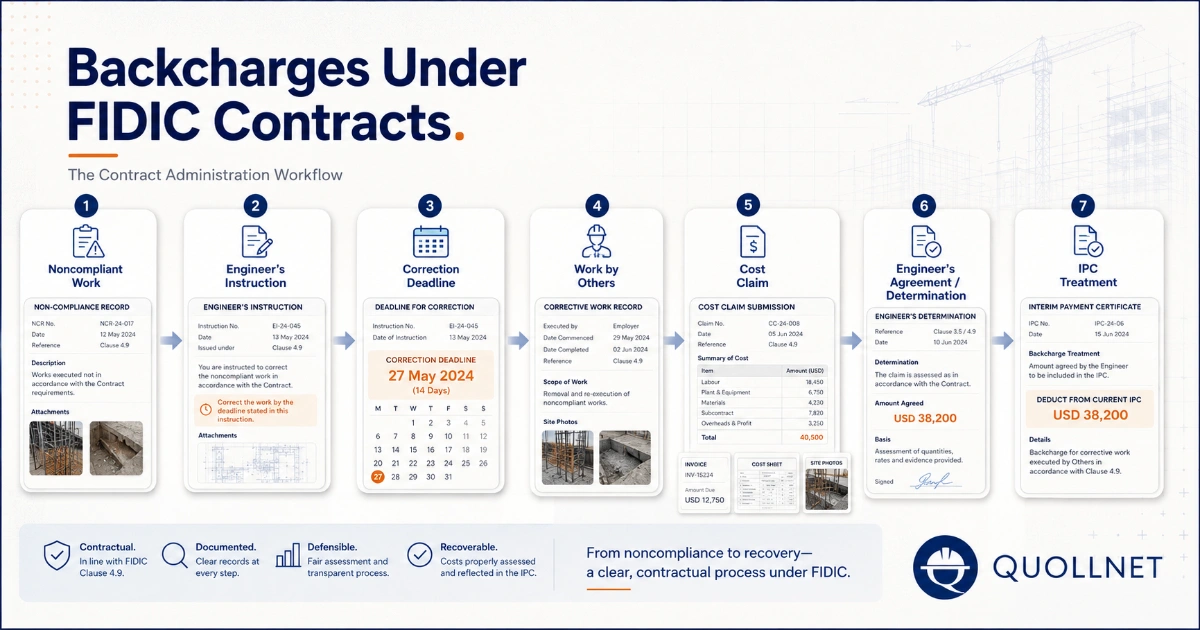
- Step 1: Confirm the contract, form, edition, and amendments.
- Step 2: Confirm the contractual Parties.
- Step 3: Identify the obligation and alleged failure.
- Step 4: Preserve technical and programme evidence.
- Step 5: Identify the authorised issuer.
- Step 6: Issue the applicable instruction, defect notice, or Notice to Correct.
- Step 7: Provide the required particulars, access, and correction opportunity.
- Step 8: Record refusal, nonattendance, failed repair, or emergency.
- Step 9: Define the corrective scope and exclude betterment.
- Step 10: Record actual labour, materials, plant, invoices, and testing.
- Step 11: Submit the applicable Employer, Contractor, or subcontract Claim.
- Step 12: Obtain agreement, determination, certification, or contractual payment treatment.
- Step 13: Record whether the amount is proposed, disputed, determined, deducted, paid, or referred.
A Construction Backcharge Log can be used to record instructions, notices, cure dates, evidence, estimates, actual cost, determinations, IPC deductions, and disputes.
Compare Other Standard Forms
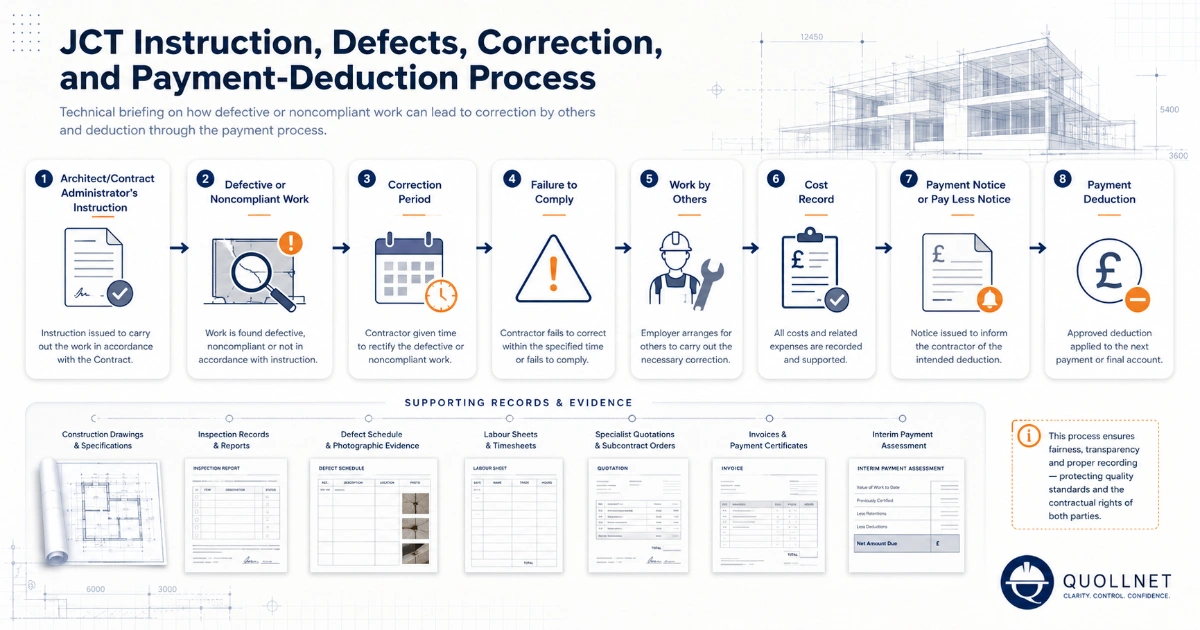
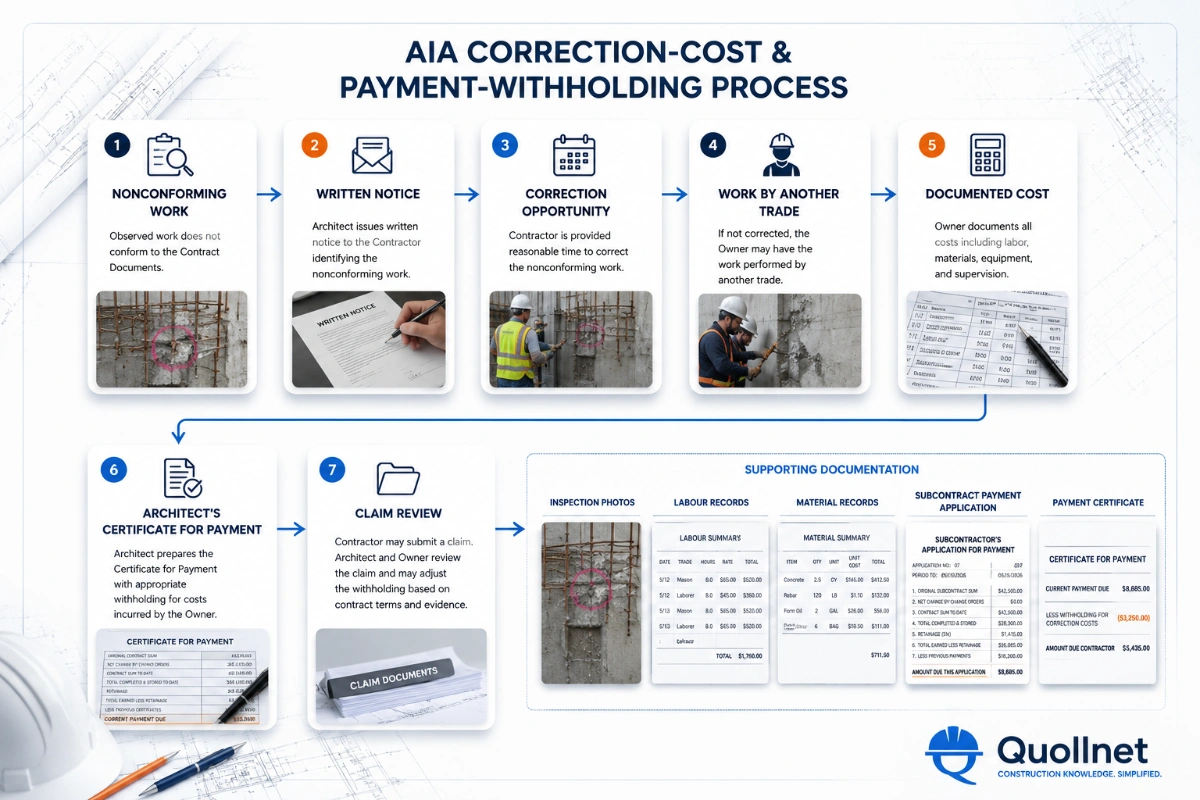
The informal term “backcharge” is translated differently by each standard form. Compare the FIDIC approach with AIA A201 and A401 correction-cost rules, NEC4 uncorrected Defect cost assessment, and JCT instructions and payment deductions.
Conclusion
Under FIDIC, a backcharge is not a self-contained contractual remedy. It is the possible commercial result of one or more processes involving an instruction, rejection, remedial-work obligation, defects procedure, Notice to Correct, Claim, agreement or determination, and payment treatment.
The Employer must establish more than the existence of an invoice. It must prove the contractual failure, Contractor responsibility, right to intervene, reasonable cost, compliance with the applicable Claim procedure, and entitlement to alter payment.
The Contractor or Subcontractor may challenge the contractual gateway, authority, notice, access, correction period, technical responsibility, causation, betterment, valuation, determination, or payment deduction.
The executed FIDIC form, Particular Conditions, subcontract, amendments, and governing law control. A notice template cannot create a remedy that the Contract does not provide.
This article provides general construction contract-administration information and is not legal advice. Contract-specific legal advice should be obtained where the value, termination risk, payment consequences, or dispute exposure is significant.
REFERENCES
FIDIC Construction Contract, First Edition 1999 Red Book
FIDIC Construction Contract, Second Edition 2017, Reprinted 2022 with Amendments
FIDIC Plant and Design-Build Contract, Second Edition 2017, Reprinted 2022 with Amendments
FIDIC Contracts Guide, Second Edition 2022
FIDIC Conditions of Subcontract for Construction, First Edition 2011
Amendments to the FIDIC 2017 Red Book
FIDIC Claims Procedures: Employer and Contractor Claims under the 1999 Forms
FIDIC Sub-Clause 3.5 Determinations Explained
The New FIDIC Suite 2017: Significant Developments and Key Changes