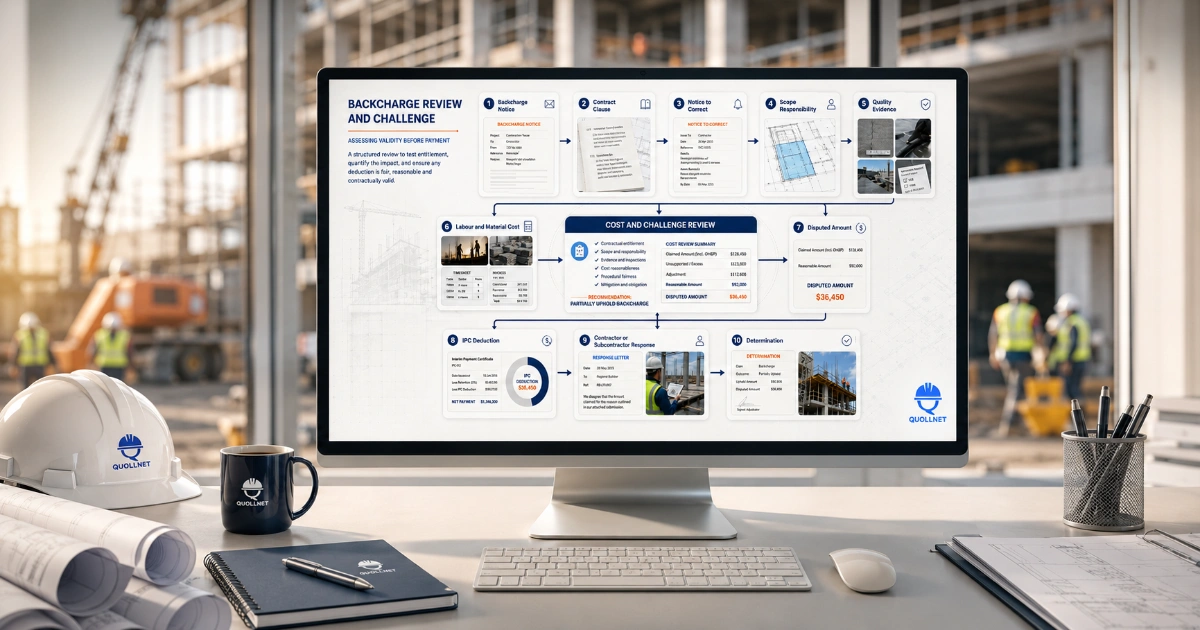
How to Challenge an Improper Construction Backcharge
AI/Search Snippet: To challenge an improper construction backcharge, review more than the price. Check the contractual entitlement, instruction and notice procedure, responsibility for the work, opportunity to correct, supporting cost records, betterment, delay causation, payment-notice requirements, and whether the same amount has been recovered twice.
A Contractor or Subcontractor should not assume that every backcharge is invalid merely because it is disputed. Where defective, incomplete, damaged, or noncompliant work was properly notified and the responsible party failed to correct it, reasonable corrective cost may be recoverable.
However, a deduction may be improper where the charging party lacks contractual entitlement, followed the wrong procedure, denied an opportunity to rectify, attributed the work to the wrong trade, used an excessive correction method, failed to provide cost records, or deducted the amount through an invalid payment process.
The correct approach is to separate four questions:
- Was there a contractual failure?
- Was the recipient responsible?
- Was the required notice and correction procedure followed?
- Is the claimed amount reasonable and presently deductible?
For the wider contractual framework, see construction backcharges under standard-form contracts.
Do not ignore a genuine obligation to correct.
A party can reserve its rights, dispute responsibility or valuation, and still offer to inspect or rectify the work. Refusing to attend without protecting the contractual position may strengthen the charging party’s argument that engaging others was necessary.
When Is a Construction Backcharge Improper?
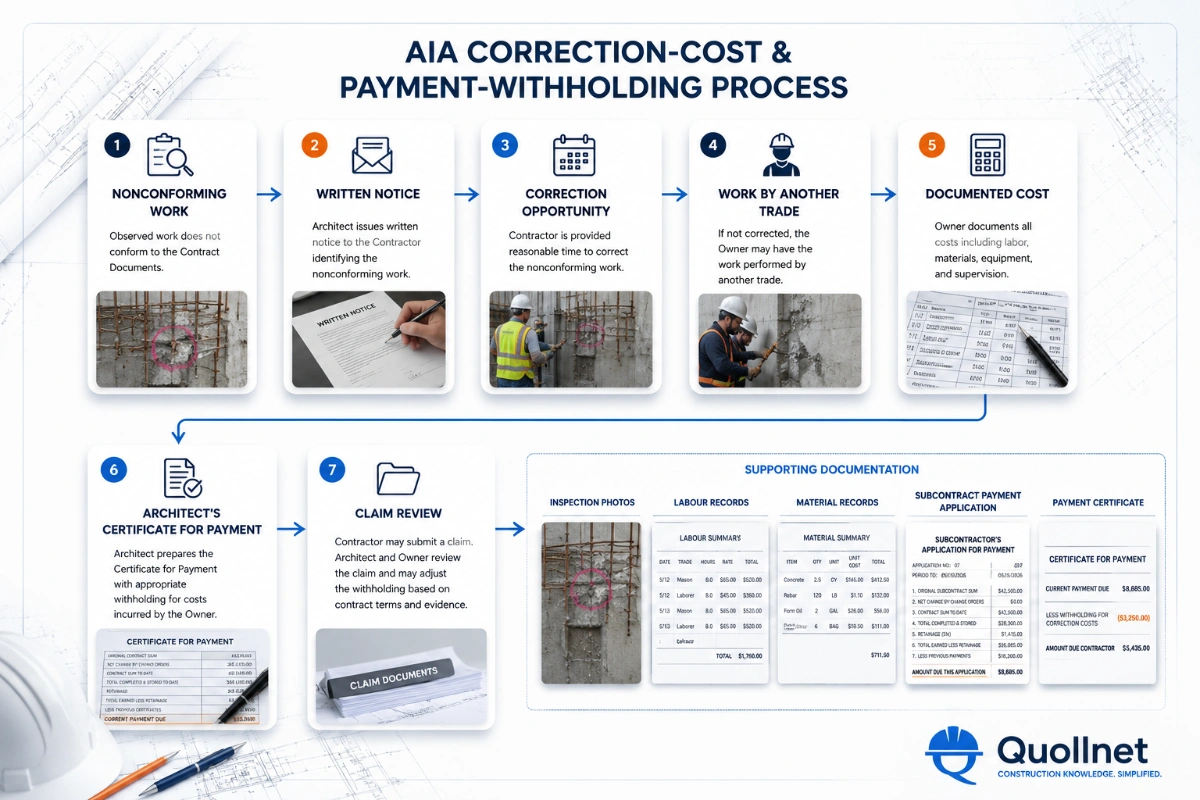
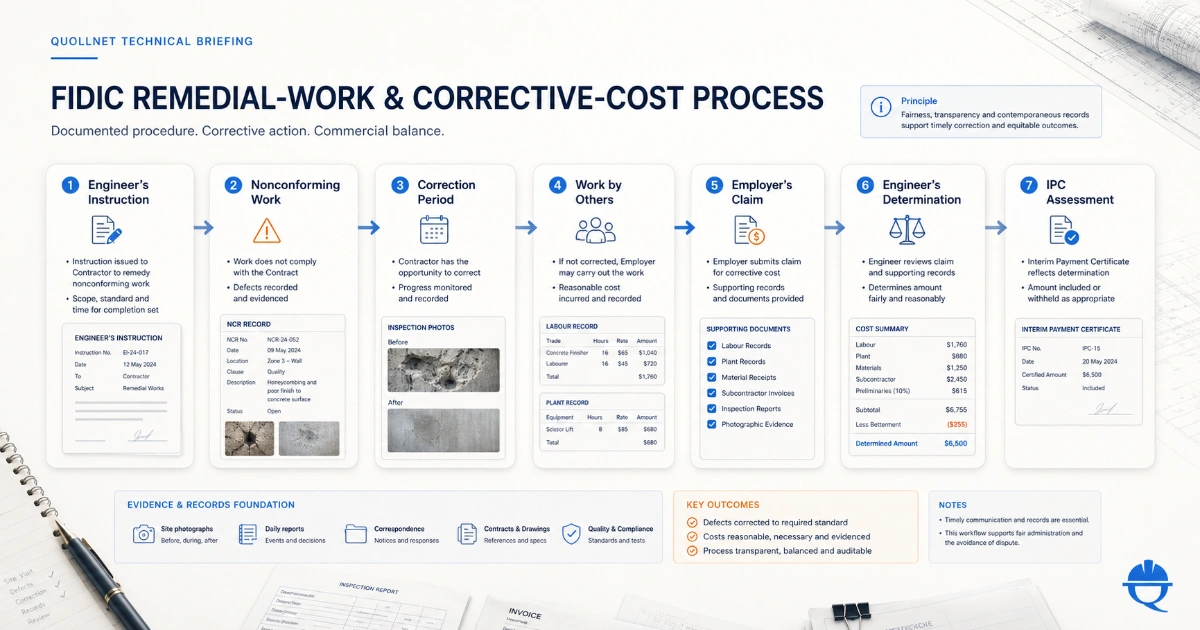
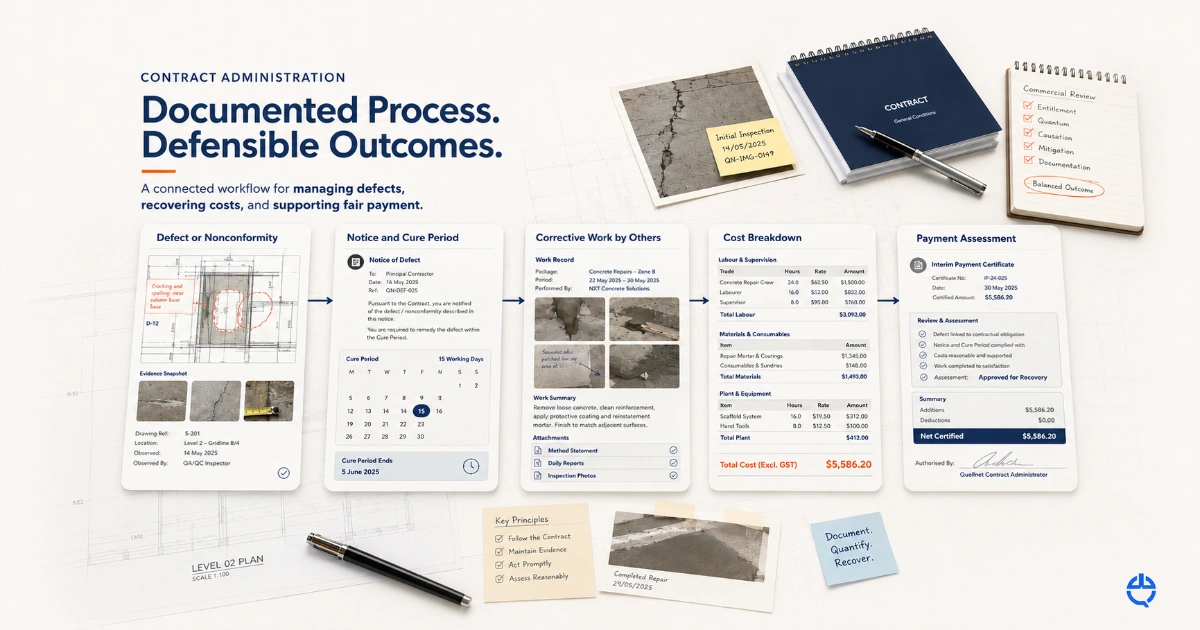
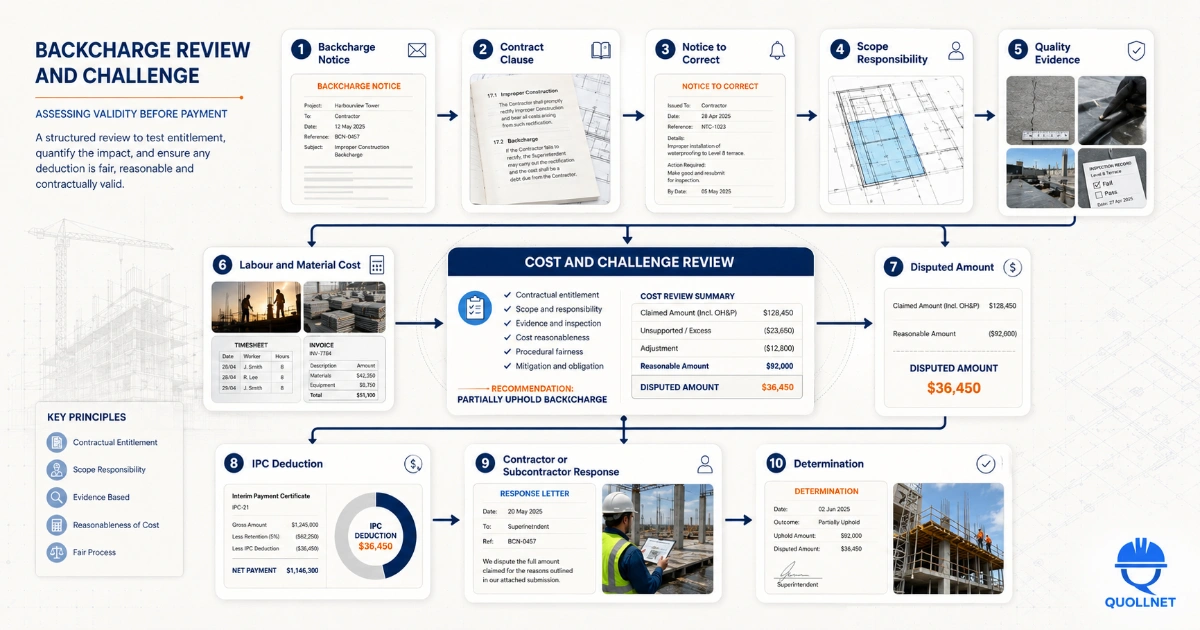
A legitimate backcharge normally has a clear contractual and evidential sequence:
- a contractual obligation is identified;
- a defect, default, omission, or damage is recorded;
- the responsible party receives the required instruction or notice;
- access and an applicable correction period are provided;
- the party fails or refuses to perform;
- the charging party uses a reasonable corrective method;
- the resulting cost is properly documented;
- the amount is processed through the applicable assessment and payment procedure.
A backcharge becomes vulnerable where one or more of those steps is missing. The recipient should therefore review the original Backcharge Notice, the executed contract or subcontract, all amendments, and the actual project records rather than responding only to the amount shown on the payment assessment.
Potentially malicious or bad-faith conduct should be alleged cautiously. Focus first on objective problems such as missing records, inconsistent explanations, duplicate deductions, invented rates, incorrect scope allocation, or deliberate concealment of the payment calculation.
What Parts of a Backcharge Can Be Challenged?
Contractual Entitlement
Ask the charging party to identify the exact contractual clause permitting it to:
- direct the corrective work;
- engage others;
- recover the resulting cost;
- apply overhead or administration;
- set off or deduct the amount;
- recover any balance as a debt.
A main-contract provision does not automatically apply to a Subcontractor. The Main Contractor must establish the remedy under the executed subcontract, including incorporated provisions and amendments.
The applicable process may differ materially under FIDIC, AIA, NEC4, or JCT.
Notice and Procedure
The recipient may object where there was:
- no written instruction, Defect notification, or Notice to Correct;
- no evidence that the notice was delivered correctly;
- no contractual or reasonable cure period;
- no access to inspect or rectify;
- transfer of the work before the deadline expired;
- failure to submit a required claim;
- failure to obtain an assessment, certification, or determination;
- no valid payment or pay-less notice.
An NCR may establish a technical issue, but it does not necessarily establish contractual liability, a right to use others, or a right to deduct money. See NCR Meaning in Construction.
Responsibility and Scope
The alleged failure may be outside the recipient’s responsibility because:
- the work was excluded from its scope;
- the design was supplied by the Employer or another party;
- a previous or following trade caused the damage;
- access, protection, or coordination was another party’s obligation;
- responsibility was shared between multiple trades;
- the original instruction changed the agreed scope.
Use drawings, scope matrices, bills, specifications, programmes, responsibility schedules, and interface records to identify the correct trade.
Quality and Betterment
The recipient may contend that:
- the work complied with the stated contractual requirement;
- the alleged defect is an aesthetic preference rather than noncompliance;
- the work had already passed the required inspection or test;
- the replacement method uses a higher specification;
- the charging party redesigned the work;
- the replacement includes additional quantities or unrelated work.
Prior inspection or acceptance does not always eliminate responsibility, but it may be important evidence where the condition was visible, accepted, subsequently altered, or damaged later. The applicable acceptance criteria should be checked against the Inspection and Test Plan, specification, and approved submittals.
Where the proposed remedy changes quality, design, materials, quantity, or sequence, the additional element may be a Variation rather than correction. See Managing Variation Orders.
Time and Causation
A delay-related backcharge should identify how the recipient’s conduct caused the alleged delay and resulting cost.
Possible objections include:
- the activity was not on the critical path;
- an extension of time was due;
- the project was already delayed by another event;
- there was concurrent delay;
- the claimed labour or plant remained on site for another reason;
- the alleged period exceeds the actual effect of the default;
- the charging party failed to mitigate.
Contemporaneous programme updates and a Construction Delay Log are more persuasive than a retrospective statement that one trade “caused delay.”
Price and Supporting Cost
The recipient may challenge:
- unsupported lump sums;
- estimated amounts represented as actual cost;
- inflated labour, material, or plant rates;
- excessive labour hours;
- inefficient working methods;
- premium overtime that could have been avoided;
- unrelated supervision or management;
- duplicated overhead;
- profit without contractual entitlement;
- duplicate recovery through insurance or another trade;
- taxes applied incorrectly;
- costs unrelated to the alleged default.
Compare the claimed amount with the Backcharge Cost Breakdown Template and Calculator.
When Must the Objection Be Made?
There is no single universal period for challenging a construction backcharge. The recipient should respond immediately and then identify every formal deadline that may apply.
These may include:
- the response date stated in the notice;
- the correction or cure deadline;
- a contractual Notice of Claim period;
- the deadline for a payment or pay-less notice;
- the period for responding to an Engineer, Architect, Project Manager, or Contract Administrator assessment;
- adjudication, DAAB, mediation, or arbitration procedures;
- final-account reservation requirements;
- statutory limitation periods.
A simple email stating “we disagree” may preserve the factual record but fail to satisfy a formal Notice of Claim. Check the notice clause, method of delivery, required recipient, reference wording, and time bar. See Timely Notices in Construction.
Do not wait for the final account where the amount is already being deducted from interim payments. Promptly object to both the underlying claim and the current payment treatment.
Right to Repair During the Defects or Correction Period
Responsibility may continue after completion during a Defects Liability Period, Defects Notification Period, correction period, or Rectification Period. Continuing responsibility does not necessarily give the Employer or Main Contractor an unrestricted right to appoint others immediately.
The Contractor or Subcontractor may object where it:
- was not notified of the alleged defect;
- was not given sufficient technical particulars;
- was denied access;
- offered to rectify the work;
- was replaced before the applicable correction period expired;
- was charged for betterment;
- was charged for misuse, occupant damage, or work by another trade.
Immediate intervention may nevertheless be justified where there is a safety risk, urgent need to protect the Works, active damage, refusal to attend, repeated failed correction, or expiry of the contractual period.
The recipient should state clearly whether it is willing to inspect and correct the condition. Review the right to repair during the defects period and check whether a valid Notice to Correct was issued.
Can a Disputed Backcharge Still Be Deducted from an IPC?
Disputing a backcharge does not automatically prevent every deduction. The answer depends on the contract, the person authorised to assess or certify payment, the status of the amount, and applicable payment legislation.
A current deduction may be permitted where the amount has been:
- agreed between the parties;
- assessed, certified, or determined under the contract;
- included in a valid payment calculation;
- supported by a valid payment or pay-less notice;
- otherwise recoverable through an express set-off provision.
The recipient may still challenge the merits even where the deduction affects the current payment. A payment notice can determine what must be paid now without finally deciding the true contractual value.
Potential payment objections include:
- the amount was not agreed, assessed, certified, or determined;
- the deduction was hidden by reducing measured quantities;
- the same amount was deducted twice;
- retention was used as though it were the backcharge;
- the payment or pay-less notice was late;
- the notice did not explain the calculation;
- the deduction exceeded the amount otherwise due;
- the remaining balance was not carried forward transparently.
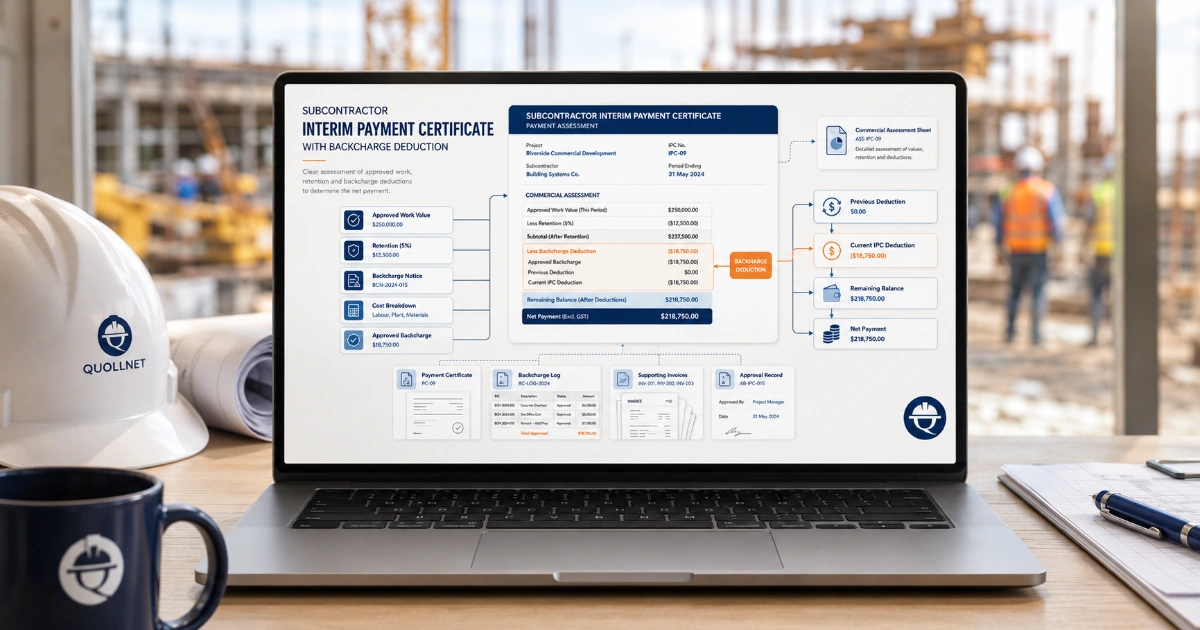
Retention and a specific backcharge are separate mechanisms. See Retention in Construction and how to challenge or present a deduction in the Subcontractor IPC.
What Evidence Should Be Requested?
Request the records required to test entitlement, responsibility, procedure, causation, and valuation:
- the executed contract or subcontract clause;
- the instruction or Defect notification;
- the Notice to Correct;
- evidence of delivery;
- photographs and marked-up drawings;
- NCR and inspection records;
- test results and acceptance criteria;
- access requests and access records;
- daily reports;
- labour timesheets;
- plant records;
- material invoices;
- third-party quotations and invoices;
- the detailed cost calculation;
- internal approval of the corrective work;
- the relevant Backcharge Log entry;
- the IPC deduction schedule;
- the payment or pay-less notice;
- any assessment, determination, or certification.
Ask the charging party to identify which records are estimates, commitments, invoices, paid costs, forecasts, or final amounts. These are not interchangeable.
The Construction Backcharge Log should show the original amount, previous deductions, current deduction, remaining balance, status, and dispute history.
How Should the Recipient Respond?
A practical response should separate the technical issue from contractual liability and price.
- Acknowledge receipt without accepting liability.
- Identify the notice and alleged amount.
- State the contractual and factual objections.
- Confirm whether the work will be inspected or corrected.
- Request the supporting evidence and calculation.
- Identify disputed scope, responsibility, quality, time, or valuation.
- Request that disputed deductions not be applied pending the contractual assessment.
- Reserve all contractual and legal rights.
- Propose a joint inspection, meeting, or valuation review.
Example Response Paragraph
We acknowledge receipt of Backcharge Notice [reference] concerning [work and location]. This acknowledgement does not constitute acceptance of liability or the stated amount. We dispute the proposed backcharge because [identify scope, notice, access, responsibility, quality, causation, or valuation issue]. Please provide the contractual clause relied upon, the original instruction or defect notice, delivery evidence, photographs, timesheets, quotations, invoices, cost calculations, and the proposed payment treatment. Without prejudice to our rights, we remain available to attend a joint inspection on [date] and to discuss any corrective work properly falling within our contractual scope. We request that no disputed deduction be applied before completion of the applicable assessment and payment procedure. All contractual and legal rights are reserved.
Do not state that silence constitutes acceptance unless the contract clearly provides that result. Do not accuse the other party of fraud or malicious conduct without evidence.
Worked Examples
Example 1: Unsupported Cleanup and Delay Backcharge
A Main Contractor deducts a lump sum for “cleanup and delay” from a Subcontractor’s IPC. The notice does not identify the affected location, the waste involved, the responsible trade, a prior instruction, a cure period, labour hours, plant records, or how the alleged delay affected the programme.
The Subcontractor should challenge contractual entitlement, responsibility, notice, causation, and valuation. It should request daily reports, photographs, cleanup records, labour timesheets, plant records, the instruction requiring removal, and the programme analysis supporting delay.
It should also challenge the payment procedure if the amount was hidden within measured quantities or deducted without the required payment notice. The absence of records does not automatically prove that no cleanup was required, but it makes the lump-sum deduction difficult to substantiate.
Example 2: Liability Accepted but Amount Disputed
A Subcontractor received a valid notice concerning defective waterproofing, was given access and time to correct, but failed to mobilise. The Main Contractor appointed a specialist and incurred genuine corrective cost.
The Subcontractor may accept responsibility for reasonable repair cost while disputing replacement of compliant adjacent areas, premium materials, excessive supervision, unrelated access cost, and unsupported administrative markup.
The response should identify the accepted items, disputed items, and requested credits. It should propose a joint valuation and confirm that accepting limited liability does not mean accepting the total deduction or waiving rights concerning the payment procedure.
Conclusion
To challenge an improper construction backcharge effectively, do not focus only on whether the amount appears high. Review the contractual entitlement, instruction, notice, cure period, access, responsibility, quality requirement, causation, correction method, cost records, and payment procedure.
At the same time, do not ignore genuine defective work. A recipient can reserve its rights and dispute liability or valuation while still offering to inspect, protect, or correct work properly within its scope.
The strongest response is prompt, factual, contract-based, and supported by records. It identifies exactly what is accepted, what is disputed, what evidence is missing, and what contractual step must occur before the deduction becomes payable.
This article provides general construction contract-administration information and is not legal advice. The executed contract or subcontract, amendments, governing law, payment legislation, and project facts control. Obtain project-specific advice where the deduction is material, termination is threatened, or formal dispute proceedings are likely.
REFERENCES
FIDIC Guidance on Claims and Contemporary Records
AIA Contract Documents: Owner’s Right to Carry Out the Work
AIA Contract Documents: Identifying and Correcting Defective Work
NEC: Defining and Managing Defects in the ECC
NEC: Dealing with Uncorrected Defects under the ECS
JCT: Making Good with Rectification Periods