Backcharges Under NEC4 ECC and ECS: Uncorrected Defects, Cost Assessment, and Payment
AI/Search Snippet: A NEC backcharge is an informal description of the cost consequences of an uncorrected Defect under NEC4 ECC or ECS. The contractual process normally requires a notified Defect, access to correct it, expiry of the defect correction period, assessment of correction by others, and treatment through the applicable payment procedure.
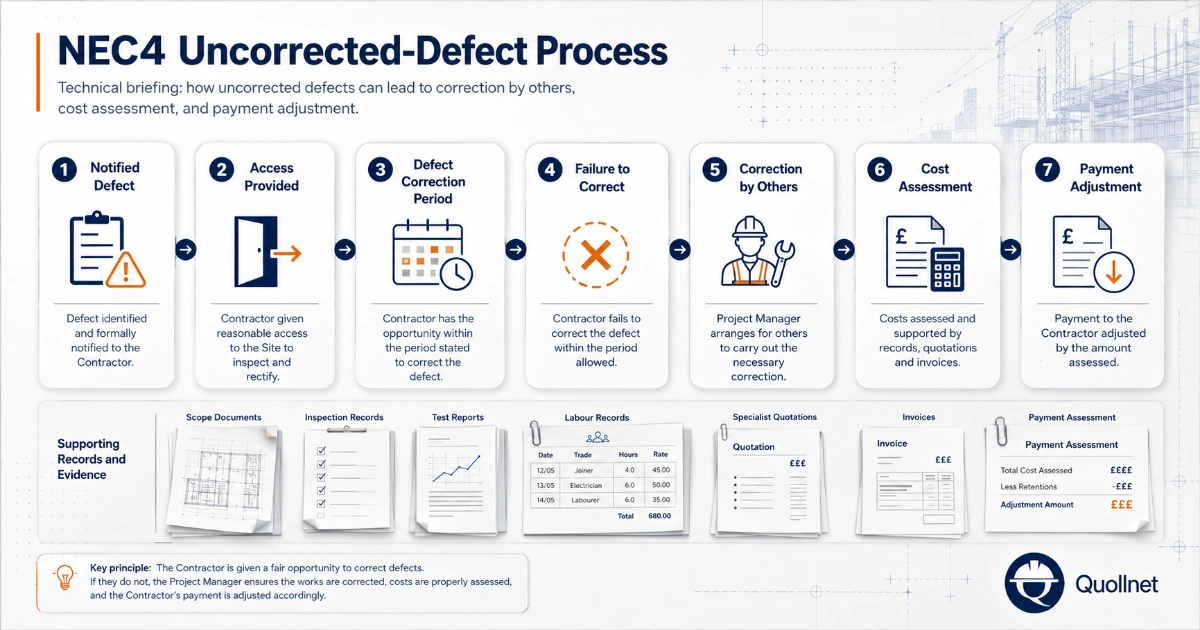
The word backcharge is commonly used by contractors and commercial teams, but it is not the terminology used by NEC4. Under the NEC4 Engineering and Construction Contract and Engineering and Construction Subcontract, the closest contractual mechanism normally follows this sequence:
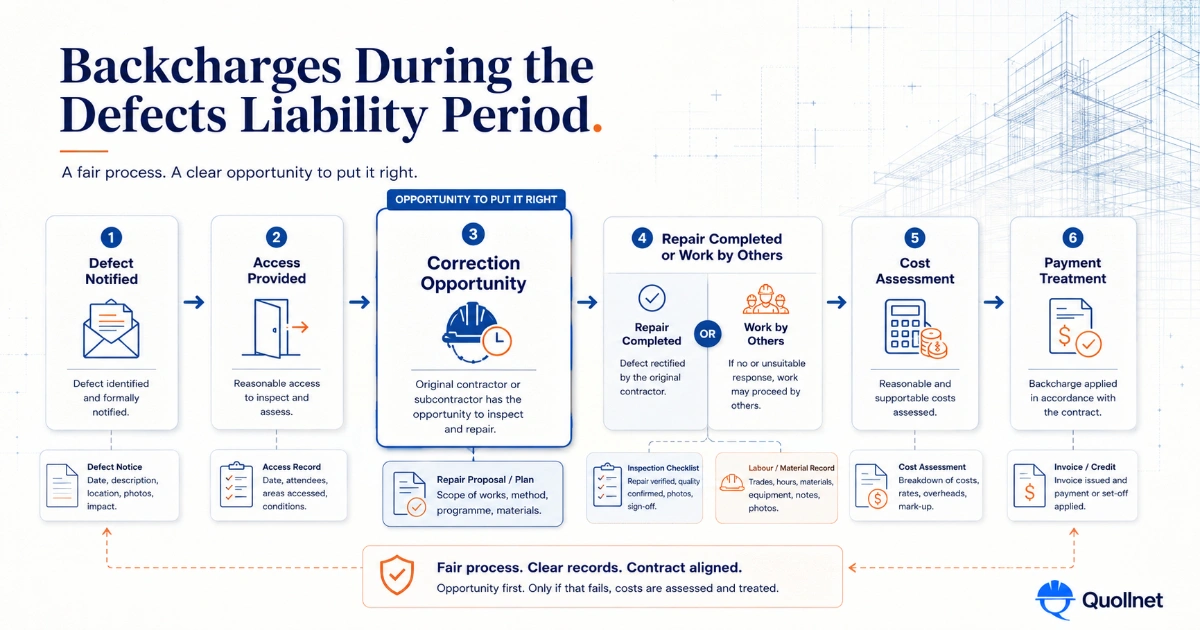
Defect notified → access provided → defect correction period → failure to correct → correction by others → cost assessment → payment treatment.
NEC users should therefore avoid importing procedures from other standard forms. An NEC Defect notification is not a FIDIC-style Notice to Correct. There is no Architect certifying payment, and “Defects Liability Period” is not a defined NEC expression. The contract instead uses defined terms such as Defect, Scope, Subcontract Scope, defect correction period, defects date, Defined Cost, and Disallowed Cost.
The executed contract controls. The applicable main Option, secondary Options, Contract Data, Scope, Subcontract Scope, Z clauses, dispute Option, governing law, and payment legislation may materially alter the standard result.
For the broader principles applying to other contract forms, see construction backcharges under standard-form contracts.
Need to notify a subcontractor right now?
Use the practical Backcharge Notice Template, but adapt its terminology to the NEC4 ECS. Before sending it, verify that the Defect has been properly notified, access has been provided, the defect correction period is correctly calculated, and the Subcontract permits the proposed cost recovery. A generic notice cannot replace the contractual NEC communication.
What Is the NEC Equivalent of a Backcharge?
Under NEC4, a backcharge is best understood as an assessed contractual amount arising from an uncorrected Defect rather than as a standalone claim document.
The principal roles under the ECC are:
- Client: the party receiving the works and providing access where required;
- Project Manager: the person administering the contract, assessing amounts and managing payment and compensation-event procedures;
- Supervisor: the person responsible for specified tests, inspections, searches for Defects, Defect notifications, and the defects certificate;
- Contractor: the party required to Provide the Works in accordance with the Scope.
Under the ECS, the relationship is between the Contractor and Subcontractor. The Contractor performs the relevant upstream administrative and assessment functions under the Subcontract, subject to the exact ECS wording and any amendments.
| Stage | NEC mechanism | Responsible person | Required record | Commercial consequence |
|---|---|---|---|---|
| Identify noncompliance | Defect definition and Scope | Supervisor or Contractor | Scope, test and inspection evidence | Potential Defect identified |
| Notify | Clause 43 | Supervisor or Contractor | Separate contractual communication | Creates a notified Defect |
| Allow correction | Clause 44 | Client and Contractor | Access and correction dates | Contractor receives correction opportunity |
| Accept instead | Clause 45 | Project Manager and Contractor | Proposal and quotation | Reduction in Prices or earlier Completion Date |
| Remains uncorrected | Clause 46.1 or 46.2 | Project Manager | Forecast assessment | Amount payable by Contractor |
| ECS recovery | ECS Clause 46 | Contractor | Subcontract cost assessment | Recovery from Subcontractor |
What Counts as a Defect Under NEC4?
The definition of a Defect is central because the Clause 43 to Clause 46 procedures depend on one existing.
Under NEC4 ECC Clause 11.2(6), a Defect generally includes:
- a part of the works that is not in accordance with the Scope;
- Contractor-designed work that does not comply with applicable law;
- Contractor-designed work that does not comply with the design accepted by the Project Manager.
This definition should be read with Clause 20.1, which requires the Contractor to Provide the Works in accordance with the Scope.
Project Manager acceptance of a Contractor design does not transfer the Contractor’s design responsibility. However, a problem originating solely in design supplied by the Client is not automatically a Contractor Defect. It may instead be a Client liability or compensation-event issue, depending on the contract.
The ECS uses the Subcontract Scope. A Defect under the ECC is therefore not automatically a Defect under the ECS. The Main Contract Scope may impose an obligation on the Contractor that was not transferred accurately into the Subcontract Scope. Conversely, the Subcontract Scope may contain more detailed requirements than the Main Contract.
A disagreement cannot be resolved simply by describing the work as defective. The alleged requirement must be found in the applicable Scope or Subcontract Scope.
Common Grounds for Disputing the Existence of a Defect
- The alleged requirement is not stated in the Scope.
- A higher test or quality standard was introduced retrospectively.
- The work complies with the stated acceptance criteria.
- The relevant design was supplied by the Client.
- The work is incomplete but remains legitimate work in progress under the accepted programme.
- Another contractor damaged compliant work.
- The proposed remedy exceeds compliance and introduces betterment.
- The direction actually changes the Scope.
The distinction between incomplete work, a snag, an NCR, and a contractual Defect is discussed further in Observation vs NCR vs Snag vs Defect.
How Are Defects Notified Under NEC4?
Under the ECC, the Supervisor and Contractor are required to notify a Defect when either becomes aware of it. The Contractor’s obligation to correct a Defect is not automatically removed because the Supervisor failed to notify it.
A proper Defect notification should identify:
- the relevant Scope requirement;
- the affected location or system;
- the nature of the noncompliance;
- relevant test, inspection, survey, or photographic evidence;
- the date the issue was identified;
- the affected work package;
- any immediate protection required.
NEC communications should use the terminology and communication process stated in the contract. Where Clause 13 requires a notification to be made separately, burying it within minutes, an NCR attachment, or an ordinary progress email may create avoidable arguments.
An internal NCR can provide strong technical evidence, but it does not automatically constitute the formal NEC Defect notification. See NCR Meaning in Construction.
Tests and inspections under Clause 41 are often the objective basis for identifying a Defect. The Scope should define the applicable standards, hold points, inspection requirements, test methods, tolerances, and acceptance criteria. A well-structured Inspection and Test Plan can provide the supporting audit trail, but it should not introduce a contractual standard that is absent from the Scope.
Defects Before and After Completion
Defects can be notified before or after Completion, up to the defects date. A notified Defect does not necessarily prevent Completion. Under NEC4, Completion may still occur where the Defect does not prevent the Client from using the works or Others from carrying out their work.
The defects date is the last contractual date for notifying Defects under the standard process. It is not automatically the end of all Contractor liability. Where Option X18 applies, an end of liability date may also be stated in Contract Data.
Access and the Defect Correction Period
The defect correction period is not a universal fixed period. It is stated in Contract Data and may differ for particular Defects or parts of the works.
The starting date depends on when the Defect was notified and whether the Client has taken over the affected part:
- For a Defect notified before Completion, the defect correction period normally begins at Completion.
- For a Defect notified after Completion, it normally begins when the Defect is notified.
- Where the Client has taken over the affected part, commencement may be delayed until the Client provides access.
The Contractor should record:
- the notification date;
- the applicable Contract Data entry;
- the date Completion or take over occurred;
- requests for access;
- access dates and restrictions;
- proposed correction methods;
- resources offered for correction;
- any refusal or postponement by the Client.
Where Access Is Provided
If the Client provides access and the Contractor does not correct the notified Defect within its defect correction period, the Clause 46.1 mechanism may be used. The Project Manager assesses the cost of having the Defect corrected by others.
Where Access Is Not Provided
Failure to provide access does not automatically eliminate the Contractor’s liability. Instead, Clause 46.2 changes the valuation basis. The Project Manager assesses what it would have cost the Contractor to correct the Defect.
This distinction is commercially important. The Client should not necessarily recover a premium third-party cost caused by denying the original Contractor a reasonable opportunity to carry out its own correction.
An unrealistically short defect correction period also creates dispute risk. The contract drafter should select periods that reflect mobilisation, design review, procurement, testing, access constraints, safety, and the technical nature of the likely correction.
For a broader discussion of post-completion access and repair rights, see rights during the defect correction period. NEC users should continue to use the defined NEC expressions rather than treating the project as having a generic Defects Liability Period.
Can a Defect Be Accepted Instead of Corrected?
Clause 45 provides a negotiated mechanism for accepting a Defect rather than correcting it.
The Contractor or Project Manager may propose changing the Scope so that the Defect does not have to be corrected. The Contractor then submits a quotation proposing:
- a reduction in the Prices;
- an earlier Completion Date;
- or both.
The Project Manager decides whether to accept the quotation. If accepted, the Scope and contractual position are adjusted and the matter is no longer treated as a Defect.
Accepting a Defect is not:
- a unilateral backcharge;
- a compensation event;
- a waiver of every possible liability;
- the same as correction by others;
- permission to accept work that violates applicable law.
The process is negotiated. The Project Manager does not simply impose a reduction under Clause 45 without the Contractor’s quotation and agreement required by that mechanism.
Clause 46: Uncorrected Defects and Correction by Others
Clause 46 is the closest NEC4 ECC mechanism to what project teams often call a backcharge.
Clause 46.1: Access Was Provided
Clause 46.1 applies where:
- a Defect has been notified;
- the Client has provided access for correction;
- the defect correction period has expired;
- the Contractor has failed to correct the Defect.
The Project Manager assesses the cost to the Client of having the Defect corrected by others. The Contractor becomes liable for the assessed amount.
The assessment should be made promptly and prospectively. The Project Manager should notify the Contractor that Clause 46.1 is being used and assess the forecast cost rather than waiting until another contractor has completed the work and automatically adopting its final invoice.
The assessment may consider:
- reasonable third-party labour;
- materials and Equipment;
- specialist design or investigation;
- access and temporary protection;
- testing and inspection;
- necessary attendance and supervision;
- reasonable reinstatement directly caused by the correction.
The Project Manager should exclude betterment, unrelated work, avoidable inefficiency, and cost caused by the Client or Others.
Clause 46.2: Access Was Not Provided
Where the Client did not provide access, the Contractor remains potentially liable, but the assessment is based on what it would have cost the Contractor to correct the Defect.
The distinction prevents the Client from automatically transferring a higher external correction cost where the Contractor was willing and able to perform the work but was denied access.
Worked Example: NEC4 ECC Waterproofing Defect
The Scope requires a roof membrane to pass a stated flood test. The Supervisor notifies a failed test as a Defect. The Client provides access, and the defect correction period begins. The Contractor proposes a repair but fails to mobilise before the period expires.
The Client obtains a specialist quotation for investigation, localised membrane replacement, temporary protection, retesting, and reinstatement. The Project Manager notifies the Contractor that Clause 46.1 is being applied and assesses the forecast correction cost.
The Contractor may challenge whether full membrane replacement is reasonably required, whether the specialist specification introduces betterment, whether premium weekend access was necessary, and whether some internal damage was caused by delayed Client protection. The Project Manager must assess the contractual correction cost rather than accept every quoted item automatically.
How Are Correction Costs Assessed and Paid?
The following questions should be treated separately:
- Does a Defect exist?
- Has it remained uncorrected after the applicable period?
- Does Clause 46.1 or Clause 46.2 apply?
- What amount should be assessed?
- How does that amount affect the amount due?
- What happens if no further payment is due?
- What contractual or statutory payment notice is required?
| Issue | NEC4 ECC | NEC4 ECS |
|---|---|---|
| Parties | Client and Contractor | Contractor and Subcontractor |
| Technical standard | Scope | Subcontract Scope |
| Notification | Supervisor or Contractor | Contractor or Subcontractor under the ECS procedure |
| Correction period | Contract Data | Subcontract Data |
| Assessment | Project Manager | Contractor |
| Correction by others | Client arranges correction after Clause 46 conditions | Contractor engages others after ECS Clause 46 conditions |
| Payment treatment | ECC amount-due and assessment process | ECS subcontract amount-due process |
| Dispute | Applicable W1, W2, or W3 procedure | ECS dispute option and governing law |
Options A and B
Options A and B are priced contracts. The Contractor normally carries the internal commercial cost of correcting its own Defects while being paid according to the activity schedule or bill of quantities, subject to the contract’s payment rules.
The original price may contain a risk allowance for quality correction, but that allowance is rarely visible as a separate amount.
Options C, D, E, and F
Under cost-based Options, the cost of correcting a Defect may form part of Defined Cost unless it falls within the definition of Disallowed Cost.
Disallowed Cost may include:
- cost that is not supported by the Contractor’s accounts and records;
- cost of correcting Defects after Completion;
- cost caused by failing to comply with a constraint in the Scope concerning how the works are provided;
- other categories added by Z clauses.
Under target Options C and D, correction cost that is not Disallowed Cost may still affect the Contractor commercially through the share mechanism.
Recovery Under the ECS
Under ECS Clause 46.1, where access was provided and the Subcontractor failed to correct within the defect correction period, the Contractor may recover the cost incurred or expected to be incurred in engaging others.
Official NEC guidance indicates that this can include reasonable:
- cost of arranging another specialist;
- attendance provided by the Contractor;
- associated overhead.
Profit is not included merely as an additional percentage because it is not a correction cost under that mechanism. An amended Subcontract may produce a different result, so the executed ECS and Z clauses must be checked.
Worked Example: NEC4 ECS Firestopping Defect
The Subcontract Scope requires the MEP Subcontractor to complete tested firestopping to all penetrations created by its services. The Contractor notifies incomplete penetrations as Defects, provides access, and states the applicable defect correction period.
The Subcontractor does not mobilise. The Contractor appoints a specialist firestopping firm and records its quotation, labour, materials, access, testing, and reasonable attendance. Openings created later by another trade are excluded from the assessment.
The Contractor assesses the amount recoverable under the ECS and reflects it through the subcontract payment procedure. The Subcontractor may challenge whether particular openings were within its Subcontract Scope, whether the correction method was excessive, whether overhead was duplicated, and whether the statutory payment or pay-less procedure was followed.
For practical payment presentation, see deducting a backcharge from a Subcontractor payment and tracking NEC correction costs in a Construction Backcharge Log.
Early Warnings, Compensation Events, and Changed Scope
An early warning is not a substitute for a Defect notification.
An early warning concerns a matter that may affect cost, progress, Completion, or performance. A Defect is notified after the noncompliance exists. There is no general requirement for the Project Manager to give an early warning before the Supervisor notifies a Defect.
Correcting the Contractor’s own Defect is not normally a compensation event. However, an apparent correction may instead involve a compensation event where:
- the Project Manager changes the Scope;
- the Client’s design is defective;
- access is restricted or changed;
- the Client instructs a higher performance standard;
- work by Others damages the Contractor’s work;
- the proposed remedy introduces additional quantity or revised design.
A change to Scope is generally administered through the compensation-event procedure unless it is the specific change used to accept a Defect under Clause 45 or another contractual exception applies.
Where the proposed remedy changes the required quality, materials, design, quantity, or sequence, see Managing Variation Orders.
What Can the Contractor or Subcontractor Challenge?
A correction-cost assessment may be challenged on technical, procedural, valuation, payment, or causation grounds.
Existence of a Defect
- No relevant requirement exists in the Scope or Subcontract Scope.
- The wrong test or acceptance criterion was used.
- The work was legitimate work in progress.
- The issue arose from Client design.
- The work had been altered or damaged by Others.
- The alleged Defect had already been corrected.
Notification and Procedure
- No valid Defect notification was issued.
- The communication did not identify the contractual failure.
- The defect correction period was calculated incorrectly.
- The period had not expired.
- The Contractor offered correction but was prevented.
- The wrong person made the assessment.
Access and Clause 46 Basis
- Clause 46.1 was applied even though access was not provided.
- The Clause 46.2 assessment exceeds what correction would have cost the original Contractor.
- The Client created premium cost through restricted access.
Scope and Betterment
- The remedy uses higher-grade materials.
- The replacement includes redesigned or additional work.
- Unnecessary demolition or reinstatement was included.
- The work falls outside the Subcontract Scope.
Valuation
- Labour hours or Equipment rates are excessive.
- The specialist quotation was not reasonably tested.
- Attendance or supervision is unrelated.
- Overhead is duplicated.
- Profit was added without an express basis.
- The Client failed to mitigate.
- Insurance or third-party recovery was not credited.
- An estimate is being represented as final actual cost.
Payment
- The amount due was assessed incorrectly.
- A mandatory payment or pay-less notice was not issued.
- The amount was deducted twice.
- The assessed amount was taken from retention and payment without reconciliation.
- The dispute procedure was not followed.
The Backcharge Cost Breakdown Template and Calculator can be used to test labour, materials, Equipment, attendance, overhead, credits, and forecasts. For a structured objection, see how to challenge an unsupported correction-cost assessment.
When Must an NEC Assessment Be Challenged?
There is no universal NEC backcharge objection deadline.
Potentially relevant contractual and statutory periods include:
- the defect correction period;
- the contractual period for reply;
- the payment assessment cycle;
- payment and pay-less notice deadlines;
- the final assessment procedure;
- adjudication notification;
- Option W1, W2, or W3 dispute steps;
- the defects date;
- the Option X18 end of liability date;
- statutory limitation periods.
Clause 46.1 does not state one specific deadline for the Project Manager’s assessment. However, the assessment should be made promptly, the Contractor should be informed that the clause is being used, and the forecast basis should be disclosed.
The Contractor or Subcontractor should:
- respond promptly to the Defect and assessment;
- identify the disputed Scope requirement;
- record access requests and restrictions;
- state whether correction remains available;
- request the forecast and supporting calculations;
- preserve payment objections;
- follow the applicable W option and statutory adjudication procedure;
- avoid waiting until final assessment.
Practical NEC Correction-Cost Workflow
- Step 1: Confirm the ECC or ECS form, edition, main Option, Contract Data, and Z clauses.
- Step 2: Identify the relevant Scope or Subcontract Scope requirement.
- Step 3: Record tests, inspections, photographs, and programme status.
- Step 4: Notify the Defect through the required NEC communication.
- Step 5: Calculate the defect correction period correctly.
- Step 6: Provide and document access.
- Step 7: Record correction proposals, refusal, or failure to act.
- Step 8: Determine whether Clause 45, 46.1, or 46.2 applies.
- Step 9: Prepare a prospective and supported cost assessment.
- Step 10: Separate correction from changed Scope or betterment.
- Step 11: Apply the amount through the correct payment procedure.
- Step 12: Preserve adjudication and dispute rights.
Conclusion
Under NEC4, a backcharge is not a generic notice followed by an immediate deduction. It is the possible payment result of the contract’s Defect-management process.
The charging party should establish that a Defect exists under the Scope or Subcontract Scope, notify it correctly, provide access, calculate the defect correction period, allow the responsible party to correct it, and apply the correct Clause 46 assessment.
The distinction between Clause 46.1 and Clause 46.2 is fundamental. Where access was provided, the assessment concerns correction by others. Where access was not provided, the assessment is based on what correction would have cost the original Contractor.
At subcontract level, the Contractor must rely on the ECS and Subcontract Scope rather than assuming that every Main Contract Defect creates automatic Subcontractor liability.
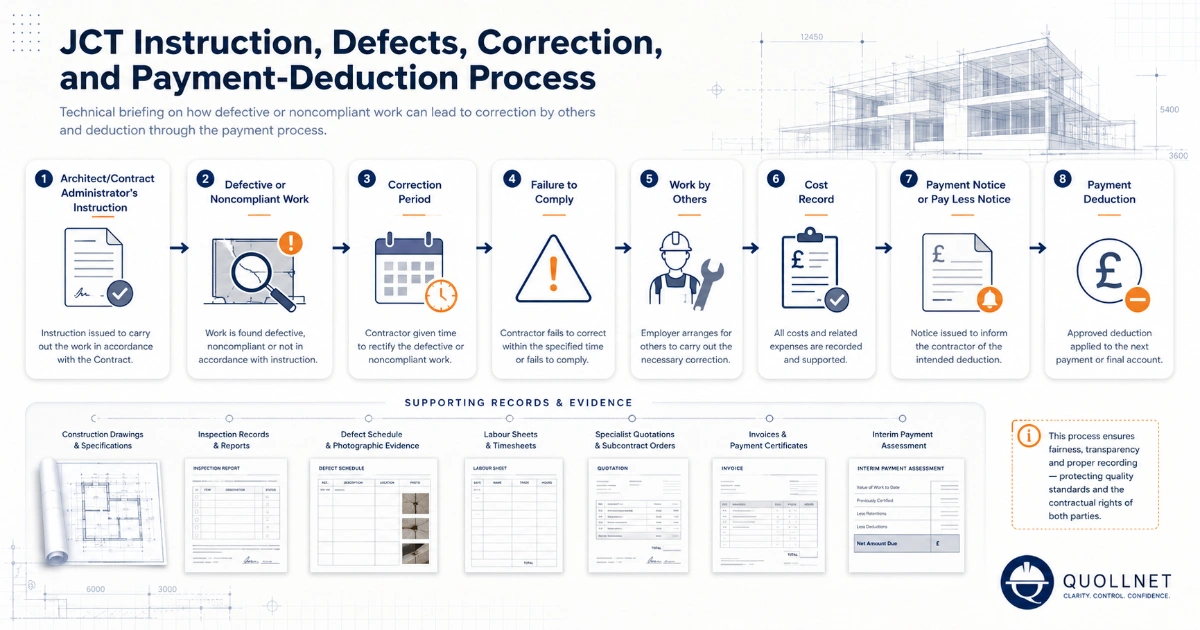
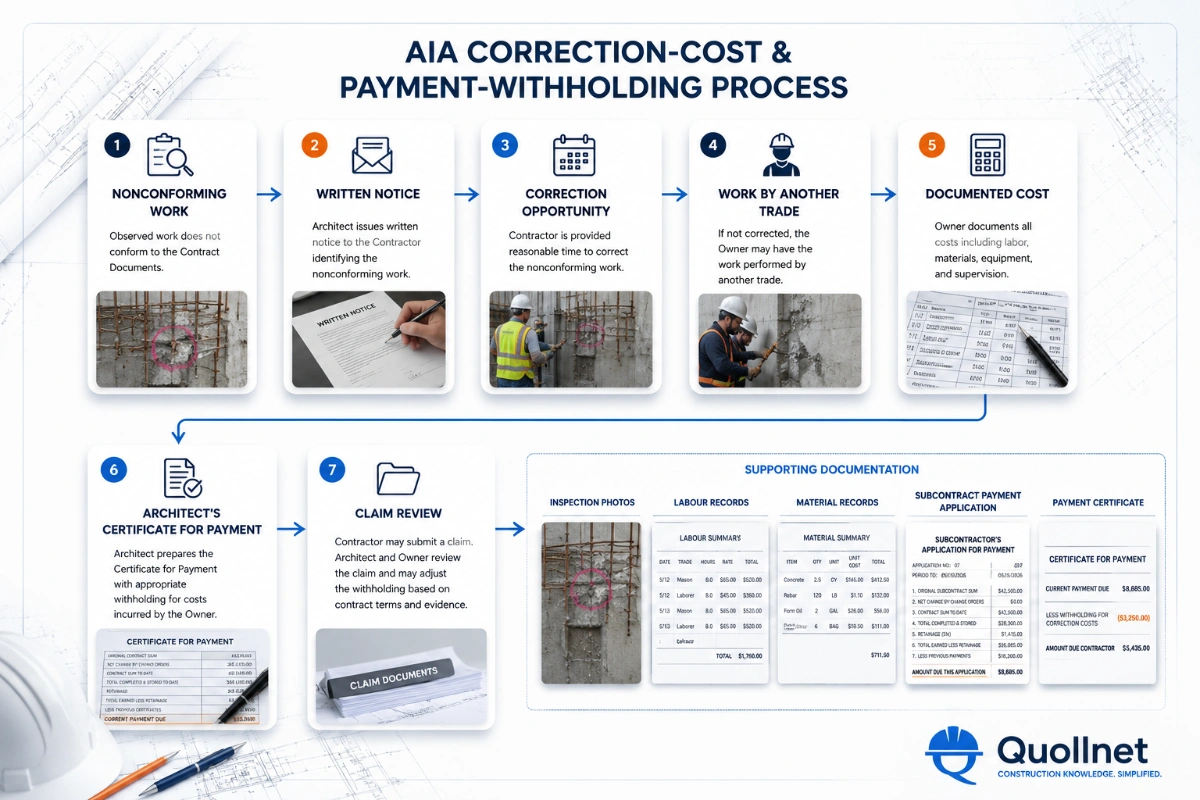
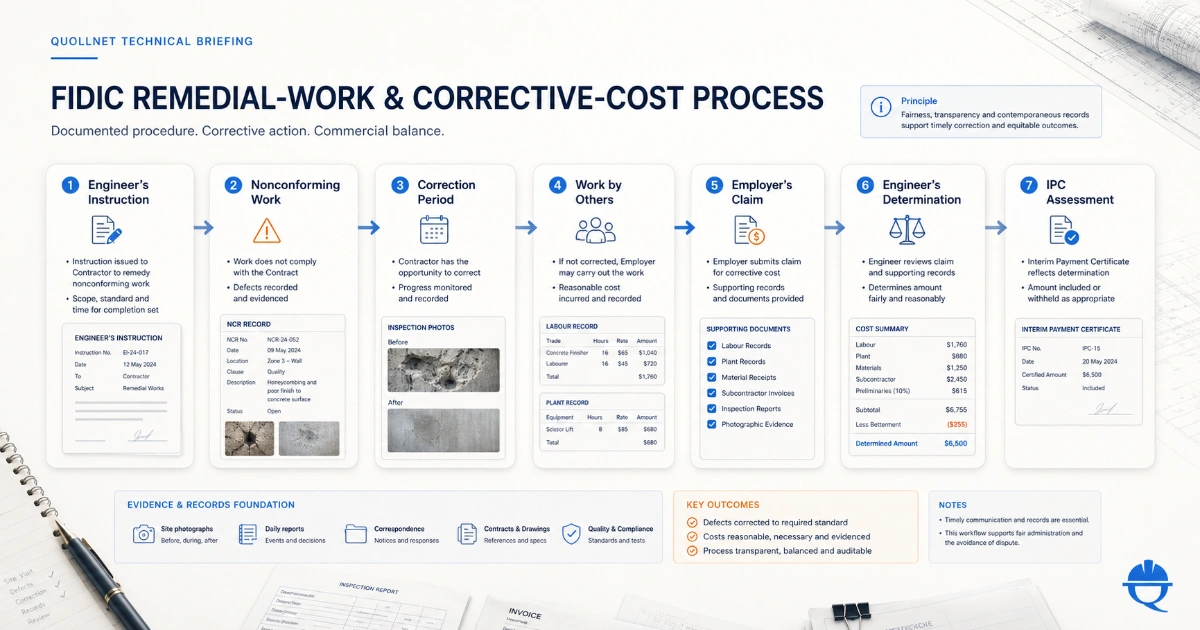
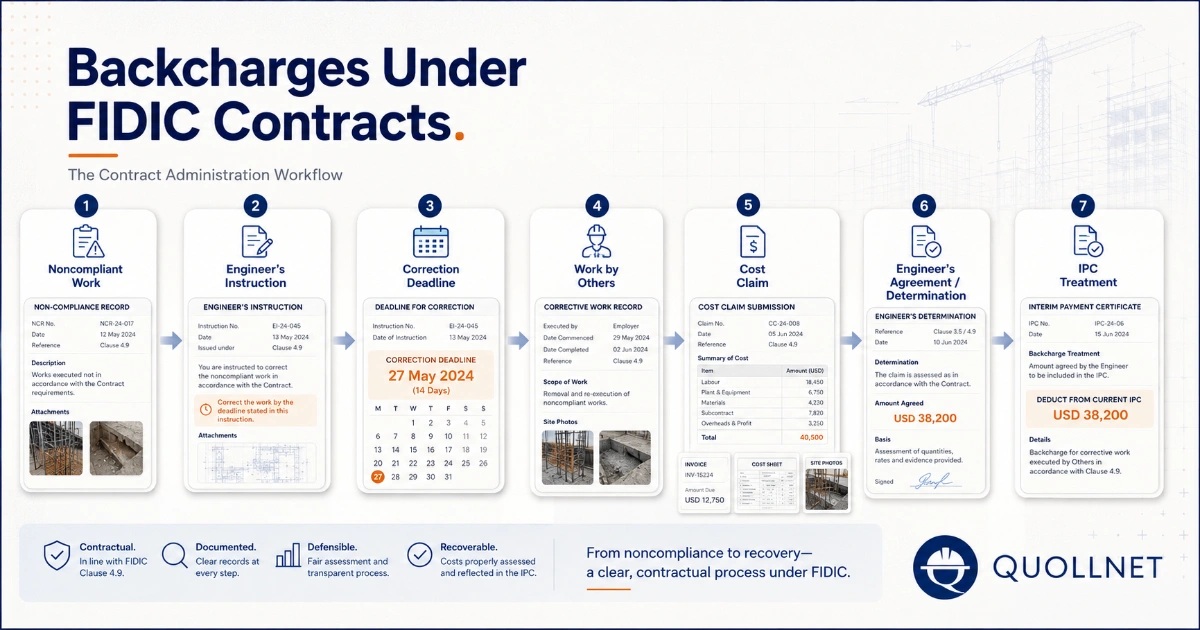
Compare the NEC procedure with the FIDIC remedial-work and backcharge procedure, AIA A201 and A401 correction-cost rules, and JCT instructions and payment deductions.
This article provides general construction contract-administration information and is not legal advice. The executed ECC or ECS, Contract Data, Scope, Subcontract Scope, Z clauses, amendments, governing law, and mandatory payment legislation control. Significant payment or Defect disputes require project-specific legal advice.
REFERENCES
NEC4 Engineering and Construction Contract and Subcontract Bundle
NEC4 Suite of Contracts: June 2017 Edition Revised January 2023
NEC: Defining and Managing Defects in the ECC
NEC: What NEC4 ECC Supervisors Do and Need to Know
NEC FAQ: Dealing with Uncorrected Defects under the ECS
NEC FAQ: Timing and Assessment of an Uncorrected Defect
NEC FAQ: Early Warning of a Defect
NEC: The Use and Abuse of Disallowed Cost
NEC: Compensation Events—An Introduction