Create a Work Breakdown Structure for 100% Coverage
Definition: Work breakdown structure creation checklist for project teams delivers end-to-end guidance to decompose scope, build a deliverable hierarchy, and validate 100% coverage with auditable evidence.
- Define deliverables, work packages, and acceptance criteria with clear IDs
- Ensure 100% scope coverage using MECE and dictionary cross-references
- Apply numbering, control accounts, and versioned governance for traceability
- Interactive, commentable checklist with export and QR code verification
Work breakdown structure is the foundation for organizing project scope into a clear, deliverable-based hierarchy. Also called a WBS, project breakdown, or scope decomposition, it helps teams transform a broad statement of work into manageable, measurable components. This checklist focuses on a deliverable-oriented, construction-ready approach applicable to any discipline and size, emphasizing the 100% rule, MECE thinking, and traceable work packages. By following these steps, you’ll prevent common risks such as double-counting, scope gaps, ambiguous ownership, and uncontrolled rework. You’ll also accelerate estimating, scheduling, cost control, and progress measurement by building a robust WBS dictionary and coding structure aligned to your organization. Use this interactive page to tick items, add comments for clarifications, and attach evidence (screenshots, matrices, approvals). When complete, export as PDF/Excel and authenticate the output via QR for fast sharing and audits.
- Build a deliverable-based WBS that enforces the 100% rule and MECE coverage across all levels. The checklist drives precise definitions, structured numbering, and evidence capture so every work package has clear acceptance criteria, ownership, and traceability to estimates, risks, and quality requirements.
- Accelerate downstream planning by defining completion criteria and dictionary entries before scheduling. Clear work package boundaries reduce logic errors, enable realistic duration estimates, and simplify resource planning, cost rollups, and change control. Evidence attachments and version tags maintain a reliable audit trail from baseline to closeout.
- Reduce ambiguity and rework with consistent coding, control accounts, and interface mapping. Structural validation detects orphans, duplicates, and overlaps early. Quantitative reconciliation with estimates and risk links keeps budgets aligned, highlights gaps, and supports approvals per approved project specifications and authority requirements.
- Interactive online checklist with tick, comment, and export features secured by QR code.
Plan Scope and Standards
Structure and Numbering
Decompose Deliverables
Validate and Optimize
WBS Dictionary and Traceability
Baseline, Communication, and Control
Deliverable-Based Decomposition for 100% Coverage
A robust WBS is deliverable-oriented: you decompose outputs, not activities. Start by clustering scope into Level-1 deliverables that collectively represent every contracted outcome. Then decompose each parent until its children fully describe the parent and each work package has a clear, testable completion definition. Applying the 100% rule ensures nothing is omitted; using MECE thinking prevents overlaps and double counting. Engage subject-matter experts in short workshops, keep decisions visible, and write dictionary entries as you go—don’t defer them. Stop decomposing when control is practical: typically when work packages can be estimated, sequenced, resourced, and objectively verified. This approach reduces downstream rework, stabilizes estimates, and makes scheduling faster because dependencies and interfaces become obvious when deliverables are explicit rather than implied.
- Decompose outputs, not tasks or methods
- Enforce the 100% rule at every level
- Use MECE to prevent overlap and gaps
- Write dictionary entries during workshops
- Stop when control is practical and testable
Numbering, Control Accounts, and Dictionary Discipline
Consistent coding keeps scope traceable from proposal through closeout. Establish a simple hierarchical mask early (for example 1, 1.1, 1.1.1), then lock auto-numbering to avoid manual errors. Nominate control accounts where scope, cost, and schedule integrate; give each an accountable owner. The WBS dictionary is your contract with execution teams: record each work package’s description, outputs, acceptance tests, assumptions, constraints, and exclusions. Link quality requirements and applicable specifications to the relevant WBS IDs to minimize interpretation risk. With this discipline, you can roll up quantities and budgets accurately, filter reports by responsibility, and hand off to planners with fewer questions and less waiting.
- Use hierarchical IDs with auto-numbering
- Define control accounts with named owners
- Complete dictionary fields without blanks
- Link requirements and risks to WBS IDs
Validation, Baseline, and Change Governance
Before baseline, verify structural integrity (no orphans, duplicate IDs, or unbalanced depths), reconcile quantitative rollups with your estimating model, and confirm contract deliverables are fully covered. Capture evidence: logs, screenshots, and approvals. Baseline only when acceptance checks are green. Move into controlled change by enabling versioning and a simple change request flow so every edit leaves an audit trail. Export the WBS to PDF/Excel alongside the native file and store them in a document management system. Use QR authentication to link printed sets back to the authoritative record, preventing outdated copies from circulating during execution.
- Run structural and coverage checks pre-baseline
- Reconcile rollups to estimates within tolerance
- Baseline once acceptance checks pass
- Use QR to authenticate printed exports
How to Use This WBS Creation Checklist
- Preparation: gather scope statement, drawings, SOW, and estimates; select a WBS template and tool; invite SMEs; set repository access and notification rules.
- Start interactive mode: open the checklist, assign owners, and set due dates. Tick items as you proceed and use comments to capture decisions.
- Work through Planning and Structure groups first to set decomposition criteria, numbering, and control accounts before any deep breakdown.
- Run decomposition workshops by deliverable. Draft dictionary entries in-session, attach screenshots, and record assumptions while context is fresh.
- Execute validation steps: structural checks, coverage matrix, and rollup reconciliations. Resolve comments before requesting baseline approval.
- Collaborate: mention reviewers, attach evidence, and log agreements. Use the comment thread to close open points and preserve the audit trail.
- Export: generate PDF/Excel plus native files. Archive to the document management system and verify the QR code resolves to the correct record.
- Sign-off: capture digital signatures from the PM and key stakeholders. Distribute links and restrict edits to change-controlled requests only.
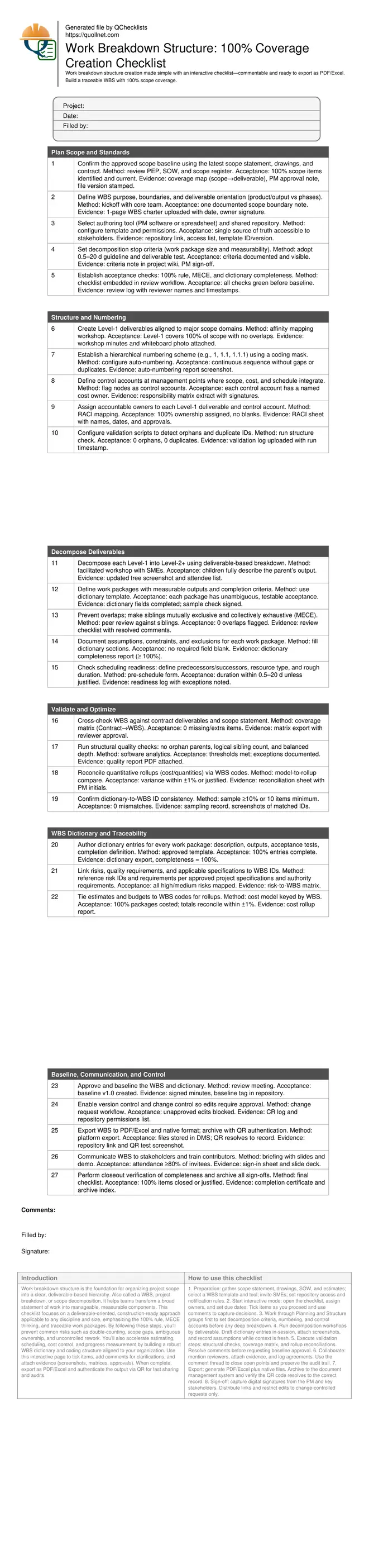
Call to Action
- Start Checklist Tick off tasks, leave comments on items or the whole form, and export your completed report to PDF or Excel—with a built-in QR code for authenticity.
- Download Excel - Work Breakdown Structure Creation
- Download PDF - Work Breakdown Structure Creation
- View Image - Work Breakdown Structure Creation
Cite & Embed
“Work Breakdown Structure Creation by Quollnet”
with a link to
this source page.
FAQ
Question: What is the difference between a work breakdown structure and a schedule?
Question: How deep should I decompose the WBS?
Question: How do I ensure 100% scope coverage without overlaps?
Question: Can I create a WBS before the design is finalized?
Question: How often should the WBS change during execution?
Related Articles
Broader reading and guidance connected to this checklist topic.
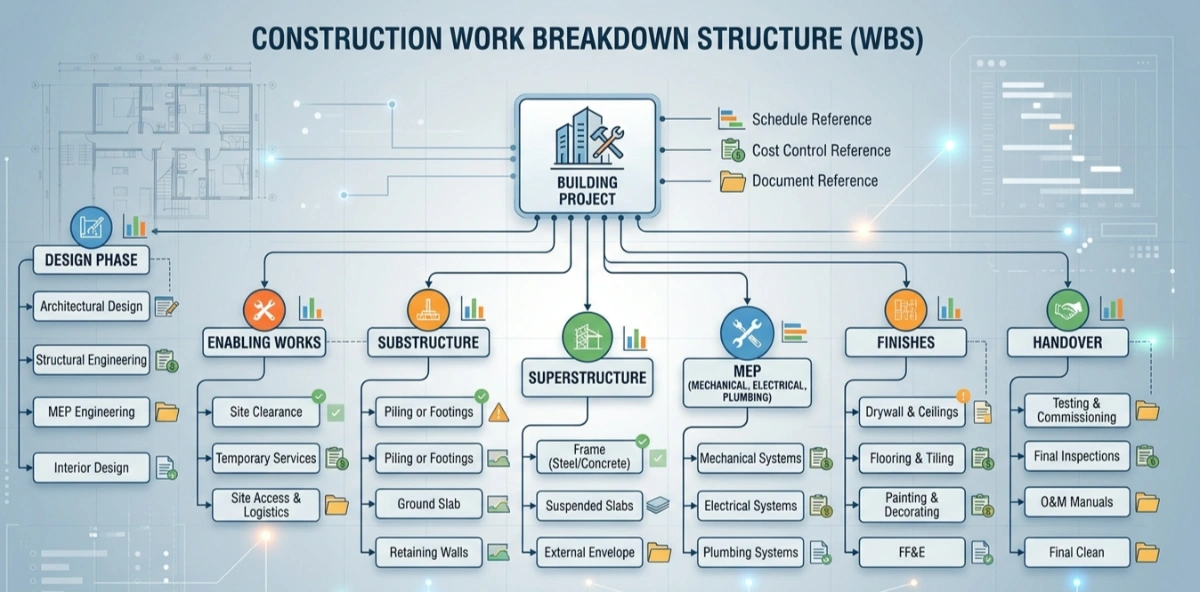
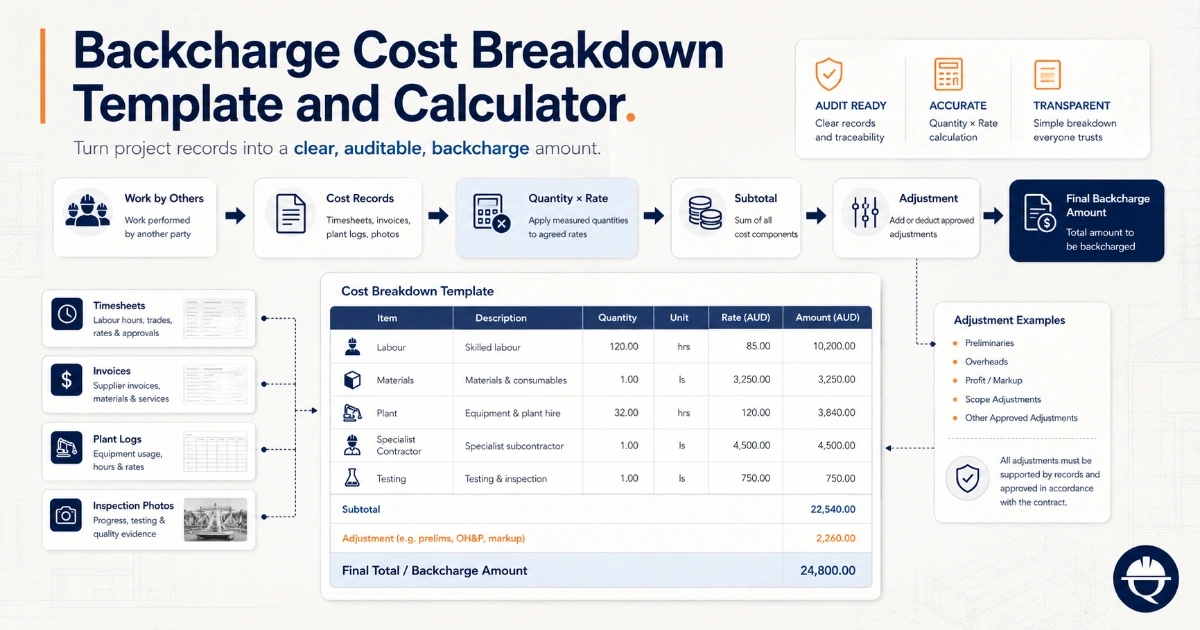
Backcharge Cost Breakdown Template And Calculator


Comprehensive Guide To Managing Variation Orders In Construction Projects

Related Checklists
Keep the workflow moving with nearby templates chosen from similar checklist content.