Substructure Handover Dossier Checklist (QA/QC, Tests, Warranties)
Definition: Substructure handover dossier compiles verified QA/QC records, test results, warranties, and approvals for foundations and below-grade works, guiding contractors and consultants to a clean, compliant closeout while excluding O&M manuals.
- Covers QA/QC records, tests, warranties, and authority approvals only
- Ensures traceable evidence, sign-offs, and compliant, dispute-ready closeout
- Uses rigorous indexing, metadata, and cross-referenced document control
- Interactive, commentable checklist with export and QR code authenticity
Substructure handover dossier is the definitive closeout package for foundations, piles, pile caps, rafts, basement slabs, and retaining structures. It consolidates quality records, inspection and test plans (ITPs), as-built documentation, laboratory test reports, warranties, and approvals while explicitly excluding O&M manuals. Within this focused scope, you’ll assemble material certificates, mix design approvals, concrete strength results in MPa, waterproofing test evidence, survey as-builts in metres, and closeout of NCRs/CARs. The objective is a complete, traceable record proving the substructure is built per approved project specifications and authority requirements. Done well, the dossier prevents delayed practical completion, rework, and claims arising from undocumented variances or missing tests. It also accelerates payments and sets a reliable baseline for superstructure works. Use this interactive, commentable checklist to guide collection, verification, and sign-off; then export your dossier index and evidence register to PDF/Excel with a secured QR link for authentication.
- Deliver a single-source, evidence-backed package for substructure works that integrates ITPs, material certificates, lab tests, survey as-builts, warranties, and approvals. Explicitly exclude O&M manuals to keep scope tight and prevent cross-scope confusion or closeout delays.
- Build reliable traceability with consistent file naming, revision control, metadata (location grids, pour IDs), and cross-referencing from index to evidence. This structure speeds consultant review, reduces queries, and safeguards against disputes by linking every claim to primary records.
- Interactive online checklist with tick, comment, and export features secured by QR code. Collaborate in real time, attach photos and reports, and generate a PDF/A dossier and Excel registers that meet audit expectations and support rapid, defensible handover decisions.
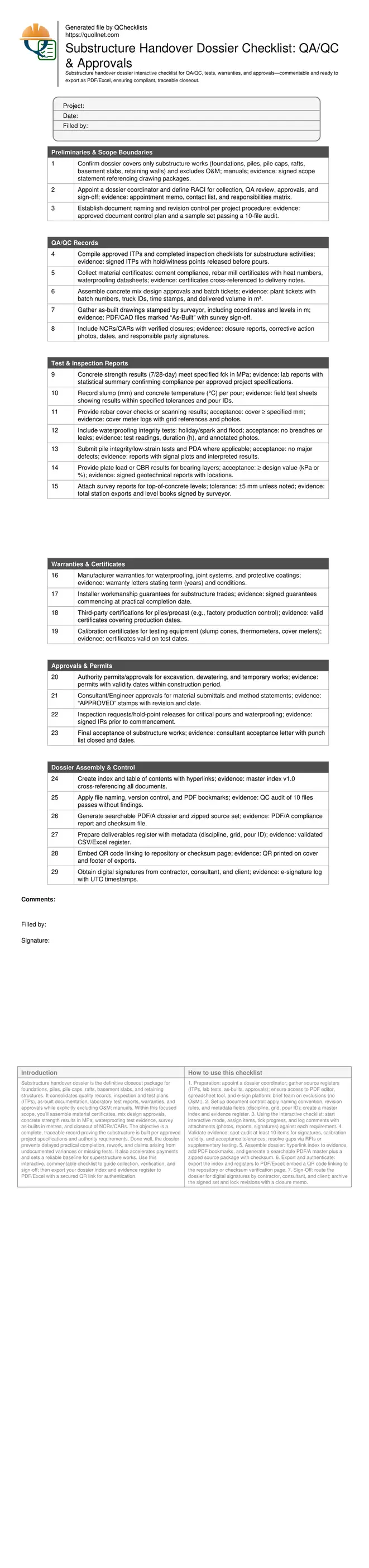
Preliminaries & Scope Boundaries
QA/QC Records
Test & Inspection Reports
Warranties & Certificates
Approvals & Permits
Dossier Assembly & Control
Scope, Boundaries, and the Value of a Focused Substructure Dossier
A disciplined dossier starts by defining what belongs—and what stays out. This checklist targets foundations, piles, pile caps, rafts, basement slabs, and retaining structures, assembling QA/QC records, test reports, warranties, and approvals. It deliberately excludes O&M manuals to prevent scope creep that confuses reviewers and stalls closeout. By aligning content with approved project specifications and authority requirements, the package demonstrates that materials, methods, and results meet acceptance criteria. The payoff is speed and certainty: quicker consultant approvals, fewer resubmissions, reduced claims risk, and a defensible record that protects all parties. Clear boundaries also help site teams focus collection efforts where they matter most—on test evidence, traceability, and sign-offs that prove conformity. The result is a clean, auditable handover that anchors the start of superstructure works and supports payment milestones without ambiguity.
- Keep O&M manuals out to avoid cross-scope delays.
- Tie every record to drawings, pours, or locations.
- State acceptance criteria clearly next to evidence.
- Use approvals and releases to prove timing compliance.
Traceability, Indexing, and Document Control that Survive Audits
Traceability underpins review speed and legal resilience. Adopt a naming convention that embeds discipline, location grid, pour ID, and revision; maintain a live register mapping index entries to evidence. Use PDF bookmarks and hyperlinks so reviewers can jump from the index to primary documents instantly. Audit a sample set to catch missing signatures, invalid calibration dates, or obsolete revisions before submission. Produce a searchable PDF/A master and include original source files in a zipped archive for transparency. On real projects, this approach short-circuits endless RFI loops: for example, an IR release linked directly to batch tickets and 28‑day results ends debate about pour timing and conformity. The combination of structure, metadata, and cross-references turns a pile of files into a coherent quality proof accepted the first time.
- Standardise file names and embed location metadata.
- Maintain a live register with hyperlink targets.
- Audit 10 random files for signatures and dates.
- Deliver PDF/A plus the zipped source set.
Acceptance Evidence: Tests, Warranties, and Approvals that Matter
Acceptance hinges on measurable results and valid endorsements. For concrete, confirm strength in MPa meets fck with adequate sampling and lab accreditation. Cross-check slump (mm) and temperature (°C) logs against pour IDs. Verify rebar cover via scans or spot checks meets the specified minimum. For waterproofing, provide holiday/spark test reports and documented flood tests showing no leaks. Calibrations for instruments must be valid on the test dates. Warranties from manufacturers and installers should specify terms and triggers, while authority permits and consultant approvals must align with construction dates. Typical pitfalls include missing survey sign-off for levels, unclosed NCRs, and expired calibration certificates. This checklist guides you to close those gaps early so final acceptance is frictionless and backed by unambiguous evidence.
- Match tests to pours, grids, and dates.
- Confirm calibration validity on test dates.
- Show waterproofing integrity with photos and logs.
- Close NCRs/CARs with verified actions.
How to compile, collaborate on, and sign off this dossier
- Preparation: appoint a dossier coordinator; gather source registers (ITPs, lab tests, as-builts, approvals); ensure access to PDF editor, spreadsheet tool, and e-sign platform; brief team on exclusions (no O&M).
- Set up document control: apply naming convention, revision rules, and metadata fields (discipline, grid, pour ID); create a master index and evidence register.
- Using the interactive checklist: start interactive mode, assign items, tick progress, and log comments with attachments (photos, reports, signatures) against each requirement.
- Validate evidence: spot-audit at least 10 items for signatures, calibration validity, and acceptance tolerances; resolve gaps via RFIs or supplementary testing.
- Assemble dossier: hyperlink index to evidence, add PDF bookmarks, and generate a searchable PDF/A master plus a zipped source package with checksum.
- Export and authenticate: export the index and registers to PDF/Excel; embed a QR code linking to the repository or checksum verification page.
- Sign-Off: route the dossier for digital signatures by contractor, consultant, and client; archive the signed set and lock revisions with a closure memo.
Call to Action
- Start Checklist Tick off tasks, leave comments on items or the whole form, and export your completed report to PDF or Excel—with a built-in QR code for authenticity.
- Download Excel - Substructure Handover Dossier Checklist
- Download PDF - Substructure Handover Dossier Checklist
- View Image - Substructure Handover Dossier Checklist
Cite & Embed
“Substructure Handover Dossier Checklist by Quollnet”
with a link to
this source page.

FAQ
Question: What is included in a substructure handover dossier, and what is excluded?
Question: How do I handle missing tests or expired calibration certificates?
Question: What file formats and structure should the dossier use for fast approval?
Question: Who should sign the final dossier and when?
Related Articles
Broader reading and guidance connected to this checklist topic.
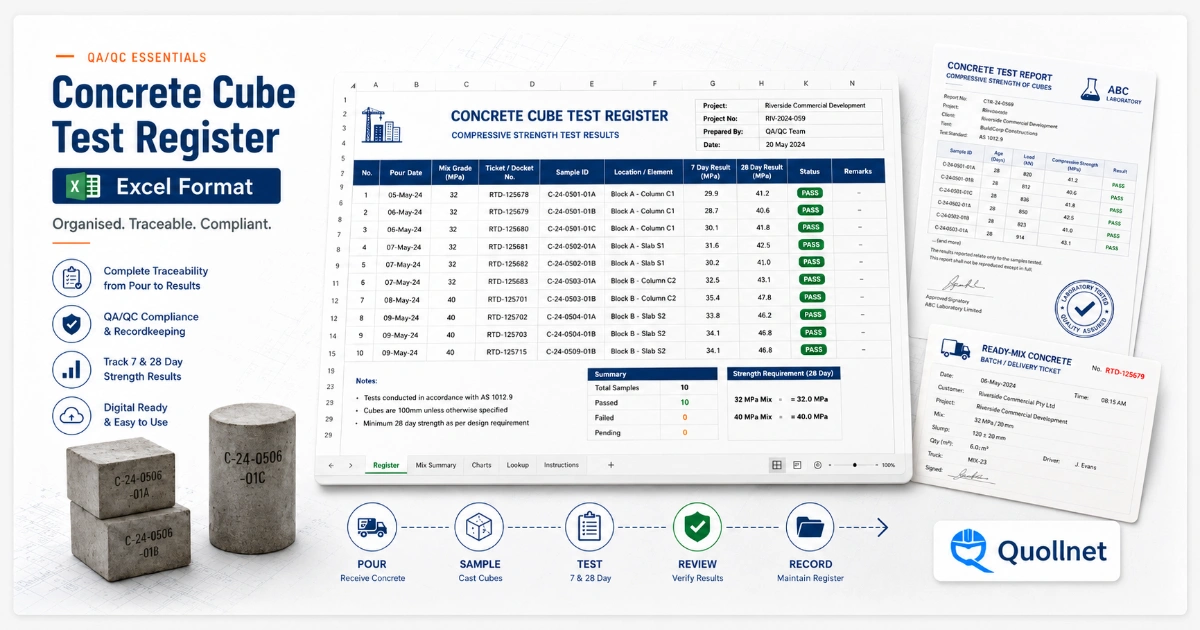
Concrete Cube Test Register Excel Format – Pdf & Excel Sample

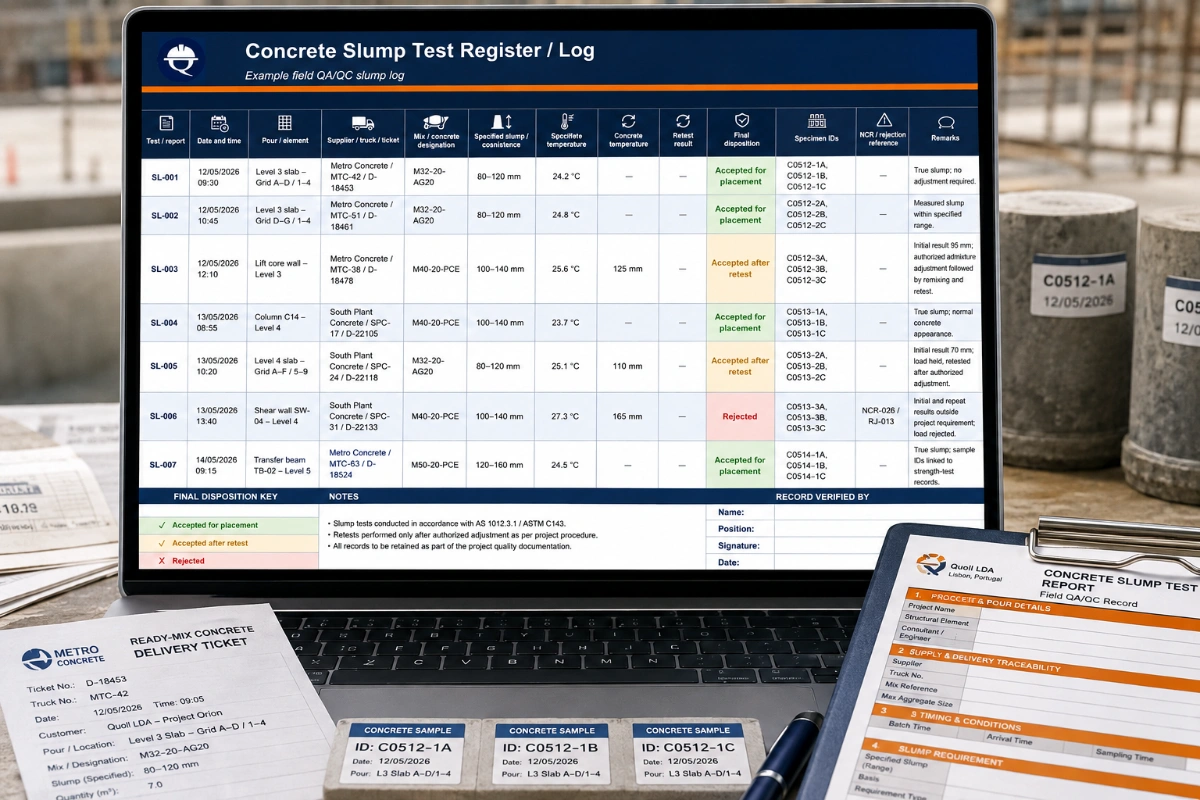
Concrete Slump Register & Log Template

Related Checklists
Keep the workflow moving with nearby templates chosen from similar checklist content.