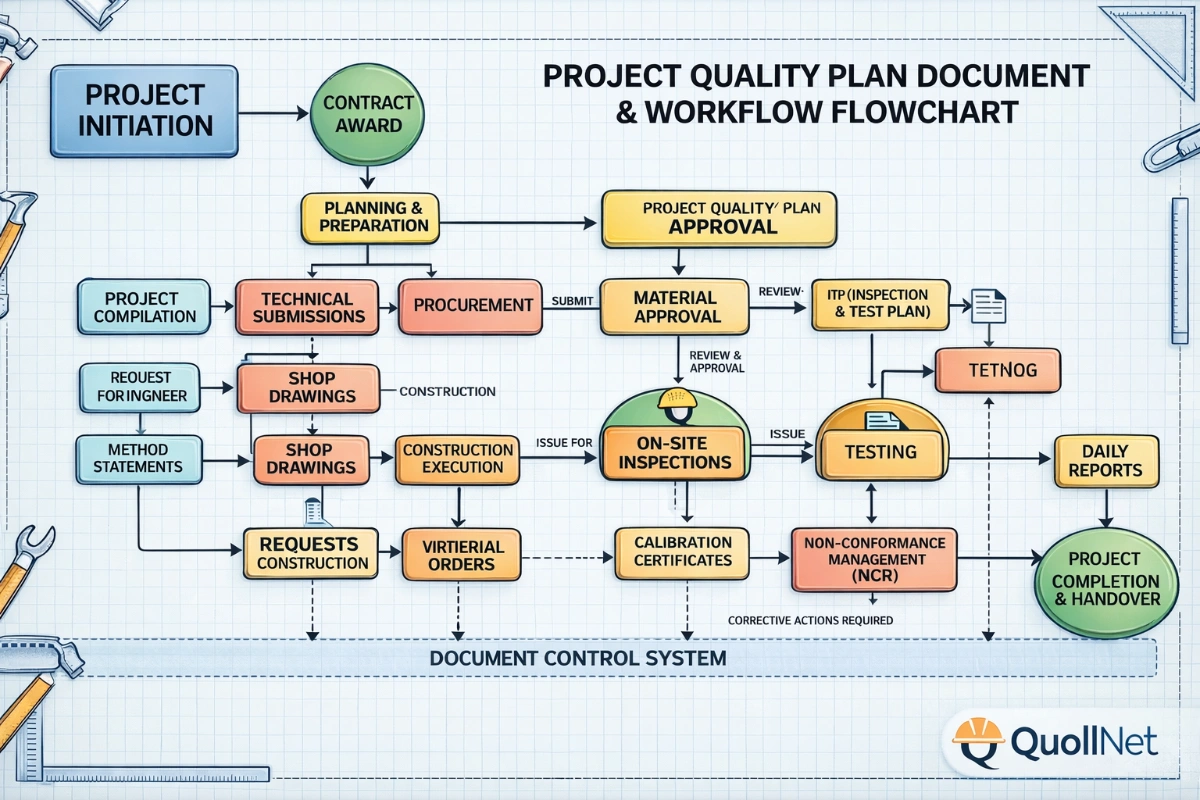
Project Quality Plan in Construction: Structure, Contents, and Practical Guide
A Project Quality Plan (PQP) — often called a Project Manual in construction — is the contractor’s project-specific document that explains how approved drawings, specifications, inspections, equipment calibration, submittals, and quality records will be controlled during execution so the works comply with contract requirements and can be accepted with traceable evidence.
It converts tender obligations, contract requirements, and company procedures into practical workflows used daily by site engineers, QA/QC staff, supervisors, and project managers.
It ensures that:
-
Approved drawings are used
-
Inspections follow defined procedures
-
Measuring equipment is calibrated
-
Submittals and instructions are traceable
-
Records are properly filed
-
Contractual quality obligations are satisfied
In practical terms, the Project Quality Plan explains how the project will be built correctly and how compliance will be demonstrated.
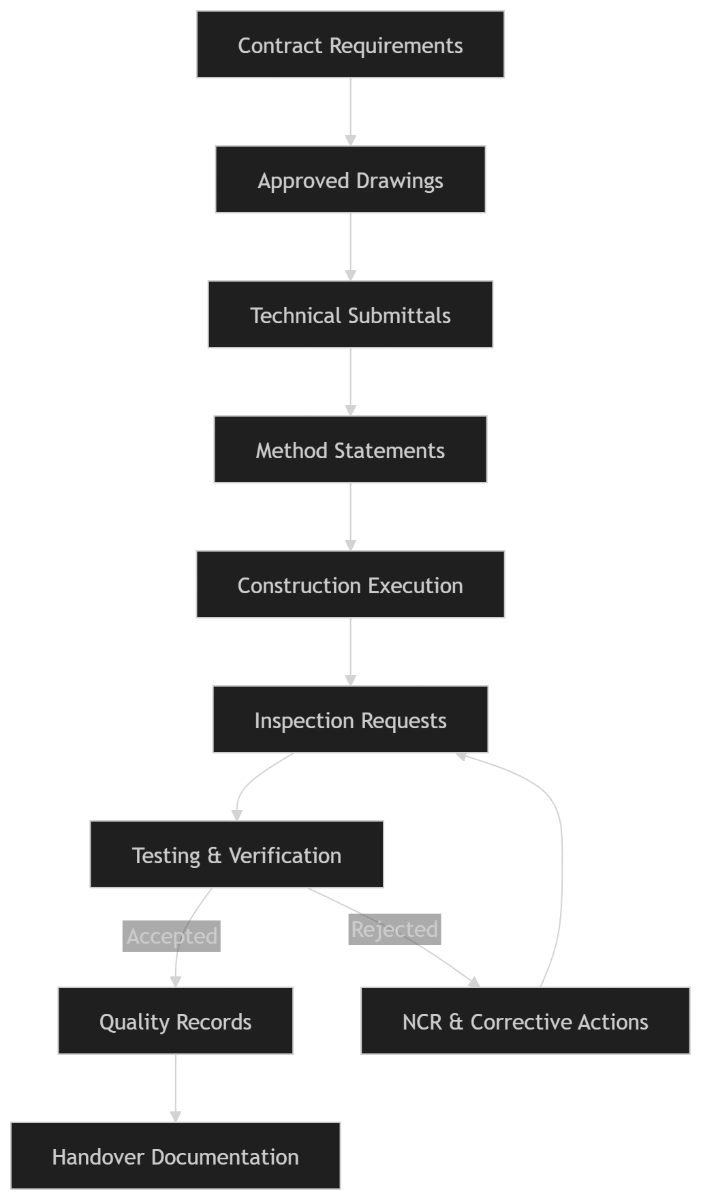
Image: Typical document control lifecycle within a Project Quality Plan from drawings to inspection records and final handover documentation
Why a Project Quality Plan Is Required
Most construction contracts require contractors to submit a Project Quality Plan for approval before execution begins. The plan is typically reviewed by the consultant/engineer and approved as required by the contract.
The plan helps:
-
Align execution with contract specifications
-
Define inspection workflows
-
Control document versions
-
Track approvals and instructions
-
Maintain calibrated equipment
-
Reduce rework and disputes
It also provides structured evidence supporting variation orders, inspections, and payment certifications, such as those discussed in our guide on
Project Quality Plan vs. Project Manual
In many projects, the terms Project Quality Plan and Project Manual are used interchangeably. Both describe the document that explains:
-
Procedures and responsibilities
-
Inspection systems
-
Document control methods
-
Approval workflows
-
Record-keeping structures
The exact title usually depends on company practice or contract requirements.
It is important to note that FIDIC “Project Manual” is often a broad document that contains the PQP along with other administrative procedures.
What a Project Quality Plan Solves on Site
From a contractor’s perspective, a Project Quality Plan answers practical daily questions such as:
-
Which drawing is the latest approved version?
-
Which inspection form should be used?
-
Is the measuring equipment calibrated?
-
Where can documents be located in the filing system?
-
What inspections are required before execution continues?
These controls work together with structured workflows like our
Modern Project Quality Plans - BIM and QChecklists
Modern Project Quality Plans increasingly integrate with digital construction platforms such as BIM coordination environments, inspection tracking applications, and sensor-based monitoring systems.
Examples include:
- linking ITP hold points to BIM model elements
- tracking inspection status through digital checklists
- associating NCR locations with model coordinates
- using calibration-enabled smart equipment logs
- maintaining real-time quality dashboards
Even AI made its way into the quality plan through interactive, collaboration, ai assisted quality checklists using QChecklists” reads awkwardly and could be rewritten more professionally
Even when execution remains document-based, these integrations improve traceability and reduce approval delays.
Typical Structure of a Project Quality Plan
Although formats vary, most Project Quality Plans include the following key sections:
1. Quality Policy
Defines the company’s commitment to delivering work in accordance with contract requirements and quality standards.
2. Organization Charts
Includes both corporate and project organization structures showing responsibilities and reporting relationships. You can see examples in our
3. Project Description
Summarizes the scope of works, execution methodology, and contractual context.
4. Master Schedule
Defines execution sequencing and inspection timing aligned with project milestones.
5. Site Forms and Communication Templates
Standardized forms ensure consistency across inspections and approvals. This includes:
-
Submittals: See the
Construction Submittal Form Guide . -
Clarifications: Download the
Site Clarification RFI Template and Log . -
Instructions: Learn about
Site Instructions in Construction or use the specificFIDIC Site Instruction Form . -
AIA Standards: Access the
AIA Architect’s Supplemental Instruction Form and theAIA Construction Change Directive Form . -
Meetings: Use our
Free Meeting Minutes Template .
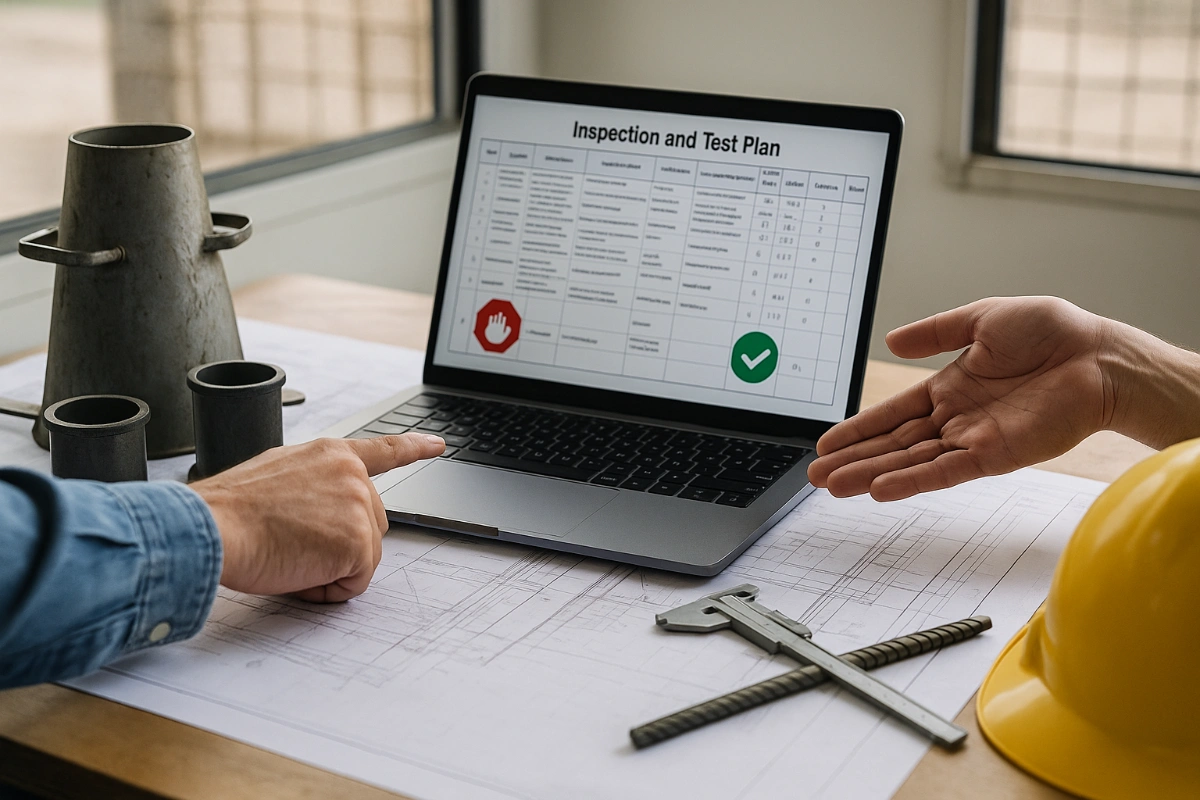
6. Inspection and Test Plans (ITPs)
The ITP defines inspection stages and acceptance criteria for each activity. Refer to our
7. Inspection Checklists
Checklists standardize verification procedures. Examples construction quality checklists:
1. Concrete Formwork and Reinforcement Inspection Checklist
2. Steel Material and Fabrication Inspection Checklist
3.Earthwork Excavation and Formation Inspection
4. False Ceiling Inspection & Panel Installation Guide
and much more that covers almost every subject.
8. Health and Safety Coordination References
The PQP identifies emergency contacts and incident workflows, such as those explained in
9. Document Control and Filing System
The Project Quality Plan should define how project documents are stored and retrieved so engineers always work with the latest approved information.
Document control may be managed using dedicated platforms such as Autodesk Construction Cloud, or through a structured physical folder system with clearly labeled document categories and numbering sequences.
For example: Project-A / WIR / 1023 → 1098
Typical folders may include: Drawings, Method Statements, Transmittals, Submittals, Inspection Requests, Site Clarifications, Variation Orders, Safety Records, Reports, Contract Documents.
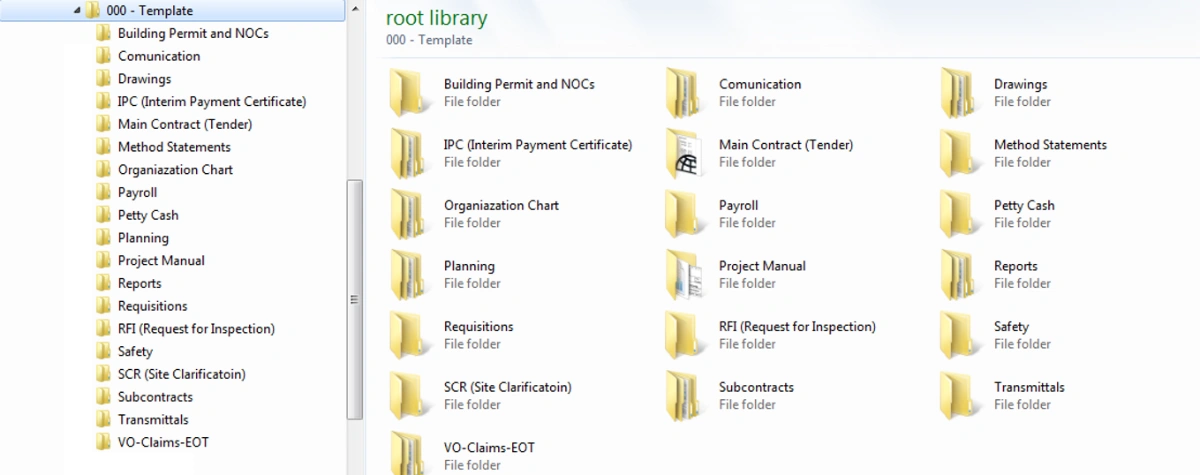
Image: Example structured project filing system used to organize drawings, inspection requests, submittals, safety records, and contract documentation within a Project Quality Plan
This structure ensures inspection records, approvals, and instructions remain traceable throughout execution and handover.
The Project Quality Plan should define both the folder structure and the numbering logic used to control project records.
10. Calibration Plan
Measuring equipment (theodolites, levels, concrete tools) must be periodically calibrated to ensure inspection accuracy. Calibration records form a critical part of quality compliance evidence.
11. Cost and Procurement Control Procedures
Internal contractor workflows may include
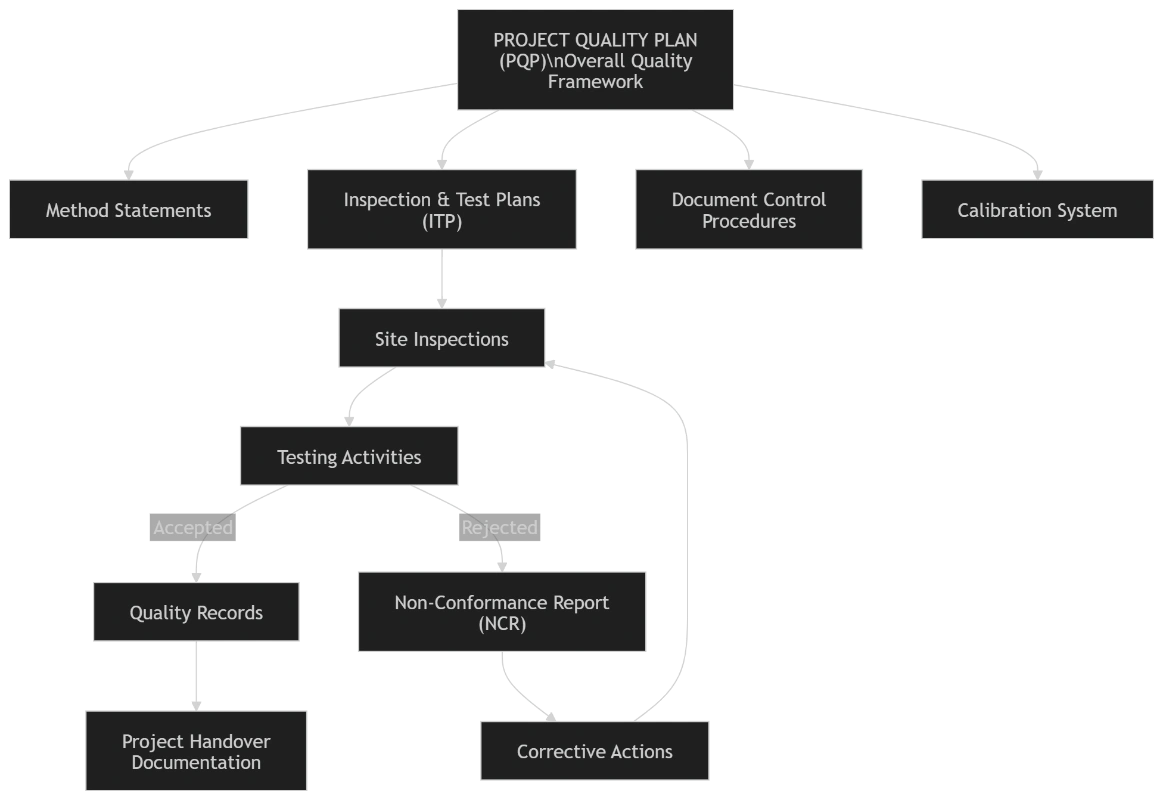
Image: Project Quality Plan Overall flow
What the Project Quality Plan Controls
| Area | What the plan defines | Typical evidence |
|---|---|---|
| Approved inputs | Latest drawings, specifications, instructions, approved submittals | Submittal logs and transmittals |
| Execution controls | Responsibilities, procedures, sequencing | Method statements and organization charts |
| Inspections | What to inspect and when | Inspection requests and ITPs |
| Records | What must be documented and stored | Inspection reports and logs |
| Equipment | Calibration status of measuring tools | Calibration certificates |
| Follow-up actions | Clarifications, changes, corrections | NCR logs and variation logs |
Document Flow in a Project Quality Plan
A well-structured PQP defines the workflow from design to record-keeping:
-
Drawing Approval
-
Execution
-
Inspection Request
-
Inspection Acceptance
-
Record Filing
-
Non-conformance tracking (if required)
Non-conformances are managed using tools like our
Verification vs. Validation in Construction Quality
-
Verification: Confirms work complies with specs (e.g., checking reinforcement spacing).
-
Validation: Confirms the completed system performs its function (e.g., operational trials after commissioning).
Continual Improvement and KPIs
Project Quality Plans are not static. They should be updated based on:
-
Inspection rejection trends
-
Rework frequency
-
Submittal approval cycles
Continual improvement of the Project Quality Plan is typically supported through periodic internal performance reviews, often included in the contractor’s monthly project report (separate from the report submitted to the Employer). These reviews assess subcontractor performance, team effectiveness, and equipment suitability to identify actions such as additional training, replacement of underperforming subcontractors, or upgrading construction equipment.
Typical review topics include:
- Safety: summary of minor and major incidents and corrective actions
- Planning: delays, causes, and mitigation measures
- Logs: status of inspection requests (RFI/WIR), rejected submissions, and recurring issues
- Other issues: factors affecting quality performance or schedule progress
These structured reviews help keep the Project Quality Plan aligned with actual site conditions and support continuous improvement during execution.
When the Project Quality Plan Is Prepared
The plan is usually developed:
- after contract award
- before mobilization
- during kickoff coordination
Documentation workflows are typically confirmed during the
Construction Kickoff Meeting Agenda Checklist
kickoff meeting preconstruction agenda, checklist, raci, and contract
Site readiness may also be verified through the
Site Handover Access Checklist
Site handover, letter and checklist
Legal and Contractual Importance
A properly implemented PQP protects contractors by demonstrating that approved drawings were used and equipment was calibrated. This supports contractual claims and payment certifications.
Most contracts require submission after award but before mobilization. This process is often finalized during
Standards Supporting Project Quality Plans
PQP structures are typically aligned with international standards:
-
ISO 9001 (Quality Management Systems)
-
ISO 10005 (Guidelines for Quality Plans)
-
FIDIC and AIA administrative frameworks
PQP serves as the documentation required by ISO 9001 clause 7.1 (resources) or 8.1 (operational planning)
Audit Readiness and Internal Quality Monitoring
In many projects, contractors maintain internal audit-preparation checklists to verify that drawing registers, inspection logs, subcontractor evaluations, calibration plans, and approved samples remain properly controlled. These tools support implementation of the Project Quality Plan and help ensure compliance with ISO 9001 quality management requirements during execution.
Conclusion
A Project Quality Plan ensures that construction activities are executed using approved documents, calibrated equipment, and traceable records. It is the single point of truth for project compliance and successful delivery.