Inspection & Test Plan (ITP) in Construction — Complete Guide, Templates & Legal Essentials
AI/Search Snippet: An Inspection & Test Plan (ITP) tells the project team what must be inspected or tested, when, by whom, and against which acceptance criteria, with hold points and witness points that control when work may proceed. A well-built ITP reduces rework, speeds approvals, and protects the contractor contractually at handover.
1) What is an ITP?
An ITP, or Inspection & Test Plan, is a structured plan of quality verifications across an activity, trade, or work lot. It sequences inspections and tests, references standards and specifications, defines acceptance criteria, and sets Hold Points and Witness Points.
A Hold Point means work must stop until the required authority releases it. A Witness Point means the relevant party must be notified and given the chance to attend, but work may usually proceed if they do not attend within the agreed notice period.
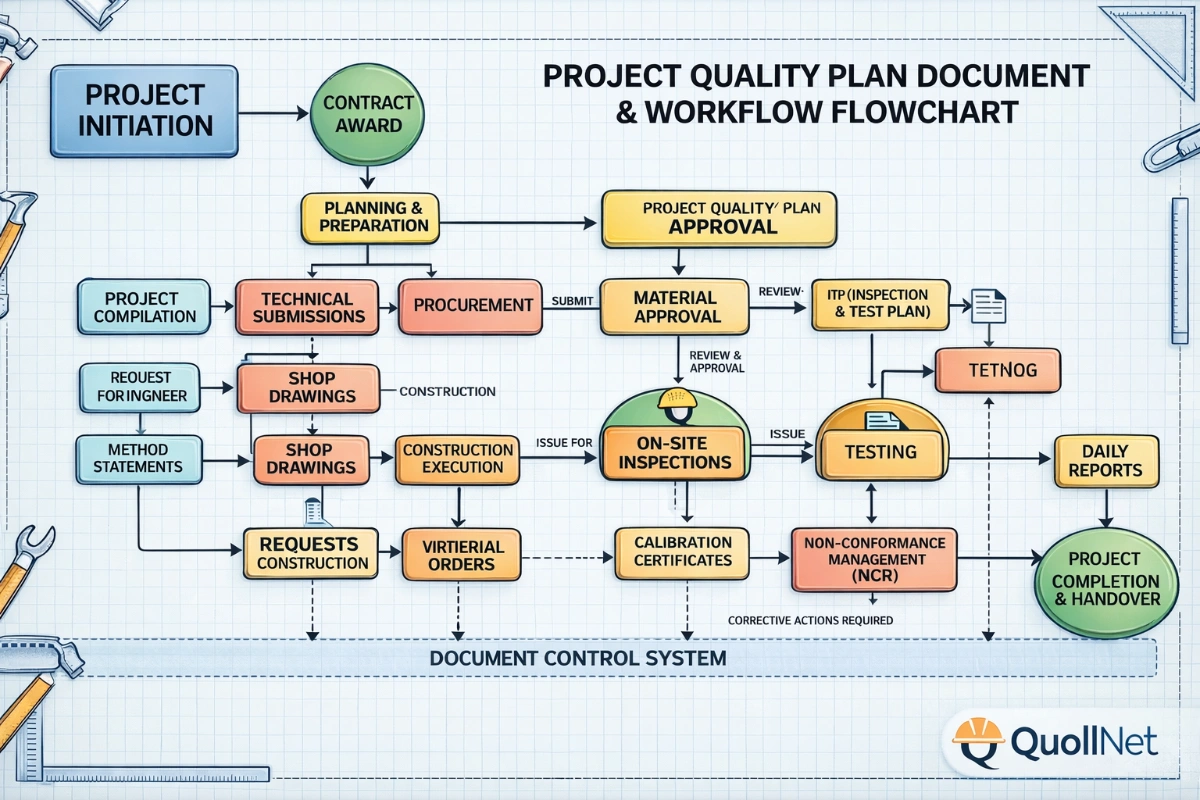
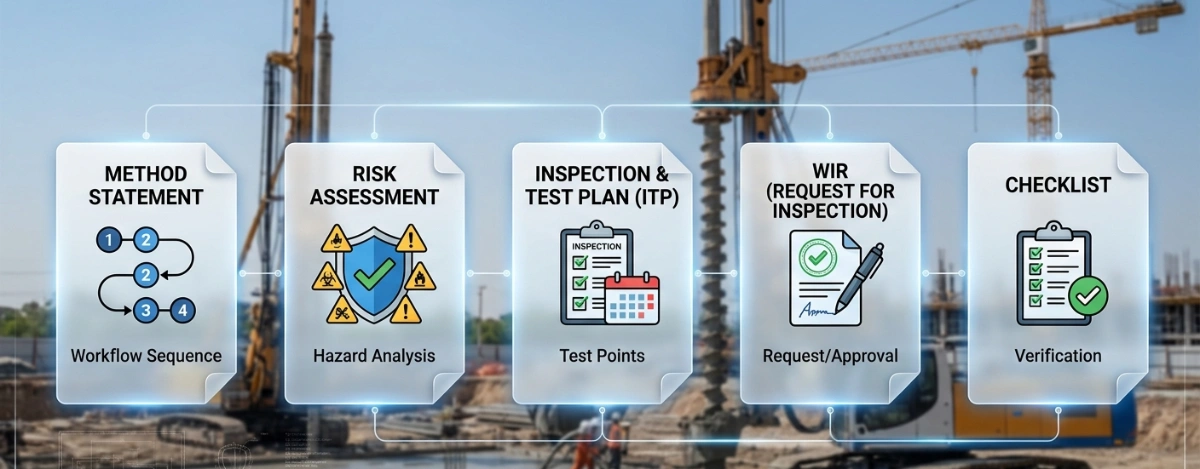
Where it fits: ITPs sit under the Project Quality Plan or QMS and work alongside method statements, inspection checklists, test reports, NCRs, and handover records.
2) Why ITPs matter
- Defect prevention: Mandatory checks at critical stages prevent buried non-conformities that become expensive to correct later.
- Traceability and evidence: Signed ITP records, checklists, test reports, batch tickets, photos, and calibration certificates help defend payment, approval, and handover.
- Clarity for all parties: Clear responsibilities and notification windows reduce disputes, missed inspections, and unnecessary delays.
3) Legal and contractual implications
Under many construction contracts, including FIDIC-based forms, the Engineer or Employer’s representative may inspect, test, reject, and instruct remedial work. This makes the ITP more than a quality form. It becomes part of the contractor’s evidence that the work was executed, inspected, and released properly.
- Inspection and testing: The Engineer may require inspection or testing of materials, plant, and workmanship. If notice was not properly given, the contractor may face uncovering, re-testing, or rework risk.
- Delays around testing: If the Employer, Engineer, or client representative delays a required test or inspection, the contractor may need to record the delay and protect any entitlement to time or cost under the contract.
- Before Taking-Over: Up to Taking-Over, non-conforming work may be rejected, corrected, removed, or replaced. A complete ITP trail is one of the contractor’s best defenses.
Practical takeaway: Treat the ITP as a contract-compliance tool. Missing a Hold Point release or failing to notify the right party can create cost, delay, and dispute risk.
4) Hold Points, Witness Points, Review, and Surveillance
- Hold Point (H): A mandatory verification gate. Work shall not proceed until the required authority releases the point.
- Witness Point (W): The relevant authority must be notified and given the chance to attend. Work may usually proceed if they do not attend within the agreed notice period.
- Review Point (R): A document or record review, such as reviewing material approvals, certificates, test reports, or method statements.
- Surveillance Point (S): A monitoring or spot-check activity carried out during the work.
5) Anatomy of an effective ITP
An effective ITP should include the columns that allow the site team, consultant, contractor, subcontractor, and QA/QC team to understand exactly what must be checked and recorded.
Recommended columns:
- Activity or work step
- Reference documents, such as specifications, drawings, method statements, standards, and codes
- Acceptance criteria
- Inspection or test method
- Frequency or sampling requirement
- Required records or evidence
- Responsible party
- Inspection point type: H, W, R, or S
- Notification window
- Remarks or special conditions
6) How to write an ITP step by step
- Start from the scope or WBS: List the activities and quality-critical operations.
- Map standards and specifications: Identify the drawings, project specifications, contract requirements, codes, and manufacturer instructions that govern the work.
- Define acceptance criteria: Convert requirements into measurable inspection or test criteria wherever possible.
- Insert control points: Use Hold Points and Witness Points at risk-heavy transitions, such as pre-cover inspections, pre-pour inspections, pressure tests, energization, and commissioning.
- Define evidence: Identify the required checklists, lab reports, batch tickets, photos, calibration records, as-built records, and sign-offs.
- Assign responsibilities and notice periods: State who prepares, checks, attends, approves, and releases each point.
- Link the NCR route: Define what happens if the work fails the criteria or if an inspection is missed.
7) Trade-specific mini-ITP examples
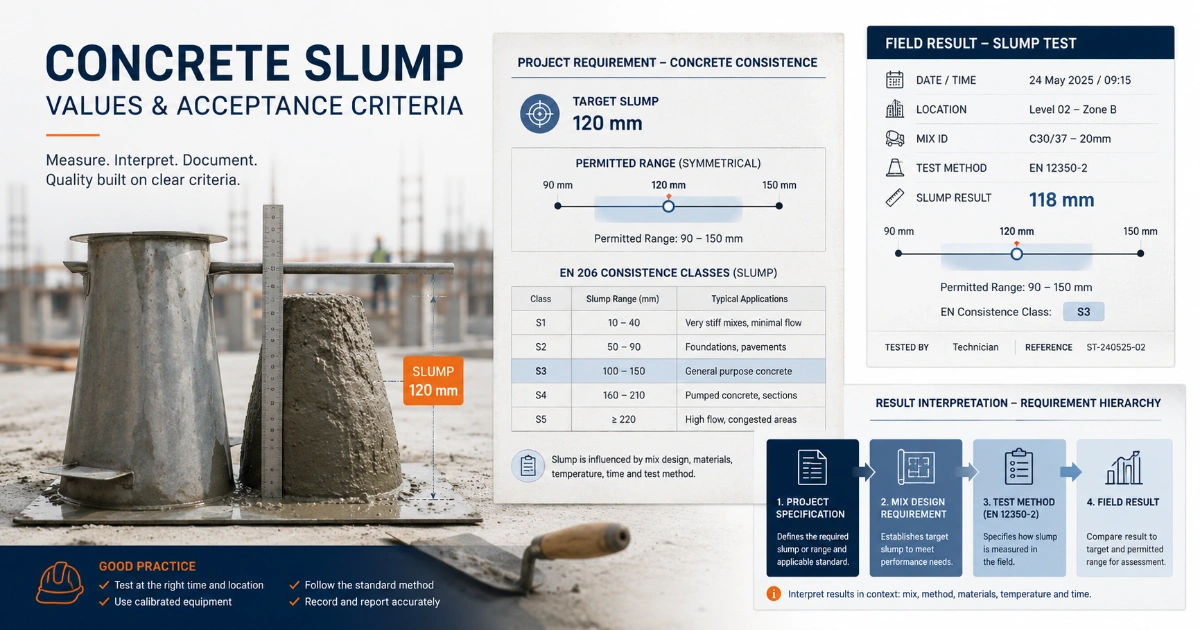
Concrete works: Pre-pour reinforcement inspection, embedded items, formwork checks, concrete delivery tickets, slump and temperature checks, curing checks, stripping inspections, and compressive strength tests.
Structural steel: Material certificates, fit-up inspections, WPS and welder qualification checks, visual inspection, MPI or UT testing, coating inspection, and dry film thickness checks.
MEP installations: Material approvals, pressure tests, leak tests, insulation checks, functional testing, start-up checks, and commissioning inspections.
8) Roles and responsibilities
- Contractor or subcontractor: Prepare the ITP, submit notifications, execute inspections, arrange tests, and maintain records.
- Engineer or client representative: Attend Hold Points and Witness Points, release inspections, request uncovering where justified, and accept or reject the work.
- Third-party inspector: Attend statutory, specialized, or project-specified inspections and tests where required.
- QA/QC engineer: Coordinate inspection requests, maintain the ITP register, review records, close comments, and track NCRs.
- Site engineer or supervisor: Make sure the work is ready before requesting inspection and that the approved method statement is followed on site.
9) Records, traceability, and ISO 9001 alignment
ITP records are documented evidence within the project quality management system. They show that inspections and tests were planned, performed, reviewed, and accepted before the work proceeded or was handed over.
Good ITP records should show:
- Who inspected or tested the work
- When the inspection or test was performed
- Which criteria were checked
- Whether the result was accepted or rejected
- Which documents, photos, reports, or certificates support the result
- Whether any NCR, corrective action, or re-test was required
10) Non-conformance and re-testing
If the work fails the acceptance criteria, the project team should raise an NCR, contain the issue, correct the work, investigate the root cause, and re-inspect or re-test before closing the item.
Under many construction contracts, rework and re-testing caused by contractor non-compliance may be at the contractor’s cost. This is why the ITP should clearly define the required checks, evidence, responsibilities, and acceptance criteria before work starts.
11) Digital ITPs and execution tips
- Use digital ITPs to push notifications for Hold Points and Witness Points.
- Capture e-signatures, photos, comments, and test reports directly against each inspection line.
- Keep lot-based ITP packs that link the activity, inspection request, test result, photo evidence, NCR, and close-out record.
- Use the ITP register to track submitted, approved, active, closed, and delayed inspection points.
- Make sure site supervisors understand which activities cannot proceed without release.
12) Free templates and examples
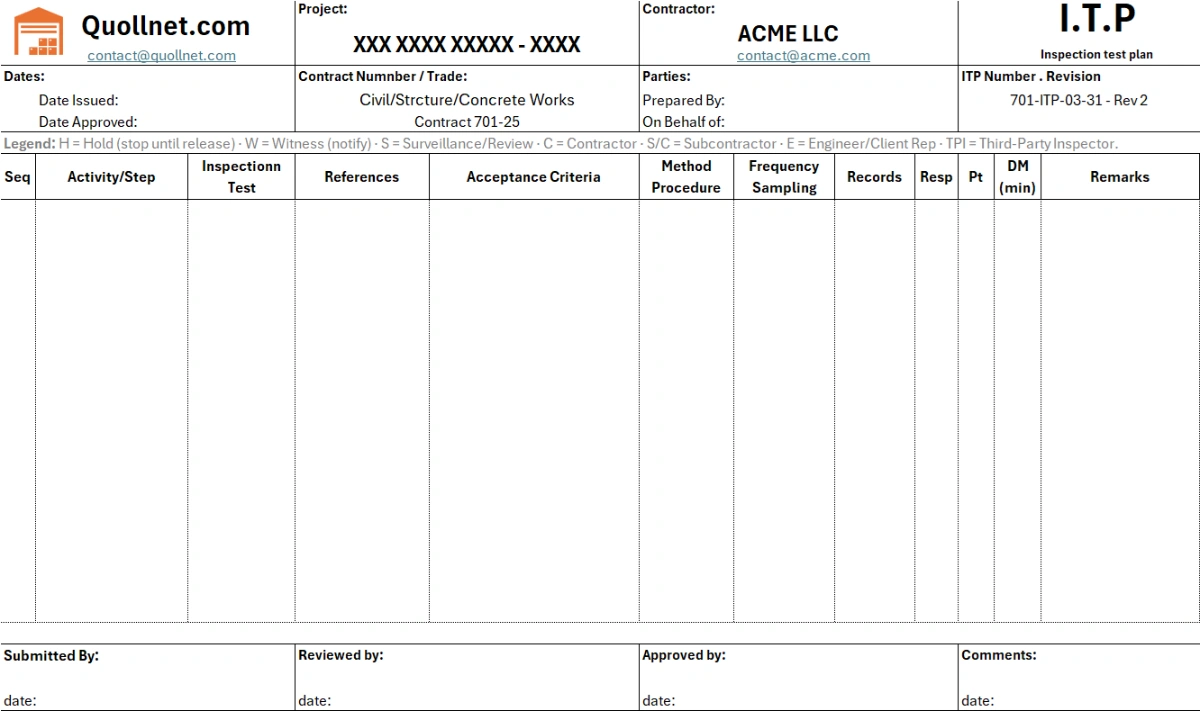
Use the following downloadable templates as starting points. Always adjust the acceptance criteria, inspection frequency, responsibility matrix, and Hold/Witness points to match your project specification and contract requirements.
- ITP | Inspection Test Plan Excel Template: Ready to customize with Hold/Witness points, criteria, frequencies, and records. Download the ITP Excel template
- ITP | Inspection Test Plan PDF Template: Printable version of the ITP form. Download the ITP PDF template
- ITP | Inspection Test Plan WebP Template: Image version for quick preview or sharing. Download the ITP image template
- Concrete ITP Excel Example: Example ITP for concrete works with typical inspection points. Download the concrete ITP Excel example
- Concrete ITP PDF Example: Printable concrete ITP example. Download the concrete ITP PDF example
- Concrete ITP WebP Example: Image version of the concrete ITP example. Download the concrete ITP image example