Break Pile Heads: Low-Vibration Checklist to Sound Substrate
Definition: Break pile heads is a controlled demolition task for safely reducing pile tops to design level, limiting vibration, preventing rebar damage, and removing weak concrete to sound substrate; capping excluded.
- Minimize vibration to protect adjacent structures and sensitive equipment.
- Expose reinforcement without nicks; retain bar length and cover.
- Remove laitance and weak concrete to a dense, sound substrate.
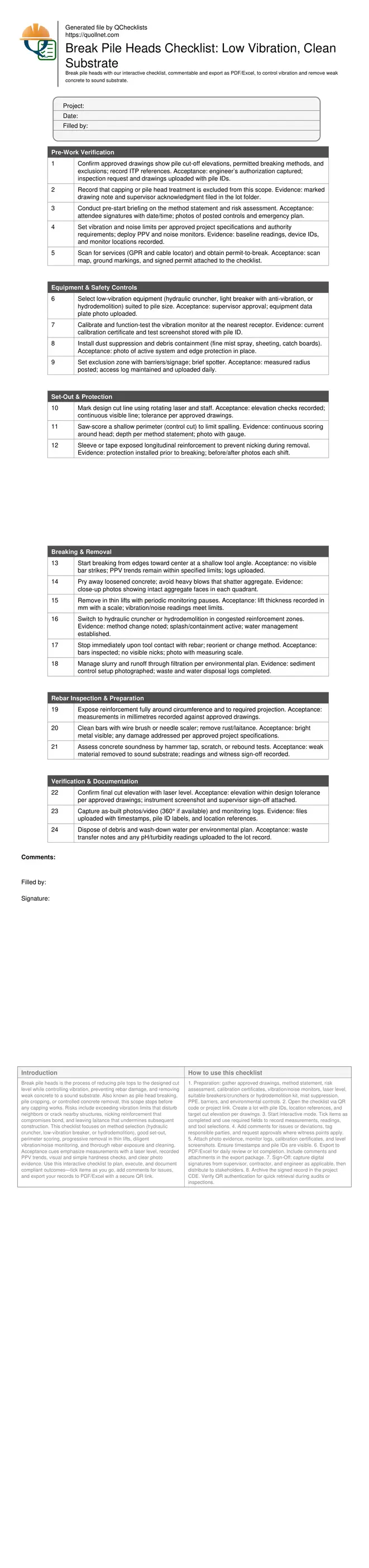
- Interactive, commentable checklist with export and QR code.
Break pile heads is the process of reducing pile tops to the designed cut level while controlling vibration, preventing rebar damage, and removing weak concrete to a sound substrate. Also known as pile head breaking, pile cropping, or controlled concrete removal, this scope stops before any capping works. Risks include exceeding vibration limits that disturb neighbors or crack nearby structures, nicking reinforcement that compromises bond, and leaving laitance that undermines subsequent construction. This checklist focuses on method selection (hydraulic cruncher, low-vibration breaker, or hydrodemolition), good set-out, perimeter scoring, progressive removal in thin lifts, diligent vibration/noise monitoring, and thorough rebar exposure and cleaning. Acceptance cues emphasize measurements with a laser level, recorded PPV trends, visual and simple hardness checks, and clear photo evidence. Use this interactive checklist to plan, execute, and document compliant outcomes—tick items as you go, add comments for issues, and export your records to PDF/Excel with a secure QR link.
- Use low-vibration methods and real-time PPV monitoring to prevent nuisance or damage to adjacent assets while progressively removing weak concrete. Protect reinforcement, maintain designed bar projection, and verify concrete soundness before handover to the next trade.
- Strong set-out and control reduce error: laser-mark the cut line, perimeter score to avoid spalling, break in thin lifts, and switch tools when congestion demands. Document readings, photos, and sign-offs to build traceable quality evidence for the project record.
- Environmental and safety controls matter: mist suppression, debris containment, runoff filtration, and enforced exclusion zones significantly reduce dust, mess, and risks. Clear roles and a pre-start briefing align crews on methods, limits, and witness points for efficient, compliant delivery.
- Interactive online checklist with tick, comment, and export features secured by QR code.
Pre-Work Verification
Equipment & Safety Controls
Set-Out & Protection
Breaking & Removal
Rebar Inspection & Preparation
Verification & Documentation
Control Vibration Without Compromising Neighbors or the Pile
Low-vibration methods are essential when you break pile heads near occupied buildings, utilities, or sensitive equipment. Choose hydraulic crunchers, light breakers with anti-vibration features, or hydrodemolition based on pile size, access, and reinforcement congestion. Set project-specific PPV and noise limits per approved project specifications and authority requirements, then place monitors at the most critical receptors. Score a perimeter control cut to prevent breakout beyond the design line. Work from perimeter to center in thin lifts, pausing to review monitor trends and tool technique. Where reinforcement density increases, switch methods rather than forcing the tool and risking rebar damage. Maintain mist suppression and debris containment to control dust and fragments, and manage runoff through filtration. Document equipment settings, monitor IDs, locations, and readings so acceptance decisions are traceable and defensible.
- Select the lowest-vibration tool that fits the task.
- Position PPV and noise monitors at critical receptors.
- Break in thin lifts; pause to review readings.
- Use perimeter scoring to limit spalling.
- Capture monitor logs with timestamps and locations.
Protect Reinforcement and Reach Sound Concrete
Reinforcement integrity is non-negotiable. Before breaking, apply sleeves or tape to exposed bars to prevent accidental nicking. Angle tools away from steel and stop immediately if contact occurs; reorient or change method as needed. Remove concrete progressively until weak, low-strength material is gone and you reach a dense, ringing substrate. Simple, reliable checks include hammer tapping, surface scratch, or rebound tests, recorded alongside photos. Clean bars with a wire brush or needle scaler until bright metal appears; this promotes future bond and inspection clarity. Verify bar projection and spacing against drawings, recording all measurements in millimetres. Any suspected damage or discrepancy should be escalated for direction per approved project specifications and authority requirements.
- Sleeve/tape bars to prevent tool-induced nicks.
- Stop on contact; protect steel before proceeding.
- Use tap, scratch, or rebound tests for soundness.
- Clean to bright metal for inspection and bond.
- Measure and log bar projection and spacing.
Set-Out, Acceptance Cues, and Evidence You Can Trust
Accuracy starts with set-out. Establish the cut line at the correct elevation using a calibrated laser level and staff, then verify it around the full perimeter. Apply a shallow saw cut to reduce spalling and provide a visual control. During removal, maintain tool angles and lift thickness that respect the control line. At completion, recheck elevations and compare with drawings; acceptance is based on meeting design tolerance per the approved documents. Capture comprehensive evidence: laser screenshots, photos from multiple angles, monitor logs, and witness sign-offs. Manage environmental factors by documenting dust suppression, containment, and waste handling. Organized records build confidence for handover and simplify the transition to the next trade without scope creep into capping.
- Laser-mark and verify the cut line perimeter.
- Perimeter score to control breakout and chips.
- Recheck final elevation before sign-off.
- Upload photos, logs, and witness approvals.
- Document environmental controls and disposals.
How to Use This Break Pile Heads Checklist
- Preparation: gather approved drawings, method statement, risk assessment, calibration certificates, vibration/noise monitors, laser level, suitable breakers/crunchers or hydrodemolition kit, mist suppression, PPE, barriers, and environmental controls.
- Open the checklist via QR code or project link. Create a lot with pile IDs, location references, and target cut elevation per drawings.
- Start interactive mode. Tick items as completed and use required fields to record measurements, readings, and tool selections.
- Add comments for issues or deviations, tag responsible parties, and request approvals where witness points apply.
- Attach photo evidence, monitor logs, calibration certificates, and level screenshots. Ensure timestamps and pile IDs are visible.
- Export to PDF/Excel for daily review or lot completion. Include comments and attachments in the export package.
- Sign-Off: capture digital signatures from supervisor, contractor, and engineer as applicable, then distribute to stakeholders.
- Archive the signed record in the project CDE. Verify QR authentication for quick retrieval during audits or inspections.
Call to Action
- Start Checklist Tick off tasks, leave comments on items or the whole form, and export your completed report to PDF or Excel—with a built-in QR code for authenticity.
- Download Excel - Break Pile Heads Inspection & Work Checklist
- Download PDF - Break Pile Heads Inspection & Work Checklist
- View Image - Break Pile Heads Inspection & Work Checklist
Cite & Embed
“Break Pile Heads Inspection & Work Checklist by Quollnet”
with a link to
this source page.

FAQ
Question: Which method is best: hydraulic breaker, cruncher, or hydrodemolition?
Question: How do I protect rebar from damage during pile head breaking?
Question: How can I confirm I have removed weak concrete to a sound substrate?
Question: What vibration limits should I apply and how do I monitor them?
Related Articles
Broader reading and guidance connected to this checklist topic.




Related Checklists
Keep the workflow moving with nearby templates chosen from similar checklist content.