Construct Secant Pile Wall—Guide Wall Sequence Checklist
Definition: Construct secant pile wall—guide wall and sequence checklist for site engineers to verify primary/secondary offsets, guide wall accuracy, and drilling tolerances, ensuring consistent sequencing and records while explicitly excluding diaphragm wall methods.
- Validate offsets, guide wall geometry, and drilling verticality tolerances.
- Standardize primary–secondary sequencing to achieve reliable pile interlock.
- Capture survey, photos, and logs for traceable quality evidence.
- Interactive, commentable checklist with export and QR code verification.
Construct secant pile wall—guide wall and sequence is the focus of this practical, job-ready checklist for site engineers and inspectors. It covers secant bored piles with clear emphasis on guide wall construction, primary and secondary pile offsets, and drilling tolerance control. You will verify alignment using total stations and templates, manage drilling verticality, and sequence primaries then secondaries to achieve the designed overlap. This checklist deliberately excludes diaphragm walls to keep the scope precise and avoid method confusion. Following it helps prevent misaligned guides, inadequate interlock, overbreak, and costly rework while delivering a watertight, dimensionally accurate wall ready for excavation support. Each step calls for tools, acceptance criteria, and evidence such as photos, batch tickets, and survey files. Use the interactive features to tick items, add field comments, and export your records to PDF/Excel with a secure QR for authentication.
- Ensure guide wall accuracy, pile set-out, and drilling tolerances are controlled from day one. The sequence mandates primaries before secondaries, protecting interlock and water cut-off, with survey checks, template verification, and documented acceptance at each hold point.
- Improve construction reliability by validating primary/secondary offsets with total station data and drilling logs. Capture concrete placement evidence, verify verticality, and compare placed volumes to theoretical values to flag anomalies early and reduce rework and delays.
- Interactive online checklist with tick, comment, and export features secured by QR code.
- Produce defensible, audit-ready records. Photos, batch tickets, survey files, and signed inspections demonstrate conformance per approved project specifications and authority requirements, de-risking approvals and enabling confident handover before excavation.
Survey & Controls
Guide Wall Construction
Pile Layout & Offsets
Drilling (Primary Piles)
Concreting & Reinforcement
Drilling (Secondary Piles)
Concreting & Reinforcement
Verification & Records
Guide Wall Accuracy Drives the Entire Secant Wall
The guide wall is the physical reference that controls pile spacing, alignment, and verticality at the ground surface. Achieving a top elevation within ±5 mm keeps drilling tools correctly seated and prevents entry angle errors that magnify with depth. Survey the guide alignment with a total station at 5–10 m intervals and fix steel templates or sleeves whose hole centers sit within ±2 mm of set-out and remain plumb to ≤ 1:500. Record reinforcement placement and concrete pours with batch tickets and photos. On busy city sites, small temperature-driven expansion or traffic vibrations can shift unsecured templates; positive fixation and a re-check before each drilling shift prevent those drifts. A short field example: after a midday temperature swing, a re-shot caught a 3 mm lateral creep in sleeves; tightening dowels restored compliance before drilling resumed, avoiding misaligned bores and lost interlock.
- Top of guide wall elevation within ±5 mm.
- Template hole centers within ±2 mm of set-out.
- Template plumbness tolerance ≤ 1:500.
- Alignment deviation ≤ 5 mm over 10 m.
Primary–Secondary Sequence and Drilling Tolerances
Install primary piles first, then secondary piles with reinforcement to cut into primaries and form the designed overlap. Control verticality to ≤ 1:100 using rig inclinometers and periodic checks from a digital inclinometer or caliper shoes at the guide. Keep the bore clean; residual sediment should not exceed 50 mm or the more stringent project requirement. During concreting, keep tremie pipes embedded and maintain a concrete head above groundwater to prevent segregation and contamination. Before drilling secondaries, confirm the primaries have reached the required handling strength, and re-verify offsets. Monitor cuttings during secondary drilling for fragments of primary concrete, a practical confirmation of interlock engagement. Compare placed concrete volumes to theoretical values to flag overbreak, obstructions, or voids, and document any corrective actions immediately.
- Verticality tolerance: ≤ 1:100.
- Residual sediment: ≤ 50 mm or stricter per specs.
- Maintain tremie embedment and concrete head.
- Verify primary strength before drilling secondaries.
Offsets, Overlap Assurance, and Documentation
Offsets determine whether secant piles will interlock as designed. Use total station set-out to place centers within ±5 mm, and re-check before secondary drilling using as-built primary coordinates. Since direct overlap measurement is difficult, demonstrate compliance indirectly by verifying spacing, verticality, and consistent engagement with primaries during secondary drilling. Document everything: survey CSVs, drilling logs, inclinometer outputs, batch tickets, and integrity testing reports where specified. Good records accelerate approvals and enable objective troubleshooting. Produce daily as-built plots comparing actual positions to design; highlight any outliers and obtain engineer acceptance for mitigations. An organized record set, including tagged photos at chainages and elevations, supports confident handover and protects the schedule when excavation begins against the secant wall.
- Center spacing tolerance: ±5 mm.
- Daily as-built plots against design line.
- Indirect overlap proof via spacing and verticality.
- Attach tagged photos and survey CSVs.
How to Use This Interactive Secant Pile Guide Wall Checklist
- Preparation: Gather total station, digital level, drilling templates, plumb gauges, inclinometers, tremie gear, cleaning buckets, GPR, PPE, and the approved drawings/specifications. Confirm ITP hold points, concrete supply, and access/permits.
- Start Interactive Mode: Open the checklist on your device, select the work area, and enable tick and comment features. Attach photos, logs, and survey files directly at each item in real time.
- Collaborate and Capture: Assign items to team members, add comments, and tag issues. Validate tolerances with instrument readings, then store approvals and evidence to build a traceable record automatically.
- Sign-Off and Archive: Capture digital signatures from contractor, consultant, and client. Export the commentable record as PDF/Excel with an embedded QR code for authentication and archive it per project protocol.

Call to Action
- Start Checklist Tick off tasks, leave comments on items or the whole form, and export your completed report to PDF or Excel—with a built-in QR code for authenticity.
- Download Excel - Secant Pile Wall Guide Wall & Sequence Inspection
- Download PDF - Secant Pile Wall Guide Wall & Sequence Inspection
- View Image - Secant Pile Wall Guide Wall & Sequence Inspection
Cite & Embed
“Secant Pile Wall Guide Wall & Sequence Inspection by Quollnet”
with a link to
this source page.

FAQ
Question: What tolerances should I hold for guide wall and drilling when building a secant pile wall?
Question: How do I verify overlap between primary and secondary secant piles on site?
Question: When can I start drilling secondary piles after casting primaries?
Question: What documentation is essential for approvals before excavation against the wall?
Question: Does this checklist apply to diaphragm walls?
Related Articles
Broader reading and guidance connected to this checklist topic.
Is The Crack You See On Your Wall Serious Or Minor Cosmetic Issue?
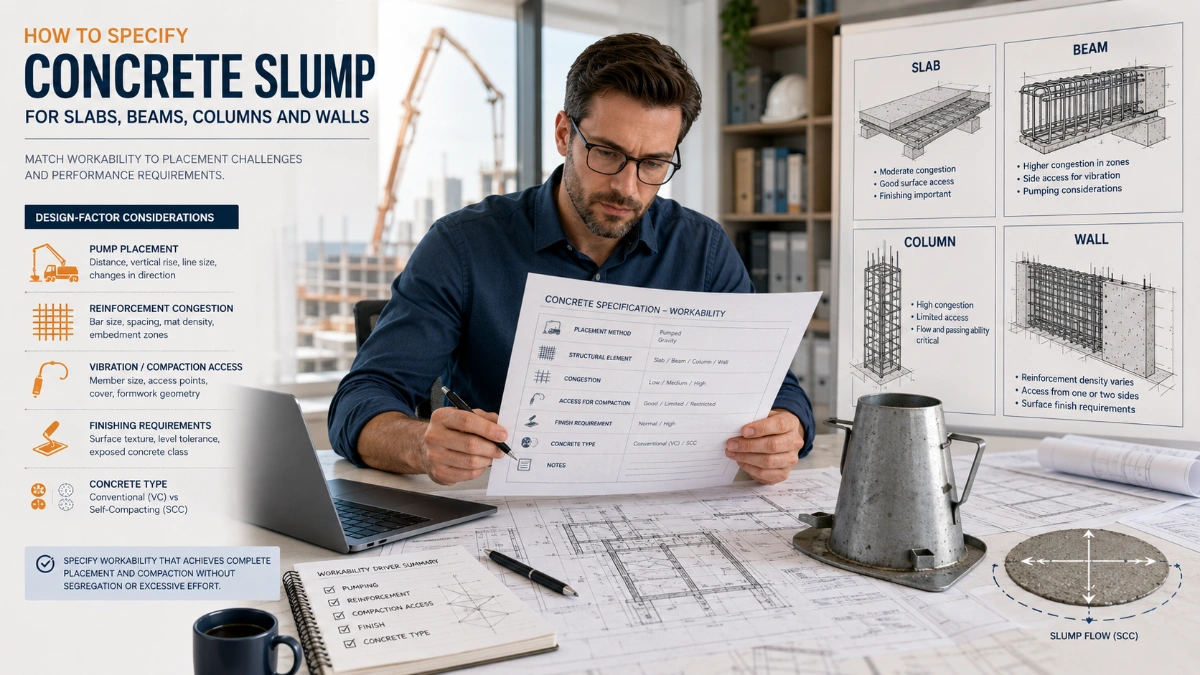
How To Specify Concrete Slump For Slabs, Beams, Columns And Walls


Concrete Compressive Strength Acceptance Criteria: Aci 318-25 Vs En 206
Related Checklists
Keep the workflow moving with nearby templates chosen from similar checklist content.