Approve Select Backfill Sources and Moisture Checklist
Definition: Approve select backfill sources and moisture for civil and infrastructure QA teams; verify gradation, moisture conditioning, and contamination control before placement, explicitly excluding compaction activities from this pre-approval scope.
- Verify gradation, moisture range, and cleanliness before placement.
- Prevent differential settlement, poor drainage, corrosion risks, and rework.
- Use standardized sampling, lab tests, and documented moisture conditioning evidence.
- Interactive, commentable checklist; export PDF/Excel with QR code authentication.
Approve select backfill sources and moisture is a targeted pre-placement quality assurance process that confirms materials meet gradation, moisture conditioning, and cleanliness requirements before use. This checklist focuses on select fill approval, gradation verification, and contamination control while excluding any compaction or density testing. You will confirm source qualifications, verify particle size distribution with laboratory reports, and set a clear target moisture range based on laboratory data. Field teams then condition moisture—by controlled wetting or aeration—and recheck uniformity, ensuring consistent handling and traceability from quarry to stockpile. By preventing oversize particles, excessive fines, or deleterious contaminants, you reduce settlement risk, drainage issues, and corrosion potential near concrete and steel. The result is predictable performance and fewer costly rejections at the point of placement. Use this interactive, commentable workflow to tick steps, log moisture readings, attach lab certificates, and document approvals. Start now, add field photos, and export your records to PDF/Excel with a secure QR for verification.
- Use this checklist to pre-approve select backfill by confirming source credentials, verifying lab gradation against the approved envelope, and conditioning moisture to the agreed range. Document sampling, test reports, and contamination controls to reduce rework and ensure traceable, consistent material quality before placement.
- Interactive online checklist with tick, comment, and export features secured by QR code. Capture moisture readings, lab results, delivery tickets, and photographs; assign actions to suppliers or crews; and maintain auditable approvals that align with project specifications and authority requirements across stages from quarry to on-site stockpiles.
- Strengthen durability and performance by eliminating deleterious materials, oversize particles, and moisture variability. The process protects adjacent concrete and steel, supports drainage behavior, and streamlines approvals—so materials arrive clean, within target moisture, and ready for subsequent placement steps without surprise rejections.
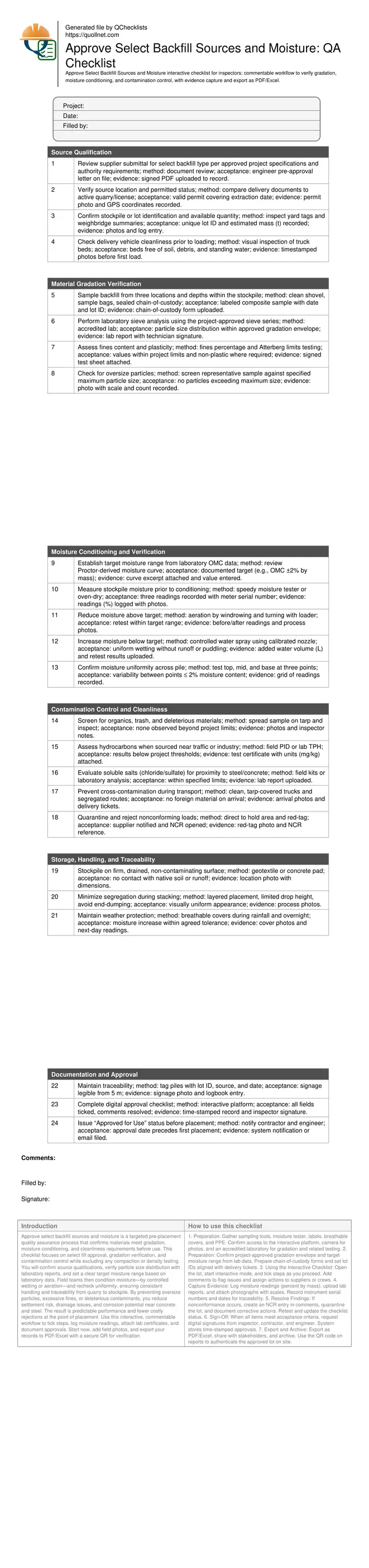
Source Qualification
Material Gradation Verification
Moisture Conditioning and Verification
Contamination Control and Cleanliness
Storage, Handling, and Traceability
Documentation and Approval
Gradation Verification: Ensuring the Right Particle Mix
Gradation determines how select backfill composes into a stable, drainable mass once placed, so it must be confirmed before any work proceeds. Begin by sampling from multiple stockpile locations and depths to create a representative composite. Send the sample to an accredited laboratory and compare the particle size distribution against the project-approved gradation envelope. Focus on oversize control, fines fraction, and plasticity characteristics that influence drainage and compressibility. Oversize particles can bridge or damage adjacent structures, while excess fines can trap water and slow consolidation. Consolidate all lab reports, photographs with scale references, and inspector notes into a single record. If results fall outside the envelope, coordinate with the supplier for corrective screening or stockpile blending before delivery continues. This approach reduces rejections at the point of use and provides a defensible trail for approvals per approved project specifications and authority requirements.
- Sample from several locations and depths for representativeness.
- Verify fines and plasticity align with the approved envelope.
- Document oversize findings with scale-referenced photos.
- Blend or screen stockpiles before further deliveries.
- Archive signed lab sheets with traceable lot IDs.
Moisture Conditioning: Hitting the Target Without Compaction
Moisture content must be within a defined target range to support efficient placement and performance, but this pre-approval step excludes field compaction activities. Establish the target using laboratory data, typically the optimum moisture content from a Proctor curve, and agree on an acceptable tolerance (for example, OMC ±2%). Measure existing stockpile moisture using a speedy moisture tester or oven-dry method. If readings are high, aerate by windrowing and turning; if low, add water via a controlled spray to avoid runoff. Retest at the top, middle, and base of the pile to confirm uniformity and record all readings in percent by mass. Consistent moisture across the stockpile reduces variability during placement, shortens on-site adjustments, and minimizes rejected loads. Keep before-and-after photos and device serial numbers for traceability.
- Define target range from lab OMC data.
- Measure with speedy tester or oven-dry method.
- Condition by aeration or calibrated water spray.
- Confirm uniformity with grid-based retesting.
- Record readings, photos, and device IDs.
Contamination Control and Traceability on Busy Sites
Cleanliness is as important as gradation and moisture. Visual inspections should rule out organics, wood, plastic, deleterious fines, and construction debris that compromise performance or corrode adjacent materials. Where risk exists—near fueling areas or salted roads—screen for hydrocarbons and soluble salts using field kits or laboratory testing. Transport and handling routines must prevent cross-contamination: use clean, tarp-covered trucks; segregate travel lanes; and keep stockpiles on non-contaminating pads with drainage. If materials fail any criterion, quarantine them in a signed hold area and notify the supplier immediately. Maintain signage with lot ID, source, and date so every test report maps back to a physical pile. This traceable system accelerates approvals, supports NCR resolution, and ensures only compliant backfill reaches the point of placement.
- Inspect visually for organics and debris.
- Test hydrocarbons and salts when risk is suspected.
- Use clean, tarped trucks and segregated routes.
- Stockpile on geotextile or concrete pads.
- Quarantine nonconforming loads with red-tags.
How to Use the Interactive Approval Checklist
- Preparation: Gather sampling tools, moisture tester, labels, breathable covers, and PPE. Confirm access to the interactive platform, camera for photos, and an accredited laboratory for gradation and related testing.
- Preparation: Confirm project-approved gradation envelope and target moisture range from lab data. Prepare chain-of-custody forms and set lot IDs aligned with delivery tickets.
- Using the Interactive Checklist: Open the lot, start interactive mode, and tick steps as you proceed. Add comments to flag issues and assign actions to suppliers or crews.
- Capture Evidence: Log moisture readings (percent by mass), upload lab reports, and attach photographs with scales. Record instrument serial numbers and dates for traceability.
- Resolve Findings: If nonconformance occurs, create an NCR entry in comments, quarantine the lot, and document corrective actions. Retest and update the checklist status.
- Sign-Off: When all items meet acceptance criteria, request digital signatures from inspector, contractor, and engineer. System stores time-stamped approvals.
- Export and Archive: Export as PDF/Excel, share with stakeholders, and archive. Use the QR code on reports to authenticate the approved lot on site.
Call to Action
- Start Checklist Tick off tasks, leave comments on items or the whole form, and export your completed report to PDF or Excel—with a built-in QR code for authenticity.
- Download Excel - Select Backfill Source and Moisture Approval
- Download PDF - Select Backfill Source and Moisture Approval
- View Image - Select Backfill Source and Moisture Approval
Cite & Embed
“Select Backfill Source and Moisture Approval by Quollnet”
with a link to
this source page.

FAQ
Question: How do I set a target moisture range if specifications don’t state one?
Question: How frequently should I test gradation and moisture during approval?
Question: Can recycled concrete aggregate be approved as select backfill?
Question: What evidence is required to demonstrate contamination control?
Related Articles
Broader reading and guidance connected to this checklist topic.
Concrete Cube Curing: Site Storage, Water Tank & Laboratory Requirements

How To Create Your First Sang In 4 Easy Steps

Is It Important To Customize Your Qr Code And How To Do It?


Concrete Core Test Guide: Astm C42, Aci 318-25 & Bs En 13791
Related Checklists
Keep the workflow moving with nearby templates chosen from similar checklist content.