Backfill against Waterproofed Walls Checklist
Definition: Backfill against waterproofed walls is a field checklist for supervisors and crews to protect membranes, place staged lifts, maintain drainage integrity, and restore surfaces without including any testing procedures.
- Protect membranes with boards and careful equipment exclusion zones
- Place uniform staged lifts, compact with plate near wall edges
- Maintain drainage composite, pipes, fabric laps, and outlet continuity
- Interactive, commentable checklist with exportable PDF/Excel and QR code
Backfill against waterproofed walls demands disciplined sequencing to protect the waterproofing system while restoring grades and drainage. This checklist supports foundation wall backfilling teams with practical controls for membrane protection, staged lifts, and drainage continuity. It focuses on vertical waterproofed walls using protection boards or drainage composites, perforated footing drains, geotextiles, and free‑draining granular backfill. You will control lift thickness, equipment standoff, and outlet elevations while preventing punctures, surcharges, and water traps. The scope excludes laboratory or field testing; verification relies on measurements, visual evidence, photos, and sign‑offs per approved project specifications and authority requirements. Following these steps reduces rework from membrane damage, eliminates settlement at restored surfaces, and keeps discharge paths clear. Use this interactive checklist to standardize documentation, sequence work safely, and coordinate with waterproofing installers and excavator operators. Start in interactive mode to tick items, add comments, and export your records to PDF/Excel with a secure QR link.
- Control the entire backfilling sequence around waterproofed walls, from membrane protection and drainage assembly to staged lifts and final surface restoration. Reduce damage risks, maintain outlet elevations, and document each step with photos.
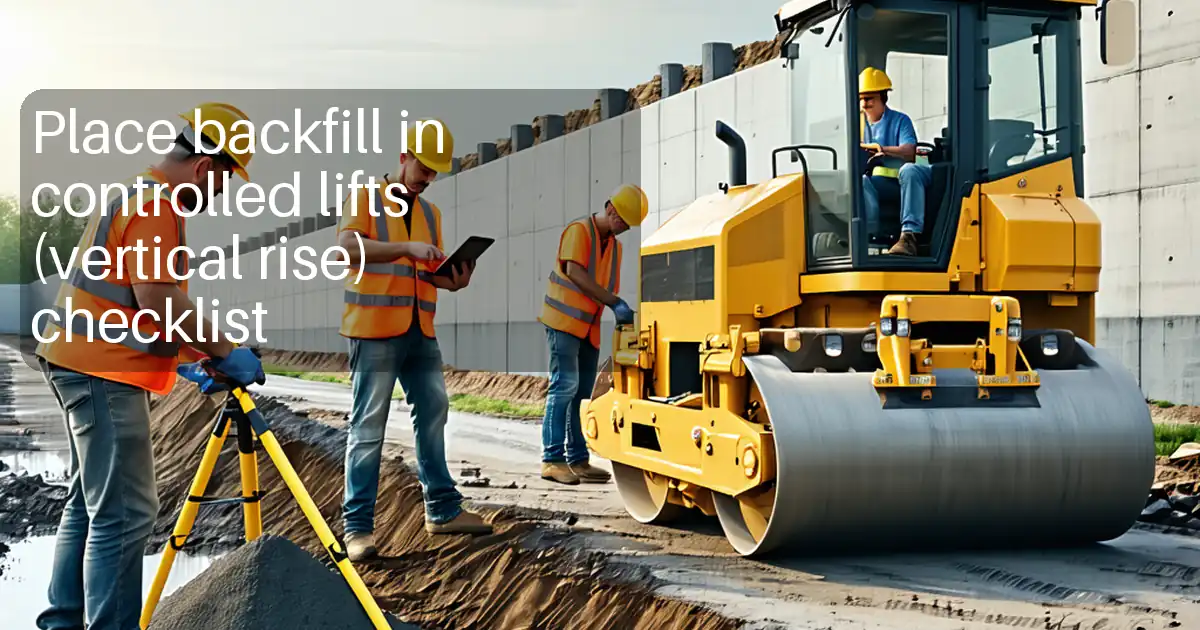
- Granular backfill placement in measured lifts with defined equipment standoff safeguards the wall and membrane. Plate compaction near the wall and roller compaction farther out create uniform support without overloading or puncturing protected surfaces.
- Interactive online checklist with tick, comment, and export features secured by QR code.
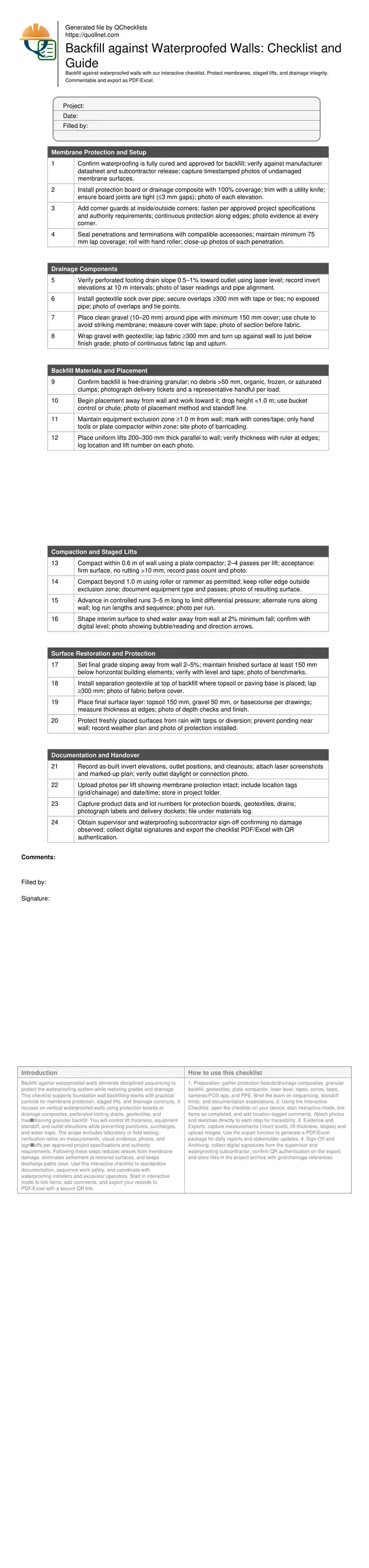
Membrane Protection and Setup
Drainage Components
Backfill Materials and Placement
Compaction and Staged Lifts
Surface Restoration and Protection
Documentation and Handover
Protecting Membranes Before Any Soil Moves
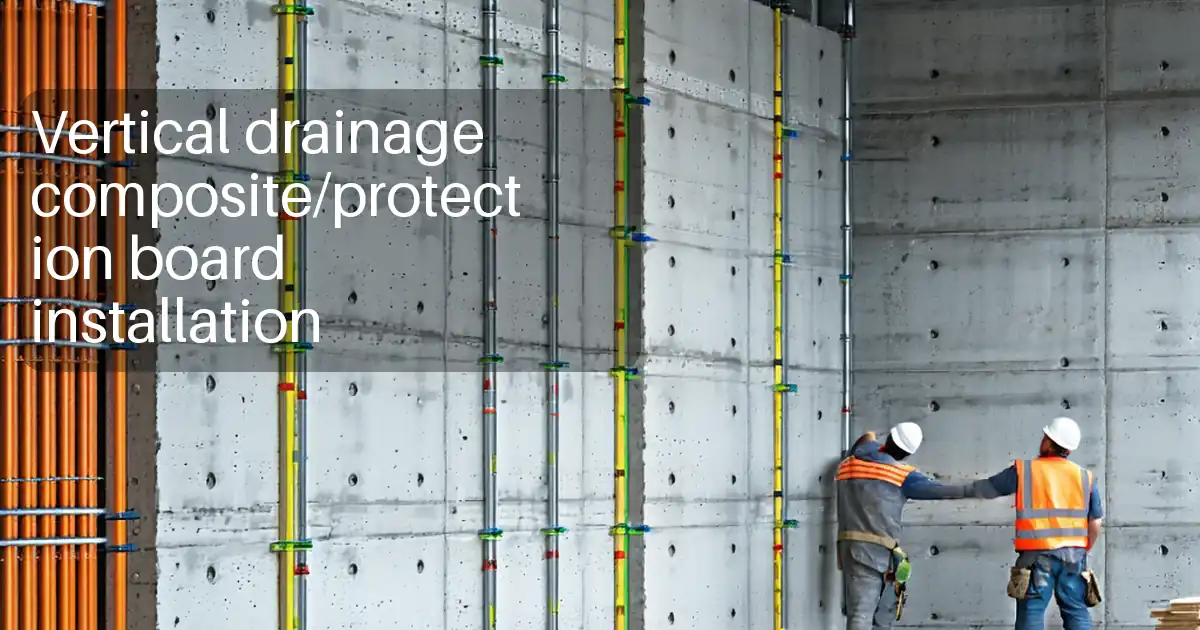
Waterproofing systems are vulnerable to punctures, scuffs, and peel-back during backfill. Begin by verifying cure status and receiving a release from the waterproofing installer. Protection boards or drainage composites distribute incidental contact and create a sacrificial layer over membranes. Pay special attention at corners, terminations, and penetrations—these concentrate movement and are the first to fail under stray bucket strikes. Fit corner guards and seal laps using the manufacturer’s accessories. Keep tools sharp and movements deliberate; a utility knife and hand roller are often safer than improvised fixes. Establish a clear equipment exclusion zone and brief the excavator operator before placement starts. A short pre-task meeting documenting responsibilities reduces the likelihood of rushed decisions. Require timestamped photos of every elevation after protection installation and again after the first lift is placed. This visual record supports quick issue resolution and prevents disputes later.
- Confirm cure and installer release before backfilling starts
- Install full-coverage protection boards or drainage composites
- Guard corners and penetrations; lap a minimum of 75 mm
- Create and enforce a visible equipment exclusion zone
- Capture photos before and after the first lift
Staged Lifts and Equipment Discipline
Uneven or over-energetic placement can overload walls, crease boards, or opening laps. Place free-draining granular backfill in uniform 200–300 mm lifts, always working from away toward the wall to minimize impact. Keep heavy plant at least 1.0 m off the wall; within 0.6 m use a plate compactor with two to four passes per lift. Progress in 3–5 m runs to limit lateral pressure spikes and allow frequent inspections. Maintain a temporary 2% fall away from the wall so rain does not pool against fresh work. Avoid dropping material from more than 1.0 m and never surge-fill corners. Instead, feather material in thin sheets, raking by hand near sensitive details. These habits cut rework and eliminate the most common causes of damage: impact, surcharge, and trapped water.
- Uniform lifts 200–300 mm thick, parallel to wall
- Plate compact within 0.6 m; record pass counts
- Keep heavy rollers beyond 1.0 m standoff
- Advance in 3–5 m runs to manage pressures
- Maintain 2% fall away during all stages
Drainage Continuity and Surface Restoration
A perfect membrane cannot compensate for poor drainage. Set the perforated drain at a 0.5–1% slope to its outlet, surround with 10–20 mm gravel, and encapsulate with geotextile to prevent fines migration. Continue protection and fabric upturns so fines from surface layers do not clog the system. Keep weeps and outlets visible and free during works; photograph clear paths before covering. Final grading should shed water 2–5% away from the wall and sit at least 150 mm below sills or cladding transitions. Use a digital level for quick verification and record benchmarks. Where landscaping follows, place a separation geotextile and the specified topsoil or basecourse thicknesses. These measures sustain long-term performance without relying on tests, because the design intent is preserved by geometry, materials, and workmanship.
- Pipe slope 0.5–1% with measured inverts
- Gravel 10–20 mm, ≥150 mm cover over pipe
- Geotextile laps and upturns ≥300 mm
- Final grade 2–5% away, 150 mm below sills
- Photograph clear outlets before burial
How to Use This Interactive Backfill Checklist
- Preparation: gather protection boards/drainage composites, granular backfill, geotextiles, plate compactor, laser level, tapes, cones, tarps, cameras/POS app, and PPE. Brief the team on sequencing, standoff limits, and documentation expectations.
- Using the Interactive Checklist: open the checklist on your device, start interactive mode, tick items as completed, and add location-tagged comments. Attach photos and sketches directly to each step for traceability.
- Evidence and Exports: capture measurements (invert levels, lift thickness, slopes) and upload images. Use the export function to generate a PDF/Excel package for daily reports and stakeholder updates.
- Sign-Off and Archiving: collect digital signatures from the supervisor and waterproofing subcontractor, confirm QR authentication on the export, and store files in the project archive with grid/chainage references.
Call to Action
- Start Checklist Tick off tasks, leave comments on items or the whole form, and export your completed report to PDF or Excel—with a built-in QR code for authenticity.
- Download Excel - Backfill Against Waterproofed Walls
- Download PDF - Backfill Against Waterproofed Walls
- View Image - Backfill Against Waterproofed Walls
Cite & Embed
“Backfill Against Waterproofed Walls by Quollnet”
with a link to
this source page.

FAQ
Question: What backfill material should I use against a waterproofed wall?
Question: How close can heavy equipment operate to the waterproofed wall?
Question: What should I do if the membrane or protection board is damaged during backfilling?
Question: How do I manage rain events during or immediately after backfilling?
Related Articles
Broader reading and guidance connected to this checklist topic.

Is The Crack You See On Your Wall Serious Or Minor Cosmetic Issue?

How To Specify Concrete Slump For Slabs, Beams, Columns And Walls

Related Checklists
Keep the workflow moving with nearby templates chosen from similar checklist content.