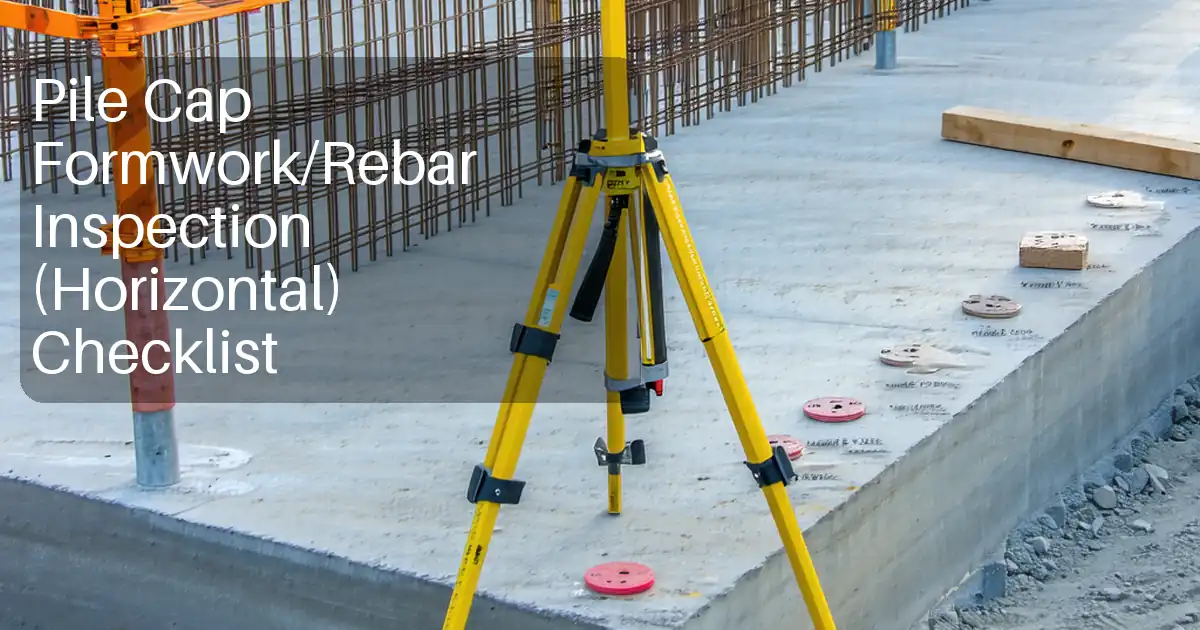
Close Substructure Punch List for Defect Closure and Sign-Off
Definition: Close substructure punch list for contractors and consultants to capture defects, execute rectification, verify results, and secure final sign-off, focused strictly on foundations, basements, and below-grade systems.
- Systematic record, rectify, and verify process for substructure elements
- Protects waterproofing, drainage, and concrete quality before backfill
- Evidence-driven closeout with photos, readings, and approvals attached
- Interactive, commentable, export-ready checklist secured by QR code
Close substructure punch list is the essential final sweep before releasing foundations and below-grade works. This substructure closeout checklist targets pile caps, footings, grade beams, basement slabs, waterproofing, and drainage—while explicitly excluding any superstructure items. By structuring a rigorous foundation punchlist around record–rectify–verify–sign-off, you prevent water ingress, settlement issues, and rework that becomes expensive after backfilling. The checklist guides a disciplined walkdown by grid and elevation, requires evidence such as geotagged photos, test reports, and survey files, and drives rectification through approved methods and materials traceability. Verification steps cover dimensions, levels, cover readings, flow tests, and membrane integrity checks, culminating in transparent sign-off and archival. Keep the scope clean: no columns, upper walls, or above-grade finishes. Use this interactive tool on mobile or desktop to tick items, leave field comments, and export your closeout package as PDF/Excel with a project QR link.
- Structured punch list that confines scope to substructure only, ensuring foundations, basements, waterproofing, and drainage are fully defect-free before backfill, while avoiding scope creep into superstructure and above-grade elements.
- Evidence-first workflow: capture annotated photos, survey CSVs, test data, and batch numbers. Each record links to location, grid, and elevation, enabling rapid triage, targeted rectification, and traceable verification by discipline.
- Interactive online checklist with tick, comment, and export features secured by QR code.
- Clear acceptance cues tied to approved project specifications and authority requirements, with defined responsibilities, due dates, and digital signatures for a defensible, audit-ready closeout package.
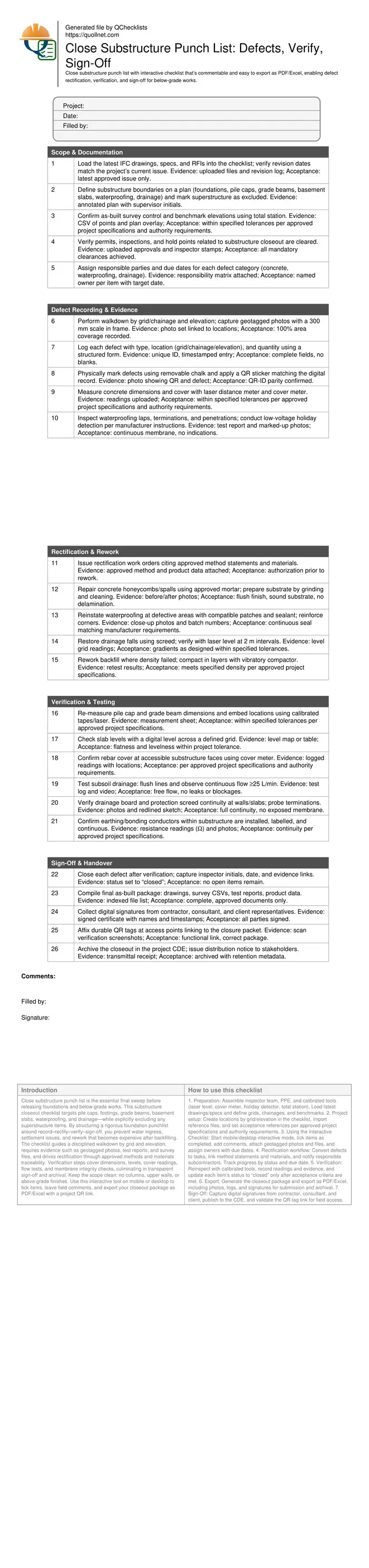
Scope & Documentation
Defect Recording & Evidence
Rectification & Rework
Verification & Testing
Sign-Off & Handover
Scoping the Substructure and Structuring the Walkdown
A successful closeout starts by locking the scope. Limit the punch list strictly to substructure: foundations, pile caps, grade beams, basement slabs, waterproofing, and below-grade drainage. Exclude superstructure without exception to prevent dilution of effort and disputes over responsibilities. Create an annotated plan highlighting boundaries, gridlines, chainages, and benchmark elevations. Segment the walkdown by grid and elevation so no area is missed. Capture geotagged photos with a scale reference to substantiate defect size. Use consistent defect categories (concrete, waterproofing, drainage, earthing) to streamline assignment and reporting. Tie every entry to location, quantity, and due date. This disciplined approach keeps the team aligned, avoids rework after backfilling, and provides the traceability auditors expect. By organizing early, inspectors can move rapidly from recording to rectification while maintaining high evidence quality and defensible acceptance decisions.
- Define hard boundaries; exclude superstructure entirely
- Segment by grid, chainage, and elevation for coverage
- Standardize defect categories and data fields
- Attach geotagged photos with a visible scale
- Reference current drawings, RFIs, and benchmarks
Rectification Tactics for Concrete, Waterproofing, and Drainage
Rectification must follow approved method statements and compatible materials, especially for waterproofing where patch chemistry and edge prep are critical. For concrete defects, remove unsound material, clean, and rebuild with approved repair mortar; finish flush and cure as required. Reinstate membranes with reinforced patches, sealing laps and terminations per manufacturer guidance. Restore drainage falls using laser-controlled screeds, verifying gradients at regular intervals. When density fails, rework backfill in layers with appropriate compaction equipment and retest. Keep traceability: record batch/lot numbers, photos, and signatures before, during, and after rework. Clear ownership and target dates help maintain pace, while robust evidence shortens consultant review cycles and prevents repeat defects.
- Use compatible materials; follow manufacturer instructions
- Grind, clean, and rebuild concrete to a flush finish
- Reinforce membrane patches and seal penetrations
- Verify drainage falls at 2 m intervals
- Retest densities and upload results
Verification, Acceptance Cues, and Final Sign-Off
Verification converts effort into closure. Re-measure critical dimensions and levels using calibrated tools and compare against the approved project specifications and authority requirements. Validate rebar cover with a cover meter and confirm continuity of protection layers. Test subsoil drainage by flushing and recording sustained flow with clear video evidence. Check earthing continuity and labelling, logging resistance readings. Consolidate all results into an as-built package, then capture digital signatures from contractor, consultant, and client. Anchor the package to durable QR tags placed at access points so future teams can instantly retrieve evidence. Archive in the common data environment with retention metadata to satisfy audits and future maintenance needs.
- Use calibrated tools and document serial numbers
- Record readings and attach location references
- Confirm continuity of membranes and protection
- Capture flow tests with video and logs
- Secure digital sign-off and archive
How to Use This Interactive Substructure Closeout Punch List
- Preparation: Assemble inspector team, PPE, and calibrated tools (laser level, cover meter, holiday detector, total station). Load latest drawings/specs and define grids, chainages, and benchmarks.
- Project setup: Create locations by grid/elevation in the checklist, import reference files, and set acceptance references per approved project specifications and authority requirements.
- Using the Interactive Checklist: Start mobile/desktop interactive mode, tick items as completed, add comments, attach geotagged photos and files, and assign owners with due dates.
- Rectification workflow: Convert defects to tasks, link method statements and materials, and notify responsible subcontractors. Track progress by status and due date.
- Verification: Reinspect with calibrated tools, record readings and evidence, and update each item’s status to “closed” only after acceptance criteria are met.
- Export: Generate the closeout package and export as PDF/Excel, including photos, logs, and signatures for submission and archival.
- Sign-Off: Capture digital signatures from contractor, consultant, and client, publish to the CDE, and validate the QR tag link for field access.
Call to Action
- Start Checklist Tick off tasks, leave comments on items or the whole form, and export your completed report to PDF or Excel—with a built-in QR code for authenticity.
- Download Excel - Close Substructure Punch List
- Download PDF - Close Substructure Punch List
- View Image - Close Substructure Punch List
Cite & Embed
“Close Substructure Punch List by Quollnet”
with a link to
this source page.
FAQ
Question: What elements are included in this substructure punch list, and what is excluded?
Question: How should I document waterproofing defects to avoid disputes during closeout?
Question: What tolerances should I apply if the project specifications are silent?
Question: Can I close a defect before all test results are received?
Question: How do QR codes improve punch list closure in the field?
Related Articles
Broader reading and guidance connected to this checklist topic.
Download Excel Format Snag List


What Is a Snag List Or Punch List

How To Create Your First Sang In 4 Easy Steps
Related Checklists
Keep the workflow moving with nearby templates chosen from similar checklist content.