Backcharges Under AIA A201 and A401: Correction Costs, Notice, and Payment Withholding
AI/Search Snippet: An AIA backcharge is an informal construction term for correction cost pursued through the actual procedures in AIA A201–2017 or A401–2017. Depending on the contractual relationship, the process may require written notice, an opportunity to correct, documented work by others, Architect payment review, withholding, and a formal Claim.
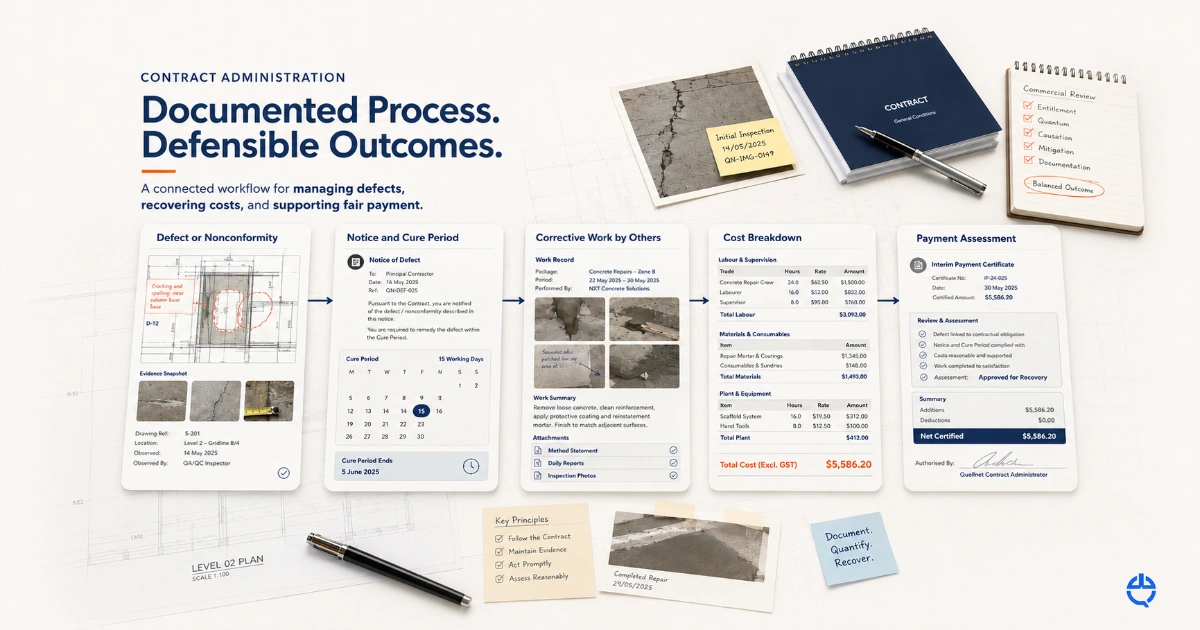
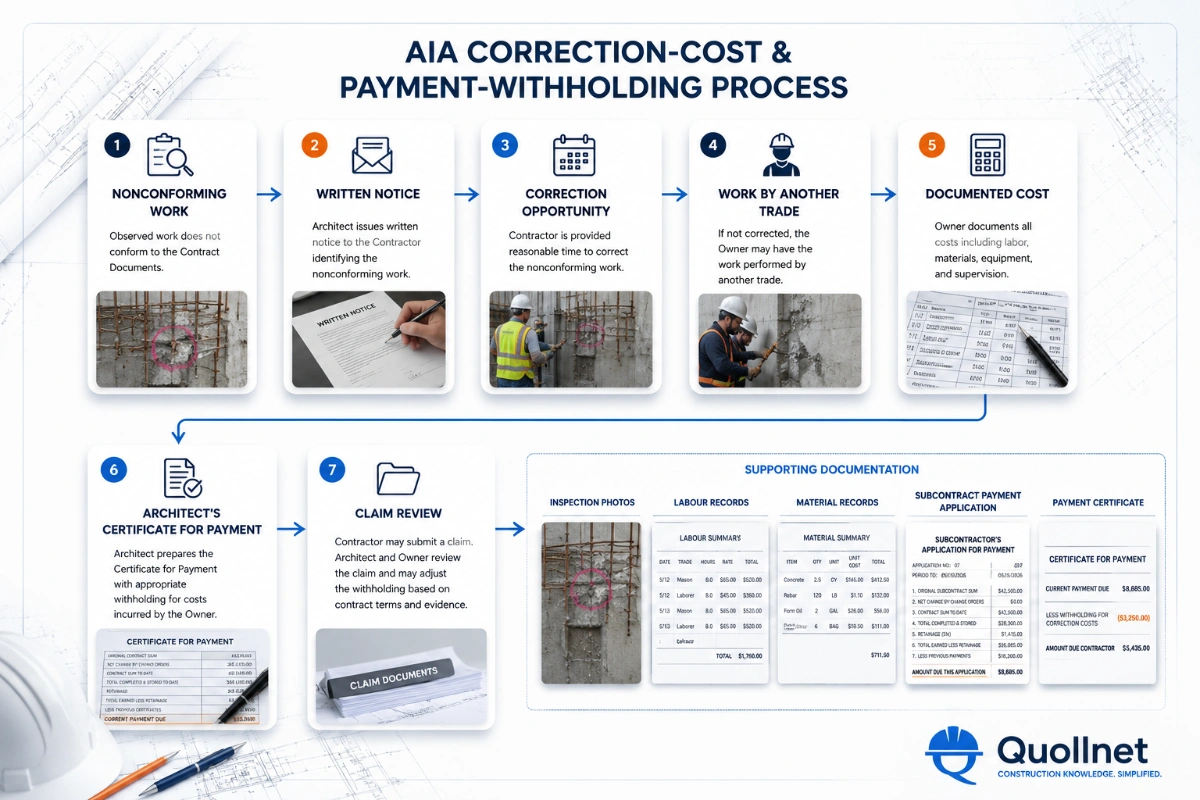
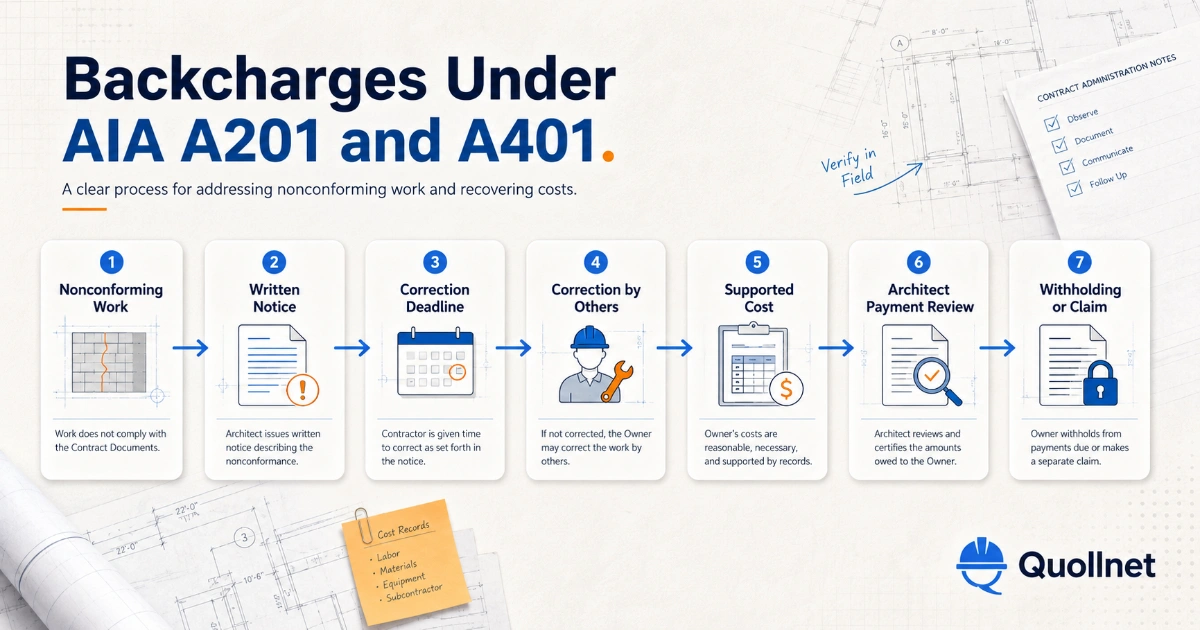
The word backcharge is widely used on US construction projects, but AIA A201–2017 and A401–2017 do not establish one universal procedure formally titled “Backcharge Notice.” The practical equivalent normally arises when an Owner or Contractor alleges defective, incomplete, or nonconforming Work, gives the responsible party an opportunity to correct it, arranges correction by others where permitted, documents the resulting cost, and seeks reimbursement or withholding through the applicable payment and Claims procedures.
The contractual relationship must be identified first. A201 governs the Owner–Contractor relationship when incorporated into the applicable Owner–Contractor agreement. A401 governs the separate Contractor–Subcontractor relationship and incorporates A201 as part of its coordinated contractual structure. Supplementary Conditions, subcontract amendments, state prompt-payment statutes, lien laws, and governing law may materially alter the standard result.
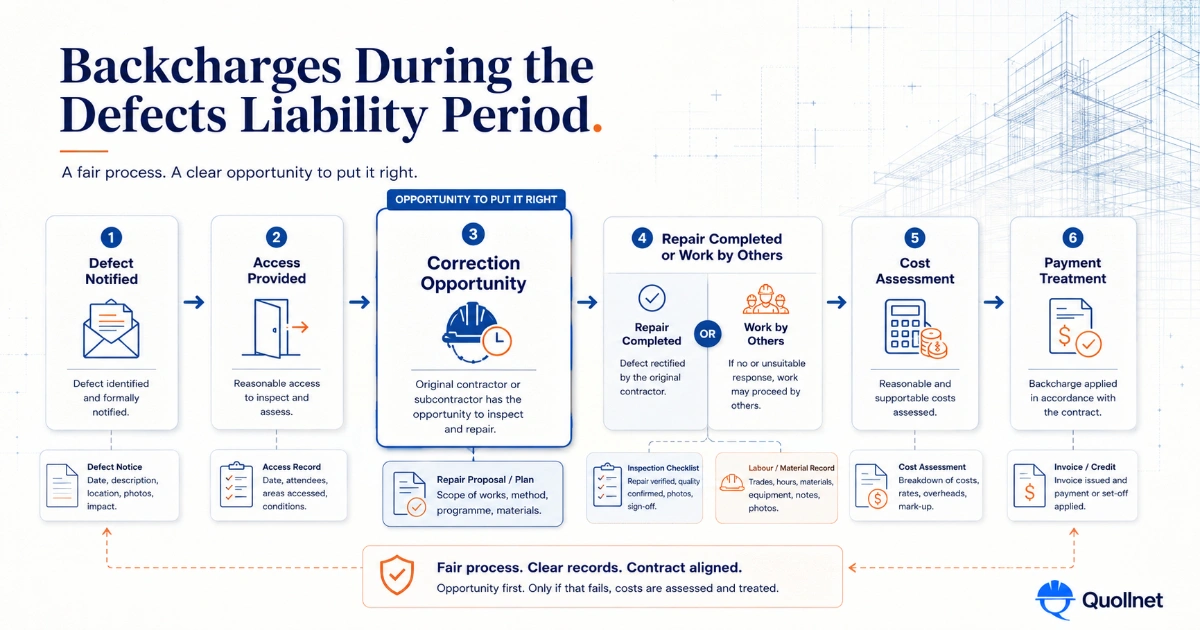
For the broader principles applying across different contract forms, see construction backcharges under standard-form contracts.
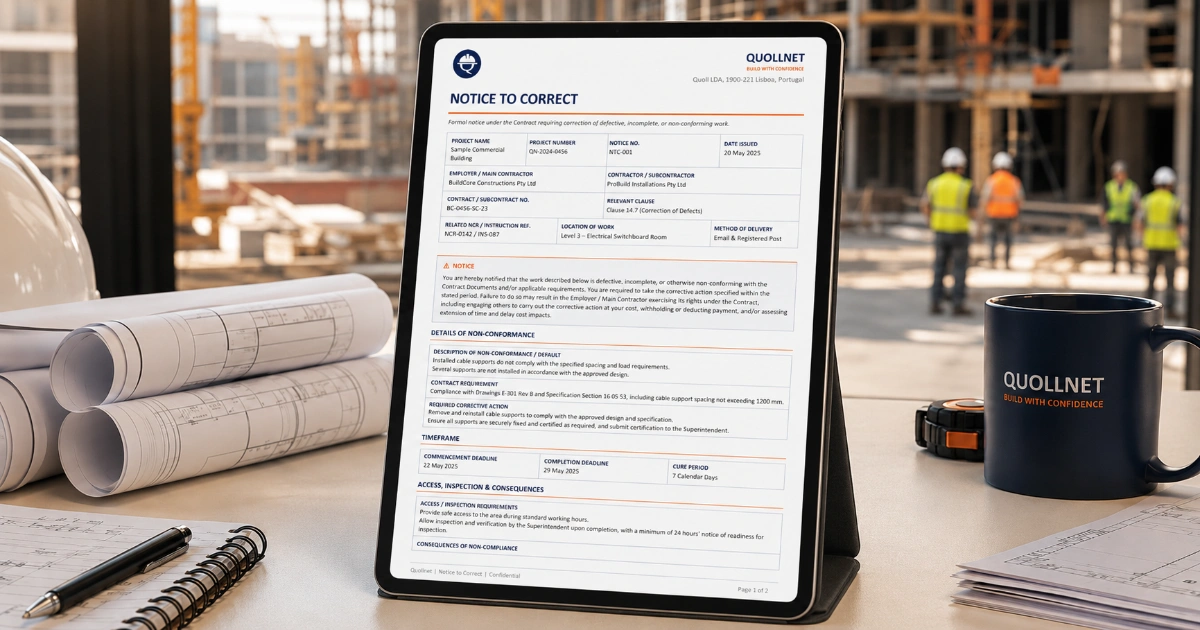
Need to issue a backcharge notice right now?
Download the practical Backcharge Notice Template. Before sending it on an AIA project, verify whether A201, A401, Supplementary Conditions, the payment provisions, or state law require a particular notice, correction period, Claim, delivery method, or withholding procedure.
What Does “Backcharge” Mean Under AIA Contracts?
Under AIA documents, the commercial term “backcharge” may correspond to several different contractual mechanisms:
- correction of default or neglect by the Owner;
- correction of rejected or nonconforming Work;
- correction of Subcontractor Work by the Contractor;
- withholding or nullification of a Certificate for Payment;
- withholding correction cost from current or future subcontract payments;
- acceptance of nonconforming Work with an equitable reduction;
- a formal Claim for payment or other relief;
- completion cost following termination for cause.
These mechanisms are related but not interchangeable. A technical defect record does not necessarily authorise correction by others. A right to correct does not automatically establish the final amount recoverable. A cost claim does not always permit immediate deduction from the next payment.
| Relationship or event | Relevant AIA mechanism | Main procedural step | Possible payment consequence |
|---|---|---|---|
| Owner against Contractor | A201 Sections 2.5, 9.5 and 12.2 | Written notice and opportunity to correct | Architect may withhold or nullify certification to the extent reasonably necessary |
| Contractor against Subcontractor | A401 Sections 3.3.5 and 3.5 | Notify the Subcontractor and follow the correction procedure | Correction cost may be withheld from current or future payments |
| Post-Substantial Completion defect | A201 Section 12.2.2 | Prompt notice and opportunity to correct | Owner may proceed under Section 2.5 after failure to correct |
| Termination and completion | A201 Section 14.2 or A401 Section 7.2.1 | Separate termination grounds, notice, and cure process | Completion-cost accounting after termination |
AIA A201: When May the Owner Correct the Contractor’s Work?
A201–2017 Section 2.5 addresses the Owner’s right to carry out Work where the Contractor defaults or neglects to perform in accordance with the Contract Documents.
The standard process requires written notice from the Owner. After receiving it, the Contractor has a ten-day period in which to commence and continue correction of the default or neglect with diligence and promptness. If the Contractor does not do so, the Owner may correct the default without giving up other available remedies.
The Owner’s intervention and the amounts charged to the Contractor are subject to prior approval by the Architect. The reasonable cost may include the Owner’s expenses and compensation for additional Architect services made necessary by the default, neglect, or failure.
The Contractor remains entitled to dispute both the Owner’s action and the amount claimed through Article 15. Section 2.5 therefore does not convert the Owner’s internal calculation into an automatically agreed debt.
Worked Example: Owner Against Contractor
Waterproofing installed below a terrace fails the specified flood test. The Architect identifies the nonconforming Work, and the Owner gives written notice requiring the Contractor to commence and continue correction. The Contractor disputes the test but does not mobilise during the ten-day period.
After Architect approval, the Owner engages another waterproofing specialist. The Owner records investigation, removal, membrane repair, protection, retesting, and reinstatement costs. The Architect then considers what amount, if any, should affect payment.
The Contractor may still challenge whether the entire terrace required removal, whether premium labour was necessary, whether some damage was caused by another trade, and whether the replacement detail exceeded the Contract Documents. These issues may proceed as a Claim under Article 15.
AIA A401: Contractor Correction of Subcontractor Work
A401–2017 creates a separate contractual mechanism between the Contractor and Subcontractor. It should not be confused with the Owner’s rights under A201.
Section 3.3.5 requires the Contractor to notify the Subcontractor of known faults or defects in the Subcontract Work or nonconformity with the Subcontract Documents. This gives the Subcontractor an opportunity to investigate and resolve the issue before it causes wider disruption.
Section 3.5 addresses a Subcontractor that defaults or neglects to carry out its Work in accordance with the Subcontract Documents. The Contractor may correct the Work and withhold the cost of correction from current or future payments.
This is a relatively express correction-cost remedy, but it does not remove the need to establish:
- the Subcontractor’s contractual obligation;
- the specific fault, defect, default, or nonconformity;
- adequate notice and access;
- the Subcontractor’s failure to act;
- the scope reasonably required for correction;
- the actual and supported correction cost;
- compliance with the Subcontract payment and Claims provisions.
The Contractor should also review Article 6, Article 11, Article 14, incorporated Prime Contract provisions, and any project-specific amendments.
Worked Example: Contractor Against Subcontractor
A ceiling Subcontractor leaves incomplete perimeter closures and several damaged ceiling areas. The Contractor sends a written defect notice identifying the locations, drawings, photographs, required repair, access dates, and correction deadline.
The Subcontractor does not mobilise. The Contractor engages another ceiling trade and records labour, materials, access equipment, disposal, and daily reports. Work relating to damage caused by following trades is recorded separately rather than assigned automatically to the original Subcontractor.
The Contractor then issues a final cost breakdown and withholds the supported amount from a later payment under the Subcontract. The Subcontractor may challenge responsibility, excessive hours, supervision, markup, or work outside its scope through the applicable A401 Claims procedure.
What Notice Is Required Before an AIA Backcharge?
The required notice depends on the remedy being used. One generic “Backcharge Notice” should not be assumed to satisfy every AIA procedure.
Relevant communications may include:
- notification of a fault, defect, or nonconformity;
- the Owner’s written notice under A201 Section 2.5;
- notice of Work requiring correction under A201 Section 12.2;
- a notice supporting termination for cause;
- a formal notice of Claim;
- a payment-certification or subcontract-withholding communication.
A useful correction notice should identify:
- the relevant Contract or Subcontract requirement;
- the defective, incomplete, or nonconforming Work;
- its precise location;
- inspection photographs, test reports, or other evidence;
- the correction required;
- access and inspection arrangements;
- the applicable correction deadline;
- the consequences of failure;
- the reservation of correction-cost recovery;
- the proposed payment treatment.
An NCR may support the technical allegation, but it is not automatically the complete contractual notice. See NCR Meaning in Construction.
There is no universal AIA backcharge cure period. The ten-day Owner correction procedure under A201 Section 2.5, the reasonable time used in the post-completion correction provisions, the A401 Section 3.5 remedy, and termination cure periods have different purposes.
For a practical notice sequence, see notice and opportunity to correct before a backcharge. Formal Claim deadlines and delivery methods should also be tracked through a project notice register, as explained in Timely Notices in Construction.
Correction Before and After Substantial Completion
A201 Section 12.2 distinguishes correction before Substantial Completion from correction during the standard post-completion correction period.
Before Substantial Completion
The Contractor must promptly correct Work rejected by the Architect or failing to conform to the Contract Documents, whether the affected Work has been fabricated, installed, or completed.
Correction cost may include:
- additional testing and inspections;
- uncovering and replacement;
- Architect services and expenses made necessary by the nonconforming Work;
- repair of Owner or Separate Contractor construction damaged during removal or correction.
If concealed Work is uncovered and proves compliant, the Contractor may be entitled to an equitable adjustment. If it is nonconforming, uncovering and correction cost may remain the Contractor’s responsibility.
After Substantial Completion
A201 establishes a standard one-year correction period beginning from Substantial Completion, the applicable commencement date for warranties, or another date stated for a special warranty.
If nonconforming Work is discovered during that period, the Owner must notify the Contractor promptly and give it an opportunity to correct. If the Contractor fails to correct within a reasonable time after notice, the Owner may proceed under Section 2.5.
The one-year period is a correction period, not a general one-year statute of limitations or universal warranty period. Other contractual obligations and legal claims may extend beyond it.
Where the Owner fails to notify the Contractor and provide an opportunity to correct during the one-year period, A201 imposes specific consequences concerning the right to require correction and assert a warranty Claim under that provision.
For a broader practical discussion, see correction rights and backcharges during the defects or correction period.
Architect Certification and Payment Withholding
The existence of defective Work, the reasonable cost of correction, and the right to withhold that amount from the next payment are related but distinct questions.
Certificates for Payment
Under Section 9.4, the Architect reviews the Contractor’s Application for Payment and may:
- certify the full amount applied for;
- certify only the amount properly due and explain the reduction;
- withhold certification of the entire Application and state the reason.
A Certificate for Payment represents the Architect’s evaluation of progress, apparent conformity, and the amount properly payable. It is not an exhaustive inspection, a final acceptance of all Work, or a complete audit of every Subcontractor invoice.
Withholding Under Section 9.5
The Architect may withhold or nullify certification to the extent reasonably necessary to protect the Owner from loss for which the Contractor is responsible. Relevant grounds include:
- defective Work not remedied;
- damage to the Owner or a Separate Contractor;
- reasonable evidence that the unpaid balance is insufficient to complete the Work;
- anticipated delay exposure not adequately covered by the unpaid balance;
- repeated failure to carry out the Work in accordance with the Contract Documents.
The limitation “to the extent reasonably necessary” is important. The amount withheld should bear a rational relationship to the identified risk or supported correction cost.
If the Contractor and Architect cannot agree on a revised payment amount, the Architect should certify the amount it can support. When the reasons for withholding are removed, previously withheld certification should be restored.
Subcontract Withholding
A401 Section 3.5 permits the Contractor to withhold correction cost from current or future payments. That does not authorise arbitrary internal rates, unsupported estimates, or deductions unrelated to the Subcontractor’s responsibility.
The deduction should be shown separately in the payment assessment. See how to show a backcharge separately in the Subcontractor payment and record disputed and approved deductions in a Construction Backcharge Log.
Retainage is a different payment mechanism. It should not be treated automatically as a general fund for every disputed correction cost. See Retention in Construction.
Claims, the Initial Decision Maker, and Time Limits
A disagreement over an Owner correction cost, Architect withholding decision, or disputed entitlement may constitute a Claim under A201 Article 15.
For conditions first discovered before expiration of the Section 12.2.2 correction period, Section 15.1.3.1 generally requires a Claim to be initiated within 21 days after the event or after the claimant first recognises the condition giving rise to the Claim, whichever is later.
The notice is sent to:
- the other party;
- the Initial Decision Maker;
- the Architect, if the Architect is not serving as Initial Decision Maker.
For a condition first discovered after expiration of the correction period, notice is given to the other party, and an Initial Decision Maker decision is not required under Section 15.1.3.2.
Role of the Initial Decision Maker
The Architect normally acts as Initial Decision Maker unless another person is identified in the Agreement. The Initial Decision Maker may request information, evaluate the Claim, and issue a written decision that states the reasons and any resulting change in the Contract Sum or Contract Time.
The initial decision is binding unless pursued through mediation and the selected binding dispute-resolution procedure.
A401 Claims
A401 Article 6 coordinates Contractor–Subcontractor Claims and disputes with the A201 structure. The executed Subcontract must be checked for amendments, pass-through requirements, shorter upstream notice periods, and payment-dispute deadlines.
A401 also distinguishes ordinary written notices from formal Claim notices. Under the standard Section 14.4 structure, ordinary notices may be transmitted electronically where permitted, but a Notice of Claim must be delivered to the designated representative by the specified formal method, rather than being sent only by ordinary email.
There is therefore no universal rule that every objection to an AIA backcharge has exactly 21 days. The recipient should object promptly and determine separately whether a formal A201 Claim, A401 Claim, payment notice, lien notice, or statutory response is required.
Correction Cost Versus Termination Completion Cost
Correcting a defined defect while the contract remains active is different from terminating the Contractor or Subcontractor and completing the remaining Work.
| Issue | Correction while the contract remains active | Completion following termination |
|---|---|---|
| Purpose | Correct a defined default or nonconforming item | End employment and complete remaining Work |
| Typical provision | A201 Section 2.5 or A401 Section 3.5 | A201 Section 14.2 or A401 Section 7.2.1 |
| Scope | Normally limited corrective Work | Potentially all incomplete Work |
| Notice | Correction-specific notice and opportunity | Separate termination grounds and cure requirements |
| Accounting | Reasonable correction cost and payment withholding | Final comparison of unpaid balance against completion cost and damages |
| Main risk | Premature or inflated deduction | Wrongful termination exposure |
Owner Termination Under A201
Section 14.2 permits Owner termination for specified causes, including repeated failure to provide suitable labour or materials, repeated disregard of legal requirements, failure to pay Subcontractors, or another substantial breach.
Termination requires Architect certification of sufficient cause and seven days’ notice to the Contractor and surety. The Owner may then exclude the Contractor, take possession of relevant materials and equipment, accept assignment of Subcontracts, and finish the Work by a reasonable method.
Subcontract Termination Under A401
Section 7.2.1 addresses repeated Subcontractor failure or neglect. After receiving notice, the Subcontractor has ten days to commence and continue correction diligently. If it does not, the Contractor may terminate the Subcontract and finish the Work.
This ten-day termination cure process should not be treated as a universal condition for every routine correction-cost withholding under Section 3.5. Termination is a distinct and more serious remedy.
How Should Correction Cost Be Valued and Challenged?
A legitimate AIA correction-cost claim should be reasonable, attributable, supported, and non-punitive.
Potentially Recoverable Items
- direct labour;
- replacement materials;
- equipment and access systems;
- specialist subcontractors;
- testing and inspections;
- uncovering and replacement;
- disposal and temporary protection;
- necessary Architect or professional services;
- necessary site supervision.
Potential Grounds for Challenge
- no contractual entitlement;
- inadequate or late written notice;
- no opportunity to inspect or correct;
- the wrong party was held responsible;
- the Work complied with the Contract Documents;
- another contractor caused the damage;
- the correction method was unnecessarily expensive;
- the replacement included betterment or additional scope;
- labour hours or equipment rates were excessive;
- unrelated management or supervision was included;
- overhead or profit lacked a contractual basis;
- cost was duplicated or recovered from insurance;
- an estimate was presented as final actual cost;
- the withholding exceeded what was reasonably necessary;
- the payment or Claims procedure was not followed.
Prior inspection, payment certification, or Architect observation does not necessarily release the Contractor from responsibility, but it may be relevant evidence where the condition was visible, previously accepted, altered later, or caused by another party.
The Backcharge Cost Breakdown Template can be used to separate labour, materials, equipment, testing, professional services, overhead, credits, estimates, and actual cost. For a structured response, see how to challenge an unsupported AIA backcharge.
When Is Alleged Correction Actually a Change in the Work?
A Contractor or Subcontractor should object where the instructed “correction” requires more than compliance with the existing Contract Documents.
The work may be a change where it requires:
- a higher quality or performance standard;
- revised design;
- different materials;
- additional quantity;
- changed sequence;
- acceleration;
- work outside the original scope;
- correction of damage caused by others.
For example, replacing compliant standard membrane with a premium reinforced system may include both correction and betterment. The parties should separate the cost of restoring contractual compliance from the additional cost of the upgraded solution.
A201 Section 12.3 also allows the Owner to accept nonconforming Work rather than require removal and correction, with an appropriate and equitable reduction in the Contract Sum.
Where the direction changes scope, design, material, sequence, or performance criteria, consider the applicable change procedure. See Managing Variation Orders and the AIA Construction Change Directive Form.
Conclusion
Under AIA A201 and A401, the practical equivalent of a backcharge is not one form or one unilateral commercial decision. It is a sequence involving identification of nonconforming Work, written notice, an opportunity to correct, intervention by another party where authorised, substantiation of reasonable cost, and the applicable certification, withholding, Claim, and dispute procedures.
At the Owner–Contractor level, A201 Section 2.5, Article 9, Article 12, and Article 15 must be read together. At the Contractor–Subcontractor level, A401 Sections 3.3.5 and 3.5 provide a more express correction-cost mechanism, but the Subcontract, payment provisions, formal notice requirements, and state law still control.
The party seeking recovery should not begin with the amount it wants to deduct. It should begin with the contractual obligation, written notice, correction opportunity, responsibility, actual cost, and proper payment procedure.
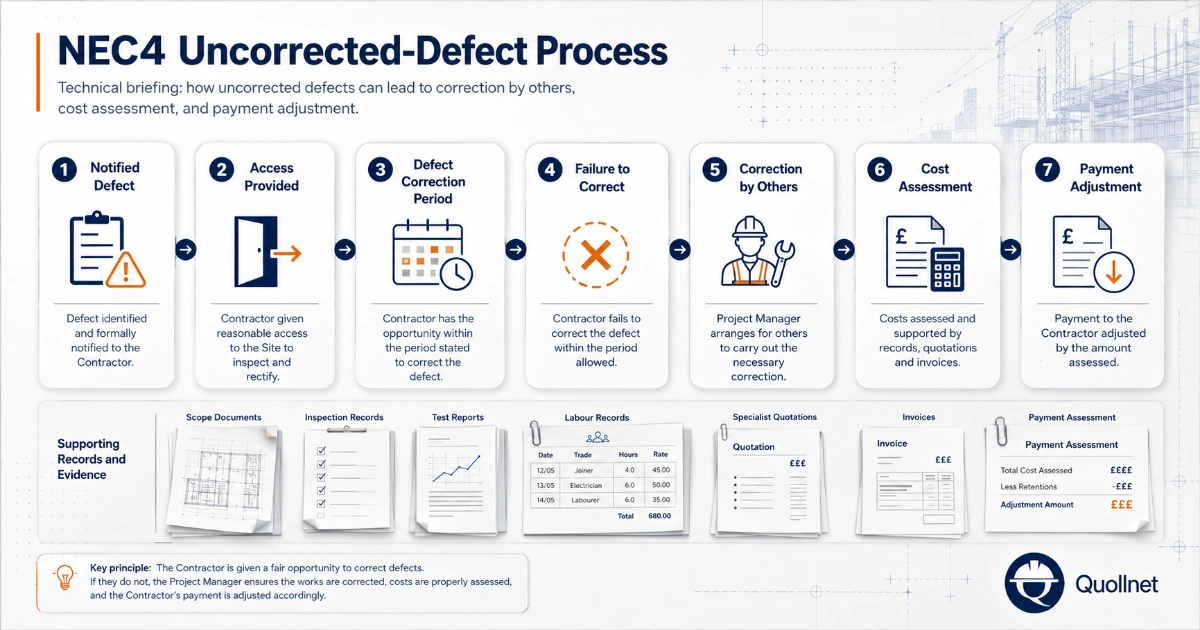
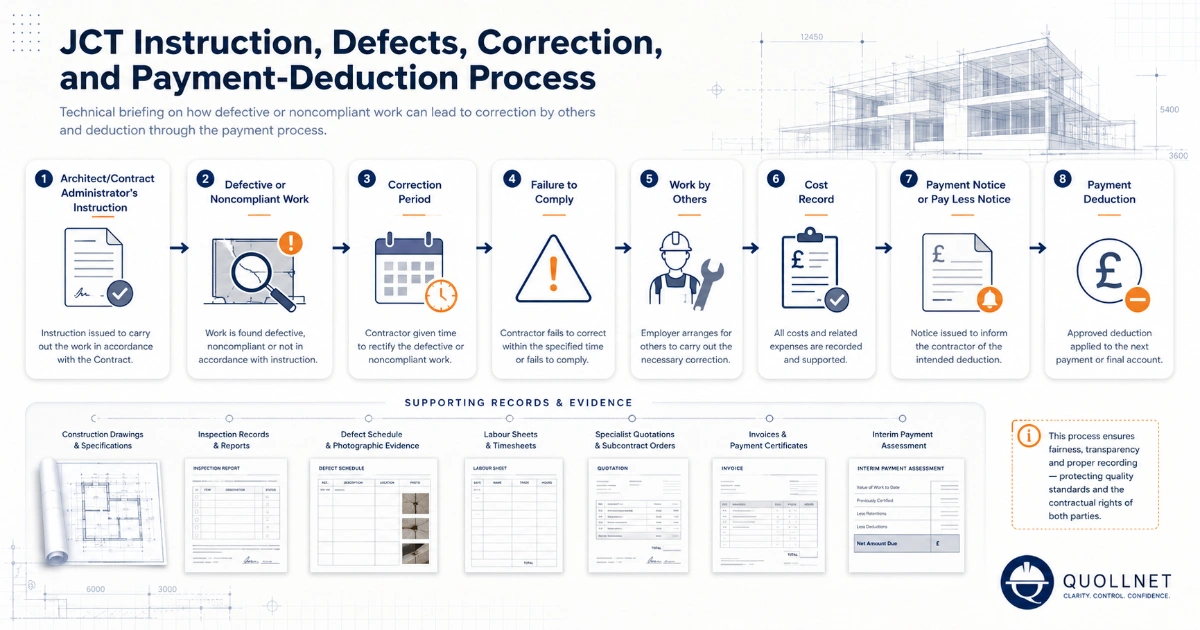
Compare the AIA procedure with the FIDIC remedial-work and backcharge procedure, NEC4 uncorrected Defect cost assessment, and JCT instructions and payment deductions.
This article provides general construction contract-administration information and is not legal advice. The executed Contract and Subcontract, Supplementary Conditions, amendments, governing law, prompt-payment statutes, lien laws, and project-specific facts control. Significant payment or termination disputes require project-specific legal advice.
REFERENCES
AIA Document A201–2017 Sample: General Conditions of the Contract for Construction
AIA Document A201–2017 Official Summary
AIA Contract Documents: Owner’s Right to Carry Out the Work
AIA Contract Documents: Rejection and Correction of Work
AIA Contract Documents: Identifying and Correcting Defective Work
AIA Contract Documents: One-Year Correction Period Versus Warranty
AIA Document A401–2017 Official Summary
AIA Document A401–2017 Official Instructions
AIA Contract Documents: Terminating a Subcontractor for Nonconforming Work
AIA Contract Documents: Notice of Claims