How to review a method statement in construction
Definition: How to review a method statement in construction equips site managers and engineers to validate scope, risks, resources, sequencing, and acceptance criteria before authorizing work.
- Verify scope, sequencing, and interfaces against current drawings and schedule.
- Confirm RAMS controls, permits, and temporary works approvals are in place.
- Check measurable tolerances, ITP hold points, and calibrated instruments.
- Interactive, commentable checklist with export and QR code verification.
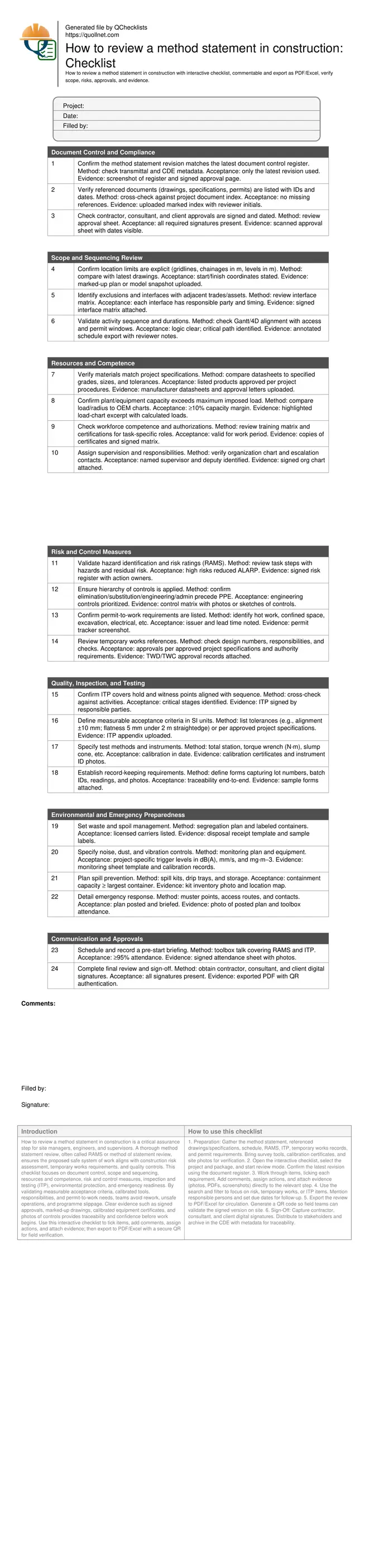
How to review a method statement in construction is a critical assurance step for site managers, engineers, and supervisors. A thorough method statement review, often called RAMS or method of statement review, ensures the proposed safe system of work aligns with construction risk assessment, temporary works requirements, and quality controls. This checklist focuses on document control, scope and sequencing, resources and competence, risk and control measures, inspection and testing (ITP), environmental protection, and emergency readiness. By validating measurable acceptance criteria, calibrated tools, responsibilities, and permit-to-work needs, teams avoid rework, unsafe operations, and programme slippage. Clear evidence such as signed approvals, marked-up drawings, calibrated equipment certificates, and photos of controls provides traceability and confidence before work begins. Use this interactive checklist to tick items, add comments, assign actions, and attach evidence; then export to PDF/Excel with a secure QR for field verification.
- Use this checklist to confirm the latest revision, explicit scope limits, correct sequencing, resource competence, and practical control measures. Capture approvals, test plans, and evidence before site activities begin to prevent delays, unsafe work, and nonconformities. The result is a clear go/no-go decision supported by documented proof.
- Strengthen risk management by verifying hazard identification, hierarchy of controls, permit requirements, and temporary works references. Establish measurable tolerances in SI units, define hold and witness points, and require in-date calibration for instruments. This reduces ambiguity, increases consistency, and supports defensible, auditable decisions during inspections or investigations.
- Improve delivery and interfaces by confirming responsibilities, communication routes, and lookahead notifications. Ensure environmental measures, spill response, and emergency procedures are specific to the location. Tie acceptance criteria to forms, photos, and signatures so that quality records are complete, searchable, and readily available for closeout and handover.
- Interactive online checklist with tick, comment, and export features secured by QR code.
Document Control and Compliance
Scope and Sequencing Review
Resources and Competence
Risk and Control Measures
Quality, Inspection, and Testing
Environmental and Emergency Preparedness
Communication and Approvals
Start with governance: version, scope, and sequence alignment
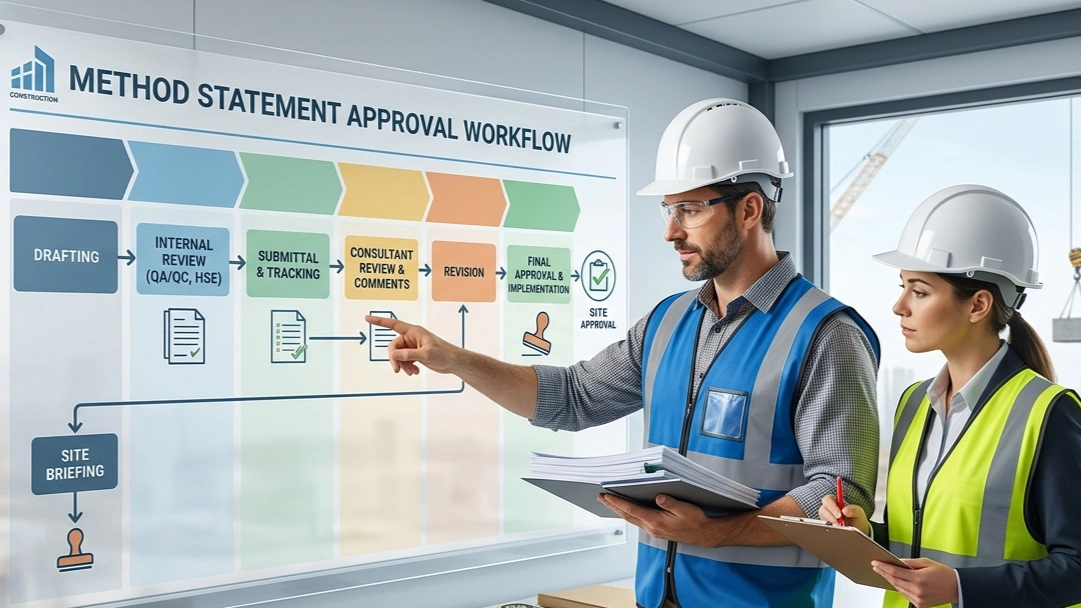
A reliable review begins with governance. Confirm the method statement is the latest approved revision in the project’s document control environment, then verify its referenced drawings and specifications align with the same issue dates. Scope clarity prevents disputes: the statement should pinpoint gridlines, chainages in metres, and levels in metres, plus list exclusions and interfaces with neighbouring works. Next, test the sequence against the current schedule or 4D model. Work windows, access constraints, and permits must logically enable each step. Look for explicit responsibilities and escalation routes, so decisions don’t stall mid-task. Capture concrete evidence: screenshots of the CDE, a marked-up plan showing limits, and an annotated programme with critical path recognition. This structure allows reviewers to focus on actual content, not paperwork noise, and sets the tone for consistent, auditable decisions that survive site pressure and time.
- Use only the latest approved revision.
- State gridlines, chainages, and levels.
- Map interfaces with responsible parties.
- Align sequence with permits and access.
- Attach marked-up drawings and schedule.
Risk-first thinking: RAMS, permits, and temporary works
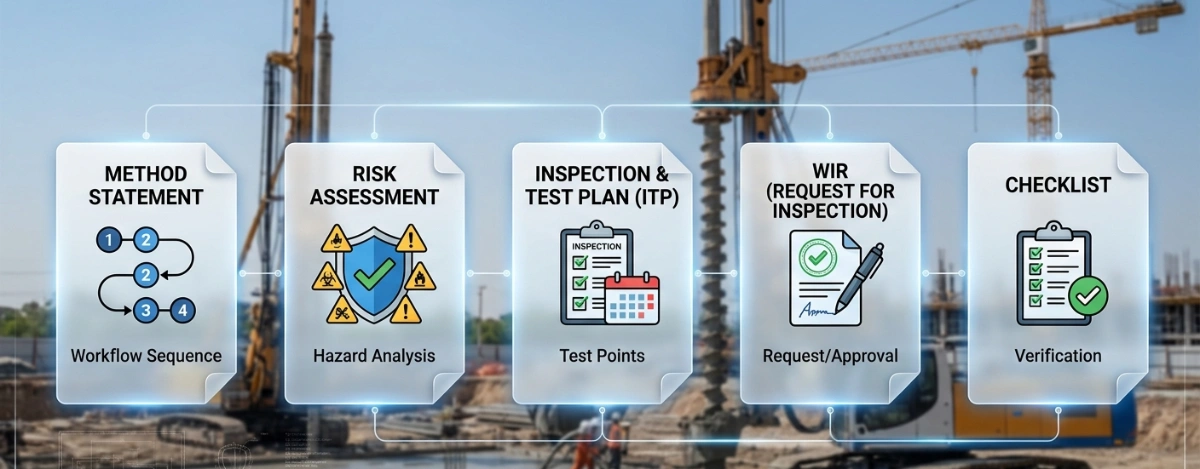
Risk drives the review. For every task step, the method must identify hazards and prescribe controls using the hierarchy: remove, substitute, engineer, administrate, then PPE. Ensure residual risk is meaningfully reduced and that permits (hot work, confined space, excavation, electrical, etc.) are named with issuers and lead times. Temporary works require special focus—confirm design references, responsibilities, and approval records are cited. Where lifting, pressure, or confined operations appear, load calculations and rescue arrangements should be explicit. Verify briefings: how crews will be inducted on controls, and how supervision will monitor compliance. Evidence matters: a signed risk register, example permits, and temporary works approvals should accompany the method. Prioritizing risk in this way turns the review into a proactive barrier audit, not a reactive paperwork exercise.
- Apply the hierarchy of controls.
- List permit types and issuers.
- Reference temporary works approvals.
- Include rescue and emergency plans.
- Attach signed RAMS evidence.
Quality proof: measurable criteria, calibrated tools, and records
Quality assurance turns intent into acceptance. The method statement should define measurable criteria in SI units—alignment tolerances, flatness, cover, torque, pressure, and performance thresholds. The ITP must place hold and witness points at critical stages, matching the activity sequence. Instruments (total stations, torque wrenches, gauges) require in-date calibration, with certificates tied to instrument IDs. Record-keeping should capture lot numbers, batch IDs, readings, and photos that prove conformance and traceability. Don’t forget practicalities: how measurements will be taken, by whom, and what forms are used. Environmental and emergency specifics complete the picture: waste segregation, dust/noise monitoring arrangements, spill prevention, and clear muster points. By asking for quantifiable criteria, calibrated tools, and searchable records, you transform a narrative into a verifiable plan that site teams can execute confidently and auditors can trust.
- State SI-unit tolerances.
- Add hold and witness points.
- Use in-date calibrated instruments.
- Tie records to batch and lot IDs.
- Attach photos and forms.
How to use this interactive method statement review checklist
- Preparation: Gather the method statement, referenced drawings/specifications, schedule, RAMS, ITP, temporary works records, and permit requirements. Bring survey tools, calibration certificates, and site photos for verification.
- Open the interactive checklist, select the project and package, and start review mode. Confirm the latest revision using the document register.
- Work through items, ticking each requirement. Add comments, assign actions, and attach evidence (photos, PDFs, screenshots) directly to the relevant step.
- Use the search and filter to focus on risk, temporary works, or ITP items. Mention responsible persons and set due dates for follow-up.
- Export the review to PDF/Excel for circulation. Generate a QR code so field teams can validate the signed version on site.
- Sign-Off: Capture contractor, consultant, and client digital signatures. Distribute to stakeholders and archive in the CDE with metadata for traceability.
Call to Action
- Start Checklist Tick off tasks, leave comments on items or the whole form, and export your completed report to PDF or Excel—with a built-in QR code for authenticity.
- Download Excel - Method Statement Review (Construction)
- Download PDF - Method Statement Review (Construction)
- View Image - Method Statement Review (Construction)
Cite & Embed
“Method Statement Review (Construction) by Quollnet”
with a link to
this source page.
FAQ
Question: What should a good construction method statement include before approval?
Question: How do I verify the latest revision of a method statement?
Question: How specific should acceptance criteria be in a method statement?
Question: What evidence should I collect during the review?
Question: When should permits be confirmed in the review process?
Related Articles
Broader reading and guidance connected to this checklist topic.
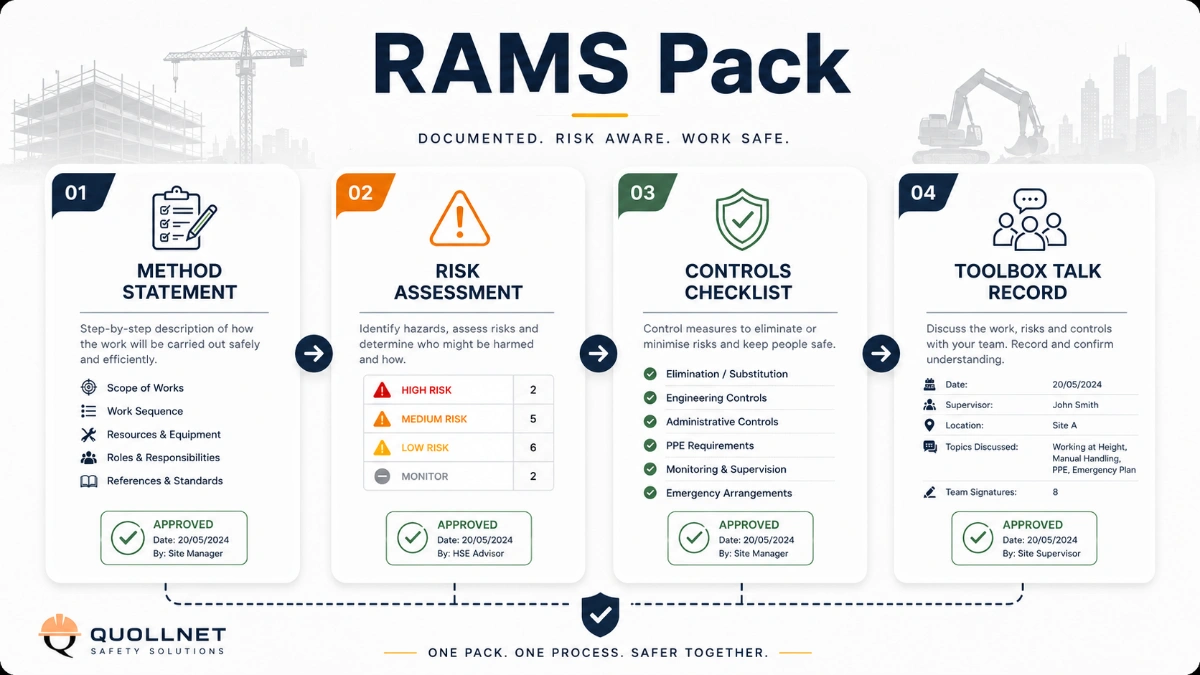
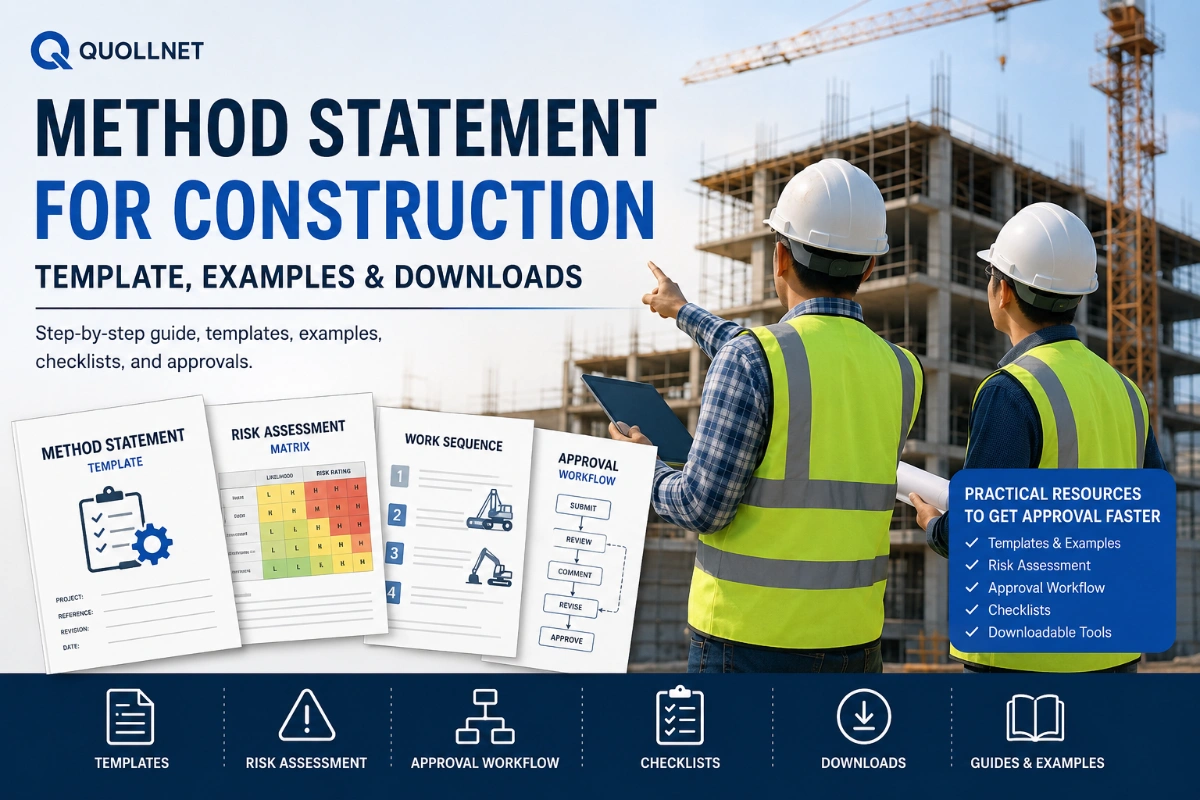
Rams Pack In Construction: Method Statement And Risk Assessment Template
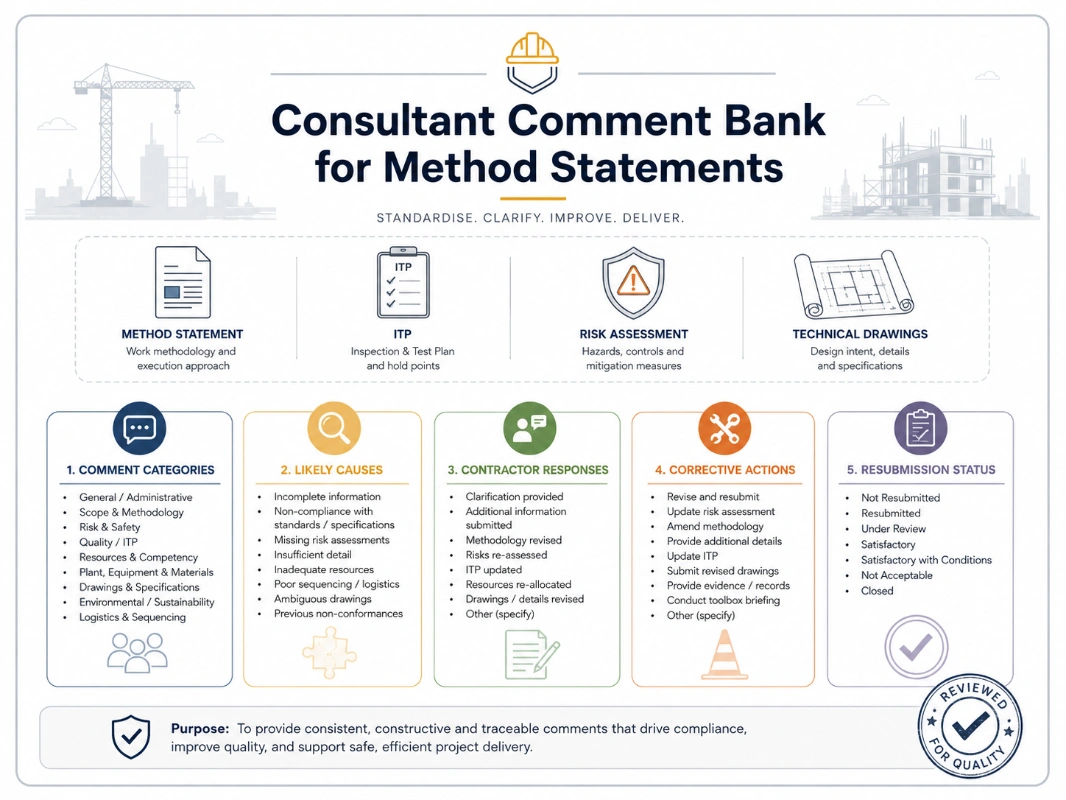
Consultant Comment Bank For Method Statements
Related Checklists
Keep the workflow moving with nearby templates chosen from similar checklist content.