Method Statement vs Risk Assessment vs ITP: What to Include Before Submission
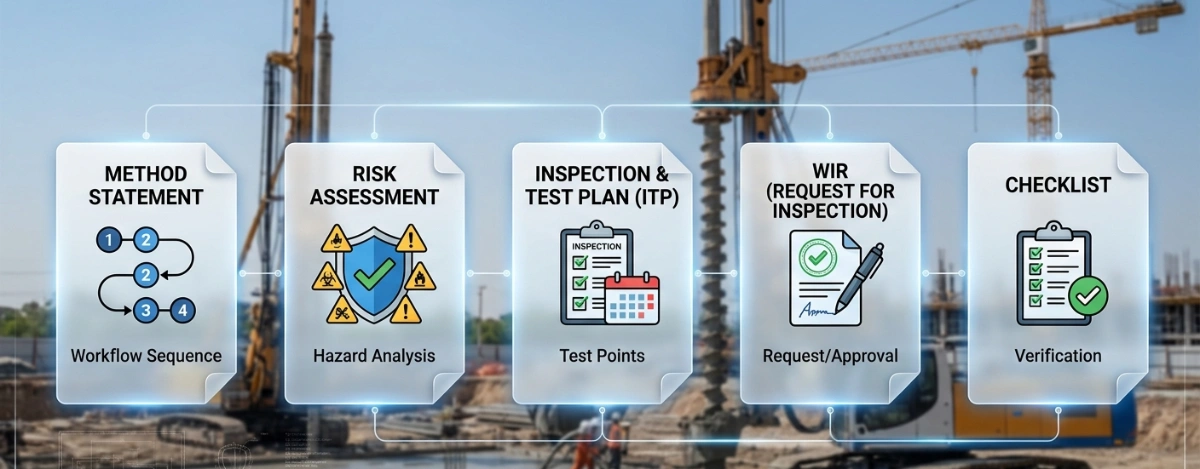
A method statement explains how construction work will be carried out. A risk assessment identifies what can go wrong and how hazards are controlled. An ITP defines what must be inspected, tested, witnessed, or accepted. A WIR is only the request for inspection, while checklists and toolbox talks support readiness.
These documents are often submitted together, especially for high-risk or quality-critical work. However, they do not do the same job. Confusing them can lead to rejected submittals, missed inspections, weak safety planning, unclear responsibilities, and avoidable rework.
This article is not a full method statement guide. It is a practical comparison page for site engineers, QA/QC engineers, HSE officers, consultants, subcontractors, and junior engineers who need to understand what belongs in each document before preparing a real construction submission.
Why This Matters Before You Generate or Submit a Method Statement
AI can quickly produce a method statement, risk assessment, or ITP draft. The problem is that a good-looking document can still be wrong if the information is placed in the wrong control document.
For example, a method statement may describe concrete placing and curing very well, but still be rejected because it does not connect to the ITP hold points, the risk assessment is generic, or the inspection request process is unclear. In construction, the issue is not only the wording. The issue is whether the execution, safety, quality, and inspection workflow actually connect.
If you need a practical starting point, you can use Quollnet Method Statements to create, generate, clone, customize, save, and export construction method statements for submission. Many public method statements are also linked to related ITPs so the execution method and inspection controls remain connected.
The Simple Rule: How, Risk, Inspection, Request, Readiness
The easiest way to separate the documents is to ask what question each one answers:
- How will we do the work? This belongs in the method statement.
- What can go wrong and how will we control it? This belongs in the risk assessment.
- What must be inspected, tested, witnessed, or accepted? This belongs in the ITP.
- How do we formally call the consultant or engineer to inspect? This is the WIR or RFI process.
- Are we ready today and has the team been briefed? This is where checklists and toolbox talks help.
Practical distinction: A method statement is not a risk assessment. A risk assessment is not an ITP. An ITP is not a WIR. A checklist supports readiness, but it does not replace a contractual inspection or test requirement.
Printable Infographic: Construction Control Document Workflow
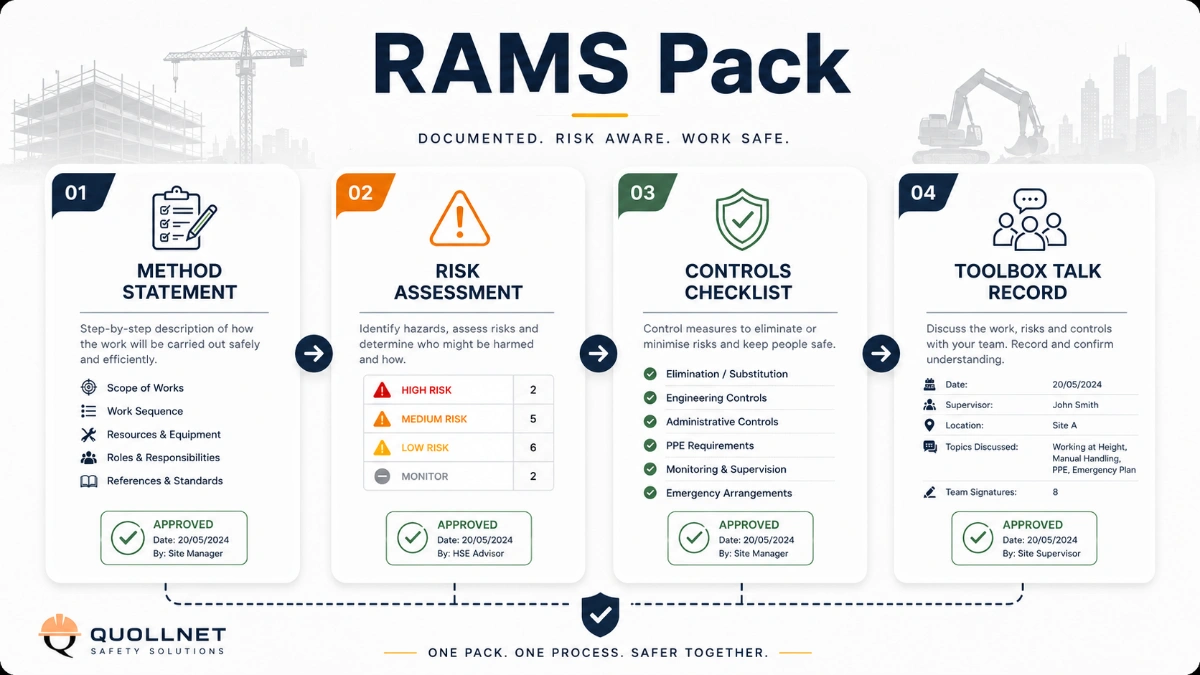
The infographic below summarizes the practical workflow: the method statement plans the work, the risk assessment controls hazards, the ITP defines inspection and testing, the WIR requests the inspection, and checklists or toolbox talks confirm readiness before execution.
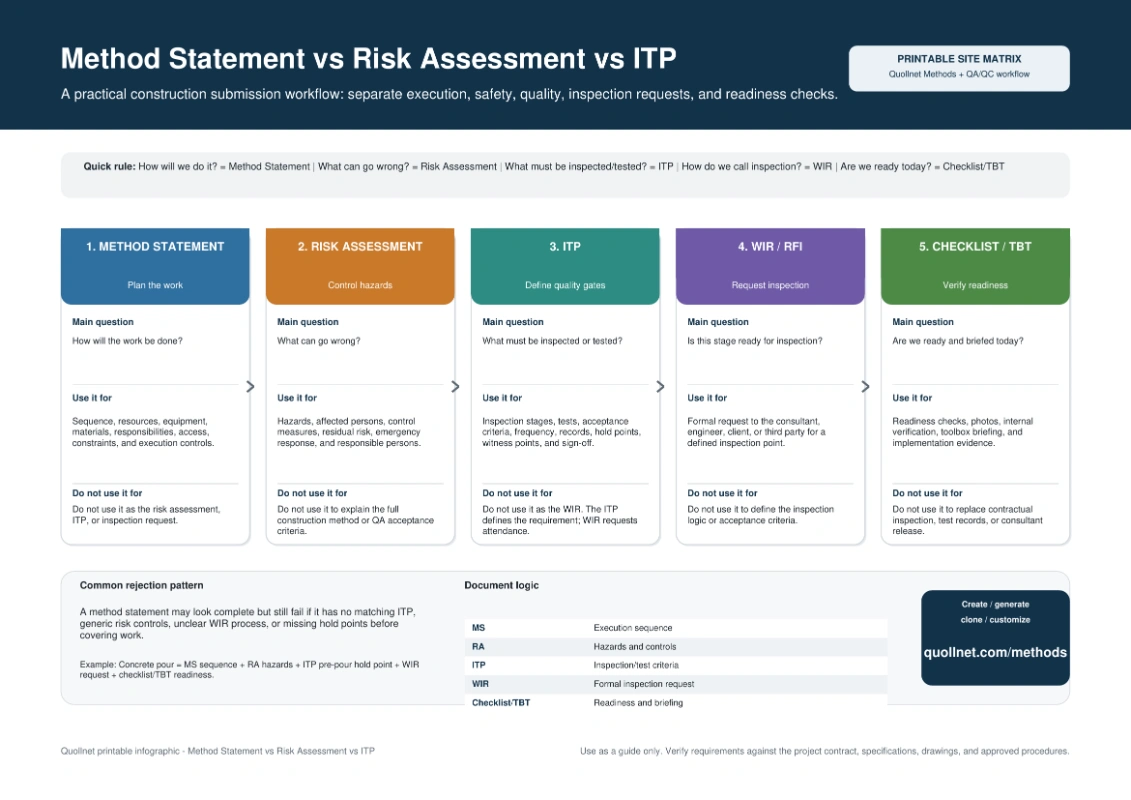
Download the printable PDF infographic
Method Statement vs Risk Assessment vs ITP Matrix
| Document | Main Question | Use It For | Do Not Use It For | Related Form or Tool |
|---|---|---|---|---|
| Method Statement | How will the work be done? | Work sequence, resources, materials, equipment, responsibilities, execution controls, and coordination requirements. | Replacing the risk assessment, replacing the ITP, or acting as proof that an inspection was requested. | Method statement template, construction sequence, drawings, material approvals, ITP. |
| Risk Assessment | What can go wrong? | Hazards, affected persons, initial risk, control measures, residual risk, and responsible persons. | Explaining the full construction sequence or defining quality acceptance criteria. | Toolbox talk, safety checklist, permit to work, emergency plan. |
| ITP | What must be inspected or tested? | Inspection stages, tests, acceptance criteria, frequency, records, responsibilities, hold points, and witness points. | Requesting the inspection itself or replacing the method statement. | WIR/RFI, test reports, inspection checklist, lab results, calibration records. |
| WIR / RFI | Is this work ready for inspection? | Formally requesting consultant, engineer, client, or third-party inspection at a defined stage. | Defining the inspection criteria or replacing the ITP. | Work Inspection Request form, Request for Inspection template, attachments, photos. |
| Checklist / Toolbox Talk | Are we ready and briefed? | Daily readiness, internal verification, safety communication, photo evidence, and site implementation checks. | Replacing contractual approval, test records, or formal inspection release. | Safety checklist, QA checklist, pre-task briefing, toolbox talk record. |
Where the WIR Fits
The ITP defines the inspection or test requirement. The WIR is the formal request submitted when that inspection or test point is ready.
For example, the ITP may state that reinforcement, formwork, embedded items, and MEP sleeves must be inspected before a concrete pour. The WIR is then submitted to request the consultant’s attendance or approval for that specific pre-pour inspection.
This distinction is important. If the contractor sends a WIR without understanding the ITP requirement, the inspection may be rejected because the wrong area, wrong stage, missing attachment, or incomplete readiness evidence was submitted. For a deeper explanation of the inspection request process, see the Work Inspection Request guide and the Request for Inspection templates.
Where Checklists and Toolbox Talks Fit
A checklist helps the project team verify readiness or compliance before, during, or after the activity. A toolbox talk communicates the method, hazards, control measures, access restrictions, PPE requirements, emergency arrangements, and site-specific concerns to the workforce.
However, a checklist is not automatically an ITP. It may support the ITP by recording evidence, but the ITP remains the document that defines the contractual inspection and testing requirements. Similarly, a toolbox talk supports the risk assessment, but it does not replace the risk assessment itself.
For safety implementation, daily and periodic checks can be managed through construction safety checklists and morning briefings.
Example: Concrete Pour Submission Package
For a concrete pour, the documents should connect clearly:
- Method Statement: describes formwork checks, reinforcement coordination, embedded items, concrete delivery, pump setup, placing sequence, vibration, finishing, curing, and protection.
- Risk Assessment: covers pump line pressure, hose whip, vehicle movement, manual handling, work at edges, cement burns, heat stress, slips, and emergency response.
- ITP: defines inspections for formwork, rebar, embedded items, concrete slump, temperature, cube samples, delivery tickets, curing records, and hold points before pouring.
- WIR: requests the pre-pour inspection before concrete is placed.
- Checklist / Toolbox Talk: confirms area readiness, access, lighting, tools, curing materials, pump route, manpower, PPE, and team briefing.
If any part is missing, the submission becomes weak. A strong method statement cannot compensate for a missing pre-pour ITP hold point. A signed checklist cannot replace consultant release. A toolbox talk cannot replace a risk assessment.
Example: Waterproofing Submission Package
Waterproofing is another useful example because the quality risk is often hidden after protection layers, screeds, tiles, or backfilling.
- Method Statement: explains substrate preparation, primer application, membrane installation, lap treatment, upturns, corners, terminations, protection board, and curing requirements.
- Risk Assessment: covers fumes, skin contact, hot works if applicable, slips, poor ventilation, material handling, confined spaces, and access restrictions.
- ITP: defines substrate inspection, material verification, primer approval, membrane thickness or lap checks, flood test, spark test if applicable, and inspection before covering.
- WIR: requests inspection before the waterproofing is covered by protection board, screed, backfill, or finishes.
- Checklist: confirms surface cleanliness, dryness, corners, penetrations, approved material batch, weather conditions, and protection readiness.
Common Mistakes That Cause Rejected Submittals
- Submitting a method statement without a matching ITP: The work sequence may be clear, but the inspection gates are not defined.
- Using a generic risk assessment: Copy-paste hazards do not prove that the team reviewed the actual site conditions.
- Calling a checklist an ITP: A checklist can record checks, but the ITP defines the inspection plan, acceptance criteria, and hold or witness points.
- Treating the WIR as the inspection plan: The WIR requests the inspection. It does not define the inspection logic.
- Missing hold points before covering work: Concrete pours, waterproofing, embedded MEP items, underground services, and backfilling often require inspection before the work is hidden.
- Using AI-generated text without project adaptation: AI can draft the structure, but acceptance criteria, standards, drawings, notification periods, responsibilities, and site constraints must be checked against the project requirements.
Use Quollnet to Create or Customize Method Statements
If you are preparing a real submission, start from a practical document instead of a blank page. In Quollnet Method Statements, users can browse public construction method statements, generate new method statements, clone existing examples, customize them for a specific project, save them to their account, and export them for submission.
This is especially useful when the method statement must connect to the project’s ITP, inspection records, HSE controls, and site execution sequence. The goal is not only to create text. The goal is to create a submission package that a contractor, consultant, QA/QC engineer, and HSE officer can actually review and use.
Download the Printable Matrix
You can download the printable matrix as a PDF and use it as a quick reference for site engineers, QA/QC engineers, HSE officers, subcontractors, and junior engineers preparing construction submissions.
Download Method Statement vs Risk Assessment vs ITP Matrix
Site rule: Before starting work, the team should be able to answer five questions: How will we do it? What can go wrong? What must be inspected or tested? How do we request the inspection? Are we ready today?
Final Practical Takeaway
Method statements, risk assessments, ITPs, WIRs, checklists, and toolbox talks are connected, but they are not interchangeable. Each one controls a different part of construction execution.
The method statement controls the work sequence. The risk assessment controls hazards. The ITP controls inspection and testing. The WIR requests the inspection. The checklist and toolbox talk help verify readiness and communicate requirements before the work starts.
When these documents are aligned, the submission is easier to review, the site team understands what to do, the QA/QC process becomes clearer, and the risk of missed inspections or rejected work is reduced.
REFERENCES:
Inspection and Test Plan (ITP) in Construction — Quollnet Guide
Work Inspection Request (WIR) Guide — Quollnet
Request for Inspection Templates — Quollnet
Construction Safety Checklists and Morning Briefings — Quollnet
HSE — Risk Assessment Template and Examples
HSE — Construction Administration, Risk Assessments and Method Statements