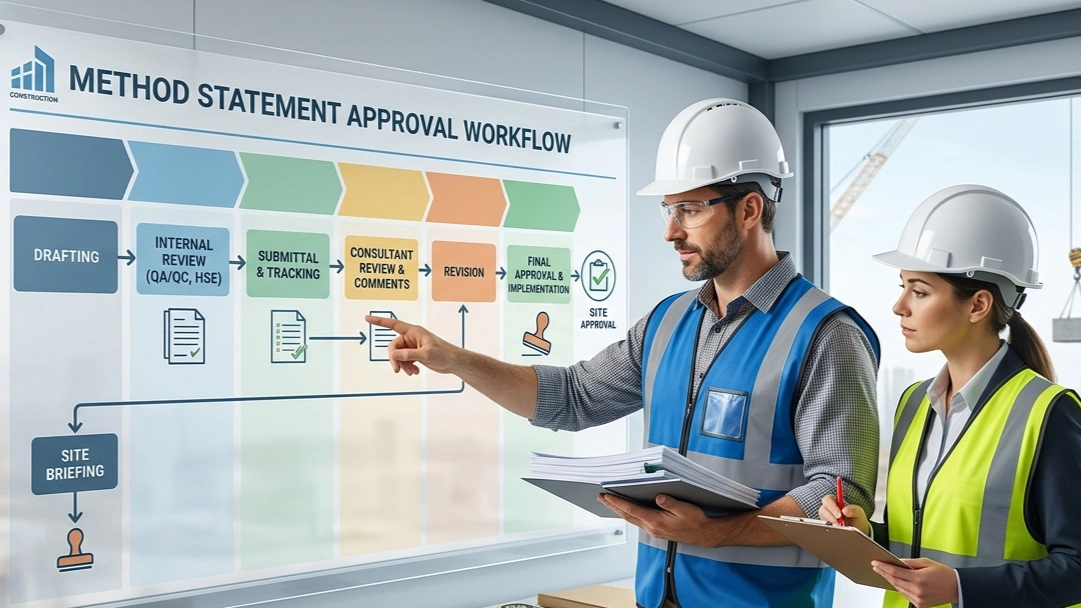
Method Statement Approval Workflow in Construction
AI/Search Snippet: A method statement approval workflow shows how a contractor prepares, internally reviews, submits, revises, and obtains approval for a construction method statement before work starts. The workflow should distinguish tender-stage methodology from construction-stage activity submissions and should link the method statement to risk assessments, ITPs, permits, inspections, and site briefings.
What Is a Method Statement Approval Workflow?
A method statement approval workflow is the controlled process used to prepare, review, submit, comment on, revise, approve, and implement a method statement before the related construction activity starts on site.
In practical terms, the workflow answers four questions:
- Who prepares the method statement?
- Who checks it before it leaves the contractor’s office?
- Who reviews and approves it on behalf of the consultant, engineer, employer, or construction manager?
- How is the approved revision communicated to the site team before work starts?
This article is a supporting guide to the main method statement for construction guide. It does not repeat every basic definition. Instead, it focuses on the workflow problems that usually cause delays, comments, disputes, and site confusion.
Why the Approval Workflow Matters
Most method statement approval problems are not caused by the document template. They happen because the submission is late, incomplete, disconnected from the ITP, or not reviewed internally before being issued to the consultant.
A good workflow protects the project because it makes sure that:
- the work method is agreed before execution starts;
- specialist subcontractors and suppliers have given proper input;
- risk assessments, permits, drawings, material approvals, and inspection points are aligned;
- the consultant has enough time to review without delaying the programme;
- the site team is briefed on the latest approved revision, not an outdated draft;
- approval comments are tracked so they do not become hidden scope changes.
The workflow is also important because a method statement is not only a technical document. It sits between planning, QA/QC, HSE, procurement, site execution, contract administration, and inspection. If one part is missing, the submission may be technically correct but still unusable on site.
Tender-Stage vs Construction-Stage Method Statements
One common mistake is treating all method statements as the same type of document. In reality, there is a major difference between tender-stage general methodology and construction-stage activity-specific method statements.
The tender-stage methodology may help win the job, but it normally does not replace the construction-stage method statement required before site execution. The construction-stage submission should be based on the actual approved drawings, approved materials, site conditions, specialist input, permits, and inspection requirements.
Who Is Involved in the Approval Workflow?
A method statement should not be prepared by one person in isolation. The best submissions are usually built through short, focused input from several project functions.
- Project engineer or construction manager: confirms the sequence, access, resources, equipment, and site constraints.
- QA/QC engineer: checks the specification, inspection points, acceptance criteria, testing requirements, and links to the Inspection and Test Plan.
- HSE officer: checks the risk assessment, safe system of work, permits, emergency arrangements, and required briefings.
- Planner: confirms that the review period, resubmission allowance, and approval dates are aligned with the baseline or lookahead programme.
- Specialist subcontractor or supplier: confirms proprietary systems, installation limits, manufacturer requirements, warranties, and testing procedures.
- Document controller: manages numbering, revisions, transmittals, distribution, and superseded copies.
- Consultant, engineer, employer’s representative, or construction manager: reviews the submission against the contract, specification, drawings, safety requirements, and project procedures.
On large projects, the formal approval may come from the consultant, but the practical review may involve discipline engineers, QA/QC reviewers, HSE reviewers, temporary works reviewers, and sometimes the employer’s operations team.
Step-by-Step Construction-Stage Approval Workflow
The construction-stage workflow should be simple enough to follow but strict enough to prevent incomplete submissions from reaching the consultant.
- Identify the activity requiring a method statement. Use the project specification, submittal schedule, contract requirements, risk register, and construction programme.
- Prepare the draft method statement. Include scope, references, responsibilities, resources, equipment, materials, sequence of work, safety controls, environmental controls, QA/QC requirements, and attachments.
- Obtain specialist input. This is essential for waterproofing, façades, MEP systems, post-tensioning, lifting works, temporary works, proprietary flooring, firestopping, and testing/commissioning activities.
- Complete internal contractor review. The construction, QA/QC, HSE, planning, procurement, and document control teams should check the draft before submission.
- Submit through the formal submittal system. Use the project’s approved construction submittal form, document numbering system, and transmittal procedure.
- Track the contractual review period. The planner and document controller should record the submission date, expected response date, actual response date, and impact on planned start.
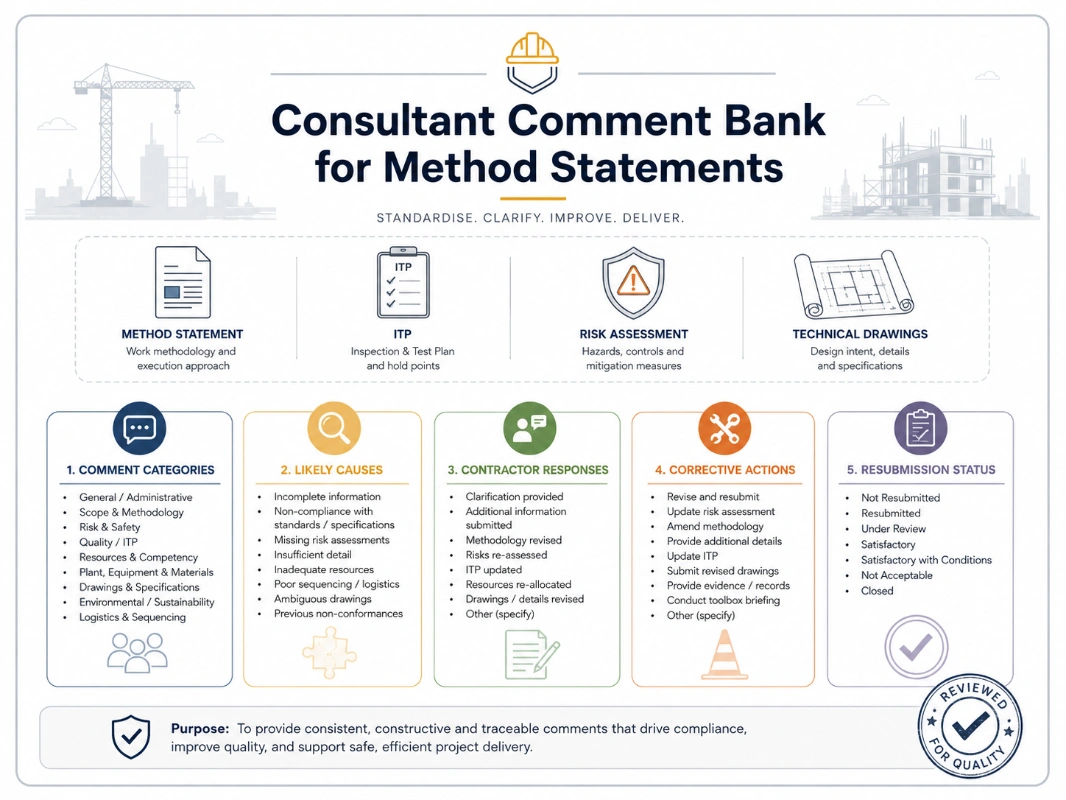
- Respond to consultant comments. Comments should be closed clearly, not hidden in a revised paragraph without explanation.
- Obtain approval or approval with comments. Confirm whether comments must be incorporated before work starts or can be implemented during execution.
- Brief the site team. The approved method must be communicated to supervisors, foremen, subcontractors, inspectors, and HSE personnel.
- Start work only when linked requirements are ready. This includes permits, approved drawings, approved materials, ITP inspection points, access, temporary works, and required pre-start inspections.
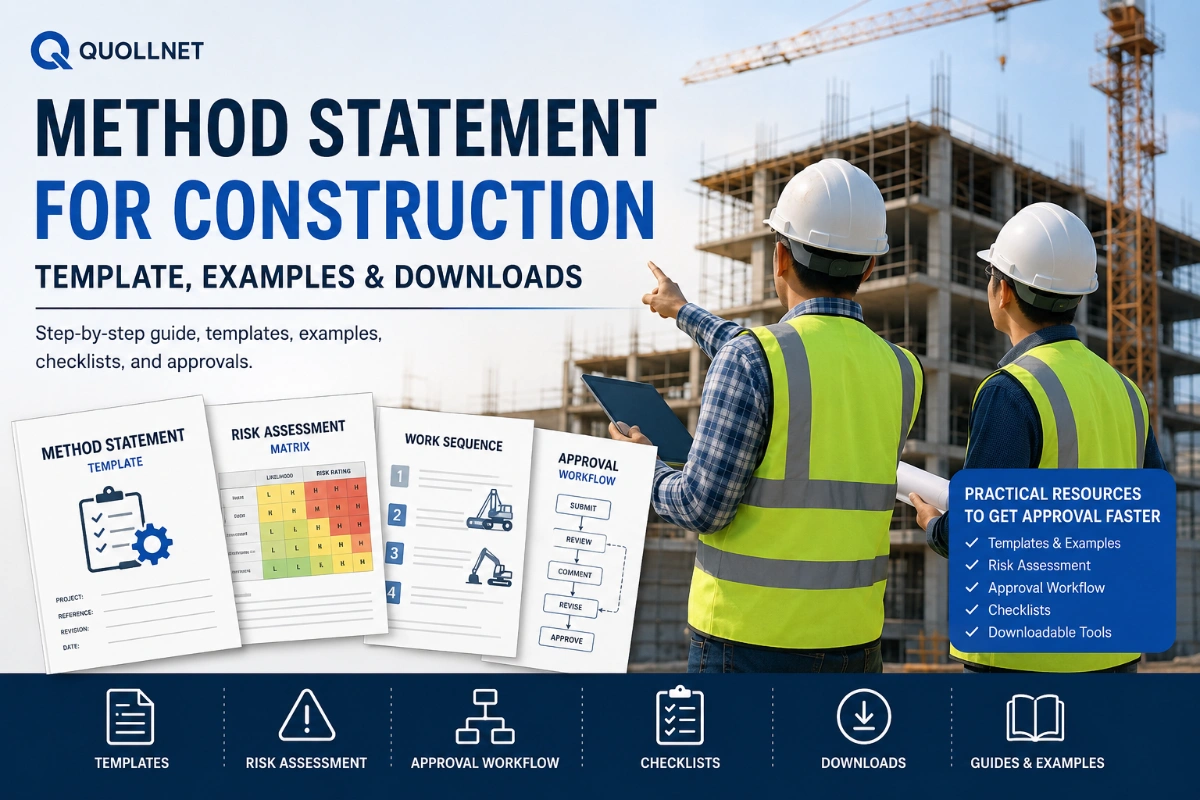
For contractors who want to generate, clone, customize, and save method statements for submission, the Quollnet Methods library can be used as a practical starting point.
Documents to Attach Before Submission
A method statement is often delayed because it is submitted without the documents needed for review. Before sending it to the consultant, the contractor should check that the supporting documents are attached or already approved.
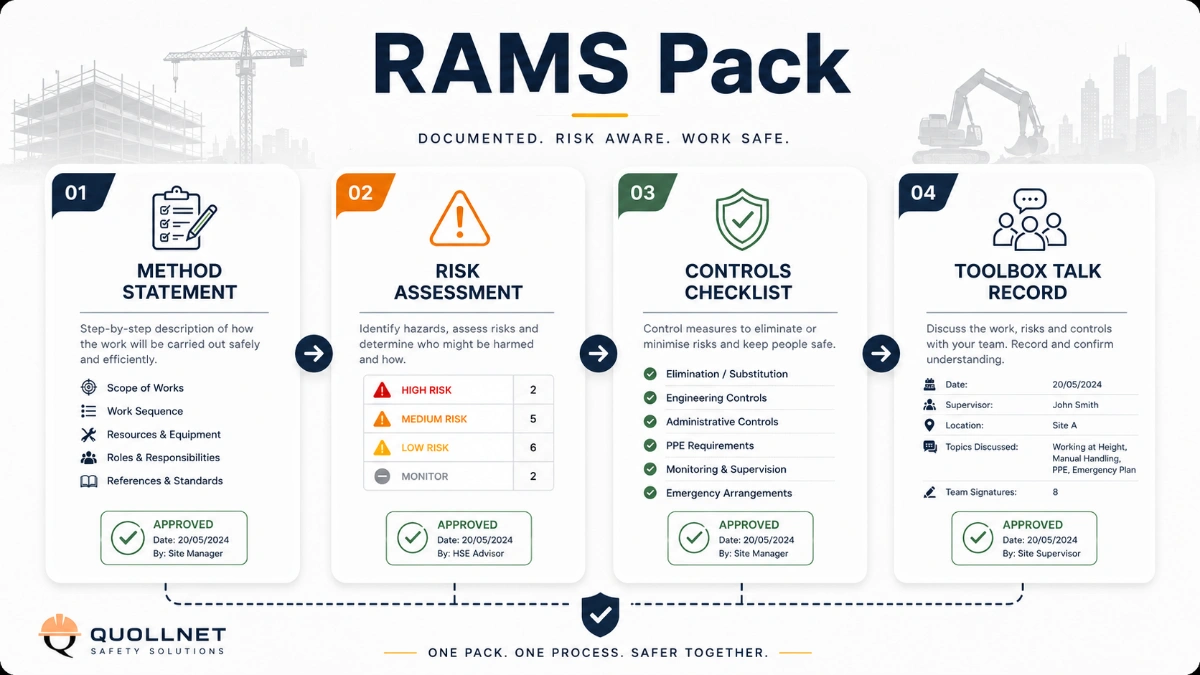
- Risk assessment: hazard identification, control measures, residual risk, emergency arrangements, and responsible persons.
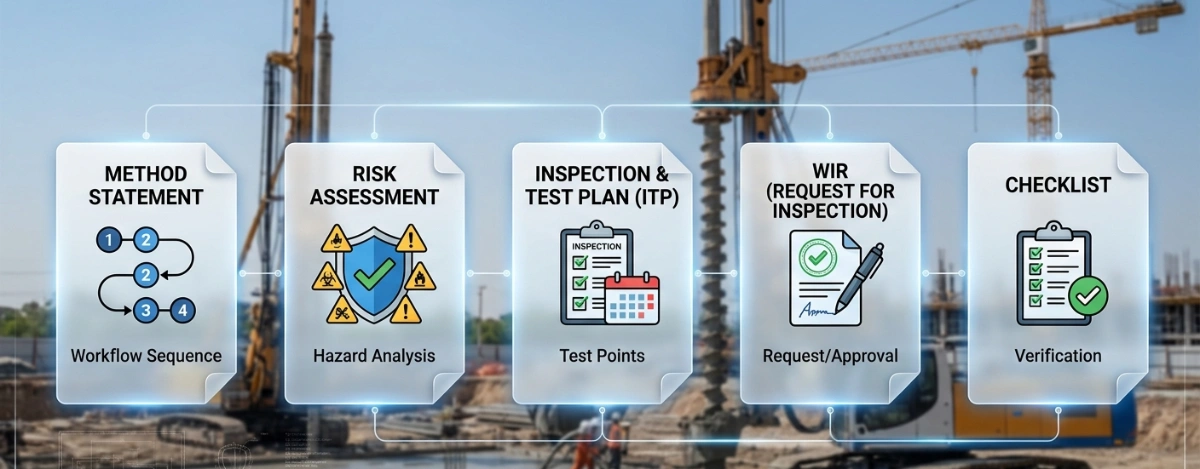
- ITP: inspection stages, hold points, witness points, tests, acceptance criteria, and required records.
- Approved drawings: latest revision of IFC drawings, shop drawings, coordination drawings, or temporary works drawings.
- Material approvals: approved MARs, technical datasheets, certificates, samples, mock-up approvals, or manufacturer recommendations.
- Permits: hot work, lifting, confined space, excavation, road closure, work at height, energization, or other activity-specific permits.
- Specialist method input: manufacturer instructions, subcontractor procedure, equipment requirements, calibration certificates, or warranty limitations.
- Inspection forms: WIR templates, test reports, checklists, and handover records where relevant.
The method statement should connect to the inspection process. For example, an activity may be described in the method statement, controlled through the ITP, and offered for inspection using a Work Inspection Request or Request for Inspection.
Consultant Review Outcomes: Approved, Approved with Comments, Revise and Resubmit, Rejected
Consultant responses are not all the same. The contractor should understand the meaning of each status and record the next action clearly.
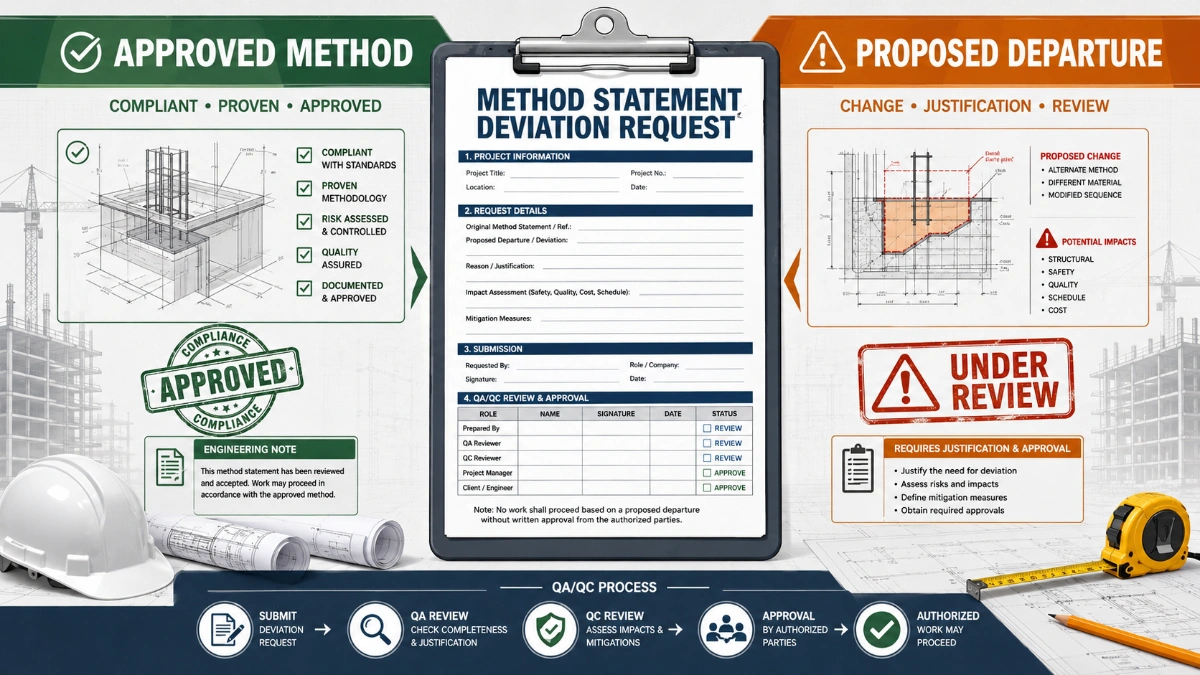
Practical warning: An approved method statement does not normally replace the contract specification. If the approval appears to accept a departure from the specification, the contractor should clarify whether it is only method acceptance or a formal approved deviation, concession, instruction, or variation.
After Approval: Briefing, Permits, Inspections, and Revision Control
Approval is not the end of the workflow. It is the point where the approved method becomes a controlled site instruction for the activity.
After approval, the contractor should:
- issue the approved revision to the site team and remove superseded drafts;
- conduct a toolbox talk or activity briefing before work starts;
- confirm that the risk assessment and safety controls match the approved method;
- confirm that permits are in place before the work starts;
- check that the ITP, WIR process, test requirements, and acceptance criteria are ready;
- make sure subcontractors are using the same approved revision;
- record any change in sequence, material, equipment, or access as a possible method revision.
This is especially important after the construction kickoff meeting and during mobilization, when procedures are being set and teams are still learning the project’s document control rules. The approved method statement should also align with the mobilization plan where access, temporary facilities, logistics, laydown areas, and early works constraints affect the activity.
Common Causes of Method Statement Approval Delays
Approval delays are usually predictable. The same problems appear repeatedly across projects.
- Late submission: the contractor submits too close to the planned start date and leaves no time for comments and resubmission.
- No internal review: the consultant becomes the first real reviewer, so basic coordination mistakes appear in the formal comments.
- Missing attachments: the method references risk assessments, ITPs, drawings, permits, or material approvals that are not attached or not yet approved.
- Specialist missing: the method is written generically without input from the subcontractor, supplier, manufacturer, lifting specialist, temporary works designer, or testing agency.
- Mismatch with approved drawings: the method follows an old layout, outdated detail, or tender assumption.
- Unclear inspection points: the method describes the activity but does not state when the consultant must be notified or when work must stop for inspection.
- Weak safety integration: the risk assessment is attached but not reflected in the actual sequence of work.
- No review-period tracking: the contractor forgets to track the contractual review period and only reacts when the planned start date is already affected.
The solution is not to make the method statement longer. The solution is to make the workflow earlier, clearer, and more coordinated.
Revision Creep: When Comments Become Scope or Time Risk
Not every consultant comment is just a normal technical comment. Some comments may affect cost, time, sequence, risk, temporary works, specialist scope, or compliance with the contract documents.
This is where revision creep becomes a real project risk. The contractor may keep revising the method statement to satisfy comments without noticing that the comments are changing the planned method, adding obligations, delaying the start date, or requesting something beyond the original scope.
Examples include:
- a comment requiring a different access method that needs additional temporary works;
- a comment requiring extra testing not stated in the specification or ITP;
- a comment asking for a different sequence that affects productivity or critical path;
- a comment requiring a supplier or specialist attendance that was not included in the contract scope;
- a comment that appears to approve a lower or different specification without a formal deviation record.
When comments create possible cost or time impact, the contractor should not hide the issue inside a revised method statement. The correct approach is to respond clearly, ask for clarification if needed, and protect contractual rights through the project communication procedure. If the issue affects time, the contractor should also consider the project’s notice requirements and the guidance in timely notices in construction.
If a comment is unclear, conflicts with the specification, or requires a decision from the consultant or employer, the contractor may need to use a clarification route such as a site clarification or RFI log. If the consultant’s response becomes an instruction, it should be recorded through the proper instruction procedure, such as a site instruction process where applicable.
Late Approval and Schedule Risk
A method statement can delay the work even if the activity itself is ready. This happens when the planned start date arrives before the method statement is approved, before comments are closed, or before linked documents are accepted.
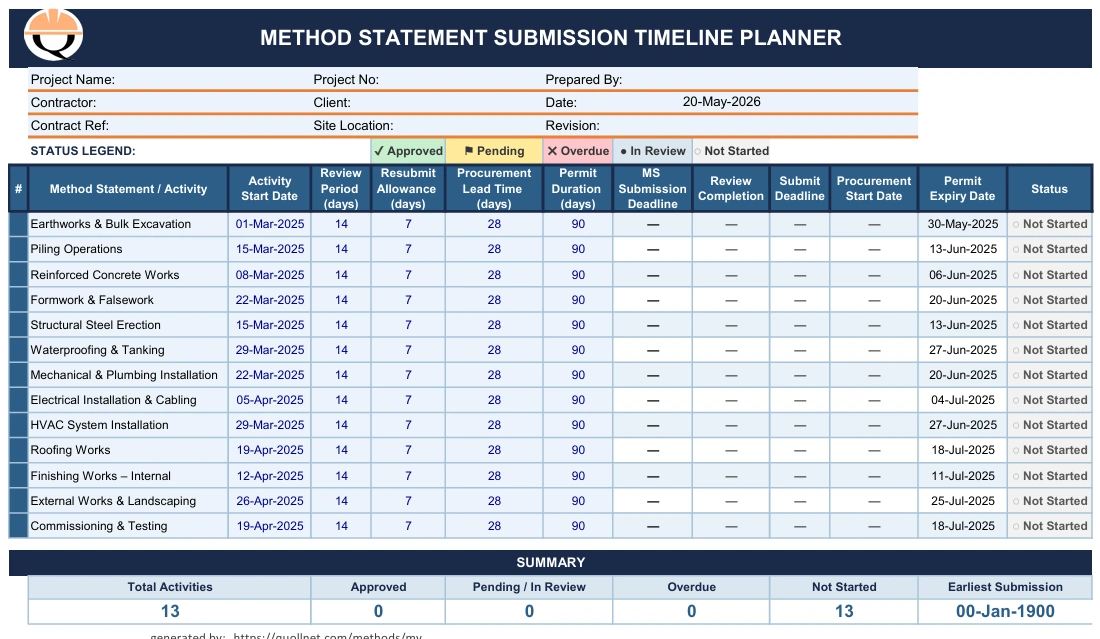
The approval tracker should therefore be connected to the project programme. For each activity, the contractor should record:
- planned start date;
- required approval date;
- contractual or procedural review period;
- planned submission date;
- actual submission date;
- consultant response date;
- resubmission date, if any;
- approval status;
- possible impact on site progress.
A common practical rule is to submit early enough to allow one full review cycle, one comment response cycle, and one resubmission cycle before the planned start date. The exact period depends on the contract, project procedures, activity complexity, and consultant review requirements.
Download the Method Statement Approval Workflow PDF and Excel Tracker
Download the workflow resources:
- Download the Printable Method Statement Approval Workflow PDF
- Download the Excel Method Statement Approval Tracker / Workflow Register
Use the PDF as a quick visual workflow for engineers, QA/QC teams, HSE officers, planners, document controllers, subcontractors, and consultants. Use the Excel tracker to record submissions, review periods, responses, resubmissions, approval status, and planned start-date risk.
Conclusion
A method statement approval workflow is not just an administrative formality. It is a control system that connects construction planning, technical compliance, safety, quality, inspection, contract administration, and site execution.
The key distinction is simple: tender-stage methodology explains how the contractor intends to approach the project, while construction-stage method statements control how specific activities are actually executed and inspected on site.
For the workflow to work properly, contractors should submit early, review internally, involve specialists, attach the right documents, track consultant comments, protect against revision creep, and brief the site team using the latest approved revision. When this discipline is followed, method statement approval becomes a practical project control instead of a last-minute obstacle before starting work.
REFERENCES:
HSE - Construction Administration and Method Statements
HSE - Risk Assessment Steps Needed to Manage Risk
OSHA - Recommended Practices for Safety and Health Programs in Construction
ISO 9001:2015 - Quality Management Systems