Method Statement for Construction: Template, Examples, Approval, and Contract Risks
AI/Search Snippet: A method statement for construction explains how a specific activity will be carried out, including the work sequence, resources, safety controls, inspections, permits, and specialist requirements. It is not only paperwork: tender-stage method statements, approved construction methods, consultant comments, and specification conflicts can all create contractual and schedule consequences.
A method statement is one of the most important execution documents on a construction project. It tells the contractor, consultant, site team, subcontractors, and inspectors how a specific activity will be performed, controlled, inspected, and recorded.
But a method statement is not only a safety document and not only a template to satisfy a submittal log. On real projects, it can affect approvals, starting dates, resource planning, procurement, temporary works, quality control, claims, and even the contractor’s contractual obligations.
This guide explains what a construction method statement should include, who should contribute to it, when it should be submitted, what happens when it contradicts the specification, and how contractors can avoid common rejection and revision traps.
Professional Utility Tool: Do not draft your submittals from scratch. Use Quollnet Methods to create, generate, clone, customize, and save professional method statements and Inspection & Test Plans for submission.
What Is a Method Statement in Construction?
A method statement in construction is a written procedure explaining how a specific work activity will be carried out. It normally includes the scope of work, sequence of operations, required materials, equipment, manpower, safety controls, environmental controls, inspection requirements, permits, and supporting attachments.
In simple terms, a method statement answers this question:
How will this work be executed safely, correctly, and in compliance with the contract?
For example, a concrete pouring method statement should not only say “pour concrete as per specification.” It should explain pre-pour inspections, approved mix reference, delivery control, slump and temperature testing, placing sequence, vibration, finishing, curing, protection, and inspection records.
A good method statement is specific to the project. It should reflect the approved drawings, contract specifications, site conditions, available equipment, subcontractor input, inspection requirements, and actual sequence of work.
Why Method Statements Matter
Method statements are required because construction work involves technical risk, safety risk, sequencing risk, quality risk, and coordination risk. They help the project team confirm that the contractor has a realistic and controlled way to execute the activity before the work starts.
A properly prepared method statement helps to:
- confirm the construction sequence before work begins;
- connect execution to approved drawings and specifications;
- identify inspection and testing requirements;
- confirm required permits and pre-start approvals;
- coordinate plant, access, temporary works, storage, and logistics;
- communicate safety and environmental controls to the workforce;
- reduce rework, rejected inspections, and non-conformances;
- create a record of the approved method of work.
Method statements are usually submitted through the project’s document control system. For related submission workflow, see the Construction Submittal Form Guide.
Tender Method Statements: When the Contractor’s Proposed Method Becomes Contractual
During tender, the contractor may be asked to submit a general method statement, construction methodology, execution plan, or technical proposal. This document may describe how the contractor intends to deliver the project, including sequencing, mobilization, procurement, temporary works, equipment, manpower, quality control, safety, and environmental management.
If the tender-stage method statement is incorporated into the contract, it may become more than a proposal. It may become evidence of the contractor’s promised approach, assumptions, resources, and understanding of the work.
This is especially important in RFP-based procurement, where the employer evaluates the contractor’s technical solution, not only the price. For related tender context, see RFQ vs RFP vs Tender in Construction Procurement and the Construction Tender Preparation Guide.
The contractor should therefore avoid making unrealistic tender promises. If the tender method statement says that the contractor will use a certain sequence, equipment capacity, specialist system, or accelerated method, the contractor may later be expected to follow that approach unless a change is properly approved.
At the same time, a tender method statement is usually not detailed enough to control every activity on site. After award, the contractor should develop detailed activity-specific method statements that convert the tender methodology into buildable execution procedures.
Method Statement vs Risk Assessment vs ITP
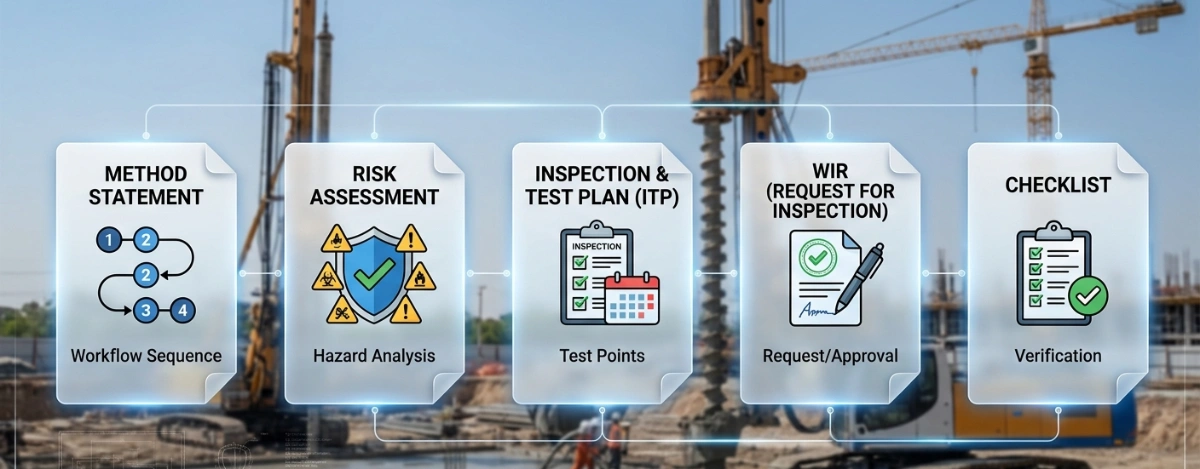
Method statements, risk assessments, and Inspection and Test Plans are connected, but they are not the same document.
| Document | Main Question | Practical Example |
|---|---|---|
| Method Statement | How will the work be done? | The sequence for excavation, lifting, concrete pouring, waterproofing, or façade installation. |
| Risk Assessment | What can go wrong and how will risks be controlled? | Controls for collapse, falling objects, plant movement, lifting failure, dust, noise, or hot works. |
| ITP | What must be inspected, tested, witnessed, or accepted? | Hold points, witness points, test frequency, inspection requests, and acceptance criteria. |
The method statement gives the work sequence. The risk assessment identifies hazards and control measures. The ITP defines what must be inspected or tested before the work can proceed. For more detail, see Inspection & Test Plan (ITP) in Construction.
Why Specialist Input Is Required for Complex Method Statements
One of the biggest mistakes in method statement preparation is assuming that the engineer compiling the document fully knows the method of work. In many cases, the site engineer or QA/QC engineer has a general understanding of the activity, but not the detailed execution knowledge required for specialist work.
Important method statements are often team documents. They may require input from:
- specialist subcontractors;
- temporary works designers;
- formwork or shoring suppliers;
- piling subcontractors;
- dewatering subcontractors;
- waterproofing manufacturers or approved applicators;
- lifting engineers and crane suppliers;
- mechanical, electrical, or commissioning engineers;
- HSE officers and safety specialists;
- QA/QC engineers and inspectors;
- planners and procurement teams.
For example, an engineer may understand the general concept of constructing foundations below water level, but the detailed method may depend on pump capacity, standby pumps, discharge route, power supply, settlement monitoring, excavation sequence, access constraints, confined spaces, emergency response, and specialist dewatering design.
The person writing the method statement may compile the document, but the people who understand the work must help build the method. Otherwise, the submission becomes a formatted document with weak technical content.
Field Examples: When Method Statements Delay or Unlock the Work
Method statements become critical when the work is specialized, risky, congested, or difficult to access. In these cases, the document is not a formality; it becomes proof that the contractor has a buildable, controllable, and inspectable method.
Example 1: Transfer slab requiring specialist input
On one high-rise project, a heavily reinforced transfer slab supporting inclined structural elements could not be approved through a generic contractor-prepared method statement. The reinforcement congestion, temporary support arrangement, casting sequence, access, inspection points, and concrete placement strategy required specialist input. The contractor eventually had to involve engineers from the relevant system supplier to prepare a method statement that the consultant could review properly.
The issue was not only paperwork. The method statement had to prove that the proposed work sequence was technically buildable, safe, coordinated, and inspectable.
Example 2: Steep mountain excavation delaying project start
On a mountain residential project, excavation was the first major activity after the notice to proceed, but the land inclination made equipment access and safe operation difficult. The first excavation method statement was rejected several times because it did not clearly explain how machinery would access, operate, turn, excavate, load, and leave the work area safely.
Lesson learned: A method statement is as much about logistics, such as how the truck turns, as it is about engineering, such as how the dirt is moved.
The project start was delayed not because excavation was impossible, but because the method statement was not developed early enough with the right specialist input. For complex site conditions, the method statement should be prepared before mobilization or immediately after award, not when the machinery is already expected to start.
When to Submit Method Statements Without Delaying the Project
A method statement should not be submitted just before the activity starts. If approval is required before work, late submission can become a contractor-caused delay.
The correct approach is to calculate the submission date backward from the planned activity start date. The contractor should allow for:
- the contractual review period;
- internal contractor review;
- consultant comments;
- at least one resubmission cycle;
- specialist subcontractor input;
- temporary works review if required;
- linked material approvals and shop drawings;
- permit approvals;
- worker briefing before starting work.
Many contracts or project procedures specify a review period such as 14, 21, or 28 days. If the review period is 21 days, submitting the method statement two weeks before the activity is already late. The contractor should check the Contract Data, Particular Conditions, Project Quality Plan, consultant procedure, or approved submittal schedule before setting dates.
For routine work, the submission may only need the review period plus a resubmission allowance. For complex work such as deep excavation, major lifting, façade access, dewatering, demolition, or traffic diversion, the submission may need to start much earlier because the method depends on specialist review, permits, temporary works, procurement, and safety planning.
For related start-up and planning topics, see Mobilization Plan in Construction, Site Access and Possession in Construction Claims, and Construction Delay Log Template.
What a Construction Method Statement Should Include
A method statement should be short enough to be usable and detailed enough to be reviewed. The exact structure depends on the project, but the following table shows the main sections and the common mistake in each one.
| Section | What to Include | Common Mistake |
|---|---|---|
| Scope | Activity covered, limits, exclusions, location, and zones. | Using a vague scope that does not match the actual work. |
| References | Specifications, approved drawings, shop drawings, ITP, risk assessment, material approvals, codes, and manufacturer instructions. | Referencing outdated drawings or missing the relevant specification section. |
| Materials | Approved material references, supplier, certificates, storage, handling, shelf life, and inspection on delivery. | Listing generic materials without approval references. |
| Plant and Equipment | Plant, tools, capacity, certificates, calibration, lifting accessories, standby equipment, and access requirements. | Naming equipment without proving it is suitable for the method. |
| Work Sequence | Step-by-step execution from pre-start checks to completion, protection, and records. | Writing “as per specification” instead of explaining the actual method. |
| Inspection and Testing | Hold points, witness points, WIRs, test frequency, acceptance criteria, and records. | Not linking the method statement to the ITP. |
| HSE and Environmental Controls | Activity-specific safety controls, PPE, emergency response, permits, dust, noise, waste, spills, and discharge controls. | Adding generic safety text that does not control the actual risk. |
Procurement, environmental, and sustainability information should be included where they affect execution, approval, inspection, or compliance. For example, a waterproofing method statement may need to mention approved applicators, storage temperature, substrate moisture limits, primer compatibility, VOC restrictions, and protection before backfilling. An excavation method statement may need to mention dewatering discharge, disposal route, dust control, contaminated soil, and access for equipment.
For related project quality controls, see Project Quality Plan in Construction. For procurement workflow context, see Requisition Form: Materials, Services, Budget Control, and Workflow.
Approval Workflow and Binding Effect
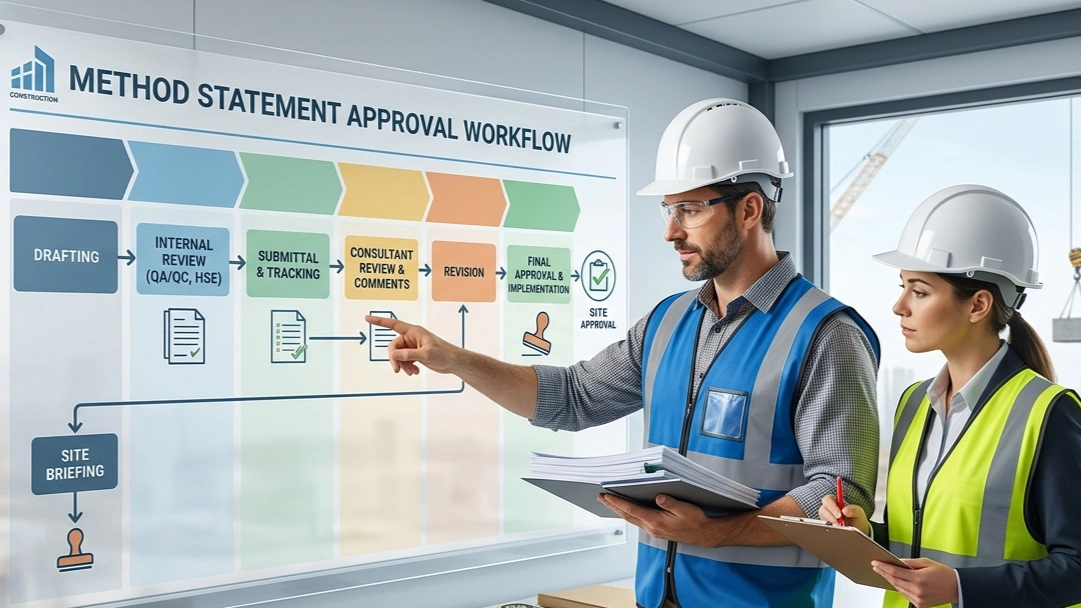
A typical construction-stage method statement workflow is:
- the contractor identifies required method statements from the contract, programme, and quality plan;
- the responsible engineer prepares the draft with specialist input;
- construction, QA/QC, HSE, planning, procurement, and subcontractors review the draft internally;
- document control submits the method statement to the consultant;
- the consultant returns approval, comments, or rejection;
- the contractor revises and resubmits if required;
- the approved revision is briefed to supervisors and workers;
- work starts only after linked permits, inspections, and prerequisites are satisfied.
For project-start controls and responsibility planning, see the Construction Kick-off Meeting Agenda, Checklist, RACI, and Contract Guide and the Construction Organization Chart Guide.
An approved method statement is usually binding on the contractor as the approved way of executing the work. The contractor should not materially change the sequence, equipment, safety controls, temporary works, inspection points, or specialist method without submitting a revision or obtaining the required approval.
However, approval does not normally rewrite the contract. It usually means the consultant has no objection to the proposed method, subject to continued compliance with the contract documents. The approval does not usually reduce the contractor’s responsibility for safety, quality, workmanship, testing, specifications, or legal compliance.
There is an important legal nuance. If the consultant clearly approves a departure from the specification, instructs the contractor to proceed, and the contractor relies on that approval, the issue may become more complicated depending on the contract and governing law. The contractor should protect the record by asking whether the approval is only a method approval or a formal departure, instruction, waiver, or variation.
What Happens If an Approved Method Statement Contradicts the Specification?
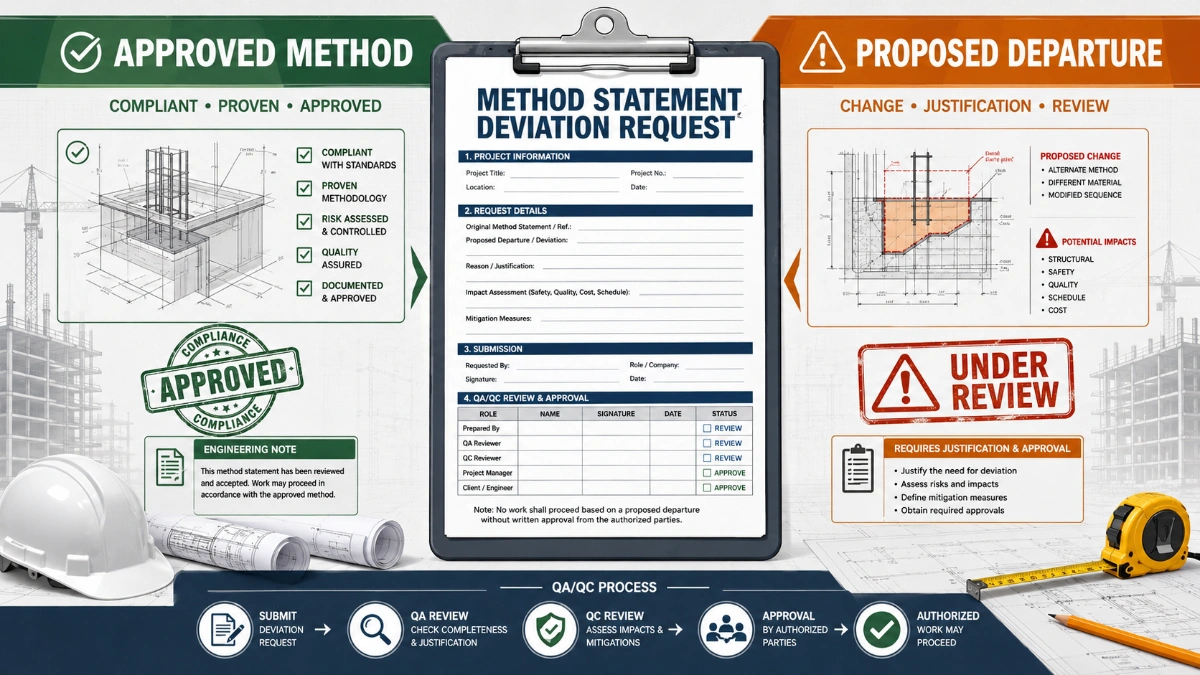
If an approved method statement contradicts the specification, the contractor should not assume that the approval changes the contract. In most cases, the specification should be followed unless there is a formal instruction, approved deviation, waiver, variation, or contract amendment that clearly changes the requirement.
This issue often appears in workmanship and installation requirements. For example:
- the specification requires 100 mm waterproofing laps, but the method statement says 75 mm;
- the specification requires mechanical surface preparation, but the method statement says manual cleaning;
- the specification requires certified installers, but the method statement lists ordinary labor;
- the specification requires a hold point or test, but the method statement omits it.
The contractor should issue a written clarification before proceeding. A practical RFI wording is:
The approved method statement appears to conflict with Specification Section [X] / Drawing [Y] regarding [issue]. Please confirm whether the specification remains applicable or whether a formal instruction or approved deviation will be issued.
If the method statement has already been approved but includes a specific departure from the specification, the contractor should clarify the legal effect of that approval. A practical wording is:
Please confirm whether your approval of Method Statement Ref. [MS-XXX], which includes [specific departure], constitutes formal acceptance of a departure from Specification Clause [X], or whether the approval is limited to acceptance of the proposed method only, without changing the specification requirements.
Download placeholder: RFI Sample for Method Statement vs Specification Conflict — a short editable template asking whether approval of a method statement is only method acceptance or formal acceptance of a departure from the specification.
If the consultant does not give a clear answer, the contractor should not simply proceed with the lower standard. The contractor should repeat the discrepancy in writing, identify the programme impact, state the intended interpretation if no response is received by a defined date, and reserve rights if the issue affects time or cost. For tracking this type of issue, see the Site Clarification Log / RFI Log Template.
If the method statement proposes a higher standard than the specification, the contractor may be held to that higher commitment, especially if it formed part of the tender, contractor’s proposal, or approved construction methodology.
Related guide and form
Method Statement Deviation Request Form
Use this when the contractor needs to depart from an approved method statement, specification requirement, sequence, material, inspection point, or temporary works arrangement.
Open the guide →
Revision Creep: When Consultant Comments Become Scope Creep
Not every consultant comment is only a correction. Some comments on a method statement may introduce new scope, new resources, new temporary works, new monitoring, new specialist attendance, night work, standby equipment, additional inspections, or a different construction sequence.
If the comment is already required by the contract, the contractor should revise the method statement. But if the comment changes the contract scope, cost, time, risk allocation, or method promised at tender, the contractor should not quietly absorb it as “Revision 02.”
Examples of possible revision creep include:
- requiring standby equipment not specified in the contract;
- adding third-party monitoring not included in the employer’s requirements;
- changing the sequence in a way that affects the programme;
- requiring a different specialist system after tender award;
- adding additional supervision, testing, or permits beyond the contract;
- requiring work at night or during restricted hours to suit access constraints.
The practical rule is simple: review comments technically and commercially before accepting them. If a comment changes the contractor’s obligation, the response should be handled through the proper contract route, such as clarification, site instruction, variation, or notice. For related instruction control, see the FIDIC Site Instruction Form Guide and Site Instructions in Construction.
Bad vs Good Method Statement Wording
The easiest way to understand a strong method statement is to compare generic wording with project-specific wording.
| Weak Wording | Better Wording |
|---|---|
| Surface shall be prepared as per specification before waterproofing. | The concrete surface shall be inspected for laitance, sharp projections, standing water, oil, dust, and loose material. High spots shall be mechanically ground. Voids and honeycombs shall be repaired using the approved repair mortar under Material Approval Ref. [X]. QA/QC shall raise a WIR before primer application. |
| Excavation will be carried out using excavators and dump trucks. | Excavation shall proceed from Grid [A] to Grid [D] in maximum [X] m stages. Equipment shall use the approved access ramp shown on Sketch [Y]. No plant shall operate within [X] m of the unsupported edge. Excavated material shall be loaded from the designated platform and removed through Gate [Z]. |
| Safety precautions shall be followed. | The supervisor shall verify edge protection, access ladder, banksman position, exclusion zone, permit approval, and emergency access before work starts. The HSE officer shall brief operators and banksmen using the approved risk assessment and record attendance. |
| Inspection shall be done before proceeding. | The contractor shall raise a WIR after substrate preparation and before primer application. This is a hold point under ITP Ref. [X]. Work shall not proceed until the inspection is accepted or released by the consultant. |
The difference is not word count. The difference is whether the method can actually be used by the site team and reviewed by the consultant.
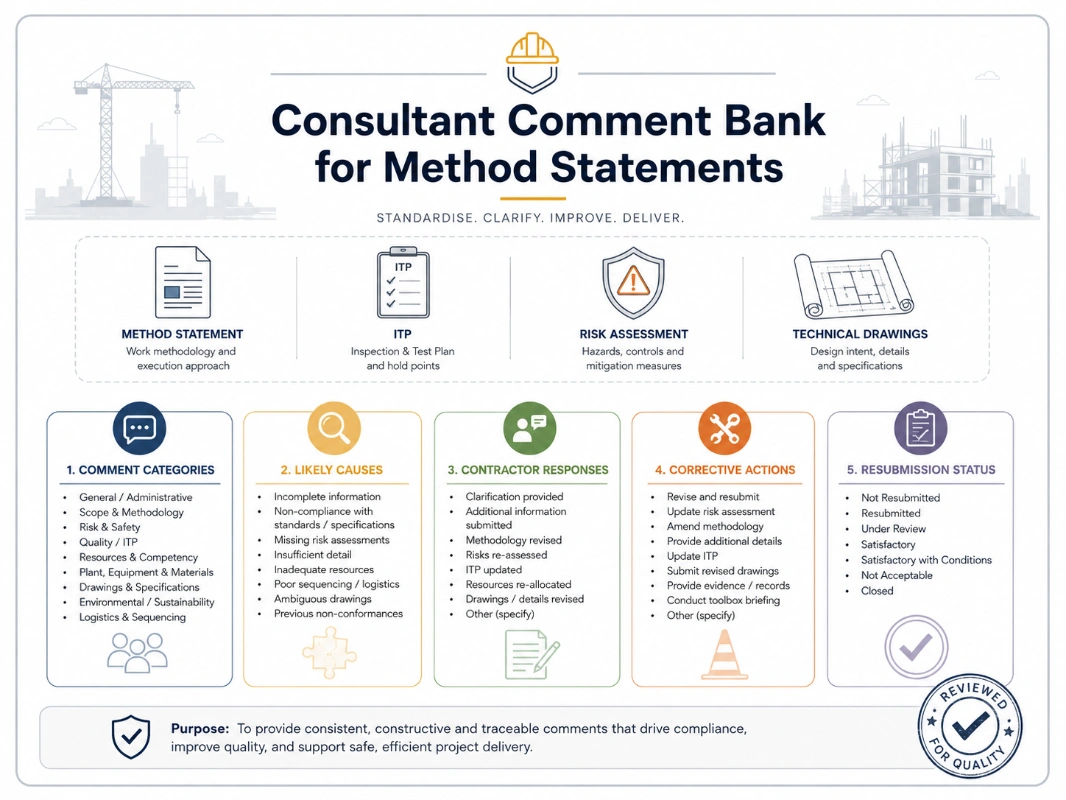
Common Consultant Comments on Method Statements
Consultants usually reject method statements because they are generic, incomplete, or inconsistent with the project documents.
Common comments include:
- method statement does not reference the latest approved drawings;
- specification clauses and acceptance criteria are missing;
- work sequence is generic and not site-specific;
- ITP reference, hold points, or witness points are missing;
- risk assessment is too generic or not attached;
- temporary works, access, and equipment movement are unclear;
- material approval references are missing;
- environmental controls are not specific to the activity;
- method statement conflicts with the specification;
- specialist subcontractor or manufacturer input is missing.
If non-compliant work occurs because the approved method statement was not followed, or because the method itself was defective, the issue may lead to observations, NCRs, snags, or defects depending on timing and severity. For related QA/QC guidance, see NCR Meaning in Construction, NCR Form Template, and Observation vs NCR vs Snag vs Defect in Construction.
Templates, Tools, and Downloads to Support Method Statements
This article is designed as an anchor guide. Some resources should be downloadable templates, while others can become separate sub-articles or interactive tools.
| Resource | Format | Purpose |
|---|---|---|
| Construction Method Statement Templates | Online generator, cloneable templates, PDF, and Excel exports | Helps engineers draft consultant-ready method statements with prompts and attachment checks. |
| Method Statement Review Checklist | Excel/PDF or QChecklists page | Allows reviewers to mark Conform / Non-Conform / Comment before submission. |
| Method Statement vs Risk Assessment vs ITP Matrix | Sub-article and printable infographic | Explains the difference between the main execution, safety, and inspection documents. |
| Method Statement Approval Workflow | Flowchart PDF or sub-article | Shows tender-stage and construction-stage approval paths. |
| Consultant Comment Bank | Searchable spreadsheet | Provides common comments, likely causes, suggested responses, and resubmission notes. |
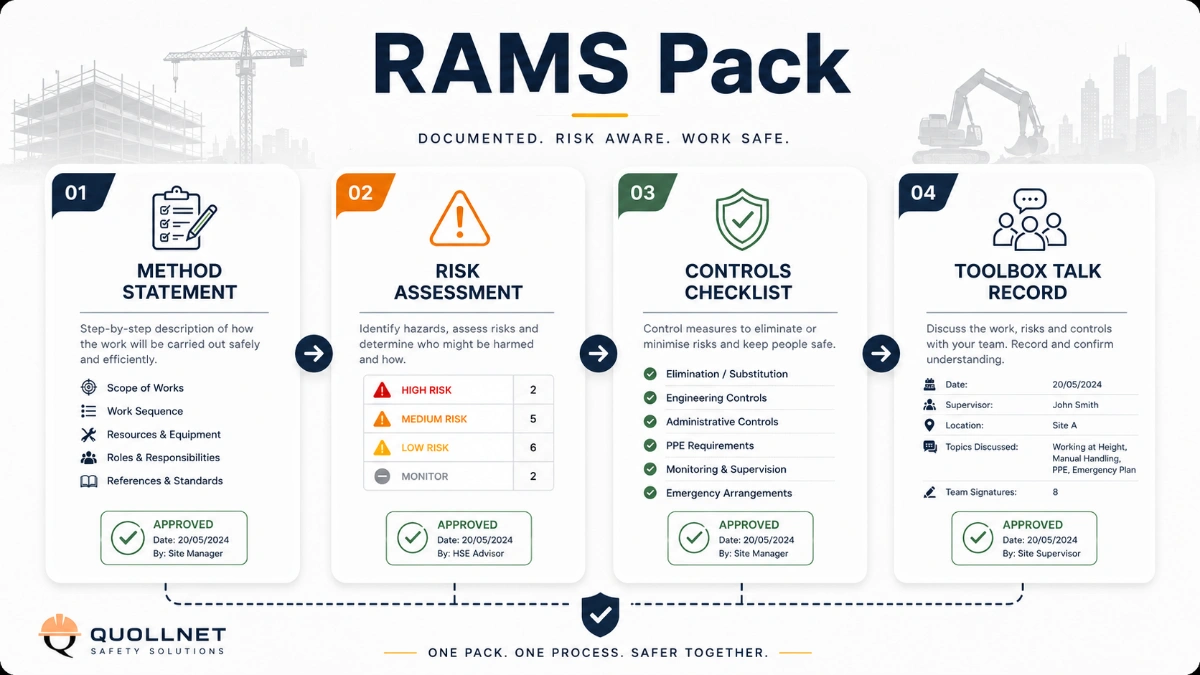
| RAMS Pack | Sub-article and download pack | Combines method statement and risk assessment into one practical package. |
Conclusion
A construction method statement is not just a form to submit before work starts. It is a practical execution document that controls how the contractor plans, coordinates, supervises, inspects, and records the work.
For simple activities, a method statement may be prepared by the contractor’s site and QA/QC team. For complex or specialist works, it should be built with input from subcontractors, suppliers, temporary works designers, HSE teams, manufacturers, planners, procurement teams, and engineers who understand the actual method.
The strongest method statements are specific, buildable, coordinated, and linked to the contract documents. They are submitted early enough to protect the programme, reviewed commercially as well as technically, and clarified whenever they conflict with specifications or consultant comments introduce new obligations.
Templates are useful, but only if they force the team to answer the real project questions: what exactly will be done, who will do it, what controls the risk, what will be inspected, what approvals are needed, and what happens if the proposed method does not match the contract requirements?
References
- HSE — Construction Guidance
- HSE — Risk Assessment Template and Examples
- OSHA — Recommended Practices for Safety and Health Programs in Construction
- FIDIC — Construction Contracts and Guidance
- ISO — ISO 9001:2015 Quality Management Systems
- ISO — ISO 14001:2015 Environmental Management Systems