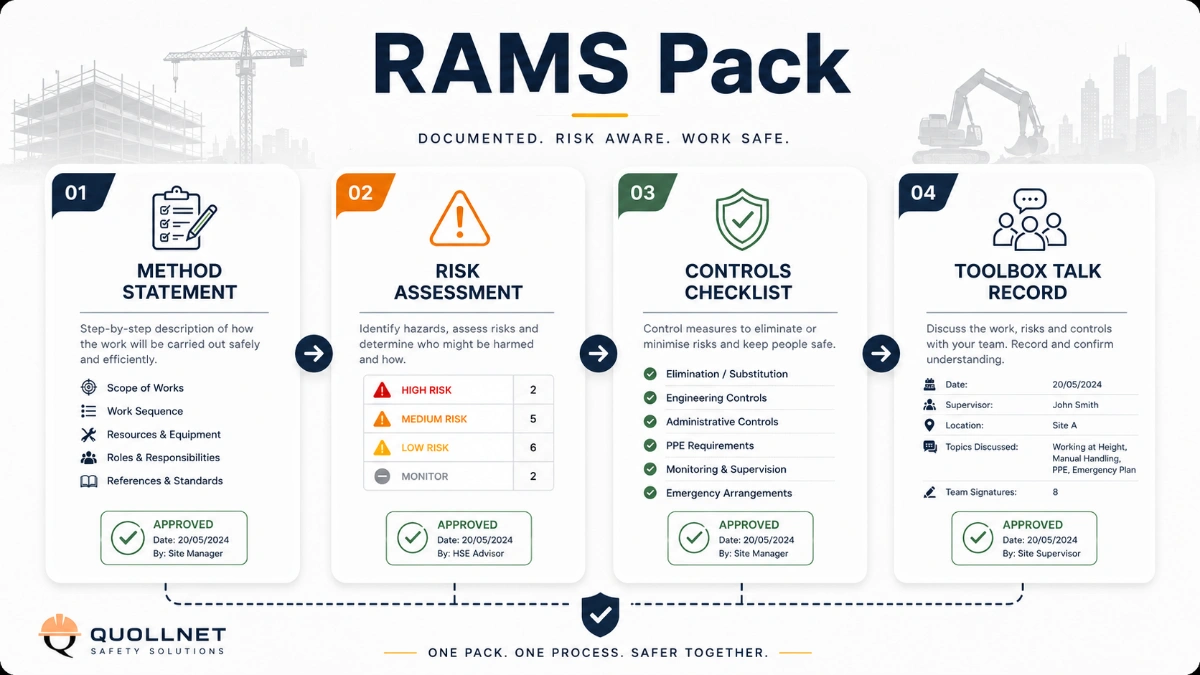
RAMS Pack in Construction: Method Statement and Risk Assessment Template
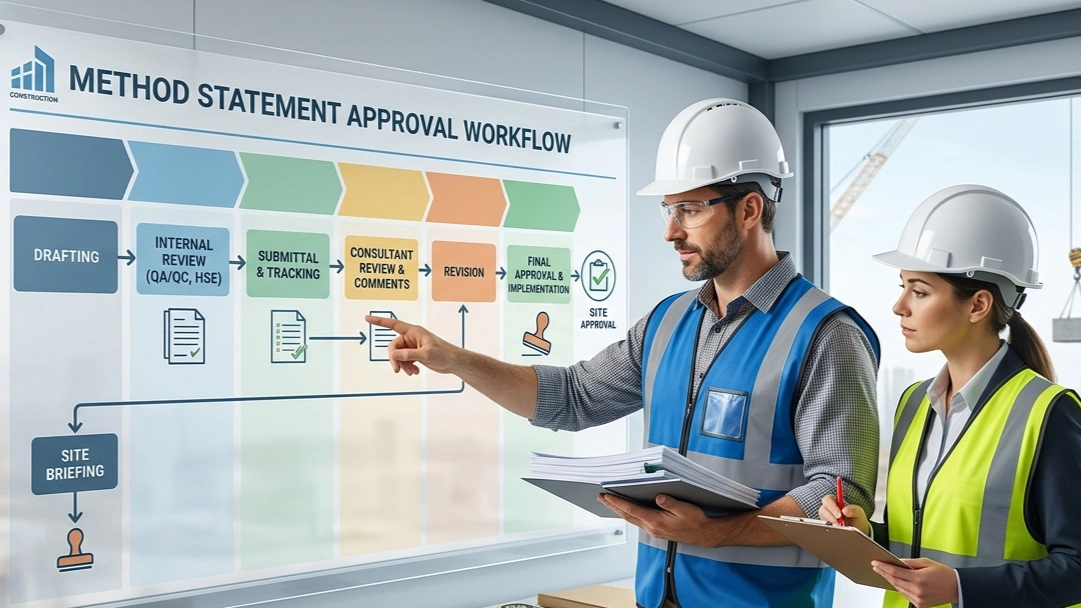
A RAMS pack in construction combines a method statement and risk assessment so the site team understands both how the work will be carried out and how the hazards will be controlled. It is commonly used before high-risk or complex activities and should be linked to permits, ITPs, inspections, toolbox talks, and site briefings.
A method statement alone explains the planned sequence of work. A risk assessment explains what can go wrong, who may be harmed, how severe the risk is, and what controls are needed. A RAMS pack brings both together so the document is not only a technical procedure, but also a practical site execution control.
For contractors, consultants, QA/QC engineers, HSE officers, site engineers, supervisors, and subcontractors, RAMS is useful because it connects planning with execution. It should help the people doing the work understand the approved method, the hazards, the controls, the hold points, the permits, and the briefing requirements before starting the activity.
What Is a RAMS Pack in Construction?
RAMS usually means Risk Assessment and Method Statement. In construction, a RAMS pack is a set of documents prepared before a specific activity starts. It normally combines the method statement, risk assessment, required controls, permits, emergency arrangements, inspection links, and worker briefing records.
The purpose of RAMS is not to create paperwork for the sake of paperwork. The purpose is to make sure the planned work sequence is safe, controlled, communicated, and suitable for the actual site conditions.
A good RAMS pack should answer four practical questions:
- What exactly is the work activity?
- How will the work be carried out?
- What hazards and risks are created by that method?
- What controls must be in place before and during execution?
This is why RAMS should be activity-specific. A generic risk assessment attached to a copied method statement is not a useful RAMS pack. It may look complete on paper, but it often fails on site because it does not reflect the real sequence, access constraints, plant movement, workforce, adjacent activities, weather, permits, or inspection requirements.
Why RAMS Is More Than a Method Statement
A method statement explains how the work will be done. It usually includes the scope, references, responsibilities, resources, materials, equipment, sequence of work, quality controls, safety controls, environmental controls, and attachments.
However, the method statement is not always enough by itself. If the work involves excavation, lifting, work at height, hot works, confined spaces, live services, demolition, temporary works, or heavy plant access, the team also needs a structured risk assessment. The risk assessment identifies hazards, evaluates the initial risk, defines control measures, and records the residual risk after controls are applied.
This is the main value of a RAMS pack: it connects the method of work to the risk controls required for that exact method.
For example, a method statement may say that an excavator will access a sloped area and excavate in stages. The risk assessment then asks: can the excavator overturn? Can the edge collapse? Can workers enter the swing radius? Can material fall from the slope? Is a banksman required? Is a permit required? Is there a temporary works design? Where is emergency access?
Without this connection, the method statement becomes a technical description and the risk assessment becomes a generic safety form. RAMS is strongest when the two documents speak to each other.
Method Statement vs Risk Assessment Inside RAMS
The easiest way to understand RAMS is to separate each document by its function.
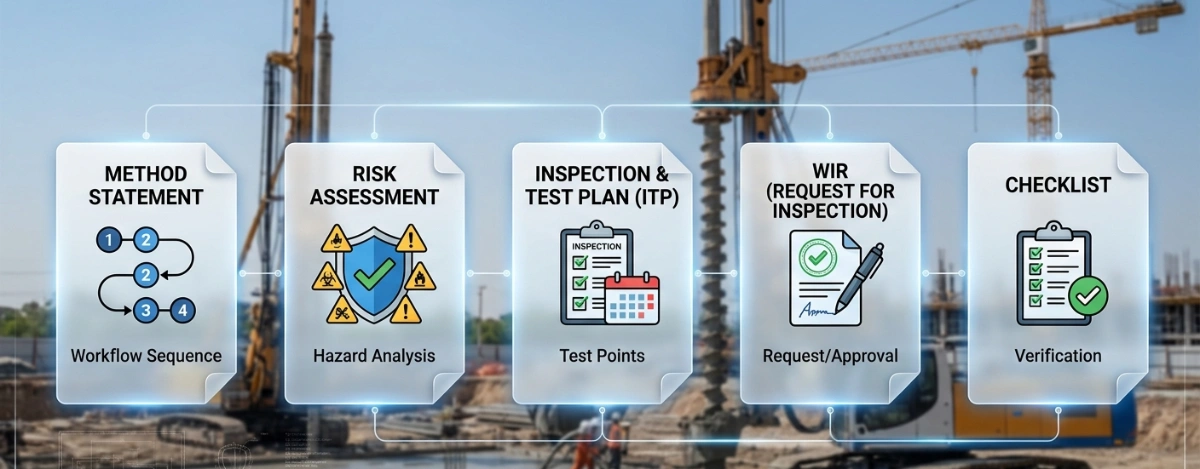
- Method Statement: explains how the work will be done.
- Risk Assessment: explains what can go wrong and how the risks will be controlled.
- ITP: explains what must be inspected or tested.
- WIR: is the formal request to inspect a completed or ready-to-inspect work stage.
- Checklist or toolbox talk: confirms site-level verification and communication before execution.
This distinction matters because many project teams mix these documents together. A RAMS pack can refer to an ITP, permit, checklist, or WIR, but it does not replace them. The risk assessment is not an inspection plan. The ITP is not a safety document. The WIR is not a work sequence. Each document has a different job.
For a deeper comparison, see the Quollnet guide on Method Statement vs Risk Assessment vs ITP.
When Is a RAMS Pack Required?
A RAMS pack is usually required when the work activity has significant safety, quality, environmental, logistical, or coordination risk. Requirements vary by jurisdiction, client, consultant, contractor procedure, and project specification, but RAMS is commonly expected before high-risk or non-routine construction activities.
Typical activities where RAMS is useful include:
- Excavation and trenching
- Lifting operations and crane works
- Working at height
- Hot works and welding
- Confined space entry
- Demolition and breaking works
- Temporary works
- Waterproofing and chemical application
- Concrete pouring in difficult access areas
- MEP installation near live services
- Plant movement in congested areas
- Works near traffic, public areas, or occupied facilities
RAMS should also be updated when the method, equipment, sequence, site condition, workforce, material, access route, weather exposure, permit condition, or risk profile changes. A RAMS pack approved for one project, one floor, or one condition should not be blindly reused elsewhere.
What Should Be Included in a RAMS Pack?
A practical RAMS pack should be clear enough for review and simple enough for site teams to use. It should not be overloaded with unrelated corporate procedures, generic safety manuals, or duplicated attachments that make the document difficult to read.
A complete RAMS pack may include:
- Cover page and document control
- Scope of work
- Project references, drawings, specifications, and standards
- Roles and responsibilities
- Materials, plant, tools, and equipment
- Sequence of work
- Hazard identification
- Risk rating before controls
- Control measures
- Residual risk rating after controls
- Required PPE
- Emergency arrangements
- Environmental controls
- Required permits
- Linked ITP or inspection requirements
- Toolbox talk or briefing record
- Attachments checklist
Who Prepares and Reviews RAMS?
RAMS is usually prepared by the contractor or subcontractor responsible for the work. The person preparing it should understand the construction method, resources, plant, materials, site constraints, and actual work sequence.
For specialized work, the RAMS should include input from the right specialists. For example, lifting operations may need input from the appointed person or lifting supervisor. Temporary works may need input from the temporary works coordinator or designer. Chemical works may need input from the supplier’s technical data and safety data sheets. Confined space works may need specific rescue planning.
The review normally involves a combination of:
- Site engineer or construction manager
- HSE officer or safety manager
- QA/QC engineer
- Consultant or supervision team
- Specialist subcontractor
- Temporary works or lifting specialist, where applicable
The reviewer should not only check whether the document exists. The reviewer should check whether the method is buildable, the risks are specific, the controls are realistic, the inspection links are clear, and the workers can understand what is required on site.
How RAMS Connects to ITPs, WIRs, Permits, and Checklists
RAMS does not sit alone. It should connect with the wider construction control system.
The ITP defines inspection and testing requirements. The RAMS may refer to inspection hold points, but the detailed acceptance criteria should remain in the ITP or project specification.
The WIR is the formal request to inspect work. RAMS may say that the work must not proceed beyond a certain stage before inspection, but the WIR is still needed to notify and record the inspection.
Permits control activities such as excavation, lifting, hot works, confined space entry, electrical isolation, or work at height. The RAMS should identify which permits are required and when they must be obtained.
Checklists and toolbox talks bring the RAMS to site level. A checklist can verify that controls are in place before work starts. A toolbox talk confirms that supervisors and workers have been briefed on the method, hazards, controls, emergency actions, access restrictions, PPE, and communication requirements.
For construction safety checklists, see Construction Safety Checklists.
Common RAMS Mistakes
The most common RAMS mistake is treating it as a form to be filled instead of a site control document. A RAMS pack should not be a copied document with the project name changed on the cover page.
Common mistakes include:
- Using a generic risk assessment that does not match the method statement
- Listing hazards without practical control measures
- Leaving residual risk ratings unchanged after controls
- Ignoring access, logistics, public interface, weather, and adjacent works
- Not linking the RAMS to permits, ITPs, WIRs, or inspection hold points
- Attaching outdated drawings or missing the latest revision
- Not involving specialist input for specialized work
- Failing to brief workers before starting the activity
- Not updating the RAMS when the method changes
- Writing the document in language that the workforce cannot understand
Language is often underestimated. On multinational projects, the RAMS briefing may need translated toolbox talks, visuals, sketches, pictorial work sequences, or supervisor-led explanation in the workers’ language. A signed attendance sheet does not prove understanding if the briefing was not understood.
Example: RAMS for Excavation on Sloped Land
Consider excavation works on sloped land where an excavator must access the work area and excavate in stages. The method statement may define the access route, excavation sequence, plant type, operator requirements, spoil handling, edge protection, and inspection steps.
The risk assessment should then identify the hazards created by that method.
- Method risk: equipment access and stability on a sloped surface.
- Hazards: overturning, edge collapse, falling material, plant-pedestrian interface, unstable access, poor visibility, and emergency access restrictions.
- Controls: designed access ramp, competent operator, banksman, exclusion zone, staged excavation, minimum edge distance, temporary works review where required, excavation permit, weather monitoring, emergency access, and daily inspection.
- Related documents: excavation permit, ITP, WIR, risk assessment, temporary works documents, latest drawings, and site logistics plan.
The RAMS should make it clear which controls are required before the excavator enters the area, which controls are required during excavation, and which inspection or hold point must be completed before proceeding to the next stage.
This is the difference between a useful RAMS pack and a weak one. A weak RAMS says “excavation works shall be carried out safely.” A useful RAMS explains what safe execution means for the exact slope, equipment, access route, personnel, sequence, and inspection requirements.
Download the RAMS Pack Templates
This RAMS pack is made of separate templates that work together as one complete Risk Assessment and Method Statement package. Start with the project details sheet, build the risk register from the work sequence, then attach the permit checklist, PPE register, toolbox talk record, and attachment list to complete the site-ready RAMS submission.
The Excel files are editable and can be used during preparation. The PDF files are useful for printing, briefing, review, or attaching to a submission package where an editable file is not required.
How to Use This RAMS Pack
- Enter project and document information in the Project and Document Details Sheet.
- Use the approved or draft method statement to break the activity into clear work steps.
- Complete the Risk Register by identifying one hazard per work step where possible.
- Rate the initial risk using the Risk Assessment Matrix.
- Add specific control measures, then rate the residual risk after controls.
- Complete the PPE Register, Permit Checklist, and Attachment List.
- Record the workforce briefing in the Toolbox Talk Record before work starts.
- Update the RAMS if the method, equipment, sequence, site condition, permit requirement, or risk level changes.
Important: These templates are a starting point only. All hazards, controls, risk ratings, permits, inspections, and acceptance criteria must be verified against the actual site conditions, project specifications, contract requirements, company HSE procedure, and applicable legal requirements.
RAMS Pack Download Set
The documents below are designed to form one complete RAMS pack. Use them together rather than as isolated forms.
1. Project Details
Use this sheet to record the project name, contractor, consultant, document number, revision, activity title, and approval information.
2. Risk Assessment Matrix
Use this 5×5 matrix to rate likelihood, severity, initial risk, and residual risk after control measures are applied.
3. Risk Register
This is the main RAMS risk assessment table. Add each work step, hazard, consequence, persons at risk, control measures, and residual risk rating.
4. PPE Register
Use this register to define the required PPE for the activity, including task-specific protection such as gloves, eye protection, respiratory protection, or fall protection.
5. Permit Checklist
Use this checklist to identify permits required before work starts, such as excavation permits, hot work permits, lifting permits, confined space permits, or electrical isolation permits.
6. Toolbox Talk Record
Use this record to confirm that the RAMS was explained to the workforce before execution, including key hazards, controls, emergency actions, and attendance.
7. Attachment List
Use this list to track the documents attached to the RAMS pack, such as drawings, ITPs, WIR references, permits, lifting plans, SDS, certificates, or temporary works documents.
How These RAMS Files Work Together
The Project Details sheet identifies the RAMS submission. The Risk Matrix defines how risks are scored. The Risk Register applies that scoring to each activity step. The PPE Register, Permit Checklist, Toolbox Talk Record, and Attachment List then complete the practical site controls required before the work starts.
This structure helps the RAMS pack stay connected to the real method of work instead of becoming a generic safety document. If you already have a method statement, use its sequence as the starting point for the Risk Register. If you need a method statement first, you can browse and customize examples from Quollnet Method Statements.
Conclusion
A RAMS pack is useful because it connects the method of work with the hazards and controls required before site execution. The method statement explains how the work will be done. The risk assessment explains what can go wrong and how the risks will be controlled. The ITP, WIR, permits, checklists, and toolbox talks then support inspection, authorization, verification, and communication.
The best RAMS packs are practical, activity-specific, and easy to brief. They do not repeat generic safety language. They show the actual sequence, actual hazards, actual controls, and actual site requirements. When RAMS is prepared and reviewed properly, it becomes a working site document rather than just another submission file.
REFERENCES
HSE - Construction Administration, Risk Assessments and Method Statements
HSE - Risk Assessment Template and Examples
OSHA - Recommended Practices for Safety and Health Programs in Construction