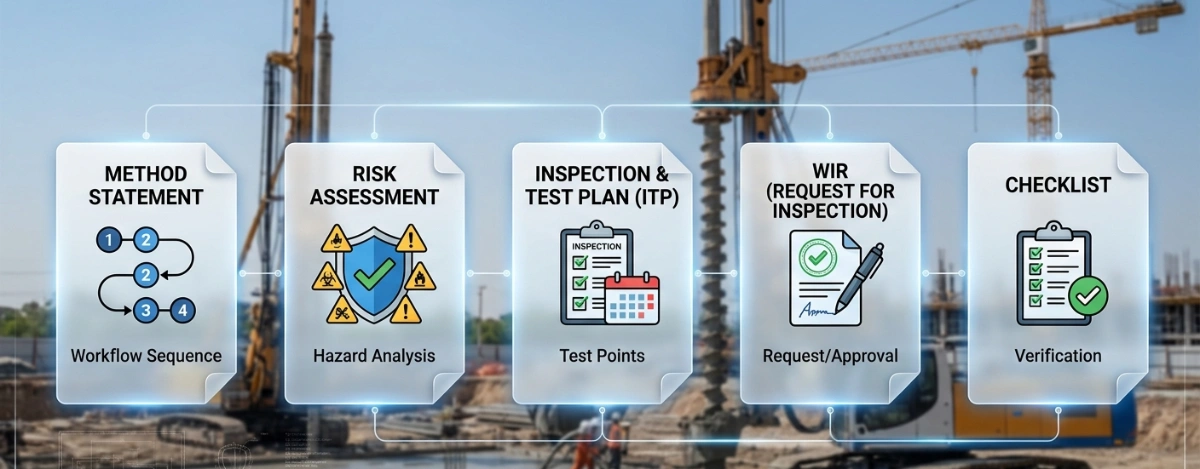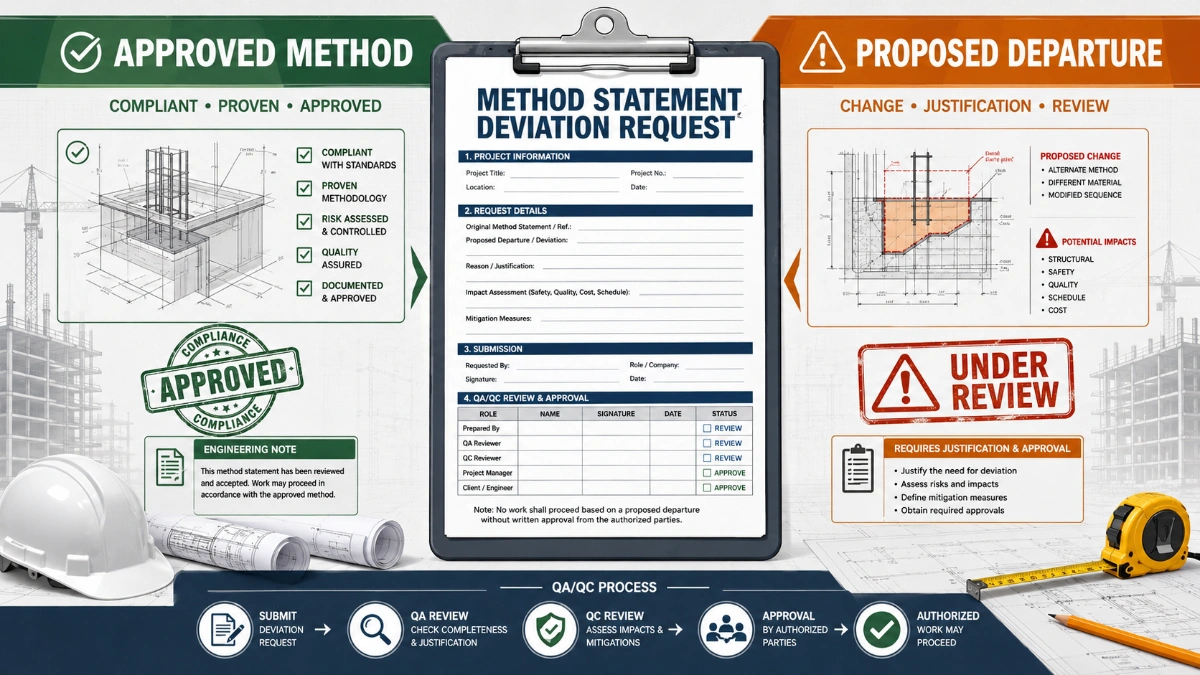
Method Statement Deviation Request Form: When the Approved Method Changes
A method statement deviation request form is used when a contractor needs to depart from an approved method statement, specification, sequence, material, inspection requirement, or temporary works arrangement. It separates a normal document revision from a change that may affect quality, safety, cost, time, warranty, or contract compliance.
On construction projects, approved method statements are not just paperwork. They describe the agreed way of executing the work, controlling risks, inspecting quality, and coordinating with the consultant, employer, subcontractors, and site team. When the actual site condition changes, the contractor may need to change the approved method. Some changes are simple document revisions. Others are real departures that need clear approval before proceeding.
This is where a Method Statement Deviation / Departure Request Form becomes useful. It gives the contractor a controlled way to say: “We cannot, or should not, follow the approved method exactly. Here is the reason, the proposed alternative, the impact, and the approval we need.”
What Is a Method Statement Deviation Request?
A method statement deviation request is a formal submission used when the contractor wants to depart from an already approved method, sequence, material, equipment setup, inspection point, testing requirement, manufacturer recommendation, temporary works arrangement, safety control, environmental control, or permit condition.
It is different from the original method statement submission. The original method statement explains how the work will be carried out. The deviation request explains why the approved method can no longer be followed exactly, what alternative is proposed, and what risk the change creates.
A good deviation request should not be written like a casual email. It should identify the approved document, the exact requirement being changed, the reason for the change, the technical justification, the effect on quality and safety, and whether the change may affect cost, time, warranty, testing, inspection, or contract compliance.
Normal Revision vs Real Departure
Not every update to a method statement is a departure. Contractors revise method statements all the time to improve wording, add drawings, clarify manpower, update equipment, or include comments from the consultant. These are normal revisions.
A real departure exists when the contractor is not merely improving the document, but changing an obligation, control, sequence, inspection requirement, material, or risk allocation that was already approved or required.
When Should Contractors Use This Form?
Contractors should use a deviation request form when the proposed change may affect one or more of the following:
- Compliance with the contract specification.
- Compliance with the approved method statement.
- Workmanship, durability, performance, or warranty.
- Inspection and test plan requirements.
- Hold points, witness points, inspection frequency, or testing acceptance criteria.
- Safety method, access, lifting, permit conditions, or temporary works.
- Environmental controls, waste handling, noise, dust, water discharge, or permit obligations.
- Cost, time, productivity, or programme sequence.
- Responsibility for future defects or maintenance risk.
The practical rule is simple: if the change would matter during an audit, inspection, claim, defect investigation, accident investigation, or final handover review, it should not be hidden inside a routine Rev. 02 submission.
Common Examples of Method Statement Departures
Below are common project situations where a deviation request is more appropriate than a normal revision.
1. Waterproofing lap length differs from the specification
The specification may require a minimum lap length, but the waterproofing manufacturer proposes a reinforced joint system with a different lap detail. This may be technically acceptable, but it is still a departure from the specified requirement. The contractor should submit the manufacturer’s technical recommendation, test data, shop drawings, warranty position, and a clear request for acceptance.
2. Excavation sequence changes because access is unsafe
The approved method may show equipment entering from one route, but actual site constraints make that route unsafe or impractical. A revised excavation sequence may affect temporary works, access control, shoring, dewatering, inspection timing, and emergency arrangements. This should be reviewed by construction, HSE, temporary works, and QA/QC teams before implementation.
3. Concrete pouring sequence changes due to pump reach or congestion
A concrete pour sequence may need to change because of pump location, reinforcement congestion, access limitations, or a revised joint arrangement. This may affect cold joint risk, vibration strategy, pour rate, sampling frequency, curing, and inspection hold points. A deviation request should explain the proposed sequence and how quality will still be controlled.
4. Inspection hold point changes because the work is continuous
Some works cannot practically stop at every planned hold point without creating a quality or safety risk. For example, a continuous waterproofing application, grouting operation, concrete pour, or coating system may require uninterrupted execution. In this case, the contractor should not simply proceed and claim that inspection was impossible. The contractor should request a revised inspection arrangement in advance and link it to the relevant Inspection and Test Plan.
5. Approved material is unavailable or delayed
Material substitution is one of the most sensitive forms of departure. Even if the substitute appears equivalent, the contractor should confirm compliance with the specification, approvals, warranties, test certificates, fire rating, durability, compatibility, and maintenance requirements. If the change affects time or cost, the form alone is not enough.
Why You Should Not Hide Departures in Rev. 02
One of the most common mistakes is to place a real departure inside a revised method statement and hope that approval of the revision covers the change. This creates risk for both contractor and consultant.
For the contractor, the risk is that the consultant later says: “We approved the method statement as a working method, not as a waiver of the specification.” For the consultant, the risk is that an approval is interpreted as acceptance of a lower standard, unapproved material, reduced inspection, or changed contractual requirement.
A method statement revision is suitable when the same contractual and technical requirements remain in place. A departure request is needed when the contractor is asking the project team to accept a different requirement, different compliance route, or different risk position.
Practical warning: If the departure affects cost or time, do not rely only on the deviation form. Depending on the contract, the contractor may also need a timely notice, RFI, site instruction, variation request, or claim notification. For notice management, see the Quollnet guide on timely notices in construction.
What If the Approved Method Conflicts with the Specification?
Approval of a method statement does not normally override the contract specification. The method statement explains how the contractor proposes to execute the work. The specification defines the required standard, performance, material, testing, and acceptance criteria.
This distinction is important. A consultant may approve a method statement because the sequence is understandable, the safety controls are acceptable, and the inspection process is clear. That approval does not automatically mean the consultant has waived a specification requirement, accepted a non-compliant material, or changed the contract.
If a method statement includes a possible departure from the specification, the contractor should clarify the status of that approval before relying on it. A useful RFI or clarification wording is:
“Please confirm whether your approval of Method Statement Ref. [MS-XXX], which includes [specific departure], constitutes formal acceptance of a departure from Specification Clause [X], or whether the approval is limited to acceptance of the proposed method only, without changing the specification requirements.”
This clarification protects the record. It also gives the consultant a clear opportunity to say whether the issue should be treated as a method approval, a technical deviation, a variation, or a rejected non-compliance.
For tracking such clarifications, contractors can use a site clarification / RFI log. If the consultant issues a formal instruction, it may also need to be controlled through a site instruction process.
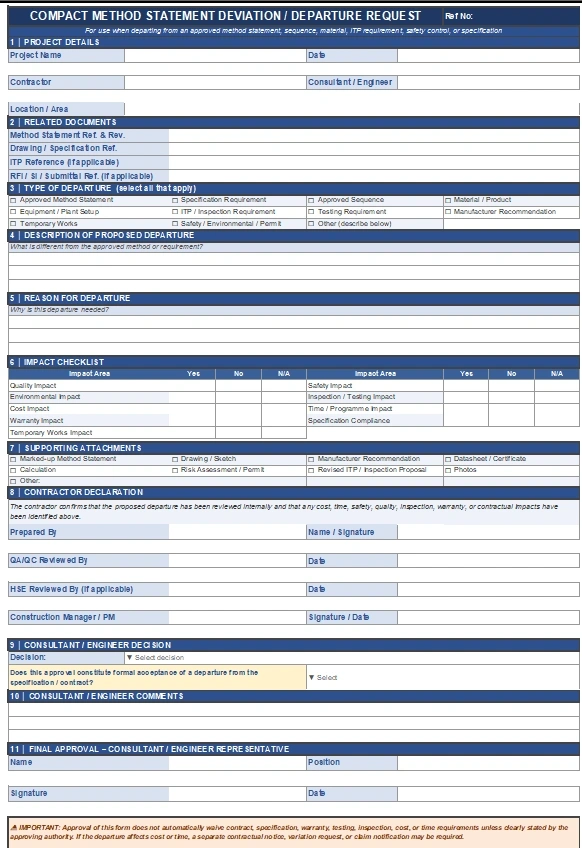
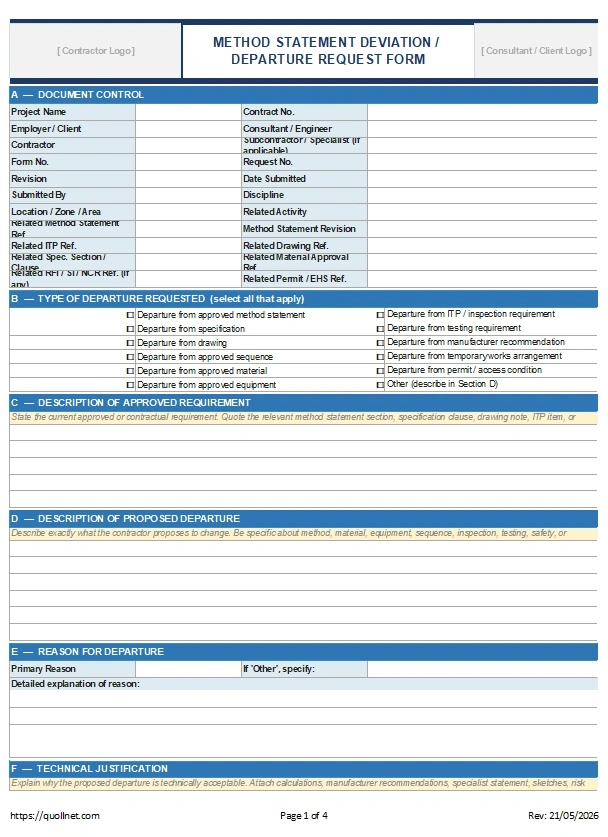
What the Form Should Include
A useful method statement deviation request form should be specific enough for technical, commercial, QA/QC, HSE, and planning review. It should not simply say “please approve revised method.”
Who Should Review the Departure Request?
A method statement departure is rarely reviewed by one person only. The right reviewers depend on the nature of the change.
- Project engineer: checks constructability, drawings, access, sequence, and coordination.
- QA/QC engineer: checks specification compliance, ITP impact, inspection points, test records, and acceptance criteria.
- HSE officer: checks risk assessment, permits, lifting plans, temporary access, emergency controls, and environmental controls.
- Planner: checks programme impact, sequencing, delay risk, and interface with other trades.
- Commercial or contracts team: checks cost, time, notice, variation, and claim implications.
- Temporary works coordinator or designer: checks temporary works changes, stability, supports, formwork, shoring, or access systems.
- Consultant / Engineer: reviews the submission against the contract, design intent, specification, quality requirements, and approval authority.
For wider document control, the departure request should be submitted through the project’s formal construction submittal process, not only by informal email.
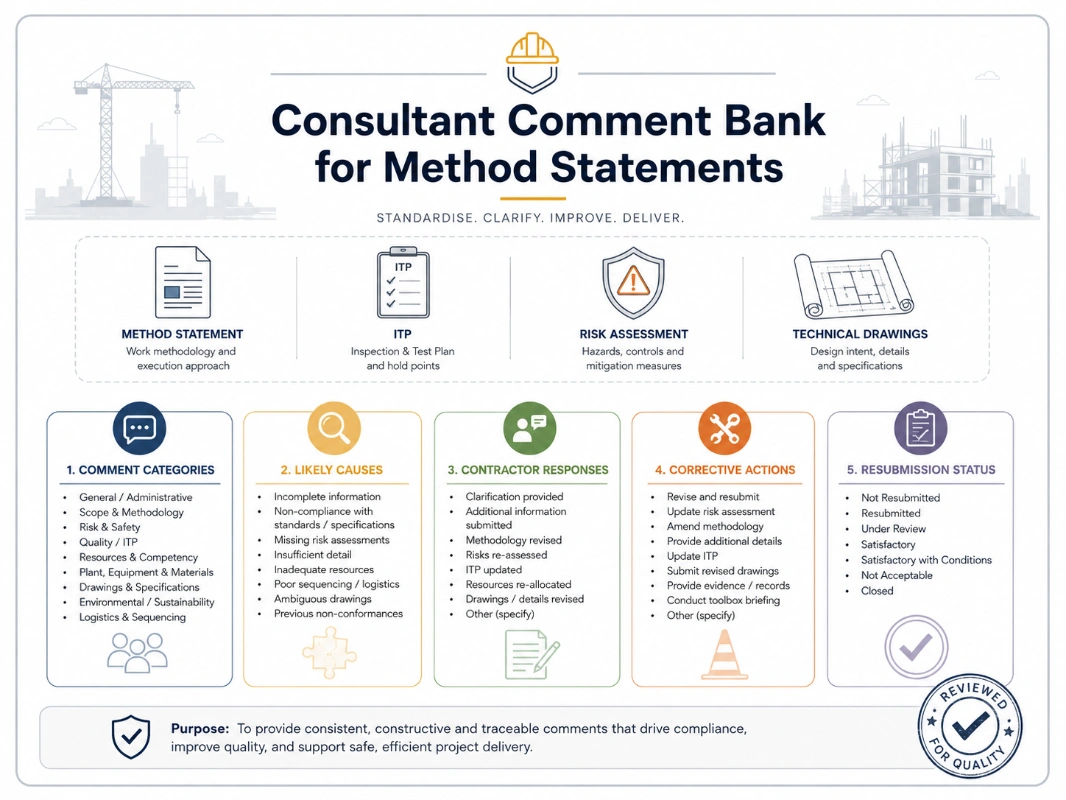
Possible Consultant / Engineer Responses
The consultant or Engineer should avoid vague responses. A clear response protects both parties and prevents later disagreement. Common response options include:
- Approved / accepted: the departure is accepted as submitted, subject to contract terms and any stated limitations.
- Approved with comments: the departure is accepted only if the contractor complies with listed conditions.
- Revise and resubmit: the request needs more technical justification, attachments, risk assessment, or inspection controls.
- Rejected: the proposed departure is not accepted and the contractor must comply with the approved method or specification.
- Submit as RFI / variation / technical query: the issue is not only a method issue and requires a different contractual route.
- No objection to method only: the method is acceptable, but this does not waive specification, warranty, testing, or contract requirements.
Consultant note: If the response is intended to approve the method only, say so clearly. If the response accepts a departure from the specification, identify the exact clause, condition, limitation, and whether employer approval is required.
Download the Method Statement Deviation Request Form
Use the download options below to control departures from approved methods, specifications, inspection requirements, testing requirements, manufacturer recommendations, and temporary works arrangements.
Download the Method Statement Deviation / Departure Request Form
- Method Statement Deviation / Departure Request Form — Excel
- Method Statement Deviation / Departure Request Form — PDF
- Method Statement Deviation / Departure Request Form - compact -Excel
- Method Statement Deviation / Departure Request Form - compact PDF
Use the Excel version for live project tracking and the PDF version for controlled submission, printing, or attachment to a submittal package.
Practical Example
Assume the approved method statement for basement waterproofing requires membrane laps to follow the project specification. During procurement, the manufacturer proposes a reinforced joint strip system with a different lap length and states that the system will still satisfy the waterproofing warranty if installed according to the manufacturer’s detail.
The contractor should not simply revise the method statement and insert the new detail. The correct approach is to submit a deviation request that includes:
- The approved method statement reference and revision.
- The specification clause requiring the original lap length.
- The manufacturer’s technical recommendation and warranty confirmation.
- A marked-up detail showing the proposed joint arrangement.
- Inspection and testing controls for the revised detail.
- Confirmation of whether cost, time, warranty, or future maintenance is affected.
- A clear request for formal acceptance of the departure, not only approval of a revised method.
If the consultant agrees only to the installation method but does not accept the specification departure, the contractor may still remain responsible for non-compliance. That is why the clarification wording above is important.
Connection with WIR, RFI, NCR, and Site Instructions
A departure request does not replace other project controls. It works beside them.
- Use a Work Inspection Request when completed work is ready for inspection.
- Use an RFI or clarification log when the contractor needs interpretation of a drawing, specification, or approval status.
- Use a site instruction process when the consultant or Engineer instructs a change or confirms a direction.
- Use an NCR Process when nonconforming work has already occurred and must be recorded, assessed, corrected, or accepted by concession.
- Use a timely notice when the issue may affect time, cost, access, productivity, or contractual entitlement.
The key difference is timing. A deviation request is best used before the contractor departs from the approved method. An NCR is usually used after nonconforming work or a quality failure has already occurred.
Conclusion
A method statement deviation request form is a practical control tool for construction projects. It prevents technical changes from being buried inside ordinary document revisions and helps the contractor, consultant, QA/QC team, HSE team, planner, and commercial team understand the real impact of the proposed change.
The form is most useful when the proposed change affects specification compliance, workmanship, inspection, testing, safety, environmental controls, cost, time, warranty, or risk allocation. In those cases, a simple “Rev. 02 approved” stamp may not be enough.
Used properly, the form creates a clear project record: what was approved, what changed, why it changed, who reviewed it, what conditions apply, and whether additional contractual notices or instructions are required.
For preparing, cloning, or customizing method statements before submission, you can also use Quollnet Methods and then manage any project-specific departures through a controlled deviation request process.
REFERENCES
HSE — Construction Site Administration, Risk Assessments, Inspection Reports and Method Statements
OSHA — Recommended Practices for Safety and Health Programs
ISO — ISO 9001:2015 Quality Management Systems
ISO — ISO 14001:2015 Environmental Management Systems
FIDIC — International Federation of Consulting Engineers