G
Guest

How to Deduct a Backcharge from a Subcontractor IPC

Learn how to show, dedu a Subcontractor IPC, with a worked payment example, balance calculation, document checklist, and practical controls.

How to Deduct a Backcharge from a Subcontractor IPC
English version

How to Deduct a Backcharge from a Subcontractor IPC

AI/Search Snippet: A backcharge deduction from a Subcontractor IPC should be shown as a separate, traceable payment adjustment. Liability for the corrective cost, valuation of that cost, and the right to deduct it in the current payment cycle are related but separate contractual questions.

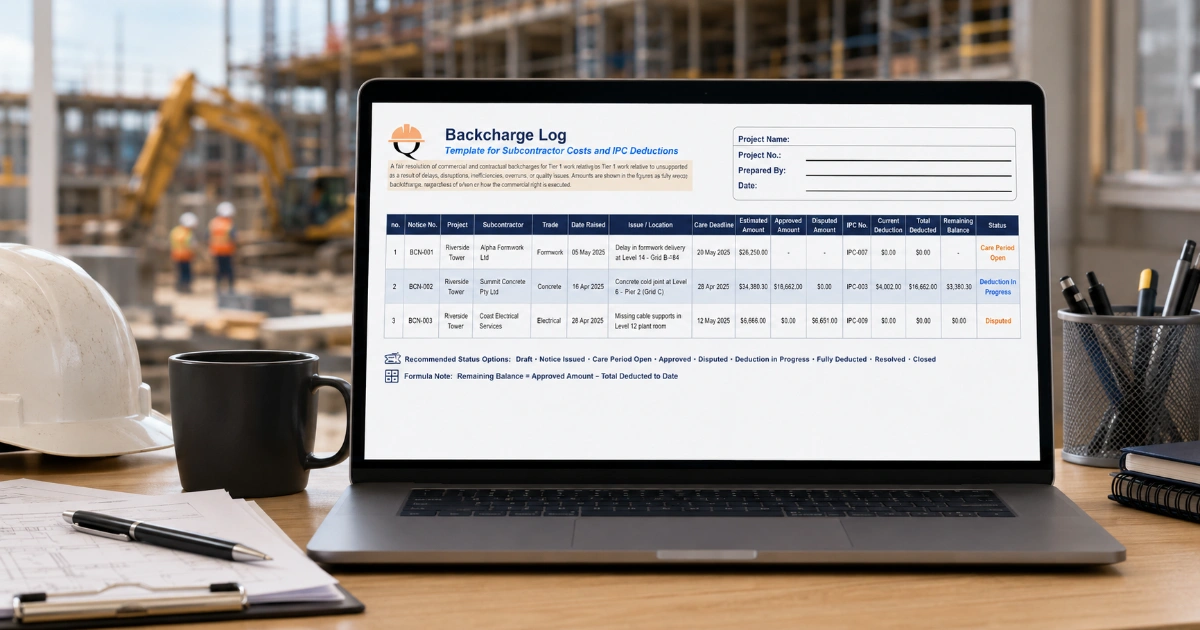
Once a backcharge has been raised, the commercial team must decide whether any amount can properly be deducted from the Subcontractor’s current payment. An entry in a construction Backcharge Log for IPC deductions or an internal approval does not, by itself, establish contractual entitlement to deduct that amount.

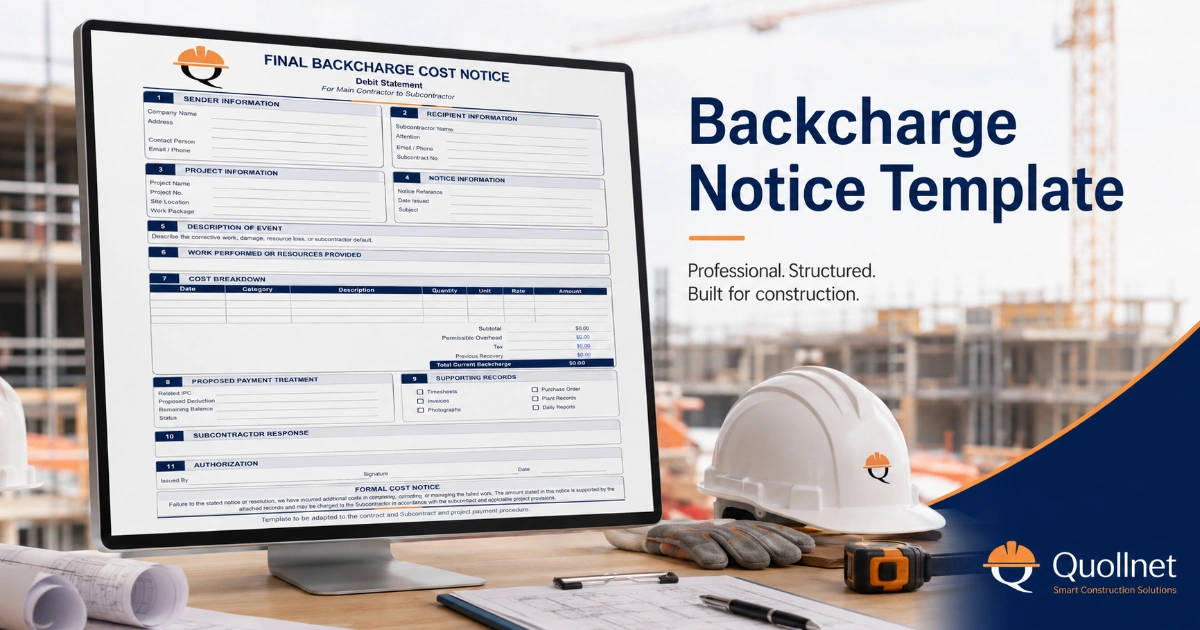
Need to issue the underlying notice first?

Use the Backcharge Notice Template to identify the default, correction period, possible work by others, and proposed cost recovery. Record the notice and every later deduction in the Construction Backcharge Log.

What Is a Subcontractor IPC?

A Subcontractor Interim Payment Certificate, or IPC, is the periodic assessment used to calculate what is currently payable under a subcontract. Depending on the project and jurisdiction, it may instead be called an interim valuation, progress claim, payment application, subcontract payment assessment, or payment certificate.

In some projects, the Subcontractor submits an application and the Main Contractor prepares the assessment. In others, the document itself is called an IPC. It commonly records:

  • gross value of completed work;
  • approved Variations;
  • permitted materials on or off site;
  • retention;
  • advance-payment recovery;
  • previously certified amounts;
  • other contractual deductions;
  • backcharges;
  • the net current amount due.

A backcharge should be presented as a distinct commercial adjustment. It should not be hidden by reducing measured quantities, changing agreed rates, removing unrelated approved work, or increasing construction retention.

When May a Backcharge Be Deducted?

Before deducting a backcharge from a Subcontractor IPC, the Main Contractor should normally verify:

  • the contractual basis for recovery or set-off;
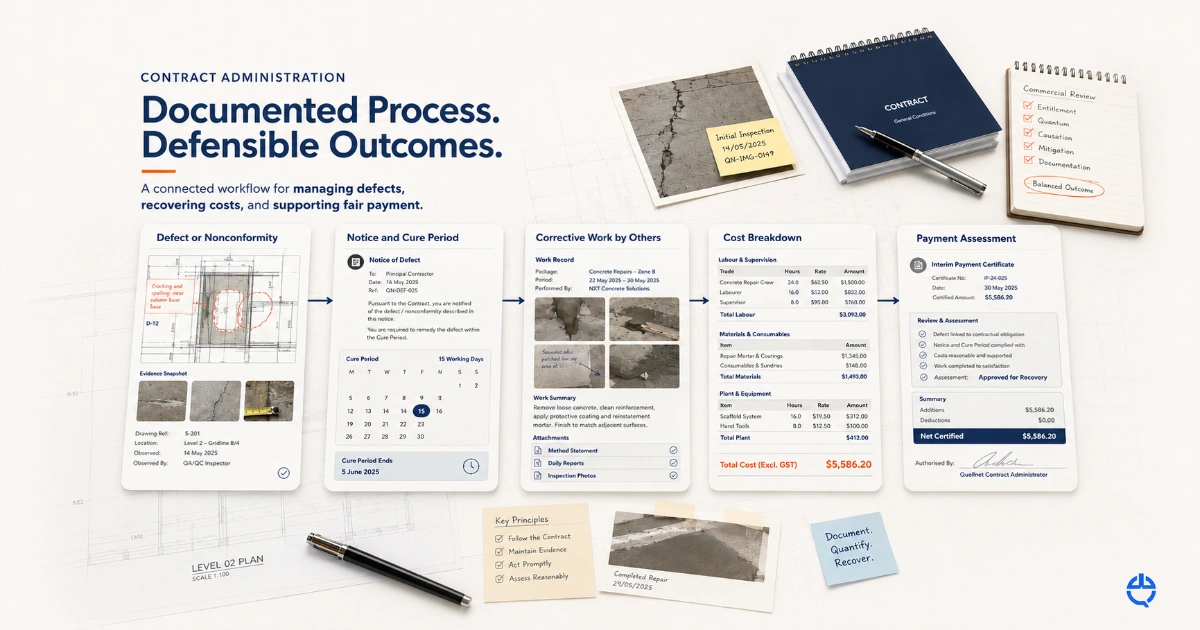
  • the instruction, Defect notification, NCR, or Notice to Correct issued before engaging others;
  • the Subcontractor’s access and opportunity to correct the work, where applicable;
  • the right to use supplementary resources or engage another party;
  • responsibility, causation, and scope allocation;
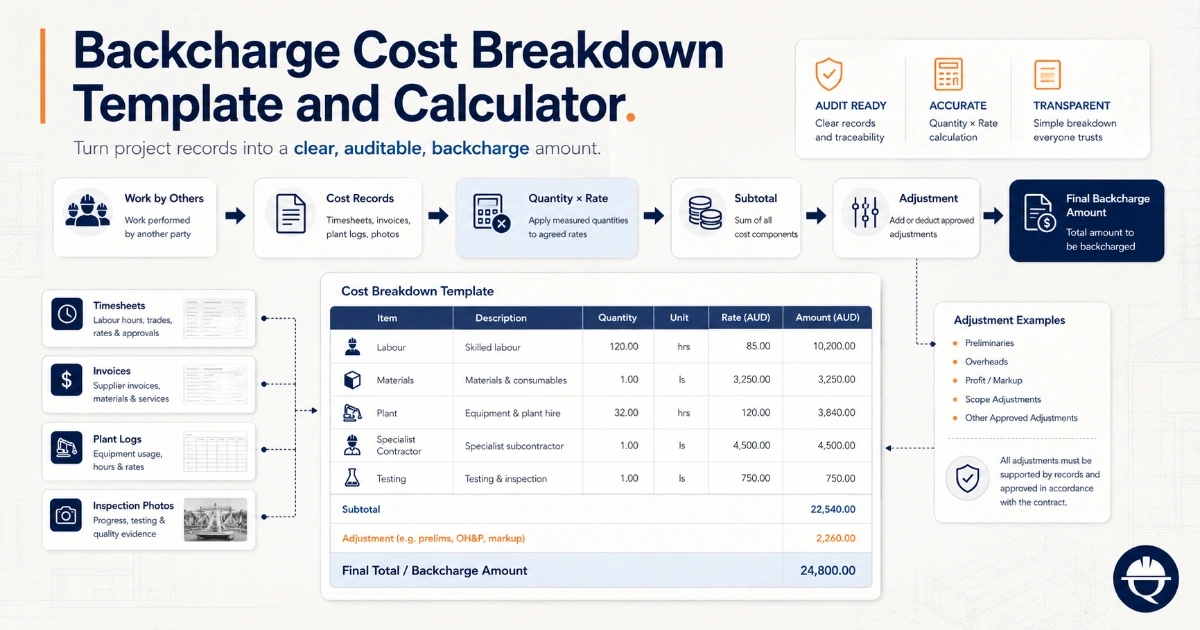
  • actual labour, material, plant, testing, and specialist records;
  • internal commercial approval;
  • any required agreement, assessment, certification, or determination;
  • the Subcontractor’s response or dispute;
  • the payment notice, pay-less notice, set-off, or other payment procedure.

The following statuses should not be treated as interchangeable:

  • Potential backcharge: a warning that corrective cost may arise.
  • Estimated backcharge: a preliminary value before complete records are available.
  • Actual backcharge cost: an evidenced cost incurred or otherwise assessable under the Subcontract.
  • Internally approved backcharge: an amount authorized through the Main Contractor’s internal process.
  • Agreed or determined amount: an amount accepted by the Subcontractor or established through the contractual mechanism.
  • Current IPC deduction: the portion permitted to be applied in the present payment cycle.

Internal approval confirms that the Main Contractor is commercially prepared to proceed. It does not necessarily prove liability, valuation, or the right to deduct from the current IPC.

How Should the Backcharge Deduction Appear in the IPC?

Show the backcharge as a separate and identifiable line. Each line should state the Backcharge Notice number, short description, related clause, approved or assessed value, previous deductions, current deduction, remaining balance, status, cost-breakdown reference, and any payment-notice reference.

Where several backcharges apply, list each separately or attach a detailed schedule reconciled to one total deduction line. Do not combine unidentified corrective costs into a single unexplained “miscellaneous deduction.”

Worked IPC Calculation

Description Current Assessment Deduction or Adjustment Net Effect
Gross value of completed work $150,000 $150,000
Approved Variations $10,000 $10,000
Gross assessed value $160,000 $160,000
Retention ($8,000) $152,000
Previous certified amount ($100,000) $52,000
Current approved backcharge deduction ($7,500) $44,500
Other contractual deduction ($2,000) $42,500
Net current amount due $42,500

The $7,500 should also reconcile with the Backcharge Notice, cost breakdown, approval record, Backcharge Log, and payment notice or assessment.
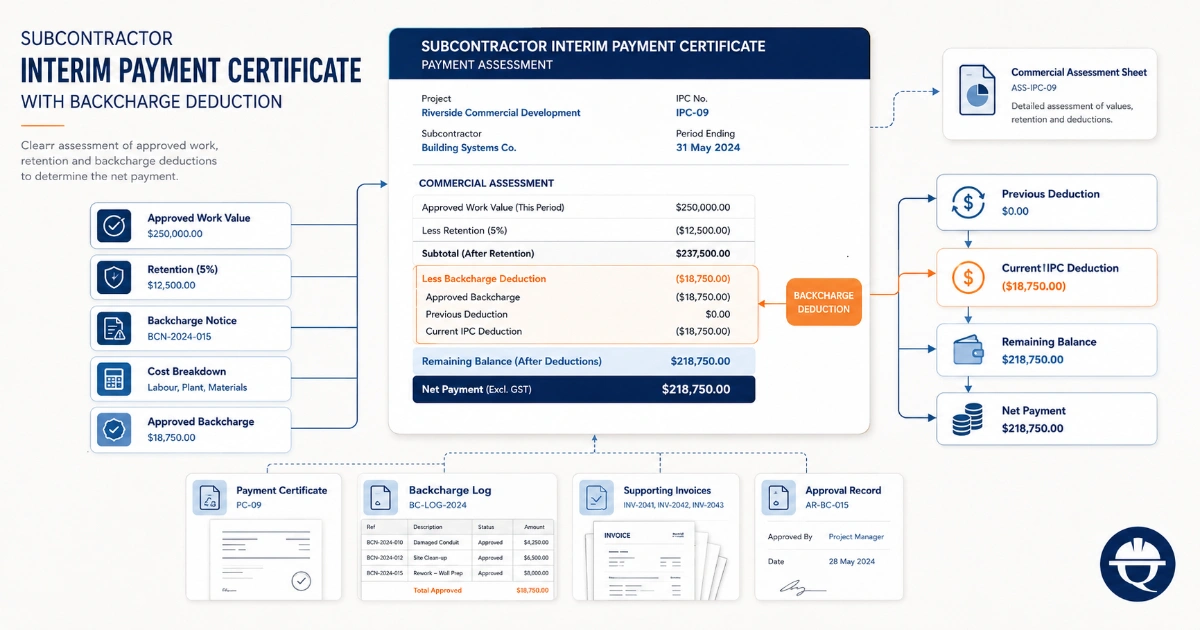
ipc with backchage deduction quollnet

Calculating the Remaining Backcharge Balance

Track the approved amount separately from amounts already recovered:

Remaining balance = Approved backcharge − Total deducted to date

For example, if the approved backcharge is $18,000, $6,000 was deducted in IPC 7, and $5,000 is deducted in IPC 8:

  • approved backcharge: $18,000;
  • deducted in IPC 7: $6,000;
  • deducted in IPC 8: $5,000;
  • total deducted to date: $11,000;
  • remaining balance: $7,000.

The current deduction should not exceed the remaining approved balance or the amount contractually available for deduction in that payment cycle.

When the Backcharge Exceeds the Current Amount Due

If the current IPC is smaller than the backcharge, the Main Contractor should not assume that the full balance can automatically be taken from retention or another account. Depending on the Subcontract, possible treatments may include:

  • a partial deduction in the current IPC;
  • carrying the remaining balance to later IPCs;
  • a final-account adjustment;
  • set-off against other payments where expressly permitted;
  • recovery as a debt;
  • a separate claim or dispute procedure.

The outstanding balance should remain open in the Backcharge Log until it is recovered, reversed, settled, transferred, or formally closed.

Disputed Backcharges and Payment Notices

A disputed amount should remain visible. The IPC schedule may separately record the claimed amount, internally approved amount, accepted amount, disputed amount, current deduction, amount held pending determination, and remaining balance.

Marking an amount as disputed does not automatically prevent deduction, and internal approval does not automatically permit it. The Subcontract and applicable payment law determine whether the amount may be withheld in the current cycle.

The Subcontractor may challenge contractual entitlement, responsibility, scope, notice, correction opportunity, access, causation, correction method, actual cost, labour hours, rates, overhead, profit, betterment, duplicate recovery, or the timing and basis of the payment notice. See how to challenge an improper backcharge.

Contract and Payment Procedures

  • FIDIC: the relevant procedure may involve notice, an Employer’s claim, Engineer review or determination, and treatment in the payment certificate.
  • AIA: correction costs, withholding, certification, and Claims may be separate stages.
  • NEC: notified Defects, correction periods, cost assessment, and payment mechanisms must be followed.
  • JCT: substantive entitlement may need to be supported by a compliant payment notice or pay-less notice.

Review the applicable FIDIC, AIA, NEC, or JCT backcharge guide. Contract editions, amendments, jurisdiction, and notice deadlines matter.

Where a payment notice or pay-less notice is required, it should identify the amount considered due and the basis of calculation, including the backcharge deduction. Missing or late notice may affect the amount payable in that cycle even where the underlying correction-cost claim can still be pursued separately. See Timely Notices in Construction.

Reversals, Credits, and Later Adjustments

A backcharge may later be reduced, rejected, withdrawn, settled, partly accepted, transferred to another responsible party, covered by insurance, found to include betterment, duplicated, or reversed through determination or dispute resolution.

Any correction should appear transparently in the next IPC. For example:

  • previously deducted: $10,000;
  • final agreed backcharge: $6,500;
  • credit due to the Subcontractor: $3,500.

Show the $3,500 as a separate credit or backcharge reversal. Do not silently return it by increasing quantities, rates, or unrelated Variation values. Update both the IPC schedule and Backcharge Log.

Reconcile the IPC with the Backcharge Log

Every deduction should reconcile with the commercial record. The Backcharge Log should show:

  • notice number and description;
  • approved and disputed amounts;
  • previous and current deductions;
  • total deducted to date;
  • remaining balance;
  • related IPC and payment-notice reference;
  • status, reversal, settlement, and closure date.

Documents to Check Before Deduction

  • executed Subcontract and relevant clause;
  • site instruction, Defect notification, NCR, or Notice to Correct;
  • evidence of delivery and correction deadline;
  • Subcontractor response;
  • photographs, inspection records, and test results;
  • labour timesheets and plant records;
  • material invoices and specialist quotations or invoices;
  • supported Backcharge Cost Breakdown and Calculator;
  • internal approval and Backcharge Log entry;
  • current IPC assessment;
  • payment notice, pay-less notice, agreement, or determination where required.

Common IPC Backcharge Deduction Errors

  • deducting an estimated amount as though it were final;
  • hiding the deduction in measured quantities or agreed rates;
  • using retention as a substitute for a specific backcharge;
  • deducting without a notice or cost-breakdown reference;
  • deducting more than the approved remaining balance;
  • repeating the same amount in multiple IPCs;
  • failing to show previous deductions and remaining balance;
  • ignoring the disputed status of an amount;
  • adding unsupported overhead, administration, or profit;
  • deducting before the correction period expires;
  • charging work caused by another trade or additional scope;
  • missing a required payment or pay-less notice;
  • failing to credit a rejected or reduced backcharge.

Conclusion

A backcharge deduction from a Subcontractor IPC should be separately identified, supported, approved, reconciled, and processed through the correct contractual payment mechanism. Liability for the event, valuation of the corrective cost, and the right to deduct it from the current IPC must each be checked.

Use the Backcharge Notice Template before transferring corrective work, the cost calculator to substantiate the amount, and the Backcharge Log to track deductions, remaining balances, disputes, credits, and closure.

This article provides general construction contract-administration guidance and is not legal advice. The executed Subcontract, amendments, governing law, payment procedure, and project facts control.


REFERENCES

FIDIC Guidance on Notices and Notice to Correct

FIDIC: Determination of Costs Incurred in Remedying Defects

AIA Contract Documents: Right to Carry Out Corrective Work and Recover Costs

AIA A201–2017 General Conditions Summary

AIA G703S–2017 Contractor–Subcontractor Payment Continuation Sheet

NEC: Dealing with Uncorrected Defects under the Engineering and Construction Subcontract

NEC: Defining and Managing Defects and Liability for Not Correcting Them

JCT Explains: Interim Payments and Pay Less Notices

JCT: Payment Notices and Paying Now, Arguing Later

Elie Saad's photo
Elie Saad
Jul 19, 2026
0
0
5
6

How to Deduct a Backcharge from a Subcontractor IPC

Frequently Asked Questions


FAQ

Q: Can a backcharge be deducted from a Subcontractor IPC?

A: It may be deducted where the Subcontract and applicable payment procedure permit recovery or set-off and the required notices, assessment, substantiation, and payment steps have been completed.

FAQ

Q: Must the backcharge be approved before deduction?

A: Internal approval is an important commercial control, but it does not necessarily establish contractual entitlement. Any required agreement, certification, assessment, determination, or payment notice must also be considered.

FAQ

Q: Can an estimated backcharge be deducted?

A: This depends on the Subcontract. An estimate should be clearly identified as preliminary and should not automatically be treated as a final debt or final deduction.

FAQ

Q: How should a backcharge appear in the IPC?

A: Show it as a separate line identifying the notice number, description, approved or assessed amount, previous deductions, current deduction, remaining balance, status, and supporting references.

FAQ

Q: Can the Main Contractor reduce measured quantities instead?

A: The backcharge should not normally be hidden by reducing properly measured work, changing agreed rates, or removing unrelated approved items. It should remain separately identifiable.

FAQ

Q: What is the difference between retention and a backcharge?

A: Retention is a percentage withheld under the payment terms as security for performance or defects. A backcharge is a specific cost attributed to an identified event, failure, or resource use.

FAQ

Q: What happens when the backcharge exceeds the current IPC?

A: The current deduction may be limited to the amount available. The balance may be carried forward, adjusted through the final account, set off elsewhere where permitted, or pursued separately under the Subcontract.

FAQ

Q: How should a disputed backcharge be shown?

A: Keep the claimed, approved, accepted, disputed, previously deducted, currently deducted, and remaining amounts visible. The Subcontract and payment law determine whether a disputed amount may be withheld.

FAQ

Q: Is a payment notice or pay-less notice required?

A: Some contracts and jurisdictions require a valid and timely payment notice or pay-less notice identifying the amount due and the basis of calculation. There is no universal deadline.

FAQ

Q: What happens if a backcharge is later reduced?

A: The next IPC should show a separate credit or reversal for the excess previously deducted, and the Backcharge Log should be updated accordingly.

Related Checklists


Nominated Subcontractor Proposal/Instruction Review Checklist
✅ 24 items
Nominated Subcontractor Proposal/Instruction Review Checklist provides a structured, internal form for contractors to assess a proposed or instructed nomination before acceptance, conditional acceptance, or objection. This practical nomination review consolidates scope definition, programme and sequencing, commercial exposure, technical capability, and contractual protection in one place. Within the first pass, you will surface interface gaps, builder’s work in connection, temporary works responsibilities, lead times, authority approvals, and back-to-back obligations per approved project specifications and authority requirements. The checklist avoids common risks such as misaligned LD caps, inadequate insurance limits, weak pass-through of delay damages, unclear warranty terms, and unfunded advance payments. Outcomes are decision-ready, evidence-backed, and immediately distributable to project controls, procurement, and commercial leads. Use the interactive mode to tick items, add comments, attach proofs, and export to PDF/Excel with a QR-secured audit trail.
What to Do When the Contractor Receives an NCR: Action Guide
✅ 22 items
What to do when the contractor receives an NCR is a practical, step-by-step response plan for construction teams facing a nonconformance report, non-compliance notice, or quality deviation. This checklist focuses on immediate containment, factual root cause analysis, corrective and preventive actions, and transparent closeout—without drifting into unrelated scopes. By following a structured approach, you reduce rework, avoid safety incidents, protect delivery dates, and maintain a defensible contractual position. Every step emphasizes objective evidence: calibrated measurements, annotated photos, batch numbers, inspection reports, and signatures. You will find guidance for logging, isolating affected work, coordinating hold points, and aligning with stakeholder expectations per approved project specifications and authority requirements. The result is a clear record demonstrating control of the nonconformance, verification of the fix, and prevention of recurrence. Start in interactive mode to tick items, add comments, attach files, and export your record as PDF/Excel with a QR link for quick field access.
Verify Subcontractor Prequalification & Quality Agreements
✅ 14 items
Ensuring subcontractor prequalification and quality agreements are thoroughly verified is essential to maintaining high standards in any project. This checklist guides project managers and quality assurance teams through the critical steps necessary to confirm that subcontractors meet all prequalification criteria and adhere to quality agreements. By completing these tasks, you minimize risks, ensure compliance with standards, and guarantee the integrity of the work delivered. Utilize our interactive checklist to track progress, leave comments, and export reports for documentation and stakeholder communication.
Inspect Façade Glass Quality: Scratches, Chips, Distortion
✅ 26 items
Inspect façade glass quality for scratches, chips, and distortion is a focused, field-ready process to validate installed glazing before handover. This checklist supports glazing inspection across curtain walls, addressing surface defects, edge chips and spalls, and optical distortion such as roller wave or local bow. It defines viewing conditions, tools, and documentation so results are repeatable and defensible. By verifying glass against approved project specifications and authority requirements, teams reduce rework, avoid warranty disputes, and protect the building’s visual performance. The scope stays on exterior façade glass panels and their visible faces; it excludes frame alignment, sealant quality, structural performance, and unrelated envelope trades. Practical methods—diffuse lighting, set viewing distances, reflection grid tests, and macro photography with scales—ensure consistent acceptance decisions. Outcomes include traceable pane IDs, defect mapping, a clear disposition for repair or replacement, and complete records for sign-off. Use this interactive checklist: tick items, add comments, and export PDF/Excel with a secure QR.
Provisional Sum Package Maturity (PCS) Gap Checklist
✅ 27 items
Provisional Sum Package Maturity (PCS Gap Analysis) Checklist enables a clear, auditable decision on whether a provisional sum package is ready for instruction, procurement, and execution. This package readiness review focuses on scope maturity, design completeness, authority approvals, interfaces, and programme integration, not on subcontractor experience or financial standing. By applying a structured PCS gap analysis, the contractor can avoid scope drift, rework, abortive procurement, late approvals, and programme resequencing. The checklist demands evidence-based confirmation of IFC drawings, coordinated specifications, defined performance requirements, identified temporary works, and clear design responsibilities. It also validates that approval paths are known, submissions are tracked, and timelines align with the baseline programme logic. Commercial clarity is captured through measurable scope, stated assumptions, testing obligations, warranties, and LD implications per approved project specifications and authority requirements. Use this tool to accept instruction, accept with reservations, request clarification, issue a notice of risk, or object to premature conversion. Tick, comment, and export to PDF/Excel with a secure QR.

Related Articles


Challenge Improper Construction Backcharge
⏳ 11 min read
How To Challenge An Improper Construction Backcharge
Learn how to challenge an improper construction backcharge by testing contractual entitlement, notice, responsibility, right to repair, cost records, betterment, delay causation, IPC deductions, payment notices, and duplicate recovery.
Construction Backcharge Log Template Ipc Deductions
⏳ 6 min read
Backcharge Log Template - Excel, Pdf Free Downlaod
Use this construction Backcharge Log template to track notices, cure periods, approved costs, disputes, Subcontractor IPC deductions, remaining balances, reversals, and closure without duplicating deductions.
Backcharge Cost Breakdown Template
⏳ 9 min read
Backcharge Cost Breakdown Template And Calculator
Use this Backcharge Cost Breakdown Template and Calculator to itemize remedial labour, materials, plant, specialist work, testing, adjustments, credits, and tax. Separate estimates from actual costs, prepare a final cost summary, and support a Backcharge Notice, Log, or IPC deduction.
Backcharges Construction Contracts
⏳ 23 min read
Backcharges In Construction Contracts: Notices, Cost Recovery, And Payment Deductions
Backcharges in construction contracts explained: notice and cure procedures, correction by others, cost evidence, IPC deductions, disputes, defects periods, and how FIDIC, AIA, NEC, and JCT address construction cost recovery.
Backcharge Notice Template Construction Subcontractor
⏳ 6 min read
Backcharge Notice Template For Construction Subcontractors
Download two construction backcharge notice templates in Excel and PDF: a Notice to Correct and Intent to Backcharge issued before corrective work, and a Final Backcharge Cost Notice issued after costs are incurred.