Notice to Correct in Construction: Meaning, Cure Period, and Template
AI/Search Snippet: A Notice to Correct in construction is a formal contractual escalation requiring a Contractor or Subcontractor to remedy a clearly identified failure within a stated contractual or reasonable cure period. It is different from an NCR, site instruction, backcharge notice, payment deduction, or termination notice.
A Notice to Correct in construction is used when a Contractor or Subcontractor has failed to meet a contractual obligation and must be given a formal, time-bound opportunity to remedy the failure. The notice should identify what is wrong, what must be done, when corrective action must start and finish, and what contractual consequences may follow if the recipient does not comply.
The document may also be called a construction cure notice, notice to remedy default, notice to cure, default notice, or correction notice. However, not every contract uses the exact title “Notice to Correct,” and changing the heading of a letter does not make it contractually valid.
A properly issued notice may later support correction by others, recovery of reasonable costs, a backcharge, payment deduction, or a separate termination procedure. Those consequences are not automatic. The issuing party must follow the actual contract or subcontract, including any further notice, assessment, claim, payment, or termination requirements.
Download the Notice to Correct Template
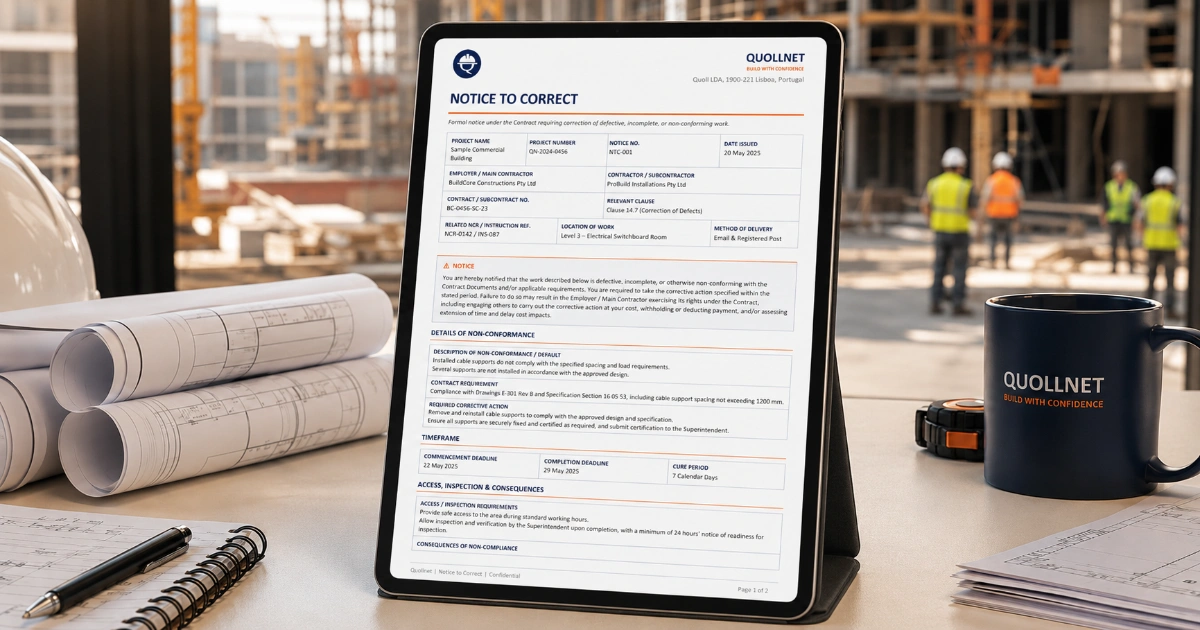
Use the editable construction template to record the contractual failure, clause reference, required corrective action, cure period, access arrangements, inspection requirements, consequences of noncompliance, response, authorisation, and proof of delivery.
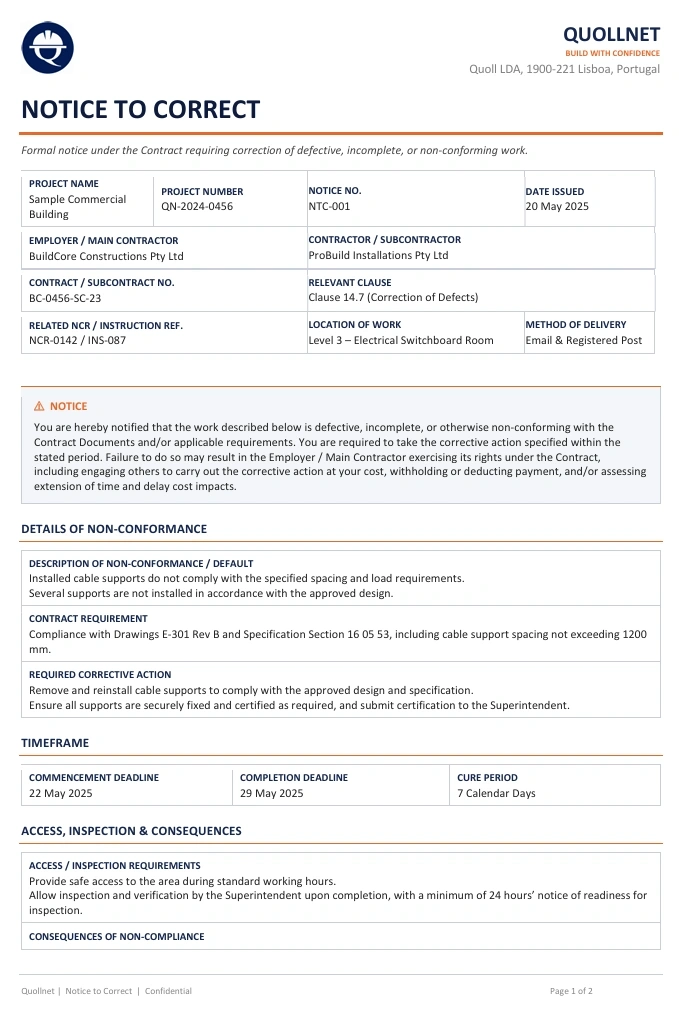
What Is a Notice to Correct in Construction?
A Notice to Correct is a formal contractual communication requiring a party to remedy a specified default, omission, noncompliance, or performance failure within a defined or reasonable period.
It may be issued by an Employer, Engineer, Architect, Contract Administrator, Project Manager, Main Contractor, or another representative authorised under the applicable contract. The recipient may be a Main Contractor, Subcontractor, supplier, specialist contractor, or another party with an express contractual obligation.
The notice normally performs four functions:
- records the contractual failure and supporting facts;
- requires a defined corrective action;
- establishes response, commencement, and completion deadlines;
- reserves the issuing party’s right to pursue further contractual remedies.
A Notice to Correct is more serious than an ordinary reminder or coordination email. It creates a formal record that the recipient was informed of the failure and given an opportunity to remedy it before further action was taken.
Routine minor items should not automatically be escalated into contractual default notices. A proportionate response may begin with coordination, an inspection record, an NCR, or a site instruction. Formal escalation becomes more appropriate where the failure is serious, repeated, urgent, disruptive, or remains unresolved after earlier communication.
Notice to Correct Terminology Under FIDIC, AIA, NEC, and JCT
The contractual function exists in different forms across the main standard contract suites, but the terminology, issuer, correction period, and consequences vary.
| Contract suite | Equivalent mechanism | Typical issuer | Correction period | Possible consequence |
|---|---|---|---|---|
| FIDIC | Express Notice to Correct, remedial-work instruction, or defects procedure | Engineer or another authorised contract administrator | The time stated under the applicable provision and contract amendments | Remedial work, correction by others, Employer claim, determination, or termination procedure |
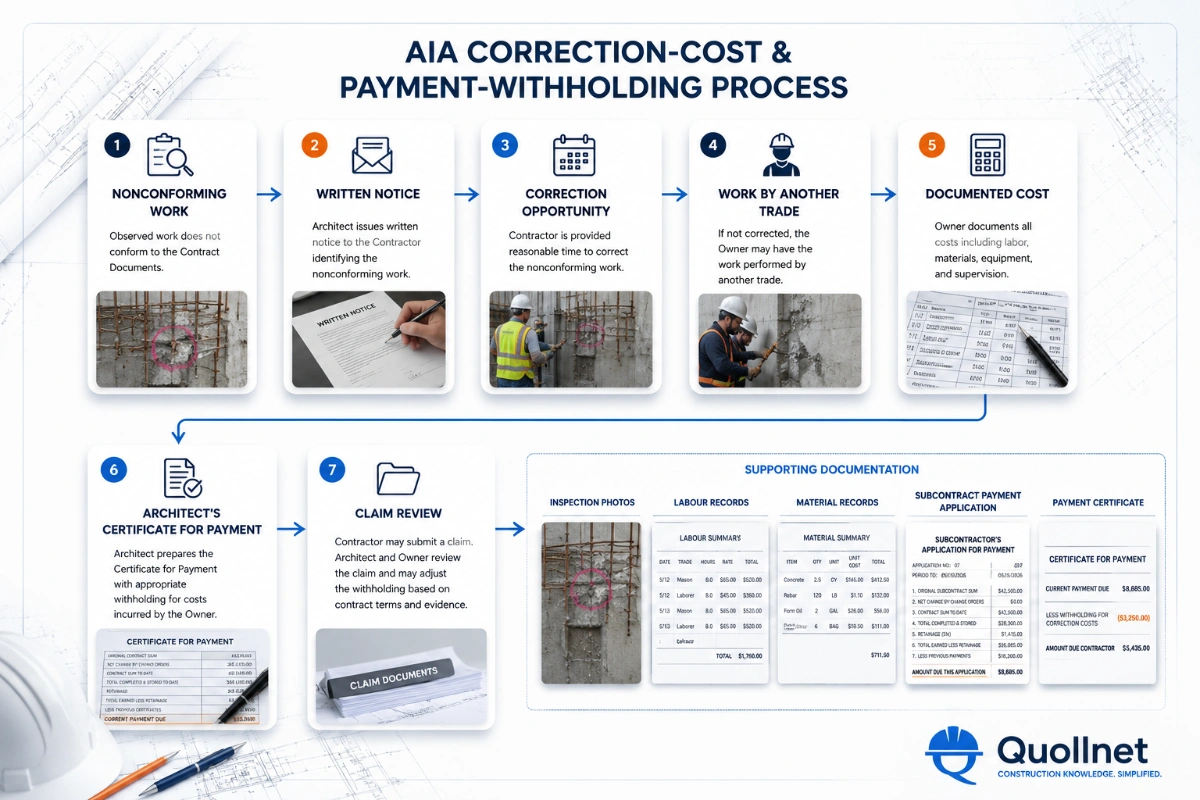
| AIA | Written notice requiring correction of default, neglect, defective Work, or nonconforming Work | Owner or Contractor, depending on the A201 or A401 relationship | Depends on the remedy; different correction and termination provisions may use different periods | Correction by others, payment withholding, Claim, or termination procedure |
| NEC4 | Notification of a Defect, access to correct, and defect correction period | Supervisor or Contractor under the ECC, with corresponding roles under the ECS | Stated in Contract Data or Subcontract Data | Accepted Defect, assessment of an uncorrected Defect, correction by others, or payment treatment |
| JCT | Instruction, notice of noncompliance, defects notification, or default notice | Architect, Contract Administrator, Employer, or Contractor under a subcontract | Depends on the form, edition, instruction, Rectification Period, and amendments | Work by others, appropriate deduction, cost recovery, Pay Less Notice, or termination procedure |
FIDIC may expressly use the term Notice to Correct as a formal default mechanism. It should still be distinguished from an Engineer’s ordinary remedial-work instruction, rejection of nonconforming work, or a defects notice.
AIA documents may require written notice before an Owner or Contractor corrects another party’s default. “Notice to cure” is frequently used in project correspondence, but the actual A201 or A401 provision and remedy should be identified.
NEC4 normally uses its own defined process: a Defect is notified, access is provided, the defect correction period runs, and an uncorrected Defect may then be assessed. The NEC procedure should not be relabelled as a Notice to Correct if that obscures the contract’s required communications.
JCT contracts may use instructions, noncompliance provisions, defects schedules, making-good procedures, or default notices. The exact mechanism depends on the selected main contract or subcontract and whether the project uses the 2016 or 2024 edition.
Before issuing the notice, verify the applicable procedure under the Quollnet guides for FIDIC contracts, AIA contracts, NEC4 contracts, or JCT contracts.
When Should a Notice to Correct Be Issued?
A formal construction cure notice may be appropriate where a Contractor or Subcontractor has failed to address:
- defective or nonconforming work;
- incomplete work affecting progress, testing, handover, or following trades;
- failure to comply with an authorised instruction;
- insufficient labour, supervision, materials, plant, or other resources;
- failure to remove waste or maintain required housekeeping;
- failure to protect completed work;
- failure to attend notified defects;
- repeated quality failures;
- failure to submit required drawings, methods, calculations, programmes, or records;
- breach of safety or other contractual obligations.
The notice should be proportionate to the failure. Consider its seriousness, urgency, safety implications, effect on following trades, technical complexity, material availability, access, testing requirements, previous warnings, and whether the default has been repeated.
For example, an isolated minor finishing snag may be managed through an ordinary snag list. Repeated failure to complete firestopping before ceiling closure may justify immediate formal escalation because it affects life safety, inspection, sequencing, and concealment of the work.
The distinction between an observation, snag, NCR, and contractual defect is explained in Observation vs NCR vs Snag vs Defect.
Notice to Correct Versus NCR, Site Instruction, and Backcharge Notice
These records may relate to the same event, but they perform different functions.
- NCR: records a technical nonconformity against a drawing, specification, standard, method, or inspection requirement.
- Site instruction: directs the recipient to carry out, remove, replace, inspect, test, protect, or correct work.
- Notice to Correct: formally escalates a contractual failure and creates a time-bound cure requirement.
- Backcharge notice: warns of or confirms potential cost recovery arising from the failure.
- Payment notice: deals with the amount payable during a particular assessment cycle.
- Termination notice: invokes a separate and substantially more serious contractual remedy.
An NCR may provide strong technical evidence, but it does not automatically satisfy the contractual requirements for a Notice to Correct. It may not identify the cure period, consequences of noncompliance, authorised contractual sender, or required delivery method.
The issuing party should attach the relevant NCR Form, inspection records, photographs, drawings, specification clauses, testing results, and earlier correspondence where they support the notice.
A valid site instruction may also need to precede the notice, particularly where the contract requires the Engineer, Architect, Contract Administrator, or another named person to direct corrective work.
If the recipient does not comply and the issuing party intends to recover the cost of work by others, a separate Notice to Correct and Potential Backcharge Template, final cost notice, assessment, or payment notice may still be required.
How Long Should the Construction Cure Period Be?
There is no universal cure period for a Notice to Correct in construction.
The period may be:
- expressly stated in the contract or subcontract;
- stated in an earlier instruction;
- based on a defined defect correction period;
- linked to a defects or Rectification Period procedure;
- assessed as reasonable in the circumstances.
The issuing party must also calculate the period from the correct contractual trigger. Depending on the contract, time may run from receipt of the notice, the date access is provided, Completion, a stated instruction date, or another defined event.
Factors Affecting a Reasonable Cure Period
- safety and urgency;
- risk of continuing damage;
- availability of access, permits, and escorts;
- technical investigation required;
- design review or approval;
- specialist and material procurement lead times;
- temporary works and protection;
- inspection, testing, and reinstatement;
- effect on the accepted programme and following trades;
- whether a temporary repair can reduce the immediate risk;
- previous warnings or failed correction attempts.
An unrealistically short cure period should not be used simply to create a default record. A deadline that cannot reasonably be achieved may weaken the issuing party’s position and allow the recipient to argue that it was never given a genuine opportunity to comply.
The notice can set separate deadlines for:
- written acknowledgement and response;
- immediate protective or safety action;
- submission of the proposed correction method;
- commencement of permanent correction;
- completion of physical work;
- inspection, testing, certification, and close-out records.
Emergency action may be necessary where there is an immediate safety risk, instability, water ingress, exposed services, damage to completed work, or risk to the public. The issuing party should distinguish limited emergency protection from the permanent corrective work and document why immediate intervention was necessary.
What Should a Notice to Correct Contain?
A practical contract-neutral notice should include:
- project name and number;
- contract or subcontract form and edition;
- notice reference and date;
- authorised sender and contractual recipient;
- required delivery method and delivery record;
- relevant contract clause and amendments;
- related instruction, NCR, inspection, or earlier notice;
- description and exact location of the failure;
- the contractual requirement not achieved;
- the corrective action required;
- access and working arrangements;
- response deadline;
- commencement deadline;
- completion deadline;
- inspection, testing, and acceptance requirements;
- possible consequences of noncompliance;
- reservation of contractual rights;
- name, position, signature, and issue date.
The notice should be specific enough for the recipient to understand exactly what it must do. Avoid vague directions such as “correct all defective work immediately” where the affected locations, records, contractual standards, and acceptance criteria can be stated precisely.
Sample Notice to Correct Wording
Subject: Notice to Correct – [Project, Contract and Notice Reference]
We refer to [insert contract or subcontract], [insert relevant clause], and [insert instruction, NCR, inspection, or previous correspondence]. The following contractual failure has been identified at [insert location]: [describe the defective, incomplete, noncompliant, delayed, or omitted work].
You are required to provide your written response by [date and time], commence the corrective action by [date and time], and complete the required work by [date and time]. The correction must comply with [insert drawing, specification, Scope, Subcontract Scope, Employer’s Requirements, Contractor’s Proposals, or other contractual standard] and will be subject to [insert inspection or testing requirement]. Access will be provided as follows: [insert arrangements].
If the failure is not corrected within the applicable period, the issuing party may consider the further remedies available under the executed contract, including correction by others, recovery of properly supported cost, payment treatment, or other contractual action. No remedy is asserted beyond those available under the contract and governing law.
Please confirm your corrective method, programme, responsible representative, resource plan, and any contractual or technical objection. All contractual rights are reserved.
The downloadable Notice to Correct Template expands this wording into a controlled project form with clause references, deadlines, supporting records, recipient response, internal approval, and proof of delivery.
How Should the Recipient Respond?
A Contractor or Subcontractor receiving a Notice to Correct should respond promptly. Ignoring the notice may allow the issuer to argue that the recipient refused or failed to remedy the default.
The response should:
- acknowledge receipt without making an unintended admission of liability;
- confirm whether the recipient will inspect or correct the work;
- request clarification where the allegation or required action is unclear;
- request access and identify any restrictions;
- challenge incorrect scope allocation or responsibility;
- identify design, instruction, coordination, misuse, or preceding-trade causes;
- propose realistic commencement and completion dates;
- submit a correction method and resource plan where appropriate;
- reserve any extension-of-time or additional-cost entitlement;
- distinguish genuine correction from a Variation or additional scope;
- preserve objections to any threatened backcharge or payment deduction.
The recipient may dispute responsibility while still offering to attend a joint inspection or perform urgent protective work. This preserves its contractual position without creating the impression that the notice has been ignored.
Where the cure period is unreasonable, the recipient should explain the technical and practical reasons, identify required access or procurement constraints, and propose achievable alternative dates.
If a backcharge has already been threatened or deducted, see how to challenge an improper construction backcharge.
What Happens After a Notice to Correct?
If the Failure Is Corrected
The parties should inspect or test the corrected work against the stated acceptance criteria. The project record should then show:
- the date corrective work was completed;
- the inspection or test result;
- any remaining items;
- closure of the Notice to Correct;
- closure or update of the related NCR or defects register;
- cancellation or revision of any potential backcharge;
- receipt of test certificates, warranties, as-built records, or other close-out submissions.
Physical completion alone may not close the issue if the contract also requires testing, certification, commissioning records, or other supporting documentation.
If the Failure Is Not Corrected
Subject to the exact contract, further action may include:
- supplementary labour, plant, materials, or supervision;
- temporary protection or emergency work;
- correction or completion by others;
- assessment and recovery of reasonable corrective cost;
- issue of a potential or final backcharge notice;
- deduction through the applicable IPC or payment procedure;
- acceptance of the work with an appropriate deduction;
- a formal claim, certification, assessment, or determination;
- a separate termination procedure for serious or continuing default.
Failure to comply does not automatically authorise every remedy. The issuing party must identify the specific contractual entitlement and follow any additional notice, assessment, payment, set-off, determination, or termination procedure.
Where others perform the correction, the issuing party should calculate and substantiate the corrective cost, track the notice and remaining balance in the Backcharge Log, and show any approved amount separately when it is deducted from the Subcontractor IPC.
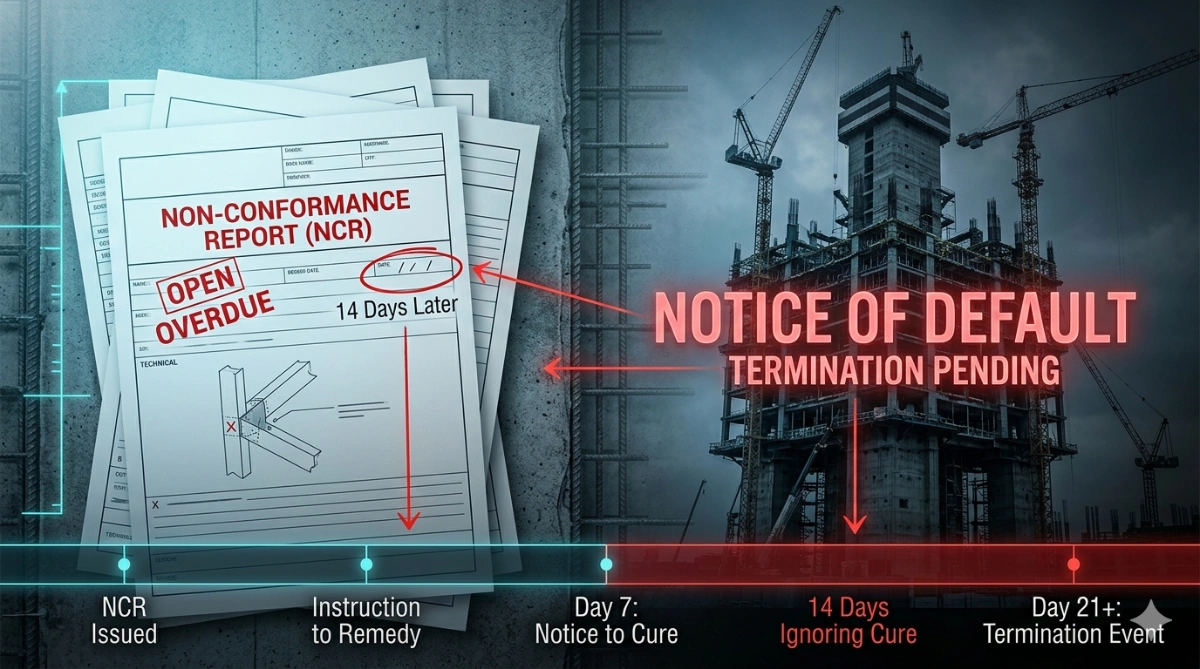
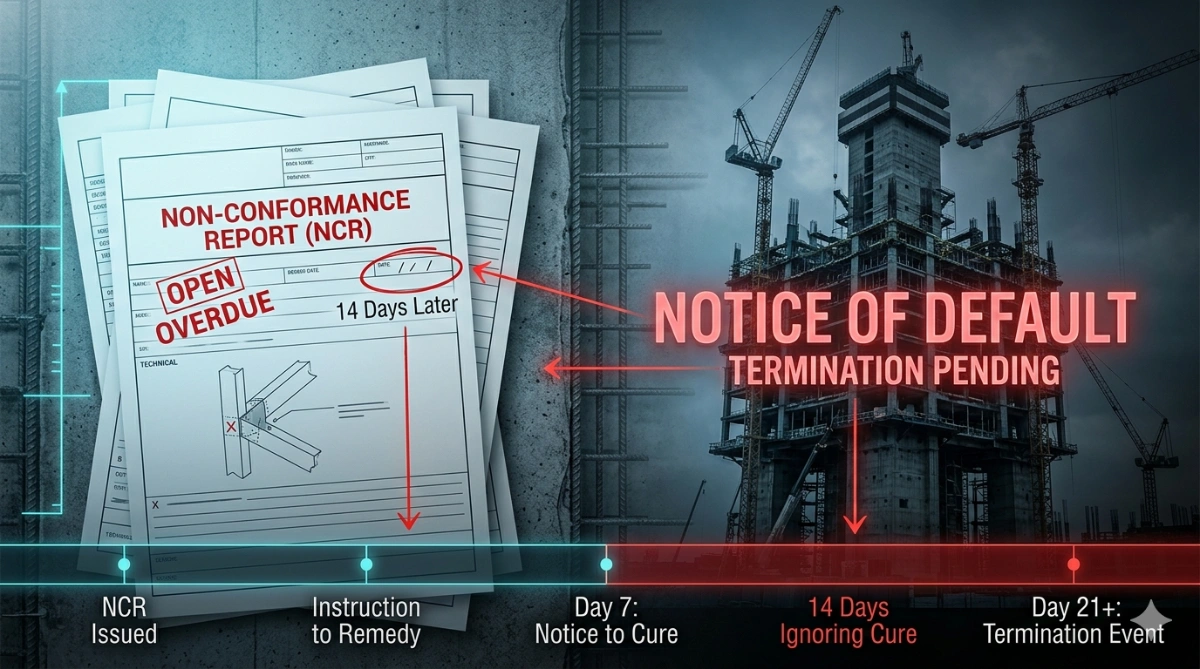
For the separate escalation risk, see how an ignored Notice to Correct can lead to termination. Termination requires its own strict contractual analysis and should not be treated as the automatic consequence of every uncorrected item.
Common Notice to Correct Mistakes
- Using the wrong contract, clause, or edition.
- Issuing the notice through an unauthorised person.
- Sending it to the wrong contractual recipient.
- Ignoring the required method of delivery.
- Describing the failure too vaguely.
- Failing to identify the contractual standard.
- Giving no access or inspection opportunity.
- Combining unrelated failures in one notice.
- Setting an unrealistically short cure period.
- Demanding betterment or additional scope as correction.
- Threatening remedies that are not available under the contract.
- Engaging others before the applicable period expires.
- Failing to distinguish emergency protection from permanent correction.
- Failing to inspect and close the notice after compliance.
- Assuming the notice itself authorises a backcharge or payment deduction.
Conclusion
A Notice to Correct in construction is a formal contractual escalation, not merely a strongly worded email. It should identify a real contractual failure, require a defined corrective action, provide a contractual or reasonable cure period, and explain the possible consequences of continued noncompliance.
The issuing party should use the terminology, authority, delivery method, and procedure required by the exact contract. The recipient should respond promptly, request clarification or access where necessary, protect its rights, and distinguish corrective work from changed or additional scope.
A properly administered Notice to Correct gives the recipient a fair opportunity to remedy the failure and creates a reliable project record if correction by others, cost recovery, a backcharge, payment action, or another contractual remedy later becomes necessary.
This article provides general construction contract-administration information and is not legal advice. The executed contract or subcontract, amendments, governing law, payment legislation, and project circumstances control.
REFERENCES
FIDIC Construction Contract, Second Edition 2017, Reprinted 2022
FIDIC Construction Contract, First Edition 1999
FIDIC Paper Discussing Sub-Clause 15.1 Notice to Correct
AIA Contract Documents: Owner’s Right to Carry Out the Work
NEC: Defining and Managing Defects in the ECC
NEC: Words and Phrases to Avoid
JCT: Making Good with Rectification Periods
JCT Standard Building Contract with Quantities 2024 Contents