G
Guest

Can Ncr Lead To Termination

An NCR does not terminate a contract by itself—but it can create the grounds for default if a Notice to Correct/Cure is issued and ignored. Learn the NCR→notice→default pathway across common contracts, what happens after cure fails, and how contractors and engineers should act.

Can Ncr Lead To Termination
English version

Can an NCR Lead to Termination? Hidden Risk Behind “Notice to Correct”

An NCR cannot terminate a contract by itself, but it can set the grounds for default termination if it escalates into a formal “Notice to Correct / Cure” and the contractor fails to remedy within the allowed time. This page explains the NCR→notice→default mechanism, shows a simple example timeline, and highlights the hidden risk for contractors and the ethical responsibility for engineers when recommending escalation.

One-line truth: The termination risk is usually triggered by failure to correct after notice — not by the existence of an NCR.

What this page is (and isn’t)

This is not a general guide to termination. It focuses on the short clause found in most contract families that sounds harmless (“notice to correct/cure”) but can become a high-stakes default pathway if mishandled.

NCR vs default: what changes when a notice is issued

  • NCR is a QA/QC control record: identify non-compliance, contain it, correct it, verify it, close it.
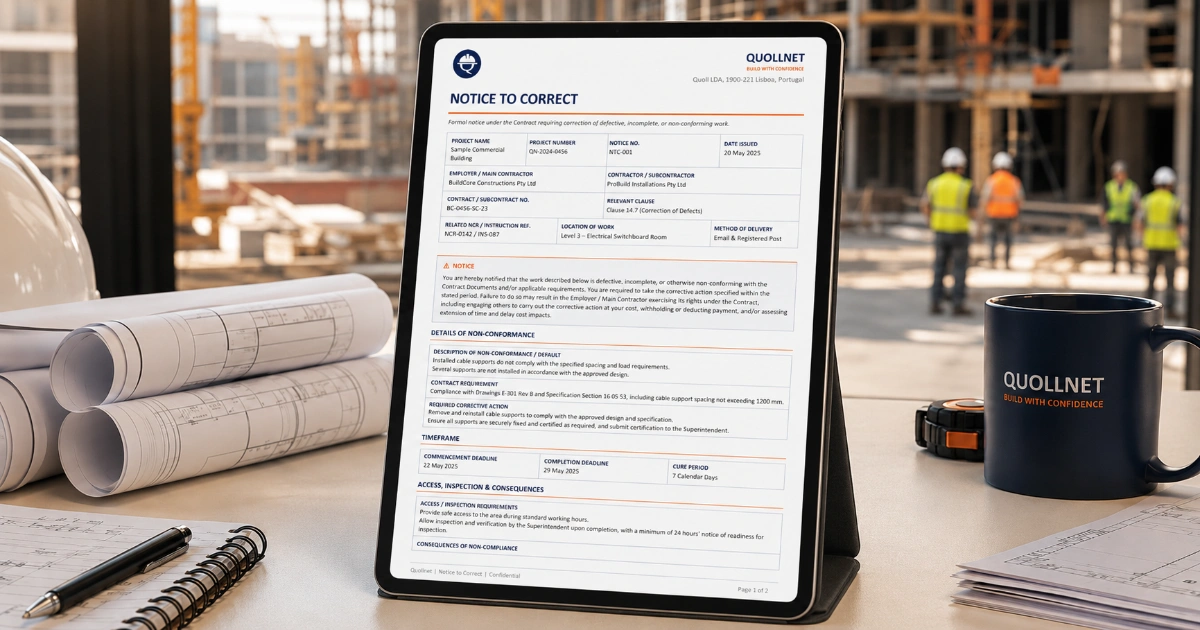
  • Notice to Correct / Cure is a contractual escalation: it sets a time-bound obligation to remedy a failure and preserves stronger remedies if the failure continues.
  • Termination risk appears when the contractor ignores deadlines, refuses to remedy, or allows issues to remain open beyond the cure period.

If you need the NCR basics first, see NCR Meaning in Construction. For templates, see NCR Form Template and NCR Log Template. For notice discipline, see Timely Notices in Construction.

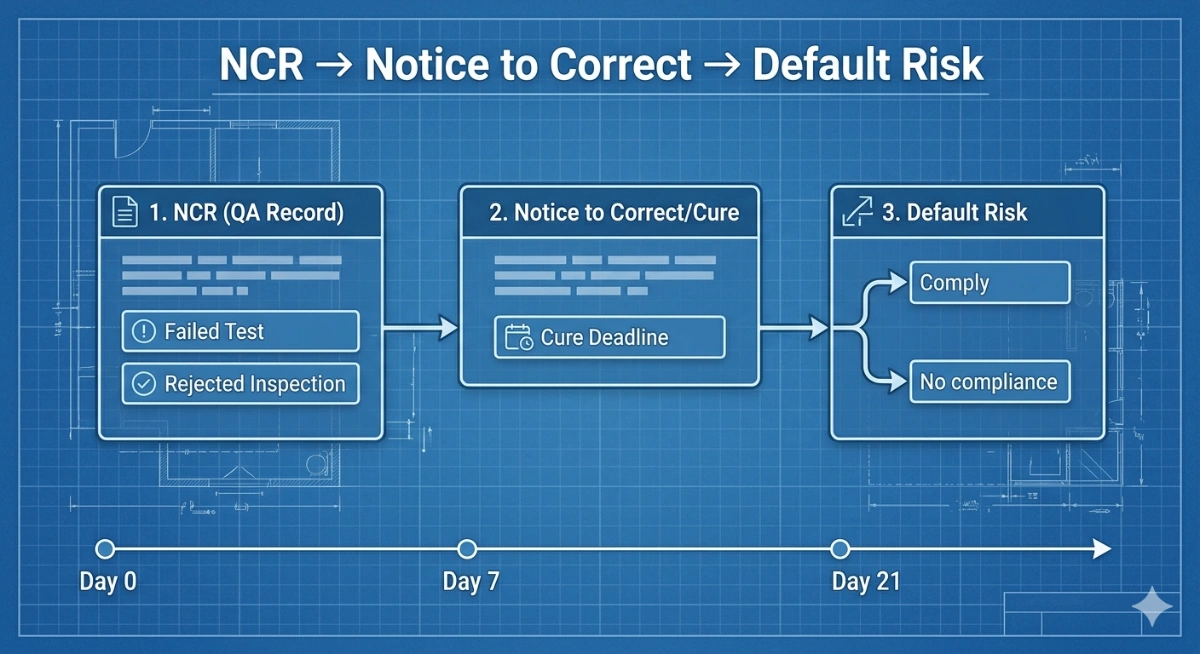
The escalation ladder (what most projects look like)

  1. NCR raised (facts + references + containment requirements).
  2. Instruction to remedy (clear direction and target date).
  3. Notice to Correct / Cure (formal cure clock starts).
  4. If still not corrected → default remedies may be triggered (including termination, subject to strict procedure).

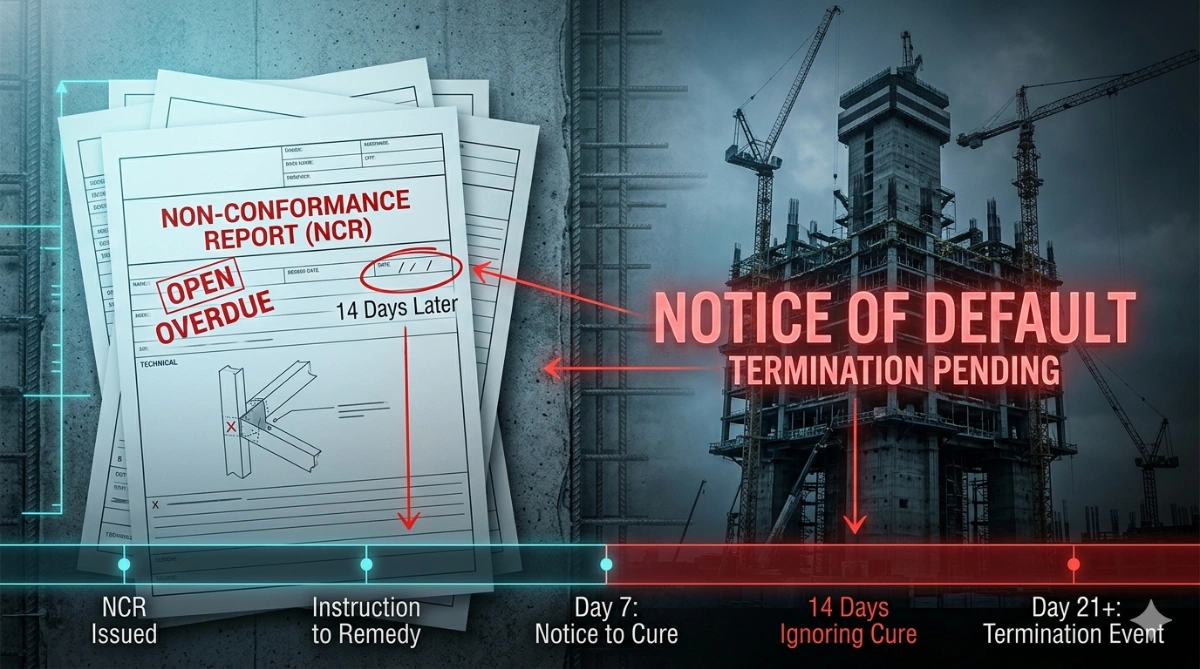
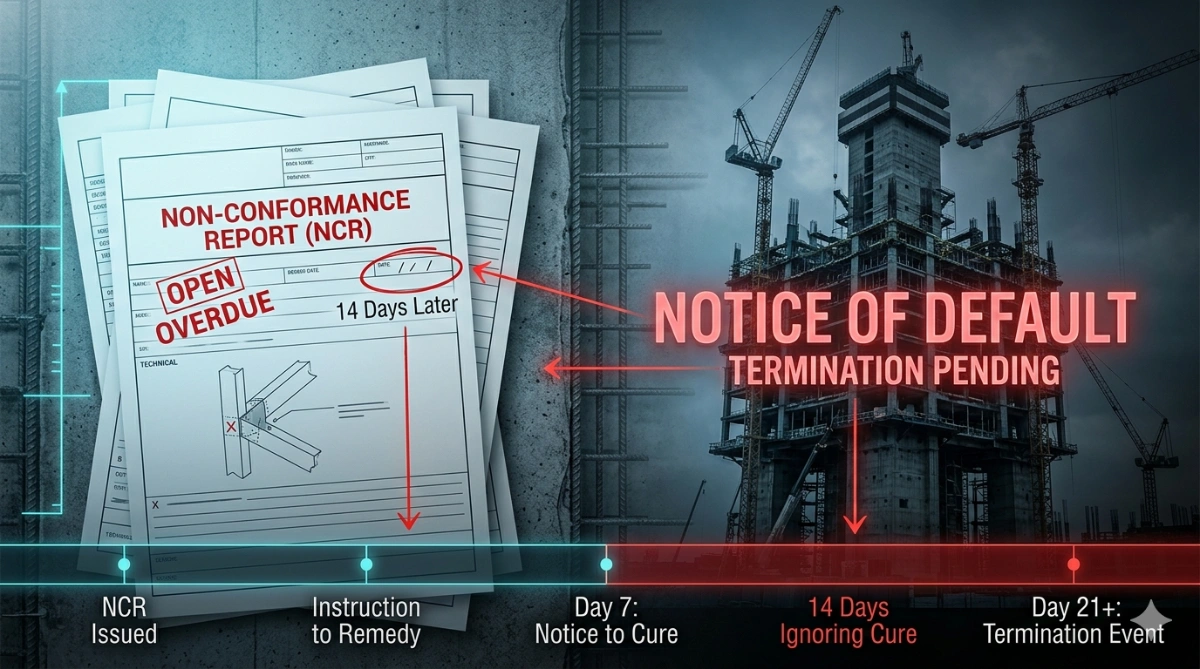
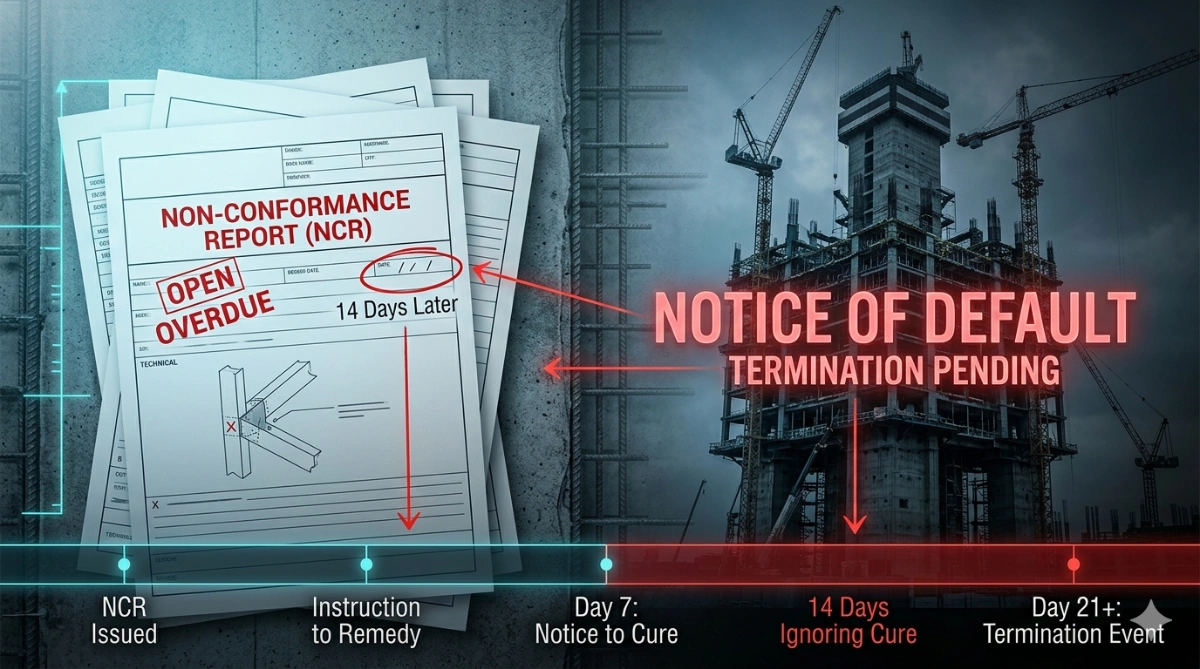
Example timeline (illustrative only)

This is a practical example of how an ignored NCR can become a contractual default. Your project may be faster or slower depending on contract wording and risk severity.

Day Record / Issued by What it means
0 NCR issued
Engineer / Consultant or Contractor QA
Non-compliance recorded; containment + corrective action required.
2 Instruction to remedy
Engineer / CA / PM
A clear direction and deadline to correct (technical control step).
7 Notice to Correct / Cure
Employer / Contract Admin authority (per contract)
Contractual escalation: “remedy by X date” or consequences may follow.
21 Default remedies considered
Employer (per contract procedure)
If failure continues after cure, stronger remedies may be triggered (including termination, subject to strict notice rules).
ncr notice to cure termination chart quollnet NCR, Notice To Correct, Risk - FLOW CHART

Why “minor” NCRs can still become high risk

Not all NCRs are about safety or structural integrity. Some are “contract compliance NCRs” such as:

  • using a brand not on the approved list,
  • using a supplier not in the approved sources,
  • using a subcontractor not approved/allowed under the contract or project procedures.

Even if the work operates correctly and meets performance tests, the Employer/Engineer may treat “approved source” requirements as contractual compliance. The hidden risk is when the situation becomes a hard commercial fork:

  • Replace (expensive, disruptive), or
  • Accept with deduction (often tied to valuation, sometimes disputed if the basis is not transparent).

Contractor warning: A minor compliance NCR becomes dangerous when response deadlines slip. Once a cure notice is issued, it’s no longer “QA paperwork” — it’s a countdown.

Contract clause map (where this mechanism usually lives)

Clause numbers vary by edition and Particular Conditions. The items below are the most common “labels” used in standard forms. Always verify your contract edition.

  • FIDIC 1999 (typical): Sub-Clause 15.1 (Notice to Correct) → Sub-Clause 15.2 (Termination by Employer for specified defaults) → Sub-Clause 15.5 (Termination for Employer’s convenience, where applicable).
  • AIA A201-2017 (typical): Article 14, including termination for cause procedures (often described as requiring notice and architect involvement/certification depending on the ground).
  • JCT (typical): Termination is often a two-stage notice process (initial default notice, then a further notice if default continues after a defined period).
  • NEC4 ECC (typical): Termination requires proper notification to the Project Manager and the other party, often required to be a separate communication, then a termination certificate and defined post-termination steps.

What happens after a Notice to Correct (two outcomes)

Outcome 1: contractor complies within the cure period

  • Corrective action is completed and verified (re-inspection / re-test / evidence accepted).
  • The escalation stops.
  • Commercial impacts (holds/deductions) are adjusted according to the project’s valuation rules and documented references.

Outcome 2: contractor does not comply

If the contractor does not remedy within the cure period, the employer may proceed toward default remedies under the contract. While the exact steps differ by form, the practical consequences are consistently serious:

  • Termination notice may be served (procedure-sensitive).
  • Site control changes: access restrictions, takeover of materials/plant (depending on contract), protection of records.
  • Completion by others: the employer appoints others to complete/repair; costs may be pursued through contract mechanisms.
  • Valuation becomes aggressive: re-measurement, withheld payments, set-offs, backcharges, final account disputes.
  • Security pressure: performance security / surety involvement (where applicable).
  • Records become weapons: NCR log, notices log, inspection/test reports, emails, meeting minutes.

Field scenario (both sides): how this becomes “termination leverage”

Scenario (anonymized): During a market downturn on a major project, the Employer later viewed the project as commercially unattractive. A quality paper trail was used to build a “clean” default narrative: NCRs were raised aggressively, cure notices were issued on tight timelines, and any procedural slip by the contractor (late response, incomplete evidence) was treated as continued default. This pushed the termination outcome toward contractor default rather than employer convenience.

  • Contractor risk lesson: A contractor can “lose on paperwork” even when the site work is broadly functional, if responses are late or evidence is weak after a cure notice is issued.
  • Employer misuse risk: Using notice-to-cure mechanisms as a commercial exit strategy can create disputes and reputational damage—and may trigger scrutiny over procedure, reasonableness, and record quality.

Contractor playbook: how to protect yourself once an NCR or cure notice appears

  • Respond fast in writing: within 24–48 hours (even if it’s “under review; plan by X date”).
  • Propose compliant paths: replace with approved source or request formal concession with defined acceptance criteria.
  • Never miss the cure clock: once a cure notice lands, treat it as a priority risk item.
  • Separate technical vs commercial: correct compliance first; reserve rights on deductions separately and ask for basis in writing.
  • Log it correctly: NCR log can store “notice ref/date”; a separate notices register should track cure deadlines and follow-ups.

Run this tool:  Contractor NCR: What to Do After Receiving a Report.

Engineer/consultant note: use this power carefully

Notice-to-cure clauses are powerful and can change the commercial balance of a project. A professional recommendation should be grounded in:

  • Safety and compliance (life-safety, structural integrity, statutory approvals, concealment risk),
  • Repeated failures and refusal to cooperate,
  • Clear, factual records with realistic remedy expectations and verification paths.

Practical principle: use the “hammer” only when justified. Over-issuing cure notices for low-risk issues can damage collaboration and project outcomes.

Call To Action:


Related reading:

Timely Notices in Construction, Open NCRs at Taking-Over / DLP, NRC Meaning, Open NCR at handing over, SOR vs NCR vs Snag

References:

Fenwick Elliott: Termination by the Employer under FIDIC (notice to correct and termination pathway)

International Construction Knowledge Hub: FIDIC 1999 Commentary on Clause 15

FIDIC: Termination, Risk and Force Majeure (presentation)

CMS: JCT termination notices — getting the procedure right

Fenwick Elliott: Termination and notice timing under JCT (14 days / 21 days discussion)

NEC: Termination in an NEC4 ECC (notice and communication requirements)

Andrews Myers: Termination for cause under AIA A201 (architect certification and notice)

AIA: A201–2017 General Conditions (reference document)



Lena Miller's photo
Lena Miller
Apr 26, 2026
0
0
31
150

Can Ncr Lead To Termination

Frequently Asked Questions


FAQ

Q: Can an NCR terminate a contract by itself?

A: Usually no. The termination risk appears when the contractor fails to correct the issue after a formal instruction and then a Notice to Correct/Cure issued under the contract.

FAQ

Q: Why can a “minor” NCR (brand/supplier list) still become serious?

A: Because approved sources can be a contractual requirement independent of performance. If the contractor refuses to remedy or misses a cure deadline after notice, it can become a default issue even if the work functions.

FAQ

Q: What should a contractor do immediately after receiving a Notice to Correct?

A: Respond in writing, propose a compliant remedy (or a formal concession route), confirm dates, and track the cure deadline. Treat it as a countdown and prioritize evidence-based closure.

FAQ

Q: What happens if the contractor does not comply after the cure period?

A: The employer may move to default remedies under the contract (including termination, subject to strict notice rules), take control of completion/repairs, revalue payments, and rely on performance security where applicable.

FAQ

Q: Should engineers/consultants recommend Notice to Correct for every NCR?

A: No. Overuse creates disputes and can be ethically problematic. It should be reserved for safety/statutory risk, concealed works risk, repeated failures, or refusal to cooperate—after clear instructions and reasonable timeframes.

FAQ

Q: How should this be tracked on site?

A: Keep NCRs in an NCR log, and record whether a contractual notice was issued (reference/date). Track cure deadlines and follow-ups in a separate contract notices log.

Related Checklists


What to Do When the Contractor Receives an NCR: Action Guide
✅ 22 items
What to do when the contractor receives an NCR is a practical, step-by-step response plan for construction teams facing a nonconformance report, non-compliance notice, or quality deviation. This checklist focuses on immediate containment, factual root cause analysis, corrective and preventive actions, and transparent closeout—without drifting into unrelated scopes. By following a structured approach, you reduce rework, avoid safety incidents, protect delivery dates, and maintain a defensible contractual position. Every step emphasizes objective evidence: calibrated measurements, annotated photos, batch numbers, inspection reports, and signatures. You will find guidance for logging, isolating affected work, coordinating hold points, and aligning with stakeholder expectations per approved project specifications and authority requirements. The result is a clear record demonstrating control of the nonconformance, verification of the fix, and prevention of recurrence. Start in interactive mode to tick items, add comments, attach files, and export your record as PDF/Excel with a QR link for quick field access.
Apply Vertical Liquid-Applied Membranes: DFT, Curing, QA
✅ 22 items
Apply vertical liquid-applied membranes effectively with this practical inspection checklist for roller and brush applications only. It focuses on dry film thickness (DFT) verification, controlled curing, pinhole detection, and adhesion confirmation on vertical substrates such as concrete and masonry. You will prepare the substrate, control environmental conditions, establish realistic acceptance criteria, and capture photo and instrument evidence at each stage. By excluding sprays, the procedure reduces overspray risk, improves edge detailing, and supports small-area control on façade and foundation walls. The checklist also covers consumption reconciliation, recoat windows, protection from rain and dust, and clean termination details before handover. Following these steps helps you avoid blistering, debonding, under-thickness, and hidden holidays that can cause costly leaks or rework. Start in interactive mode, tick each requirement, add comments for deviations, and export results to PDF or Excel with an embedded QR code for secure sharing and traceability.
Vertical PVC/Bituminous Membrane Installation Checklist
✅ 24 items
Vertical PVC/Bituminous Membrane Installation Checklist gives project teams a focused, field-ready process to install vertical waterproofing membranes correctly on walls. It covers vertical waterproofing membranes from both PVC and bituminous systems, including bituminous torch-on vertical membrane work and PVC wall liners, without touching any horizontal scopes. The checklist zeroes in on substrate verification, seam laps, top and side terminations, and the critical detailing at plinths to keep water out for the structure’s lifespan. By enforcing temperature and moisture controls, strict overlap dimensions, calibrated welding or torching, and verified termination bars and sealants, teams reduce rework, blistering, and hidden leaks in backfilled conditions. Practical acceptance cues—such as evenness tolerances, confirmed dew point margins, and documented peel tests—anchor decisions and sign-offs. Use this interactive checklist on site: tick items as you go, add comments to flag punch points, and attach photos and readings. When complete, export to PDF/Excel and secure records with a QR-backed audit trail.
Provisional Sum Package Maturity (PCS) Gap Checklist
✅ 27 items
Provisional Sum Package Maturity (PCS Gap Analysis) Checklist enables a clear, auditable decision on whether a provisional sum package is ready for instruction, procurement, and execution. This package readiness review focuses on scope maturity, design completeness, authority approvals, interfaces, and programme integration, not on subcontractor experience or financial standing. By applying a structured PCS gap analysis, the contractor can avoid scope drift, rework, abortive procurement, late approvals, and programme resequencing. The checklist demands evidence-based confirmation of IFC drawings, coordinated specifications, defined performance requirements, identified temporary works, and clear design responsibilities. It also validates that approval paths are known, submissions are tracked, and timelines align with the baseline programme logic. Commercial clarity is captured through measurable scope, stated assumptions, testing obligations, warranties, and LD implications per approved project specifications and authority requirements. Use this tool to accept instruction, accept with reservations, request clarification, issue a notice of risk, or object to premature conversion. Tick, comment, and export to PDF/Excel with a secure QR.
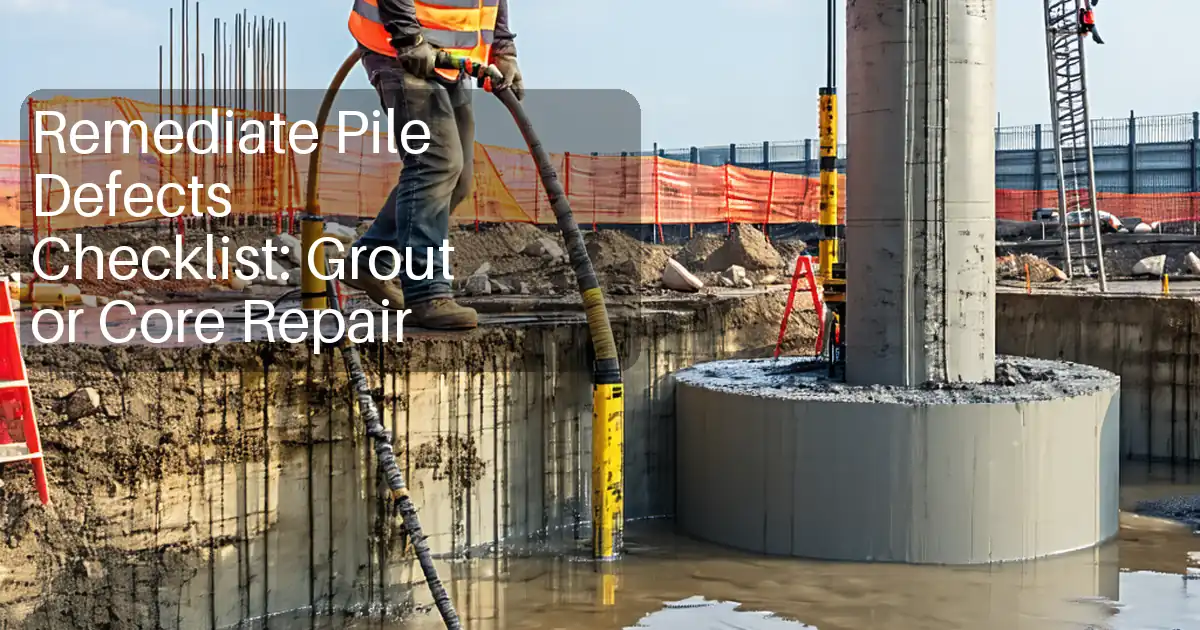
Remediate Pile Defects Checklist: Grout or Core Repair
✅ 26 items
Remediate pile defects with a disciplined, field-proven process focused on pressure grouting or core repair, verification, and closing nonconformance reports. This checklist guides supervisors, QC engineers, and contractors through practical pile repair steps without adding new tests, relying on the approved investigation and method statement. It helps decide between pressure grouting for internal voids or core repair for localized damage, manages materials and equipment, and controls grouting pressures, volumes, and curing. You will capture photo evidence, pressure/volume logs, batch certificates, and as-built sketches to demonstrate that defective piles are restored to intent per approved project specifications and authority requirements. The scope excludes new integrity or load testing; verification depends on process records, dimensional checks, and joint inspections. Outcomes include safe, durable repairs, traceable documentation, and timely NCR closure. Use this interactive checklist to tick off actions, add field comments, and export a QR-secured PDF/Excel package for review and archiving.

Related Articles


Site Handover Accessible Site Letter Checklist
⏳ 5 min read
Construction Site Handover: Legal Meaning, “accessible Site” Clause, Checklist & Free Letter Template
A practical guide to construction site handover: legal meaning, “Accessible Site” clause, risks of informal possession, a step-by-step checklist, and a free handover letter template.
Ncr At Handover
⏳ 5 min read
Open Ncrs At Taking-over / Dlp: What Happens At Handover And How To Escalate
Can taking-over happen with open NCRs? Learn when handover is allowed, when it must be blocked, how to document outstanding NCRs, and when to escalate to contractual notices (e.g., Notice to Correct) through common contract authorities.
Ncr Meaning Construction
⏳ 3 min read
Ncr Meaning In Construction (qa/qc Non-conformance Report Guide)
NCR meaning in construction: an NCR (Non-Conformance Report) is a QA/QC record issued when work or materials don’t meet project requirements. Learn when to issue an NCR, who issues it, and how it’s closed.
Site Access Possession Construction Claims Notices
⏳ 13 min read
Site Access And Possession In Construction: Fidic, Nec, Jct, Claims, And Notices
Learn the difference between site access and possession in construction, how delayed site handover affects EOT and cost claims, what to check before accepting handover, and how notices work under FIDIC, NEC, JCT, and similar contracts.
Ncr Log Template E46
⏳ 2 min read
Ncr Log Template (register & Ncr Tracker) – Excel/pdf Download
Download an NCR log template (NCR register) to track non-conformance reports by ID, date, status, location, references, actions, and closure. Includes an empty template and a filled example in Excel and PDF.