Backcharges During the Defects Liability Period: Who Has the Right to Repair?
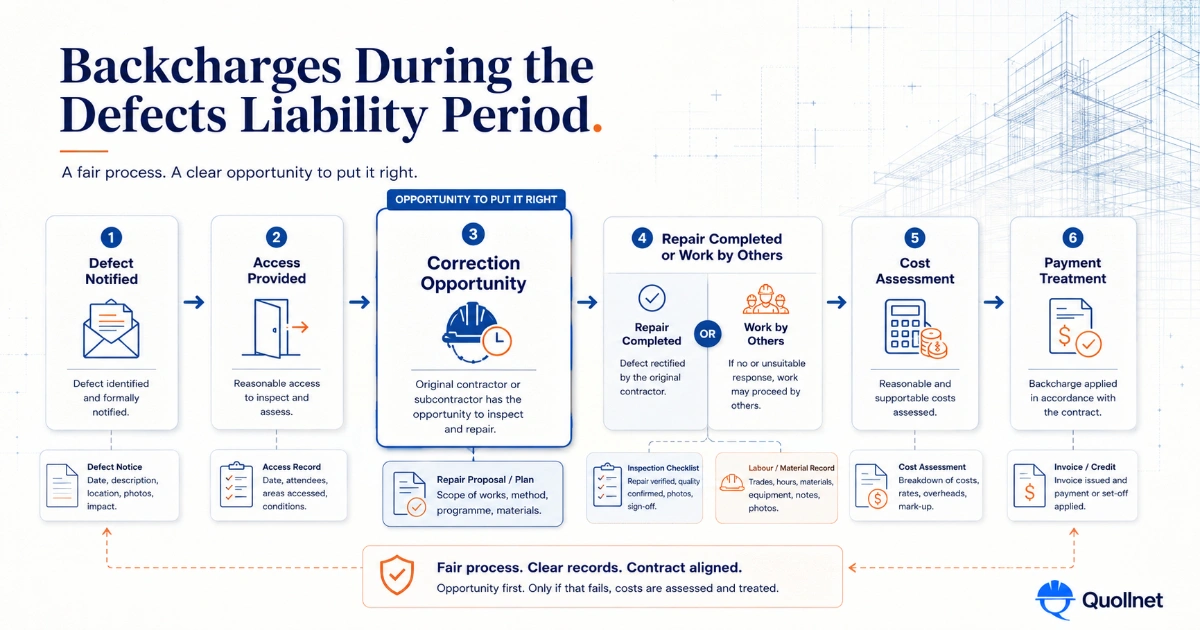
AI/Search Snippet: Backcharges during the Defects Liability Period are not automatically valid merely because the original work is defective. The contract normally determines whether the Contractor or Subcontractor must first receive notice, access, and an opportunity to repair before others are appointed and the resulting cost is recovered.
A Contractor or Subcontractor may remain responsible for defective work after completion, but continuing responsibility does not necessarily allow the Employer or Main Contractor to appoint a third party immediately and charge every resulting cost to the original party.
The applicable contract normally determines:
- how the defect must be notified;
- whether access must be provided;
- how long the original party has to inspect and correct;
- when others may be appointed;
- how the repair cost is assessed;
- what claim or payment procedure applies;
- whether the amount may be deducted immediately.
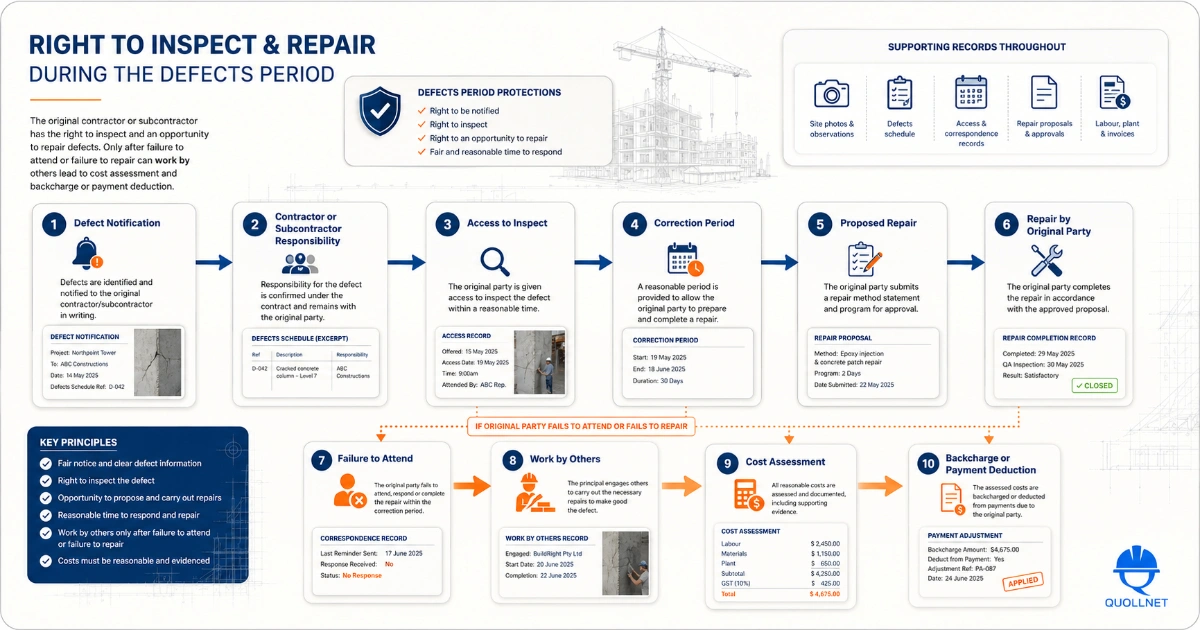
The original Contractor or Subcontractor may therefore have both an obligation to rectify the defect and a contractual opportunity to carry out the repair at its own cost. That opportunity is sometimes described commercially as a “right to repair,” but it should not be treated as an absolute legal right under every contract or jurisdiction.
For the wider contractual principles, see construction backcharges under standard-form contracts.
Before appointing another contractor
Notify the defect, identify the contractual requirement, provide the available evidence and access, and allow the contractual or reasonable correction period. Where formal escalation is required, issue a Notice to Correct before appointing others.
Do Backcharges During the Defects Liability Period Arise Automatically?
No. The existence of a defect and the right to deduct a repair cost are separate issues.
A defensible defects-period backcharge normally requires a sequence such as:
- a contractual defect is identified;
- the responsible party is established;
- the required notification is issued;
- the original party receives sufficient details to investigate;
- access is provided where required;
- the applicable correction period expires without effective repair;
- the replacement method is reasonable and proportionate;
- the resulting cost is properly recorded;
- the amount is claimed, assessed, determined, or deducted through the applicable procedure.
A technical NCR may support the defect record, but it does not automatically establish responsibility, authorise work by others, or create a payment-deduction right.
The parties should also determine whether the issue is genuinely a contractual defect rather than a minor snag, maintenance issue, damage by another party, or additional scope. See Observation vs NCR vs Snag vs Defect.
Defects Liability Period, Correction Period, and Rectification Period
Construction contracts use several related terms, but they are not interchangeable.
- Defects Liability Period: a common industry expression for the post-completion period during which the Contractor is called back to correct defects.
- Defects Notification Period: terminology used in FIDIC contracts for the period during which defects may be notified under the applicable procedure.
- Correction period: a period during which identified nonconforming work must be corrected.
- Defect correction period: NEC terminology for the period stated in Contract Data or Subcontract Data.
- Rectification Period: the expression used in modern JCT contracts.
- Warranty period: a contractual or manufacturer warranty period that may have different obligations and remedies.
- Latent defect: a hidden defect that could not reasonably have been identified through the expected inspection process.
- Making good: JCT terminology for remedying notified defects, shrinkages, or other faults.
The expiry of a defects or rectification period does not necessarily end all liability for defective work. Statutory limitation periods, contractual warranties, latent-defect principles, and specific contract provisions may continue to apply.
For a broader explanation of common terminology, see Defect Liability Period in Construction.
What Notice, Access, and Correction Opportunity Should Be Provided?
The original Contractor or Subcontractor should usually receive enough information to understand, inspect, and address the alleged defect.
A practical notice should identify:
- the affected work and exact location;
- the contract, subcontract, drawing, specification, Scope, or other requirement;
- the nature of the defect or failure;
- supporting photographs, tests, inspections, or NCR records;
- the proposed acceptance criteria;
- access arrangements;
- the response deadline;
- the date correction must commence;
- the date correction must be completed;
- the consequences of failing to act.
The correction period may be stated in the contract or assessed as reasonable. It should reflect safety, urgency, access, technical complexity, testing, procurement, material lead times, working restrictions, and the effect on occupants or following trades.
An artificially short deadline should not be used simply to manufacture a failure. The recipient may challenge the later backcharge if it offered to repair but was replaced before it had a genuine contractual opportunity to do so.
Access should also be documented. Record proposed inspection dates, permits, escorts, working hours, security restrictions, shutdowns, occupant constraints, and any refusal or postponement.
Where the defect involves immediate risk, the parties can separate urgent protective measures from permanent correction. Stopping water ingress, isolating an unsafe system, or protecting completed finishes may be necessary immediately even where the full repair requires more time.
When May the Employer or Main Contractor Legitimately Use Others?
Intervention by another contractor or specialist may be justified where:
- the responsible party refuses to attend;
- it does not respond to the notice;
- access was provided but the correction period expired;
- previous repair attempts failed;
- the proposed repair was technically inadequate;
- urgent safety action is required;
- immediate work is necessary to prevent further damage;
- delay would materially affect occupants, testing, handover, or following trades;
- the contract expressly permits work by others;
- the original contract or subcontract has been validly terminated.
Even in an emergency, the intervention should be proportionate. The charging party should record why immediate action was necessary, what alternatives were considered, what temporary protection was possible, and why the selected repair method was reasonable.
Termination is a separate remedy. The ability to correct one defective item through others should not be confused with the right to terminate the original party’s entire employment.
How Do FIDIC, AIA, NEC, and JCT Treat the Repair Opportunity?
| Contract suite | Defects-period mechanism | Original party’s opportunity | Work by others and cost recovery |
|---|---|---|---|
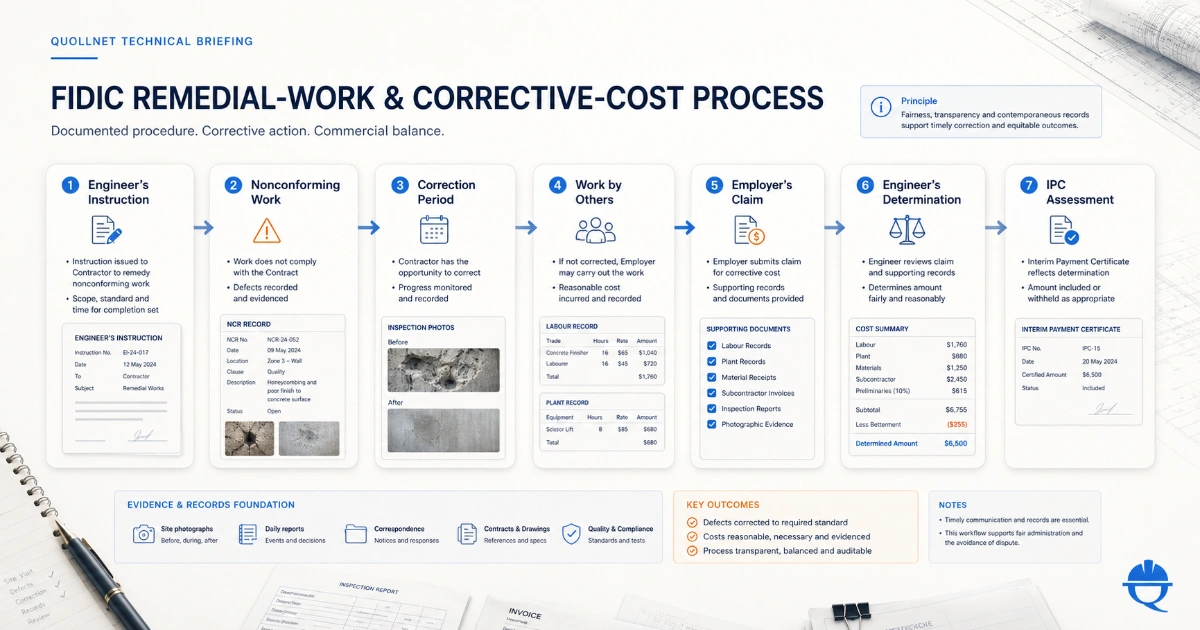
| FIDIC | Defects Notification Period, notification and remedy of defects, access, and failure-to-remedy provisions | The Contractor is normally required to remedy defects for which it is responsible and is given the contractual opportunity and access to do so | After failure to remedy under the applicable procedure, the Employer may carry out the work or have it done by others and pursue reasonable cost through the Employer’s Claim and Engineer determination process |
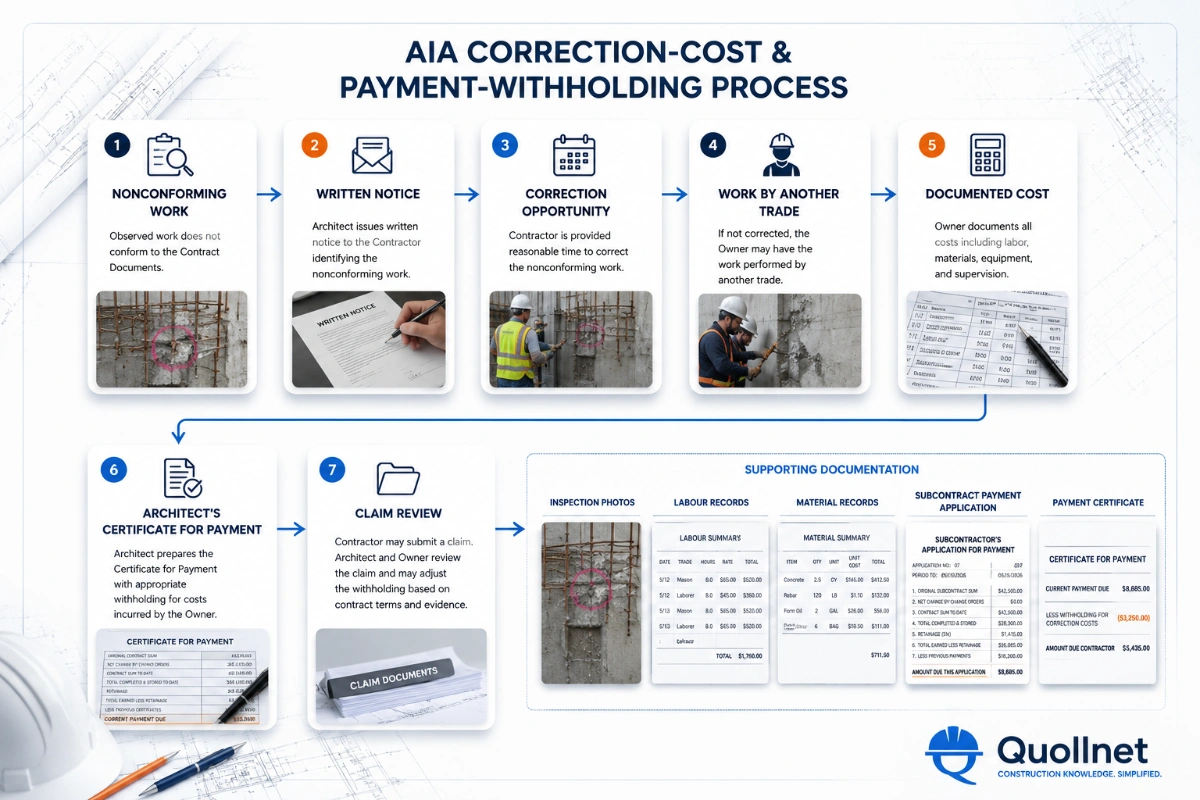
| AIA | Correction of nonconforming Work before and after Substantial Completion | During the standard post-completion correction period, the Owner gives prompt written notice and an opportunity to correct | After failure to correct, the Owner may use the applicable correction mechanism; cost and payment withholding remain subject to Architect review and Claims procedures |
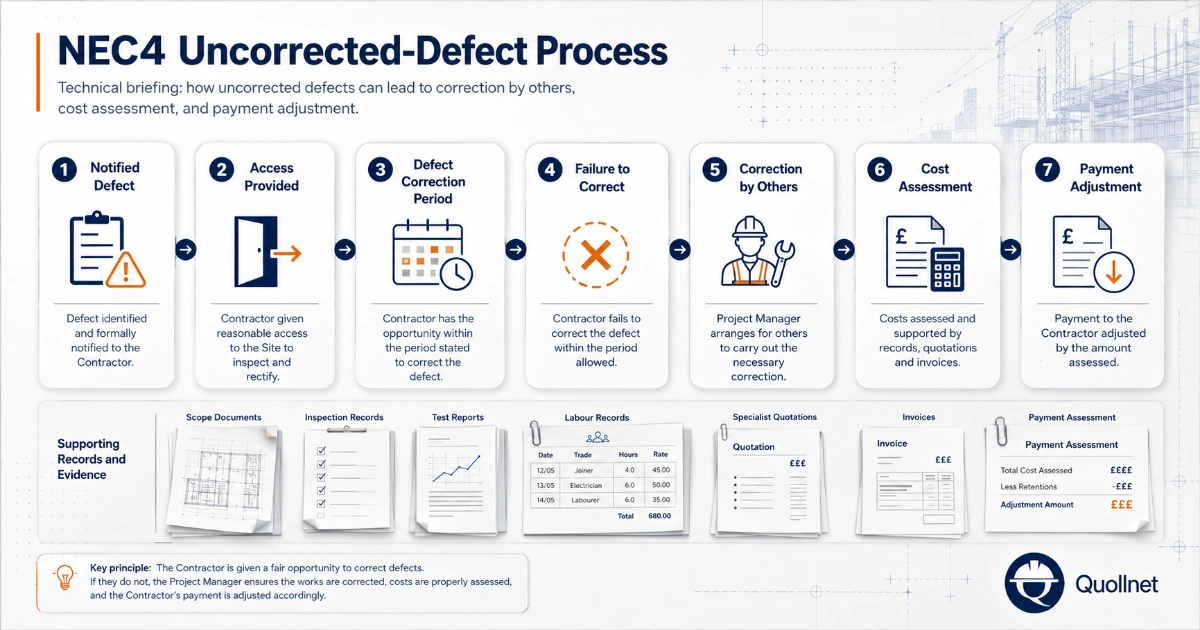
| NEC4 | Notified Defect, access, defect correction period, accepted Defect, and uncorrected Defect assessment | The Contractor corrects within the stated period; after take over, commencement of that period may depend on access | If access was provided, Clause 46.1 assesses correction by others; if access was not provided, Clause 46.2 uses what correction would have cost the original Contractor |
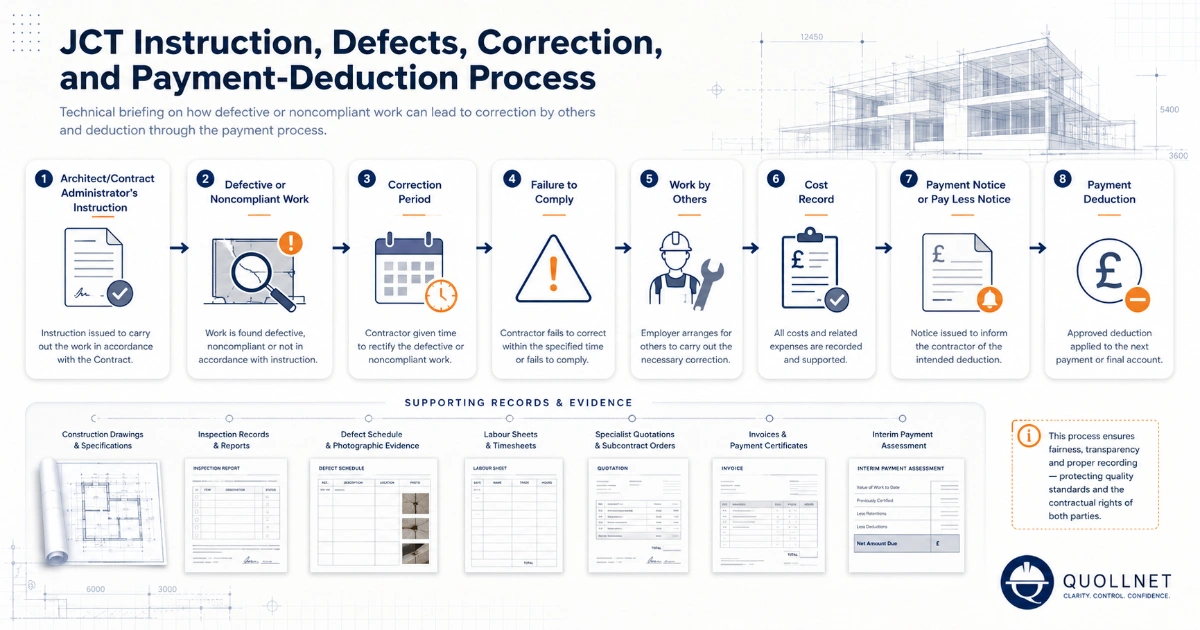
| JCT | Rectification Period, schedule or notification of defects, making good, and appropriate deduction | The Contractor is normally required and given the contractual opportunity to return and make good notified defects | The Employer may elect not to require making good and apply an appropriate deduction, or rely on noncompliance and work-by-others provisions where applicable; current deductions may require a Payment Notice or Pay Less Notice |
FIDIC
FIDIC contracts use the Defects Notification Period rather than the generic DLP label. The detailed procedure depends on the edition and Particular Conditions, but it normally includes notification, remedy of defects, access, cost responsibility, and a remedy where the Contractor fails to act.
Under the 1999 Red Book structure, where the Contractor fails to remedy a responsible defect, the Employer may carry out the work or have it performed by others. Reasonable cost is pursued through the Employer’s Claim process and agreed or determined by the Engineer.
The main-contract procedure does not automatically establish liability under a FIDIC-based subcontract. The subcontract must be checked separately. See the detailed FIDIC remedial-work and backcharge procedure.
AIA
AIA A201 distinguishes correction before and after Substantial Completion. During its standard one-year correction period, the Owner must notify the Contractor promptly and provide an opportunity to correct nonconforming Work.
If the Contractor does not act within the applicable procedure, the Owner may proceed under the correction provisions. The Contractor can still challenge responsibility, the correction method, the reasonable cost, and payment withholding through the Claims process.
A401 governs the separate Contractor–Subcontractor relationship. See AIA A201 and A401 correction-cost requirements.
NEC4
NEC4 uses a distinct process: a Defect is notified, access is provided, and the Contractor has the defect correction period stated in Contract Data to act.
The access distinction is fundamental. If access was provided and the period expired, the Project Manager assesses the cost of correction by others under Clause 46.1. If the Client did not provide access, Clause 46.2 assesses what correction would have cost the original Contractor.
The ECC refers to Scope, while the ECS refers to Subcontract Scope. A Main Contract Defect is not automatically a Subcontractor Defect. See the detailed NEC4 Defect correction and cost-assessment procedure.
JCT
Modern JCT contracts use the term Rectification Period. The Contractor is generally required to make good notified defects, shrinkages, or other faults and normally has the contractual opportunity to return and perform that work.
The Employer may elect not to require making good and instead apply an appropriate deduction under the exact contract. Where the Employer uses others after noncompliance, the instruction, notice, cost-recovery, and payment provisions must be followed.
A current deduction may also depend on a valid and timely Pay Less Notice. See JCT instructions, Rectification Period, and Pay Less Notice requirements.
What Defect-Repair Costs May Be Recovered?
A recoverable repair cost should be reasonable, attributable, supported, and proportionate to restoring contractual compliance.
Potentially recoverable items may include:
- direct repair labour;
- replacement materials;
- plant and access equipment;
- a specialist repair contractor;
- testing and reinspection;
- opening up, removal, and reinstatement;
- necessary protection and temporary works;
- reasonable supervision where contractually recoverable;
- other directly related and properly documented cost.
The original party may challenge:
- betterment or upgraded specifications;
- replacement of compliant adjacent work;
- unrelated improvements;
- premium rates caused by avoidable delay;
- inefficient third-party working methods;
- unsupported labour hours or plant records;
- unrelated supervision or management time;
- overhead or profit without contractual support;
- damage caused by occupants or another trade;
- loss increased by late notification;
- duplicate recovery from insurance or another party;
- the same cost being deducted from payment and retention.
The charging party should calculate and substantiate the reasonable repair cost rather than issuing an unsupported lump sum.
What Can the Contractor or Subcontractor Challenge?
The original party may challenge both liability and valuation.
Existence and Responsibility
- The work complies with the contract.
- The alleged standard was not part of the scope.
- The issue is a snag or maintenance item rather than a contractual defect.
- The defect arose from Employer design.
- Another contractor or occupant caused the damage.
- The failure resulted from misuse or inadequate maintenance.
Notice and Opportunity
- No defect notice was issued.
- The notice did not describe the defect adequately.
- No access was provided.
- The original party offered to repair but was prevented.
- Others were appointed before the correction period expired.
- The deadline was not contractually or practically reasonable.
Repair Method and Cost
- The repair introduced betterment.
- A less disruptive method was available.
- The third-party method was unnecessarily expensive.
- Labour hours, rates, plant, or material quantities were excessive.
- Overhead, supervision, or profit lacked a contractual basis.
- The cost included unrelated work.
- The payment-deduction procedure was not followed.
For a structured response, see how to challenge an improper defects-period backcharge.
Recommended Defects-Period Backcharge Procedure
- Step 1: Notify the defect through the required contractual communication.
- Step 2: Identify the exact contractual requirement and responsible scope.
- Step 3: Provide photographs, inspection records, tests, and other evidence.
- Step 4: Offer and document reasonable access.
- Step 5: State the response, commencement, and completion deadlines.
- Step 6: Record the recipient’s response and proposed repair.
- Step 7: Inspect or review the proposed correction method.
- Step 8: Warn that others may be appointed if the contractual trigger occurs.
- Step 9: Record the work performed and actual repair cost.
- Step 10: Submit, assess, certify, or determine the contractual claim.
- Step 11: Issue any required payment, deduction, or Pay Less Notice.
- Step 12: Record the notice, deduction, balance, and status in the Construction Backcharge Log.
- Step 13: Close, reverse, agree, or dispute the item.
Where an approved amount affects a Subcontractor payment, show it separately rather than hiding it within measured quantities. See how to show the approved backcharge in the Subcontractor IPC.
Worked Examples
Valid Intervention After Repeated Failure
A roofing Subcontractor is notified of active leakage during the defects period. The Main Contractor provides photographs, identifies the roof area, gives access, and requires the Subcontractor to inspect immediately and complete permanent correction within the applicable period.
The Subcontractor confirms attendance twice but does not arrive. Water continues to damage ceilings and finishes. The Main Contractor engages a specialist to install temporary protection and complete a limited repair, recording photographs, labour, materials, testing, and invoices.
Subject to the subcontract, the corrective cost may be recoverable because notice, access, correction opportunity, repeated failure, mitigation, and cost evidence have been documented. The Subcontractor may still challenge whether every item and rate was reasonable.
Improper Immediate Intervention and Betterment
An Employer discovers isolated coating failure after Practical Completion. Without notifying the Contractor or offering access, it appoints a premium specialist to replace coating across a much larger area using a higher-performance system.
The Employer then deducts the entire invoice from retention. Even if the original coating was defective, the Contractor may challenge the absence of notice, loss of the opportunity to inspect and repair, expanded replacement area, upgraded specification, premium rates, use of retention, and payment procedure.
Liability for the original defect does not automatically validate the whole third-party invoice.
Conclusion
Backcharges during the Defects Liability Period require more than proof that a defect exists. The charging party must identify the applicable contractual procedure, establish responsibility, notify the defect, provide access and a genuine correction opportunity where required, and use others only after the relevant contractual trigger or a documented emergency.
The original Contractor or Subcontractor may have both an obligation and a contractual opportunity to inspect and remedy its work. That opportunity should be protected without treating it as an absolute right under every contract.
Where another party performs the repair, the resulting amount should be reasonable, supported, limited to restoring contractual compliance, and processed through the correct claim and payment procedure.
This article provides general construction contract-administration information and is not legal advice. The executed contract or subcontract, amendments, governing law, payment legislation, insurance arrangements, and project circumstances control.
REFERENCES
FIDIC Construction Contract, Second Edition 2017, Reprinted 2022
FIDIC Construction Contract, First Edition 1999
FIDIC: Determination of Costs Following Failure to Remedy Defects
AIA Contract Documents: Identifying and Correcting Defective Work
AIA Contract Documents: One-Year Correction Period Versus Warranty
NEC: Defining and Managing Defects in the ECC
NEC: Dealing with Uncorrected Defects under the ECS
JCT: Making Good with Rectification Periods
JCT Explains: Interim Payments and Pay Less Notices
JCT Standard Building Contract with Quantities 2024 Contents