Undercarriage & Track Wear Inspection (Crawler Excavators)
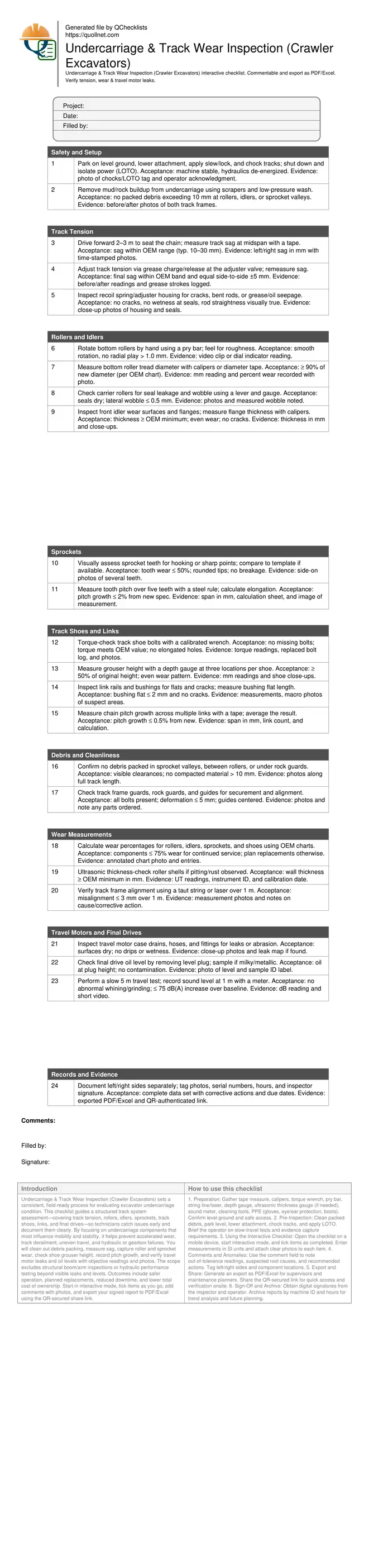
Definition: Undercarriage & Track Wear Inspection (Crawler Excavators) is a practical field checklist for technicians and supervisors to assess track tension, rollers, idlers, sprockets, shoe wear, and travel motor leaks.
- Verify wear, tolerances, and leaks with simple, repeatable field methods.
- Extend undercarriage life, reduce downtime, and prevent costly track failures.
- Capture photos and comments; interactive, commentable, export, with QR code.
- Standardize inspections across fleets and sites, supporting objective replacement planning.
Undercarriage & Track Wear Inspection (Crawler Excavators) sets a consistent, field-ready process for evaluating excavator undercarriage condition. This checklist guides a structured track system assessment—covering track tension, rollers, idlers, sprockets, track shoes, links, and final drives—so technicians catch issues early and document them clearly. By focusing on undercarriage components that most influence mobility and stability, it helps prevent accelerated wear, track derailment, uneven travel, and hydraulic or gearbox failures. You will clean out debris packing, measure sag, capture roller and sprocket wear, check shoe grouser height, record pitch growth, and verify travel motor leaks and oil levels with objective readings and photos. The scope excludes structural boom/arm inspections or hydraulic performance testing beyond visible leaks and levels. Outcomes include safer operation, planned replacements, reduced downtime, and lower total cost of ownership. Start in interactive mode, tick items as you go, add comments with photos, and export your signed report to PDF/Excel using the QR-secured share link.
- Use a disciplined, repeatable process to measure track sag, roller diameters, sprocket tooth profiles, and link pitch growth. Capture side-specific data, photos, and signatures to build an auditable record that supports timely component rotation or replacement before failures create downtime and collateral damage on site.
- Control premature wear by removing packed debris, setting correct track tension, and validating roller and idler condition. The checklist highlights objective acceptance cues—millimetres, percentages, and pass/fail notes—so supervisors can compare both sides, prioritize actions, and authorize parts ordering with confidence and traceability.
- Interactive online checklist with tick, comment, and export features secured by QR code. Attach photos, enter measurements in SI units, and instantly generate a signed report for stakeholders. Consistent documentation improves safety, compliance with approved specifications, and long-term cost forecasting across fleets and job locations.
- Detect leaks early around travel motors and final drives, preventing environmental spills and gearbox failures. Oil level checks, case drain inspections, and controlled movement tests make issues visible under safe conditions, enabling corrective maintenance to be scheduled during low-impact windows rather than after critical breakdowns.
Safety and Setup
Track Tension
Rollers and Idlers
Sprockets
Track Shoes and Links
Debris and Cleanliness
Wear Measurements
Travel Motors and Final Drives
Records and Evidence
Why Track Tension and Wear Measurement Matter
Correct track tension is the foundation of undercarriage health. Too tight increases bushing, idler, and motor loads; too loose encourages de-tracking and uneven sprocket engagement. Seat the chain by rolling forward and record sag in millimetres at the specified midspan. Combine this with objective wear measurements: sprocket tooth pitch over five teeth, roller diameters against new values, and link pitch growth across multiple links. These methods produce reliable percentages rather than guesswork. A field example: a machine with marginal sag and 2% pitch growth showed accelerated bushing flats—re-tensioning and scheduling a chain turn extended service by hundreds of hours. Always compare left and right sides; divergence signals misalignment, a seized roller, or uneven operator patterns. Consistent, side-specific readings and photos let supervisors decide whether to adjust, rotate components, or plan replacements during low-impact windows.
- Record sag after rolling forward to seat the chain.
- Use five-tooth span to assess sprocket pitch growth.
- Track both sides; asymmetry indicates hidden alignment issues.
- Convert millimetres to percent wear using OEM charts.
- Schedule adjustments before damage escalates into failures.
Rollers, Idlers, and Sprockets: Practical Acceptance Cues
Rollers and idlers should rotate smoothly with dry seals and minimal play. Measure tread diameters and check wobble with a lever and gauge; pitting warrants ultrasonic checks. Idler flanges must retain thickness and show even wear to maintain chain guidance. Sprockets should present rounded tips without hooking; measure pitch growth to quantify engagement quality. On track shoes, confirm fastener torque, inspect holes for elongation, and measure grouser height at multiple points. Field technicians often spot mixed wear: healthy rollers with worn sprockets typically indicate chronic slack tension or abrasive debris. Address root causes—debris packing, rock guard misalignment, or incorrect operating technique—before merely replacing parts. Capturing mm readings and photo angles consistently (side-on teeth, top-down grousers, label on calipers) improves later comparisons and component life forecasting across the fleet.
- Rollers: smooth, dry, minimal radial play.
- Idlers: even wear and adequate flange thickness.
- Sprockets: no hooking; confirm pitch growth limits.
- Shoes: torque bolts and verify grouser height.
- Photograph measurements with tools visible.
Cleanliness, Leaks, and Evidence-Driven Decisions
Debris packing multiplies wear by forcing the chain against guides and sprocket valleys, so thorough cleaning precedes every inspection. After cleanliness checks, focus on travel motors and final drives: oil level at the plug, no milky contamination, and dry case drain lines. A short, controlled travel test with a sound level meter can reveal early bearing or gear damage; keep conditions comparable for trend analysis. Align rock guards and guides to prevent side-loading, and string-check frames if one side shows faster wear. Convert measurements to percent wear with OEM charts, then plan adjustments, parts orders, or component rotations. Document left/right separately, attach time-stamped photos, and secure sign-offs. This disciplined approach transforms scattered notes into defensible maintenance decisions that minimize downtime and environmental risk.
- Clean before measuring to avoid false readings.
- Verify oil level and dryness at case drains.
- Use a sound level meter for consistent travel tests.
- Align guides and frames to prevent side-loading.
- Document side-specific data and approvals.
How to Use This Interactive Checklist
- Preparation: Gather tape measure, calipers, torque wrench, pry bar, string line/laser, depth gauge, ultrasonic thickness gauge (if needed), sound meter, cleaning tools, PPE (gloves, eye/ear protection, boots). Confirm level ground and safe access.
- Pre-Inspection: Clean packed debris, park level, lower attachment, chock tracks, and apply LOTO. Brief the operator on slow-travel tests and evidence capture requirements.
- Using the Interactive Checklist: Open the checklist on a mobile device, start interactive mode, and tick items as completed. Enter measurements in SI units and attach clear photos to each item.
- Comments and Anomalies: Use the comment field to note out-of-tolerance readings, suspected root causes, and recommended actions. Tag left/right sides and component locations.
- Export and Share: Generate an export as PDF/Excel for supervisors and maintenance planners. Share the QR-secured link for quick access and verification onsite.
- Sign-Off and Archive: Obtain digital signatures from the inspector and operator. Archive reports by machine ID and hours for trend analysis and future planning.
Call to Action
- Start Checklist Tick off tasks, leave comments on items or the whole form, and export your completed report to PDF or Excel—with a built-in QR code for authenticity.
- Download Excel - Undercarriage & Track Wear Inspection
- Download PDF - Undercarriage & Track Wear Inspection
- View Image - Undercarriage & Track Wear Inspection
Cite & Embed
“Undercarriage & Track Wear Inspection by Quollnet”
with a link to
this source page.
FAQ
Question: How often should I perform an undercarriage and track wear inspection on crawler excavators?
Question: What are the most critical measurements to prioritize if time is limited?
Question: How do I decide between adjusting tension, rotating components, or replacing parts?
Question: What evidence should I capture to support maintenance decisions and warranties?
Related Articles
Broader reading and guidance connected to this checklist topic.

Construction Delay Log Template | Excel, Pdf & Word Download

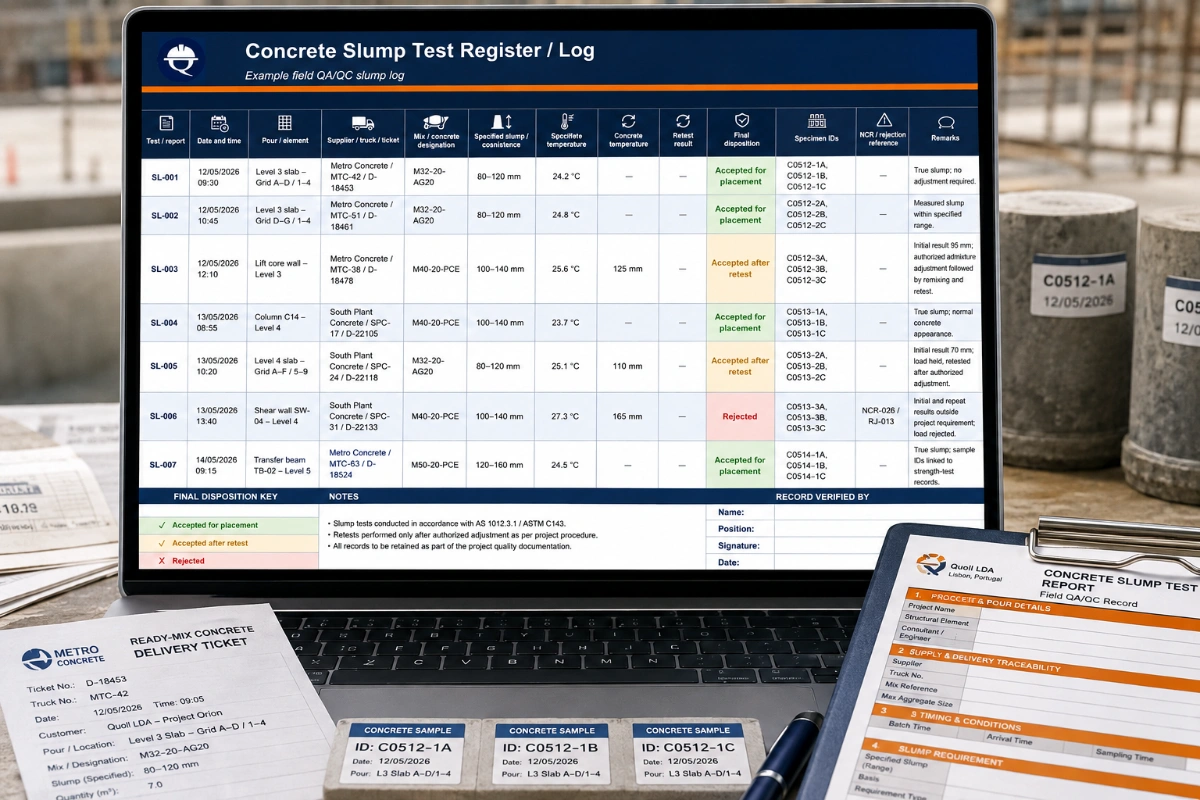
Concrete Slump Register & Log Template


Related Checklists
Keep the workflow moving with nearby templates chosen from similar checklist content.