
Method Statement: Beneficial Reuse of Dredged Material for Beach Nourishment and Habitat Creation – Method Statement
AI-assisted method statement with matching ITP, PDF download, and Excel export.
More than a static template
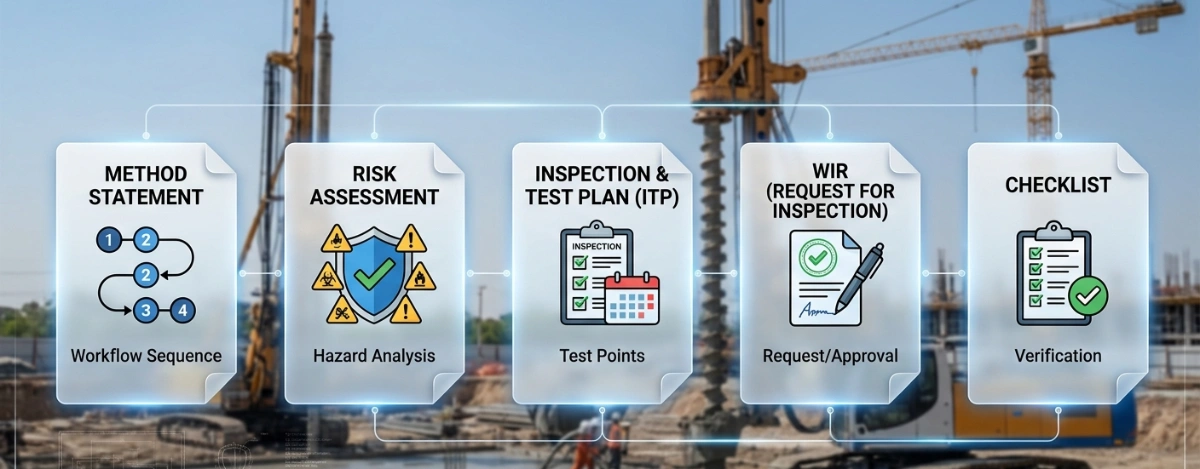
Unlike a downloadable Word or PDF template, this method statement is an AI-assisted editable starting point connected directly to a matching Inspection and Test Plan. Every section is structured, project-adaptable, and ready to export.
- AI-assisted drafting — Customize every section with AI for your specific project scope.
- Linked ITP — A matching inspection and test plan is generated alongside the method statement.
- Multiple export formats — Download as a formatted PDF or editable Excel spreadsheet.
- Editable starting point, not a final document — Review, verify, and adjust all content against your project requirements before use.
Static template vs. Quollnet workflow
| Feature | Static template | Quollnet |
|---|---|---|
| Project-specific content | Manual fill-in required | AI-assisted customization |
| Linked ITP | Separate document, no link | Matching ITP included |
| Export formats | Usually PDF only | PDF and Excel |
| Structured sections | Free-form layout | 13 standardized sections |
| Saved to your account | Local file only | Cloud-saved, reusable |
| Content accuracy | You verify everything | AI-assisted, you still verify |
| Cost | Often free but time-intensive | Free to customize and download |
What you can customize
When you save this method statement to your account, every section becomes editable. The following 13 sections are included:
- Scope — Defines the activity and its boundaries.
- References — Standards, specifications, and drawings.
- Responsibilities — Roles and accountabilities.
- Resources — Labour, plant, and equipment summary.
- Materials — Materials and compliance requirements.
- Equipment — Tools and equipment details.
- Prerequisites — Hold points and pre-conditions.
- Method sequence — Step-by-step construction sequence.
- Safety controls — HSE risk controls and PPE.
- Environmental controls — Environmental mitigation measures.
- QA/QC — Quality inspection and test requirements.
- ITP — Inspection and Test Plan table (has its own page).
- Attachments — Referenced drawings and documentation.
Why this method statement is used
This method statement is used to define and communicate the approved procedure for carrying out method statement: beneficial reuse of dredged material for beach nourishment and habitat creation on site. It ensures the work is planned in advance, the correct resources and controls are in place, and all personnel understand responsibilities, sequence, quality requirements, and safety controls before work begins. It aligns site execution with the documented scope and acceptance expectations.
Who uses this method statement
This method statement is used by contractors, site supervisors, project engineers, QA/QC engineers, HSE officers, consultants, and client representatives. It serves as a shared reference for planning, execution, supervision, inspection, and approval of the activity on site.
When it is prepared and submitted
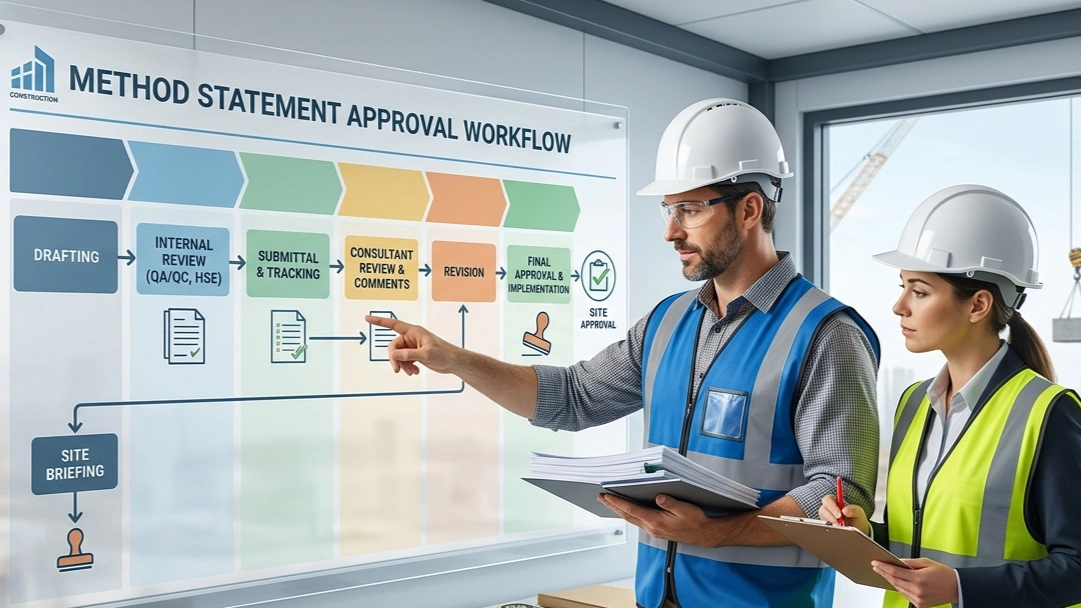
The method statement is prepared before the work activity starts and submitted as part of the pre-construction documentation package for review and approval.
Who reviews or approves it
The method statement is usually submitted to the client representative, consultant, resident engineer, or project management consultant for review and approval before the work commences.
Important approval note
This method statement is an AI-assisted editable starting point, not a pre-approved document. Before use on any project, all content must be reviewed and approved by the relevant parties (superintendent, principal contractor, or client representative) in accordance with your contract and project quality plan.
For example: if your specification requires a departure from a referenced standard, that departure must be documented and approved separately — this method statement will not capture that automatically. Always verify against your applicable drawings, specifications, and regulatory requirements.
Method statement content
Scope
Overview
This method statement covers the beneficial reuse of suitable dredged material for:
- Beach nourishment (berm and nearshore profile adjustment)
- Habitat creation/restoration (e.g., tidal marsh/mudflat, dune, or bird nesting features)
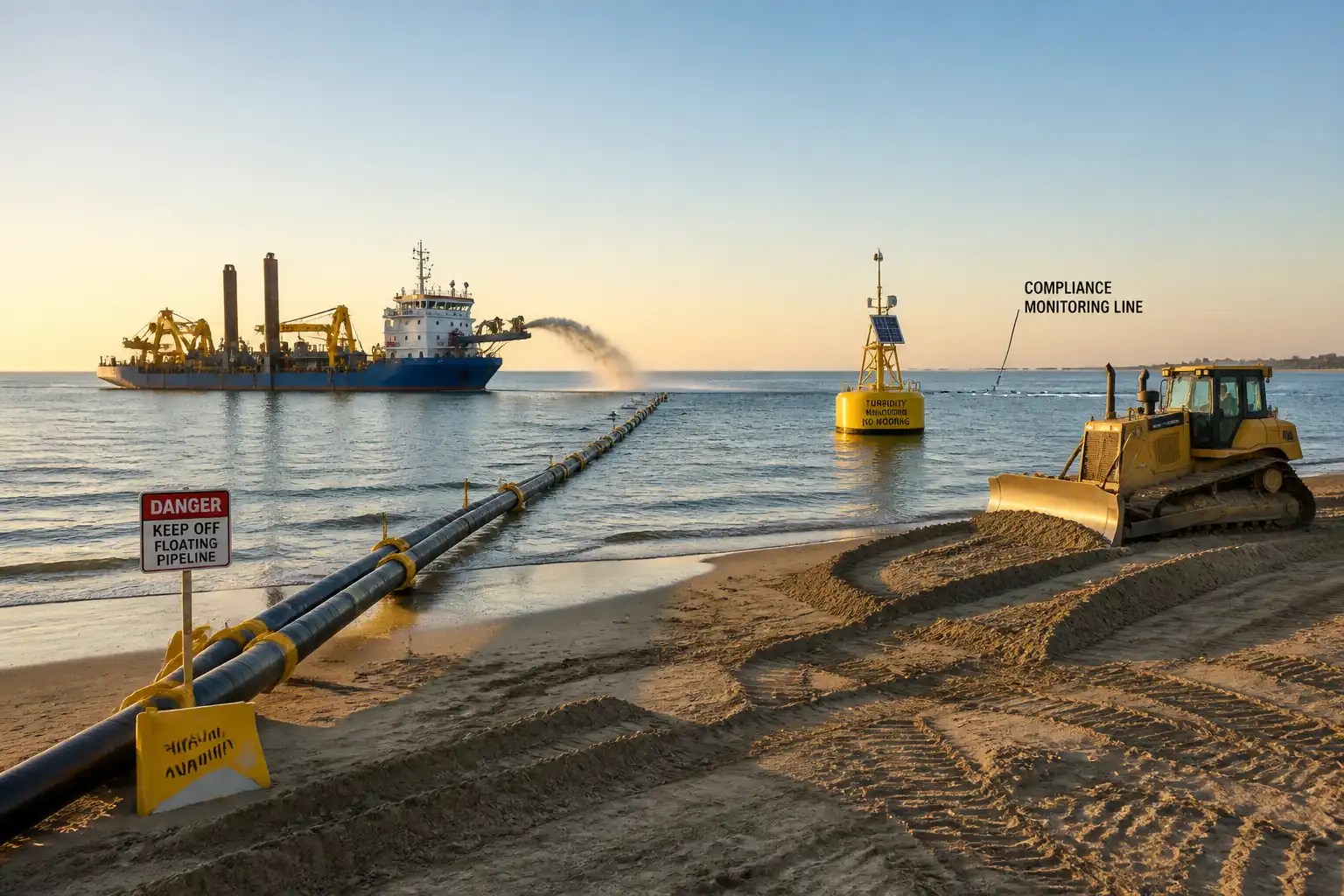
It includes: pre-dredge investigations and approvals, mobilization, pipeline/barges and booster setup, material transport and placement, grading/shaping, turbidity and environmental monitoring, QA/QC testing (including grain size verification), survey control and as-built deliverables, documentation, and demobilization. Both hydraulic (pipeline) and mechanical (barge and excavator) placement methods are addressed, selected per source location, permits, and sea-state constraints.
Objectives
- Place only compliant, non-contaminated material meeting design gradation and fines limits for the intended receptor (beach or habitat).
- Achieve the beach/habitat design template within stated tolerances.
- Maintain turbidity within permitted limits at compliance points.
- Execute with ALARP risk controls, preserve sensitive species and habitats, and prevent pollution.
Key Acceptance Targets [Verify per project specifications]
- Beach nourishment: D50 of placed sand typically within ±10% of design D50; fines (passing 0.063 mm) ≤ 5–10% depending on design; shell/oversize control as specified.
- Habitat creation (marsh/mudflat): Gradation per design; fines proportion per habitat function (typ. 20–60% silt/clay) and organic content per design intent.
- Finished elevations: Beach berm/foreshore ±0.15 m vertical; nearshore bar ±0.20 m; marsh platform ±0.10 m (account for consolidation/settlement as directed).
- Turbidity at compliance boundary: Not to exceed background by X NTU over Y-min averaging period [Verify per permit].
- As-built survey within template and volume tolerances per Contract.
References
| Document Type | Reference / Number | Revision | Notes |
|---|---|---|---|
| Standard | USACE EM 1110-2-5025; ER 1105-2-100 | Use most current editions. | |
| Standard | ASTM D6913; ASTM D7928; ASTM D1140; ASTM D2216 | ||
| Guidance | USEPA/USACE ITM; Ocean Testing Manual | Apply per water body jurisdiction. | |
| Standard | ISO 7027; EPA 180.1 | Align units/averaging per permit. | |
| Standard | IHO S-44; USACE Hydrographic Survey Manual | ||
| Standard | ISO 9001; ISO 14001; ISO 45001 | ||
| Guidance | PIANC; CEDA/IADC |
Responsibilities
| Role | Responsibility | Name / Party |
|---|---|---|
| Contractor | Approve method, resources, programme; ensure permits in place. | Contractor |
| Contractor | Implements method; coordinates dredge, pipeline, shore crew. | Contractor |
| Contractor | Maintains production within environmental and pressure limits. | Contractor |
| Contractor | Hold/witness points; sample plans; data review; NCR control. | Contractor |
| Contractor | Monitoring plans; trigger actions; regulatory reporting. | Contractor |
| Contractor | Ensure equipment calibration; data QA; deliverables. | Contractor |
| Contractor | Toolbox talks; inspections; emergency drills. | Contractor |
| 3rd Party | Timely analysis per ASTM/permit; CoC integrity. | Lab |
| Employer | Attend defined hold/witness points; issue instructions. | Engineer |
Resources
| Resource Type | Description | Quantity | Remarks |
|---|---|---|---|
| Labor | Dredge master, mates/engineers, leverman, deckhands, pumpman. | 2 shifts | |
| Labor | Superintendent, dozer/excavator operators, grade checker, spotter, pipeline watch. | 2 shifts | |
| Labor | Hydrographic + topographic surveyors, data processor. | Daily | |
| Labor | Field scientist(s) for turbidity sondes, grab samples, wildlife observers as required. | Per shift | |
| Labor | HSE manager, safety officers. | As required |
Materials
| Material | Specification / Grade | Quantity | Remarks |
|---|---|---|---|
| Sand | As per BOQ | ||
| Silty sand/silt | |||
| HDPE pipe | |||
| Fabric curtain |
Equipment
| Equipment | Capacity / Type | Quantity | Inspection Required |
|---|---|---|---|
| Dredger | 1 | ||
| Booster | As required | ||
| Pipeline | As required | ||
| Dozer/Excavator | 2–4 | ||
| Survey kit | 1 set | ||
| Sondes | Min. 3 stations + spares |
Prerequisites
- Approved method statement, risk assessments, Environmental Management Plan, and ITP.
- All permits and licenses in force (dredging, placement, water quality/mixing zone, wildlife, navigation notices). [Verify per project HSE plan and local regulations]
- Pre-construction meeting with Engineer and regulators; define communication and emergency protocols.
- Baseline surveys: pre-dredge hydrographic survey; beach/marsh topography; photographic/video record.
- Baseline water quality: background turbidity (NTU) under comparable tide/sea-state; establish compliance trigger logic.
- Pre-dredge sediment characterization approvals (gradation, contaminants per ITM/Green Book as required).
- Utilities/UXO/cultural resources clearance for shore works; stakeout of exclusion zones and access/egress routes.
- Wildlife surveys and protections: sea turtle nest surveys and relocations if permitted; bird nesting buffers; marine mammal observers as required.
- Mobilization plan: marine traffic management, aids to navigation, beach closure and public access control, night-work lighting plan.
- Emergency response: spill kits staged; pipeline rupture plan; medical/immersion rescue plan; weather and surf monitoring set up.
- Calibration certificates current for survey and environmental equipment; labs on standby with chain-of-custody documents.
Method Sequence
| Step | Activity | Description | Responsibility | Inspection / Hold Point |
|---|---|---|---|---|
| 1 | Pre-Works & Controls | Confirm permits, finalize work windows, install survey control/benchmarks, mark exclusion and access zones. | Site Superintendent; Survey Lead | Hold Point HP-00 kickoff |
| 2 | Baseline Monitoring | Record baseline turbidity at background and compliance locations; log tide/sea-state; verify telemetry. | Environmental Manager | Witness Point |
| 3 | Pipeline/Barge Mobilization & Testing | String and anchor floating pipeline; protect shore crossing; hydrostatic test at 1.25× working pressure; function-test boosters and ESDs. | Dredge Captain; Superintendent | Witness Point WP-PT1 |
| 4 | Trial Dredge and Screening | Commence trial cut; screen for debris; confirm slurry density/velocity; adjust diffuser/spreader. | Dredge Captain; QA/QC | Hold Point HP-GS1 |
| 5 | Full Production Dredging | Maintain cutter/draghead within approved borrow; control density/production to avoid excessive fines carryover; continuous leak watch. | Dredge Captain | Routine |
| 6 | Hydraulic Placement—Beach | End-of-pipe with diffuser/spreader; place in windrows; dozer grading from dune tie-in to foreshore; avoid above-water "rainbowing" unless permitted. | Superintendent | Ongoing |
| 7 | Hydraulic/Mechanical Placement—Habitat | Place in controlled lifts (0.15–0.30 m); allow drainage/consolidation between lifts; shape to microtopography and tidal datum. | Superintendent | Ongoing |
| 8 | Turbidity Monitoring & Triggers | Operate sondes at background, near-field, and compliance boundary; 1-min logging; 15-min rolling averages; 2-hourly manual grabs for QA. | Environmental Team | Continuous |
| 9 | Grain Size QA/QC During Production | Sample slurry at discharge or placed material at defined frequency (e.g., 1/5,000–10,000 m³; min 1/shift). | QA/QC Manager | Hold Point HP-GS2 (nonconforming) |
| 10 | Environmental Compliance Sampling | If required by permit, perform water sampling for TSS, metals, hydrocarbons at stated intervals/locations; marine fauna observation logs. | Environmental Manager | Hold Point HP-ENV2 (regulatory) |
| 11 | Interim Surveys and Template Control | Hydrographic and topographic checks to guide placement; update volume tracking; adjust slopes/berm as needed. | Survey Lead | Witness Point |
| 12 | As-Built Survey & Acceptance | Final multibeam/singlebeam and RTK profiles; compute volumes; compare to template and tolerances. | Survey Lead; QA/QC | Hold Point HP-ASB |
| 13 | Demobilization & Restoration | Flush and cap pipelines; remove anchors/floats; restore access points; remove temporary fencing/signage. | Superintendent | Final inspection |
| 14 | Post-Construction Monitoring (if required) | Follow-up beach profiles/habitat elevation and vegetation checks at specified intervals (e.g., 1, 3, 6, 12 months). | Survey/Environmental | Witness |
Health, Safety, and Environment (HSE) – Safety Controls
Task-Specific Hazards and Controls
- Hazard: High-pressure slurry pipeline rupture
- Likely consequence: Struck-by, drowning/engulfment, environmental release
- Engineering/procedural control: Hydrostatic test at 1.25× working pressure; install pressure relief valves and ESDs; pressure alarms; anchor/weight pipelines; exclusion zones at joints; routine patrols and IR thermography/visual leak watch at night
- Required PPE: Helmet, eye protection, gloves, high-vis PFD, steel-toe boots
- Collective preventive measure: Physical barriers/signage along beach access; emergency stop pull-cords at booster
-
Inspection/permit/supervision: Pre-shift pipeline checklist; Supervisor sign-off; maintain pressure logs
-
Hazard: Booster pump/mechanical entanglement
- Likely consequence: Crush/entanglement injuries
- Engineering/procedural control: Fixed guarding; lockout/tagout for maintenance; trained operators only; clear radio channels
- PPE: Helmet, gloves, hearing protection, PFD where near water
- Collective measure: Fenced pump skids; spill containment
-
Inspection/permit: LOTO permits; weekly HSE audits
-
Hazard: Vessel collision/grounding in surf/nearshore
- Consequence: Injury, spill, loss of plant
- Control: Marine traffic plan; AIS and navigation lights; certified operators; weather/surf limits and go/no-go matrix; redundancy in anchors
- PPE: PFD, PLB, anti-exposure suit as conditions dictate
- Collective: Safety boat on standby; man-overboard (MOB) drills
-
Inspection/permit: Daily toolbox talk; log of weather limits and decisions
-
Hazard: Working near water and unstable foreshore
- Consequence: Slips, trips, drowning, soft-sediment entrapment
- Control: Defined walkways; buddy system; retrieval equipment; geogrid/boards for soft sand access
- PPE: PFD, non-slip boots
- Collective: Temporary barriers; lighting for night work compliant with wildlife constraints
-
Inspection/permit: Permit-to-work near water; supervisor sign-off
-
Hazard: Public interface on open beaches
- Consequence: Struck-by, trespass into exclusion area
- Control: Beach closures, marshaled crossings, fencing, night security
- PPE: High-vis, radios
- Collective: Public notice boards and flagging; coordination with local authorities
-
Inspection/permit: Daily perimeter checks; incident log
-
Hazard: Heavy plant operation on steep/dynamic beach
- Consequence: Rollover, struck-by
- Control: Operate parallel to slope where possible; spotters; gradient limits per OEM; no reversing without banksman
- PPE: High-vis, hard hat, boots
- Collective: Plant–people segregation; horn protocols
-
Inspection/permit: Plant inspection; operator competency verification
-
Hazard: Environmental exposure (heat, cold, UV, lightning)
- Consequence: Heat stress/hypothermia, struck by lightning
- Control: Work/rest regimes; shade/warmth; hydration; lightning detector with stop-work at local threshold [Verify]
- PPE: Weather-appropriate clothing, sunscreen
- Collective: Shelter stations; emergency transport plan
-
Inspection/permit: HSE weather monitoring log
-
Hazard: Noise and vibration from pumps and vessels
- Consequence: Hearing loss, community disturbance
- Control: Compliant mufflers; acoustic shrouds; day-time scheduling where feasible
- PPE: Hearing protection
- Collective: Noise monitoring as required
-
Inspection/permit: Community permit conditions; noise logs
-
Hazard: Fuel/chemical handling
- Consequence: Fire, spill, contamination
- Control: Double-walled tanks; drip trays; trained refuelers; no refuelling over water where prohibited
- PPE: Anti-static PPE, gloves, goggles
- Collective: Spill kits and booms at refuel points
-
Inspection/permit: Hot work permits as needed; spill drills; [Verify per project HSE plan and local regulations]
-
Hazard: Biological hazards (jellyfish, stingrays), sharp debris
- Consequence: Injury, infection
- Control: Awareness briefings; safe entry/egress; first aid kits and vinegar packs if applicable
- PPE: Cut-resistant gloves/leggings where needed
- Collective: First aid/medical support nearby
-
Inspection/permit: Incident reporting and learning
-
Hazard: Night operations lighting vs. wildlife
- Consequence: Disorientation of protected species; reduced visibility for workers
- Control: Use wildlife-compliant amber/low-angle lighting; shielded fixtures; task lighting only
- PPE: Headlamps with red filters where permitted
- Collective: Lighting plan reviewed with environmental authority
- Inspection/permit: Permit conditions enforced; environmental supervision present
[All measures to be verified per project HSE Plan and local regulations.]
Environmental Controls
Key Environmental Risks and Controls
- Turbidity and suspended sediments
- Consequence: Water quality degradation, smothering of benthos
- Controls: Real-time turbidity monitoring with alarms; diffuser/spreader to reduce jetting; adjust production/cease work on exceedance; deploy silt curtains only in suitable calm waters (not surf zone); sequence to work with tides to maximize dispersion offshore
- Compliance: Do not exceed permit threshold at compliance boundary (e.g., Background + 10–29 NTU over 15–60 min avg) [Verify]
-
Records: Continuous logs, calibration sheets, exceedance reports
-
Placement on sensitive habitats (SAV, oyster beds, corals)
- Consequence: Habitat loss
-
Controls: No-work exclusion buffers; physical markers and GNSS geofencing; environmental observer sign-off prior to shifting pipeline
-
Protected species interactions (sea turtles, marine mammals, shorebirds)
- Consequence: Injury/mortality; legal non-compliance
-
Controls: Seasonal windows; nest surveys/relocation by permitted specialists; daylight sand pushing where possible; observers and shutdown zones; vessel speed limits
-
Contaminants in dredged material
- Consequence: Pollution, bioaccumulation
-
Controls: Pre-approval testing; production hold if visual/olfactory indicators appear; segregate suspect loads; rapid lab check; only place approved material
-
Noise and light impacts to communities and wildlife
- Consequence: Nuisance, behavioral impacts
-
Controls: Shielded, downward lighting; noise shrouds; curfew adherence where applicable; complaint hotline and response protocol
-
Spill prevention and response
- Consequence: Soil/water contamination
-
Controls: Secondary containment; spill kits; trained teams; immediate containment/notification; no refueling in surf zone unless permitted with controls
-
Waste and debris management
- Consequence: Litter, ingestion by fauna
-
Controls: Daily cleanup; debris screens; proper disposal per waste plan
-
Cultural resources unexpected finds
- Consequence: Loss of heritage
-
Controls: Stop-work and notify protocol; archaeologist on call
-
Sediment stability and erosion post-placement
- Consequence: Loss of project benefits, turbidity
- Controls: Template optimization, staged placement, sand fencing/dune vegetation establishment if in scope
[Verify all measures against the Environmental Management Plan and permit conditions.]
Quality Assurance / Quality Control
General
- Implement ISO 9001-based QA procedures with an ITP covering hold and witness points.
- Maintain daily site diaries, calibration certificates, survey QA logs, and laboratory chain-of-custody (CoC) records.
Sampling and Testing
- Grain size verification (production): Frequency 1 per 5,000–10,000 m³ placed or minimum 1 per 8–12 h shift [Verify]. Tests: ASTM D6913 (sieve), ASTM D7928 (hydrometer if fines >10%), ASTM D1140 (wash fines). Acceptance per design gradation.
- Moisture (as needed): ASTM D2216 for placed samples (for data correlation; not typically acceptance-defining for beach).
- Environmental compliance: Turbidity per ISO 7027/EPA 180.1; grab TSS correlation per permit. Additional chemical analyses only if specified in permit.
- Instrument calibration: Turbidity sondes daily with standards; survey equipment pre-deployment checks and periodic bar/patch tests.
Surveys and Tolerances
- Beach template: Berm/foreshore ±0.15 m; nearshore ±0.20 m; slope transitions smooth, no abrupt steps.
- Habitat platform: Final elevation ±0.10 m after consolidation allowance. Microtopography per design features.
- Hydrographic accuracy: Meet IHO S-44 Order suitable for nearshore (typically Special/1a) [Verify].
Non-Conformance and Corrective Action
- If grain size/fines exceed limit: reduce cutter depth to avoid fines, shift borrow area, slow production, or suspend until compliant; segregate unsuitable placed material if directed.
- If turbidity exceedance: implement trigger actions—reduce flow, relocate outfall offshore, pause placement until readings recover; document exceedance and notify Engineer/regulator per permit.
- NCRs logged with root cause, corrective action, and verification sampling.
Documentation and Deliverables
- Daily: Production logs, turbidity logs, pipeline pressure logs, HSE checks, wildlife observer logs.
- Weekly: QA summary, interim survey plots, volume-to-date.
- Final: As-built report (surfaces, volumes, control report), lab certificates, calibration logs, environmental compliance reports, photographic record.
Attachments
- Sample forms: Turbidity field log, sonde calibration sheet, grain size sampling log, chain-of-custody, pipeline pressure test certificate, booster pump checklist, NCR form, daily report template.
- Drawings: Beach/habitat design templates, control point sketches, pipeline routing and anchorage plan, traffic and public access plan.
- Permits and approvals: Dredging/placement permits, wildlife approvals, mixing zone authorization, navigation notices.
- Emergency plans: Spill response plan, pipeline rupture response, MOB/immersion rescue plan, severe weather plan.
- Survey deliverables: Pre-, interim-, and post-construction survey reports and surfaces; volume calculations; as-built cross-sections.
- Environmental deliverables: Baseline and compliance monitoring reports; exceedance notifications; observer reports.
This content is a read-only public reference. Download or customize to get an editable version.
ITP preview
The first inspection activities from the linked ITP for Method Statement: Beneficial Reuse of Dredged Material for Beach Nourishment and Habitat Creation:
| Activity | Inspection / Test | Acceptance Criteria | Responsibility | Record |
|---|---|---|---|---|
| Pre-construction approvals | Verify permits, EMP, ITP approved | All approvals on file; kick-off held | Project Manager / Engineer | Approval register |
| Survey control establishment | Check ties to benchmarks | Horizontal/vertical closure within spec | Survey Lead | Control report |
| Pipeline hydrostatic test (WP-PT1) | Hydrostatic pressure test | No leaks at 1.25× WP for ≥30 min [Verify] | Superintendent / QA | Pressure test certificate |
Showing 3 of 12 inspection activities. View full ITP →
Related Inspection and Test Plan
An Inspection and Test Plan (ITP) is available for Method Statement: Beneficial Reuse of Dredged Material for Beach Nourishment and Habitat Creation. The ITP defines the inspection activities, acceptance criteria, hold and witness points, responsible parties, and records required to verify the work described in this method statement.
View the Method Statement: Beneficial Reuse of Dredged Material for Beach Nourishment and Habitat Creation ITP →Frequently asked questions
Continue with related Quollnet resources connected to this method statement.