
Inspection and Test Plan for Method Statement: External Timber Cladding Oiling and Weather-Protection Treatment
AI-assisted inspection and test plan connected to a method statement, with PDF and Excel export.
More than a static template
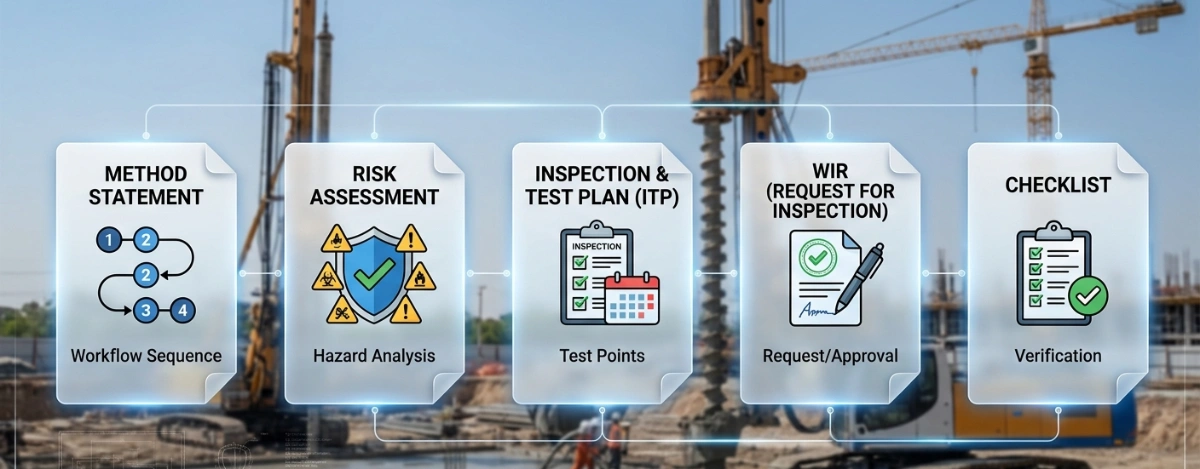
Unlike a downloadable Word or PDF template, this ITP is an AI-assisted editable starting point directly connected to its method statement. Every inspection activity, hold point, and acceptance criterion is structured and ready to adapt to your project.
- AI-assisted customization — Tailor inspection activities and acceptance criteria to your specific project scope.
- Linked method statement — This ITP is connected to the corresponding method statement describing the work sequence.
- Multiple export formats — Download as a formatted PDF or editable Excel spreadsheet.
- Editable starting point, not a final document — Review and verify all content against your project specifications and standards before use.
What you can customize
When you save this ITP to your account, every inspection row becomes editable. You can add, remove, or modify:
- Inspection activity — Description of what is being inspected.
- Inspection type — Hold point (H), Witness point (W), Review (R), or Monitor (M).
- Responsibility — Contractor, subcontractor, engineer, or client.
- Frequency — How often the inspection occurs.
- Acceptance criteria — Referenced standard or specification requirement.
- Records — Forms, test reports, or checklists required as evidence.
Why this ITP is used
To ensure the exterior timber oiling works consistently meet specification, manufacturer requirements, and durability objectives.
Who uses this inspection and test plan
QA/QC engineers, site engineers, supervisors, and the Engineer/Client’s representatives.
When this ITP is prepared and submitted
From pre-start and mock-up through application, curing, final inspection, and handover, including maintenance schedule issuance.
Who receives or approves this ITP
Engineer/Client Representative for review and approval.
Inspection scope
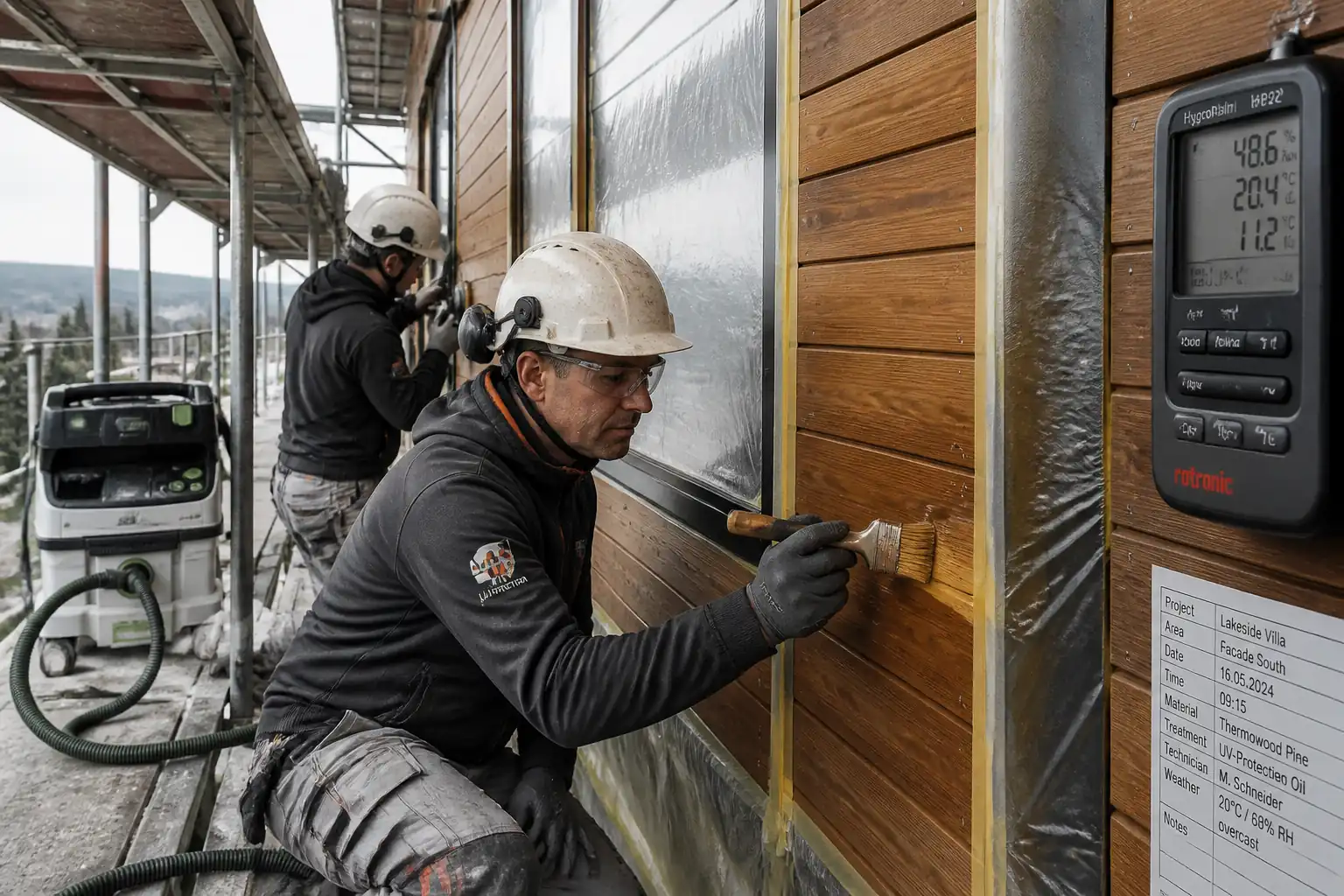
Verification of substrate moisture, climatic windows, surface preparation, masking, application quality, penetration/wipe-off timing, and post-cure performance.
Typical hold, witness, and review points
Mock-up approval (Hold), first-of-kind (Witness/Hold), final finish inspection (Hold/Witness), O&M and maintenance plan review (Witness).
Typical inspection records
Climatic and moisture logs, coverage and penetration time logs, IRs, photo evidence, calibration certs, checklists, and O&M documents.
Important approval note
This ITP is an AI-assisted editable starting point, not a pre-approved document. Before use on any project, all inspection activities, hold points, and acceptance criteria must be reviewed and approved by the relevant parties (superintendent, principal contractor, or client representative) in accordance with your contract and project quality plan.
Always verify acceptance criteria against your applicable drawings, specifications, and regulatory requirements. Hold points must be confirmed with the relevant authority before work proceeds past that point.
Inspection and test plan
| Activity | Inspection / Test | Acceptance Criteria | Responsibility | Record |
|---|---|---|---|---|
| Pre-start documentation | Approved MS/ITP, SDS, datasheets available | All approvals in place | QA/QC Engineer | Document register |
| Equipment and calibration | Calibration certificates valid (<12 months) | Compliant instruments | QA/QC Engineer | Calibration log |
| Climatic conditions | T/RH, substrate temp, dew point | T 10–30°C; RH <80%; Tsubstrate ≥ Tdew+3°C | Site Engineer / QA | Climatic log |
| Timber moisture content | Moisture meter readings per sampling plan | ≤18% MC [Verify per spec] | QA/QC Engineer | MC log with locations |
| Surface preparation | Sanding grade and cleanliness | P150–P180 finish; dust-free | QA/QC + Supervisor | Prep checklist; photos |
| Protection/masking | Continuity and coverage | Adjacent elements fully protected | Supervisor | Photos |
| Mock-up / first-of-kind | Colour/finish verification | Approved benchmark | Engineer/Client + QA | IR approval |
| First coat application | Coverage rate; absence of defects | 8–14 m²/L/coat [Verify] ; no runs/laps | Supervisor + QA | Coverage log; photos |
| Penetration and wipe-off | Penetration window observed; surface not tacky | 15–30 min penetration; no residual film | Supervisor | Time log; checklist |
| Second coat (if required) | Interval and wipe-off compliance | Per datasheet; uniform finish | Supervisor + QA | Coverage/time log |
| Curing protection | Weather shielding in place | Protected for min 24 h (or per datasheet) | Supervisor | Daily log |
| Final finish inspection | Uniformity, masking lines, defects | Uniform colour; no runs/laps; clean lines | Engineer/Client + QA | IR; punch list closeout |
| Water beading test (post-cure) | Water droplet beading within 1–2 min | Stable beading indicating repellency | QA/QC Engineer | Test log; photos |
| O&M and maintenance schedule | Completeness and intervals | Accepted by Engineer/Client | Project Manager + QA | O&M manual; maintenance log |
This table is a read-only public reference. Download the PDF or Excel version, or customize this ITP to edit it for your project.
Frequently asked questions
Related method statement
This Inspection and Test Plan is associated with the Method Statement: External Timber Cladding Oiling and Weather-Protection Treatment method statement, which describes the step-by-step construction sequence, resources, materials, equipment, safety controls, and environmental controls for this activity.
View the Method Statement: External Timber Cladding Oiling and Weather-Protection Treatment method statement →Continue with related inspection, method statement, article, and checklist resources.