
Method Statement – Skim Coat Application on Plastered Surfaces – Method Statement
AI-assisted method statement with matching ITP, PDF download, and Excel export.
More than a static template
Unlike a downloadable Word or PDF template, this method statement is an AI-assisted editable starting point connected directly to a matching Inspection and Test Plan. Every section is structured, project-adaptable, and ready to export.
- AI-assisted drafting — Customize every section with AI for your specific project scope.
- Linked ITP — A matching inspection and test plan is generated alongside the method statement.
- Multiple export formats — Download as a formatted PDF or editable Excel spreadsheet.
- Editable starting point, not a final document — Review, verify, and adjust all content against your project requirements before use.
Static template vs. Quollnet workflow
| Feature | Static template | Quollnet |
|---|---|---|
| Project-specific content | Manual fill-in required | AI-assisted customization |
| Linked ITP | Separate document, no link | Matching ITP included |
| Export formats | Usually PDF only | PDF and Excel |
| Structured sections | Free-form layout | 13 standardized sections |
| Saved to your account | Local file only | Cloud-saved, reusable |
| Content accuracy | You verify everything | AI-assisted, you still verify |
| Cost | Often free but time-intensive | Free to customize and download |
What you can customize
When you save this method statement to your account, every section becomes editable. The following 13 sections are included:
- Scope — Defines the activity and its boundaries.
- References — Standards, specifications, and drawings.
- Responsibilities — Roles and accountabilities.
- Resources — Labour, plant, and equipment summary.
- Materials — Materials and compliance requirements.
- Equipment — Tools and equipment details.
- Prerequisites — Hold points and pre-conditions.
- Method sequence — Step-by-step construction sequence.
- Safety controls — HSE risk controls and PPE.
- Environmental controls — Environmental mitigation measures.
- QA/QC — Quality inspection and test requirements.
- ITP — Inspection and Test Plan table (has its own page).
- Attachments — Referenced drawings and documentation.
Why this method statement is used
This method statement is used to define and communicate the approved procedure for carrying out method statement – skim coat application on plastered surfaces on site. It ensures the work is planned in advance, the correct resources and controls are in place, and all personnel understand responsibilities, sequence, quality requirements, and safety controls before work begins. It aligns site execution with the documented scope and acceptance expectations.
Who uses this method statement
This method statement is used by contractors, site supervisors, project engineers, QA/QC engineers, HSE officers, consultants, and client representatives. It serves as a shared reference for planning, execution, supervision, inspection, and approval of the activity on site.
When it is prepared and submitted
The method statement is prepared before the work activity starts and submitted as part of the pre-construction documentation package for review and approval.
Who reviews or approves it
The method statement is usually submitted to the client representative, consultant, resident engineer, or project management consultant for review and approval before the work commences.
Important approval note
This method statement is an AI-assisted editable starting point, not a pre-approved document. Before use on any project, all content must be reviewed and approved by the relevant parties (superintendent, principal contractor, or client representative) in accordance with your contract and project quality plan.
For example: if your specification requires a departure from a referenced standard, that departure must be documented and approved separately — this method statement will not capture that automatically. Always verify against your applicable drawings, specifications, and regulatory requirements.
Method statement content
Scope
Work Included
- Preparation of internal cement-lime or gypsum plastered substrates for skim coat.
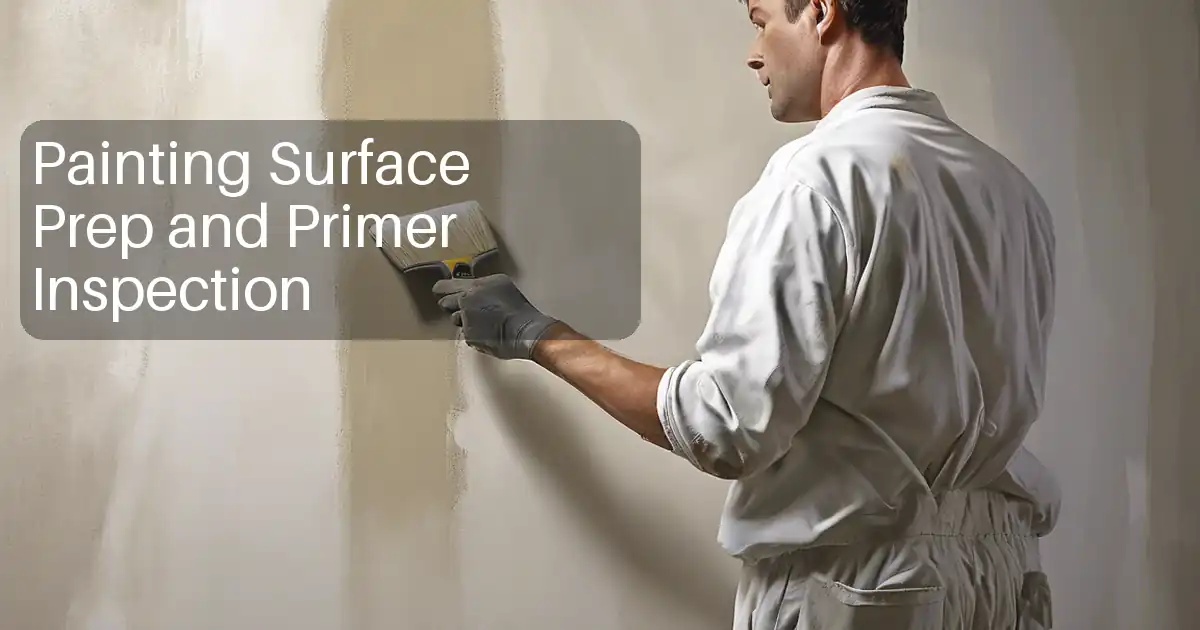
- Surface assessment, repairs, crack treatment, priming/bonding (as required by manufacturer), and masking/protection.
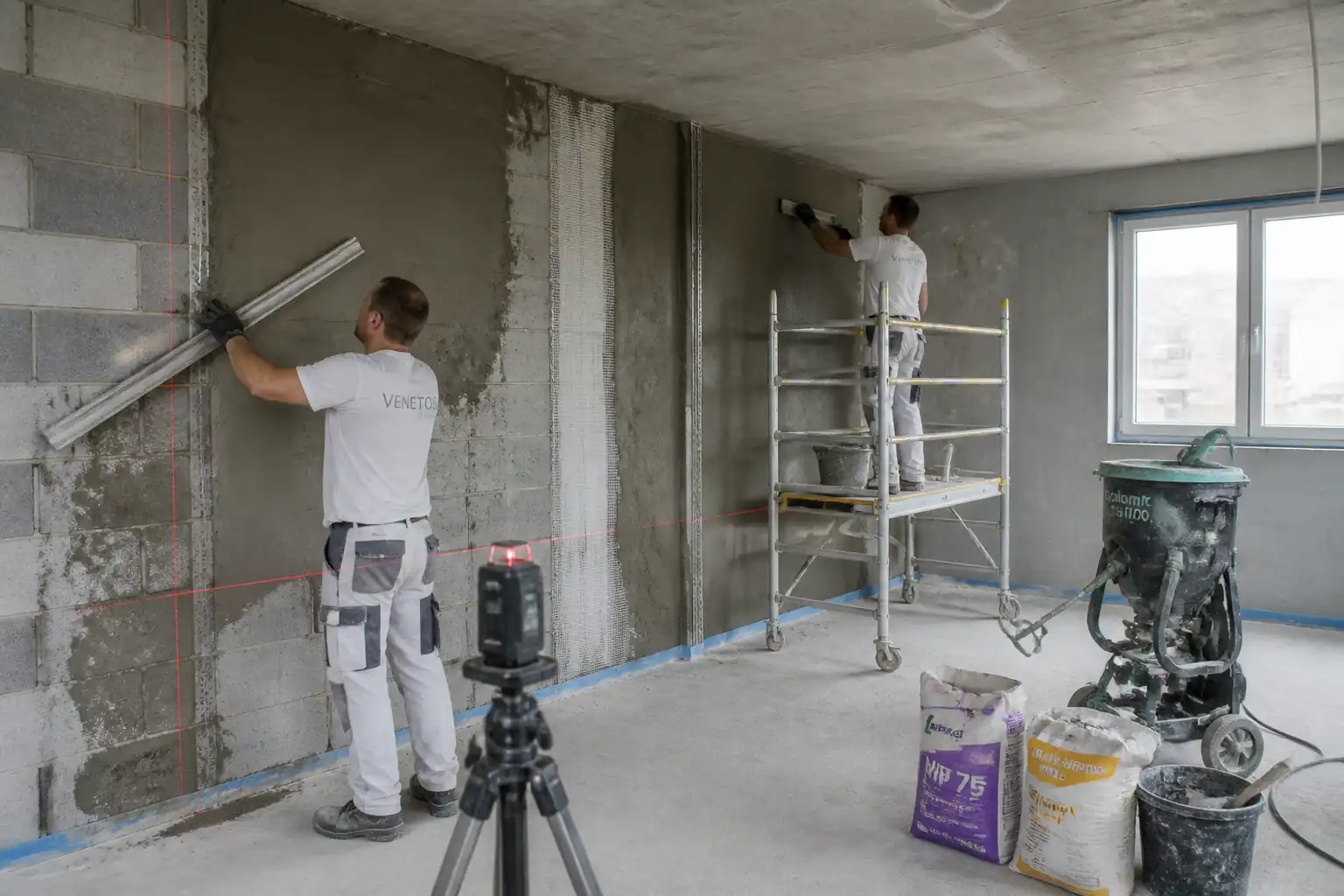
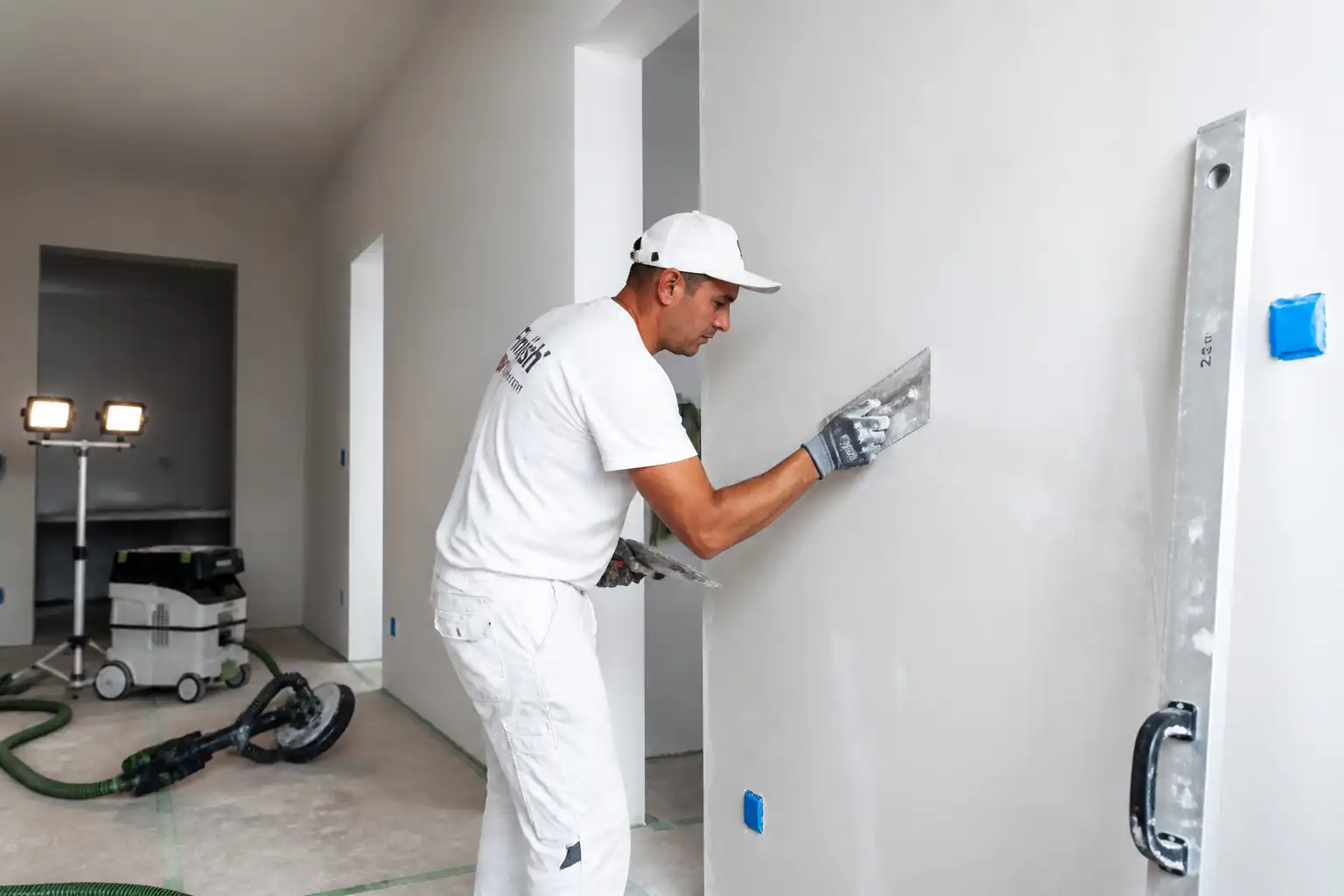
- Mixing and application of polymer-modified cementitious or gypsum-based skim coat in one or more passes to achieve a smooth, paint-ready surface.
- Drying/curing time control, environmental condition control, sanding/finishing, and defect rectification.
- QA/QC inspections including moisture, pH, flatness, thickness, visual finish, and adhesion (where specified), with defined hold points.
- Handover of completed, paint-ready surfaces to painting trade.
Exclusions
- Application over previously painted or coated substrates unless specifically approved and prepared with a compatible system [Verify per project specifications].
- External renders and EIFS systems.
- Substrates requiring structural repair or significant re-plastering.
Interfaces
- Coordinate with MEP and door/window installers to ensure penetrations and trims are complete before final skim.
- Coordinate with painting contractor for compatible primer/finish system and required surface profile.
References
| Document Type | Reference / Number | Revision | Notes |
|---|---|---|---|
| Standard | BS EN 998-1 | Material classification and performance [Verify per project specifications] | |
| Standard | EN 13279-1 | ||
| Standard | EN 13914-2 | ||
| Standard | ASTM C842 | For substrate suitability and workmanship guidance | |
| Standard | ASTM D4263 | Use as indicative moisture check; confirm with moisture meter as required | |
| Standard | EN 1542 | Typical acceptance ≥0.5 MPa [Verify per project specifications] | |
| Standard | BS 8000-10 | Workmanship tolerances and finish quality [Verify] | |
| Standard | BS 6150 | ||
| Standard | ISO 9001 | ||
| Product Data | PDS/MSDS | Shall take precedence where more stringent than this method |
Responsibilities
| Role | Responsibility | Name / Party |
|---|---|---|
| Project Manager | Approve and oversee | Contractor |
| Manager | Coordinate | Contractor |
| Engineer | Supervise | Contractor |
| QC | Inspect/Test | Contractor |
| HSE | HSE oversight | Contractor |
| Supervisor | Execute/Control | Contractor |
| Trades | Apply | Contractor |
| Consultant | Approve/Reject | Client |
Resources
| Resource Type | Description | Quantity | Remarks |
|---|---|---|---|
| Labor | 1 Finishing Supervisor, 4–6 Skilled Plasterers, 2–3 Helpers [Verify per project] | As noted | |
| Staff | 1 QC Engineer/Inspector shared between areas; calibrated instruments | 1 | |
| Staff | 1 HSE Officer for toolbox talks, inspections, and permits | 1 |
Materials
| Material | Specification / Grade | Quantity | Remarks |
|---|---|---|---|
| Skim coat (cementitious) | |||
| Skim coat (gypsum) | |||
| Acrylic/Polymer primer | |||
| Tape & repair mortar | |||
| Water | |||
| Protection materials |
Equipment
| Equipment | Capacity / Type | Quantity | Inspection Required |
|---|---|---|---|
| Mixer | 1 per crew | ||
| Set per applicator | |||
| 1 set | |||
| 1 set per area | |||
| As required | |||
| 1 set | |||
| As needed | |||
| As required |
Prerequisites
Approvals and Documentation
- Approved method statement, ITP, product submittals, and MSDS on site.
- Toolbox talk conducted addressing specific task hazards and controls; attendance recorded.
Substrate Readiness
- Plaster base cured and dried: cement-based plaster typically cured ≥7 days and dried to moisture content acceptable to the skim system; gypsum plaster fully set and dry [Verify per project specifications and PDS].
- Substrate sound, free from dust, oil, laitance, efflorescence, and loose particles. No active water ingress.
- Services and fixings complete; chases closed and patched.
Environmental Conditions
- Ambient and substrate temperature during application: typically 10–35°C [Verify per PDS].
- Relative humidity: preferably <75% for predictable drying [Verify]. Avoid condensation.
- Adequate ventilation without direct drafts or strong sunlight on surfaces.
Access and Protection
- Working platforms in place, tagged, and inspected. Adjacent finishes protected with masking and floor protection.
Hold Points (HP)
- HP1: Substrate acceptance prior to priming/skimming.
- HP2: First-coat inspection prior to second coat application.
- HP3: Final smoothness and visual acceptance prior to paint handover.
Method Sequence
| Step | Activity | Description | Responsibility | Inspection / Hold Point |
|---|---|---|---|---|
| 1 | Material verification | Verify material approvals, delivery condition, batch numbers, and shelf-life. Store bags dry, elevated on pallets, within temperature limits per PDS. | Finishing Supervisor / Storekeeper | Visual check; document review |
| 2 | Surface assessment (HP1) | Check substrate: soundness (hammer tap), flatness, defects, and contamination. Remove dust using HEPA vacuum; degrease localized contamination with approved cleaner; lightly abrade glossy/over-trowelled patches. | Site Engineer / QC | Joint inspection with Consultant if required |
| 3 | Moisture and pH checks | Measure substrate moisture using pin moisture meter at representative points (min 1 per 20 m², each wall/ceiling). For cementitious bases conduct ASTM D4263 plastic sheet test as indicative check. Measure surface pH with strips moistened with DI water. | QC Engineer | On-site tests |
| 4 | Repairs and crack treatment | Cut and widen cracks to V-groove (~3–5 mm), remove dust, prime if required, fill with polymer-modified repair mortar. For non-structural cracks, embed alkali-resistant mesh/joint tape in base skim layer. | Skilled Plasterers | QC check before covering |
| 5 | Masking and protection | Mask junctions, trims, sockets, and protect floors/adjacent finishes. Install corner beads if specified. | Helpers / Supervisor | Visual |
| 6 | Priming/bonding (if required) | Apply manufacturer-approved primer/bonding agent to high-suction or low-porosity substrates. Allow to dry per PDS. | Skilled Plasterers | QC verification |
| 7 | Mixing of skim coat | Measure clean water to PDS ratio (typ. 0.30–0.35 w/p by weight for cement skim; gypsum per PDS) [Verify]. Add powder to water, mix 2–3 min to lump-free paste, rest (slake) 2–5 min, remix 30–60 s. Do not re-temper after pot life (typ. 60–90 min) [Verify]. | Skilled Plasterer | Supervisor oversight |
| 8 | First coat application | Apply thin coat using stainless steel trowel at ~1–2 mm. Work wet-on-wet to maintain open time. Level using 2 m straightedge; feather at edges and around openings. | Skilled Plasterers | In-process |
| 9 | Drying/curing control of first coat | Allow to firm up; avoid forced drying, direct sunlight, or strong airflow. Use dehumidifiers/air movers only as allowed by PDS. Typical recoat time 4–24 h depending on product and conditions [Verify]. | Site Engineer / Supervisor | Env. monitoring |
| 10 | First coat inspection (HP2) | Check flatness with 2 m straightedge, defects/voids, pinholes. Touch-up low areas before second coat. | QC / Consultant | Hold point inspection |
| 11 | Second (finish) coat application | Apply finishing coat ~0.5–1.5 mm to remove tool marks and achieve paint-ready smoothness. Re-level; burnish lightly only if permitted by PDS. | Skilled Plasterers | In-process |
| 12 | Final drying/curing | Allow to dry fully prior to sanding/painting. Typical full dry 12–48 h depending on product, thickness, and climate [Verify]. Prevent condensation and dust deposition. | Supervisor | Env. monitoring |
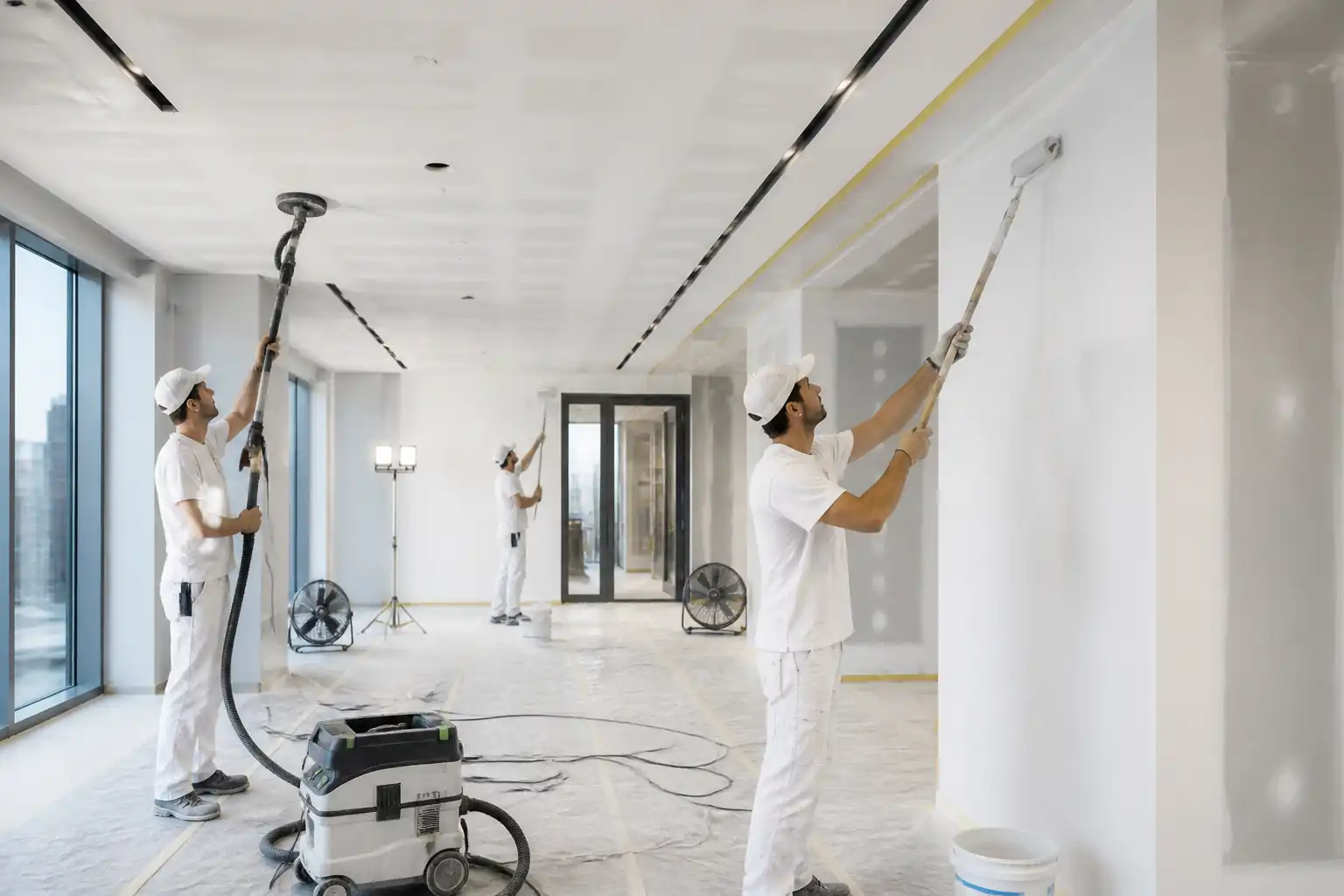
| 13 | Sanding and finishing | Dry sand with P180–P240 abrasives using dust-extraction sander; avoid over-sanding. Remove dust with HEPA vacuum and tack cloth. | Skilled Plasterers | In-process |
| 14 | Final QA inspection (HP3) | Flatness, thickness sampling, visual quality under 500–1000 lux raking light, and adhesion testing if specified. | QC / Consultant | Hold point |
| 15 | Cleaning and protection | Remove masking; clean adjacent surfaces. Protect finished skim from impact, moisture, and contamination until painting. | Helpers / Supervisor | Final walkdown |
Health, Safety, and Environment – Safety Controls
Key Task-Specific Hazards and Controls
- Hazard: Silica/nuisance dust from sanding and surface prep
- Likely consequence: Respiratory irritation, long-term lung disease
- Engineering/procedural control: Use vacuum-assisted sanders with HEPA extraction; pre-vacuum surfaces; wet-wipe where compatible; limit dry sweeping.
- Required PPE: FFP3/N99 respirator, safety goggles, gloves, long sleeves.
- Collective measure: Local exhaust ventilation; dust barriers/containment.
-
Inspection/permit: HSE inspections; check extractor filters and flow daily.
-
Hazard: Alkaline/irritant exposure from cement-based skim and primers
- Likely consequence: Skin/eye irritation, dermatitis, chemical burns
- Engineering/procedural control: Use closed mixing; decant water first to avoid splashes; provide hand-wash stations; no bare-hand contact.
- Required PPE: Chemical-resistant gloves (nitrile), goggles/face shield, coveralls.
- Collective measure: Safety data sheets on site; emergency eyewash within 10 m.
-
Inspection/permit: SDS briefing in TBT; HSE checks of eyewash and PPE issue.
-
Hazard: Manual handling of 20–25 kg bags
- Likely consequence: Strains/sprains
- Engineering/procedural control: Use trolleys; split loads; team lift; store at waist height.
- Required PPE: Safety footwear, gloves.
- Collective measure: Manual handling training; clear access routes.
-
Inspection/permit: Supervisor spot checks; housekeeping audits.
-
Hazard: Working at height on steps/podiums/scaffolds
- Likely consequence: Falls causing serious injury
- Engineering/procedural control: Use podium steps/mobile towers with guardrails; maintain three-point contact; no overreach; keep platform within 300 mm of work face.
- Required PPE: Hard hat, non-slip footwear; fall protection where required [Verify per project HSE plan and local regulations].
- Collective measure: Edge protection; proper access/egress.
-
Inspection/permit: Pre-use inspection and green-tag system; weekly scaffold inspections.
-
Hazard: Electrical hazards from mixing drills and portable lighting
- Likely consequence: Electric shock, burns
- Engineering/procedural control: PAT-tested tools; 110 V centre-tapped or RCD-protected circuits; dry area mixing; cable management.
- Required PPE: Dielectric gloves when inspecting, safety footwear.
- Collective measure: RCDs; lockable distribution boards.
-
Inspection/permit: PAT records; daily visual checks; permit to work if in wet areas.
-
Hazard: Trip hazards/poor housekeeping
- Likely consequence: Slips, trips, minor injuries
- Engineering/procedural control: Hose/cable routing at edges; immediate spill cleanup; defined material laydown areas.
- Required PPE: Safety footwear.
- Collective measure: Housekeeping schedule.
-
Inspection/permit: Supervisor walkdowns twice daily.
-
Hazard: Noise/vibration from sanding equipment
- Likely consequence: Hearing damage, hand-arm vibration
- Engineering/procedural control: Select low-vibration tools; limit exposure time; job rotation.
- Required PPE: Hearing protection where LAeq >80 dB(A) [Verify per local regs].
- Collective measure: Noise mapping and signage.
-
Inspection/permit: HSE monitoring; equipment maintenance records.
-
Hazard: Air quality and confined/poorly ventilated rooms
- Likely consequence: Dizziness, discomfort, delayed drying
- Engineering/procedural control: Use air movers/dehumidifiers as permitted; ensure make-up air; avoid combustion heaters.
- Required PPE: As per dust control; ensure breaks.
- Collective measure: Ventilation plan.
- Inspection/permit: Supervisor to record temp/RH at start/mid/end of shift.
Environmental Controls
Controls and Good Practice
- Dust emissions
- Impact: Nuisance to adjacent areas and occupants
- Control: HEPA extraction, sealed doors, negative pressure if needed; schedule dusty works off-hours.
-
Monitoring: Visual checks, complaints log.
-
Waste management
- Impact: Cementitious/gypsum waste contamination, packaging waste
- Control: Collect slurry and sanding dust; do not discharge to drains; dispose via approved waste contractor. Segregate paper/plastic bags.
-
Monitoring: Waste transfer notes; skip logs.
-
Water use and washout
- Impact: Alkaline wash water entering drainage
- Control: Dedicated washout tubs with pH neutralization media if required; solids allowed to settle then dispose appropriately.
-
Monitoring: Periodic pH checks of washout; inspection records.
-
VOCs/odors from primers
- Impact: Indoor air quality
- Control: Select low-VOC products where possible; ensure ventilation; keep lids closed.
-
Monitoring: SDS review; spot checks.
-
Energy and noise
- Impact: Excess power usage, disturbance
- Control: Use energy-efficient LED lighting; switch off idle equipment; maintain noise barriers where required.
-
Monitoring: Supervisor checks; meter readings if available.
-
Complaints and sensitive receptors
- Impact: Disruption to adjacent tenants/operations
- Control: Notification and signage; work windows agreed with stakeholder; maintain access/egress clean.
- Monitoring: Stakeholder log and closeout.
Quality Assurance and Quality Control
QA/QC Strategy
- Submittals: Product data sheets, MSDS, primers/tapes, and equipment calibration certificates.
- Pre-works: HP1 substrate acceptance including moisture and pH results.
- In-process controls: Batch mixing logs (water/powder ratio, time), environmental log (temp/RH), thickness spot checks (≥3 per 10 m² per coat), and straightedge checks.
- Post-works: HP2 and HP3 inspections with Consultant sign-off.
Inspection and Testing Frequencies [Verify per project specifications]
- Moisture/pH: Min 1 set per 20 m² per room/zone; additional at suspect areas.
- Flatness: 2 m straightedge checks at 1 location per 20 m² (min 3 per room).
- Thickness: Pin measurements at 3 points per 10 m² per coat; record min/avg/max.
- Adhesion (if specified): EN 1542 pull-off tests, 1 per 200 m² per substrate type, min 3 per floor.
Acceptance Criteria (Typical Benchmarks)
- Flatness after final coat: ≤2 mm deviation under a 2 m straightedge for high-finish areas; ≤3 mm for standard finish [Verify].
- Visual finish: Smooth, uniform color/texture; no ridges, trowel marks, pinholes, crazing, or blisters; corners true and neat.
- Thickness: Total 2–5 mm or per PDS; single pass 1–3 mm unless otherwise approved.
- Moisture: ≤5% by weight (cementitious substrates) or as per PDS; gypsum fully dry.
- pH: ≤9 at surface prior to paint, unless paint system tolerates higher [Verify].
- Adhesion (if tested): ≥0.5 MPa or as specified.
Records and Documentation
- ITP/IRs, moisture/pH logs, mixing logs, environmental logs, inspection checklists, NCRs with corrective actions, photos, and handover certificates.
Nonconformance and Corrective Action
- Identify defects (ridging, pinholes, delamination). Mark-up, rectify by re-skimming or localized filling after proper prep. Re-test affected area. Record in NCR log.
Training and Competency
- Applicators trained by manufacturer or with ≥3 years experience; evidence retained.
Interfaces
- Confirm paint manufacturer acceptance of substrate; conduct joint inspection prior to paint mobilization.
Attachments
- Manufacturer Product Data Sheets (PDS) and Safety Data Sheets (MSDS) for skim, primer, and accessories.
- ITP checklists and inspection request (IR/ITR) forms (HP1/HP2/HP3).
- Moisture/pH log sheet; mixing log; environmental log template.
- Tool and instrument calibration certificates (moisture meter, thermo-hygrometer).
- Job Hazard Analysis / Task Risk Assessment for skim coat operations.
- Example mark-up of acceptance tolerances and inspection frequency map.
- Training/competency records for applicators and supervisors.
- NCR form template and corrective action flowchart.
This content is a read-only public reference. Download or customize to get an editable version.
ITP preview
The first inspection activities from the linked ITP for Method Statement – Skim Coat Application on Plastered Surfaces:
| Activity | Inspection / Test | Acceptance Criteria | Responsibility | Record |
|---|---|---|---|---|
| HP1 – Substrate acceptance | Visual soundness; cleanliness; key/texture; hammer tap | Substrate sound, clean, free of laitance/contaminants; defects identified and repaired | QC Engineer (W), Consultant (H) | IR/ITR – HP1; photos |
| Moisture and pH testing | Moisture meter; ASTM D4263 plastic sheet (indicative); pH strips | Moisture and pH within product/paint limits (e.g., ≤5% moisture; pH ≤9) [Verify] | QC Engineer | Moisture/pH log |
| Crack/defect repair verification | Visual, tap test after cure | Repairs fully bonded, flush, and dry; tape embedded with no blisters | QC Engineer | Repair checklist |
Showing 3 of 13 inspection activities. View full ITP →
Related Inspection and Test Plan
An Inspection and Test Plan (ITP) is available for Method Statement – Skim Coat Application on Plastered Surfaces. The ITP defines the inspection activities, acceptance criteria, hold and witness points, responsible parties, and records required to verify the work described in this method statement.
View the Method Statement – Skim Coat Application on Plastered Surfaces ITP →Frequently asked questions
Continue with related Quollnet resources connected to this method statement.