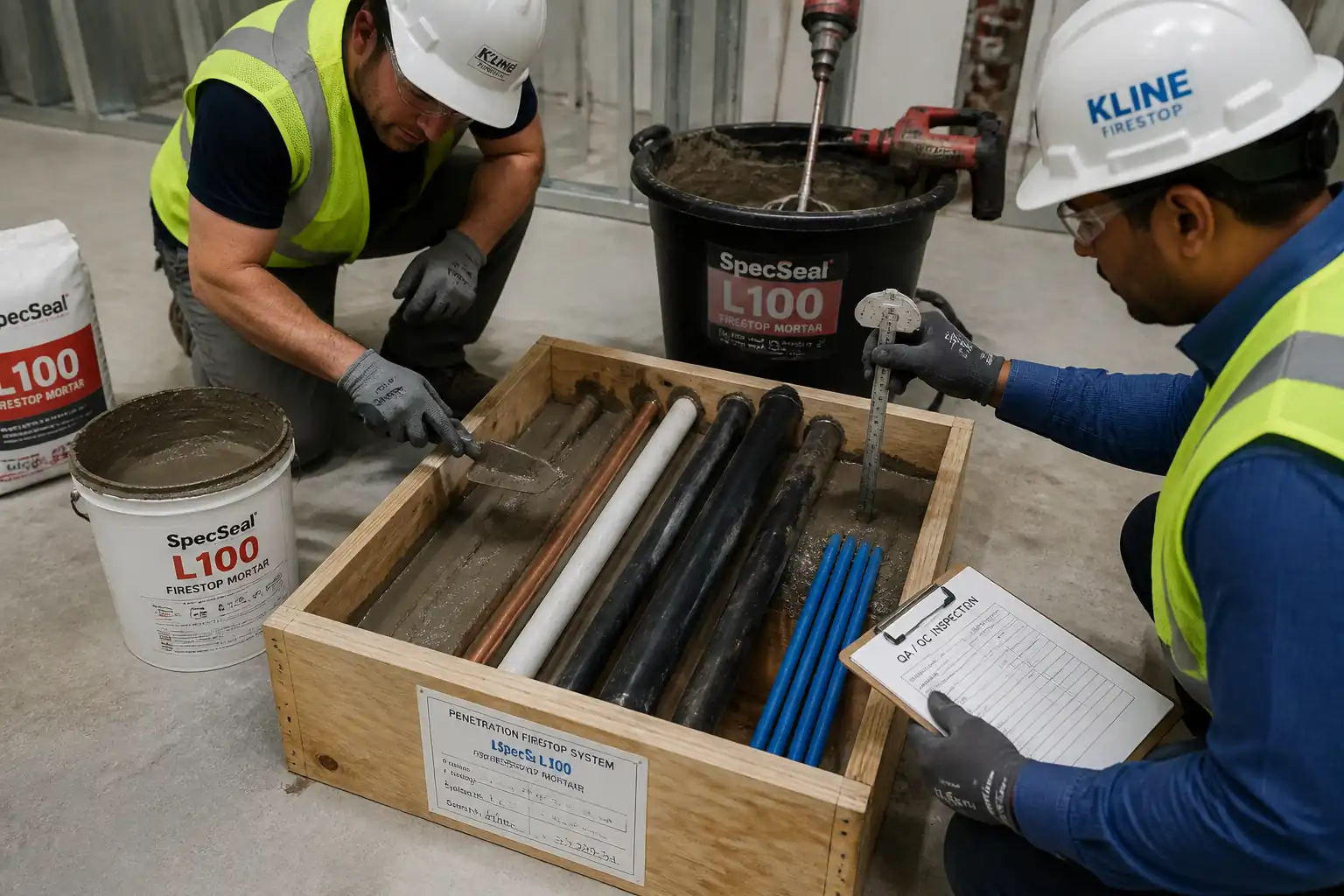

Method Statement: Firestop Mortar Application for Large Openings and Mixed Services – Method Statement
AI-assisted method statement with matching ITP, PDF download, and Excel export.
More than a static template
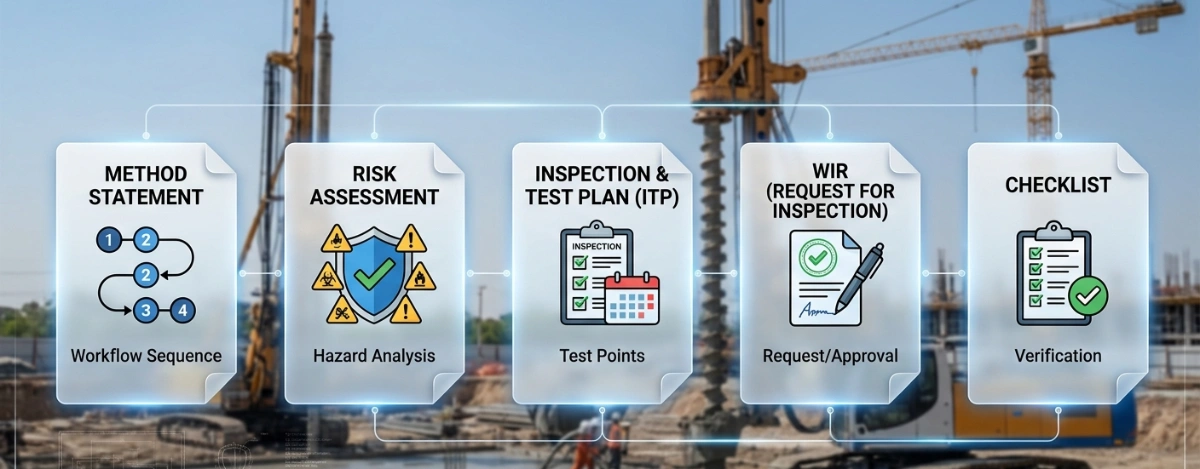
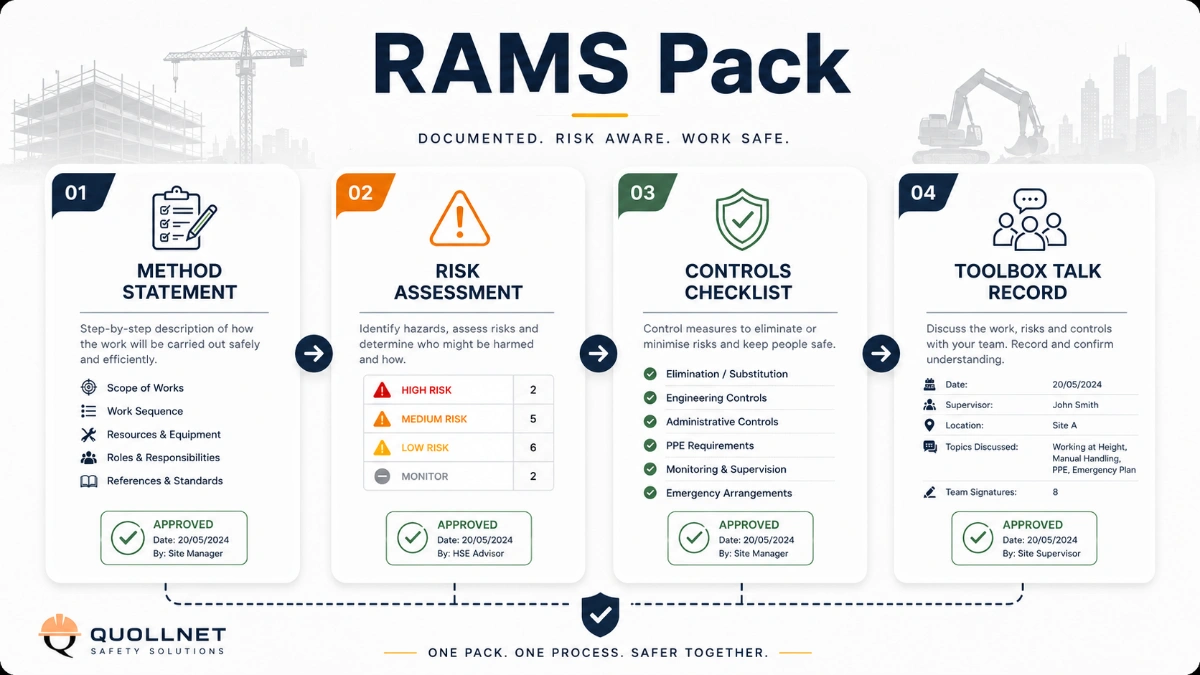
Unlike a downloadable Word or PDF template, this method statement is an AI-assisted editable starting point connected directly to a matching Inspection and Test Plan. Every section is structured, project-adaptable, and ready to export.
- AI-assisted drafting — Customize every section with AI for your specific project scope.
- Linked ITP — A matching inspection and test plan is generated alongside the method statement.
- Multiple export formats — Download as a formatted PDF or editable Excel spreadsheet.
- Editable starting point, not a final document — Review, verify, and adjust all content against your project requirements before use.
Static template vs. Quollnet workflow
| Feature | Static template | Quollnet |
|---|---|---|
| Project-specific content | Manual fill-in required | AI-assisted customization |
| Linked ITP | Separate document, no link | Matching ITP included |
| Export formats | Usually PDF only | PDF and Excel |
| Structured sections | Free-form layout | 13 standardized sections |
| Saved to your account | Local file only | Cloud-saved, reusable |
| Content accuracy | You verify everything | AI-assisted, you still verify |
| Cost | Often free but time-intensive | Free to customize and download |
What you can customize
When you save this method statement to your account, every section becomes editable. The following 13 sections are included:
- Scope — Defines the activity and its boundaries.
- References — Standards, specifications, and drawings.
- Responsibilities — Roles and accountabilities.
- Resources — Labour, plant, and equipment summary.
- Materials — Materials and compliance requirements.
- Equipment — Tools and equipment details.
- Prerequisites — Hold points and pre-conditions.
- Method sequence — Step-by-step construction sequence.
- Safety controls — HSE risk controls and PPE.
- Environmental controls — Environmental mitigation measures.
- QA/QC — Quality inspection and test requirements.
- ITP — Inspection and Test Plan table (has its own page).
- Attachments — Referenced drawings and documentation.
Why this method statement is used
This method statement is used to define and communicate the approved procedure for carrying out method statement: firestop mortar application for large openings and mixed services on site. It ensures the work is planned in advance, the correct resources and controls are in place, and all personnel understand responsibilities, sequence, quality requirements, and safety controls before work begins. It aligns site execution with the documented scope and acceptance expectations.
Who uses this method statement
This method statement is used by contractors, site supervisors, project engineers, QA/QC engineers, HSE officers, consultants, and client representatives. It serves as a shared reference for planning, execution, supervision, inspection, and approval of the activity on site.
When it is prepared and submitted
The method statement is prepared before the work activity starts and submitted as part of the pre-construction documentation package for review and approval.
Who reviews or approves it
The method statement is usually submitted to the client representative, consultant, resident engineer, or project management consultant for review and approval before the work commences.
Important approval note
This method statement is an AI-assisted editable starting point, not a pre-approved document. Before use on any project, all content must be reviewed and approved by the relevant parties (superintendent, principal contractor, or client representative) in accordance with your contract and project quality plan.
For example: if your specification requires a departure from a referenced standard, that departure must be documented and approved separately — this method statement will not capture that automatically. Always verify against your applicable drawings, specifications, and regulatory requirements.
Method statement content
Scope
Work Included
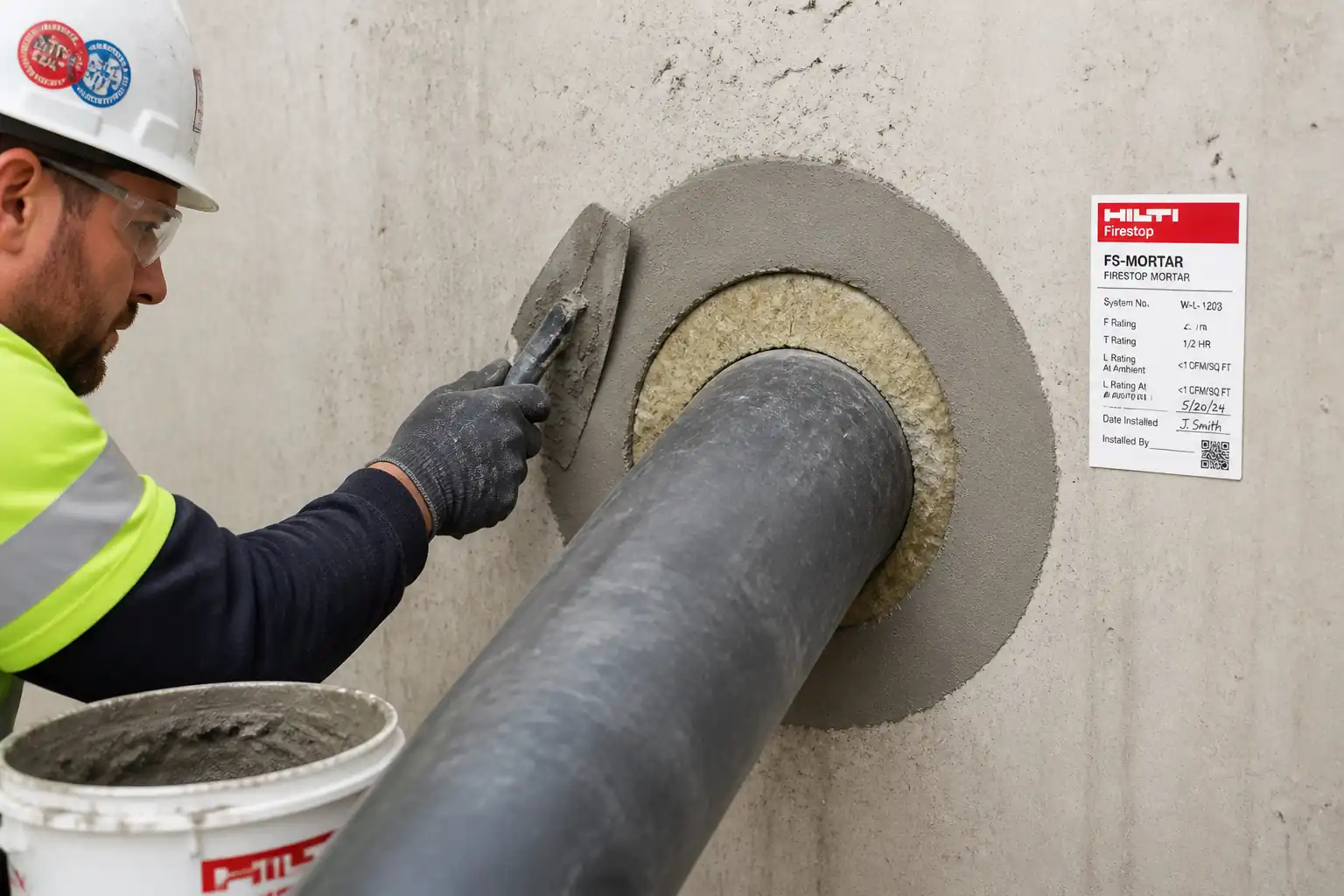
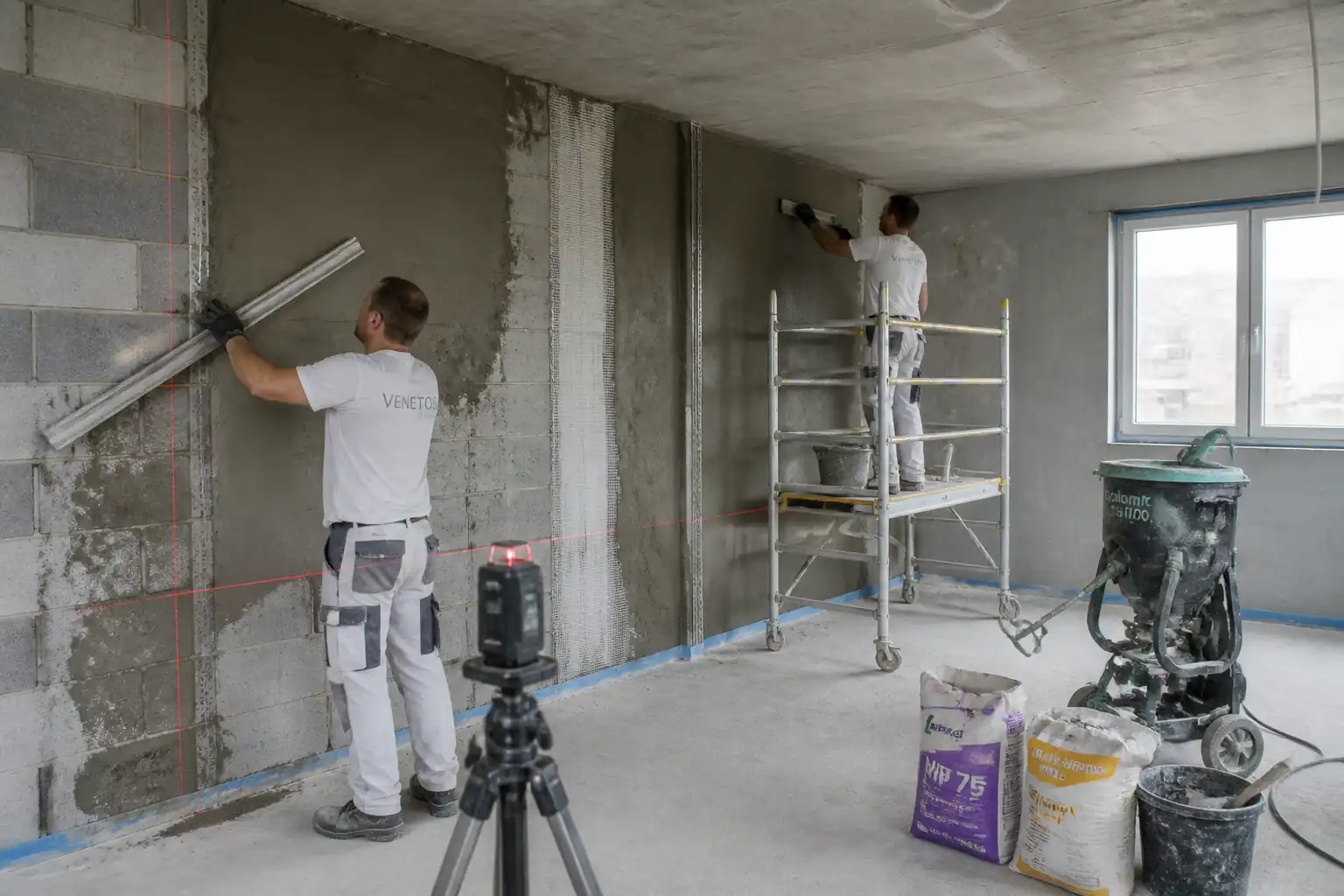
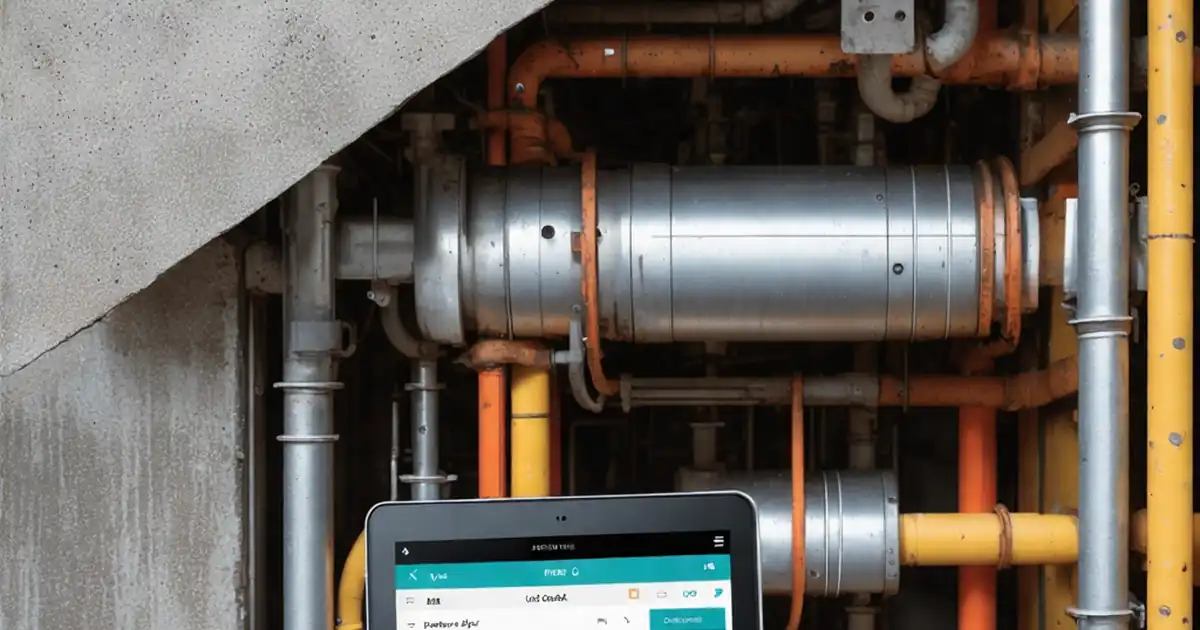
- Supply, preparation, installation, and curing of cementitious firestop mortar to seal large/complex openings in rigid walls and floors containing mixed MEP services.
- Temporary and/or sacrificial formwork to control geometry and leakage; backing materials; reinforcement/mesh where required by system.
- Substrate preparation to achieve sound, clean surface and adequate bond; priming/bonding as per manufacturer.
- Compliance with approved tested systems (UL 1479/ASTM E814; BS EN 1366-3; ETA/DoP as applicable) or approved Engineering Judgment (EJ) [Verify per project specifications].
- QA/QC including wet density checks, dimensional checks, annular space compliance, adhesion verification, documentation, and labeling.
- Crack inspection and repair; maintenance of service operability; protection of adjacent finishes.
Exclusions
- Structural support of services (to be by others and verified before firestopping).
- Fireproofing of structural members and duct fire dampers (separate scope).
Locations
- Rigid concrete/masonry floors and walls where mixed services pass through and rated separation must be restored to the required fire resistance rating (F/FT/FRR as per system).
References
| Document Type | Reference / Number | Revision | Notes |
|---|---|---|---|
| Standard | ASTM E814 / UL 1479 | Primary test standards for penetrations; use listed systems. | |
| Standard | EN 1366-3 | EU testing basis for ETA-listed systems. | |
| Standard | EN 13501-2 | Classification of fire resistance (EI). | |
| Standard | ASTM E2174 | Field inspection sampling guidance. | |
| Guideline | FM 4991 / UL QFC | Recommended competency framework. | |
| Contract Docs | Values, approvals, and tolerances to be verified. | ||
| MDS/SDS | Follow strictly; do not exceed water ratio. |
Responsibilities
| Role | Responsibility | Name / Party |
|---|---|---|
| Principal Contractor | Ensure preconditions and HSE controls in place. | PC |
| Installer | Method execution, batch control, density tests, records. | Subcontractor |
| Engineer | Set-out, hold points, witnessing. | PC |
| QA/QC | Review materials, density/adhesion, documentation. | PC/Consultant |
| HSE | HSE briefings, inspections, emergency readiness. | PC/Subcontractor |
| Vendor Rep | Confirm product/system suitability. | Supplier |
| Consultant | Approve ITP stages and final acceptance. | Client/Consultant |
Resources
| Resource Type | Description | Quantity | Remarks |
|---|---|---|---|
| Personnel | Experienced supervisor with manufacturer training. | 1 | FM 4991/UL-QFC preferred. |
| Personnel | Trained operatives for mixing/placing/finishing. | 2-4 | |
| Personnel | Quality checks and testing. | 1 | |
| Personnel | HSE oversight and permits. | 1 | |
| Personnel | Provide safe access/edge protection. | As req'd |
Materials
| Material | Specification / Grade | Quantity | Remarks |
|---|---|---|---|
| Firestop mortar | Per approved system | As required | |
| Primer | Per MDS | As required | |
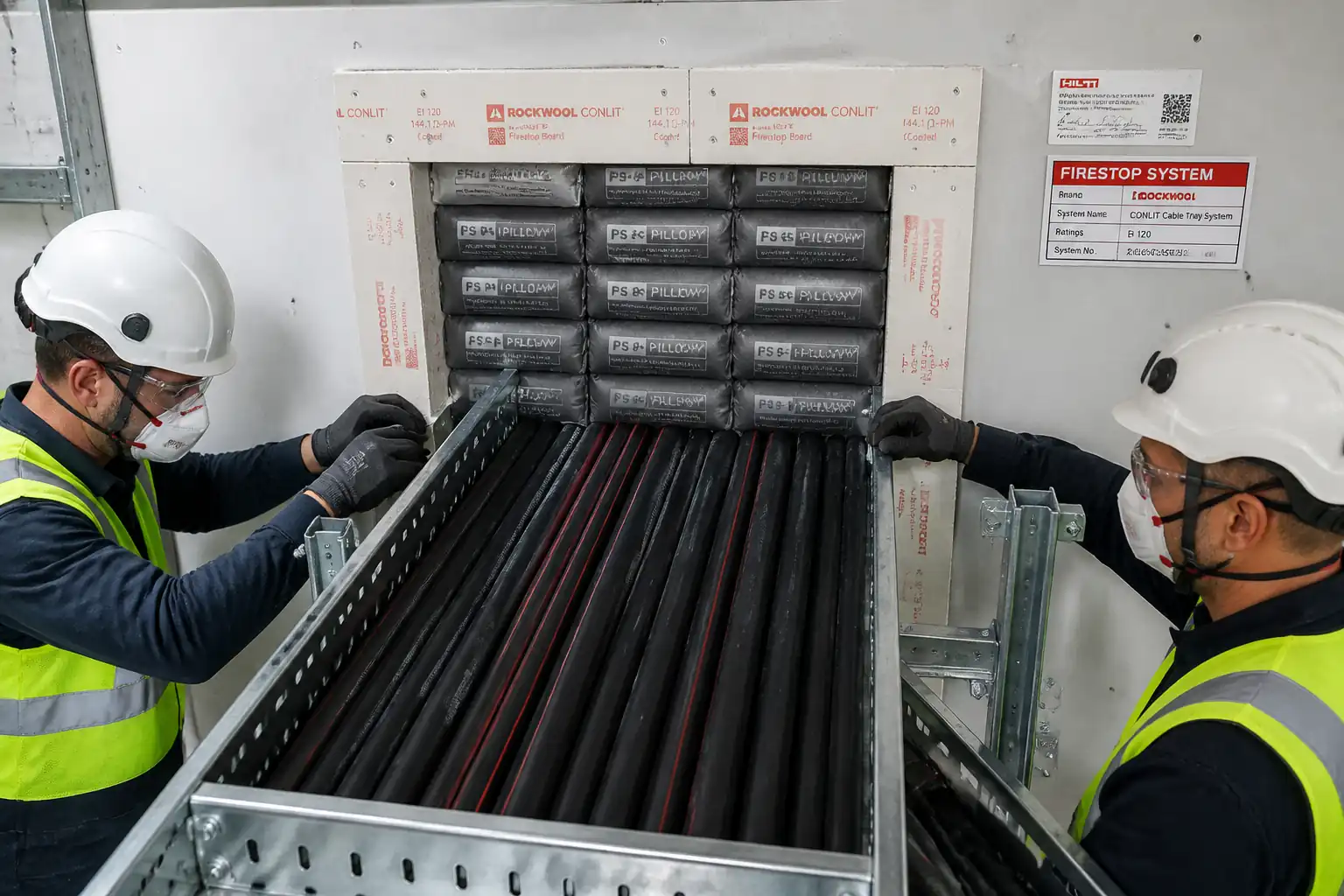
| Mineral wool | Per system | As required | |
| Intumescent device | Per system | As required | |
| Formwork | Per method | As required | |
| Water | Per MDS | As required | |
| Label | Project spec | 1 per penetration |
Equipment
| Equipment | Capacity / Type | Quantity | Inspection Required |
|---|---|---|---|
| Drill + paddle | 1–2 | ||
| Jug/Scale | 1 each | ||
| Density pot | 1 | ||
| Hand tools | Set | ||
| Formwork | As req'd | ||
| MEWP/Scaffold | As req'd | ||
| HEPA vac | 1 set | ||
| Prep tools | Set | ||
| Scanner | 1 | ||
| Adhesion kit | Set |
Prerequisites
- Approved submittals: product MDS/SDS, UL/ETA system listings or approved EJ for each penetration; ITP approved.
- Access/permits: work at height permit, hot works not expected; fire alarm impairment plan if dust could trigger detectors [Verify per project HSE plan and local regulations].
- Services verification: all services in opening identified; service supports installed and independently supported (firestop mortar shall not carry loads).
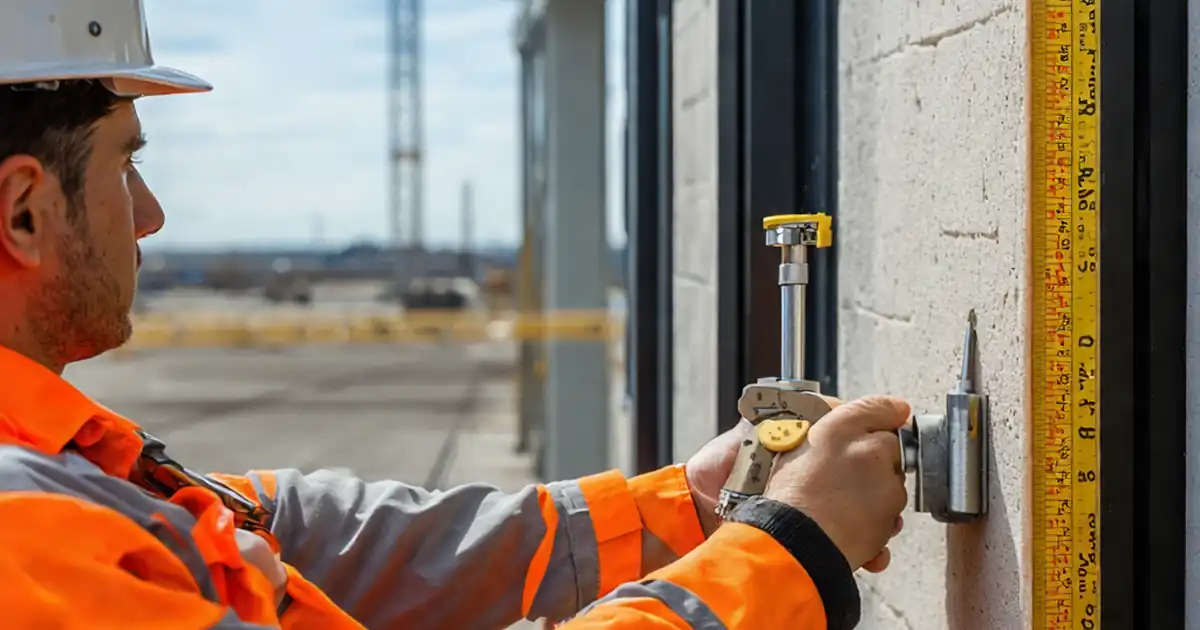
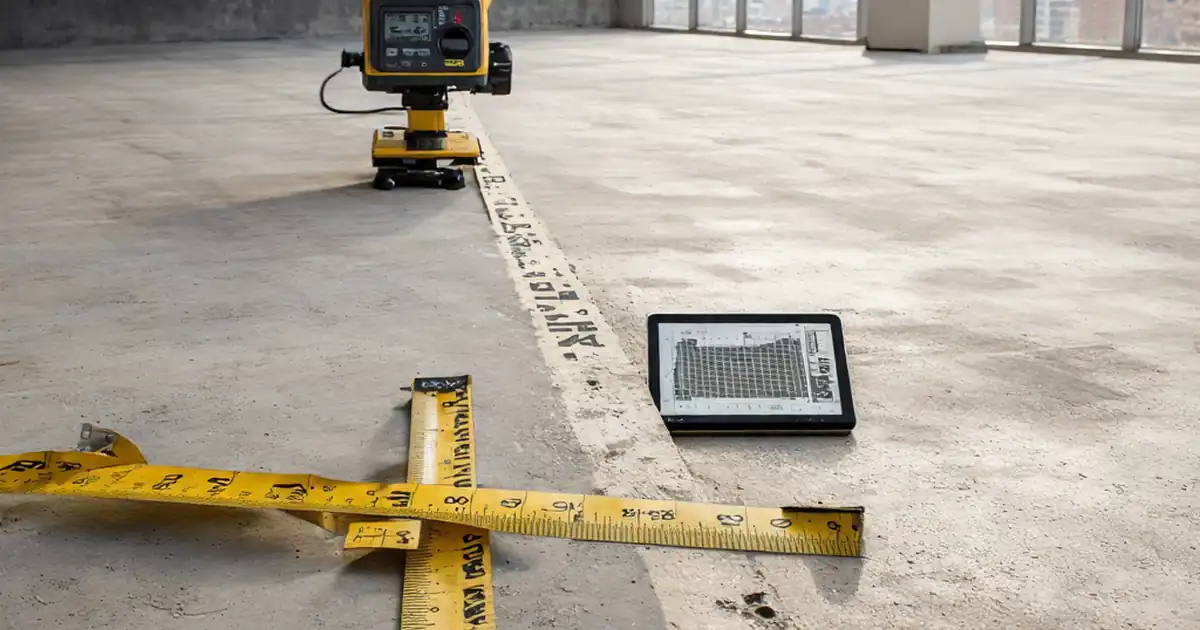
- Opening survey: dimensions, substrate type/thickness, orientation (wall/floor), expected fire rating; confirm annular gaps and service spacing compatible with system.
- Environmental: ambient 5–40°C; area enclosed from rain/sprinkling; adequate lighting and ventilation.
- Utilities and reinforcement: scan fixing areas for rebar/PT tendons; mark no-drill zones; isolate/cover live cables/pipes where feasible.
- HSE: task briefing; SDS available; eyewash and first aid on hand; exclusion zone and edge protection where floor openings are present.
- Mock-up (if required): perform and get approval for representative installation including density and adhesion checks.
- Materials: verify batch numbers, shelf life, storage dry and elevated; water source available; calibrated scale and density container ready.
- Cleanliness: substrates cleaned to sound, dust-free, oil/grease-free condition; moisture condition achieved (SSD or as per MDS).
Method Sequence
| Step | Activity | Description | Responsibility | Inspection / Hold Point |
|---|---|---|---|---|
| 1 | Confirm Approved System/EJ | Select correct tested system for opening and services; print system sheet on site. | Site Engineer / Installer | Hold Point: Consultant approval of system/EJ before start. |
| 2 | Set Out and Survey Opening | Measure opening; record service sizes, locations, annular spaces, and required fill depth. | Site Engineer | Verification by QA/QC |
| 3 | Verify Service Supports | Confirm independent supports/brackets for all services before firestopping. | Installer | Witness by QA/QC |
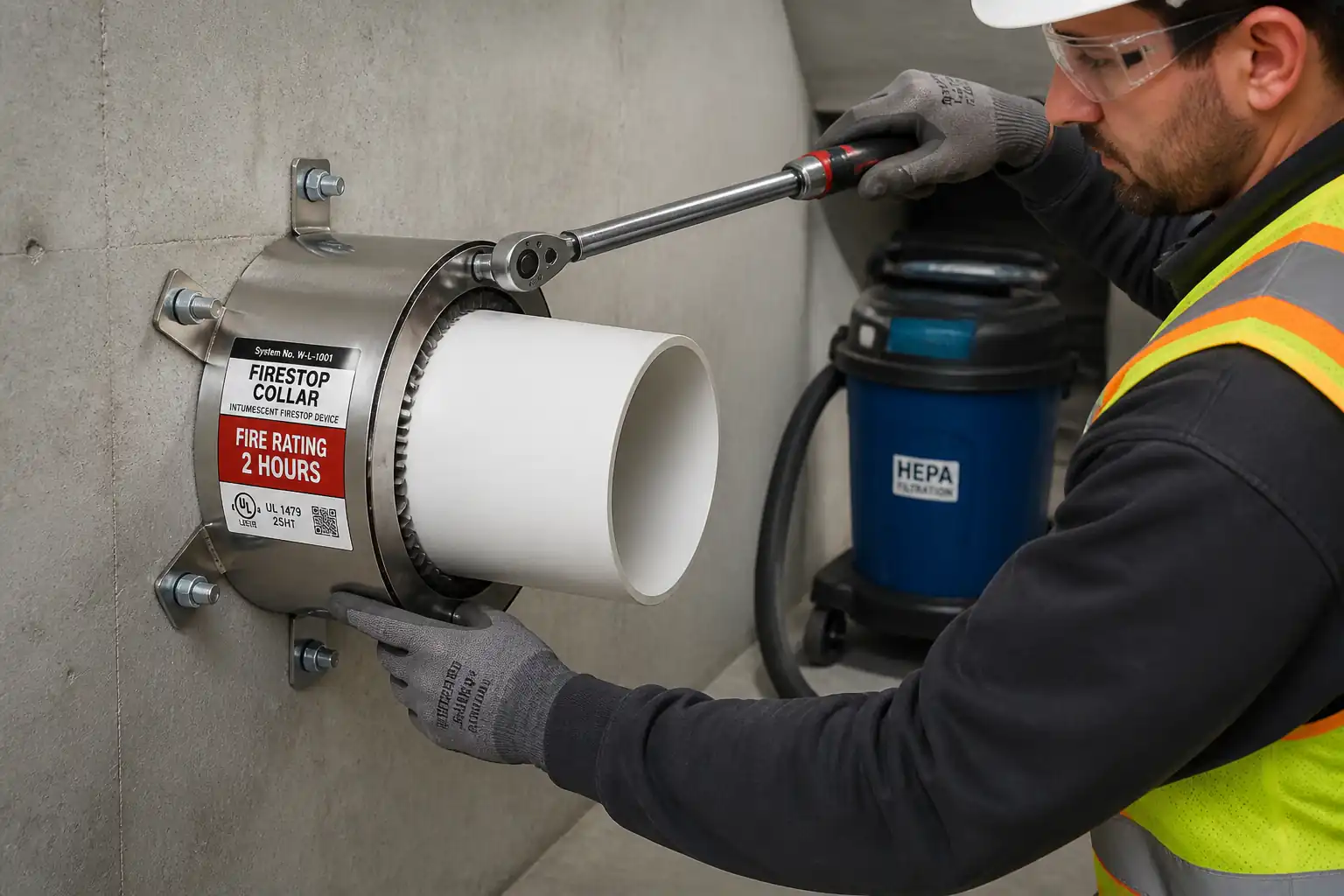
| 4 | Substrate Preparation | Remove loose material/dust using wire brush and HEPA vacuum; roughen smooth concrete to ICRI CSP 3–5 where needed; dampen to SSD; apply primer/bonding agent if specified. | Installer | Witness by QA/QC |
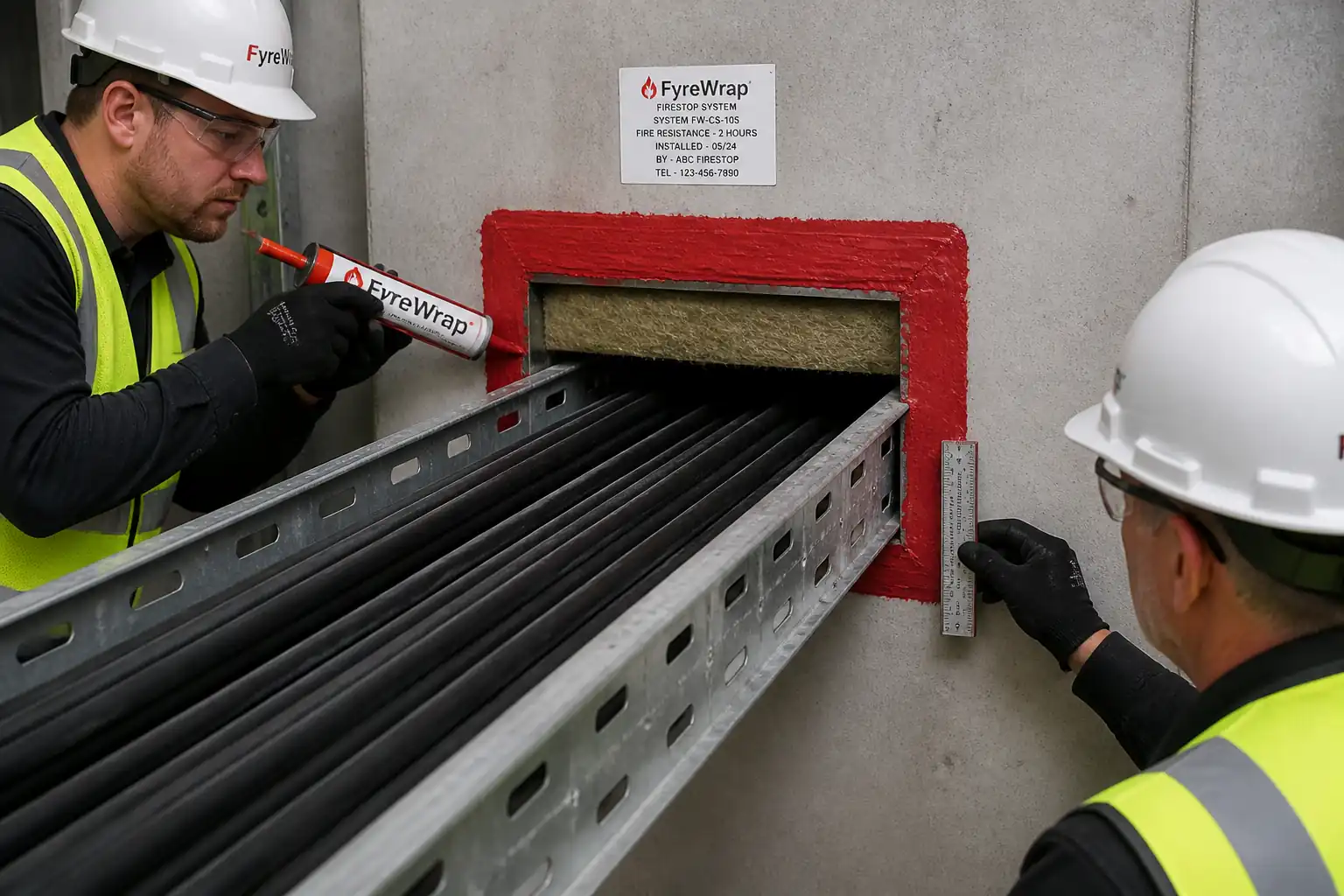
| 5 | Install Backing and Service Accessories | Install mineral wool backing to soffit/sides as per system, compressed 25–50%; install wraps/collars for plastic pipes, sleeves, or cable pathway devices; seal temporary gaps with foam tape where allowed to prevent leakage. | Installer | Hold/Witness by QA/QC |
| 6 | Erect Formwork/Containment | Build tight formwork to required geometry; line with release film/tape; seal joints; brace adequately; provide fill ports if required for deep openings. | Installer | Hold/Witness by QA/QC |
| 7 | Pre-Pour Check | Confirm annular spaces, service spacing, fill depth, and labels to be affixed post-installation; confirm environmental conditions and access. | QA/QC / Site Engineer | Hold Point |
| 8 | Mix Mortar | Add measured potable water to clean container; slowly add powder while mixing 3–5 min at 400–600 rpm until lump-free. Do not exceed manufacturer’s water-to-powder ratio. Do not retemper. | Installer | Witness by QA/QC |
| 9 | Wet Density Test (First Batch and Frequency) | Fill 1-Litre calibrated container in two lifts, rod each 25 strokes, strike-off flush, clean exterior, weigh to nearest 5 g. | Installer / QA/QC | Witness by QA/QC |
| 10 | Place Mortar (Base Layer) | Place in 50–75 mm lifts, working around services to avoid voids; gently rod/trowel to consolidate; avoid displacing wraps/collars. | Installer | Surveillance by QA/QC |
| 11 | Embed Mesh (if required by system) | Place galvanized steel mesh or manufacturer-approved reinforcement where spans/openings exceed system limits. | Installer | Witness by QA/QC |
| 12 | Place Mortar (Final Lift and Finish) | Continue lifts to reach required depth/flush finish; trowel smooth; form a slight crown if specified; clean adjacent finishes immediately. | Installer | Surveillance |
| 13 | Curing and Protection | Protect from disturbance, vibration, and rapid drying; maintain ambient conditions; lightly mist if recommended; keep formwork in place until initial set. | Installer | Surveillance |
| 14 | Formwork Stripping | Remove formwork carefully after initial set; repair any edge nicks; do not pry against services. | Installer | Witness by QA/QC |
| 15 | Dimensional and Visual Inspection | Measure final depth, check annular fill continuity, and surface finish; confirm devices and labels. | QA/QC | Hold/Witness |
| 16 | Adhesion Verification (Field) | At 48–72 h, perform perimeter pry test at 3 locations per side: insert 25 mm chisel 2–3 mm at interface and apply gentle pry to detect debond; soundness check by tapping. | QA/QC / Installer | Witness by Consultant (if required) |
| 17 | Crack Inspection and Repair | Inspect after curing for shrinkage cracks; clean and dampen; fill cracks >0.3 mm with fresh mortar or manufacturer-approved sealant; for >2 mm or mapped cracks, rout to V-notch 5–8 mm and refill; re-check adhesion. | Installer | Witness by QA/QC |
| 18 | Labeling and Documentation | Affix durable label at each penetration with system ID, rating, product, installer, and date; update penetration register with photos and test results. | Installer / QA/QC | Final Witness |
Health, Safety, and Environment (HSE) – Safety Controls
Task-Specific Hazards and Controls
1) Working at Height (floors/soffits)
- Hazard: Falls from MEWP/scaffold/edges; falling through large floor openings.
- Likely Consequence: Serious injury/fatality.
- Controls: Use engineered access (MEWP/scaffold) with guardrails; install temporary covers/guardrails around openings; maintain 3-point contact; no overreaching.
- PPE: Full-body harness with lanyard on MEWP, hard hat, safety footwear, gloves, eye protection.
- Collective Measures: Edge protection, toe-boards, exclusion zone below.
- Inspection/Permit: Pre-use MEWP inspection, current tags; work-at-height permit; competent operators [Verify per project HSE plan and local regulations].
2) Contact with Live/Hot Services
- Hazard: Electric shock, burns from hot pipes/steam.
- Likely Consequence: Injury/burns/electrocution.
- Controls: Identify and label all services; de-energize/isolate where feasible; fit insulated covers; maintain clearance; use insulated tools near conductors.
- PPE: Electrically rated gloves (as applicable), thermal gloves, face shield for high-risk work.
- Collective Measures: Lock-out/Tag-out, barriers, signage.
- Inspection/Permit: LOTO permits; supervision by site engineer.
3) Silica/Cement Dust and Caustic Exposure
- Hazard: Respiratory irritation, dermatitis/alkali burns, eye injury.
- Likely Consequence: Acute/chronic respiratory illness; skin/eye damage.
- Controls: Mix in designated ventilated area; use HEPA vacuums; pre-wet small quantities; avoid dry sweeping; provide handwashing and neutral pH soap; follow SDS.
- PPE: FFP3/N99 respirator, chemical-resistant gloves, goggles/face shield, long sleeves.
- Collective Measures: Dust containment screens, local exhaust.
- Inspection/Permit: SDS available; HSE inspections; eyewash within 10 m.
4) Manual Handling of Bags/Formwork
- Hazard: Strains/sprains.
- Likely Consequence: Musculoskeletal injury.
- Controls: Use mechanical aids (carts), split loads, team lift; store at waist height; plan lift path.
- PPE: Gloves with grip, safety footwear.
- Collective Measures: Material hoists where possible.
- Inspection/Permit: Manual handling training; supervision.
5) Drilling/Anchoring for Formwork near PT/Rebar
- Hazard: Striking PT tendons/rebar; falling debris.
- Likely Consequence: Structural damage, injury.
- Controls: Scan with GPR/ferroscan; mark no-drill zones; use stop collars to limit depth; vacuum extraction while drilling; catch nets below as needed.
- PPE: Eye/face protection, hearing protection, gloves, hard hat.
- Collective Measures: Exclusion zone; spotter.
- Inspection/Permit: Permit to drill; recorded scan results; supervision by engineer.
6) Formwork Failure/Leakage
- Hazard: Collapse or mortar leakage.
- Likely Consequence: Injuries, rework, damage below.
- Controls: Engineer formwork with adequate bracing/seals; proof-check before pour; small trial pour if uncertain; do not overload.
- PPE: Hard hat, gloves, safety footwear.
- Collective Measures: Exclusion zone during pour.
- Inspection/Permit: Pre-pour formwork inspection sign-off.
7) Noise/Vibration from Tools
- Hazard: Hearing damage; HAV exposure.
- Likely Consequence: Hearing loss; hand-arm vibration syndrome.
- Controls: Use low-vibration tools; limit exposure time; rotate tasks.
- PPE: Hearing protection (SNR/NRR per site).
- Collective Measures: Noise signage.
- Inspection/Permit: Noise monitoring where required.
8) Housekeeping/Trip Hazards, Wet Surfaces
- Hazard: Slips/trips on wet mortar or hoses.
- Likely Consequence: Minor to serious injury.
- Controls: Maintain tidy area; route hoses/cables overhead or protect; clean spills promptly; non-slip mats.
- PPE: Safety footwear with slip resistance.
- Collective Measures: Good housekeeping policy.
- Inspection/Permit: Supervisor walkdowns.
Environmental Controls
- Mortar Washout/Alkaline Water: Collect all washout water in sealed containers; neutralize to pH 6–9 before disposal; never discharge to drains or soil [Verify per local regulations].
- Dust and Air Quality: Use HEPA vacuums and wet methods; enclose mixing; seal doors/vents temporarily to prevent migration to occupied areas.
- Waste Segregation: Bag mortar waste and contaminated rags separately; recycle paper/plastic packaging where facilities exist; store off ground and under cover.
- Noise: Schedule noisy works within allowed hours; maintain equipment; use acoustic screens if near sensitive receptors.
- Material Storage: Keep bags dry on pallets, covered; prevent cement product runoff.
- Spill Prevention: Bunded mixing area; spill kits available; immediate cleanup of powder spills to prevent windblown dust.
- Energy and Carbon: Batch efficiently to minimize waste; shut off idle equipment.
- Records: Maintain environmental log for waste volumes, pH neutralization, and dust controls.
Quality Assurance / Quality Control
Submittals and Approvals
- Product data, SDS, and third-party listings (UL/ETA) for each penetration type.
- Engineering Judgments (EJ) where a direct tested system is not available, signed by manufacturer or qualified fire protection engineer.
Controls During Works
- Batch Control: Record bag count, batch numbers, water dosage, ambient/material temperatures, start/finish times, pot life adherence.
- Wet Density Testing: First batch per shift, every 10 bags thereafter, and minimum one per penetration. Use 1-L container, rod in two lifts, strike off, weigh. Acceptance: within manufacturer’s published wet density ±10% [Verify per product datasheet]. Investigate and reject if outside tolerance.
- Dimensional/Depth Checks: Measure achieved depth at a minimum of four points per opening; tolerance −0/+5 mm vs listed value.
- Annular Space/Continuity: Verify continuous contact around all services; no voids or through-gaps >2 mm; maintain listed annular spaces.
- Adhesion/Interface Check: At 48–72 h perform perimeter pry test at not less than three points per side. Acceptance: no continuous debond >100 mm and no visible through-gap. If failure occurs, remove loose areas and reinstate; re-test.
- Curing: Protect for minimum period per MDS (typ. 24–72 h) and record conditions; no forced drying or heat guns unless approved by manufacturer.
- Labeling: Affix durable label/plate with system reference, fire rating, product, installer, and date.
Documentation and Handover
- Maintain penetration register with: location, unique ID, system reference, photos before/during/after, density results, adhesion/pry results, batch logs, and labels.
- Nonconformance: Raise NCR for deviations; obtain remedial EJ or reinstall as required.
- Training/Competence: Keep current certificates for installers and toolbox talk records.
- Calibration: Maintain calibration certificates for scales, density container volume verification, and any test equipment.
Attachments
- Approved system listings/EJs for each penetration type.
- Manufacturer’s MDS/SDS and installation manual for mortar, primers, and devices.
- Density test template and sample calculation sheet.
- Pre-pour checklist and formwork inspection sheet.
- Penetration register template and label example.
- Toolbox talk briefing record for this activity.
- Calibration certificates for measuring jug/scale/density container.
- HSE permits (work at height, drilling) and scan reports for rebar/PT locations.
This content is a read-only public reference. Download or customize to get an editable version.
ITP preview
The first inspection activities from the linked ITP for Method Statement: Firestop Mortar Application for Large Openings and Mixed Services:
| Activity | Inspection / Test | Acceptance Criteria | Responsibility | Record |
|---|---|---|---|---|
| Approval of Firestop System/EJ | Review of listings/EJ vs site condition | Exact match to services, substrate, and rating; deviations approved in writing. | Site Engineer / Consultant | Approved submittal, ITP sign-off |
| Material Delivery and Storage | Check CoC, shelf life, storage conditions | Bags intact; within expiry; SDS/MDS on site. | QA/QC / Installer | Material receipt log |
| Substrate Preparation | Cleanliness, SSD, roughness/primer as required | Sound, dust-free, SSD; primer uniform (if specified). | QA/QC | Prep checklist, photos |
Showing 3 of 12 inspection activities. View full ITP →
Related Inspection and Test Plan
An Inspection and Test Plan (ITP) is available for Method Statement: Firestop Mortar Application for Large Openings and Mixed Services. The ITP defines the inspection activities, acceptance criteria, hold and witness points, responsible parties, and records required to verify the work described in this method statement.
View the Method Statement: Firestop Mortar Application for Large Openings and Mixed Services ITP →Frequently asked questions
Continue with related Quollnet resources connected to this method statement.