
Method Statement: Penetration Seals for Combustible Pipes (PVC, HDPE) through Fire-Rated Walls and Floors using Intumescent Firestop Collars – Method Statement
AI-assisted method statement with matching ITP, PDF download, and Excel export.
More than a static template
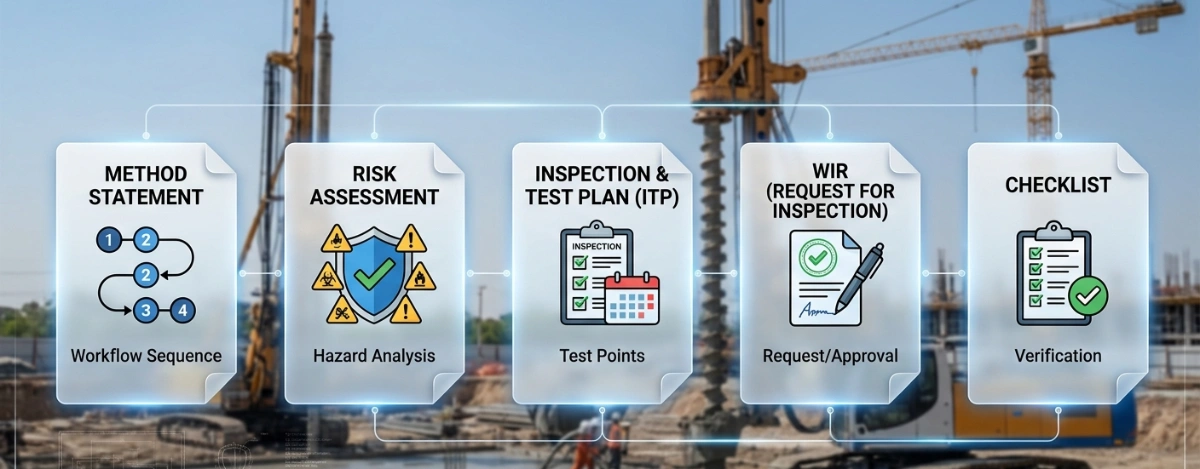
Unlike a downloadable Word or PDF template, this method statement is an AI-assisted editable starting point connected directly to a matching Inspection and Test Plan. Every section is structured, project-adaptable, and ready to export.
- AI-assisted drafting — Customize every section with AI for your specific project scope.
- Linked ITP — A matching inspection and test plan is generated alongside the method statement.
- Multiple export formats — Download as a formatted PDF or editable Excel spreadsheet.
- Editable starting point, not a final document — Review, verify, and adjust all content against your project requirements before use.
Static template vs. Quollnet workflow
| Feature | Static template | Quollnet |
|---|---|---|
| Project-specific content | Manual fill-in required | AI-assisted customization |
| Linked ITP | Separate document, no link | Matching ITP included |
| Export formats | Usually PDF only | PDF and Excel |
| Structured sections | Free-form layout | 13 standardized sections |
| Saved to your account | Local file only | Cloud-saved, reusable |
| Content accuracy | You verify everything | AI-assisted, you still verify |
| Cost | Often free but time-intensive | Free to customize and download |
What you can customize
When you save this method statement to your account, every section becomes editable. The following 13 sections are included:
- Scope — Defines the activity and its boundaries.
- References — Standards, specifications, and drawings.
- Responsibilities — Roles and accountabilities.
- Resources — Labour, plant, and equipment summary.
- Materials — Materials and compliance requirements.
- Equipment — Tools and equipment details.
- Prerequisites — Hold points and pre-conditions.
- Method sequence — Step-by-step construction sequence.
- Safety controls — HSE risk controls and PPE.
- Environmental controls — Environmental mitigation measures.
- QA/QC — Quality inspection and test requirements.
- ITP — Inspection and Test Plan table (has its own page).
- Attachments — Referenced drawings and documentation.
Why this method statement is used
This method statement is used to define and communicate the approved procedure for carrying out method statement: penetration seals for combustible pipes (pvc, hdpe) through fire-rated walls and floors using intumescent firestop collars on site. It ensures the work is planned in advance, the correct resources and controls are in place, and all personnel understand responsibilities, sequence, quality requirements, and safety controls before work begins. It aligns site execution with the documented scope and acceptance expectations.
Who uses this method statement
This method statement is used by contractors, site supervisors, project engineers, QA/QC engineers, HSE officers, consultants, and client representatives. It serves as a shared reference for planning, execution, supervision, inspection, and approval of the activity on site.
When it is prepared and submitted
The method statement is prepared before the work activity starts and submitted as part of the pre-construction documentation package for review and approval.
Who reviews or approves it
The method statement is usually submitted to the client representative, consultant, resident engineer, or project management consultant for review and approval before the work commences.
Important approval note
This method statement is an AI-assisted editable starting point, not a pre-approved document. Before use on any project, all content must be reviewed and approved by the relevant parties (superintendent, principal contractor, or client representative) in accordance with your contract and project quality plan.
For example: if your specification requires a departure from a referenced standard, that departure must be documented and approved separately — this method statement will not capture that automatically. Always verify against your applicable drawings, specifications, and regulatory requirements.
Method statement content
Scope
Purpose
Provide a complete method for sealing combustible plastic pipe penetrations (PVC, uPVC, HDPE, PP) through fire-rated walls and floors using tested and approved intumescent firestop collars. Includes selection by pipe diameter and fire rating, annular gap treatment, fixing requirements, linked collars for clustered services, QA/QC controls, hold/witness points, and an off-site/on-site activation demonstration of the intumescent material (on spare sample only).
Extent
- Applies to single or grouped penetrations of combustible pipes from nominal 25 mm to 250 mm outside diameter [Verify per project specifications and approved system range].
- Fire resistance classifications targeted: up to EI 120 (or F/R 2 hours) for walls/floors where supported by the specific tested system. [Verify per approved UL/ETA system].
Limitations
- Install strictly in accordance with the manufacturer’s tested configuration (UL System No., ETA/CE/DoP). If site conditions differ (substrate, thickness, reinforcement, annular gaps, supports, or proximity to other services), submit RFI for an engineering judgment (EJ) endorsed by the firestop manufacturer and the Engineer/Authority Having Jurisdiction before proceeding.
- Not applicable to metallic pipes, cable trays, bus ducts, or mixed plastic/metal penetrations unless included in the tested system.
- No on-assembly heat activation allowed; activation demonstration is performed only on spare samples off the penetration seal.
References
| Document Type | Reference / Number | Revision | Notes |
|---|---|---|---|
| Standard | EN 1366-3 | Primary test method for penetration seals in EU/UK contexts. | |
| Standard | EN 13501-2 | Determines EI class for walls/floors. | |
| Standard | ASTM E814 / UL 1479 | Acceptable when project approvals reference UL systems. | |
| Standard | ISO 834 / ASTM E119 | ||
| Technical Data | As approved in submittal | Follow system code and details verbatim. | |
| Contract Docs | As issued | Controls precedence. [Verify per project specifications] |
Responsibilities
| Role | Responsibility | Name / Party |
|---|---|---|
| PM | Ensure approved submittals and method/ITP in place | Main Contractor |
| Engineer | Measure and record site conditions; raise RFIs if deviations from tested system | Main Contractor |
| Supervisor | Install per approved UL/ETA system and this method; ensure collar, anchors, and sealants comply | Specialist Subcontractor |
| Installers | Follow WMS and manufacturer’s IFU; complete checklists | Specialist Subcontractor |
| QA/QC | Verify materials, batch records, hold/witness points, photo logs, torque and pull-out tests | Main Contractor |
| HSE | Issue/verify permits (penetration, hot work for demo), ensure controls and PPE | Main Contractor |
| Consultant | Approve deviations/EJs and witness hold points as specified | Engineer/Authority |
| Vendor Tech Rep | Confirm suitability of systems, advise on linked collars and close spacing | Manufacturer |
Resources
| Resource Type | Description | Quantity | Remarks |
|---|---|---|---|
| Labor | - Certified firestop installers (min. 2 persons per workface) - Coring/drilling operator - Site engineer / QA inspector - HSE officer (shared) - Manufacturer tech rep (as-needed/witness) | As required | |
| Access | - Mobile scaffold/tower, podium steps, or MEWP with edge protection - Penetration covers/guardrails for floor openings | As required |
Materials
| Material | Specification / Grade | Quantity | Remarks |
|---|---|---|---|
| EN 1366-3 / UL 1479 tested | As scheduled | ||
| EN 1366-4 where applicable | As required | ||
| EN 13162 | As required | ||
| ETA Option for cracked/non-cracked concrete as applicable | As required | ||
| As required | |||
| 1 per penetration |
Equipment
| Equipment | Capacity / Type | Quantity | Inspection Required |
|---|---|---|---|
| As required | |||
| Set per team | |||
| Per team | |||
| Per workface | |||
| As required |
Prerequisites
- Approved submittals: firestop collars, sealants, mineral wool, anchors, linked collar kits with UL/ETA evidence matching the intended assembly.
- Confirm fire compartmentation strategy, element ratings (wall/floor thickness, type), and required EI/F/R rating from drawings.
- Coordination: Verify location against MEP/shop drawings; ensure adequate clearance from edges/rebars and other services per tested system.
- Permits: Penetration/Drilling Permit; Hot Work Permit only for off-cut activation demo; Confined space permit if within shafts [Verify per project HSE plan].
- Utility scan/verification: Use cable/pipe locator and, where required, GPR. Confirm pipe content is non-live or adequately isolated if risk exists.
- Access and edge protection installed and tagged; floor openings protected/covered and labeled.
- Substrate condition: Clean, dry, sound; temperature typically 5–35°C for sealant application [Verify per TDS].
- Tools calibrated (torque wrench). Anchor suitability verified by pre-test/pull-out on representative substrate (min. 3 tests per substrate type or 1 per 20 fixings—whichever greater) [Verify acceptance per anchor ETA].
- Mock-up: Install 1–2 representative penetrations as a benchmark; obtain consultant approval before production works.
- Batch traceability: Record product batch/expiry; store per TDS.
Method Sequence
| Step | Activity | Description | Responsibility | Inspection / Hold Point |
|---|---|---|---|---|
| 1 | Pre-start verification | Review approved UL/ETA system vs site conditions (wall/floor type and thickness, fire rating, pipe OD, annular gap, accessibility). Record system code (e.g., UL W-J-XXXX or ETA detail). Toolbox talk and permits issued. | Site Engineer / Supervisor | Hold Point H1: System selection and drawings approved |
| 2 | Measure and mark penetration/pipe | Confirm pipe material (PVC/uPVC/HDPE/PP) and OD with calipers; mark collar size and fixing tab position; verify annular gap range allowed by system. | Installer | |
| 3 | Prepare opening and substrate | If required, adjust opening to achieve annular gap. Clean surfaces to bare, dust-free substrate. Ensure accessibility to both faces (walls) or soffit (floors). | Installer | Witness Point W1: Substrate and opening ready |
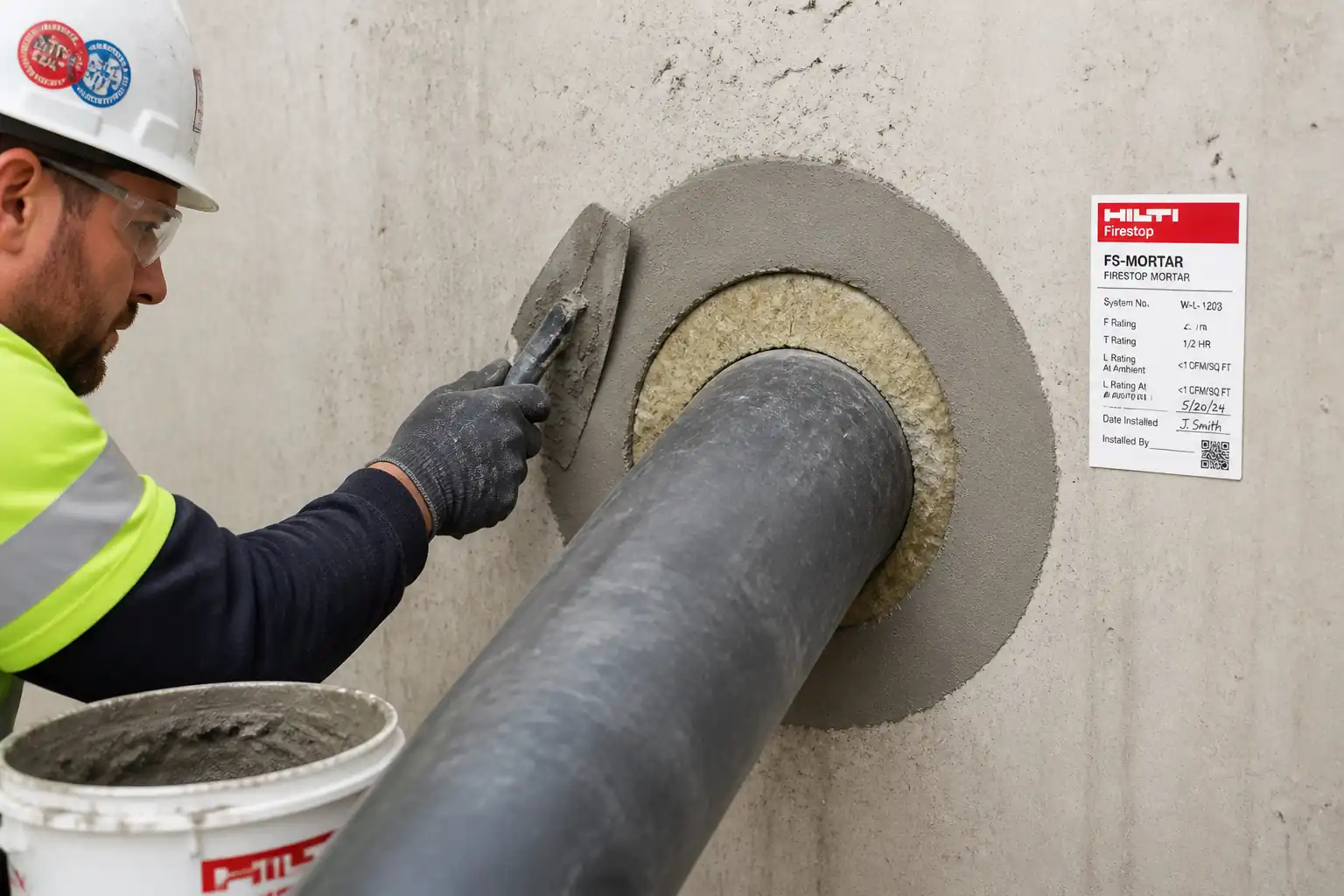
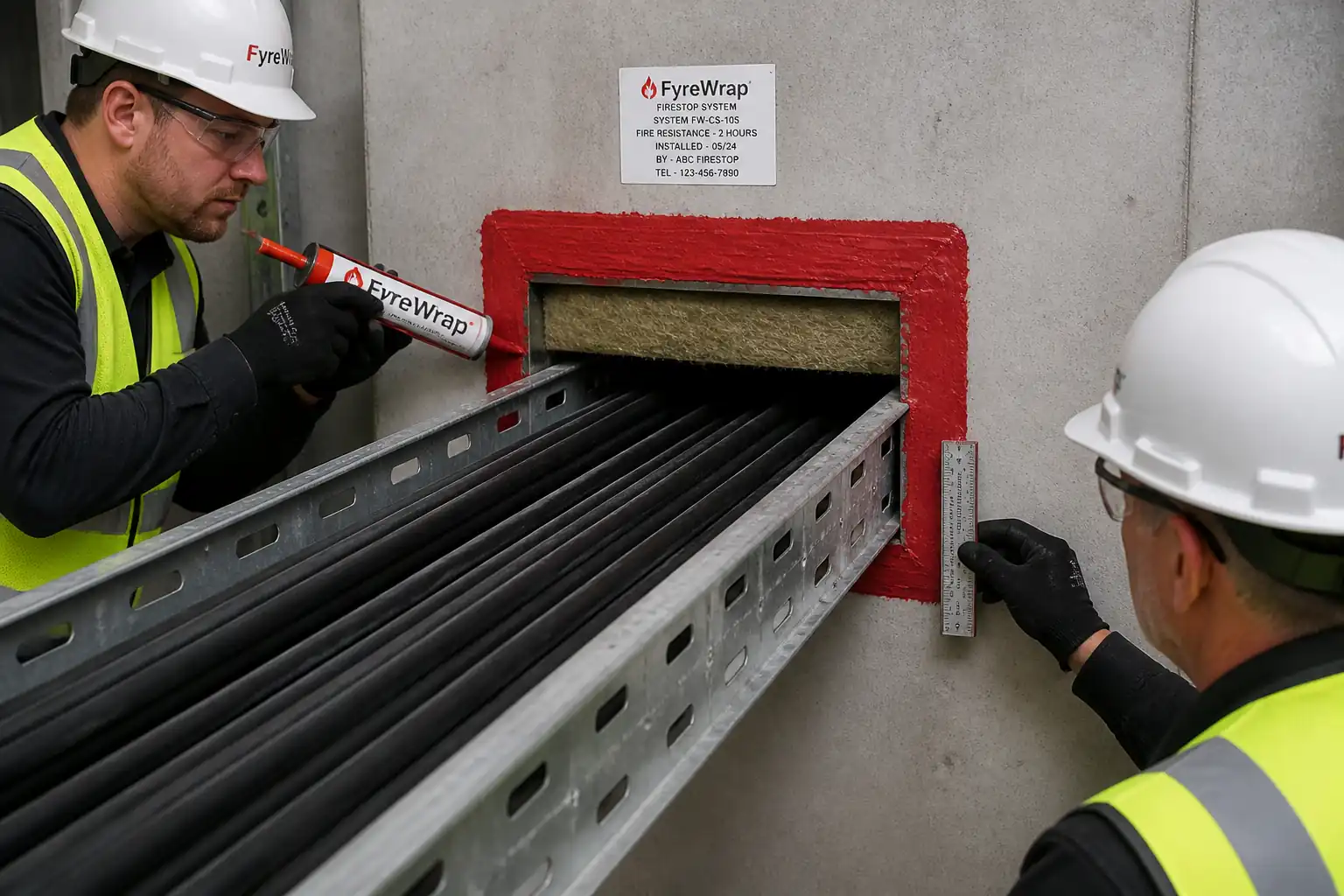
| 4 | Annular gap packing (if required by system) | Insert mineral wool backing to specified depth (typical: walls ≥50 mm; floors ≥100 mm) compressed 30–50%. Apply ablative sealant to each face to depth 10–20 mm to achieve smoke seal, unless system permits no sealant for collars with 0–5 mm gap. [Verify per system]. | Installer | |
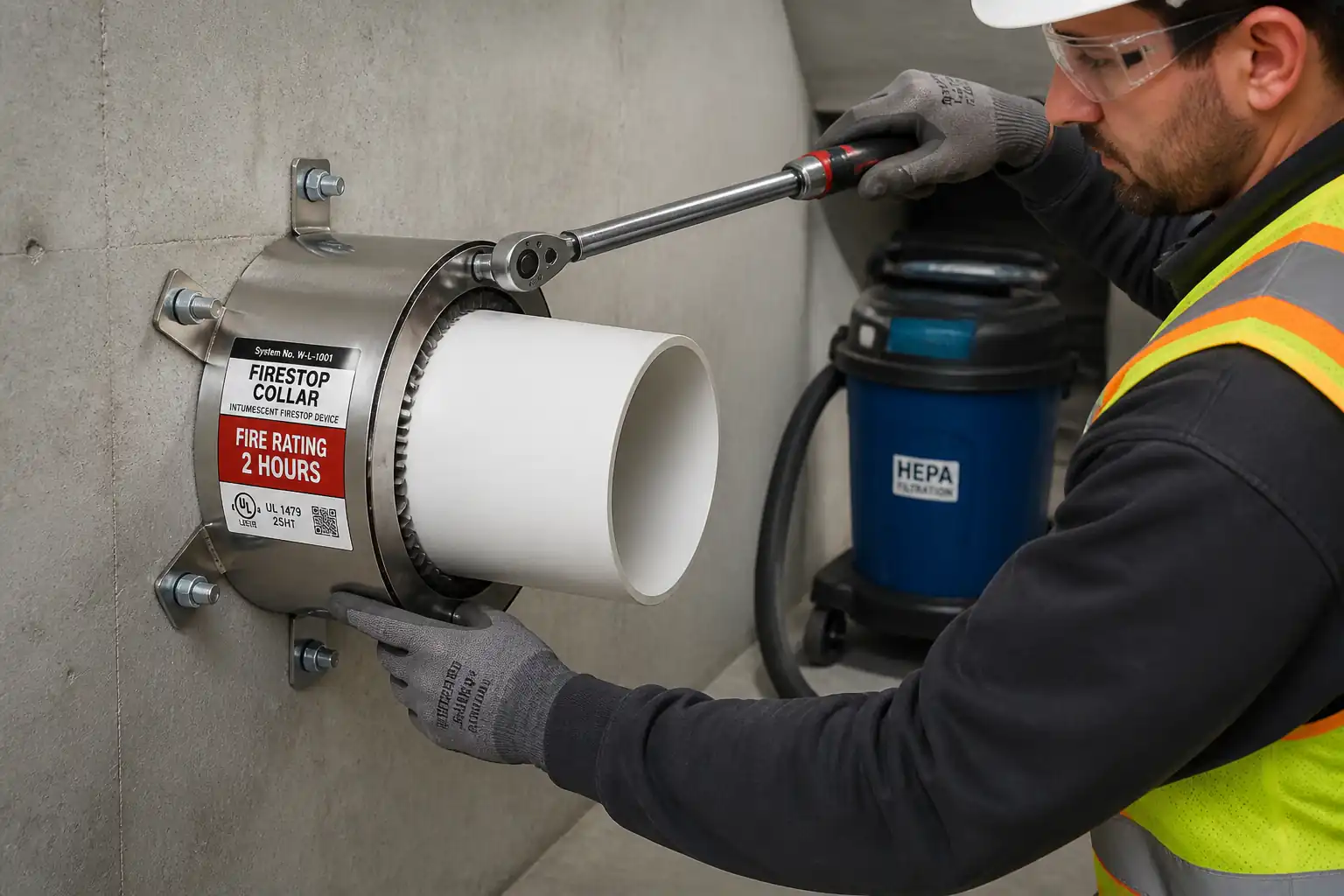
| 5 | Install collar(s) to pipe | Open hinged collar, fit around pipe flush against the fire-rated face. Orient per IFU (intumescent lining towards opening). For walls: install both sides where required. For floors: install to soffit (and top face only if system requires). | Installer | |
| 6 | Fix collar to substrate | Mark and drill fixing holes through tabs. Install stainless steel anchors M6 (or as specified) with minimum embedment 35–45 mm in concrete/masonry; for gypsum/board, use approved hollow-wall anchors or screws into studs as per system. Tighten to torque 5–7 N·m [Verify per anchor TDS]. Fix all tabs provided by the collar. | Installer | Hold Point H2: Fixings before final close-out |
| 7 | Linked collars for clustered pipes | Where pipe center-to-center or collar-to-collar spacing is below the manufacturer’s minimum (typical ≥50 mm) use approved linking/bridging kit to interconnect adjacent collar brackets ensuring simultaneous restraint and preventing interference. Alternatively, use tested multi-collar frames if specified. | Installer | Witness Point W2: Linked system arrangement |
| 8 | Perimeter finishing and make-good | Neaten any sealant fillets; remove masking; clean area. Do not paint collars unless allowed by IFU. | Installer | |
| 9 | Identification and tagging | Fix permanent label adjacent to penetration stating: System ID (UL/ETA), FRL/EI rating, installer, date, materials/batch numbers, and reference to this WMS. | Installer | |
| 10 | Quality inspections and records | Conduct final QA per ITP; verify annular gap, faces installed, anchors, sealant continuity, linked collars, labeling, and photograph all sides. Update firestop register and drawings. | QA/QC Engineer | Hold Point H3: Final inspection prior to acceptance |
| 11 | Activation demonstration (sample only) | In a controlled area, heat a spare collar segment/intumescent sample using a torch/heat gun to demonstrate expansion and charring behavior to stakeholders. Not on installed collar. | Manufacturer Rep / QA/QC | Witness Point W3: Activation demo |
Health, Safety, and Environment: Safety Controls
Principal Task-Specific Hazards and Controls
1) Hazard: Striking hidden utilities while drilling
- Likely consequence: Electric shock, gas/water release, service outage
- Engineering/procedural control: Scan with cable/pipe locator and GPR where required; review as-builts; trial holes; maintain exclusion zones; LOTO/isolation where feasible
- Required PPE: Insulated gloves for verification, eye protection, hearing protection, FFP2/FFP3 mask
- Collective preventive measure: Permit-to-Penetrate system; supervision by Site Engineer
- Inspection/permit/supervision: Penetration permit with sign-off; calibrated locator records [Verify per project HSE plan and local regulations]
2) Hazard: Falls through floor openings/working at height at slab edges/soffits
- Likely consequence: Serious injury/fatality
- Engineering/procedural control: Temporary covers rated for load, edge protection, mobile tower/MEWP with guardrails, tie-off where needed
- Required PPE: Full-body harness with double lanyard when required, helmet with chin strap, safety footwear
- Collective preventive measure: Physical barriers and toe-boards; equipment inspection tags
- Inspection/permit/supervision: Daily access equipment inspection; Work at Height permit as applicable
3) Hazard: Silica dust and debris from coring/drilling
- Likely consequence: Respiratory issues, eye injury, housekeeping hazards
- Engineering/procedural control: Wet coring or on-tool HEPA extraction; use vacuums; limit by preformed sleeves where available
- Required PPE: FFP3 respirator, goggles/face shield, gloves
- Collective preventive measure: Local exhaust ventilation; isolation of area with barriers and signage
- Inspection/permit/supervision: HSE inspections; records of vacuum filter maintenance
4) Hazard: Noise and vibration from drilling/hammering
- Likely consequence: Hearing damage, HAVS risk
- Engineering/procedural control: Low-vibration tools; time limitation/rotation; maintain tools; use torque-controlled anchors
- Required PPE: Class 4/5 hearing protection; anti-vibration gloves
- Collective preventive measure: Noise mapping and restricted hours
- Inspection/permit/supervision: HAVS records; tool condition checks
5) Hazard: Chemical exposure to sealants/primers
- Likely consequence: Dermal/eye irritation, sensitization
- Engineering/procedural control: Review SDS; select low-VOC materials; ensure ventilation; avoid incompatible cleaners on CPVC
- Required PPE: Nitrile gloves, goggles, long sleeves
- Collective preventive measure: Material substitution and ventilation
- Inspection/permit/supervision: SDS available on site; COSHH assessment
6) Hazard: Sharp metal edges on collars and drilling swarf
- Likely consequence: Lacerations
- Engineering/procedural control: Deburr edges; handle with cut-resistant gloves; maintain housekeeping
- Required PPE: Cut-resistant gloves, eye protection
- Collective preventive measure: Magnetic swarf mats and cleanup protocol
- Inspection/permit/supervision: Supervisor checks each workface
7) Hazard: Fire risk during activation demo of intumescent sample
- Likely consequence: Burns, localized fire, fumes
- Engineering/procedural control: Conduct in designated area with non-combustible tray; fire extinguisher; fire watch; limit duration
- Required PPE: Heat-resistant gloves, face shield, FR coveralls
- Collective preventive measure: Hot Work Permit and dedicated fire watch
- Inspection/permit/supervision: Hot Work Permit, gas monitoring if indoors, post-work fire watch 60 min [Verify per project HSE plan]
8) Hazard: Manual handling of cores/equipment at height
- Likely consequence: Strains, dropped objects
- Engineering/procedural control: Use mechanical aids; tool lanyards; team lifts; keep below shoulder height where possible
- Required PPE: Gloves, safety boots, helmet with chin strap
- Collective preventive measure: Exclusion zone below; load-rated tool lanyards
- Inspection/permit/supervision: Pre-task brief; supervisor monitoring
9) Hazard: Working in risers/shafts (confined/poorly ventilated)
- Likely consequence: Asphyxiation, falls
- Engineering/procedural control: Risk assess as confined space if applicable; gas test; ventilation; rescue plan
- Required PPE: Gas detector, harness, communication devices
- Collective preventive measure: Permit-to-Work; standby person
- Inspection/permit/supervision: Confined Space Permit where triggered [Verify per local regulations]
Health, Safety, and Environment: Environmental Controls
- Dust and particulate control: Use wet coring or on-tool HEPA extraction; seal adjacent grilles; routine HEPA vacuuming; prevent migration to occupied zones with temporary barriers and negative air units if needed.
- Noise management: Schedule high-noise works in permitted windows; use low-noise bits; monitor dB(A) levels where required by the EMP.
- Waste management: Segregate metal offcuts, mineral wool, empty cartridges; dispose per local regulations; return unused materials to sealed containers; no wash-out to drains.
- VOC/odors: Select low-VOC sealants; ensure ventilation; avoid solvent cleaners that can attack plastics; store chemicals in bunded areas.
- Water management (if wet coring): Contain slurry with drip trays and wet vacs; no discharge to drainage; dispose via approved waste handler.
- Material stewardship: Maintain batch traceability; FIFO stock rotation; protect materials from moisture/UV.
- Spill control: Spill kits available; immediate cleanup; reportable incidents per EMP.
- Energy/Carbon: Consolidate workfaces to reduce MEWP/scaffold moves; shut down idle tools; use LED task lighting.
- Ecology and neighbors: Avoid drilling during quiet hours adjacent to sensitive receptors; communicate schedule with building operations.
Quality Assurance and Quality Control
Submittals and Approvals
- Product datasheets, ETA/UL listings, DoP, SDS, installation instructions (IFU); anchor ETA and TDS; proposed UL/ETA system codes for each penetration condition; sample labels.
- Proposed firestop register template.
Inspection and Testing
- Hold/Witness points per ITP. Measure and record:
- Pipe OD and type, wall/floor type/thickness, required FRL/EI, system ID.
- Annular gap measured at 4 quadrants using feeler gauges.
- Packing depth and compression (where applicable).
- Anchor type, embedment depth, and torque values (sample 10% or min 3 fixings per penetration) [Verify per project].
- Linked collar configuration for clustered services, spacing to adjacent collars/services.
- Anchor pull-out tests on representative substrates: 1 per 20 anchors or minimum 3, acceptance ≥ design load or ≥0.5–1.0 kN for light-duty collar restraint [Verify per anchor ETA/project specs].
- Sealant adhesion check (field tack test) after cure where used.
- Optional smoke leakage check at 25 Pa using smoke pen where air-seal required by specification [Verify].
Acceptance Criteria (summary)
- Exact match to tested system (UL/ETA) for: element type/thickness, pipe type/OD, collar model/size, annular gap treatment, number of collars and installation face(s), anchor type/spacing, linked components, and any additional sealants.
- Annular gap within system limits; typical ranges: 0–5 mm collar-only; 5–25 mm with mineral wool + sealant [Verify per IFU].
- Collars flush to substrate; all tabs fixed; torque within specified range; no voids or cracks; labels installed; records complete.
Documentation and Handover
- Completed ITP checklists, batch/expiry logs, torque and pull-out records, photo dossier (both faces), permits, as-built drawings and updated Firestop Register (location, ID, rating, system code).
- NCRs and corrective actions closed out prior to handover.
Maintenance
- Provide O&M including inspection intervals (e.g., annual visual inspection, after service modifications). Changes to services penetrating the seal require re-approval and re-certification.
Attachments
- Manufacturer’s UL/ETA tested system sheets and IFU for each configuration (wall/floor, pipe type/OD, collar model, annular gap treatment, linked collars).
- Sample Firestop Penetration Installation Checklist (including measurement fields and batch traceability).
- Firestop Register Template (location ID, system code, rating, materials, date, installer, photos).
- SDS for collars, sealants, primers (if any).
- Anchor ETA/TDS and pre-test/pull-out template.
- Permits: Penetration/Drilling Permit, Hot Work Permit (for demo), Confined Space Permit (if applicable).
- Toolbox Talk brief: drilling hazards, dust/noise control, correct collar/anchor selection, labeling, and prohibition on on-assembly heating.
- Example labels and signages for penetrations.
- As-built mark-up legend and sample photo log requirements.
This content is a read-only public reference. Download or customize to get an editable version.
ITP preview
The first inspection activities from the linked ITP for Method Statement: Penetration Seals for Combustible Pipes (PVC, HDPE) through Fire-Rated Walls and Floors using Intumescent Firestop Collars:
| Activity | Inspection / Test | Acceptance Criteria | Responsibility | Record |
|---|---|---|---|---|
| Review/Approval of Firestop System Selection (per location) | Verify UL/ETA system matches element and service conditions | System code approved; deviations resolved by EJ | QA/QC Engineer / Consultant | Approved submittals; ITP sign-off; RFI/EJ if any |
| Material Receiving Inspection | Check certificates, batch numbers, shelf life, condition | Compliant with approvals; undamaged; traceable | QA/QC Engineer | Receiving report; COA/COC; photos |
| Substrate and Opening Preparation | Visual; measure annular gap; substrate soundness/cleanliness | Gap within limits; surfaces clean/dry; accessibility confirmed | Site Engineer / QA/QC | Inspection checklist; photos |
Showing 3 of 8 inspection activities. View full ITP →
Related Inspection and Test Plan
An Inspection and Test Plan (ITP) is available for Method Statement: Penetration Seals for Combustible Pipes (PVC, HDPE) through Fire-Rated Walls and Floors using Intumescent Firestop Collars. The ITP defines the inspection activities, acceptance criteria, hold and witness points, responsible parties, and records required to verify the work described in this method statement.
View the Method Statement: Penetration Seals for Combustible Pipes (PVC, HDPE) through Fire-Rated Walls and Floors using Intumescent Firestop Collars ITP →Frequently asked questions
Continue with related Quollnet resources connected to this method statement.