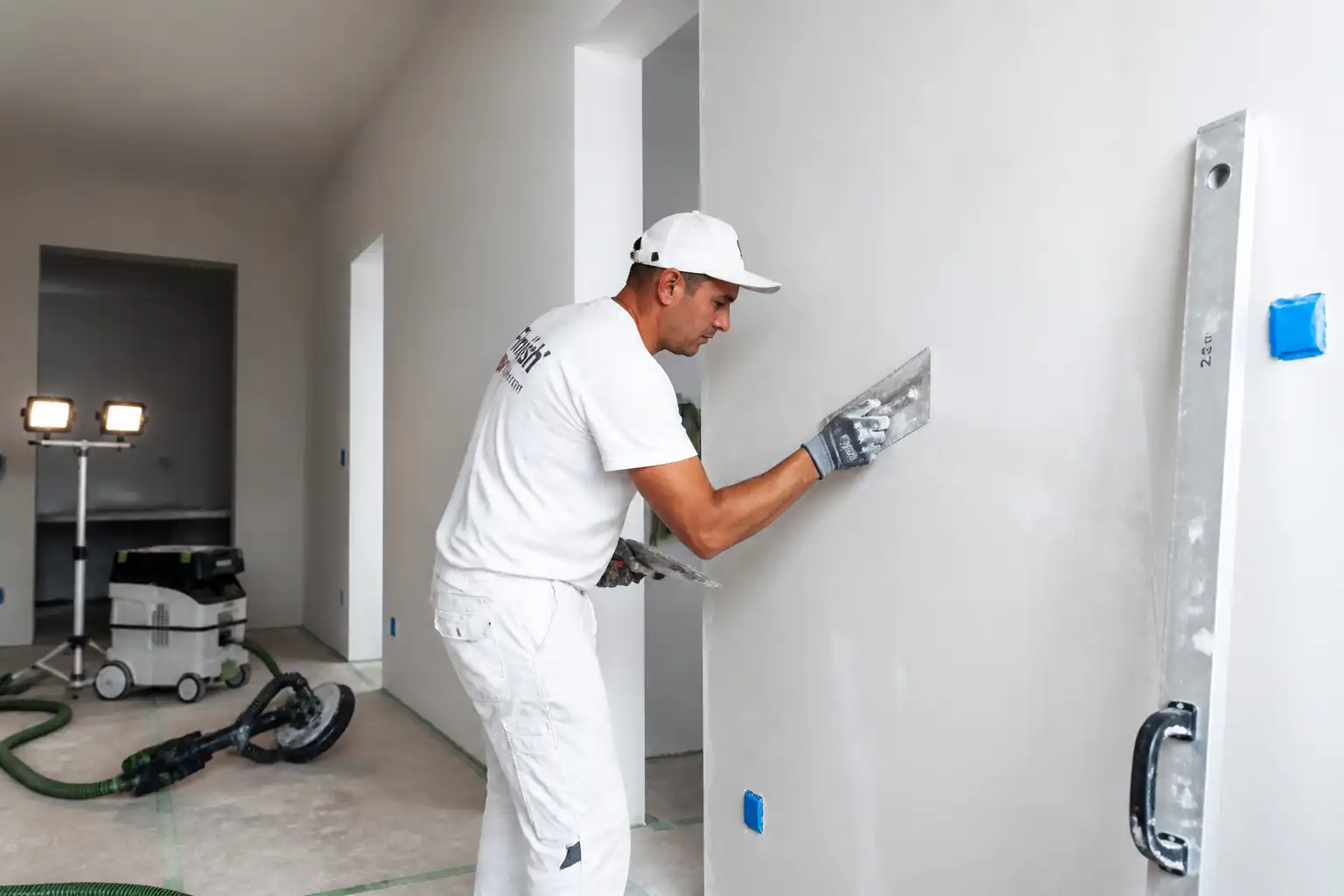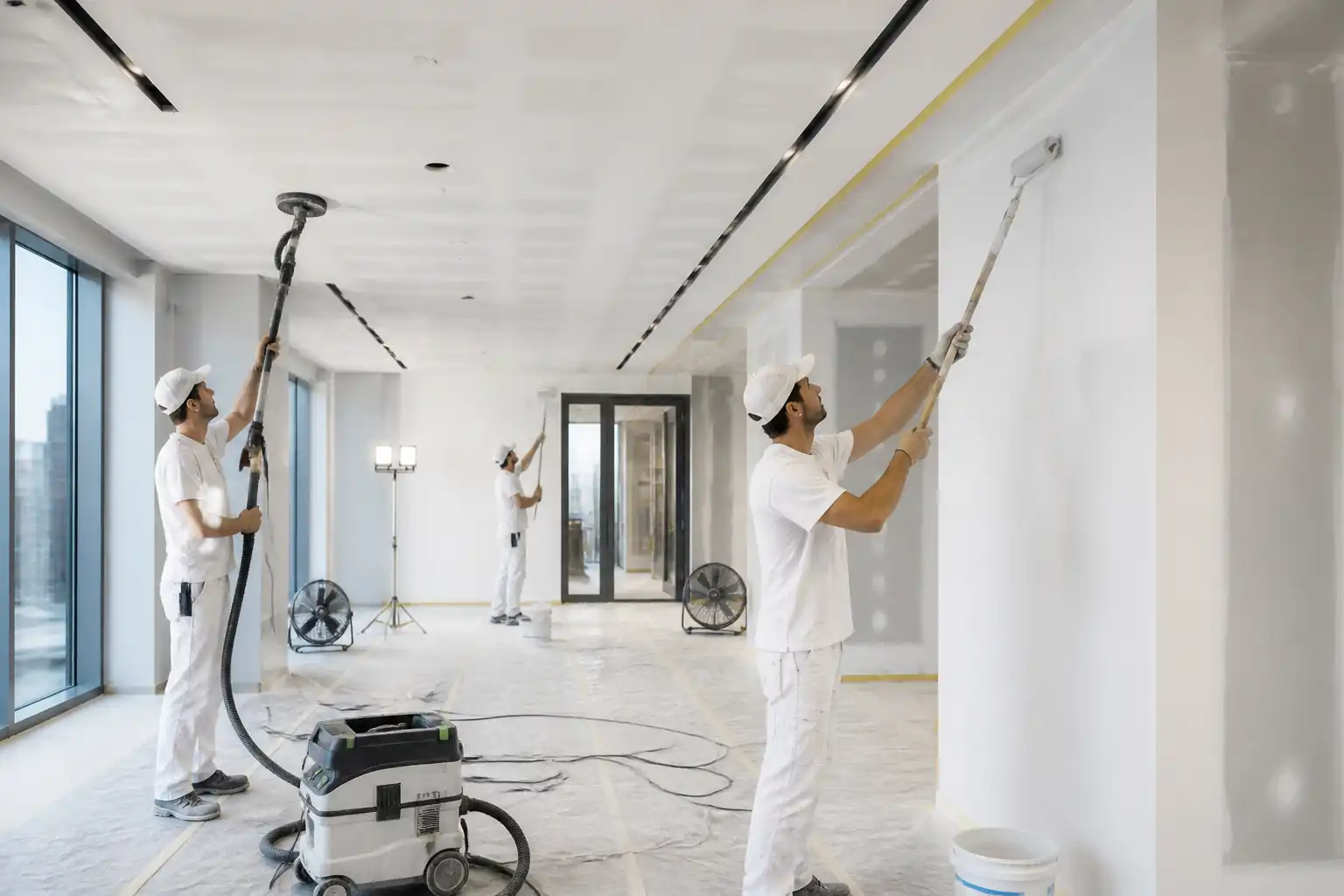

Method Statement – Internal Drywall Emulsion Painting Works (Commercial Interiors) – Method Statement
AI-assisted method statement with matching ITP, PDF download, and Excel export.
More than a static template
Unlike a downloadable Word or PDF template, this method statement is an AI-assisted editable starting point connected directly to a matching Inspection and Test Plan. Every section is structured, project-adaptable, and ready to export.
- AI-assisted drafting — Customize every section with AI for your specific project scope.
- Linked ITP — A matching inspection and test plan is generated alongside the method statement.
- Multiple export formats — Download as a formatted PDF or editable Excel spreadsheet.
- Editable starting point, not a final document — Review, verify, and adjust all content against your project requirements before use.
Static template vs. Quollnet workflow
| Feature | Static template | Quollnet |
|---|---|---|
| Project-specific content | Manual fill-in required | AI-assisted customization |
| Linked ITP | Separate document, no link | Matching ITP included |
| Export formats | Usually PDF only | PDF and Excel |
| Structured sections | Free-form layout | 13 standardized sections |
| Saved to your account | Local file only | Cloud-saved, reusable |
| Content accuracy | You verify everything | AI-assisted, you still verify |
| Cost | Often free but time-intensive | Free to customize and download |
What you can customize
When you save this method statement to your account, every section becomes editable. The following 13 sections are included:
- Scope — Defines the activity and its boundaries.
- References — Standards, specifications, and drawings.
- Responsibilities — Roles and accountabilities.
- Resources — Labour, plant, and equipment summary.
- Materials — Materials and compliance requirements.
- Equipment — Tools and equipment details.
- Prerequisites — Hold points and pre-conditions.
- Method sequence — Step-by-step construction sequence.
- Safety controls — HSE risk controls and PPE.
- Environmental controls — Environmental mitigation measures.
- QA/QC — Quality inspection and test requirements.
- ITP — Inspection and Test Plan table (has its own page).
- Attachments — Referenced drawings and documentation.
Why this method statement is used
This method statement is used to define and communicate the approved procedure for carrying out method statement – internal drywall emulsion painting works (commercial interiors) on site. It ensures the work is planned in advance, the correct resources and controls are in place, and all personnel understand responsibilities, sequence, quality requirements, and safety controls before work begins. It aligns site execution with the documented scope and acceptance expectations.
Who uses this method statement
This method statement is used by contractors, site supervisors, project engineers, QA/QC engineers, HSE officers, consultants, and client representatives. It serves as a shared reference for planning, execution, supervision, inspection, and approval of the activity on site.
When it is prepared and submitted
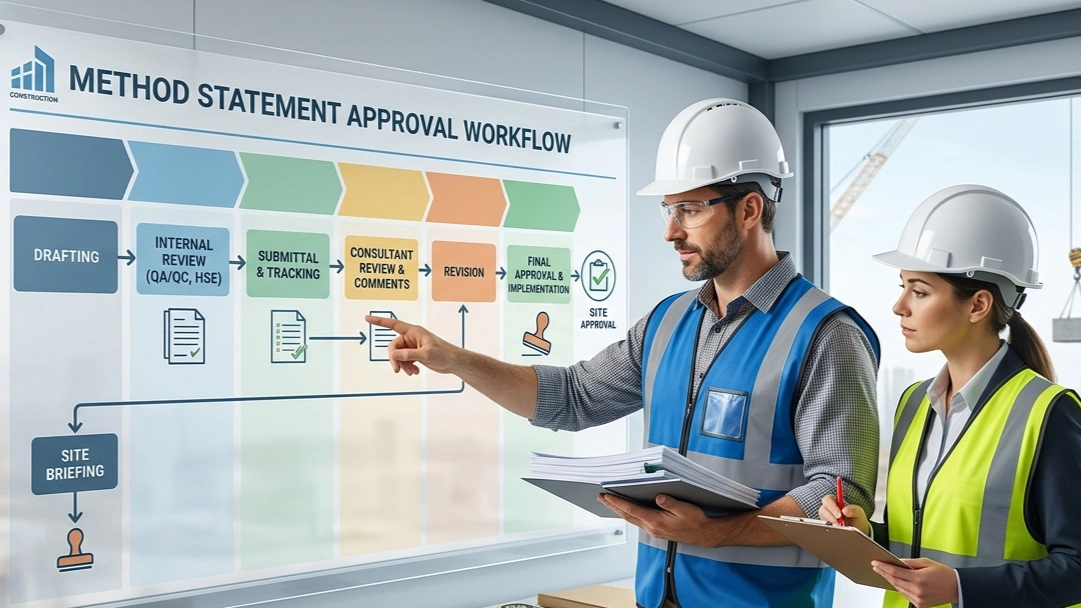
The method statement is prepared before the work activity starts and submitted as part of the pre-construction documentation package for review and approval.
Who reviews or approves it
The method statement is usually submitted to the client representative, consultant, resident engineer, or project management consultant for review and approval before the work commences.
Important approval note
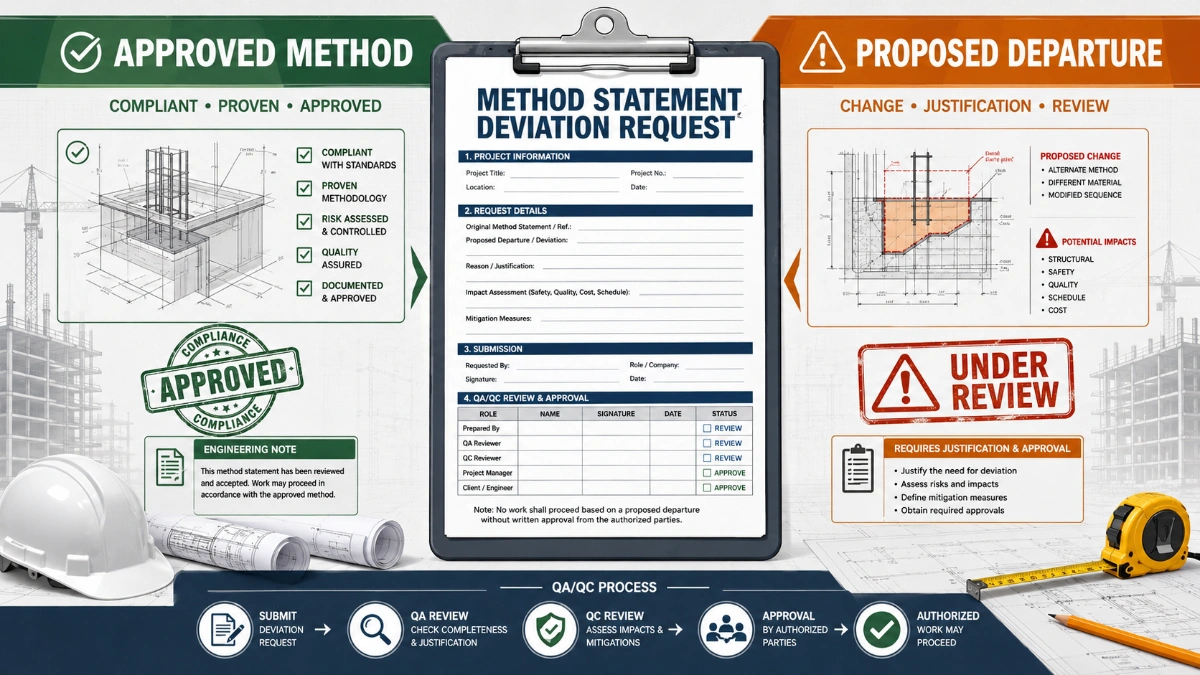
This method statement is an AI-assisted editable starting point, not a pre-approved document. Before use on any project, all content must be reviewed and approved by the relevant parties (superintendent, principal contractor, or client representative) in accordance with your contract and project quality plan.
For example: if your specification requires a departure from a referenced standard, that departure must be documented and approved separately — this method statement will not capture that automatically. Always verify against your applicable drawings, specifications, and regulatory requirements.
Method statement content
Scope
Work Included
- Internal emulsion painting to gypsum board (drywall) walls and ceilings in commercial interiors.
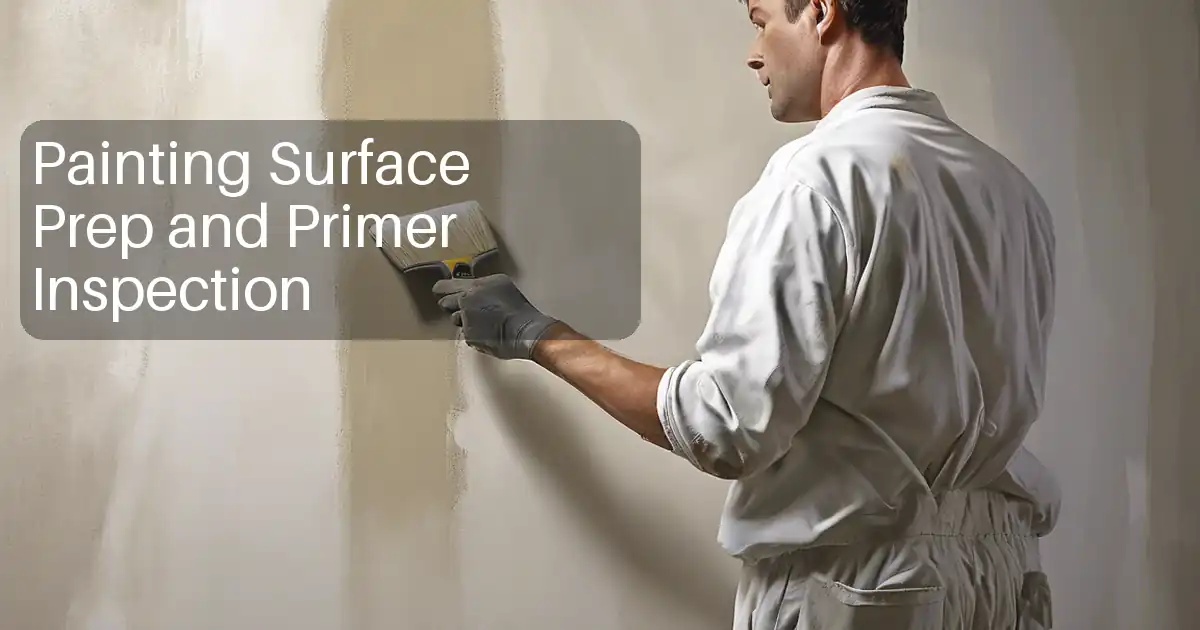
- Surface preparation: inspection of tape and jointing, sanding, dust removal, caulking, and patching.
- Moisture and ambient condition verification prior to coating.
- Primer-sealer plus multi-coat acrylic emulsion finish, including cutting-in and inter-coat preparations.
- Thickness control: wet film thickness (WFT) spot checks and dry film thickness (DFT) verification where practicable.
- Ventilation and drying/curing management, protection of adjacent finishes/fixtures, and housekeeping.
- Defect rectification, final visual acceptance, documentation, and progress logging.
Exclusions
- Structural repairs, drywall installation, or jointing works beyond minor patching.
- Painting of external works, steelwork protective coatings, or specialized high-performance systems (e.g., intumescent, epoxy).
- Replacement of damaged boards beyond localized remedial filling/feathering. [Verify per project scope]
Quality Targets
- Finish level suitable for commercial interiors to GA-214 Level 4 or Level 5 as specified. [Verify per project specifications]
- Primer + 2 finish coats minimum unless otherwise specified.
- Uniform color and sheen, visually acceptable from 1.5 m under normal lighting conditions.
References
| Document Type | Reference / Number | Revision | Notes |
|---|---|---|---|
| BS 6150:2019 – Painting of buildings – Code of practice [Verify applicability per project] | |||
| ASTM C840 – Standard Specification for Application and Finishing of Gypsum Board | |||
| Gypsum Association GA-214 – Levels of Finish for Gypsum Panel Surfaces | |||
| ASTM C475 – Joint Compound and Tape Materials (for reference to compatible patching/taping materials) | |||
| ASTM D4263 – Standard Test Method for Indicating Moisture in Concrete by the Plastic Sheet Method (used for adjacent plaster/concrete surfaces) | Apply for adjacent wet trades substrates that can influence drywall humidity; use pin-type meter for gypsum board. | ||
| ASTM D4414 – Measurement of Wet Film Thickness by Notch Gages | For WFT checks during primer/finish application. | ||
| ASTM D6132 – Nondestructive Measurement of Dry Film Thickness of Applied Organic Coatings Using an Ultrasonic Gage | Use only with instruments suitable for nonmetallic substrates such as drywall; confirm calibration and limitations. | ||
| BS EN 13300 – Paints and varnishes – Water-borne coating materials – Classification | For interior wall/ceiling coatings classification (e.g., wet-scrub resistance Class 1–5). | ||
| Directive 2004/42/EC (EU Decopaint) – VOC limits for paints and varnishes [Verify local regulations] | |||
| Manufacturer’s Technical Data Sheets (TDS) and Safety Data Sheets (SDS) – Primer, Emulsion, Caulk, Patch Compounds | Project-specific; governs spread rates, recoat times, and environmental limits. | ||
| Project Specifications and Drawings [Verify per project] |
Responsibilities
| Role | Responsibility | Name / Party |
|---|---|---|
| Project Manager | Project Manager | Contractor |
| Site Engineer | Site Engineer | Contractor |
| QA/QC Engineer | QA/QC Engineer | Contractor |
| Supervisor | Painting Supervisor / Foreman | Contractor |
| HSE Officer | HSE Officer | Contractor |
| Painter | Skilled Painters / Applicators | Contractor |
| Consultant | Client/Consultant Representative | Engineer/Client |
| Storekeeper | Storekeeper | Contractor |
Resources (Manpower)
| Resource Type | Description | Quantity | Remarks |
|---|---|---|---|
| Supervision | 1 per 6–8 painters [Verify] | ||
| Trades | 1 per 25–35 m²/day for primer + 2 coats typical [Verify] | ||
| Trades | 1 per 2 painters [Verify] | ||
| Quality | As assigned | ||
| HSE | As assigned |
Materials
| Material | Specification / Grade | Quantity | Remarks |
|---|---|---|---|
| Primer-Sealer (Water-borne) | Manufacturer-approved; minimum solids by volume 30–45% [Verify] | As per BOQ | VOC compliant per 2004/42/EC [Verify] |
| Finish Coat – Acrylic Emulsion | Sheen: Matt/Eggshell/Satin as specified; solids 30–45% [Verify] | As per BOQ | Class 1 or 2 wet-scrub resistance (BS EN 13300) [Verify] |
| Ready-mix Joint/Patching Compound | ASTM C475 compliant; low-shrink [Verify] | As required | Compatible with primer/finish |
| Acrylic Latex Caulk | Movement ±12.5% typical [Verify] | As required | Paintable |
| Masking Tapes & Films | UV-resistant for stated duration [Verify] | As required | |
| Abrasives (Sanding Discs/Sheets) | Grit: 120/180/240 [Verify] | As required | |
| Cleaning Agents / Detergents | Non-hazardous where practicable [Verify] | As required | Biodegradable preferred |
Equipment
| Equipment | Capacity / Type | Quantity | Inspection Required |
|---|---|---|---|
| Drywall Sander (Vacuum-Assisted) | Variable speed; HEPA-rated extraction | 1 per crew | |
| Rollers, Brushes, Extension Poles | As required | ||
| Airless Spray Unit | 3000 psi max; fine-finish capability | 1 per large area | |
| Moisture Meter (Gypsum-Compatible) | Accuracy ±1% MC [Verify] | 1 | |
| Hygro-Thermometer | Temp 0–50°C; RH 10–95% | 1 per work zone | |
| Wet Film Thickness Gauge | Range 25–300 µm | 1 set | |
| Ultrasonic Dry Film Thickness Gauge | Per ASTM D6132; resolution ≤1 µm [Verify] | 1 | |
| Lux Meter / Portable Inspection Lights | Target 500–1000 lux | 1 | |
| Ventilation Fans / Air Scrubbers / Dehumidifiers | 4–6 ACH target [Verify] | As required | |
| Ladders/Podiums/Mobile Towers | BS/EN compliant; load class per use | As required |
Prerequisites
- Approved material submittals: primer, finish coats, caulk, patch compounds, masking materials.
- Approved method statement and ITP; task-specific risk assessment and permits [Verify per project HSE plan and local regulations].
- Mock-up location agreed and prepared (minimum 2 m² or full wall bay) for finish, color, and sheen approval.
- Drywall installation and tape-and-joint works completed to GA-214 specified level; all services, MEP first/second fix that affect walls completed or protected.
- Substrate dryness: gypsum board fully cured and dry; verify using moisture meter; adjacent plaster/concrete checked per ASTM D4263 where applicable.
- Ambient control: maintain temperature typically 10–35°C and RH 40–70% during application and curing [Verify per TDS/project].
- Calibrations: moisture meter, DFT meter, and WFT gauges within valid calibration (certificates available).
- Access: safe working platforms with current tags; work area isolated; protection installed to floors/fixtures.
- Power and lighting: minimum 500 lux at wall plane for inspection; adequate ventilation equipment available.
- Paint batch numbers recorded; sufficient material to complete each room/zone from single batch where possible to minimize color variation.
Method Sequence
| Step | Activity | Description | Responsibility | Inspection / Hold Point |
|---|---|---|---|---|
| 1 | Pre-start briefing and permits | Conduct toolbox talk covering hazards (dust, VOCs, WAH). Verify permits, access, and interfaces. Confirm approved TDS and colors. | Supervisor / HSE Officer | Permit-to-work, RAMS briefing attendance |
| 2 | Protection and isolation | Install masking films, floor protection, and cover fixtures, diffusers, switches, and glazing. Label protected items. | Supervisor / Crew | Visual check of protection coverage |
| 3 | Substrate inspection (tape & joint) | Check GA-214 level, joint flushness, popped fasteners, corner beads, feathering, and dry/cured compound. | QA/QC Engineer + Supervisor | Straightedge/raking light; tactile check |
| 4 | Repairs and sanding | Re-fix fasteners; apply patch compound; sand to 180–240 grit; feather edges; vacuum dust (HEPA). | Crew | Spot visual/raking light |
| 5 | Moisture and ambient checks | Record substrate MC (gypsum-compatible meter) and ambient T/RH. For adjacent plaster/concrete, use ASTM D4263 plastic sheet test as applicable. | QA/QC Engineer | Instrument readings |
| 6 | Mock-up application and approval | Prepare and finish a sample area to full system (primer + 2 coats); present for approval under specified lighting. | Supervisor / QA/QC / Consultant | Visual under 500–1000 lux |
| 7 | Masking and cutting-in plan | Apply low-tack tapes at interfaces; set sequence for edges, corners, trims. Test tape on sample area to avoid peel. | Supervisor / Crew | Check adhesion/compatibility |
| 8 | Primer application | Apply primer-sealer by roller/spray; maintain wet edge; back-roll where sprayed. Perform WFT spot checks. | Crew | Surveillance by QA/QC |
| 9 | Defect spotting and touch-up | Under raking light, mark pores/defects; fill and sand; spot-prime repaired areas. | Crew | Visual/raking light |
| 10 | First finish coat | Cut-in then roll/spray walls/ceilings; maintain uniform film; ensure ventilation (4–6 ACH). | Crew | QA/QC surveillance |
| 11 | Inter-coat inspection and light de-nib | Inspect for defects; lightly sand nibs with 240 grit if needed; dust off. Optional DFT gauge reading if suitable. | QA/QC + Crew | Visual under 500–1000 lux |
| 12 | Second finish coat | Repeat application; align roller direction to eliminate lap marks; final cutting-in as required. | Crew | QA/QC surveillance |
| 13 | Mask removal and detailing | Remove tapes at tack-free stage by pulling back 45°; clean lines; minor touch-ups using small rollers/brushes. | Crew | Visual lines/bleed |
| 14 | Final QA/QC inspection | Room-by-room inspection at 1.5 m viewing distance under normal lighting; color verification vs. standard. Adhesion check if specified. | QA/QC + Consultant | Visual; optional adhesion |
| 15 | Cleaning, reinstatement, and handover | Remove protections; reinstate covers/plates; clean area; submit records and O&M including paint schedule and batch data. | Supervisor / Crew | Housekeeping check |
Health, Safety and Environment – Safety Controls
For each significant hazard, the control measures below describe consequence, engineering/procedural control, PPE, collective protection, and inspection/permit needs. [Verify per project HSE plan and local regulations]
1) Dust generation from sanding drywall compounds
- Consequence: Respiratory irritation, asthma exacerbation, nuisance dust, eye irritation.
- Controls: Use vacuum-assisted sanders with HEPA extraction; wet-sand only where safe; minimize hand-sanding; implement local exhaust ventilation; stagger operations to avoid crowding.
- PPE: P2/P3 disposable respirator; sealed goggles; gloves; disposable coveralls.
- Collective: Temporary barriers and signage; negative-air units for sensitive areas.
- Inspection/Permits: Daily equipment check of HEPA units; HSE walkdowns; record dust control in TBT.
2) Working at height (ladders/podiums/towers)
- Consequence: Falls, fractures, head injury.
- Controls: Use podium steps/mobile towers with guardrails for repetitive work; maintain three points of contact on ladders; prohibit overreaching; secure floors from slip hazards.
- PPE: Hard hat, non-slip safety footwear, fall-arrest if required by assessment.
- Collective: Tower guardrails, toe boards; ladder tags with inspection dates.
- Inspection/Permits: Weekly scaffold/tower inspection tags; pre-use ladder checks; WAH permit if required.
3) VOC/odor exposure from paints/caulks
- Consequence: Headache, nausea, sensitization.
- Controls: Select low-VOC products; maintain 4–6 air changes/hour using fans/air scrubbers; schedule after-hours in occupied buildings; keep containers closed when not in use.
- PPE: Half-mask respirator with appropriate filters if ventilation insufficient; nitrile gloves.
- Collective: Air quality monitoring where required; odor complaints protocol.
- Inspection/Permits: Ventilation plan approval; maintain ambient logs (T/RH/ACH).
4) Manual handling of paint and equipment
- Consequence: Strains, back injuries.
- Controls: Use trolleys for bulk movement; split loads; team lifts; store at working height; decant safely.
- PPE: Gloves, safety footwear.
- Collective: Clear access routes; housekeeping to remove trip hazards.
- Inspection/Permits: Manual handling briefing; spot checks by Supervisor.
5) Slips, trips, and wet surfaces
- Consequence: Sprains, fractures.
- Controls: Keep hoses/cords managed; spill trays under decanting; clean spills immediately; maintain dry walkways.
- PPE: Non-slip footwear.
- Collective: Warning signs; cord covers/ramps.
- Inspection/Permits: Daily housekeeping checklist.
6) Contact with live services (sockets/switches)
- Consequence: Electric shock, burns.
- Controls: Isolate circuits where possible; use masking/blanking plates; avoid wet methods near energized outlets.
- PPE: Electrically rated gloves as needed; insulated tools.
- Collective: Lock-out/tag-out of accessible panels.
- Inspection/Permits: Electrical isolation permit where required; pre-start service check.
7) Spray application hazards (if used)
- Consequence: Overspray inhalation, eye injury, property damage.
- Controls: Use approved airless equipment; correct tip/pressure; spray booths or curtaining; nozzles with guards; do not spray near energized equipment.
- PPE: Respirator suitable for mist; goggles/face shield; coveralls.
- Collective: Exclusion zones; ventilation/filtration.
- Inspection/Permits: Equipment inspection and pressure test logs; operator competency verification.
8) Knife/cutting hazards during masking
- Consequence: Lacerations.
- Controls: Use retractable safety knives; cut away from body; change blades frequently.
- PPE: Cut-resistant gloves.
- Collective: Designated cutting benches.
- Inspection/Permits: Toolbox talk emphasis; spot supervision.
9) Chemical splashes to skin/eyes
- Consequence: Dermatitis, irritation.
- Controls: Closed decanting; pump dispensers; use of wash stations.
- PPE: Nitrile gloves, goggles.
- Collective: Eyewash stations within 10 m.
- Inspection/Permits: SDS available; first-aid ready.
Environmental Controls
- VOC Management: Use low-VOC paints compliant with 2004/42/EC or local equivalent [Verify]. Maintain ventilation to disperse odors. Keep lids closed to reduce emissions.
- Waste Paint and Wash Water: Collect in labeled containers; do not discharge to drains. Allow solids to settle; dispose via licensed waste contractor. Keep spill kits at decanting points.
- Empty Containers: Drain, keep lids on, segregate metal/plastic for recycling where possible. Remove labels or deface before disposal.
- Dust Control: HEPA extraction on sanders; damp wipe after sanding; avoid compressed air blow-off.
- Noise: Limit sanding/spray operations to permitted hours; use quieter equipment where feasible.
- Protection of Adjacent Finishes: Full masking and floor protection; edge sealing to prevent bleed; check daily for integrity.
- Energy and Climate Control: Use dehumidifiers/fans only as needed; switch off when areas are unoccupied; doors/windows closed as per balance of ventilation and dust control.
- Material Storage: Store between 5–30°C; avoid direct sunlight; secondary containment for bulk liquids to prevent spills.
Quality Assurance / Quality Control
Submittals and Records
- Approved TDS/SDS; batch certificates; color schedule and RAL/NCS codes.
- Calibration certificates for moisture meter, WFT/DFT gauges.
- Inspection and test records per ITP; daily progress and ambient logs.
Key Quality Controls
- Substrate Level: GA-214 Level 4 or 5 as specified; straightness and flushness verified using raking light and straightedge.
- Moisture/Environment: Gypsum MC ≤ 12% [Verify]; T 10–35°C; RH 40–70% [Verify]; cross-ventilation 4–6 ACH where feasible.
- Coating System: Primer + 2 finish coats minimum unless specified otherwise.
- WFT: Spot-check each coat with ASTM D4414 gauges to meet TDS-based targets. Calculate WFT = DFT / (solids by volume) × 100.
- DFT: Verify total DFT using ASTM D6132 ultrasonic gauge only if validated for drywall coatings; otherwise confirm by theoretical film build (spread rate × solids). Typical total DFT 70–120 µm [Verify].
- Visual Acceptance: Inspect at 1.5 m under normal lighting (approx. 500–1000 lux). No visible holidays, sags, lap marks, roller splatter, telegraphing of joints, or color/shade variation beyond approved standard.
- Adhesion (If Specified): ASTM D3359 Method A on representative inconspicuous areas; achieve ≥ 4A–5A [Verify].
- Color Consistency: Use same batch within a room/zone; optional ΔE ≤ 2.0 against standard card by spectrophotometer [Verify].
- Defect Rectification: Sand and touch-up; re-prime exposed patches; re-inspect.
Handover
- Submit room-by-room checklists, final inspection forms, punch-list closeout, and O&M including maintenance and cleaning recommendations.
Attachments
- Sample Room/Area Painting Checklist (room-by-room inspection sheet)
- Moisture and Ambient Condition Log (daily)
- WFT/DFT Measurement Log
- Mock-up Approval Form
- Paint Batch and Delivery Register
- Nonconformance Report (NCR) / Site Observation Notice (SN) Templates
- Toolbox Talk Attendance Sheet
- O&M: Paint Manufacturer Data, Cleaning/Maintenance Guidance, Color Schedule
This content is a read-only public reference. Download or customize to get an editable version.
ITP preview
The first inspection activities from the linked ITP for Method Statement – Internal Drywall Emulsion Painting Works (Commercial Interiors):
| Activity | Inspection / Test | Acceptance Criteria | Responsibility | Record |
|---|---|---|---|---|
| Materials receipt and storage | Check labels, batch numbers, VOC class, shelf-life, storage temperature | Conforms to approved submittals/TDS; undamaged containers; within shelf-life. | QA/QC Engineer | Material receipt log; photos |
| Substrate/tape-and-joint inspection | Visual with raking light; straightedge at joints/corners | GA-214 Level 4/5 as specified; smooth, flush, dust-free; fasteners set and patched. | QA/QC Engineer + Consultant | Substrate inspection checklist; IR for hold point |
| Moisture and ambient conditions | Gypsum moisture meter; ambient T/RH log; ASTM D4263 if applicable for adjacent plaster/concrete | Gypsum MC ≤ 12% [Verify]; T 10–35°C; RH 40–70% [Verify]. | QA/QC Engineer | Moisture/ambient log; photos |
Showing 3 of 10 inspection activities. View full ITP →
Related Inspection and Test Plan
An Inspection and Test Plan (ITP) is available for Method Statement – Internal Drywall Emulsion Painting Works (Commercial Interiors). The ITP defines the inspection activities, acceptance criteria, hold and witness points, responsible parties, and records required to verify the work described in this method statement.
View the Method Statement – Internal Drywall Emulsion Painting Works (Commercial Interiors) ITP →Frequently asked questions
Continue with related Quollnet resources connected to this method statement.