
Method Statement: Acoustic Rockwool Batt Insulation in Internal Drywall Stud Partitions – Method Statement
AI-assisted method statement with matching ITP, PDF download, and Excel export.
More than a static template
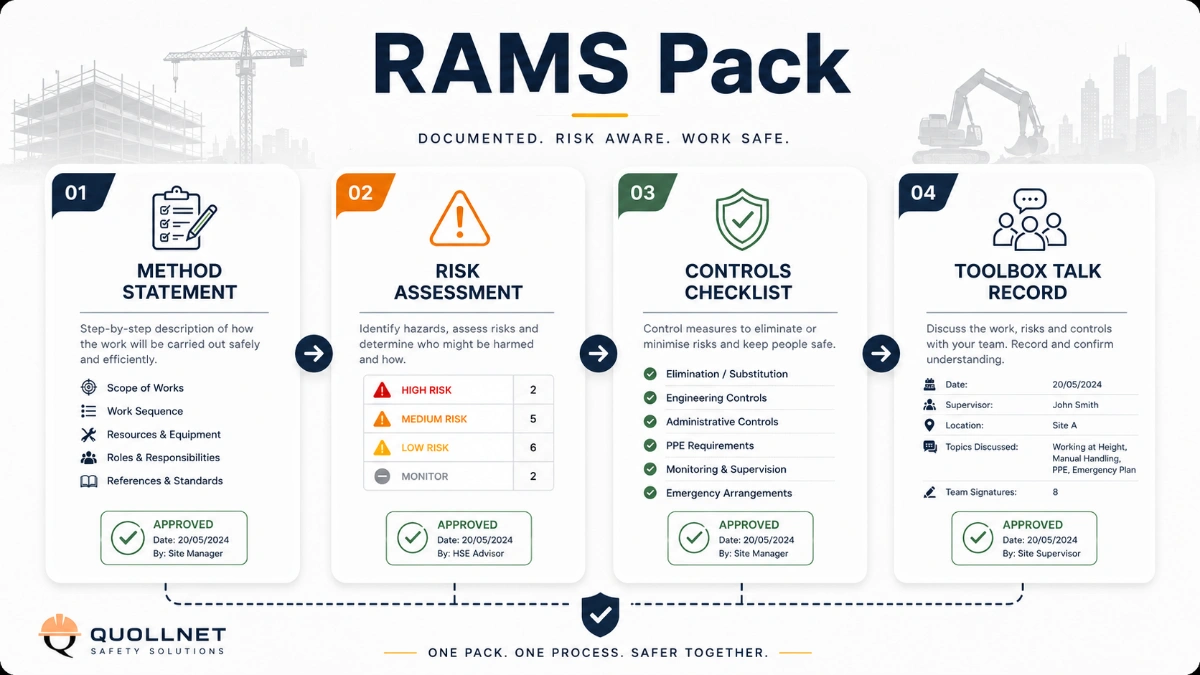
Unlike a downloadable Word or PDF template, this method statement is an AI-assisted editable starting point connected directly to a matching Inspection and Test Plan. Every section is structured, project-adaptable, and ready to export.
- AI-assisted drafting — Customize every section with AI for your specific project scope.
- Linked ITP — A matching inspection and test plan is generated alongside the method statement.
- Multiple export formats — Download as a formatted PDF or editable Excel spreadsheet.
- Editable starting point, not a final document — Review, verify, and adjust all content against your project requirements before use.
Static template vs. Quollnet workflow
| Feature | Static template | Quollnet |
|---|---|---|
| Project-specific content | Manual fill-in required | AI-assisted customization |
| Linked ITP | Separate document, no link | Matching ITP included |
| Export formats | Usually PDF only | PDF and Excel |
| Structured sections | Free-form layout | 13 standardized sections |
| Saved to your account | Local file only | Cloud-saved, reusable |
| Content accuracy | You verify everything | AI-assisted, you still verify |
| Cost | Often free but time-intensive | Free to customize and download |
What you can customize
When you save this method statement to your account, every section becomes editable. The following 13 sections are included:
- Scope — Defines the activity and its boundaries.
- References — Standards, specifications, and drawings.
- Responsibilities — Roles and accountabilities.
- Resources — Labour, plant, and equipment summary.
- Materials — Materials and compliance requirements.
- Equipment — Tools and equipment details.
- Prerequisites — Hold points and pre-conditions.
- Method sequence — Step-by-step construction sequence.
- Safety controls — HSE risk controls and PPE.
- Environmental controls — Environmental mitigation measures.
- QA/QC — Quality inspection and test requirements.
- ITP — Inspection and Test Plan table (has its own page).
- Attachments — Referenced drawings and documentation.
Why this method statement is used
This method statement is used to define and communicate the approved procedure for carrying out method statement: acoustic rockwool batt insulation in internal drywall stud partitions on site. It ensures the work is planned in advance, the correct resources and controls are in place, and all personnel understand responsibilities, sequence, quality requirements, and safety controls before work begins. It aligns site execution with the documented scope and acceptance expectations.
Who uses this method statement
This method statement is used by contractors, site supervisors, project engineers, QA/QC engineers, HSE officers, consultants, and client representatives. It serves as a shared reference for planning, execution, supervision, inspection, and approval of the activity on site.
When it is prepared and submitted
The method statement is prepared before the work activity starts and submitted as part of the pre-construction documentation package for review and approval.
Who reviews or approves it
The method statement is usually submitted to the client representative, consultant, resident engineer, or project management consultant for review and approval before the work commences.
Important approval note
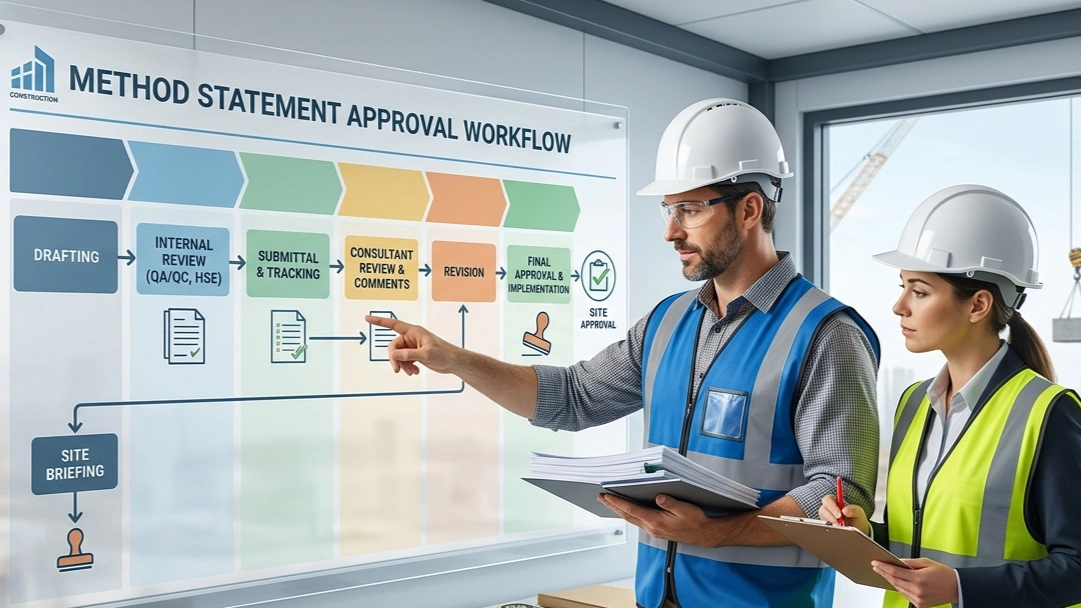
This method statement is an AI-assisted editable starting point, not a pre-approved document. Before use on any project, all content must be reviewed and approved by the relevant parties (superintendent, principal contractor, or client representative) in accordance with your contract and project quality plan.
For example: if your specification requires a departure from a referenced standard, that departure must be documented and approved separately — this method statement will not capture that automatically. Always verify against your applicable drawings, specifications, and regulatory requirements.
Method statement content
Scope
Scope of Works
- Supply, handling, and installation of acoustic mineral wool (rockwool) batt insulation within internal metal stud drywall partitions.
- Verification of stud framing alignment, spacing, and service routing readiness prior to insulation.
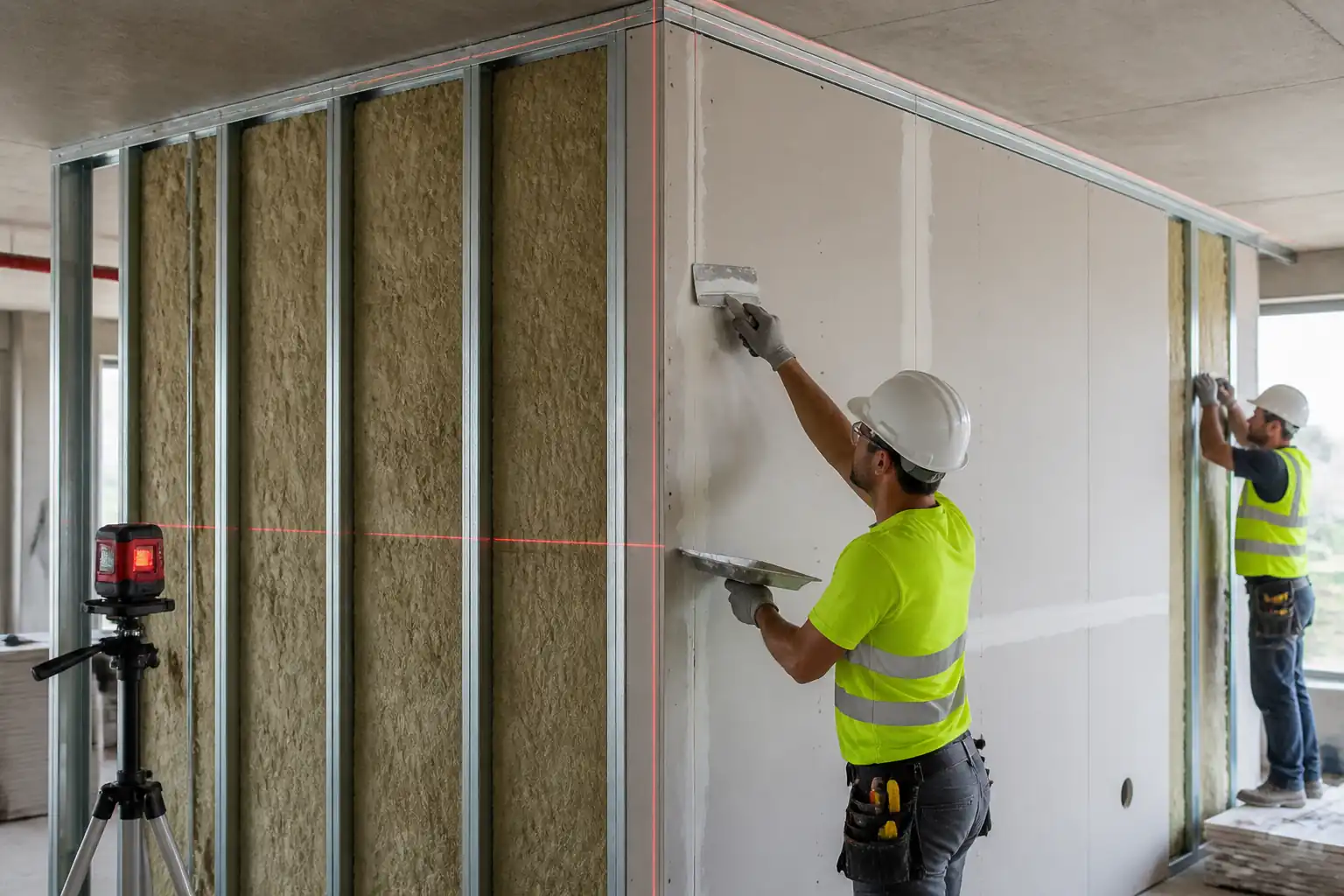
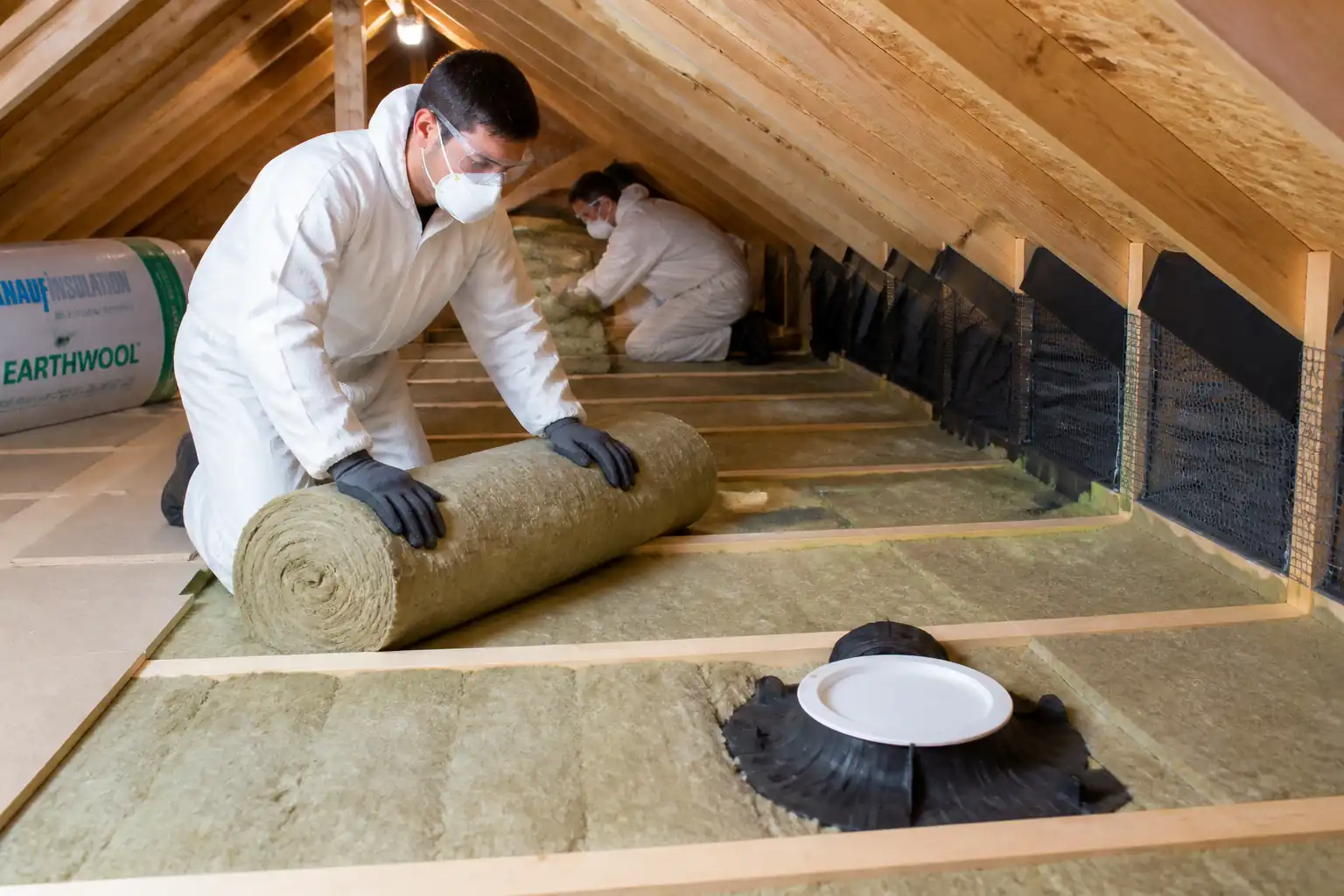
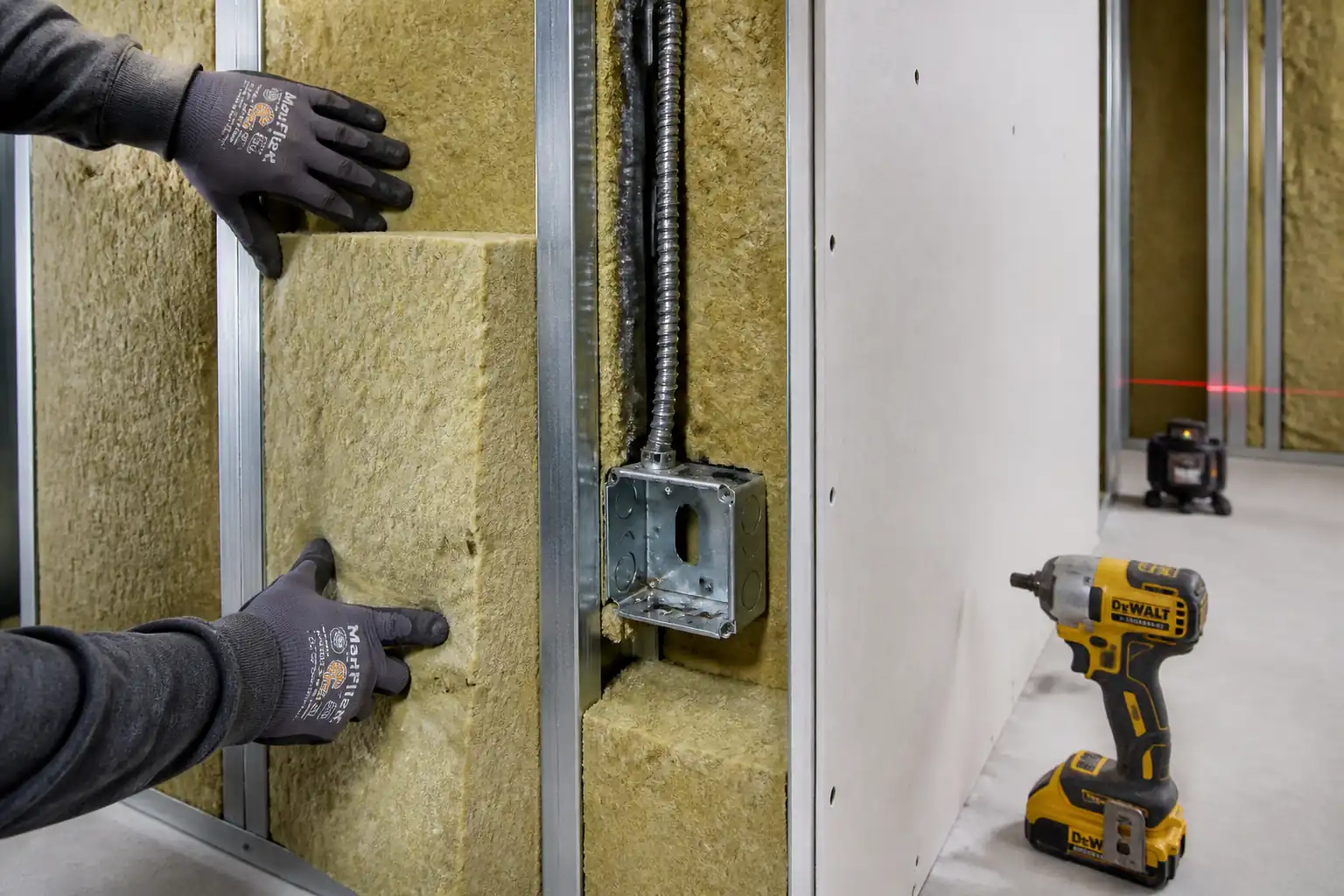
- Tight friction-fit installation of rockwool batts with no voids; precise fitting around electrical conduits, boxes, and service penetrations.
- Application of acoustic sealant at perimeter and around penetrations as specified.
- Closure of partitions with plasterboard panels on the open side, including screw-fixing and perimeter sealing to maintain acoustic integrity.
- Associated QA/QC inspections, documentation, cleanliness, waste management, and ITP compliance.
Exclusions
- Structural framing design and erection (by others; inspected prior to this work).
- Firestopping systems for through-penetrations requiring tested assemblies (separate scope; coordinate interfaces).
- Final jointing/finishing and painting (unless otherwise noted).
References
| Document Type | Reference / Number | Revision | Notes |
|---|---|---|---|
| Standard | ASTM C665; ASTM C612 | Material compliance certificates required [Verify per project specifications] | |
| Standard | BS EN 13162 | CE/UKCA or DoP as applicable [Verify] | |
| Standard | ASTM E90; ISO 10140; ASTM E413; ISO 717-1 | Target STC/Rw per project acoustic report [Verify] | |
| Standard | ASTM E84; EN 13501-1 | Mineral wool often A1/Non-combustible; verify certificates | |
| Standard | GA-216; ASTM C840; ASTM C1396 | For board closure details and screw spacing [Verify] | |
| Standard | ASTM C645; BS EN 14195 | For stud/track material and tolerances [Verify] | |
| Standard | ASTM C919; ASTM C920 | Low-VOC acoustic sealant recommended [Verify] |
Responsibilities
| Role | Responsibility | Name / Party |
|---|---|---|
| Project Manager | Ensure submittals, method statement, and ITP approvals in place | Main Contractor |
| Site Engineer | Verify locations, stud layout, and services coordination | Main Contractor |
| QA/QC Engineer | Hold/witness points; verify materials and workmanship | Main Contractor |
| HSE Officer | Toolbox talks, permits, safety audits | Main Contractor |
| Foreman | Sequence tasks, ensure tolerances and cleanliness | Main Contractor |
| Skilled Operatives | Follow method and manufacturer instructions | Subcontractor |
| MEP Team | Provide clearance; de-energize circuits as required | MEP Subcontractor |
| Storekeeper | Check deliveries, labels, and protection | Main Contractor |
Resources
| Resource Type | Description | Quantity | Remarks |
|---|---|---|---|
| Labor | 1 Foreman, 4 Drywall Installers, 1 Helper | 6 persons | |
| Time | Typical 8–10 h/day; noisy cutting scheduled daytime [Verify per project rules] |
Materials
| Material | Specification / Grade | Quantity | Remarks |
|---|---|---|---|
| Mineral wool | Label by thickness and lot | ||
| Gypsum board | |||
| Fasteners | |||
| Sealant | |||
| Putty |
Equipment
| Equipment | Capacity / Type | Quantity | Inspection Required |
|---|---|---|---|
| 2–3 | |||
| As needed | |||
| Set | |||
| 1–2 | |||
| As required | |||
| 1 |
Prerequisites
- Approved method statement, ITP, material submittals, and manufacturers' data sheets on file.
- Shop drawings approved: partition types, stud spacing (e.g., 400 or 600 mm centers), board type/thickness, acoustic/perimeter sealant locations, and details around boxes/penetrations. [Verify per project specifications]
- Framing installed, plumb, and braced; services rough-in completed and inspected; electrical circuits in the work area isolated or lock-out/tag-out implemented as required. [Verify per project HSE plan and local regulations]
- Mock-up (if specified) completed and accepted, including a typical service box and conduit penetration.
- Materials delivered, inspected, dry, and stored flat, off the ground, protected from moisture; lot identification recorded.
- Work area clear, weather-tight, and within manufacturer-recommended environmental conditions (generally 10–30°C; RH <70%) [Verify].
- Pre-start briefing/toolbox talk held; check tools and access equipment; confirm permits (e.g., working at height).
Method Sequence
| Step | Activity | Description | Responsibility | Inspection / Hold Point |
|---|---|---|---|---|
| 1 | Receive and Inspect Materials | Check rockwool batts for correct thickness/density; gypsum boards and sealants per approvals; no moisture damage. | Materials Controller / QA/QC | Visual; verify certificates |
| 2 | Pre-Insulation Framing Inspection (Hold Point) | Confirm stud spacing (e.g., 400/600 mm o.c.), plumbness, straightness, and fixity. Verify services routing and box locations. Ensure one board side installed as per design if required by sequence. | Site Engineer / QA/QC | Measure and level checks |
| 3 | Perimeter and Penetration Preparation | Clean tracks and perimeters. Mask adjacent finishes as needed. Pre-plan batt cuts for conduits/boxes. Apply backer rod if joint size requires before sealant. | Foreman / Installers | Supervisor check |
| 4 | Install Rockwool Batts – Full Bays | Insert batts vertically into stud cavities. Slightly compress edges for friction fit, avoiding bowing/sagging. For 600 mm stud centers, use 600 mm batts trimmed 3–10 mm oversize. | Installers | In-process visual |
| 5 | Fit Around Services and Boxes | Split and notch batts to fit around conduits/pipes; do not excessively compress. Behind/around electrical boxes, infill tight pieces. Apply acoustic putty pads to boxes if specified. Seal annular gaps with acoustic sealant. | Installers / MEP Coordinator | Supervisor/QA spot checks |
| 6 | Perimeter Acoustic Sealing (Insulation Stage) | Apply bead of acoustic sealant at head/track interfaces and perimeter where specified before closure. | Installers | Visual |
| 7 | Pre-Closure Inspection (Witness Point) | Verify insulation continuity, fitting quality, and perimeter seals prior to boarding the second side. | QA/QC / Consultant | Joint inspection |
| 8 | Install Plasterboard (Closure) | Fix boards to studs. Stagger joints relative to opposite face. Maintain required screw spacing (typical: 200 mm at edges, 300 mm in field) and clear edge distances (≥10 mm). | Installers | In-process visual; measure spacing |
| 9 | Perimeter and Penetration Sealing (Closure Stage) | Seal board perimeters and service penetrations from room side with acoustic sealant. Install any specified box gaskets/putty pads not previously fitted. | Installers | Visual |
| 10 | Housekeeping and Waste Management | Remove offcuts; segregate gypsum and mineral wool for recycling where facilities exist; vacuum with HEPA filter; remove protection only after acceptance. | Crew / Foreman | HSE/QA walkdown |
| 11 | Final Inspection and Handover | Checklists complete; close-out of punch items; acoustic testing if specified (field test on sample walls). | QA/QC / Consultant | Final IR |
Health, Safety, and Environment (HSE) – Task-Specific Safety Controls
Principal Hazards and Controls
- Hazard: Mineral wool fibers and gypsum dust inhalation/skin irritation
- Consequence: Respiratory irritation, dermatitis, eye irritation
- Engineering/Procedural Control: Cut on stable bench; use HEPA vacuum; avoid dry sweeping; use pre-scored cuts to reduce dust; wash stations provided
- PPE: Safety glasses, long sleeves, nitrile/cloth gloves, P2/P3 (N95/P100) respirator when cutting
- Collective Measure: Local extraction/HEPA vacs; job-specific dust management plan
-
Inspection/Permit: HSE inspections; verify SDS; [Verify per project HSE plan and local regulations]
-
Hazard: Sharp metal stud edges and cutting tools
- Consequence: Lacerations, puncture wounds
- Engineering/Procedural Control: Deburr sharp edges; use guards; store blades safely; cut away from body
- PPE: Cut-resistant gloves, long sleeves
- Collective Measure: Trained operatives; first-aid kit accessible
-
Inspection/Permit: Daily tool checks; toolbox talk
-
Hazard: Working at height on steps/platforms
- Consequence: Falls leading to injury
- Engineering/Procedural Control: Use podium steps/working platforms with guardrails where feasible; maintain three points of contact; no overreaching
- PPE: Safety footwear, where required fall arrest for MEWP
- Collective Measure: Barriers and signage; keep platforms on level surfaces
-
Inspection/Permit: Pre-use ladder/MEWP inspection tags; WAHT permit if required
-
Hazard: Manual handling of boards and batts
- Consequence: Strains, sprains, crush injuries
- Engineering/Procedural Control: Team lifts; use panel lifters/trolleys; plan route clear of obstacles
- PPE: Gloves, safety footwear
- Collective Measure: Mechanical aids available; rotate tasks
-
Inspection/Permit: Manual handling training verification
-
Hazard: Live electrical circuits during work around boxes/conduits
- Consequence: Electric shock, burns
- Engineering/Procedural Control: Confirm isolation/LOTO; prove dead before working near conductors; covers on open boxes
- PPE: Insulated tools where appropriate
- Collective Measure: Coordination with MEP; barriers to exposed gear
-
Inspection/Permit: Electrical isolation certificate/permit to work
-
Hazard: Noise from power tools
- Consequence: Hearing damage
- Engineering/Procedural Control: Use low-noise tools; limit cutting duration; schedule noisy tasks
- PPE: Hearing protection (earplugs/muffs) as required
- Collective Measure: Noise zoning and signage
-
Inspection/Permit: Noise monitoring where required
-
Hazard: Slips, trips, and housekeeping
- Consequence: Sprains, impact injuries
- Engineering/Procedural Control: Keep routes clear; immediate cleanup of offcuts; cable management
- PPE: Safety footwear
- Collective Measure: Housekeeping regime; waste bins at point-of-work
-
Inspection/Permit: Supervisor walkdowns
-
Hazard: VOC exposure from sealants/putty pads
- Consequence: Headache, irritation
- Engineering/Procedural Control: Select low-VOC products; ensure ventilation; follow TDS
- PPE: Gloves, respirator if specified in SDS
- Collective Measure: Ventilation fans if enclosed space
- Inspection/Permit: SDS available; COSHH assessment approved [Verify]
Environmental Controls
- Material Selection: Prefer rockwool and gypsum products with recycled content and EPDs where available. [Verify per project sustainability plan]
- Dust Control: HEPA vacuum during cutting; no dry sweeping; damp-wipe where appropriate; protect adjacent occupied areas with temporary sheeting and negative pressure if required.
- Noise Management: Restrict noisy operations to permitted hours; use quieter tools and cutting methods.
- Waste Segregation: Separate gypsum board, mineral wool, metals, plastic packaging. Recycle through approved vendors where facilities exist. Maintain waste transfer records.
- Spill and Sealant Management: Use drip trays and nozzles; clean excess immediately; dispose of sealant waste as per SDS.
- Energy/Resource Use: Cut to optimize yield; plan measurements to minimize offcuts; switch off tools when idle.
- Complaints/Incidents: Record and respond to dust/noise complaints; implement corrective actions.
- Compliance: Follow project Environmental Management Plan and local regulations. [Verify per project HSE plan and local regulations]
Quality Assurance / Quality Control
QA/QC Controls
- Submittals: Approvals for mineral wool, gypsum board, screws, and acoustic sealant before work.
- Mock-up: If specified, demonstrate friction-fit, service box treatment, sealant application, and closure. Acceptance sets workmanship benchmark.
- Tolerances/Criteria:
- Stud spacing within design (+/−3 mm) and plumb within 3 mm over 3 m [Verify].
- Batts to fully occupy cavity depth; visible gaps not exceeding 3 mm; compression not exceeding 10–15% of thickness [Verify].
- Acoustic sealing continuous at perimeters and penetrations; bead width typically 6–10 mm [Verify].
- Board screw spacing typically 200 mm at edges and 300 mm at field; screws slightly dimpled without breaking paper; joints tight and staggered [Verify per GA-216/ASTM C840].
- Inspection Frequency: 100% visual checks by supervisor; QA/QC sampling minimum 10% of partitions per level or as specified. Hold points at framing inspection and pre-closure.
- Testing: Field airborne sound insulation testing only if specified (ISO 16283-1). Fire resistance compliance as per approved assembly listing when applicable.
- Records: Material COCs/DoPs, IRs/WIRs, checklists, photos, NCRs, corrective actions, as-built redlines.
- Non-Conformance: Record NCRs for gaps, sagging batts, missing seals, or screw spacing deviations. Rectify by removing board where needed, refit insulation, re-seal, and re-close. Re-inspect before proceeding.
- Training/Competency: Installers trained in mineral wool handling and drywall systems; toolbox talks documented.
Attachments
- Approved product data sheets: rockwool batts, gypsum boards, screws, acoustic sealant, putty pads.
- Shop drawings: partition types, details at perimeters, head-of-wall, service boxes, and conduits.
- Manufacturer installation guides for mineral wool and drywall systems.
- Inspection checklists (material receipt; in-process insulation; board fixing; sealing).
- Risk assessment and method-specific toolbox talk sheet.
- Example photographic benchmarks of acceptable insulation fit and sealing.
- Waste management and recycling plan extracts.
This content is a read-only public reference. Download or customize to get an editable version.
ITP preview
The first inspection activities from the linked ITP for Method Statement: Acoustic Rockwool Batt Insulation in Internal Drywall Stud Partitions:
| Activity | Inspection / Test | Acceptance Criteria | Responsibility | Record |
|---|---|---|---|---|
| Material Receipt – Rockwool Batts | Verify thickness/density vs. submittal; certificates check (ASTM/EN compliance); fire class | Meets approved data; undamaged; traceable lots | QA/QC Engineer / Storekeeper | Material IR; COC/DoP; SDS |
| Material Receipt – Boards, Screws, Sealants | Visual; quantity; labeling; shelf life (sealant) | Conform to approvals; within expiry; intact packaging | QA/QC Engineer / Storekeeper | Material IR; delivery dockets |
| Framing and Services Rough-In Inspection (HOLD) | Check stud spacing; plumb; fixity; services secured; cavity clear | Spacing and plumb within tolerances; one face boarded if specified; no obstructions | Site Engineer / QA/QC / Consultant | IR/WIR; checklist; photos |
Showing 3 of 8 inspection activities. View full ITP →
Related Inspection and Test Plan
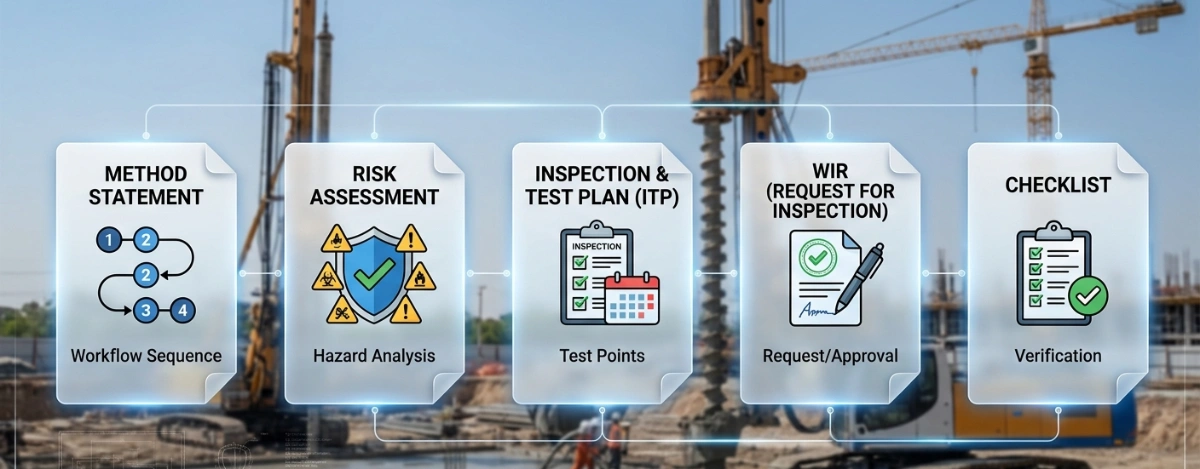
An Inspection and Test Plan (ITP) is available for Method Statement: Acoustic Rockwool Batt Insulation in Internal Drywall Stud Partitions. The ITP defines the inspection activities, acceptance criteria, hold and witness points, responsible parties, and records required to verify the work described in this method statement.
View the Method Statement: Acoustic Rockwool Batt Insulation in Internal Drywall Stud Partitions ITP →Frequently asked questions
Continue with related Quollnet resources connected to this method statement.