Requisition Form in Construction: Materials, Services, Budget Control, and Logs
Requisition forms are internal documents contractors use to request materials or services before issuing a purchase order or work order. They are not only administrative forms. In practice, they are among the most important commercial control points in a project because they are often the last stage where the team can still review quantity, specification, activity allocation, timing, and value engineering options before financial, commercial, and often legal commitment is created. This is why requisition forms matter in both procurement and budget control.
A requisition form is the internal request document used to ask for materials, services, or both before a contractor issues a purchase order, work order, or store issue. Depending on the company, the same form may also be called a purchase requisition, material requisition, store requisition, or service requisition. In many practical construction environments, especially with smaller contractors, the form may still be prepared in Excel and circulated by email rather than through ERP software. The format may vary, but the purpose remains the same: to control what is being requested, why it is being requested, and how that request affects budget, procurement, and site operations.
What Is a Requisition Form?
A requisition form is an internal document used to request something that the project needs. That need may be:
-
A material already available in the company or site store
-
A material that must be purchased from a supplier
-
A service that must be ordered from a subcontractor, vendor, or internal department
-
A mixed requirement involving both supply and service
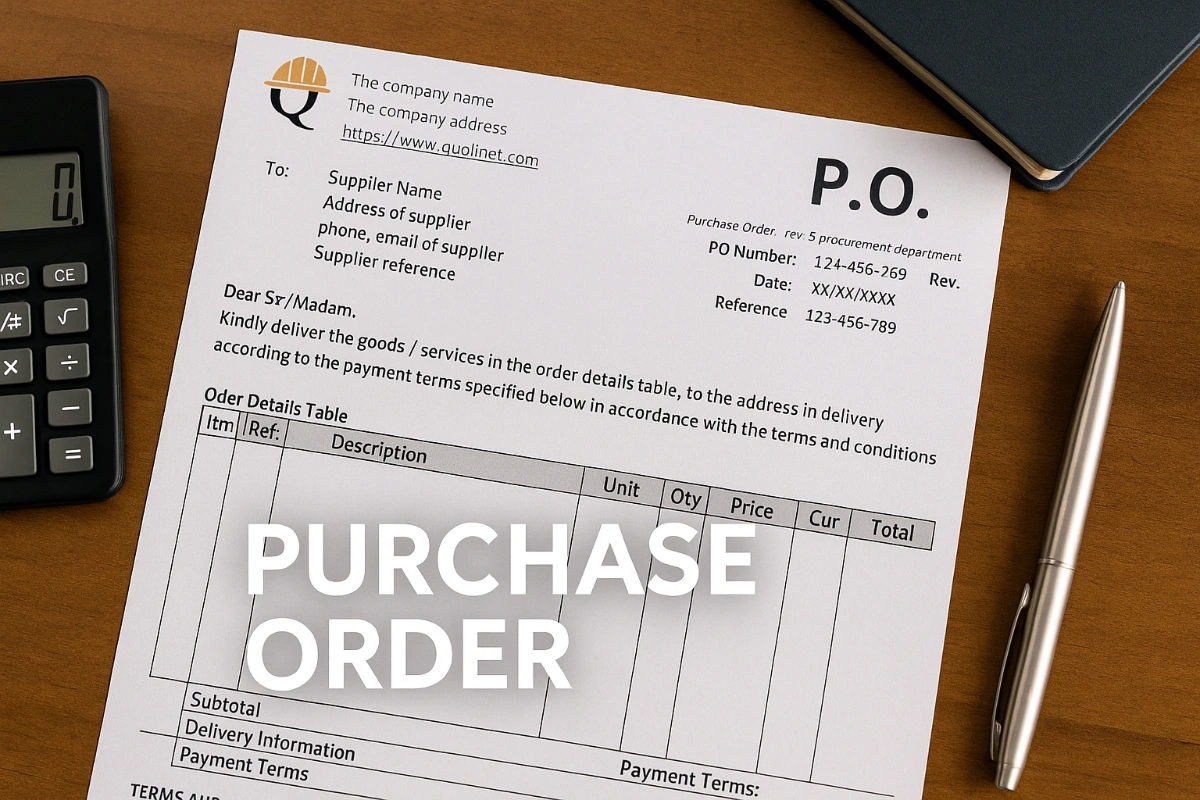
The requisition form is usually prepared before a purchase order or work order. It creates the internal basis for review and approval. It is not the same as a purchase order, and it is not the same as a supplier-facing commercial commitment.
In simple terms:
-
The requisition form asks internally for approval to proceed
-
The purchase order or work order creates the external commitment
This distinction is critical in construction.
Why Requisition Forms Matter in Construction
On many projects, the budget is the contractor’s commercial baseline. The team does not request materials or services randomly. Every request should be tied to a real activity, expected need, and cost consequence.
That is why the requisition form is much more than a document to start procurement. It is often the last internal point where the contractor can still challenge the decision and ask practical questions such as:
-
Do we really need this now?
-
Is the requested quantity correct?
-
Is there stock already available?
-
Is the specification still the latest approved one?
-
Is there an approved equivalent that improves cost or lead time?
-
Is the request tied to the correct activity?
-
Will this purchase protect margin or create avoidable loss?
Once a purchase order is issued, the situation changes. Manufacturing may start. Goods may be loaded. Suppliers may reserve stock. Subcontractors may mobilize. At that point, flexibility becomes much lower.
For that reason, the requisition form is one of the most important commercial control documents in the entire purchasing chain.
Requisition Form vs Purchase Requisition
In many companies, the terms are used interchangeably. This is why both requisition form and purchase requisition are relevant search terms.
In practice:
-
Requisition form is the broader term
-
Purchase requisition often emphasizes that the request may lead to external procurement
-
Material requisition emphasizes physical materials
-
Service requisition emphasizes services or subcontracted work
-
Store requisition often refers to internal issue from store or warehouse
Some contractors use one unified requisition form for everything. Others split it into separate forms for material, service, and store issue. Both approaches can work, provided the process is clear.
Requisition Form for Materials and Services
A good requisition form can be used for both materials and services, but some fields will differ.
Material requisition
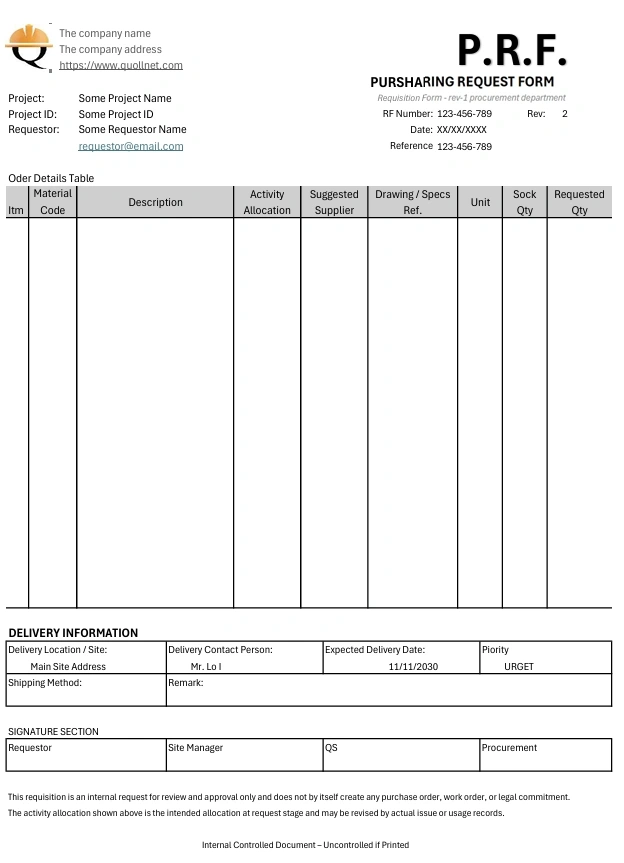
Material requests often include:
-
Item description
-
Unit
-
Quantity
-
Required date
-
Drawing or specification reference
-
Intended activity allocation
-
Stock check
-
Suggested supplier if needed
Examples include:
-
Cement
-
Masonry blocks
-
Pipes
-
Electric cables
-
Fittings
-
Finishing materials
-
General construction consumables
Service requisition
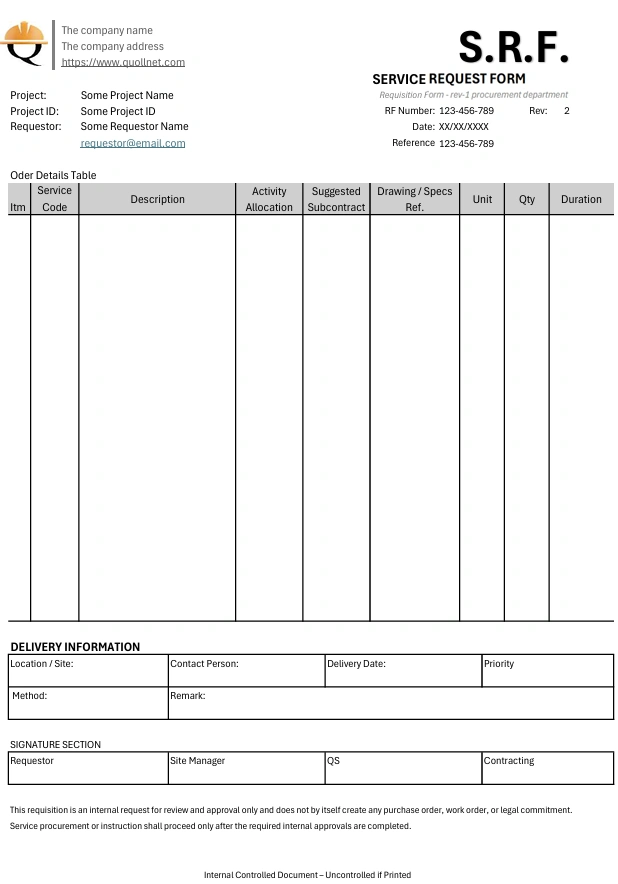
Service requests usually include:
-
Description of service
-
Scope of work
-
Location
-
Duration or period
-
Required date
-
Activity or work package
-
Measurement basis or payment basis
-
Technical requirement
-
Suggested subcontractor or vendor if applicable
Examples include:
-
Testing and commissioning
-
Survey works
-
Equipment rental
-
Calibration
-
Scaffolding support
-
Transport
-
Specialist subcontract works
For service requisitions, the activity is normally known with more certainty. For materials, especially common materials, the final activity of use may later shift on site.
The Last Internal Control Point Before Commitment
This is the main practical reason requisition forms deserve serious attention.
Before the PO or work order is issued, the contractor still has room to:
-
revise quantity
-
revise timing
-
revise purpose
-
revise supplier strategy
-
apply value engineering
-
avoid over-ordering
-
avoid buying against outdated drawings
-
avoid committing cost to the wrong activity
After the PO or work order is issued, the situation changes significantly. At that point, the contractor is often entering into a commercial and legal commitment. Manufacturing may start, goods may be loaded, suppliers may reserve stock, and subcontractors may mobilize. Once this stage is reached, very little can be adjusted without commercial consequence, delay, dispute, or wasted cost.
For materials, this may mean:
-
manufacturing started
-
stock reserved
-
material cut to size
-
loading scheduled
-
return or cancellation exposure created
For services, this may mean:
-
manpower allocated
-
mobilization planned
-
equipment booked
-
subcontractor commitment started
This is why a requisition form is not just a request sheet. It is often the last internal control point before the contractor creates a real financial, commercial, and legal commitment that cannot be easily reversed.
Requisition Form as a Budget and Profit Protection Tool
Contractors make money by controlling cost against budget. That is why the requisition stage matters so much.
At requisition stage, the team can still ask whether the request supports the budget or harms it. This includes:
-
checking if the requested quantity is excessive
-
checking if the request is early and will create storage waste
-
checking if material can be issued from stock instead of purchased
-
checking if the purpose matches the correct activity
-
checking if there is a lower-cost approved alternative
-
checking if the request is solving a site problem or simply creating a future loss
In this sense, the requisition form becomes a commercial filter. It is where budget discipline and operational need meet.
Value Engineering at Requisition Stage
The requisition stage is also the most practical point for value engineering.
This does not mean reducing quality blindly. It means reviewing the requirement intelligently before commitment. Examples include:
-
using an approved equivalent material
-
changing packaging or lot size
-
revising a quantity based on real site progress
-
avoiding duplicate requests
-
changing procurement sequence to reduce waste
-
using existing stock for a different but acceptable need
-
revising a service scope that is broader than required
Once the request becomes a PO or work order, these options become harder to apply. That is why the requisition form is a value engineering checkpoint.
Intended Activity Allocation vs Actual Usage Allocation
One of the most useful fields in a requisition form is the field that links the request to an activity.
A good name for this field is:
Intended Activity Allocation
This means the requester states which activity the request is expected to serve.
Examples:
-
Pipe steel 1/2 inch → Firefighting / pipes
-
Cement → Tiling works
-
Masonry blocks → Partition walls
-
PVC pipe → AC drainage
-
Cable tray accessories → Electrical containment
For service requisitions, this activity is usually fixed. If the service is requested for testing, calibration, duct cleaning, or waterproofing, the activity is normally clear.
For material requisitions, especially common materials, the final use may change later. Cement requested for tiling may later be used in plastering. Pipes initially requested for one system may later be diverted to another. Blocks may move from one temporary use to another permanent use.
So there are really two control moments:
-
Requisition stage records the intended activity allocation
-
Store issue or material issue stage records the actual activity allocation
This distinction is practical, not theoretical. It allows the contractor to keep budget logic clear even when physical site stock is mixed.
Why Actual Usage Must Be Captured Separately
On a real site, common materials are often stored together and used as needed. Cement is not always physically separated by budget line. The same applies to blocks, cables, pipes, and other common items.
That is normal.
The solution is not physical separation. The solution is logical allocation.
This means the site records should show:
-
what was originally received for an activity
-
what was later spent from that activity’s allocated stock
-
what was actually used for a given activity
Without this, common material usage becomes difficult to explain commercially.
Simple Activity Allocation Formula
The good news is that the logic does not have to be complicated.
At any point, the material value currently attributed to an activity can be checked using this rule:
Value on activity = Total material received for this activity − Total material spent from this activity + Total material used for this activity
This is especially useful for common materials.
Example
Assume the following cement movements:
-
We bought $100 of cement for tiling
-
We spent $20 for plaster
-
We spent $30 for tiling
-
We bought $10 of cement for tiling
-
We spent $5 for tiling
-
We bought $25 for plaster
-
We spent $40 of cement for screed
For tiling:
-
Total received for tiling = 100 + 10 = 110
-
Total spent from tiling = 20 + 30 + 5 + 40 = 95
-
Total used for tiling = 30 + 5 = 35
So:
Value currently attributed to tiling = 110 − 95 + 35 = 50
The extra $25 bought for plaster does not affect tiling because it was not received for tiling and not spent from tiling.
The key idea is simple: even if physical stock is mixed, the budget allocation can still be controlled through logical activity records.
What Information Should a Good Requisition Form Include?
A practical requisition form should usually include the following fields:
-
Requisition number
-
Project name
-
Project location
-
Date of request
-
Requested by
-
Department or section
-
Material or service type
-
Description
-
Unit
-
Quantity
-
Required date
-
Intended activity allocation
-
Budget code or cost code if applicable
-
Drawing or specification reference
-
Reason or purpose of request
-
Stock availability check
-
Suggested supplier or subcontractor if relevant
-
Priority
-
Remarks
-
Review and approval signatures or digital approvals
-
Status
If one form is used for both materials and services, some fields can be marked optional or conditional.
Typical Approval Workflow
The approval route depends on company size and project structure, but the real value of the approval chain is that each reviewer looks at the request from a different angle. Approval should not be treated as a simple signature sequence. Each role should check something specific before the requisition moves forward.
Requester
The requester should make sure the requisition is clear, technically correct, and tied to a real site need. The description, quantity, required date, intended activity allocation, and purpose should be stated properly. A vague requisition creates confusion later in procurement, stock control, and budget review.
Site engineer or section engineer
The site engineer usually checks the operational and technical need on site. This includes whether the requested quantity is reasonable for the current period, whether there is enough space on site to receive or store the material, whether the request timing matches actual progress, and whether the request is aligned with the latest approved drawings, method, or work sequence. The site engineer may ask for the quantity to be reduced, split, delayed, or technically adjusted.
Storekeeper or stock controller
The storekeeper checks existing stock and practical store conditions. If the material is already available in large quantities, the storekeeper may recommend reducing the requested quantity, postponing the requisition, or issuing from stock instead of buying more. The storekeeper may also check whether the requested item already exists in an equivalent or usable form in store, and whether receiving additional stock would create unnecessary congestion, damage risk, or overstock.
Procurement
At this stage, procurement usually focuses on supply-side practicality. This includes supplier availability, expected price level, possible source, lead time, packaging or lot size, and whether the requested route is commercially sensible. Procurement may also identify whether the same need can be fulfilled more efficiently through another supplier, another purchasing arrangement, or by combining the request with another order.
Quantity surveyor, cost controller, or commercial reviewer
This is one of the most important checks. The QS or cost controller reviews the request against budget, current progress, and cost performance of the activity. If the material or service already consumed on that activity appears high compared with budget or progress achieved, the QS should raise a flag. This does not always mean the requisition is wrong, but it means action may be needed. The issue could be due to wastage, poor workmanship, design development, wrong budget allowance, price increase, or wrong activity allocation. At this stage, the team may need to consider alternatives, value engineering, correction of quantities, or further investigation before commitment is made.
Project manager
The project manager usually performs the final project-level control check. This often includes confirming that all relevant signatures or reviews are in place, that no reviewer has raised an unresolved objection, that the requisition is aligned with project priorities, and that the source and route of supply are acceptable. The project manager is not always rechecking every technical detail, but is making sure the request has passed the required internal control steps and can proceed without unresolved concern.
Commercial manager or procurement manager if required
For larger or more sensitive commitments, an additional commercial or procurement manager review may be required. This is typically used for high-value items, unusual sourcing strategies, major service packages, or cases where budget pressure, urgency, or supplier risk justifies a higher-level decision.
The purpose of this workflow is not bureaucracy. It is to make sure the requisition is technically needed, operationally practical, commercially reasonable, and consistent with project budget before a purchase order or work order creates commitment.
Common Forms Used Alongside the Requisition Form
A requisition process is stronger when it is supported by related forms and logs.
General requisition form
This is the main form used for both materials and services.
Material requisition example
A filled version for physical materials, showing quantity, unit, intended activity allocation, and stock or procurement route.
Service requisition example
A filled version for services, showing scope, duration, activity, and work package.
Store issue or material issue form
This internal form records what is actually released from site stock and for which activity it is actually used. This is the key form for tracking actual usage allocation.
Work order or purchase order
These are not requisition forms. They are the commitment documents issued after approval.
Important Logs and Registers
Good control depends on logs, not only individual forms.
Requisition register
This is the master log of all requisitions. It should record:
-
requisition number
-
date
-
requester
-
material or service summary
-
intended activity allocation
-
approval status
-
fulfillment route
-
linked PO, work order, or store issue reference
-
remarks
Pending requisition log
This tracks requisitions that are still under review, not yet approved, or not yet fulfilled.
Procurement follow-up log
This tracks which approved requisitions resulted in RFQs, supplier offers, POs, or work orders.
Store issue log
This tracks actual withdrawals from stock and should record the actual activity of use.
Activity usage or allocation log
This is especially useful for common materials. It helps show where material was received for, where it was spent from, and where it was actually used.
Excel-Based vs Digital Requisition Workflows
Modern systems can automate routing, approvals, and status tracking. That is useful. But many smaller contractors still use Excel and email, and that is not necessarily a weakness by itself.
The real issue is not whether the form is digital or in Excel. The real issue is whether the process captures the right information and whether the team uses the form as a decision tool instead of a paperwork exercise.
An Excel-based requisition workflow can still be effective if it:
-
uses consistent numbering
-
includes intended activity allocation
-
checks stock before buying
-
links to budget review
-
records approvals clearly
-
links requisitions to POs, work orders, or store issues
-
captures actual material usage later where relevant
Software improves speed and visibility, but discipline improves results.
New Innovations in Requisition Management
The most recent innovations are usually not about changing the concept of the requisition form itself. They are about improving how the request is captured, reviewed, routed, and tracked.
Examples include:
-
dynamic digital forms for different request types
-
automatic approval routing
-
budget and policy checks before PO creation
-
OCR and attachment extraction from quotations and supporting documents
-
live status visibility
-
integration with procurement and ERP systems
-
analytics on delays, approval bottlenecks, and request patterns
These are useful developments, but in construction practice the core commercial value remains the same. Whether the request is prepared in a modern platform or in Excel, the requisition form is still the stage where the contractor can most realistically protect budget before commitment.
Common Mistakes
Some of the most common problems with requisition forms are:
-
vague descriptions
-
incorrect quantity
-
no stock check
-
no activity allocation
-
wrong or outdated specification
-
requesting too late and forcing urgent buying
-
requesting too early and increasing waste or damage risk
-
skipping technical and commercial review
-
not linking the requisition to the eventual PO, work order, or store issue
-
not tracking actual material usage for common materials
These mistakes reduce the form to paperwork. A good requisition process turns it into a real control tool.
Practical Conclusion
A requisition form is one of the most important internal documents in construction procurement and cost control. It may be used for materials, services, store issues, or purchase requests, and many contractors still manage it in Excel. But regardless of the format, its value comes from what it controls.
It is the stage where the contractor can still review quantity, specification, activity allocation, timing, and budget impact before a purchase order or work order creates commitment.
That is why a requisition form should be treated not just as a request document, but as a budget protection tool, a value engineering checkpoint, and a commercial decision gate.
Download Requisition Form Templates and Examples
Download editable requisition form templates and filled examples for purchasing and service requests. These files are useful for contractors, procurement teams, site engineers, quantity surveyors, and project managers who want practical forms that support approvals, activity allocation, and budget control.
Purchase Requisition Form Downloads
These files cover purchasing or material requisition workflows. They are suitable for requesting materials that may be purchased externally, with fields for project details, requester, reference, activity allocation, suggested supplier, drawing or specification reference, stock quantity, requested quantity, and approvals.
Service Requisition Form Downloads
These files cover service requisition workflows for subcontracted works, rentals, specialist tasks, testing, or scope-based requests. They are suitable when the contractor needs service approval before issuing a work order or procurement instruction.
REFERENCES
- SAP Help Portal: https://help.sap.com/
- Oracle Procurement Cloud Documentation: https://docs.oracle.com/en/cloud/saas/procurement/
- Jotform Requisition Form Template: https://www.jotform.com/form-templates/requisition-form
- Coupa Glossary: https://www.coupa.com/resources/glossary
- Procurement Tactics - Purchase Requisition: https://procurementtactics.com/purchase-requisition/
- Adobe Acrobat - Requisition Form Basics: https://www.adobe.com/acrobat/business/hub/what-is-a-requisition-form.html