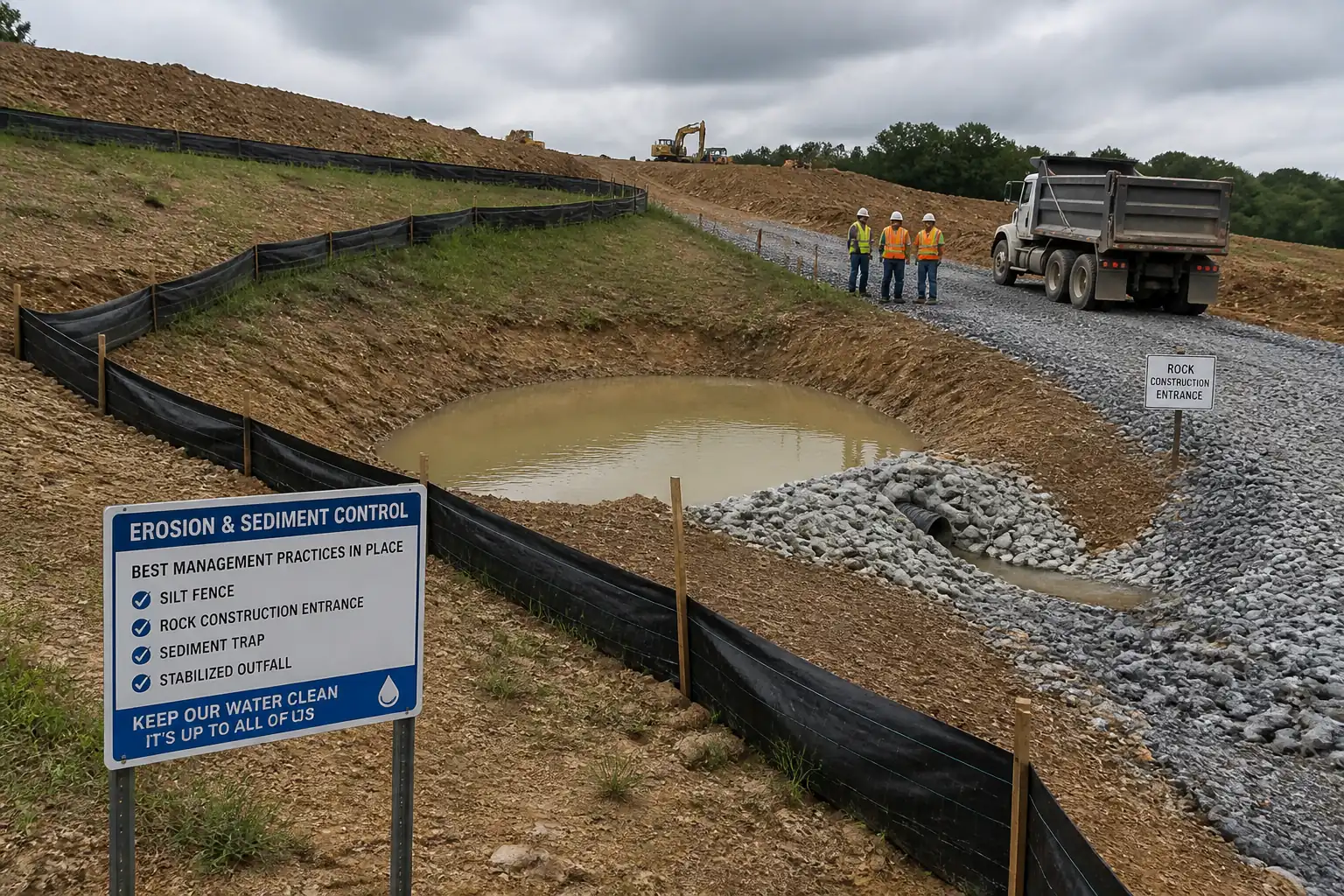

Method Statement: Installation and Maintenance of Erosion and Sediment Control (ESC) Measures – Method Statement
AI-assisted method statement with matching ITP, PDF download, and Excel export.
More than a static template
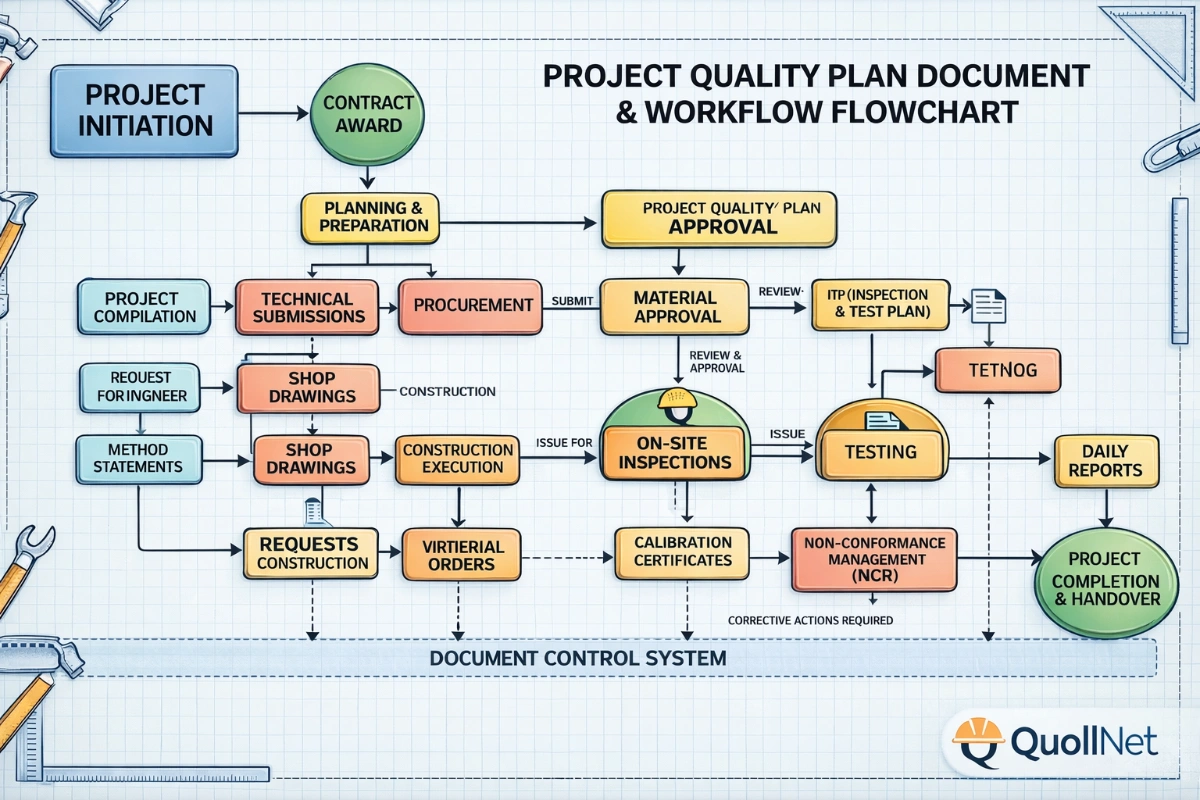
Unlike a downloadable Word or PDF template, this method statement is an AI-assisted editable starting point connected directly to a matching Inspection and Test Plan. Every section is structured, project-adaptable, and ready to export.
- AI-assisted drafting — Customize every section with AI for your specific project scope.
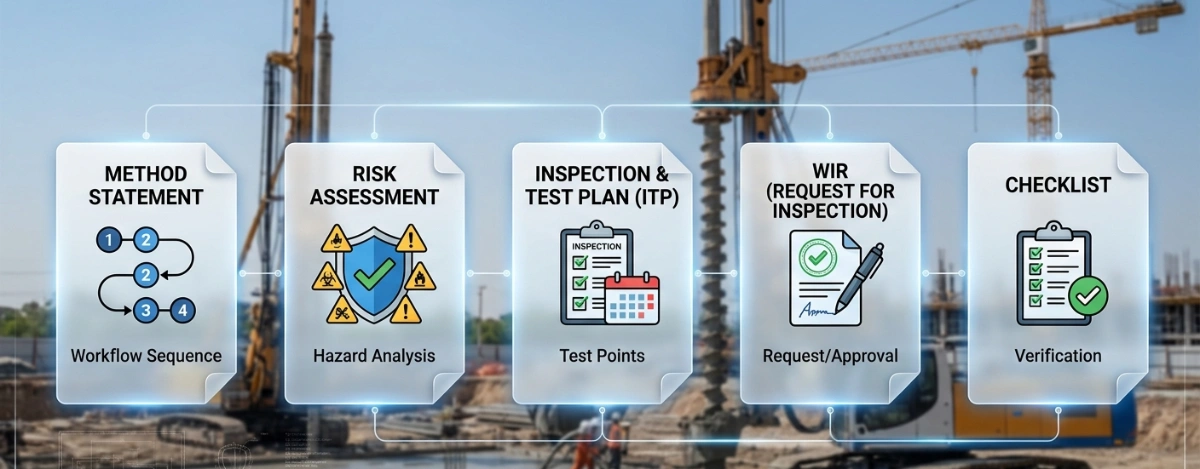
- Linked ITP — A matching inspection and test plan is generated alongside the method statement.
- Multiple export formats — Download as a formatted PDF or editable Excel spreadsheet.
- Editable starting point, not a final document — Review, verify, and adjust all content against your project requirements before use.
Static template vs. Quollnet workflow
| Feature | Static template | Quollnet |
|---|---|---|
| Project-specific content | Manual fill-in required | AI-assisted customization |
| Linked ITP | Separate document, no link | Matching ITP included |
| Export formats | Usually PDF only | PDF and Excel |
| Structured sections | Free-form layout | 13 standardized sections |
| Saved to your account | Local file only | Cloud-saved, reusable |
| Content accuracy | You verify everything | AI-assisted, you still verify |
| Cost | Often free but time-intensive | Free to customize and download |
What you can customize
When you save this method statement to your account, every section becomes editable. The following 13 sections are included:
- Scope — Defines the activity and its boundaries.
- References — Standards, specifications, and drawings.
- Responsibilities — Roles and accountabilities.
- Resources — Labour, plant, and equipment summary.
- Materials — Materials and compliance requirements.
- Equipment — Tools and equipment details.
- Prerequisites — Hold points and pre-conditions.
- Method sequence — Step-by-step construction sequence.
- Safety controls — HSE risk controls and PPE.
- Environmental controls — Environmental mitigation measures.
- QA/QC — Quality inspection and test requirements.
- ITP — Inspection and Test Plan table (has its own page).
- Attachments — Referenced drawings and documentation.
Why this method statement is used
This method statement is used to define and communicate the approved procedure for carrying out method statement: installation and maintenance of erosion and sediment control (esc) measures on site. It ensures the work is planned in advance, the correct resources and controls are in place, and all personnel understand responsibilities, sequence, quality requirements, and safety controls before work begins. It aligns site execution with the documented scope and acceptance expectations.
Who uses this method statement
This method statement is used by contractors, site supervisors, project engineers, QA/QC engineers, HSE officers, consultants, and client representatives. It serves as a shared reference for planning, execution, supervision, inspection, and approval of the activity on site.
When it is prepared and submitted
The method statement is prepared before the work activity starts and submitted as part of the pre-construction documentation package for review and approval.
Who reviews or approves it
The method statement is usually submitted to the client representative, consultant, resident engineer, or project management consultant for review and approval before the work commences.
Important approval note
This method statement is an AI-assisted editable starting point, not a pre-approved document. Before use on any project, all content must be reviewed and approved by the relevant parties (superintendent, principal contractor, or client representative) in accordance with your contract and project quality plan.
For example: if your specification requires a departure from a referenced standard, that departure must be documented and approved separately — this method statement will not capture that automatically. Always verify against your applicable drawings, specifications, and regulatory requirements.
Method statement content
Scope
Work items
- Planning, layout, and set-out of ESC measures per approved ESCP and drawings.
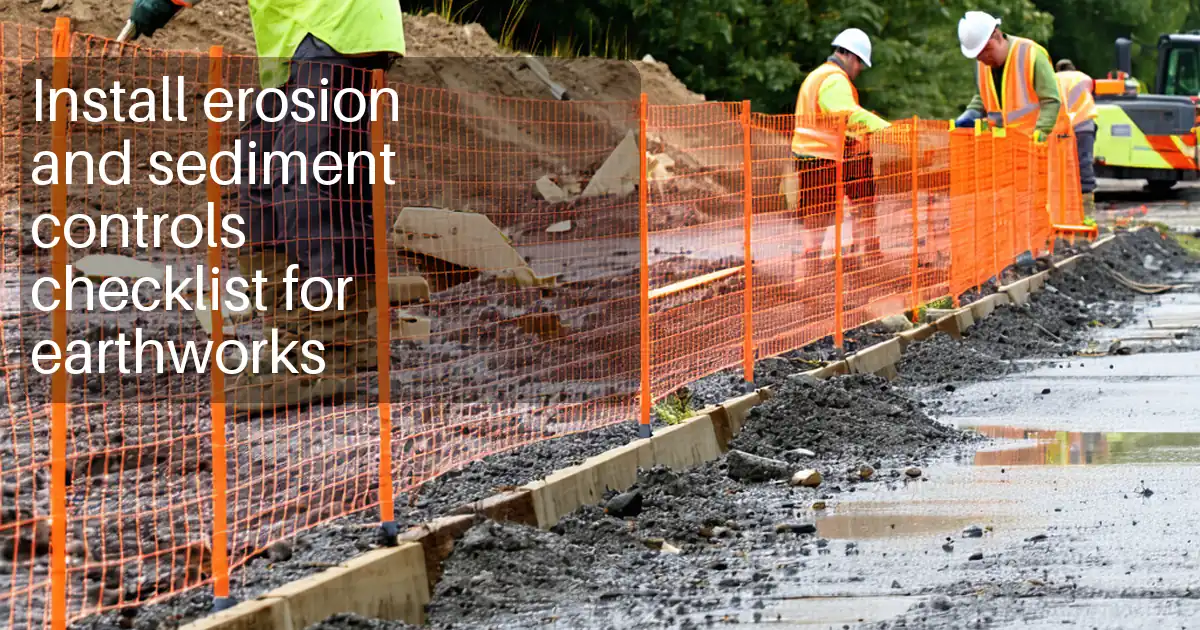
- Installation of: perimeter silt fences, sediment traps/basins, storm inlet protection, stabilized construction access/exit points, runoff diversion berms/swales, and temporary check dams where required.
- Dewatering controls through sediment bags/tanks if water is encountered.
- Routine inspection and maintenance at defined frequencies, and post-rainfall events.
- Environmental monitoring (visual assessments, turbidity/TSS sampling where specified), and reporting.
- Corrective actions for defects, non-conformances, and exceedances.
- Removal of temporary measures and reinstatement once stabilization criteria are met.
Exclusions
- Permanent drainage or outfall structures beyond temporary ESC measures.
- Chemical treatment systems beyond basic sediment flocculant dosing unless specified.
Objectives
- Prevent offsite sediment transport and protect receiving waters.
- Maintain safe, operable access points and work areas.
- Achieve compliance with permits and project specifications.
References
| Document Type | Reference / Number | Revision | Notes |
|---|---|---|---|
| Standard | ASTM D6461 – Standard Specification for Silt Fence Materials | Material performance requirements for silt fence fabrics [Verify per project specifications]. | |
| Practice | ASTM D6462 – Standard Practice for Silt Fence Installation and Maintenance | Guidance for installation and maintenance of silt fences. | |
| Standard | AASHTO M288 – Geotextile Specification for Highway Applications (Silt Fence, Separation) | Minimum geotextile properties for silt fence/separation. | |
| Standard | EN ISO 10319 – Geotextiles: Wide-width tensile test | Verification of geotextile tensile properties. | |
| Standard | EN ISO 11058 – Geotextiles: Water permeability normal to the plane | Permittivity/filtration criteria for geotextiles. | |
| Standard | BS EN 13242 – Aggregates for unbound and hydraulically bound materials | Aggregate for stabilized construction entrances. | |
| Guidance/Permit | USEPA NPDES Construction General Permit (CGP) or local equivalent | Inspection frequency, rainfall-triggered inspections, discharge limits [Verify per permit]. | |
| Code | ISO 9001 (Quality), ISO 14001 (Environment), ISO 45001 (OH&S) | Management system framework for QA/QC and HSE. | |
| Guidance | CIRIA C648/C649 (or local guidance) – Control of water pollution from construction sites | Good practice for runoff and watercourse protection. |
Responsibilities
| Role | Responsibility | Name / Party |
|---|---|---|
| Project Manager | Project Manager | Contractor |
| Engineer | Site/Setting-out Engineer | Contractor |
| Environmental Manager | Environmental Manager/Officer | Contractor |
| Foreman | General Foreman | Contractor |
| HSE Officer | HSE Manager/Officer | Contractor |
| QA/QC Inspector | QA/QC Inspector | Contractor |
| Technician | Environmental Technician/Lab | Contractor/Lab |
| Operator | Plant Operators (licensed) | Contractor |
| Traffic Supervisor | Traffic Controller/Supervisor | Contractor |
| Engineer’s Rep | Engineer/Employer’s Representative | Employer/Engineer |
Resources
| Resource Type | Description | Quantity | Remarks |
|---|---|---|---|
| Labor | 1 foreman, 2 operators, 4 laborers [Adjust to site] | Capable of installing 150–250 m silt fence/day depending on ground | |
| Professional | 1 engineer + GPS rover | Coordinates, drainage divides, as-built | |
| Technician | Shared resource | Sampling, calibration, data management |
Materials
| Material | Specification / Grade | Quantity | Remarks |
|---|---|---|---|
| Silt fence fabric (woven) | Min tensile per AASHTO M288 Class 2; permittivity per EN ISO 11058 [Verify] | As per ESCP | |
| Support wire mesh | 0.9–1.2 m high, 2–3 mm wire, 50–100 mm aperture [Verify] | As per layout | |
| Fence posts | Length 1.2–1.8 m; driven ≥600 mm embedment [Verify] | @2.0–3.0 m spacing | |
| Nonwoven geotextile (separation) | AASHTO M288 Class 2; tensile per EN ISO 10319 | As required | |
| Coarse aggregate | 50–75 mm size; thickness 150–200 mm; BS EN 13242 | Per entrance length/width | |
| Riprap | EN 13383 grading [Verify] | As required | |
| Wattles/fiber rolls | 200–300 mm dia; UV-stabilized netting | As needed | |
| Sediment bags/filters | Flow/retention certified by manufacturer | Per dewatering plan | |
| Hydroseed/erosion control matting | Biodegradable matting; seed rates [Verify] | As per area |
Equipment
| Equipment | Capacity / Type | Quantity | Inspection Required |
|---|---|---|---|
| Excavator 5–13 t | 1–2 | ||
| Post driver/rammer | 1 | ||
| Plate compactor/roller | 1 | ||
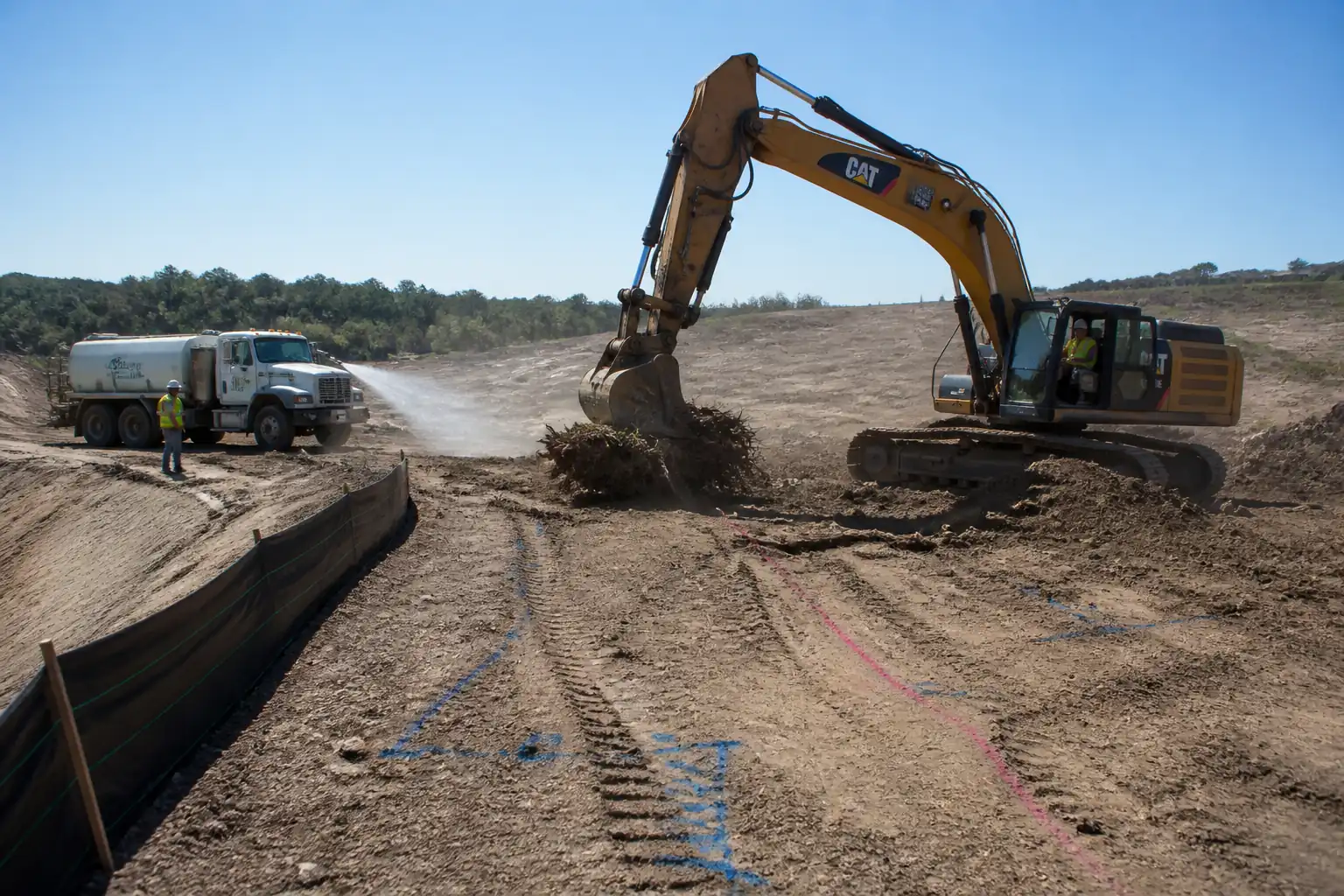
| Water truck | >8 m³ | As needed | |
| Hand tools (shovels, hammers, ties) | Assorted | ||
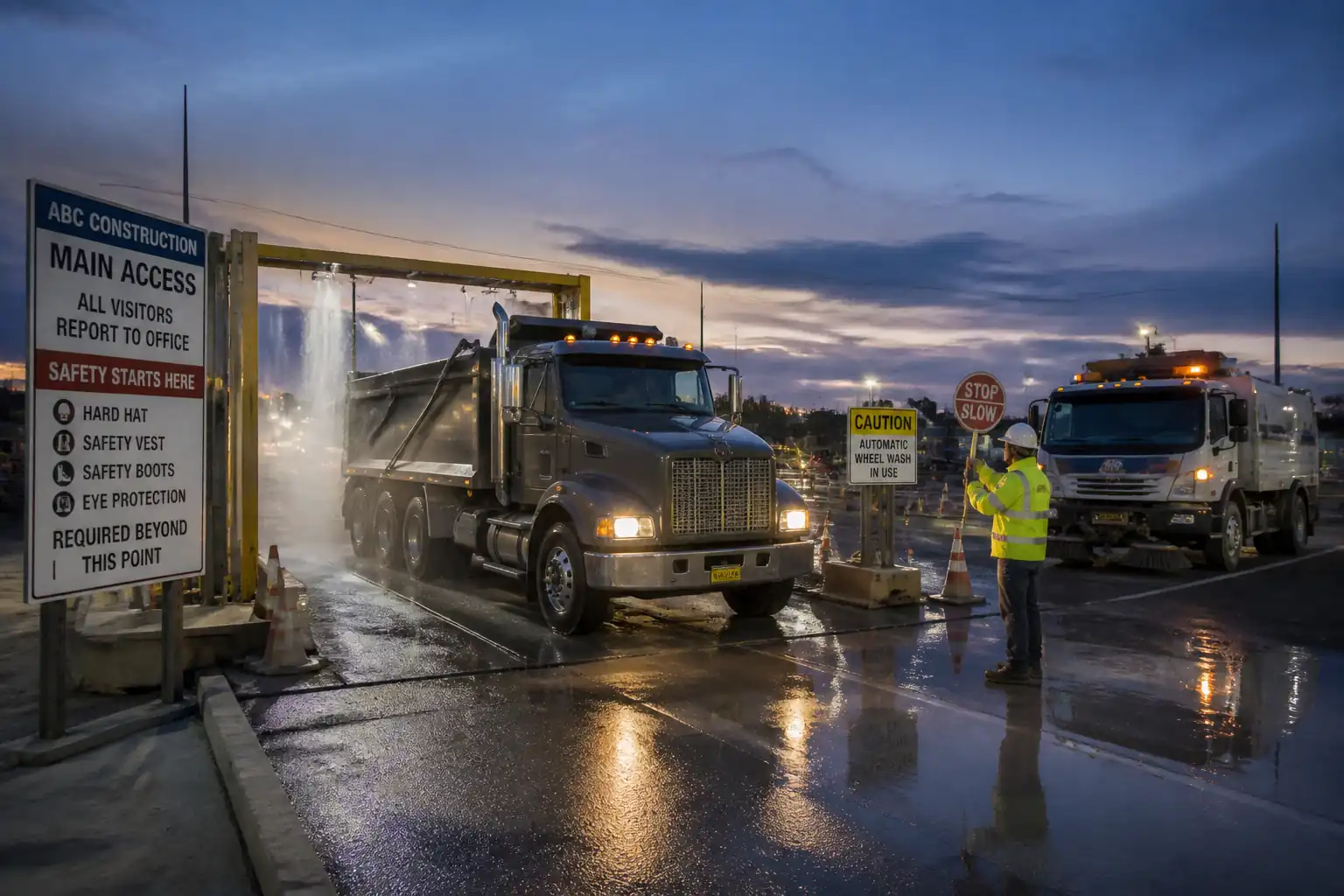
| Wheel-wash system/pressure washer | 1 set | ||
| Turbidity meter (NTU) | 1 | ||
| Sampling kit (TSS), coolers | As required | ||
| GPS rover/total station | 1 | ||
| Vacuum sweeper | As needed |
Prerequisites
- Approved ESCP, drawings, and method statement.
- Environmental permits/consents (CGP/local equivalent) and monitoring plan [Verify per permit].
- Utility locate/clearance certificates for any excavation or post driving.
- Site-specific risk assessment/JHA and Traffic Management Plan for access points.
- Baseline water quality (upstream turbidity/TSS), sensitive receptors mapped.
- Rain gauge installed and forecast reviewed; erosion season calendar identified.
- Materials approvals (geotextile certifications, aggregate source, sediment bags) and equipment pre-start checks.
- Stakeholder notifications where works interface with public roads or waterways.
- Training/toolbox briefing on ESC specifics and spill response.
- Exclusion zones and no-go vegetation buffers marked in field.
Method Sequence
| Step | Activity | Description | Responsibility | Inspection / Hold Point |
|---|---|---|---|---|
| 1 | Pre-works layout and controls | Walk site to confirm drainage divides and low points. Set-out stakes/flags for silt fence lines along contours, sediment trap footprint, diversion alignments, and stabilized access. Install rain gauge. | Site Engineer/Environmental Officer | ITP H/W: layout verification before excavation |
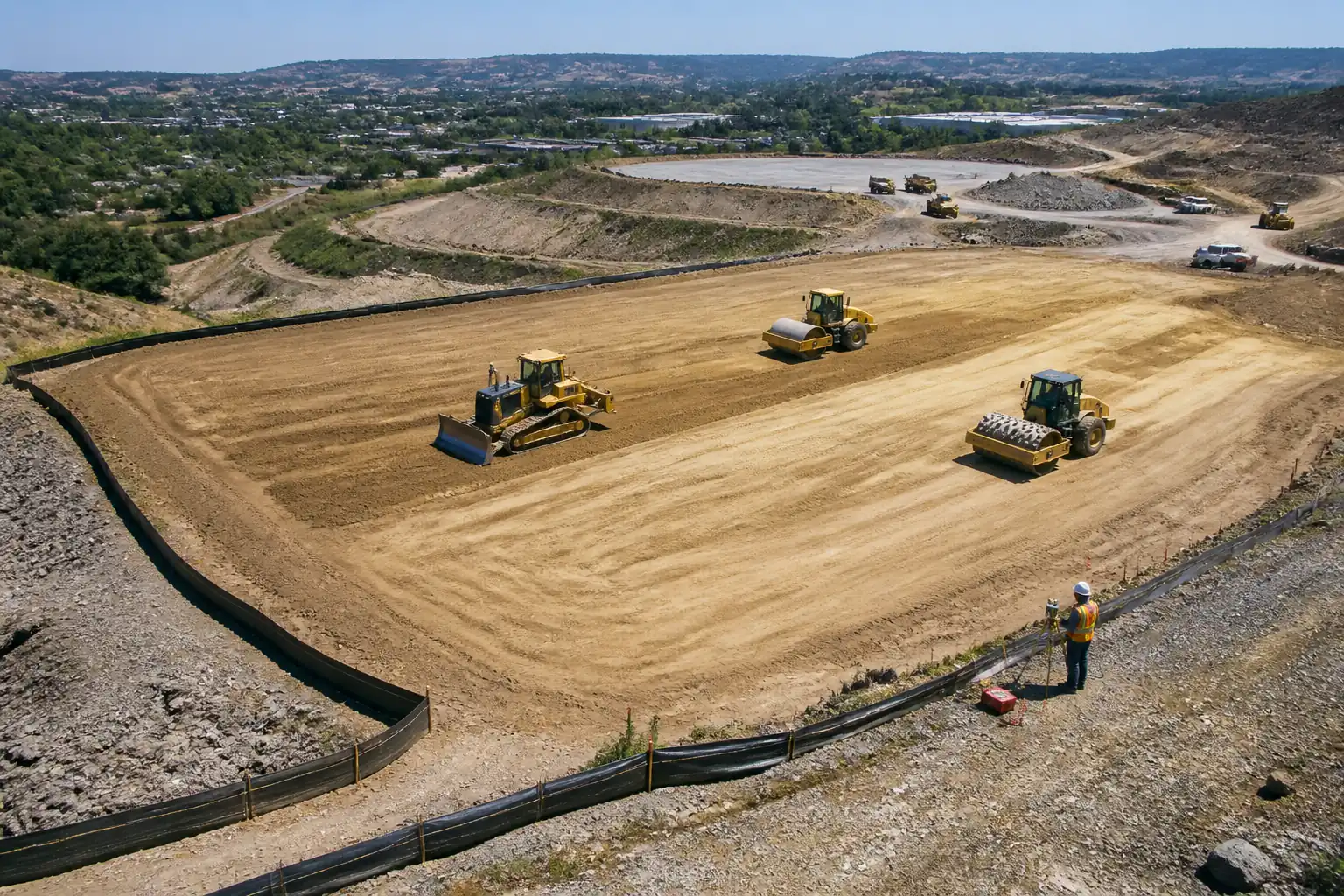
| 2 | Install silt fences (perimeter/interceptor) | Excavate trench 150–200 mm deep × ~150 mm wide upslope of line. Drive posts at 2.0 m spacing without wire support or ≤3.0 m with wire support; embed ≥600 mm. Attach fabric to upslope side; fabric height 600–750 mm above ground. Place fabric into trench, backfill and compact. Provide J-hooks/end returns every ≤20 m and at tie-ins; overlap fabric ≥300 mm around posts. Key into high ground at ends. | Foreman/Crew | Hold: first 20 m installation; then random checks each 100 m |
| 3 | Construct sediment trap/basin (temporary) | Excavate to design footprint; form embankments with suitable fill compacted to ≥95% MDD [Verify]; side slopes ≤2H:1V; provide minimum freeboard 300 mm. Install outlet (skimmer or perforated riser) and emergency spillway lined (riprap or mat) as per design. Provide sediment storage volume 30–50 m³/ha of contributing catchment [Verify]. Install inlet energy dissipation and access ramp for cleanout. | Foreman/Plant Operator | Hold: excavation and foundation approval prior to lining/outlet; Witness: spillway lining |
| 4 | Storm inlet protection | Install sediment bags/socks or silt sacks per manufacturer; ensure overflow path safe. Do not block more than ~2/3 gutter width. Secure to prevent traffic displacement. | Crew | Witness: first-of-kind |
| 5 | Stabilized construction access/exit | Grade subgrade; place nonwoven geotextile; place 50–75 mm angular rock to thickness 150–200 mm; minimum length 10–15 m and width ≥3–4 m per lane [Verify]. Provide drainage to trap; install wheel-wash if tracking persists. Post signage and delineation. | Foreman/Traffic Supervisor | Witness: subgrade/geotextile prior to rock |
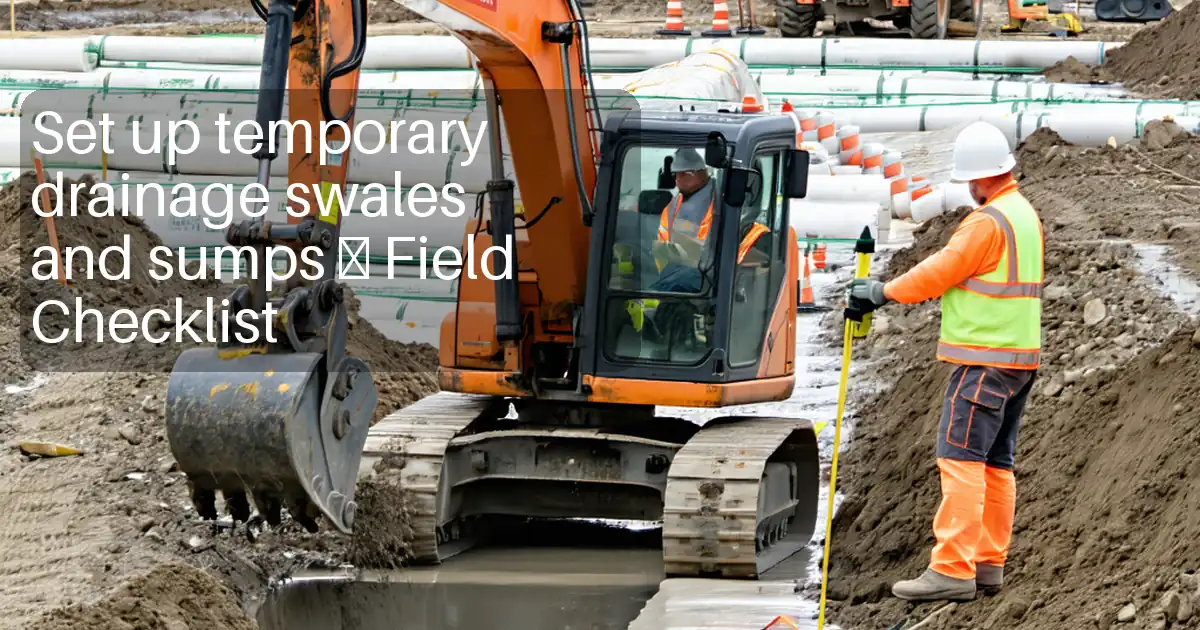
| 6 | Runoff diversion berms/swales and check dams (if required) | Construct earthen berms/swales with longitudinal grade 0.5–2% [Verify]; crest height 300–450 mm; side slopes ≥3H:1V. Line swales based on velocity: grass/matting ≤0.6 m/s; TRM/rock for higher velocities [Verify]. Install rock check dams 300–600 mm high; spacing so upstream toe is level with downstream crest; key into banks 300 mm. | Foreman/Engineer | Witness: first diversion reach and first check dam |
| 7 | Dewatering through sediment control | If excavation water present, pump to sediment bag or settling tank; discharge to vegetated area/trap. Use flow control to avoid scour. Add flocculant only with approved plan and jar tests. Monitor turbidity at discharge using calibrated meter. | Environmental Officer/Foreman | Witness: initial discharge; Permit: dewatering approval [Verify] |
| 8 | Routine inspections and maintenance | Inspect ESC at least once every 7 calendar days and within 24 hours after ≥12.7 mm (0.5 in) rainfall, or per permit [Verify]. Daily visual check of access/roads. Maintenance triggers: silt fence undermining/tears >150 mm; sediment reaching 1/3 fence height; trap sediment ≥30–50% capacity; inlet devices ≥50% full; entrance rock embedded >50 mm; diversions/check dams eroded or settled >100 mm. | Environmental Officer/Foreman | Ongoing; records kept |
| 9 | Environmental monitoring and reporting | Undertake visual turbidity checks during rain events. Where required, collect upstream/downstream or inflow/outflow samples for NTU/TSS; calibrate meters daily when in use. Submit weekly/monthly summary with exceedances and corrective actions. | Environmental Technician/Manager | Witness: first sampling event; Audits by Engineer |
| 10 | Demobilization and reinstatement | Once areas are stabilized (e.g., ≥70% vegetative cover or permanent surfacing) [Verify], remove temporary ESC progressively from upstream to downstream. Dispose of captured sediment to approved location; re-grade and seed/disturbance repaired. Final inspection and sign-off. | Foreman/Environmental Officer | Hold: final area inspection before removal |
Safety Controls (Task-Specific)
Key hazards and controls
- Hazard: Underground utility strike during trenching/post driving.
- Likely consequence: Electrocution, explosion, service outage.
- Engineering/procedural control: Validated utility plans, electronic locates and potholing to confirm; exclusion zones; hand-dig within 1 m of known services.
- Required PPE: Dielectric gloves where applicable, helmet with face shield, safety boots.
- Collective measure: Physical barriers and spotter for plant near services.
-
Inspection/permit: Service clearance certificate and permit-to-dig; supervision by Site Engineer.
-
Hazard: Plant movement and interface with public traffic at access/exit.
- Likely consequence: Vehicle-person collision, road accident.
- Engineering/procedural control: Traffic Management Plan, delineation, speed limits, banksman; separate pedestrian routes; wheel-wash layout avoiding reversing where possible.
- PPE: Hi-vis, hard hat, safety boots, hearing protection.
- Collective measure: Barriers, signage, rumble strips.
-
Inspection/permit: Daily TMP inspection; spot checks by HSE.
-
Hazard: Excavation and embankment instability at sediment traps.
- Likely consequence: Collapse, engulfment, equipment rollover.
- Engineering/procedural control: Batter slopes per design; no surcharge near edges; plant stay-back distance ≥ equipment reach; compact in layers; emergency egress ramps.
- PPE: Helmets, boots, gloves.
- Collective measure: Edge protection, bunding, and no-go zones.
-
Inspection/permit: Daily excavation inspection by competent person; permit for confined excavation if applicable [Verify per project HSE plan and local regulations].
-
Hazard: Water handling/dewatering discharge.
- Likely consequence: Slips, drowning in deep water, environmental harm.
- Engineering/procedural control: Secure hoses, flow control valves, non-eroding outlets; life-ring near deep water; dewatering plan approval.
- PPE: Life jacket near water, non-slip boots, gloves.
- Collective measure: Barriers around ponds/traps; supervised operations.
-
Inspection/permit: Dewatering permit; inspection at start and periodically.
-
Hazard: Manual handling of geotextiles, posts, sediment bags.
- Likely consequence: Strains, crush injuries.
- Engineering/procedural control: Team lifts, mechanical aids, weight labels; rotate tasks.
- PPE: Gloves, steel-toe boots, back support if approved.
- Collective measure: Use of trolleys/forklifts where practicable.
-
Inspection/permit: Manual handling training records; supervisor oversight.
-
Hazard: Sharp edges, wire ties, and post drivers.
- Likely consequence: Lacerations, eye injuries.
- Engineering/procedural control: Use guarded tools; correct tie methods; exclusion during post driving.
- PPE: Cut-resistant gloves, safety glasses/face shield.
- Collective measure: Tool condition checks and lock-outs.
-
Inspection/permit: Daily pre-start checks and permits for high-noise operations if required.
-
Hazard: Dust and noise from aggregate placement and traffic.
- Likely consequence: Respiratory irritation, hearing loss, nuisance to public.
- Engineering/procedural control: Water suppression, schedule high-noise tasks daytime, maintain equipment.
- PPE: P2/N95 dust masks, hearing protection.
- Collective measure: Noise barriers where needed; speed control to reduce dust.
-
Inspection/permit: Noise/dust monitoring as specified; HSE inspections.
-
Hazard: Spill of fuels/oils near drains/waterways.
- Likely consequence: Water contamination, regulatory breach.
- Engineering/procedural control: Designated refueling area with spill kits and secondary containment; no refueling within 30 m of water where practicable.
- PPE: Chemical-resistant gloves, eye protection.
- Collective measure: Spill pallets, booms staged near receptors.
- Inspection/permit: Spill response plan; weekly checks of kits; reportable incident process.
Environmental Controls
- Sediment containment: Install upstream-to-downstream; traps before inlets; protect low points first. Maintain silt fences and traps per triggers (1/3 height, 30–50% volume). Install check dams in long swales.
- Runoff management: Diversion berms/swales sized to capture design storm per ESCP; maintain positive drainage to stable discharge points. Provide freeboard 150 mm minimum.
- Stabilized access: Maintain aggregate thickness; sweep public roads daily or as needed; use wheel-wash if tracking persists.
- Dewatering: Use sediment bags/tanks; discharge to stabilized areas; monitor turbidity/pH as per permit; cease if thresholds exceeded and implement corrective treatment.
- Spill prevention: Fuel/chemicals in bunded areas 110% of largest container; spill kits within 20 m of risk areas. Train crews and drill scenarios.
- Dust/noise: Water suppression; cover loads; speed limits; schedule noisy work daytime; use well-maintained equipment.
- Vegetation/wildlife: Avoid clearing beyond limits; install buffers around waterways; inspect for nesting or protected species before works [Verify per local regulations].
- Waste: Dispose of sediment and used geotextiles/filters at approved facilities; keep records of transport and disposal. No burying on site unless approved.
- Monitoring and reporting: Maintain rain gauge log; conduct inspections weekly and after ≥12.7 mm rainfall [Verify]; keep turbidity/TSS records when required. Record all corrective actions with before/after photos.
QA/QC
Submittals and approvals
- ESCP approval, product data sheets for silt fence fabric, geotextiles, sediment bags, and inlet protection devices; aggregate source approvals.
- Calibration certificates for turbidity meters; sampling/analysis plan for TSS.
Hold/Witness points (minimum)
- Hold: Layout verification prior to first installation.
- Hold: First 20 m of silt fence installation before mass production.
- Hold: Sediment trap excavation/foundation before lining and outlet installation.
- Witness: Stabilized entrance geotextile prior to rock placement.
- Witness: First sampling/monitoring event.
Testing and verification
- Geotextile certifications against AASHTO M288/EN ISO 10319; UV resistance per EN 12224 [Verify].
- Aggregate gradation certificates per BS EN 13242.
- Compaction results for trap embankments if specified (e.g., ≥95% MDD per ASTM D1557) [Verify].
- Turbidity meter daily calibration check with standards; record NTU verification.
Acceptance criteria (typical)
- Silt fence embedment: 150–200 mm trench, continuous; post spacing ≤2.0 m (no wire) or ≤3.0 m (with wire); height 600–750 mm; end returns ≤20 m spacing.
- Stabilized entrance: Thickness 150–200 mm; rock 50–75 mm; length ≥10–15 m; no visible tracking onto public road (cleaned same day).
- Sediment trap: Storage volume 30–50 m³/ha; freeboard ≥300 mm; stable spillway; side slopes ≤2H:1V; safe access ramp.
- Diversions/check dams: Grades 0.5–2%; check dam height 300–600 mm; spacing per rule-of-thumb (toe to crest).
- Monitoring: Sampling and reporting per permit/plan; exceedances corrected within timeframe [Verify].
Records
- ITP checklists, hold/witness sign-offs, delivery tickets, compaction/gradation certificates, calibration logs, rain gauge logs, inspection/maintenance logs, NCR/CARs, photographic records, waste transfer notes, as-built survey.
Attachments
- Sample ESC Inspection Checklist (weekly/post-storm)
- Silt Fence Typical Detail (trench, post spacing, end returns)
- Stabilized Construction Entrance Typical Detail and TMP excerpt
- Sediment Trap Typical Section and Spillway Detail
- Diversion/Check Dam Typical Details
- Dewatering Plan Template and Monitoring Log Sheets
- Calibration Log Template for Turbidity Meter
- Nonconformance/Corrective Action (NCR/CAR) Form
- Rainfall Log Template
- Waste Transfer Note Template
This content is a read-only public reference. Download or customize to get an editable version.
ITP preview
The first inspection activities from the linked ITP for Method Statement: Installation and Maintenance of Erosion and Sediment Control (ESC) Measures:
| Activity | Inspection / Test | Acceptance Criteria | Responsibility | Record |
|---|---|---|---|---|
| Pre-works layout verification | Check set-out vs ESCP, drainage paths, protection of buffers (H) | Layout conforms to ESCP; receptors identified; permits in place | Site Engineer / QA-QC | Layout checklist, photos, hold-point release |
| Silt fence – first 20 m installation | Visual inspection of trench depth, post spacing, embedment, overlaps (H) | Trench 150–200 mm; posts ≤2.0 m (no wire) or ≤3.0 m (with wire); fabric height 600–750 mm; returns/J-hooks installed | QA-QC / Environmental Officer / Engineer | Silt fence inspection form, photos |
| Silt fence – production | Random checks every 100 m or daily, whichever first (W) | Continuous embedment; no gaps/tears; proper tie to high ground | Environmental Officer / Foreman | Daily checklists, NCR if noncompliant |
Showing 3 of 11 inspection activities. View full ITP →
Related Inspection and Test Plan
An Inspection and Test Plan (ITP) is available for Method Statement: Installation and Maintenance of Erosion and Sediment Control (ESC) Measures. The ITP defines the inspection activities, acceptance criteria, hold and witness points, responsible parties, and records required to verify the work described in this method statement.
View the Method Statement: Installation and Maintenance of Erosion and Sediment Control (ESC) Measures ITP →Frequently asked questions
Continue with related Quollnet resources connected to this method statement.