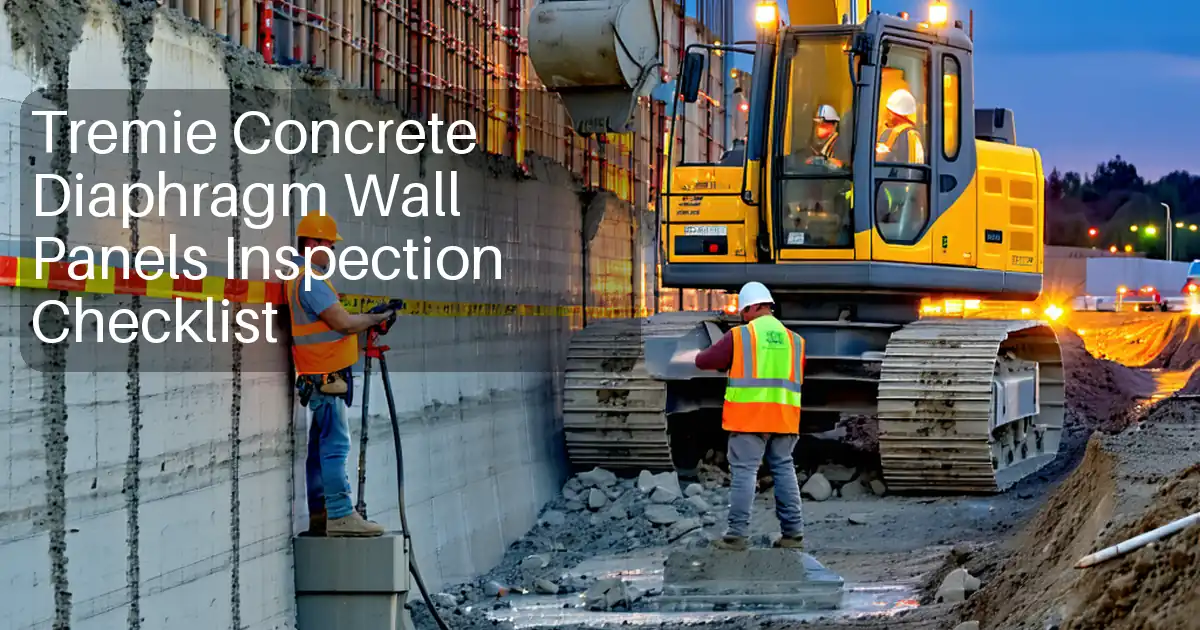
Verify Bore Clean-Out: Sediment, Cleanliness, Tremie Ready
Definition: Verify bore clean-out helps inspectors measure sediment thickness, confirm base cleanliness, and assess tremie readiness for bored piles prior to concrete placement, ensuring consistent quality control without covering drilling parameters.
- Measure sediment thickness at multiple locations to verify acceptance limits.
- Confirm base cleanliness and absence of loose debris before concreting.
- Check tremie assembly, sealing, and embedment planning for uninterrupted pour.
- Interactive, commentable, export options with QR code verification.
Verify bore clean-out is a targeted quality-control step that confirms sediment thickness, base cleanliness, and tremie readiness for bored piles. This borehole cleanout verification focuses strictly on the final cleanliness of the base and the practical readiness of the tremie system prior to concrete placement. It excludes drilling parameters, tooling, and slurry or polymer design controls. By methodically measuring sediment thickness at several points, documenting base condition, and checking that the tremie pipe is clean, sealed, and able to remain embedded, you reduce risks of soft bases, inclusions, and post-pour defects. The outcome is a uniform, sound pile base that supports durable structural performance. This checklist guides inspectors, site engineers, and foremen to capture evidence with photos, measurements, and approvals aligned with approved project specifications and authority requirements. Use the interactive features to tick off steps, add comments, and export your record as PDF/Excel with an embedded QR for fast retrieval.
- Confirm bore base cleanliness and sediment thickness using repeatable methods such as weighted tapes and flat plates. Capture photos, timestamps, and instrument IDs so your records show what was measured, where, and when—all aligned with approved project specifications and authority requirements.
- Reduce defects by validating the base is free of loose cuttings and debris, and that measured sediment thickness is within project limits. Re-clean and re-measure if thresholds are exceeded, then document the corrective cycle to close quality loops before any concrete is placed.
- Verify tremie readiness without touching drilling parameters: check internal cleanliness, joint gaskets, watertightness, plug fit, and embedment planning. A short dry run confirms alignment and reach, minimizing delays and ensuring uninterrupted tremie placement once concreting starts.
- Interactive online checklist with tick, comment, and export features secured by QR code. Instantly attach photos, sign digitally, and share acceptance status with stakeholders. Export as PDF/Excel and archive with unique QR authentication for traceable, tamper-evident project records.
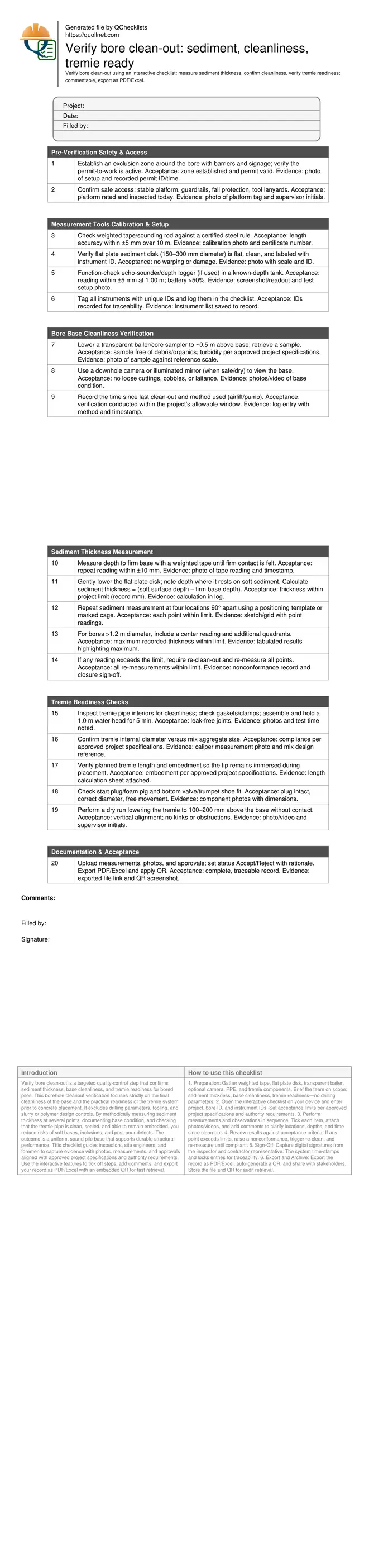
Pre-Verification Safety & Access
Measurement Tools Calibration & Setup
Bore Base Cleanliness Verification
Sediment Thickness Measurement
Tremie Readiness Checks
Documentation & Acceptance
Why bore clean-out verification matters before tremie placement
Clean-out verification ensures a sound base for tremie concrete, minimizing soft spots, laitance inclusions, and repair risk. The focus is narrow and practical: measure sediment thickness, confirm base cleanliness, and prove tremie readiness—without touching drilling parameters. This discipline protects load transfer at the pile base and reduces defects that are costly to remediate. By using simple, repeatable methods (weighted tapes, flat plates, bailers, and optional cameras), crews capture objective evidence. Acceptance is defined by project specifications and authority requirements, typically expressed as maximum allowable sediment thickness and a clean, debris-free surface. Verifying readiness also addresses the tremie’s ability to start watertight and remain embedded, preventing segregation during the pour. Real-world examples show that a few millimetres of extra sediment can markedly reduce base resistance; timely re-clean and re-measure avoids that outcome. The result is a confident green light for concreting with thorough, traceable documentation.
- Limit verification to sediment, cleanliness, and tremie readiness.
- Capture repeatable measurements with instrument IDs and timestamps.
- Use photos/video to document base condition objectively.
- Trigger re-clean and re-measure if limits are exceeded.
Practical methods to measure sediment thickness and cleanliness
A reliable sequence is: establish safety, validate instruments, take a base sample, then measure depths. Weighted tapes determine firm base depth; flat plate disks indicate the soft sediment top. Subtracting these values yields thickness in millimetres. Take multiple readings around the circumference and at the centre for larger diameters. Bailer samples and optional downhole cameras give objective views of cleanliness. Acceptance criteria come from the approved project specifications; record them in the checklist alongside your measured values. Repeat any measurement with a variance greater than the allowed repeatability, and document both attempts. If any location exceeds the sediment limit, require re-clean-out via airlift or pumping, then re-measure all points. This closed-loop approach prevents isolated nonconformances from slipping through and ensures the entire base meets the same standard before authorization to pour.
- Measure firm base and soft surface depths independently.
- Record at least four circumferential points; add center on large bores.
- Re-clean and re-measure if any point exceeds limits.
- Attach photos of instruments, readings, and sample clarity.
Proving tremie readiness without mixing in drilling parameters
Tremie readiness is about the equipment and the start sequence, not slurry design. Inspect pipe interiors, joints, and seals; assemble and hold a small water head to confirm watertightness. Verify the diameter against the aggregate size per the approved project specifications, and plan the initial embedment so the tremie tip stays immersed throughout the pour. A brief dry run confirms reach and alignment while staying above the base to avoid disturbance. Check the start plug or foam pig fits correctly and moves freely. These checks prevent washouts, cold joints, and flow interruptions during placement. Close by consolidating all evidence—photos, measurements, calculations, and sign-offs—into a single, traceable record so authorization to pour is defensible and auditable later.
- Leak-check assembled tremie for watertight joints.
- Confirm internal diameter against mix aggregate size.
- Plan and record tremie embedment calculations.
- Dry-run placement to confirm alignment and reach.
How to Use This Bore Clean-Out Verification Checklist
- Preparation: Gather weighted tape, flat plate disk, transparent bailer, optional camera, PPE, and tremie components. Brief the team on scope: sediment thickness, base cleanliness, tremie readiness—no drilling parameters.
- Open the interactive checklist on your device and enter project, bore ID, and instrument IDs. Set acceptance limits per approved project specifications and authority requirements.
- Perform measurements and observations in sequence. Tick each item, attach photos/videos, and add comments to clarify locations, depths, and time since clean-out.
- Review results against acceptance criteria. If any point exceeds limits, raise a nonconformance, trigger re-clean, and re-measure until compliant.
- Sign-Off: Capture digital signatures from the inspector and contractor representative. The system time-stamps and locks entries for traceability.
- Export and Archive: Export the record as PDF/Excel, auto-generate a QR, and share with stakeholders. Store the file and QR for audit retrieval.
Call to Action
- Start Checklist Tick off tasks, leave comments on items or the whole form, and export your completed report to PDF or Excel—with a built-in QR code for authenticity.
- Download Excel - Bore Clean-Out Verification (Sediment, Base, Tremie)
- Download PDF - Bore Clean-Out Verification (Sediment, Base, Tremie)
- View Image - Bore Clean-Out Verification (Sediment, Base, Tremie)
Cite & Embed
“Bore Clean-Out Verification (Sediment, Base, Tremie) by Quollnet”
with a link to
this source page.
FAQ
Question: How much sediment is acceptable at the bore base before tremie concreting?
Question: What if I cannot visually inspect the base due to fluid conditions?
Question: Do I need an echo-sounder, or is a weighted tape sufficient?
Question: When should I take measurements relative to final clean-out?
Question: What documentation is required to approve the bore for concreting?
Related Articles
Broader reading and guidance connected to this checklist topic.


Is It Important To Customize Your Qr Code And How To Do It?
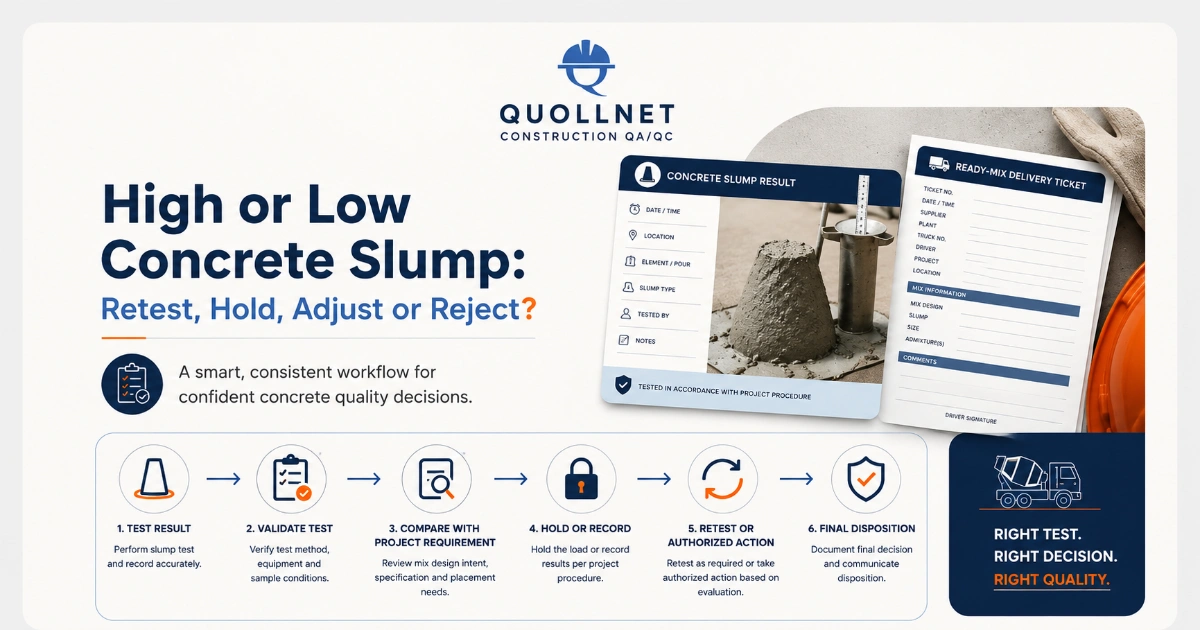
High Or Low Concrete Slump: Retest, Hold, Adjust Or Reject?

Master Construction Project Cashflow With Cashflowpot
Related Checklists
Keep the workflow moving with nearby templates chosen from similar checklist content.