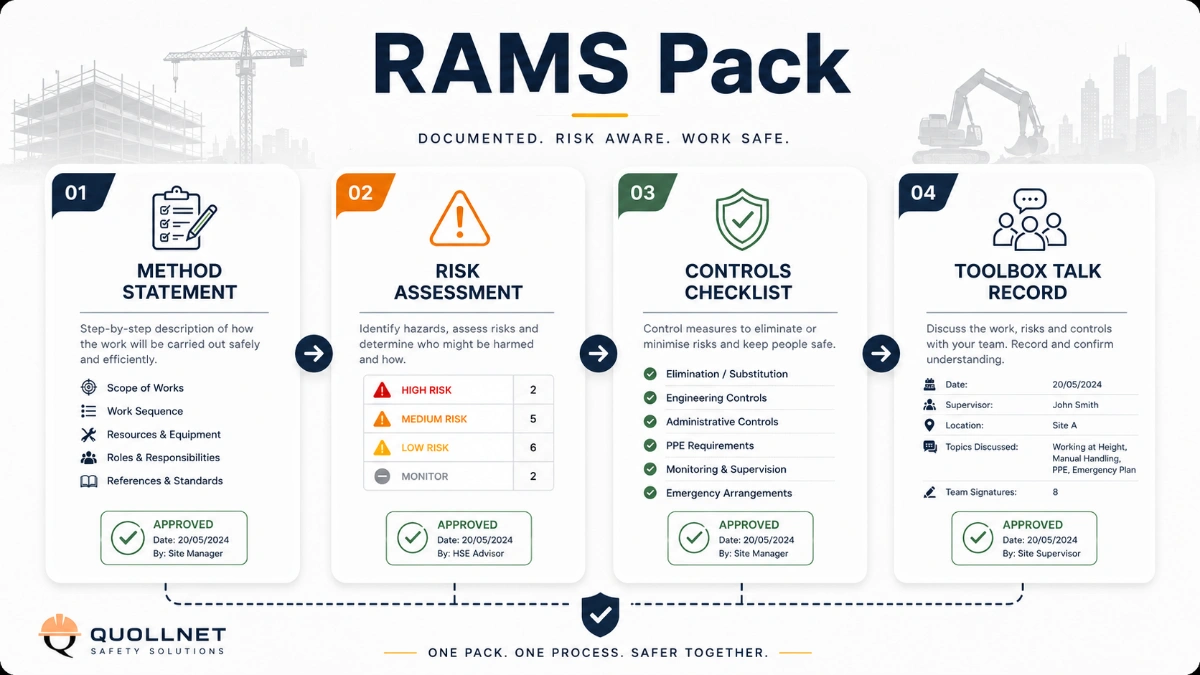

Method Statement: Bulk Earthworks for Construction Platform Preparation (Cut/Fill, Compaction, Survey Control, QA/QC) – Method Statement
AI-assisted method statement with matching ITP, PDF download, and Excel export.
More than a static template
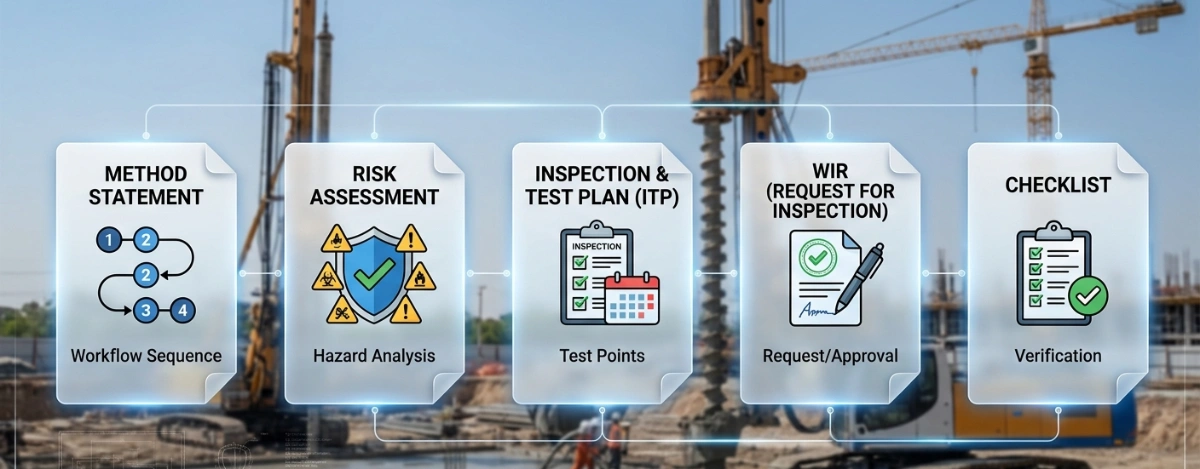
Unlike a downloadable Word or PDF template, this method statement is an AI-assisted editable starting point connected directly to a matching Inspection and Test Plan. Every section is structured, project-adaptable, and ready to export.
- AI-assisted drafting — Customize every section with AI for your specific project scope.
- Linked ITP — A matching inspection and test plan is generated alongside the method statement.
- Multiple export formats — Download as a formatted PDF or editable Excel spreadsheet.
- Editable starting point, not a final document — Review, verify, and adjust all content against your project requirements before use.
Static template vs. Quollnet workflow
| Feature | Static template | Quollnet |
|---|---|---|
| Project-specific content | Manual fill-in required | AI-assisted customization |
| Linked ITP | Separate document, no link | Matching ITP included |
| Export formats | Usually PDF only | PDF and Excel |
| Structured sections | Free-form layout | 13 standardized sections |
| Saved to your account | Local file only | Cloud-saved, reusable |
| Content accuracy | You verify everything | AI-assisted, you still verify |
| Cost | Often free but time-intensive | Free to customize and download |
What you can customize
When you save this method statement to your account, every section becomes editable. The following 13 sections are included:
- Scope — Defines the activity and its boundaries.
- References — Standards, specifications, and drawings.
- Responsibilities — Roles and accountabilities.
- Resources — Labour, plant, and equipment summary.
- Materials — Materials and compliance requirements.
- Equipment — Tools and equipment details.
- Prerequisites — Hold points and pre-conditions.
- Method sequence — Step-by-step construction sequence.
- Safety controls — HSE risk controls and PPE.
- Environmental controls — Environmental mitigation measures.
- QA/QC — Quality inspection and test requirements.
- ITP — Inspection and Test Plan table (has its own page).
- Attachments — Referenced drawings and documentation.
Why this method statement is used
This method statement is used to define and communicate the approved procedure for carrying out method statement: bulk earthworks for construction platform preparation (cut/fill, compaction, survey control, qa/qc) on site. It ensures the work is planned in advance, the correct resources and controls are in place, and all personnel understand responsibilities, sequence, quality requirements, and safety controls before work begins. It aligns site execution with the documented scope and acceptance expectations.
Who uses this method statement
This method statement is used by contractors, site supervisors, project engineers, QA/QC engineers, HSE officers, consultants, and client representatives. It serves as a shared reference for planning, execution, supervision, inspection, and approval of the activity on site.
When it is prepared and submitted
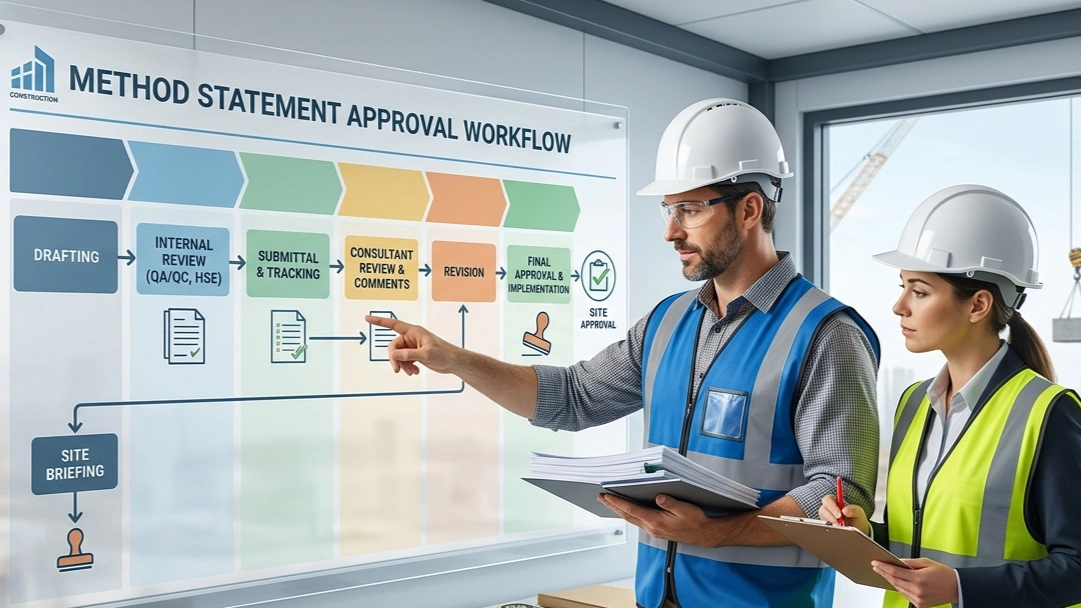
The method statement is prepared before the work activity starts and submitted as part of the pre-construction documentation package for review and approval.
Who reviews or approves it
The method statement is usually submitted to the client representative, consultant, resident engineer, or project management consultant for review and approval before the work commences.
Important approval note
This method statement is an AI-assisted editable starting point, not a pre-approved document. Before use on any project, all content must be reviewed and approved by the relevant parties (superintendent, principal contractor, or client representative) in accordance with your contract and project quality plan.
For example: if your specification requires a departure from a referenced standard, that departure must be documented and approved separately — this method statement will not capture that automatically. Always verify against your applicable drawings, specifications, and regulatory requirements.
Method statement content
Scope
Overview
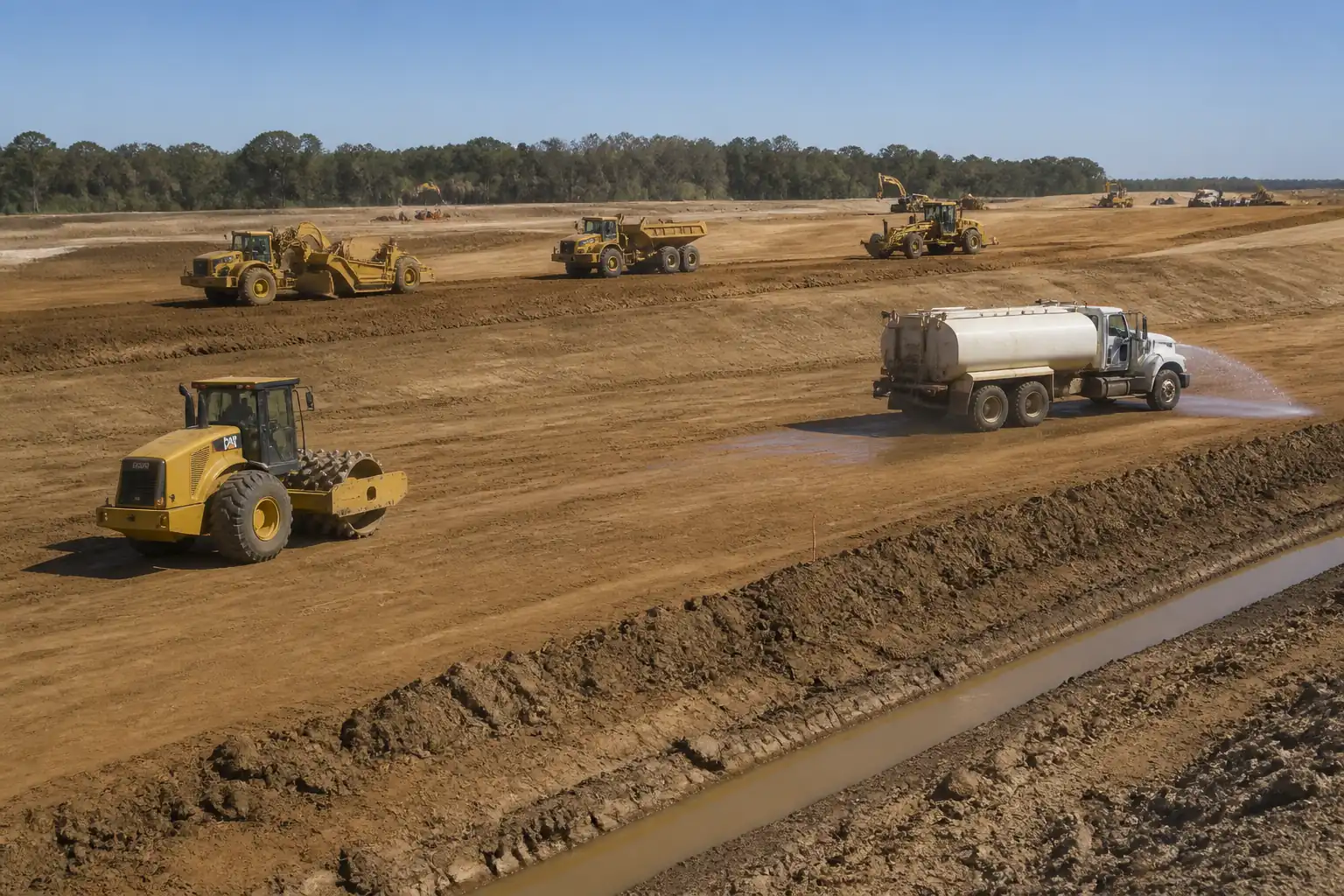
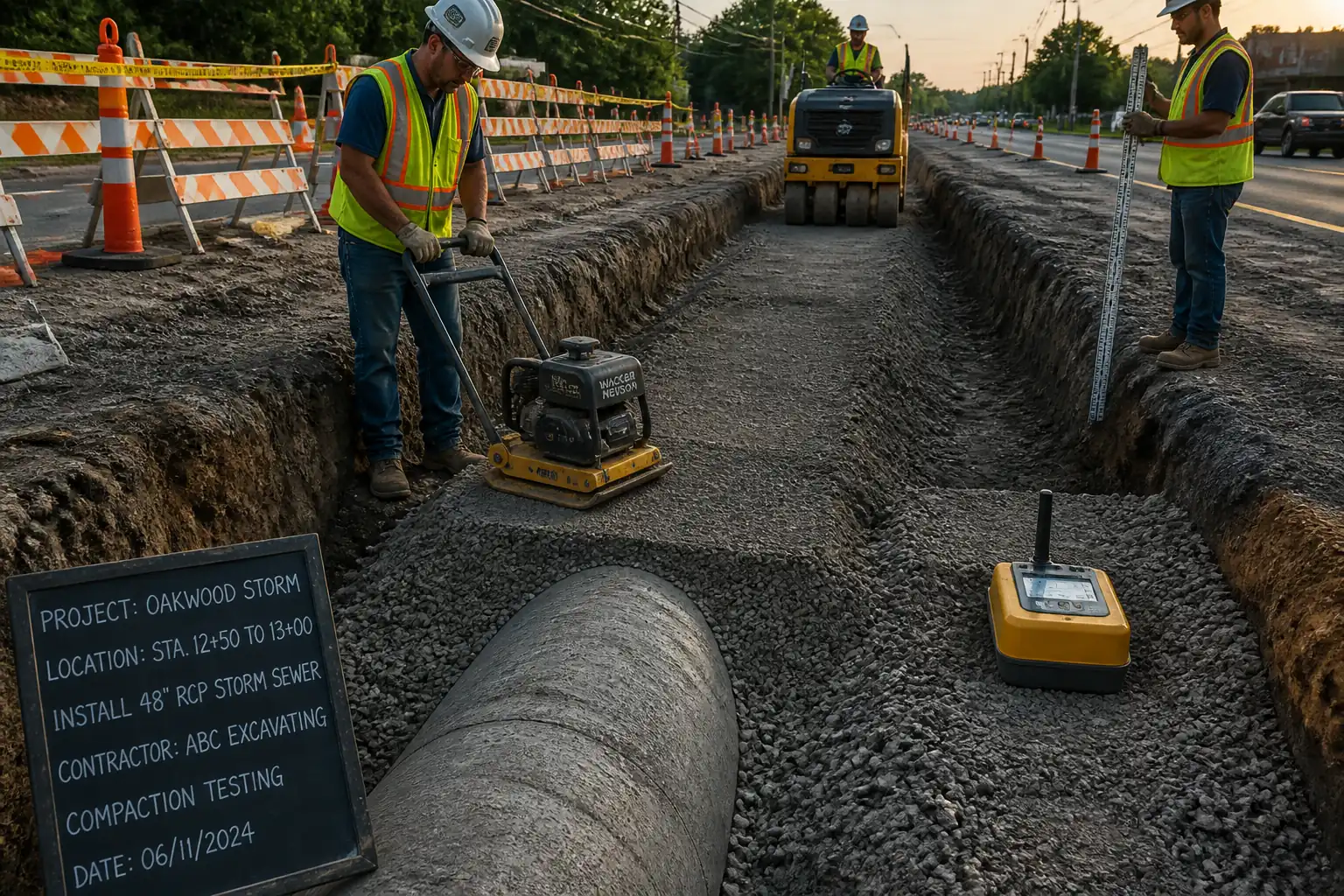
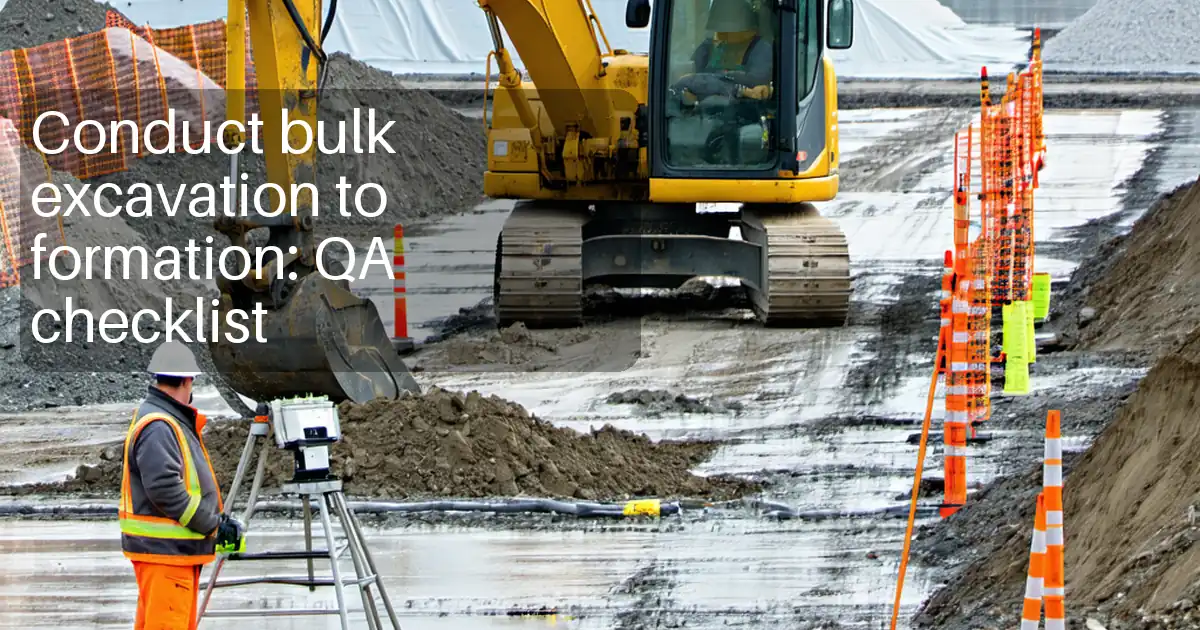
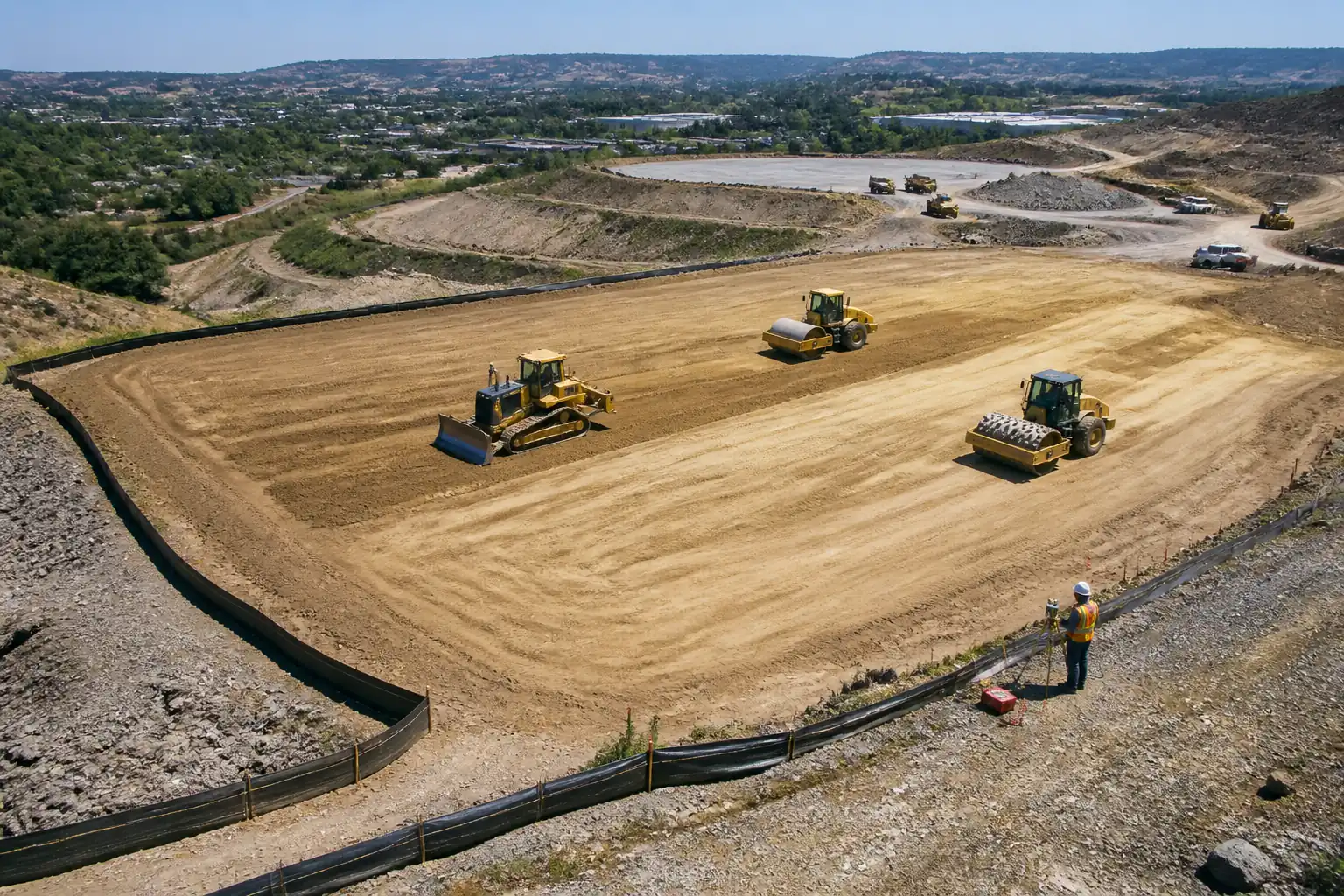
This method statement covers bulk earthworks to form stable, level construction platforms for subsequent foundation activities. It includes site clearance, stripping of topsoil and unsuitable materials, cut and fill operations, moisture conditioning, placement and compaction in controlled layers, slope formation and stability measures, survey level control, temporary drainage, field density testing, quality control, hold/witness points, and final formation approval.
Inclusions
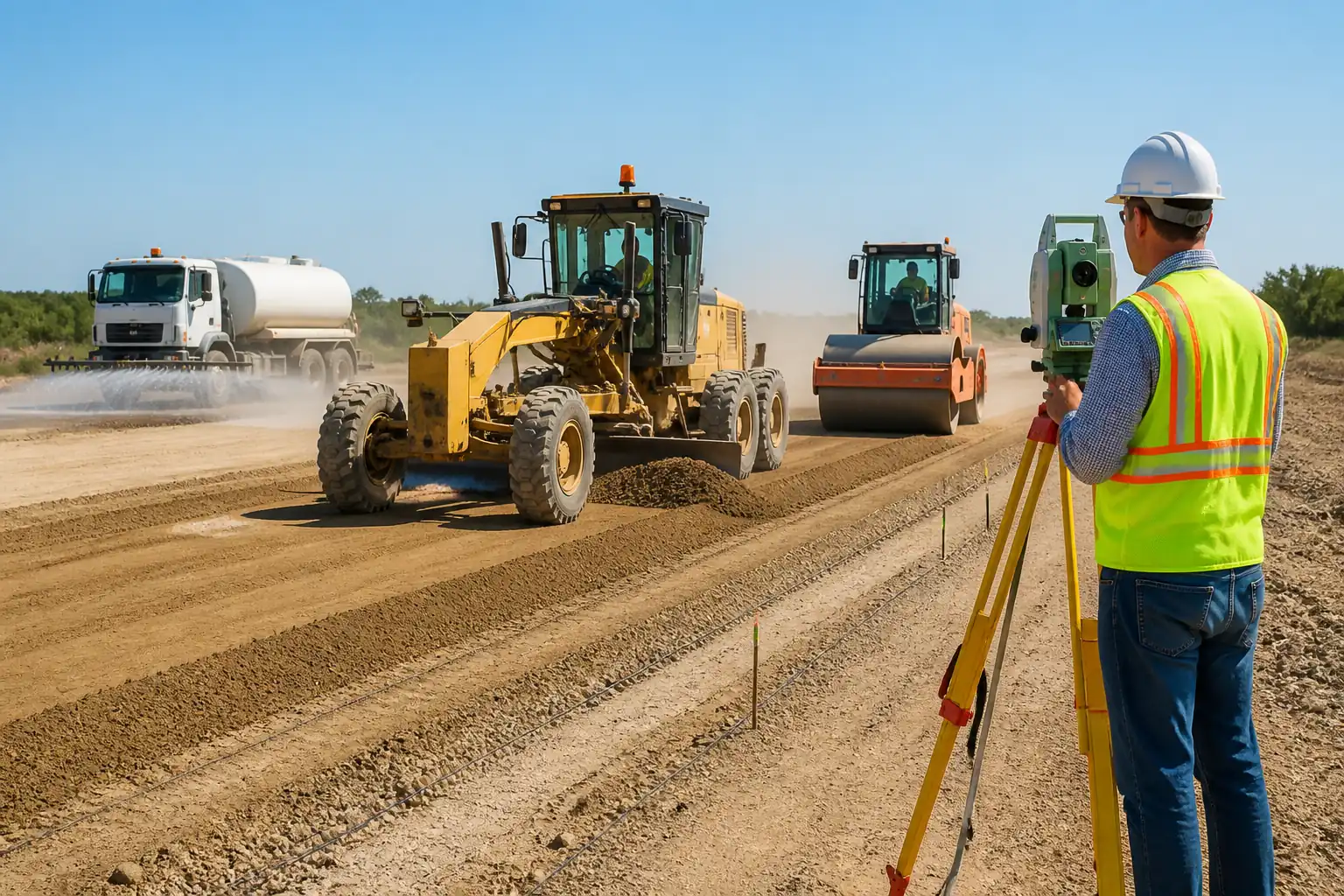
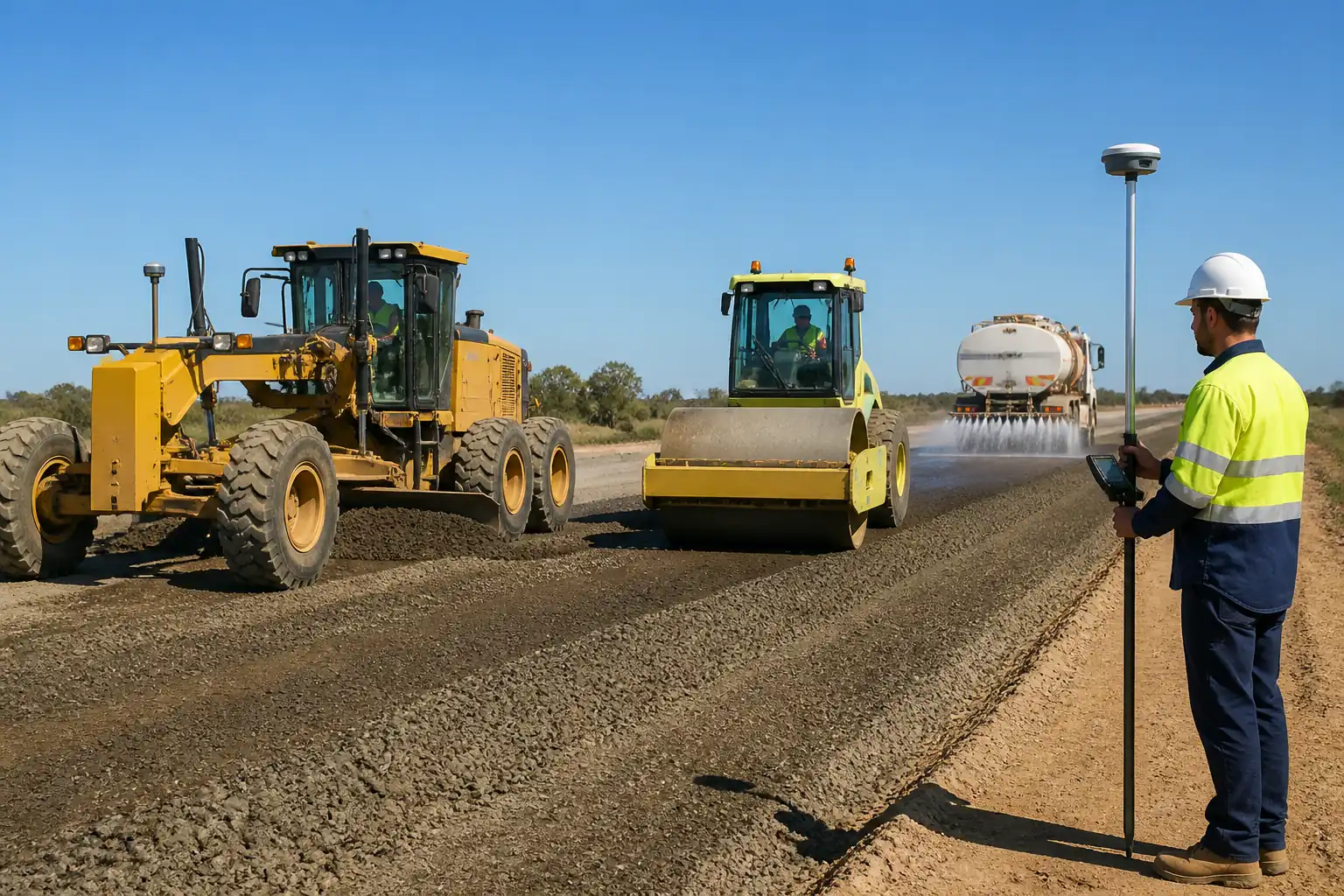
- Survey establishment and level control using total station/RTK GNSS and machine control (where approved).
- Clearing and grubbing; stripping and stockpiling of topsoil.
- Identification, treatment, and/or removal of unsuitable/soft materials.
- Cut to spoil or stock, fill placement in engineered layers, moisture conditioning, and compaction.
- Temporary haul roads and drainage measures to protect the works.
- Slope trimming, stability controls, and erosion protection of exposed surfaces.
- Field and laboratory testing (e.g., Proctor, moisture-density, CBR, DCP, plate load where specified).
- Documentation, ITP compliance, as-built survey, and final formation approval prior to foundations.
Exclusions
- Deep foundations (piles/diaphragm walls), permanent retaining structures, and permanent drainage not explicitly described herein.
- Contaminated land remediation beyond identification, segregation, and notification steps.
Target performance [Verify per project specifications]
- Compaction: General fill ≥95% MDD (ASTM D698) or ≥98% MDD (ASTM D1557) beneath foundations/roads, moisture within −2% to +2% of OMC.
- Lift thickness: 200–300 mm loose per layer (adjust to equipment and test results).
- Platform crossfall/gradient: 1%–3% for drainage unless noted otherwise.
- Formation tolerance: ±20 mm RL; local deviation ≤15 mm under a 3 m straightedge.
- CBR at formation (if specified): ≥5%–8% (soaked) depending on design requirement.
- Optional plate load (if specified): Ev2 ≥ 60 MPa and Ev2/Ev1 ≤ 2.2.
[All values to be verified per project specifications and geotechnical report.]
References
| Document Type | Reference / Number | Revision | Notes |
|---|---|---|---|
| Standard | BS 6031: Code of practice for earthworks | General guidance for execution and control of earthworks. | |
| Standard | BS EN 1997-1 (Eurocode 7) and associated National Annex | Design verification and geotechnical requirements. | |
| Standard | ASTM D698, ASTM D1557 | Determine MDD and OMC for density control. | |
| Standard | ASTM D6938, ASTM D1556, ASTM D2937 | Field compaction control methods. | |
| Standard | ASTM D6951/D6951M | Correlates to CBR/strength for verification. | |
| Standard | BS EN ISO 14688-1/2, 14689-1 | Soil classification and description practices. | |
| Specification | Manual of Contract Documents for Highway Works (UK) Series 600 | For projects adopting MCHW requirements [Verify per project]. | |
| Standard | ISO 9001, ISO 14001, ISO 45001 | Management system framework. | |
| Contract | Priority over general references where conflicts arise. |
Responsibilities
| Role | Responsibility | Name / Party |
|---|---|---|
| Project Manager | Project Manager | Contractor |
| Construction Manager | Construction Manager / Site Agent | Contractor |
| QA/QC Engineer | QA/QC Engineer | Contractor |
| Surveyor | Senior Land Surveyor | Contractor |
| Geotechnical Engineer | Geotechnical Engineer | Contractor/Engineer |
| Supervisor | Earthworks Supervisor / Foreman | Contractor |
| HSE | HSE Manager / Officer | Contractor |
| Engineer | Engineer/Employer’s Representative | Engineer/Client |
Resources
| Resource Type | Description | Quantity | Remarks |
|---|---|---|---|
| Personnel | Project Manager, Construction Manager/Site Agent | 2 | |
| Personnel | QA/QC Engineer, Geotechnical Engineer, Senior Land Surveyor | 3–4 | |
| Personnel | Earthworks Supervisor/Foreman, Leading Hand | 2–3 | |
| Personnel | Excavator, dozer, grader, roller, water truck, dump truck operators; banksmen/spotters; lab technicians | 10–20 (load-dependent) | Adjust to production plan |
Materials
| Material | Specification / Grade | Quantity | Remarks |
|---|---|---|---|
| Topsoil | Plasticity and organic content per project specs [Verify] | ||
| General/selected fill | LL ≤ 45%, PI ≤ 20% [Verify]; particle size per specs | ||
| Granular capping | CBR ≥ 15%–30% [Verify]; max size ≤ 75 mm | ||
| Geotextile | Mass ≥ 200 g/m²; permittivity per drainage design [Verify] | ||
| Geogrid | Ultimate tensile ≥ 30–80 kN/m [Verify] | ||
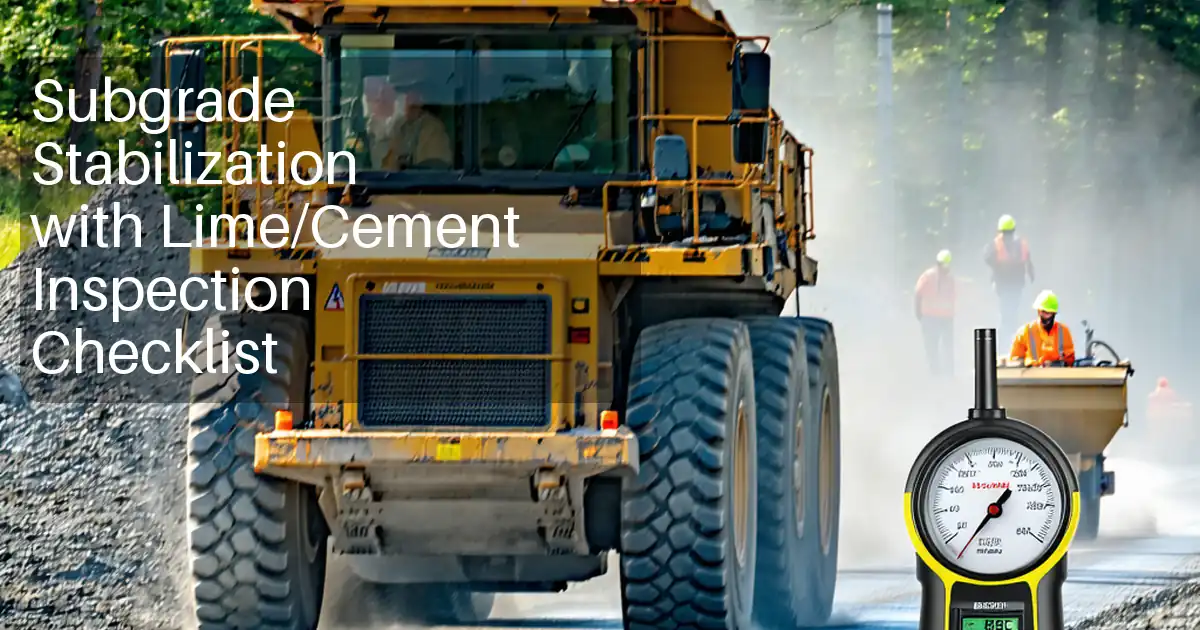
| Lime/Cement | Application 2%–8% by mass [Verify]; per ASTM C977/EN 459 (lime), ASTM C150/EN 197 (cement) |
Equipment
| Equipment | Capacity / Type | Quantity | Inspection Required |
|---|---|---|---|
| Excavator | 20–35 t | 2–4 | |
| Dozer | 150–330 hp | 1–2 | |
| Motor Grader | 12–14 ft blade | 1–2 | |
| Rollers | 10–20 t | 2–3 | |
| Water truck | 10–15 kL | 1–2 | |
| ADT/Rigid truck | 20–40 t | 4–12 | |
| Survey kit | As required | ||
| QA/QC test kit | As required |
Prerequisites
- Approved IFC drawings, specifications, geotechnical report, and this Method Statement/ITP.
- Permits: Permit-to-dig/excavate; utility clearances and mark-out; hot works/working at night if applicable [Verify per project HSE plan and local regulations].
- Survey control established and verified: at least two independent benchmarks tied to project grid; calibration/validation records for instruments and machine control models.
- Laboratory: Approved material sources and preliminary Proctor curves (ASTM D698 and/or D1557); test method matrix and frequency agreed with Engineer.
- Traffic and plant management plan: haul routes, segregation, banksmen/spotters, speed limits, lighting for low visibility.
- Temporary drainage and erosion/sediment controls designed and set out.
- HSE documentation: task-specific risk assessment, lift plans (if lifting), training/competency records, daily pre-starts.
- Weather check: avoid placement/compaction during heavy rain/freeze unless controls are in place.
- Stakeholder notifications where access or services may be affected.
Method Sequence
| Step | Activity | Description | Responsibility | Inspection / Hold Point |
|---|---|---|---|---|
| 1 | Pre-start briefing and permits | Conduct toolbox talk, review hazards, confirm permits/utility mark-out, validate survey controls. | HSE Officer / Supervisor | Permit-to-dig, utility scan records |
| 2 | Site clearance and topsoil strip | Clear vegetation/debris; strip topsoil typically 150–300 mm [Verify]; stockpile separately with silt fencing. | Supervisor / Dozer Operator | Visual classification per BS EN ISO 14688 |
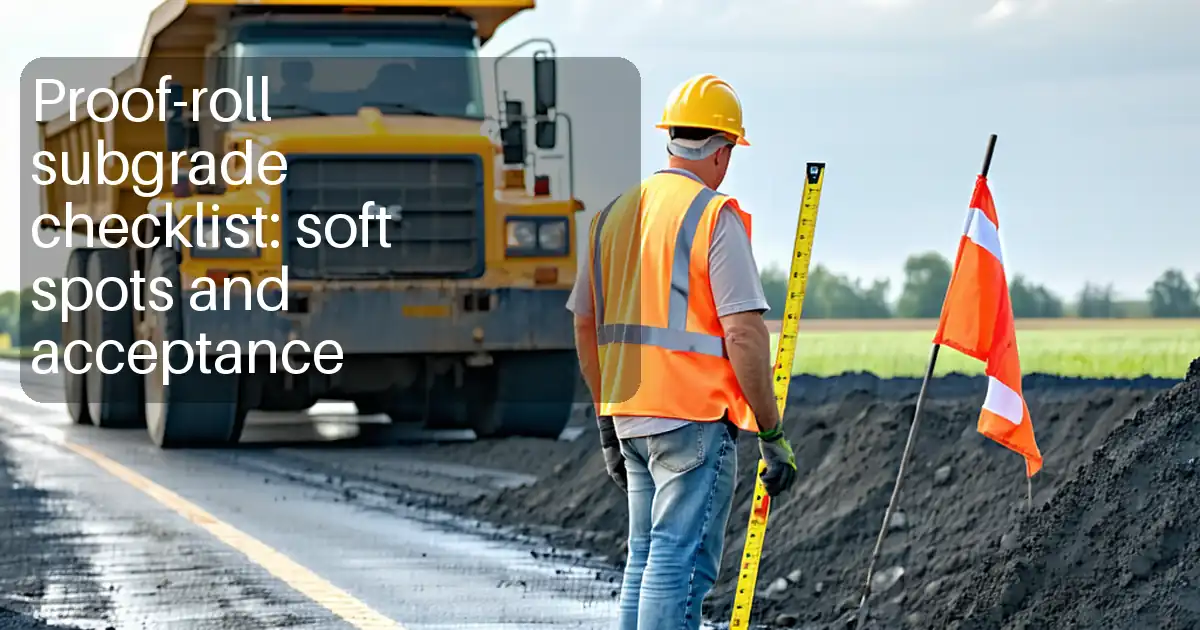
| 3 | Proof-rolling and delineation of soft spots | Proof-roll subgrade using 10–12 t vibratory roller (vibration as suitable) or loaded truck; mark deflections/pumping areas. | Supervisor / QA/QC | Engineer to witness (Hold Point HP1) |
| 4 | Treatment of unsuitable/soft materials | Undercut to firm stratum (typically 300–600 mm or to refusal) and backfill with approved granular/engineered fill; or install geotextile/geogrid and bridging layer; or in-situ stabilize with lime/cement where approved. | Supervisor / Geotechnical Engineer | Engineer to witness remediation proposal |
| 5 | Cut operations | Excavate cut to design with benches on slopes (>1.5 m vertical): bench width ≥1.0 m, fall to inside; maintain slope angles per geotechnical guidance (typical temporary slopes: cohesive 1V:1.5H, granular 1V:2H) [Verify]. | Excavator Operator / Supervisor | Survey spot checks; slope inspections |
| 6 | Haul, place and spread fill (layered) | Place approved fill in uniform lifts 200–300 mm loose. Spread by dozer/grader to achieve even thickness. Segregation avoided; oversized >150 mm removed unless approved. | Supervisor / Dozer / Grader | Visual checks per layer |
| 7 | Moisture conditioning | Condition each layer to OMC within −2% to +2% (or per spec). Add water via tanker and mix; if too wet, aerate by scarification and multiple passes; re-mix until homogeneous. | Supervisor / Water Truck / Dozer | Spot moisture tests (speedy/nuclear gauge) |
| 8 | Compaction | Compact with suitable plant: padfoot for cohesive, smooth drum/pneumatic for granular. Establish rolling pattern via trial: typically 6–10 vibratory passes per lane [Verify]. Avoid bridging; compact to edges with suitable offset. | Roller Operator / Supervisor | Rolling pattern approval (Witness) |
| 9 | Layer verification and hold point | On achieving density/moisture, request inspection prior to next lift. | QA/QC Engineer | Engineer Witness/Surveillance (HP2 for subgrade or first capping lift) |
| 10 | Slope trimming and compaction | Trim exposed slopes to design inclination; compact face using appropriate method (walk compactor/track-walk) without causing slippage. Install temporary erosion control as needed. | Supervisor / Dozer / Roller | Visual/survey checks |
| 11 | Level control and fine trim | Grade top layer to platform levels/gradient using grader and survey guidance; ensure fall 1%–3% to drainage outlets; avoid local depressions. | Surveyor / Grader Operator | Survey check grid ≤10–20 m spacing |
| 12 | Proof-rolling of final formation | Proof-roll final formation to identify any latent soft spots. Repair as per Step 4 if required. | Supervisor / QA/QC | Engineer Witness (HP3) |
| 13 | Temporary drainage and protection | Install temporary swales, check dams, silt fences; maintain surface fall; prevent inundation prior to foundation works. | Supervisor / HSE | Environmental inspection |
| 14 | As-built survey and documentation | Complete as-built surface model, levels, and test summary. Submit lot conformance and QA dossier. | Surveyor / QA/QC | Engineer review (HP4 Final Formation) |
Safety Controls
Task-specific hazards and controls
- Hazard: Underground/overhead utilities strike (excavation/stripping).
- Likely consequence: Electrocution, gas release, service outage, injury/fatality.
- Engineering/procedural control: Permit-to-dig; utility scans and potholing; marked exclusion zones; excavate near services with spotter and hand tools; maintain statutory clearances to overhead lines.
- Required PPE: Helmet, HV clothing, safety boots, gloves, eye protection; dielectric gloves if required.
- Collective preventive measure: Physical barriers/flagging; insulated goalposts for overhead lines.
-
Inspection/permit/supervision: Permit-to-dig approval; daily validation of marks; supervisor and competent plant operators; [Verify per project HSE plan and local regulations].
-
Hazard: Plant–pedestrian interface and reversing.
- Likely consequence: Struck-by, crush injury, fatality.
- Engineering/procedural control: One-way haul routes; spotters with radios; reversing alarms/cameras; exclusion zones (minimum 5 m from operating plant or as OEM); traffic management plan and speed limits ≤20 km/h on site.
- PPE: Helmet, HV vest, boots, gloves; two-way radio for spotters.
- Collective measure: Segregated walkways; barriers; lighting towers for night/low visibility.
-
Inspection/permit/supervision: Daily plant checks; competency records; traffic inspections.
-
Hazard: Slope/edge instability and rollover.
- Consequence: Plant rollover, burial, serious injury/fatality.
- Control: Work to geotechnical slope angles; benching; no surcharge near crest; safe stand-off from edge ≥ depth of cut (or ≥1.5 m minimum) unless engineered; dozer with ROPS/FOPS; spotter for edge works.
- PPE: Seat belts, HV PPE.
- Collective: Edge berms of compacted fill; demarcation.
-
Inspection/permit/supervision: Supervisor to approve access; daily slope inspections after rain.
-
Hazard: Excavation collapse/undermining.
- Consequence: Entrapment, damage to works.
- Control: Do not undercut faces; apply shoring or flatten slopes per geotechnical advice; keep plant away from toe; manage groundwater.
- PPE: Standard PPE.
- Collective: Barricades at open edges; access control.
-
Inspection/permit/supervision: Excavation inspection register; wet weather re-assessment.
-
Hazard: Dust and respirable crystalline silica.
- Consequence: Respiratory irritation, long-term illness.
- Control: Water suppression; speed control; cover loads; cease works in high winds; use stabilizers or polymers if approved.
- PPE: Dust masks (P2/N95) when required.
- Collective: Fixed water points and sprinklers on haul roads.
-
Inspection/permit/supervision: Dust monitoring/visual logs.
-
Hazard: Noise and vibration from compaction/plant.
- Consequence: Hearing damage, nuisance, damage to adjacent structures.
- Control: Maintain equipment; limit vibration near sensitive structures; establish safe distances; schedule noisy works.
- PPE: Hearing protection (SNR/NRR suitable).
- Collective: Acoustic barriers if required.
-
Inspection/permit/supervision: Noise/vibration monitoring as specified.
-
Hazard: Handling lime/cement stabilizers (if used).
- Consequence: Chemical burns, inhalation injury.
- Control: Wet method mixing where possible; controlled spreaders; emergency eyewash; controlled zones; SDS briefing.
- PPE: Chemical-resistant gloves, goggles/face shield, long sleeves, dust mask/respirator (P3) as needed.
- Collective: Damping spray during spreading; spill kits.
-
Inspection/permit/supervision: COSHH/chemical handling permit; training records.
-
Hazard: Adverse weather (rain/heat).
- Consequence: Slips, compromised compaction, heat stress.
- Control: Suspend compaction when material above workable moisture; implement shade/rest/hydration; non-slip access.
- PPE: Weather-appropriate PPE, sunscreen.
- Collective: Weather shelters; drainage maintained.
-
Inspection/permit/supervision: Supervisor to enact stop-work criteria.
-
Hazard: Night works/low visibility.
- Consequence: Reduced situational awareness; collisions.
- Control: Lighting towers to ≥20 lux on working area; reflective PPE; spotters; illuminated plant.
- PPE: HV reflective garments.
- Collective: Light positioning to avoid glare.
-
Inspection/permit/supervision: Night-work permit and lighting inspections.
-
Hazard: Working near public roads/access points.
- Consequence: Traffic incidents, third-party harm.
- Control: Temporary Traffic Management (TTM) per approved plan; flaggers; signage; wheel wash to prevent mud tracking.
- PPE: HV PPE, gloves, boots.
- Collective: Barriers and delineators.
- Inspection/permit/supervision: TTM inspections; permits with road authority where applicable.
[All controls to be verified per project HSE plan and local regulations.]
Environmental Controls
- Erosion and sediment control: Install silt fences, check dams, sediment basins before bulk earthworks. Maintain diversion swales around platforms. Inspect after rainfall events.
- Surface water management: Maintain temporary gradients (1%–3%) to prevent ponding. Isolate work area from natural waterways. Pump and treat water before discharge; obtain discharge consents [Verify per local regulations].
- Dust suppression: Water haul roads and working areas; limit vehicle speeds; cover loads leaving site. Stop works during high winds if suppression ineffective.
- Noise/vibration: Schedule high-noise activities; maintain equipment; monitor at nearest receptors where required; comply with working hour restrictions.
- Material management: Separate and protect topsoil stockpiles (≤2.0 m height, seeded/mulched). Segregate unsuitable material for treatment or disposal at approved facilities.
- Stabilizer handling (lime/cement): Control dust during spreading; manage runoff with silt curtains; prevent high-pH discharge; monitor pH if stabilizers used.
- Spill prevention: Fuel/chemicals in bunded areas (110% capacity). Spill kits on all plant; immediate containment and reporting.
- Waste: Segregate inert/contaminated waste; track via waste transfer notes; no on-site burning.
- Mud tracking: Wheel wash or rumble grids at exits; street sweeping as needed.
- Biodiversity/archeology: Stop-work and notify if protected species or finds encountered.
- Carbon/energy: Minimize idling; optimize haul routes; use Tier-compliant equipment where feasible.
[Verify site-specific limits and permits per project environmental management plan and local regulations.]
QA/QC
Controls and records
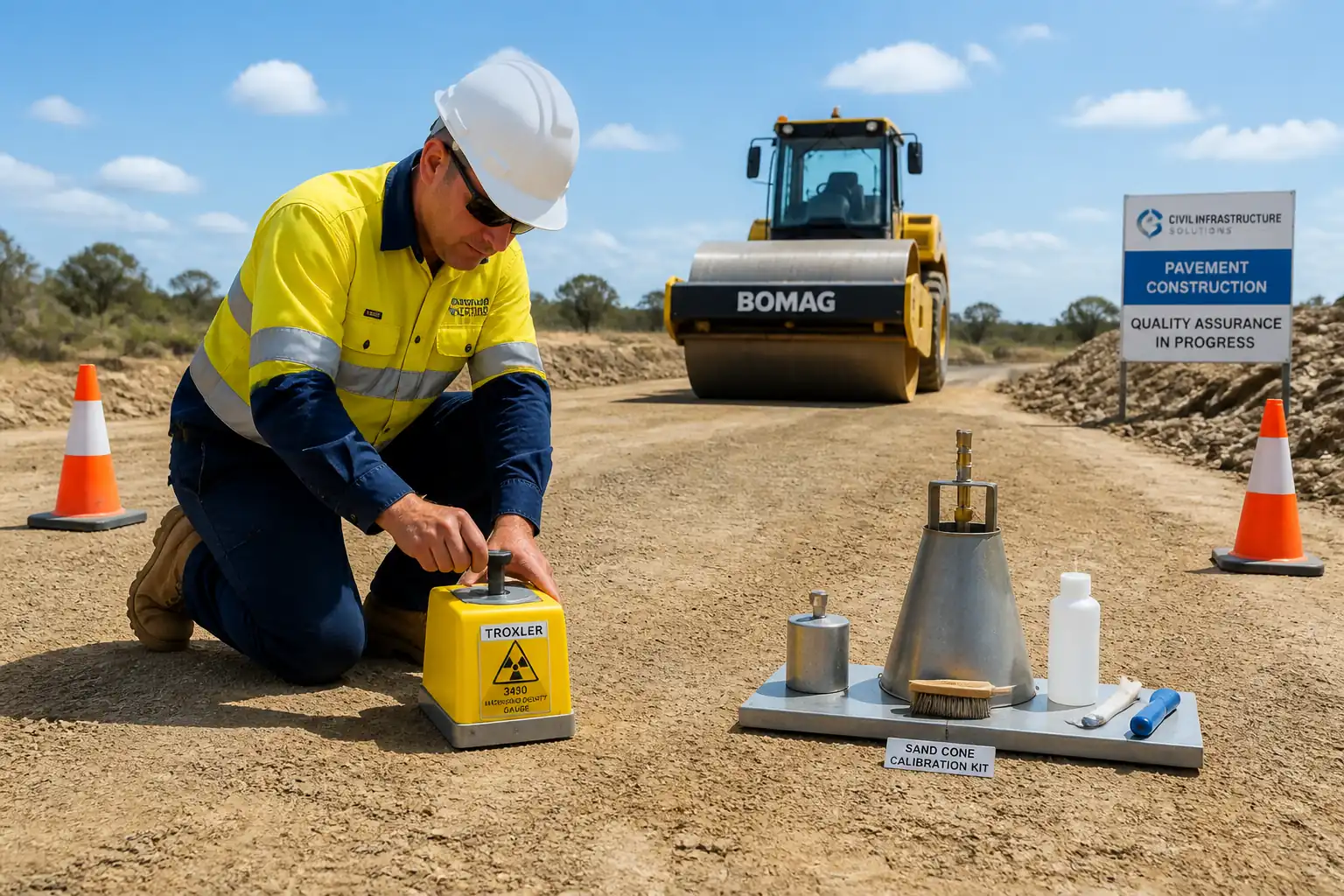
- Pre-works: Approve material sources. Obtain Proctor curves (ASTM D698 and/or D1557). Calibrate/verify survey instruments and nuclear density gauges (calibration within 12 months; daily standard count per ASTM D6938).
- Lotting: Define lots by layer, area (≤1,000 m² typical) or volume (≤500 m³ typical) [Verify]. Maintain layer register with start/finish levels, material source, plant used.
- Field testing frequency [Verify per project specs]:
- Density/moisture: Minimum 1 test per 500 m² per layer for general fill; 1 per 250 m² (or 250 m³) beneath foundations/roads. Additional tests at Engineer’s discretion or failed areas.
- DCP: 1 per 1,000 m² per lift or targeted at suspect zones.
- CBR (lab): 1 per 2,000 m³ of material type or change of source.
- Plate load (if specified): 1 per 1,000–2,000 m² of platform.
- Proctor re-validation: When material changes or at frequencies agreed.
- Acceptance criteria [Verify]:
- Compaction: ≥95% MDD (general) or ≥98% MDD (beneath foundations/roads), moisture within −2% to +2% OMC.
- Surface tolerance: RL within ±20 mm; 3 m straightedge deviation ≤15 mm; crossfall 1%–3%.
- Strength: CBR and/or Ev2 as specified.
- Nonconformance: Stop further placement on failing lots; investigate cause (moisture, thickness, plant); rework (recondition/compact), or remove and replace. Document NCR and retest until conforming.
- Survey QA: Independent check of control network; as-built survey grid ≤10–20 m spacing; produce DTM and contour plots; retain point clouds if used.
- Documentation: Daily reports; material delivery/source certificates; test results; hold/witness point forms; as-built drawings; approval for next activity.
- Handover: Final QA dossier including summary of tests, nonconformance close-outs, as-built levels, and Engineer’s final formation approval.
Attachments
- Drawings: Earthworks plan and sections, platform levels, drainage layout (IFC).
- Survey: Control point schedule, calibration certificates, machine control model approval.
- Materials: Source approvals, Proctor curves, gradation/Atterberg limits, geosynthetics datasheets and DoP/CE (where applicable).
- QA/QC: ITP, test frequency matrix, trial compaction reports, FDT/DCP/CBR/plate load results, lot register, NCRs and closeouts.
- HSE: Risk assessment, permits (dig, night work), traffic management plan, lifting plans (if any), chemical handling procedures (for lime/cement), emergency response plan.
- Environmental: Erosion and sediment control plan, discharge permits, monitoring logs.
- Handover: Final formation approval certificate, as-built survey (DTM, contours, CSV of points).
This content is a read-only public reference. Download or customize to get an editable version.
ITP preview
The first inspection activities from the linked ITP for Method Statement: Bulk Earthworks for Construction Platform Preparation (Cut/Fill, Compaction, Survey Control, QA/QC):
| Activity | Inspection / Test | Acceptance Criteria | Responsibility | Record |
|---|---|---|---|---|
| Pre-start documentation and permits | Permits, utility scans, risk assessments | All approvals in place; controls implemented | Contractor PM / HSE | Approved permits, TBT records |
| Survey control establishment | Calibration records; closed traverse/level loop | Control points verified within tolerance [Verify] | Surveyor / QA | Survey calibration/check reports |
| Topsoil stripping | Visual classification per BS EN ISO 14688 | Topsoil removed to agreed depth; segregated stockpile | Supervisor / Engineer | Daily records, photos |
Showing 3 of 12 inspection activities. View full ITP →
Related Inspection and Test Plan
An Inspection and Test Plan (ITP) is available for Method Statement: Bulk Earthworks for Construction Platform Preparation (Cut/Fill, Compaction, Survey Control, QA/QC). The ITP defines the inspection activities, acceptance criteria, hold and witness points, responsible parties, and records required to verify the work described in this method statement.
View the Method Statement: Bulk Earthworks for Construction Platform Preparation (Cut/Fill, Compaction, Survey Control, QA/QC) ITP →Frequently asked questions
Continue with related Quollnet resources connected to this method statement.