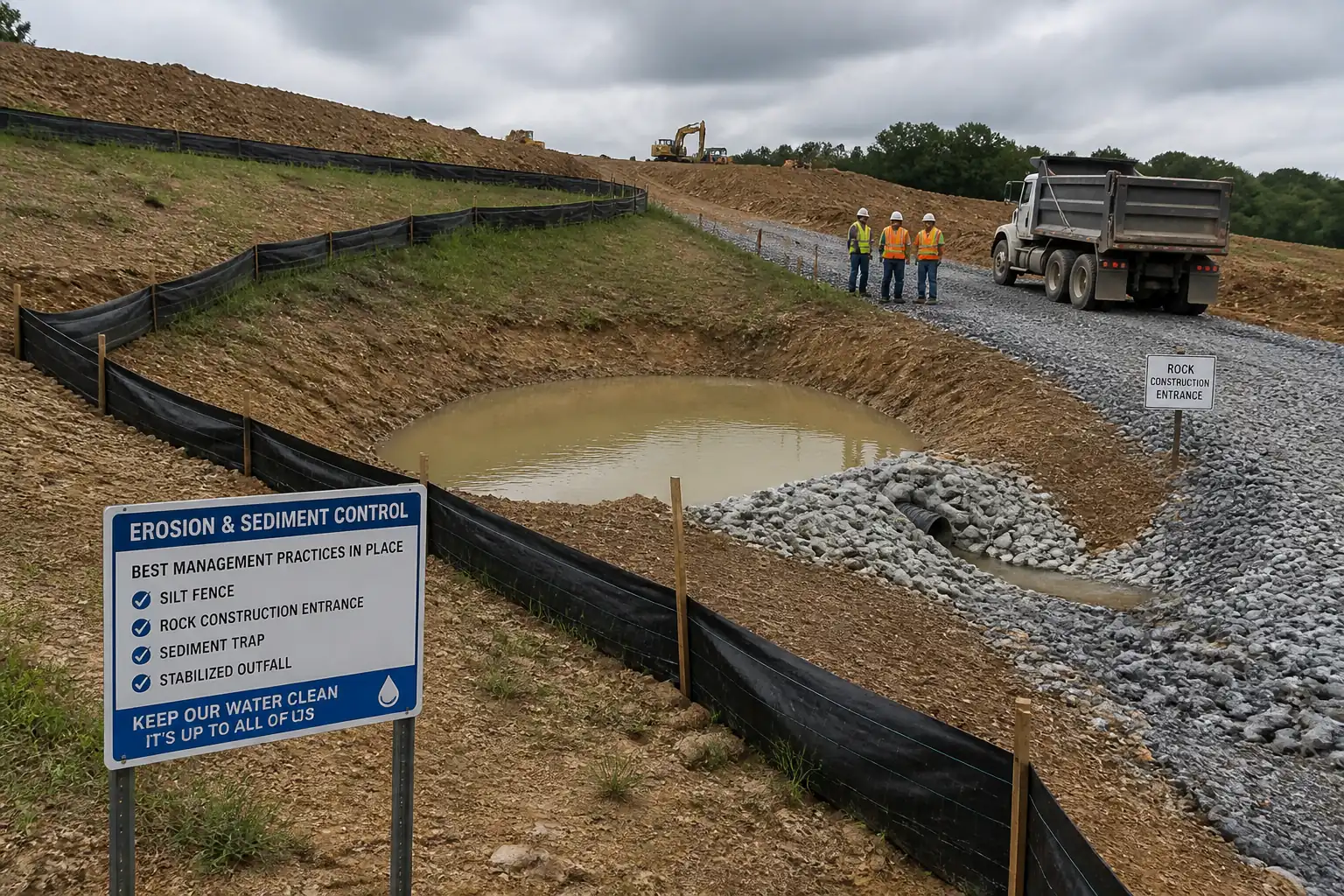

Inspection and Test Plan for Method Statement: Installation and Maintenance of Erosion and Sediment Control (ESC) Measures
AI-assisted inspection and test plan connected to a method statement, with PDF and Excel export.
More than a static template
Unlike a downloadable Word or PDF template, this ITP is an AI-assisted editable starting point directly connected to its method statement. Every inspection activity, hold point, and acceptance criterion is structured and ready to adapt to your project.
- AI-assisted customization — Tailor inspection activities and acceptance criteria to your specific project scope.
- Linked method statement — This ITP is connected to the corresponding method statement describing the work sequence.
- Multiple export formats — Download as a formatted PDF or editable Excel spreadsheet.
- Editable starting point, not a final document — Review and verify all content against your project specifications and standards before use.
What you can customize
When you save this ITP to your account, every inspection row becomes editable. You can add, remove, or modify:
- Inspection activity — Description of what is being inspected.
- Inspection type — Hold point (H), Witness point (W), Review (R), or Monitor (M).
- Responsibility — Contractor, subcontractor, engineer, or client.
- Frequency — How often the inspection occurs.
- Acceptance criteria — Referenced standard or specification requirement.
- Records — Forms, test reports, or checklists required as evidence.
Why this ITP is used
To verify ESC installations and maintenance meet design, permit, and quality requirements, preventing offsite sediment transport.
Who uses this inspection and test plan
Contractor’s QA/QC and Environmental teams, Site Engineers, Foremen, and the Engineer/Employer’s Representative.
When this ITP is prepared and submitted
During installation of ESC measures, routine inspections, dewatering, and at final demobilization.
Who receives or approves this ITP
Engineer/Employer’s Representative for review and acceptance.
Inspection scope
Covers layout, silt fences, sediment traps, inlet protection, stabilized access, diversions/check dams, dewatering, routine inspections, and final reinstatement.
Typical hold, witness, and review points
Hold: layout, first silt fence, trap excavation, final sign-off. Witness: entrances, diversions, inlet devices, monitoring events.
Typical inspection records
Checklists, hold/witness sign-offs, delivery tickets, material certificates, calibration logs, rain logs, maintenance logs, photos, lab reports.
Important approval note
This ITP is an AI-assisted editable starting point, not a pre-approved document. Before use on any project, all inspection activities, hold points, and acceptance criteria must be reviewed and approved by the relevant parties (superintendent, principal contractor, or client representative) in accordance with your contract and project quality plan.
Always verify acceptance criteria against your applicable drawings, specifications, and regulatory requirements. Hold points must be confirmed with the relevant authority before work proceeds past that point.
Inspection and test plan
| Activity | Inspection / Test | Acceptance Criteria | Responsibility | Record |
|---|---|---|---|---|
| Pre-works layout verification | Check set-out vs ESCP, drainage paths, protection of buffers (H) | Layout conforms to ESCP; receptors identified; permits in place | Site Engineer / QA-QC | Layout checklist, photos, hold-point release |
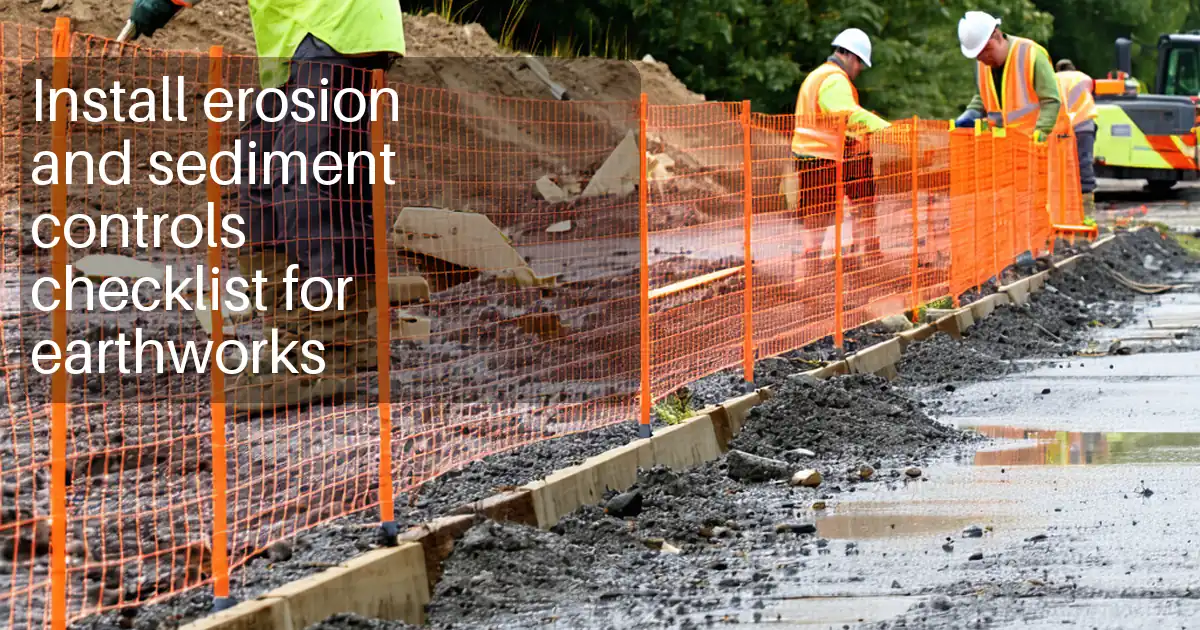
| Silt fence – first 20 m installation | Visual inspection of trench depth, post spacing, embedment, overlaps (H) | Trench 150–200 mm; posts ≤2.0 m (no wire) or ≤3.0 m (with wire); fabric height 600–750 mm; returns/J-hooks installed | QA-QC / Environmental Officer / Engineer | Silt fence inspection form, photos |
| Silt fence – production | Random checks every 100 m or daily, whichever first (W) | Continuous embedment; no gaps/tears; proper tie to high ground | Environmental Officer / Foreman | Daily checklists, NCR if noncompliant |
| Sediment trap excavation/foundation | Check dimensions, foundation condition, groundwater, stability (H) | Dimensions within ±50 mm; stable subgrade; dewatering plan approved if needed | Engineer / QA-QC | Hold-point sign-off, level records, photos |
| Sediment trap outlet/spillway installation | Verify lining, spillway elevation, outlet assembly (W) | Freeboard ≥300 mm; spillway lined; outlet per design; secure anchorage | QA-QC / Engineer | Inspection report, material certs |
| Stabilized construction entrance | Inspect subgrade, geotextile, aggregate thickness/gradation (W) | Geotextile intact; rock size 50–75 mm; thickness 150–200 mm; length/width per plan; drainage provided | QA-QC / Traffic Supervisor | Entrance checklist, delivery tickets, photos |
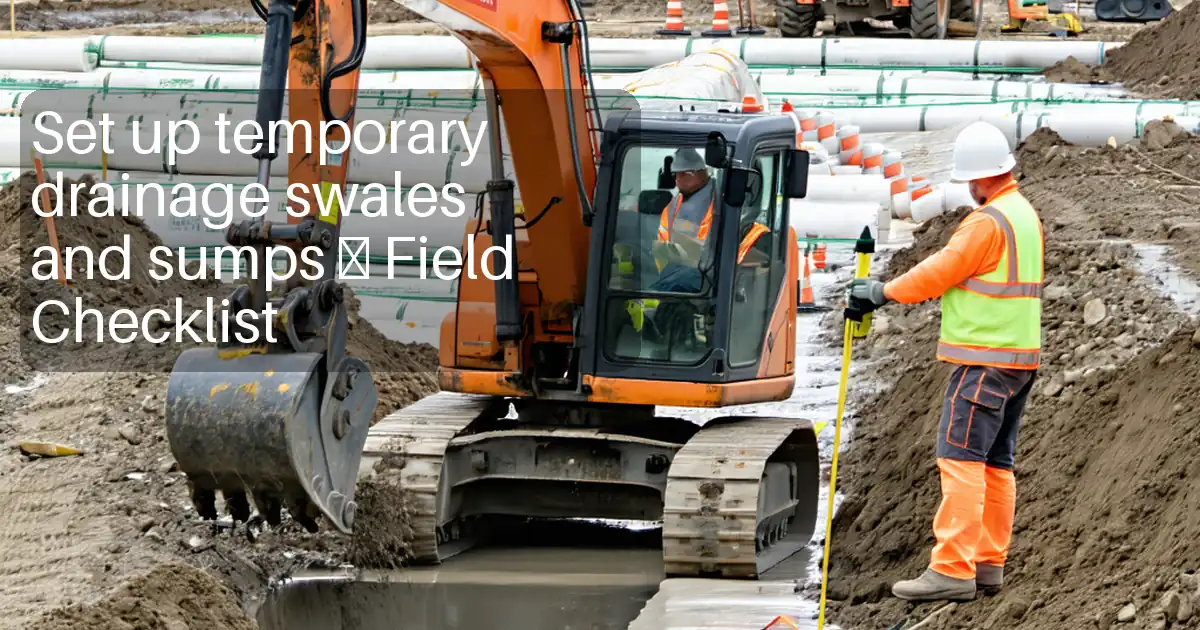
| Diversion berms/swales & check dams | Verify grades, freeboard, lining; check dam height/spacing (W) | Longitudinal slope 0.5–2%; freeboard ≥150 mm; lining adequate; dam height 300–600 mm; keyed into banks | Engineer / QA-QC | Inspection report, as-built levels |
| Inlet protection devices | Visual check seating, overflow path, traffic safety (W) | Secure; not obstructing traffic; maintainability ensured | Environmental Officer | Inlet device checklist, photos |
| Dewatering discharge monitoring | Turbidity/pH at discharge at start and periodically (W) | Within permit limits; no visible sheen; no scouring at outlet | Environmental Technician / Officer | Monitoring logs, calibration records, lab reports (if any) |
| Routine ESC inspections | Weekly and post-rain ≥12.7 mm within 24 h [Verify] | Defects rectified within 24–48 h; tracking removed same day | Environmental Officer | Weekly/post-storm inspection forms, rain log |
| Final inspection and demobilization | Confirm stabilization and removal sequence (H) | ≥70% vegetative cover or permanent surfacing; no active erosion; all temporary controls removed and waste disposed | Engineer / Environmental Manager | Final sign-off, disposal tickets, as-built/redlines |
This table is a read-only public reference. Download the PDF or Excel version, or customize this ITP to edit it for your project.
Frequently asked questions
Related method statement
This Inspection and Test Plan is associated with the Method Statement: Installation and Maintenance of Erosion and Sediment Control (ESC) Measures method statement, which describes the step-by-step construction sequence, resources, materials, equipment, safety controls, and environmental controls for this activity.
View the Method Statement: Installation and Maintenance of Erosion and Sediment Control (ESC) Measures method statement →Continue with related inspection, method statement, article, and checklist resources.