
Demolition and Removal of Concrete Pavement, Kerbs and Footpaths – Method Statement
AI-assisted method statement with matching ITP, PDF download, and Excel export.
More than a static template
Unlike a downloadable Word or PDF template, this method statement is an AI-assisted editable starting point connected directly to a matching Inspection and Test Plan. Every section is structured, project-adaptable, and ready to export.
- AI-assisted drafting — Customize every section with AI for your specific project scope.
- Linked ITP — A matching inspection and test plan is generated alongside the method statement.
- Multiple export formats — Download as a formatted PDF or editable Excel spreadsheet.
- Editable starting point, not a final document — Review, verify, and adjust all content against your project requirements before use.
Static template vs. Quollnet workflow
| Feature | Static template | Quollnet |
|---|---|---|
| Project-specific content | Manual fill-in required | AI-assisted customization |
| Linked ITP | Separate document, no link | Matching ITP included |
| Export formats | Usually PDF only | PDF and Excel |
| Structured sections | Free-form layout | 13 standardized sections |
| Saved to your account | Local file only | Cloud-saved, reusable |
| Content accuracy | You verify everything | AI-assisted, you still verify |
| Cost | Often free but time-intensive | Free to customize and download |
What you can customize
When you save this method statement to your account, every section becomes editable. The following 13 sections are included:
- Scope — Defines the activity and its boundaries.
- References — Standards, specifications, and drawings.
- Responsibilities — Roles and accountabilities.
- Resources — Labour, plant, and equipment summary.
- Materials — Materials and compliance requirements.
- Equipment — Tools and equipment details.
- Prerequisites — Hold points and pre-conditions.
- Method sequence — Step-by-step construction sequence.
- Safety controls — HSE risk controls and PPE.
- Environmental controls — Environmental mitigation measures.
- QA/QC — Quality inspection and test requirements.
- ITP — Inspection and Test Plan table (has its own page).
- Attachments — Referenced drawings and documentation.
Why this method statement is used
This method statement is used to define and communicate the approved procedure for carrying out demolition and removal of concrete pavement, kerbs and footpaths on site. It ensures the work is planned in advance, the correct resources and controls are in place, and all personnel understand responsibilities, sequence, quality requirements, and safety controls before work begins. It aligns site execution with the documented scope and acceptance expectations.
Who uses this method statement
This method statement is used by contractors, site supervisors, project engineers, QA/QC engineers, HSE officers, consultants, and client representatives. It serves as a shared reference for planning, execution, supervision, inspection, and approval of the activity on site.
When it is prepared and submitted
The method statement is prepared before the work activity starts and submitted as part of the pre-construction documentation package for review and approval.
Who reviews or approves it
The method statement is usually submitted to the client representative, consultant, resident engineer, or project management consultant for review and approval before the work commences.
Important approval note
This method statement is an AI-assisted editable starting point, not a pre-approved document. Before use on any project, all content must be reviewed and approved by the relevant parties (superintendent, principal contractor, or client representative) in accordance with your contract and project quality plan.
For example: if your specification requires a departure from a referenced standard, that departure must be documented and approved separately — this method statement will not capture that automatically. Always verify against your applicable drawings, specifications, and regulatory requirements.
Method statement content
Scope
Work Summary
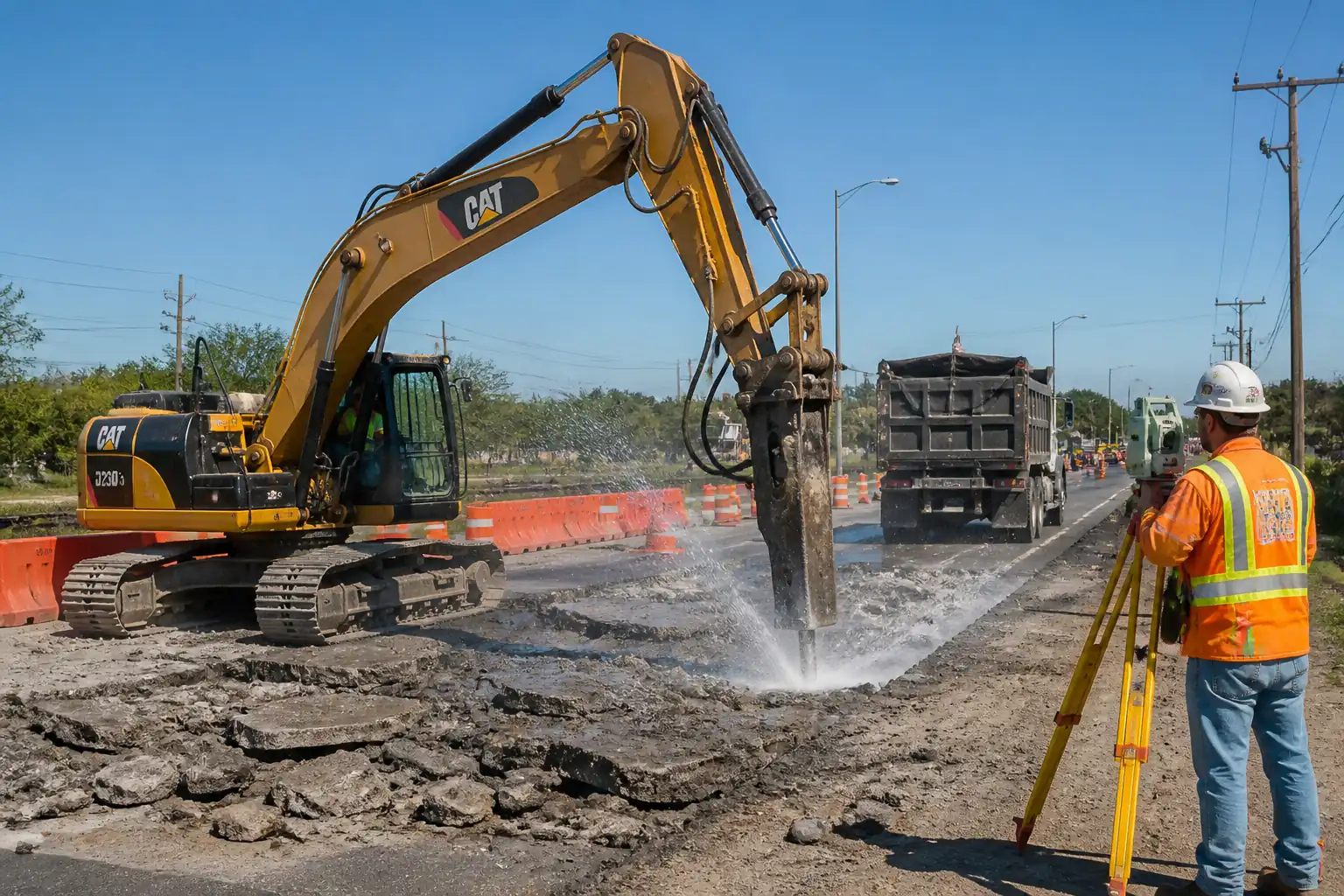
- Controlled demolition, breaking and removal of existing concrete carriageway pavement, kerbs, channels, and concrete footpaths within defined work zones.
- Establish and maintain traffic management and pedestrian diversions, including barriers, signage, and edge protection.
- Dust suppression by water misting/sprays; noise and vibration management and monitoring.
- Selective segregation of concrete and reinforcement; loading, transport, and disposal/recycling to approved facilities.
- Protection of adjacent live traffic lanes, utilities, structures, street furniture, trees, and drainage assets.
- Survey and verification of exposed subgrade/formation after removal, including proof-rolling and in-situ tests (e.g., DCP, density/moisture) and as-built level survey.
Deliverables
- Approved Traffic Management Plan (TMP) and permits.
- Daily plant/vehicle inspection records and toolbox talks.
- Utility clearance and permits-to-dig; trial pit records.
- Waste transfer notes/weighbridge tickets and recycling reports.
- Noise, dust, vibration monitoring logs.
- Subgrade test results and survey as-built data.
Exclusions
- Permanent reinstatement of pavement layers unless expressly stated. [Verify per project scope]
- Relocation/diversion of utilities (by others unless noted).
- Hazardous materials remediation (e.g., ACM, tar-bound asphalt). If encountered, works will stop and specialist procedures will apply. [Verify per project HSE plan]
References
| Document Type | Reference / Number | Revision | Notes |
|---|---|---|---|
| BS 6187:2011 Code of practice for full and partial demolition | Planning, sequencing, and execution of demolition works. | ||
| BS 5975 Temporary works procedures and the permissible stress design of falsework | Temporary works coordination and edge protection design/control. | ||
| ISO 45001 Occupational health and safety management systems | H&S management framework. | ||
| ISO 14001 Environmental management systems | Environmental controls and aspects/impacts. | ||
| ISO 9001 Quality management systems | Quality planning, inspection, and records. | ||
| BS 6031 Code of practice for earthworks | Subgrade handling, formation tolerances and protection. | ||
| BS 1377 (Parts) Methods of test for soils for civil engineering purposes | Density/moisture/CBR testing methods (UK). [Or ASTM D6938/D1556, ASTM D1883, ASTM D6951 – Verify per jurisdiction] | ||
| BS 7385-2 Evaluation and measurement for vibration in buildings – Guide to damage levels | Building response to vibration (PPV limits). [Verify project criteria] | ||
| ISO 2631-2 Evaluation of human exposure to whole-body vibration | Human comfort/health in adjacent buildings. [Verify project criteria] | ||
| Traffic control: MUTCD (US) or Traffic Signs Manual Chapter 8 (UK) or local equivalent | Temporary traffic management devices, layouts, and inspection. [Verify per project jurisdiction] | ||
| BS EN 13242 Aggregates for unbound and hydraulically bound materials for use in civil engineering works and road construction | If crushed concrete is reused/recycled as aggregate. | ||
| Waste regulations: EU Waste Framework Directive/US EPA RCRA or local equivalent | Duty of care, waste classification, tracking. [Verify local regulation] |
Responsibilities
| Role | Responsibility | Name / Party |
|---|---|---|
| Project Manager | Project Manager | Contractor |
| Supervisor | Construction Manager / Demolition Supervisor | Contractor |
| TWC | Temporary Works Coordinator (TWC) | Contractor |
| HSE | HSE Manager / Advisor | Contractor |
| Traffic Manager | Traffic Manager | Contractor |
| Engineer/Surveyor | Site Engineer / Surveyor | Contractor |
| Utility Coordinator | Utility Coordinator / Permit-to-Dig Authority | Contractor |
| Operators | Plant Operators (Excavator/Breaker) | Contractor |
| Banksman | Banksman/Spotter | Contractor |
| Laboratory | Independent Testing Laboratory | Third Party |
| Engineer | Client/Engineer’s Representative | Client/Engineer |
Resources
| Resource Type | Description | Quantity | Remarks |
|---|---|---|---|
| Personnel | 1 | Chartered civil engineer preferred. | |
| Personnel | 1 | Experienced with mechanical breaking in live highway environments. | |
| Personnel | 1 | On site during breaking and load-out. | |
| Personnel | 1 + 4-6 | Set-out/maintain TMP, inspect every 2–4 hours or after incidents/weather. | |
| Personnel | 1–2 | Setting out and as-built survey. | |
| Personnel | 1–2 | Certified, experienced with breaker attachments. | |
| Personnel | 1–2 | Always in radio contact with operators. | |
| Personnel | 1 | Manages dust suppression. | |
| Personnel | 2–6 | Licensed carriers; adhere to waste transfer documentation. |
Materials
| Material | Specification / Grade | Quantity | Remarks |
|---|---|---|---|
| Water for dust suppression | Free of contaminants. [Verify per environmental plan] | As required | Potable/non-potable clean water for misting/sprays; prevent runoff. |
| Survey/marking paint | High-visibility; non-permanent where required. | As required | Marking saw-cut/extents and utilities; biodegradable preferred. |
| Silt socks/geotextile wraps | UV-stable, appropriate flow capacity. | As required | For drainage inlet protection. |
| Steel road plates / temporary backfill aggregate | Plates with anti-skid; aggregate per local spec (e.g., 6F2). [Verify] | If required | For temporary ramps/covering openings. |
Equipment
| Equipment | Capacity / Type | Quantity | Inspection Required |
|---|---|---|---|
| Tracked excavator | 20–30 t operating weight | 1–2 | Daily plant inspections; periodic LOLER/PUWER equivalent [Verify] |
| Hydraulic breaker attachment | Approx. 1.5–2.5 t; impact energy ~2–7 kJ [Verify per supplier] | 1–2 | Daily inspection; hoses free from leaks; tool retaining system secure. |
| Excavator buckets/grapple | 0.8–1.5 m3 bucket; suitable lifting points/rotator if used | 1 | Visual daily checks; lifting accessories inspected per local regs. |
| Water bowser / water truck | 5–10 m³ tank with pump and spray lance | 1 | Daily; ensure backflow prevention; spill containment kit available. |
| Road sweeper / skid steer broom | Commercial | As required | Pre-use checks; maintain silt control. |
| Dump trucks / tipper lorries | 10–20 t payload | 2–6 | Daily vehicle inspection; driver credentials verified. |
| Survey equipment | RTK GNSS (±10 mm horiz/±15 mm vert typical) [Verify] | 1 set | Calibration/validity certificates current. |
| In-situ testing equipment | DCP kit; nuclear gauge; sand cone; plate load kit | As needed | Calibration and operator certification current. |
| Traffic management devices | Compliant with MUTCD/Chapter 8 or local equivalent | As per TMP | TMP inspections every 2–4 hours and after changes/incidents. |
Prerequisites
Approvals and Permits
- Approved Method Statement, Risk Assessment, and ITP.
- Approved Traffic Management Plan (TMP) and road occupancy permits.
- Permit-to-Dig issued following utility searches, GPR, and trial holes with as-built mark-up confirmed.
- Environmental permits/consents for water use and any discharge; waste carrier licenses and receiving-facility approvals.
Surveys and Preparations
- Pre-condition/dilapidation survey of adjacent structures, pavements, utilities, and drainage assets.
- Set-out of demolition extents and saw-cut lines by Surveyor; verify with Engineer.
- Temporary works/edge protection design checked/approved by TWC where required.
Plant, People, and Briefings
- Competency verification of operators and banksmen; equipment inspection certificates current.
- Calibrations for monitoring (vibration/dust/noise) and testing (DCP/density) are valid.
- Task-specific inductions and toolbox talks covering exclusion zones, plant interface, RCS dust, noise, vibration, manual handling, and emergency procedures.
Constraints and Interfaces
- Confirm work windows, adjacent live traffic, pedestrian routes, access/egress, lighting for night works, and laydown locations.
- Weather review: avoid high winds causing dust and heavy rainfall that could mobilize silt runoff. [Verify threshold per project HSE plan]
- Coordination with other trades/utilities; protection and isolation as needed.
Method Sequence
| Step | Activity | Description | Responsibility | Inspection / Hold Point |
|---|---|---|---|---|
| 1 | Site handover and TMP installation | Establish work zones, cones, signs, barriers, and lighting per approved TMP; install edge protection at open edges; brief all personnel. Inspect TMP prior to opening to traffic. | Traffic Manager / Supervisor | TMP pre-opening inspection and sign-off |
| 2 | Utility clearance and Permit-to-Dig | Confirm utility search results on ground; mark services; complete GPR/trial holes; set minimum 500 mm hand-dig/vacuum zone around known services. | Utility Coordinator / Supervisor | Permit-to-Dig issue |
| 3 | Pre-condition survey and monitoring set-up | Record condition of adjacent pavements/structures; install vibration and noise monitors at agreed receptors; baseline readings taken. | HSE / Surveyor | Monitoring devices commissioning |
| 4 | Set-out and saw-cutting (where required) | Mark demolition limits; saw-cut full depth along neat lines to isolate adjacent slabs/kerbs/footpaths and prevent spalling. | Surveyor / Saw-cut crew | Line verification before cutting |
| 5 | Dust suppression activation | Position water truck/bowser and wet workface using mist sprays; adjust flow to minimize runoff; continue throughout breaking and loading. | Supervisor / Water cart operator | Visual and meter checks |
| 6 | Mechanical breaking of pavement | Start at free edge/previous saw-cut; use hydraulic breaker at 90° to surface; avoid prying on reinforcement; maintain exclusion zone = machine maximum working radius + 5 m (min 10 m) [Verify]. | Demolition Supervisor / Excavator operator | Continuous supervision |
| 7 | Lifting, segregation, and load-out | Lift broken panels with bucket/grapple; segregate steel for recycling; load covered trucks; prevent overloading; wheel-wash if required. | Supervisor / Operator / Drivers | Load security check; waste classification |
| 8 | Kerb and footpath demolition | Isolate with saw-cuts; break and lift away from live carriageways; protect adjacent paving and utility covers; maintain pedestrian diversions. | Supervisor / Operator | Visual checks |
| 9 | Interface with utilities and shallow services | Within 1 m of known utilities, switch to hand tools/vacuum excavation; expose and support; maintain safe clearances. | Utility Coordinator / Crew | Hold point before mechanical breaking near utilities |
| 10 | Housekeeping and temporary protection | Remove loose debris; sweep; protect open edges with barriers/plates; ensure drainage inlets are protected with silt socks. | Supervisor / TM crew | Walkthrough |
| 11 | Subgrade exposure and preliminary proof-roll | Trim to formation; pass roller or loaded truck at slow speed to identify yielding areas; mark soft spots for investigation. | Supervisor / Engineer | Engineer witness |
| 12 | In-situ testing of subgrade | Conduct DCP at agreed grid (e.g., 1 per 250 m²) and in-situ density/moisture (e.g., 1 per 500 m²) or as specified. Plate load test if required near critical areas. | Independent Testing Laboratory / Engineer | Engineer witness |
| 13 | Survey and dimensional checks | Survey exposed formation levels and horizontals; compare to design; mark nonconformances for rework. | Surveyor / Engineer | ITP check |
| 14 | Demobilization or temporary surfacing (if required) | If area remains open to traffic/pedestrians, place temporary plates/ramps and reinstate TMP accordingly; otherwise demobilize plant and tidy site. | Supervisor / Traffic Manager | Final walkthrough |
Health, Safety and Welfare Controls
Principal Task-Specific Hazards and Controls
- Hazard: Underground utility strike (electric, gas, fiber, water).
- Likely consequence: Electrocution, explosion, service outage, flooding.
- Engineering/procedural control: Utility searches, GPR and trial holes; Permit-to-Dig; 500 mm mechanical exclusion; hand/vacuum excavation near services; lockout/tagout where permissible.
- Required PPE: Dielectric gloves (as applicable), arc-rated clothing for electrical isolation tasks, hard hat, safety boots, eye protection.
- Collective measure: Physical guards to exposed services; barriers and clear signage.
-
Inspection/permit/supervision: Permit-to-Dig; utility owner approvals; Supervisor and Utility Coordinator sign-off.
-
Hazard: Plant–person interface with excavators/breakers and trucks.
- Likely consequence: Struck-by/crush injuries or fatality.
- Engineering/procedural control: Defined plant operating zones and pedestrian walkways; exclusion zone = machine reach + 5 m (min 10 m) [Verify]; banksman with radio; reversing alarms and cameras; spotter control.
- Required PPE: Hi-vis class 3, safety boots, hard hat, gloves, eye protection.
- Collective measure: Barriers, vehicle marshaling points; physical segregation.
-
Inspection/permit/supervision: Daily plant checks; Supervisor present during breaking and loading.
-
Hazard: Flying debris and tool failure during breaking.
- Likely consequence: Eye/face injuries, lacerations.
- Engineering/procedural control: Use breaker at 90°; maintain tool retaining systems; install debris screens where risk to public; control fragment size.
- Required PPE: Safety glasses plus face shield, gloves, long sleeves.
- Collective measure: Public protection screens/netting, barriers.
-
Inspection/permit/supervision: Pre-use inspection; defective tools quarantined.
-
Hazard: Respirable crystalline silica (RCS) dust.
- Likely consequence: Acute/long-term respiratory disease.
- Engineering/procedural control: Continuous wet suppression; minimize dry sweeping; use M-class/H-class vacuums; rotate tasks; exposure monitoring to keep below OEL (e.g., 0.05–0.1 mg/m³ 8-hr TWA) [Verify per local regulation].
- Required PPE: Fit-tested P2/P3 (N95/N100) RPE when suppression/monitoring indicates; eye protection.
- Collective measure: Enforce exclusion zones downwind; schedule in low-wind periods where practicable.
-
Inspection/permit/supervision: Dust monitoring; HSE Advisor spot checks.
-
Hazard: Excessive noise from breakers and plant.
- Likely consequence: Hearing damage; nuisance to public.
- Engineering/procedural control: Use mufflers; maintain equipment; limit hours; erect acoustic barriers where needed; monitor LAeq.
- Required PPE: Class 5 earmuffs/earplugs.
- Collective measure: Acoustic barriers; distance separation.
-
Inspection/permit/supervision: Noise monitoring and records; community liaison where required.
-
Hazard: Ground-borne vibration to adjacent structures.
- Likely consequence: Cosmetic/building damage or complaints.
- Engineering/procedural control: Select appropriate breaker energy; sequence from free edges; avoid resonance; continuous monitoring with PPV alarms.
- Required PPE: N/A (environmental risk).
- Collective measure: Stand-off distances; temporary supports where necessary.
-
Inspection/permit/supervision: Vibration monitoring; hold point if PPV exceeds project thresholds (e.g., 5–10 mm/s) [Verify].
-
Hazard: Traffic interface (live carriageways).
- Likely consequence: Vehicle collisions, public injury.
- Engineering/procedural control: Approved TMP; impact-rated barriers; night works lighting; trained TM crew; emergency response plan.
- Required PPE: Hi-vis class 3, lighting/LED body-worn lights at night.
- Collective measure: Physical lane closures, crash barriers.
-
Inspection/permit/supervision: TMP inspections 2–4 hourly and after incidents/weather.
-
Hazard: Work at edge/open excavations or sudden level changes.
- Likely consequence: Falls, rollovers.
- Engineering/procedural control: Install edge protection per BS 5975; plate over openings; define plant travel routes; gradient control.
- Required PPE: Standard PPE with high-ankle boots.
- Collective measure: Guardrails and toe boards where foot traffic present.
-
Inspection/permit/supervision: TWC inspections; daily supervisor checks.
-
Hazard: Hydraulic hose/line failure and hot oil.
- Likely consequence: Burns, injection injuries, spills.
- Engineering/procedural control: Hose guards, regular inspection, pressure testing per OEM; depressurize before maintenance.
- Required PPE: Gloves rated for hydrocarbons, face/eye protection.
- Collective measure: Spill kits and drip trays.
-
Inspection/permit/supervision: Plant maintenance logs; pre-use checks.
-
Hazard: Manual handling of kerbs/rebar.
- Likely consequence: Musculoskeletal injuries, cuts.
- Engineering/procedural control: Use mechanical aids; team lifts; cut protruding rebar to safe length; deburr.
- Required PPE: Gloves (cut-resistant), boots, eye protection.
- Collective measure: Mechanical grabs/lifting attachments.
- Inspection/permit/supervision: Supervisor oversight.
[All controls to be verified per project HSE plan and local regulations]
Environmental Controls
Dust
- Continuous water misting at point of impact and during loading; avoid visible plumes leaving boundary.
- Target exposure below applicable RCS OEL; deploy personal and area monitoring where required. [Verify]
Noise and Vibration
- Schedule high-noise tasks during permitted hours; use acoustic shrouds/barriers where close to receptors.
- Monitor LAeq and PPV with alarms; if thresholds approached/exceeded, pause and modify method (reduce hammer energy, change sequence, increase stand-off). [Verify thresholds per spec]
Water and Runoff
- Prevent slurry/runoff to drains; use silt socks/geotextile wraps at inlets; vacuum slurry from saw-cutting.
- Contain bowser overflows; no discharge to surface waters without permit.
Waste and Materials Management
- Segregate concrete and metals; maximize recycling (e.g., to BS EN 13242 if reused).
- Complete waste transfer notes; verify carrier licenses and receiving facility permits.
- Inspect trucks for covered loads; wheel-wash to prevent track-out; deploy road sweeper as required.
Soil/Subgrade Protection
- Minimize trafficking on formation; no standing water; cover if rain forecast; remediate soft spots per Engineer.
Emissions and Spills
- Use low-sulfur fuel or Stage V/Tier 4 equipment where feasible; minimize idling.
- Spill kits at refueling points; drip trays under parked plant; report and clean any spills immediately.
Ecology and Trees
- Protect trees with barriers outside RPAs; avoid root disturbance; no storage under canopies. [Verify arborist requirements]
Quality Assurance and Quality Control
Controls, Tolerances, and Frequencies
- Setting Out: Extents verified by Surveyor and Supervisor prior to cutting/breaking; saw-cut line tolerance ±25 mm from design/mark-up. [Verify]
- Breaking: Fragment size targeted <600–800 mm for safe handling unless otherwise instructed. [Verify]
- Formation Levels: After removal, formation level tolerance typically ±10 mm; crossfall/grade within design tolerance. [Verify]
- Proof-Roll: 100% of exposed subgrade; defects marked and recorded for treatment.
- In-Situ Testing:
- DCP frequency: 1 per 250 m² minimum and at suspected soft spots. [Verify]
- Density/Moisture frequency: 1 per 500 m² or per layer if compaction undertaken. [Verify]
- Acceptance: Meets specified CBR/strength (e.g., 5–15% typical) and moisture within acceptable band (e.g., OMC ±2%). [Verify per project specifications]
- Monitoring:
- Dust: Keep below local OEL for RCS; record suppression flow and conditions.
- Noise: LAeq,T at boundary ≤ project limit (e.g., 70–75 dB) unless otherwise permitted. [Verify]
- Vibration: PPV at nearest structure ≤ project limit (e.g., 5–10 mm/s). [Verify]
Records and Documentation
- ITP with hold/witness points; daily diaries; inspection checklists; calibration certificates; as-built survey (CSV/DWG); test reports; waste tickets; TMP inspections; toolbox talk records.
Nonconformance and Corrective Action
- Record NCR for tolerance/test exceedances; agree remedial actions (e.g., re-trim, re-compact, stabilize soft spots) and re-test; close-out with Engineer approval.
Attachments
- Approved Traffic Management Plan (TMP) and sketches.
- Risk Assessment and Method Statement (RAMS).
- Permit-to-Dig and utility search/GPR/trial hole records.
- Temporary Works/Edge Protection design and TWC approvals.
- Plant inspection certificates; lifting accessories records; operator competencies.
- Monitoring plan and calibration certificates (dust/noise/vibration/testing).
- Waste Management Plan; carrier licenses; receiving facility approvals.
- Daily inspection checklists; toolbox talk records; site diary.
- As-built survey files (CSV/DWG/PDF) and testing reports.
This content is a read-only public reference. Download or customize to get an editable version.
ITP preview
The first inspection activities from the linked ITP for Demolition and Removal of Concrete Pavement, Kerbs and Footpaths:
| Activity | Inspection / Test | Acceptance Criteria | Responsibility | Record |
|---|---|---|---|---|
| TMP installation and opening to traffic | Layout inspection vs approved TMP | All devices installed per approved TMP; sightlines and access maintained; edge protection in place. | Traffic Manager / Engineer (Witness) | TMP inspection checklist, photos |
| Utility clearance and Permit-to-Dig | Verification of utility mark-out and trial hole records | Permit-to-Dig issued; utilities positively identified/marked; isolation/consents complete where required. | Utility Coordinator / Engineer (Hold) | Permit-to-Dig, trial hole logs, utility drawings |
| Pre-start plant and attachment inspection | Daily plant checklist; coupler safety; breaker tool condition | No leaks/defects; quick-coupler lock functional; guards fitted; certificates in date. | Demolition Supervisor | Daily plant checklists |
Showing 3 of 11 inspection activities. View full ITP →
Related Inspection and Test Plan
An Inspection and Test Plan (ITP) is available for Demolition and Removal of Concrete Pavement, Kerbs and Footpaths. The ITP defines the inspection activities, acceptance criteria, hold and witness points, responsible parties, and records required to verify the work described in this method statement.
View the Demolition and Removal of Concrete Pavement, Kerbs and Footpaths ITP →