Concrete Slump Values, Classes and Acceptance Criteria
Concrete slump values should be interpreted against the actual project requirement, not against a generic “good” or “bad” number. A measured slump may be compared with a target, permitted range, maximum, minimum or consistence class, depending on the specification system. The test method tells you how to measure slump; the project specification, concrete order and applicable concrete standard establish what the result must satisfy.
Download the Concrete Slump Values & Classes Quick Reference PDF
A one-page reference covering slump values, EN classes, target versus range requirements, and the distinction between measurement, tolerance and project acceptance.
What does a concrete slump value mean?
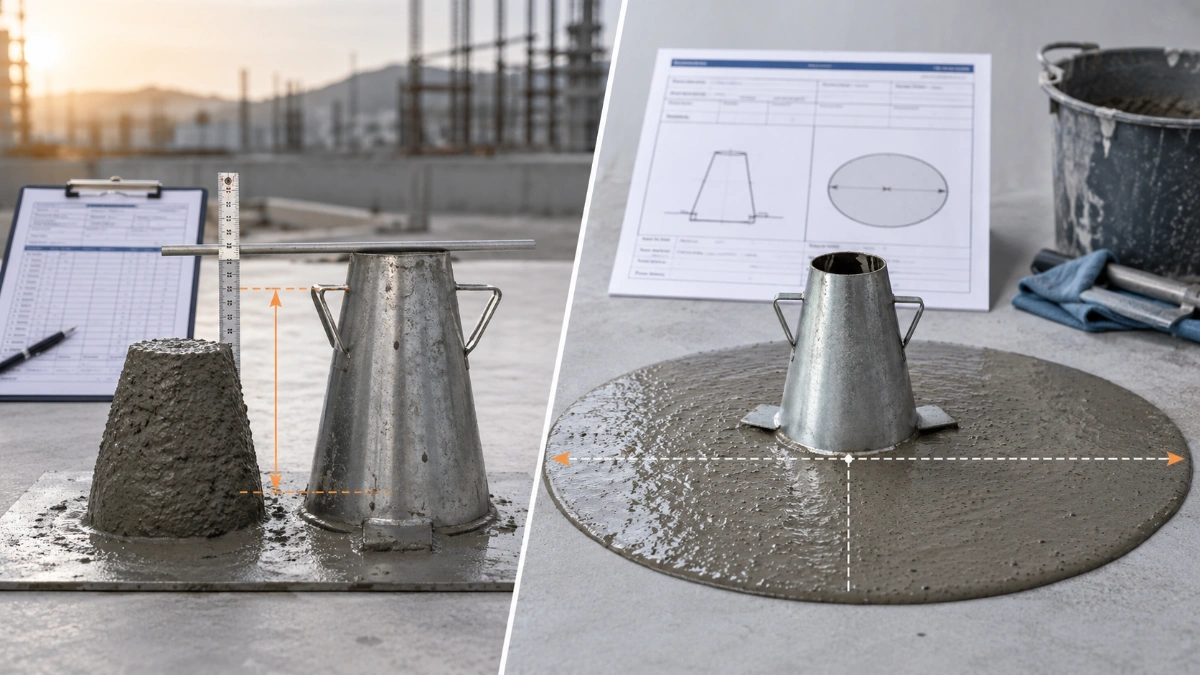
A concrete slump value is a field measurement of the consistency of fresh plastic concrete using the specified slump-test method. It is expressed as the vertical reduction in height of the concrete after the slump cone is lifted.
The value indicates how the fresh concrete behaves under that test. It does not, by itself, tell the engineer whether the concrete is acceptable, whether the water-cement ratio is correct, whether the strength will comply, or whether the load should be rejected.
That distinction matters because the same measured slump can be acceptable on one project and unacceptable on another if the specified requirement is different.
Concrete slump value, target, range and class are not the same thing
| Term | What it means |
|---|---|
| Measured slump | The result obtained from the field or laboratory test. |
| Target slump | A specified nominal value around which an applicable tolerance may operate. |
| Permitted range | A lower and upper boundary defined by the project specification, order or governing standard. |
| Minimum or maximum | A one-sided requirement where the specification controls only the lower or upper limit. |
| Consistence class | A classification system, such as the EN 206 slump classes, that groups measured consistency into defined bands. |
EN 206 slump classes: S1 to S5
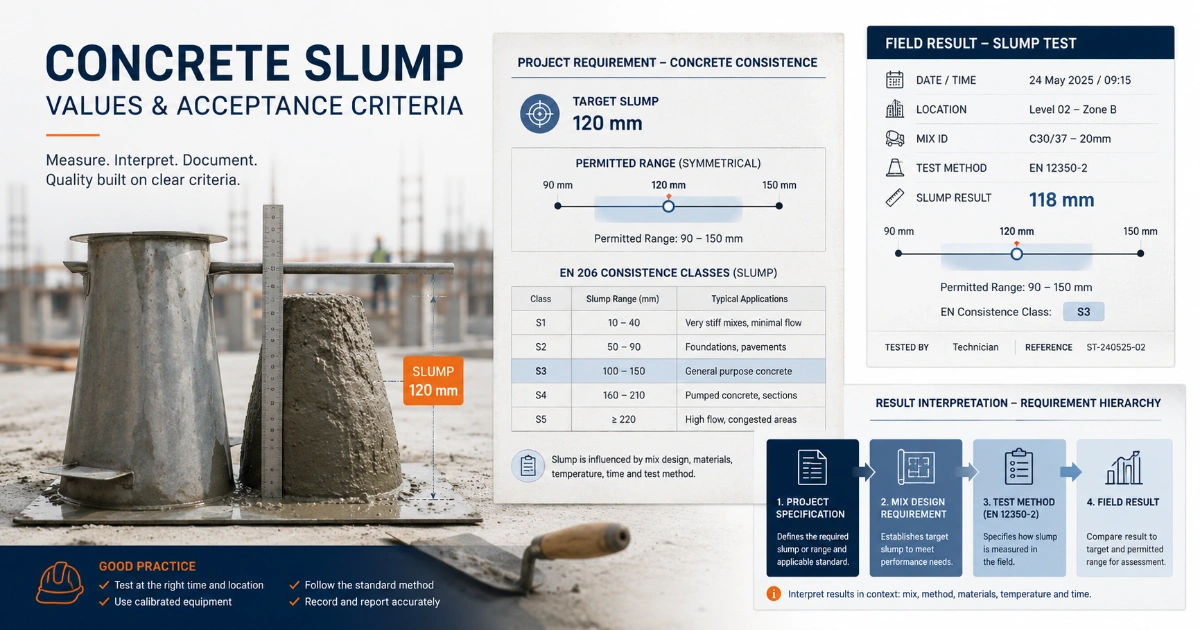
Under the EN 206 system, ordinary slump can be specified by consistence class. The familiar slump classes are S1 through S5, with slump measured using EN 12350-2. The class limits below are the established EN 206 ranges; the project should still confirm the exact edition and national provisions it has adopted.
| Slump class | Slump range |
|---|---|
| S1 | 10–40 mm |
| S2 | 50–90 mm |
| S3 | 100–150 mm |
| S4 | 160–210 mm |
| S5 | 220 mm and above |
These are consistency classes, not universal element-based design recommendations. A designer should not select S3, S4 or any other class merely because the concrete is for a slab, beam, column or wall. The required consistency should be selected from the actual placement, congestion, compaction, finishing and mix constraints. See How to Specify Concrete Slump for Slabs, Beams, Columns and Walls for that design process.
Why the gaps between EN slump classes matter
The class system is not a continuous list of every possible slump value. For example, S2 ends at 90 mm and S3 begins at 100 mm. The class boundaries are part of the classification system; they should not be casually converted into a different project tolerance or interpreted as a universal acceptance band.
If the project specifies a class, assess the result against that class and the applicable EN 206 provisions. If the project specifies a target value instead, use the target-value rules and tolerances adopted by the project rather than substituting a class after testing.
ASTM does not assign universal slump values to structural elements
Under an ASTM-based ready-mixed concrete specification route, ASTM C94/C94M governs ready-mixed concrete supplied to the purchaser, while ASTM C143/C143M provides the slump test method. ASTM C94 also recognizes purchaser requirements stated in the concrete order or project specification.
This means ASTM C143 is not a table of acceptable slump values for slabs, columns or walls. It explains how the field measurement is made. The required slump, permitted range or other consistency requirement must come from the applicable concrete specification, approved mix/order and project documents.
Slump tolerance is not the same as project acceptance
The word tolerance is often used loosely on site, but several different concepts may be involved:
- Specification tolerance: the permitted variation around a specified target or requirement under the governing concrete specification.
- Test-method precision: the repeatability and reproducibility characteristics of the measurement procedure.
- Project acceptance rule: the contractual or technical rule that determines what happens when a measured result does not satisfy the specified requirement.
These concepts should not be mixed together. A test result being close to a limit does not authorize the site team to invent a new tolerance. Likewise, a result outside the specified range does not automatically tell the team whether to retest, hold, adjust, accept under concession or reject.
Where should the project slump requirement come from?
When reviewing a slump result, use a clear source hierarchy. The applicable requirement should normally be traced through documents such as:
- the approved project concrete specification and drawings where relevant;
- the approved concrete mix design, mix submittal or concrete order;
- the governing concrete specification system, such as ASTM C94/C94M or EN 206-1 as adopted by the project;
- the approved method statement, ITP or project testing procedure for the measurement and disposition workflow; and
- the measured slump test result.
The measured result belongs at the end of that chain. It does not create the requirement by itself.
Example: target slump versus range versus class
The following examples show why the wording of the project requirement matters. They are illustrative only and are not universal acceptance criteria.
| Specification wording | How to interpret it |
|---|---|
| Target slump: 120 mm | Apply the tolerance rules required by the governing specification and project documents. Do not assume that 120 mm is a hard single-point pass/fail value unless the project explicitly says so. |
| Permitted range: 100–150 mm | Compare the measured result with the stated lower and upper boundaries, then follow the project's disposition procedure if it is outside. |
| Consistence class: S3 | Assess the result using the applicable EN 206 class requirements and the project-adopted edition/national provisions. |
Does a slump outside the specified range mean automatic rejection?
No. An outside-range result is a nonconforming or potentially nonconforming test result that must be handled according to the approved project procedure. It does not, by itself, authorize a technician or truck driver to reject the load, add water, add admixture, retest indefinitely or proceed with placement.
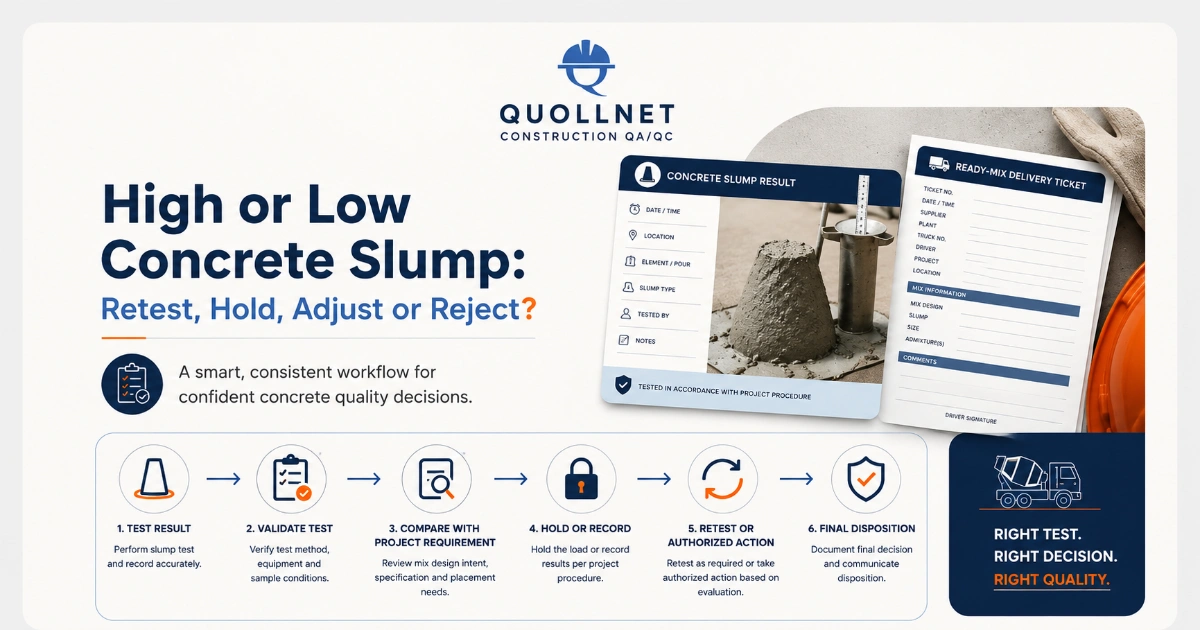
The correct sequence is to confirm the validity of the sample and test, compare the result with the actual requirement, place the load on hold where required, and obtain the authorized disposition. The detailed decision workflow is covered in High or Low Concrete Slump: Retest, Hold, Adjust or Reject?.
Measured slump should be recorded separately from the requirement
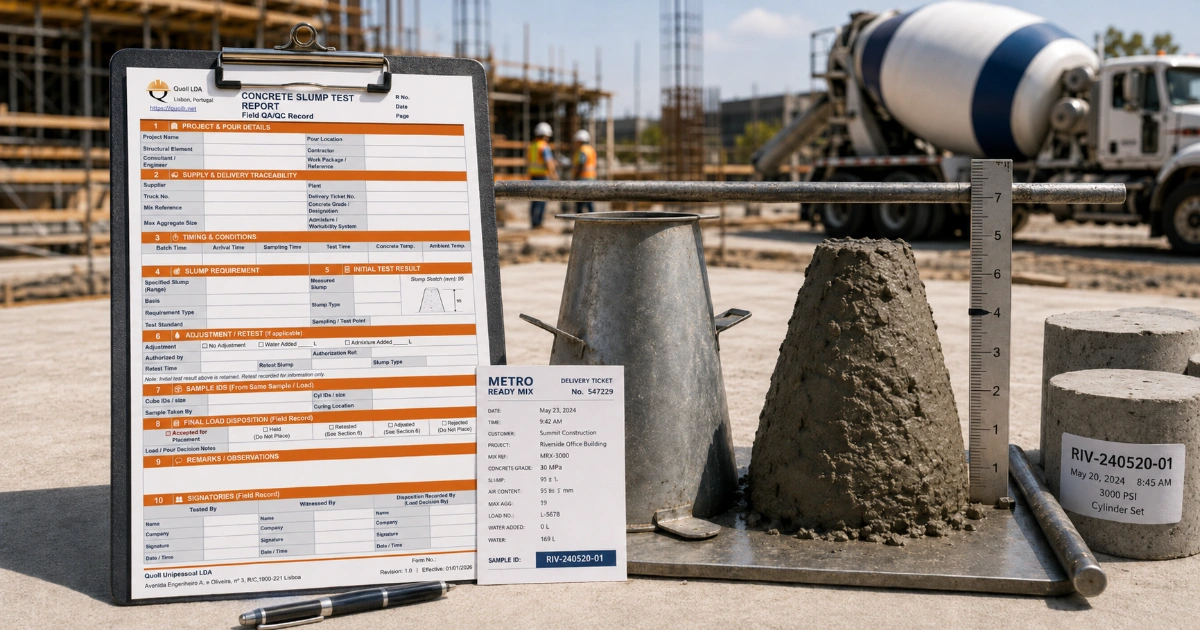
A good concrete QA/QC record does not write only one number under “slump.” It records both the specified requirement and the measured result, together with the truck/load, mix, pour location, test time and any retest or disposition.
The Concrete Slump Test Report Template is intended for the detailed test record, while the Concrete Slump Register & Log tracks many results across the project.
When an ordinary slump value is not the right measurement
Ordinary slump is not suitable for every fresh-concrete condition. BS EN 12350-2 states that the slump test is sensitive to consistency changes in a defined slump range and that other methods should be considered outside the method's suitable limits. ASTM C143/C143M likewise cautions against interpreting the test for concrete that is not suitably plastic or cohesive.
Self-compacting concrete should be specified and assessed using the applicable SCC consistency system, such as slump flow, rather than forcing an ordinary slump number to represent a different type of fresh-concrete behavior.
Common mistakes when interpreting slump values
- Treating one generic slump value as acceptable for every project and element.
- Using the slump-test standard as if it were the project specification.
- Confusing a target value with a permitted range.
- Applying an EN consistence class when the project actually specifies a target, or vice versa.
- Inventing a site tolerance because the result is close to the limit.
- Assuming high slump automatically proves excess water or low strength.
- Assuming low slump automatically means stronger or more durable concrete.
- Rejecting or adjusting a load without following the authorized project disposition process.
- Using ordinary slump for self-compacting concrete when the project requires slump-flow testing.
Concrete slump acceptance checklist
Before deciding whether a measured slump complies, confirm:
- What exact requirement applies: target, range, minimum, maximum or class?
- Which project document establishes that requirement?
- Which edition of the concrete specification is adopted?
- Which slump test method applies?
- Where is the specified measurement point?
- Was the sample representative and the test valid?
- Is there an applicable specification tolerance?
- Does the project require a retest or hold before disposition?
- Who is authorized to approve adjustment, concession, placement or rejection?
- Have the measured result and final disposition been recorded separately?
References
ASTM C94/C94M-26c – Standard Specification for Ready-Mixed Concrete
ASTM C143/C143M-26b – Standard Test Method for Slump of Concrete
BS EN 206-1:2026 – Concrete: Specification, performance, production and conformity