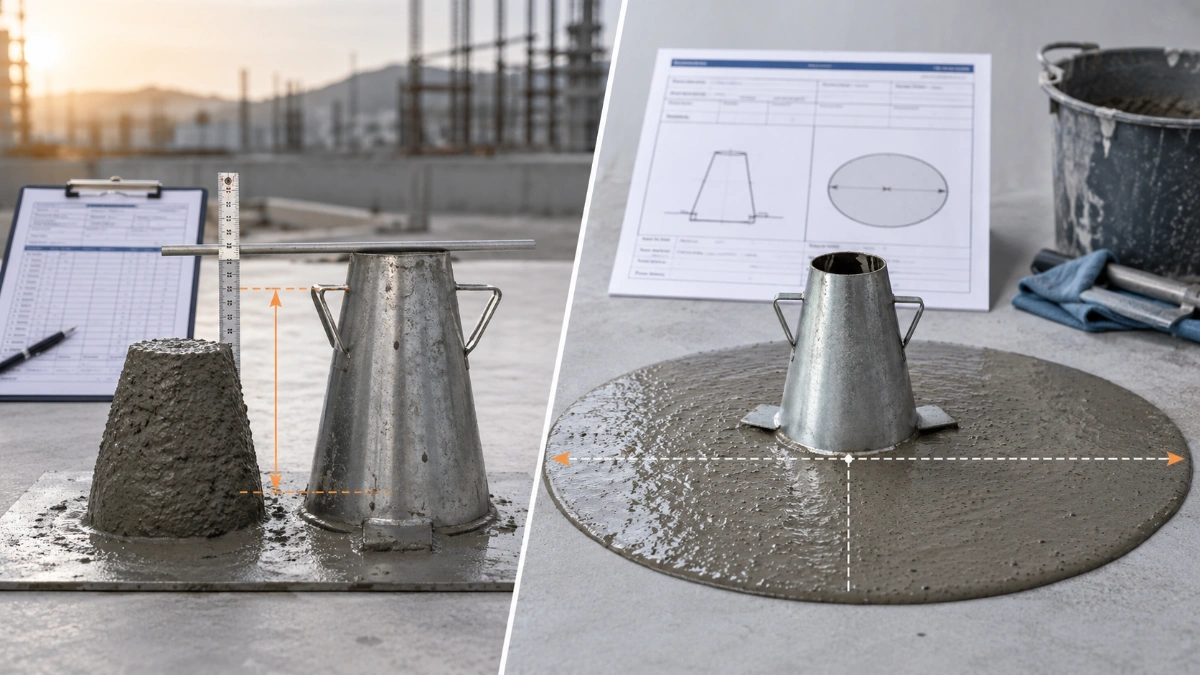
Download a Concrete Slump Test Report Template in Excel & PDF
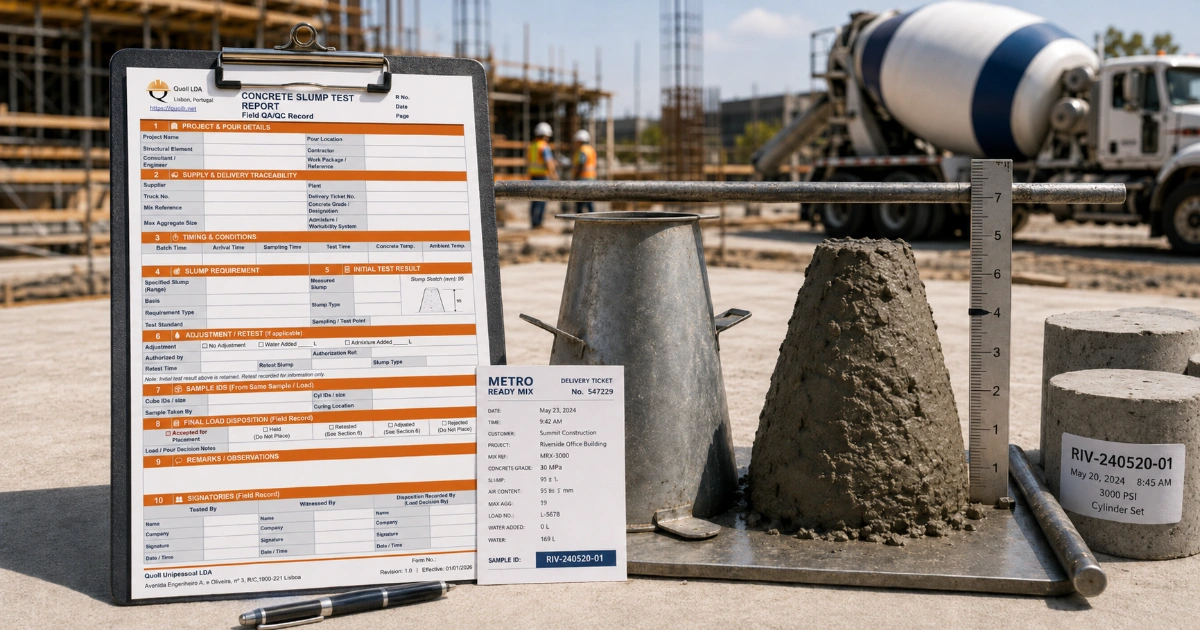
A concrete slump test report template should record more than the measured slump. A useful field report links one test to the concrete load, delivery ticket, approved mix, pour location, sampling and testing times, specified consistency requirement, related strength specimens, any adjustment or retest, and the final authorized disposition.
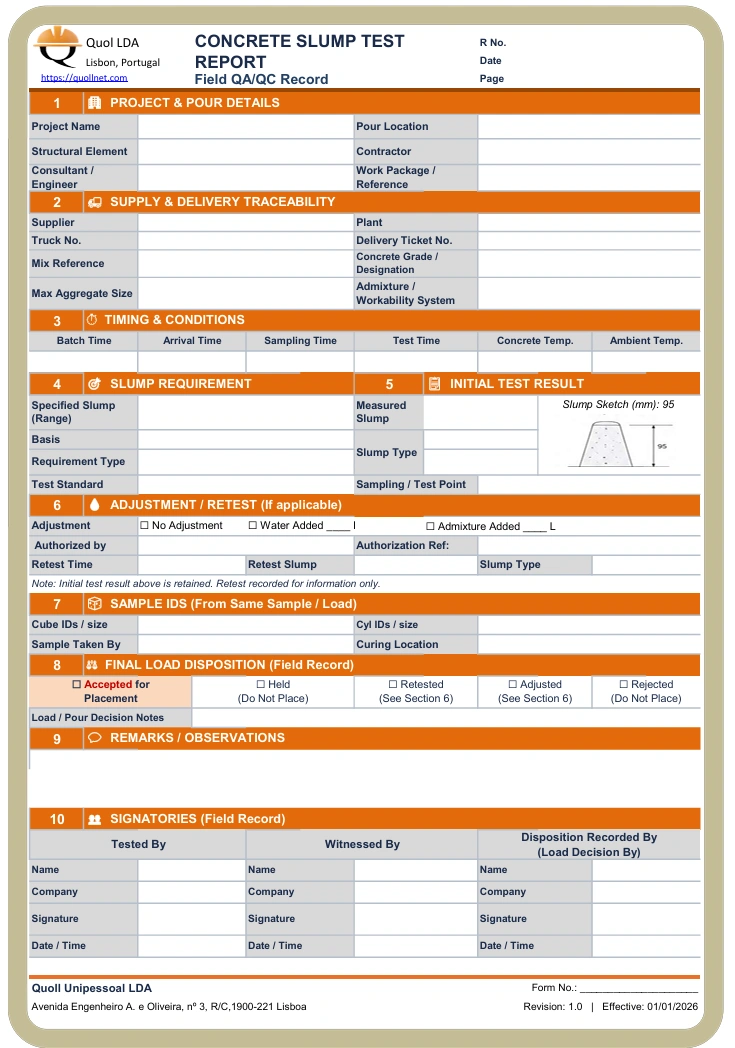
Download the Concrete Slump Test Report Template
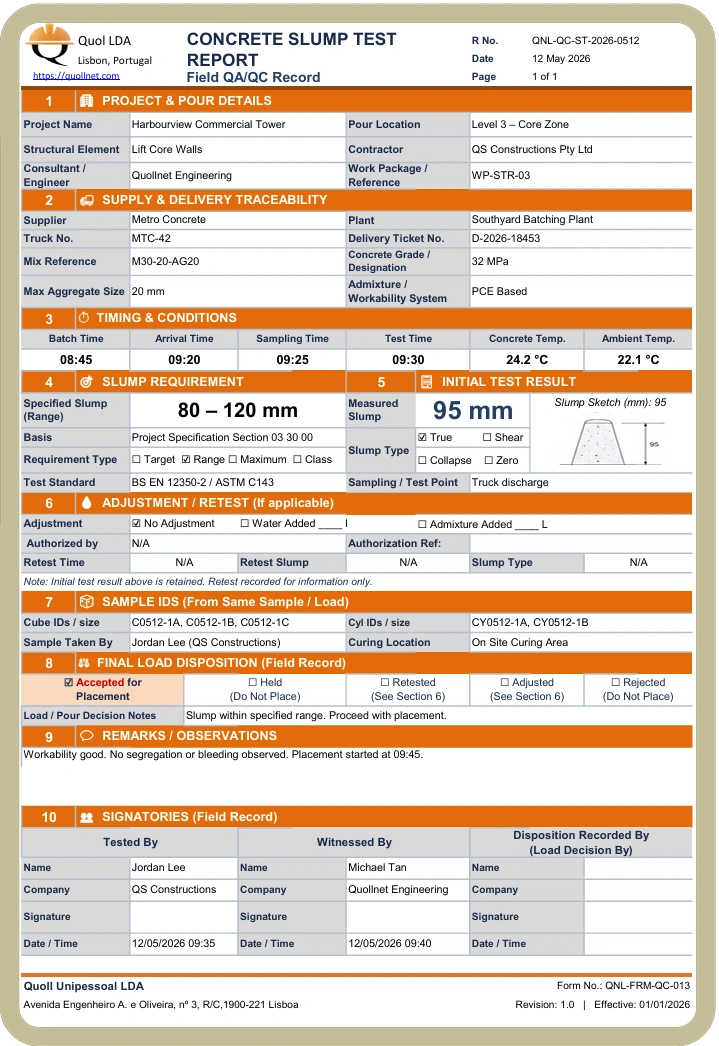
Use the blank report for project records, or open the completed example to see how the fields can be filled in. Both versions are available in editable Excel and printable PDF formats.
Blank template
For use on site or adaptation to your project QA/QC system.


Completed example
Use the example as a reference when setting up or completing your own report.
Adapt the report to the project specification, approved mix, ITP and applicable testing standard before use.
What is a concrete slump test report?
A concrete slump test report is the detailed field record for an individual slump test, sample or concrete load. Its purpose is traceability: someone reviewing the record later should be able to identify exactly which concrete was tested, what requirement applied, what was measured and what happened next.
A result such as 110 mm is not a complete quality record by itself. Without the truck number, delivery ticket, mix reference, pour location, test time and specified requirement, it may be impossible to determine what concrete the result represents or whether the result required any action.
The report should therefore answer four practical questions:
- What concrete was tested?
- What consistency requirement applied?
- What result was obtained?
- What was the authorized disposition of the load?
What should a slump test report include?
A practical construction report can be organized into the following sections.
| Report section | Typical information |
|---|---|
| Project and report identification | Project, contract, report number, date and testing location |
| Pour identification | Structural element, pour location, drawing or pour reference |
| Delivery traceability | Supplier, batching plant, truck number, delivery-ticket number and delivered quantity where relevant |
| Concrete identification | Concrete designation, grade or class, approved mix-design reference and relevant mix code |
| Timing | Batch time, arrival time, sampling time and test time |
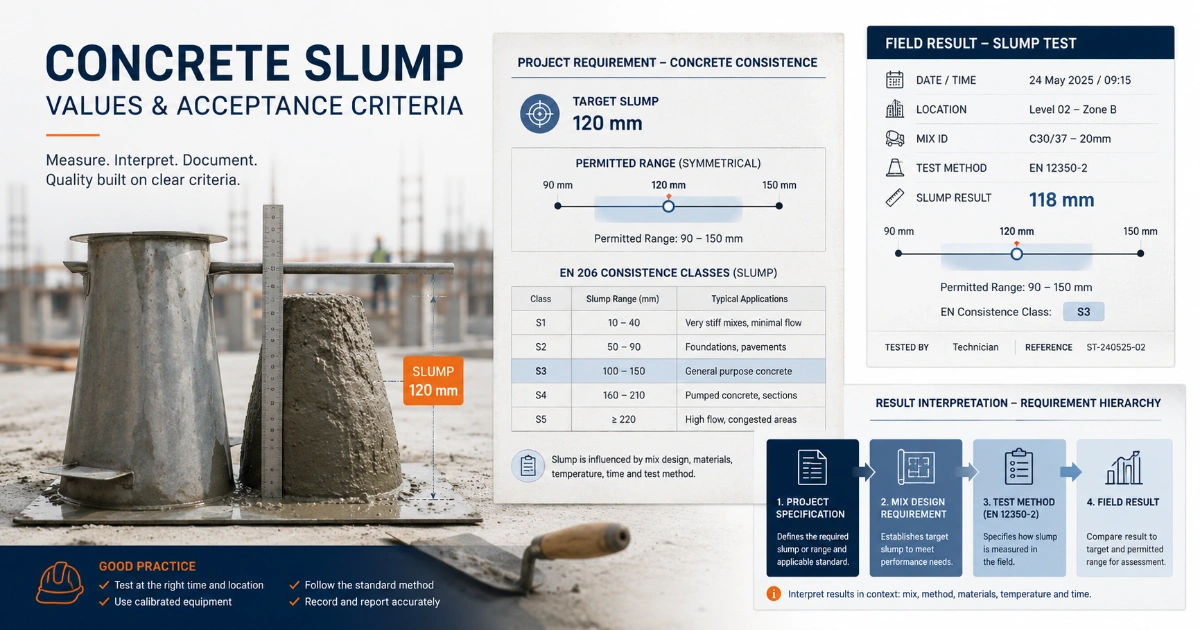
| Specified consistency | Target slump, permitted range, maximum value or consistence class, with units and source document |
| Test result | Initial measured slump, observed slump type and concrete temperature where tested |
| Adjustments and retest | Water or admixture addition, authorization, remixing and repeat result without deleting the original result |
| Related samples | Cube or cylinder set IDs and references to other fresh-concrete tests |
| Disposition | Accepted, held, retested, accepted after authorized adjustment, returned or rejected |
| Sign-off | Tester, witness, contractor representative and authorized decision-maker as required by the project |
Start with traceability to the concrete load
The strongest report is one that can be traced directly back to the concrete delivery. Record the supplier, truck and delivery-ticket details before they are lost in the activity of the pour. Where the project uses a pour card, inspection request or concrete-pour reference, include that number as well.
This traceability is especially important when several trucks of the same concrete grade arrive within a short period. If a later strength result, NCR or delivery query arises, the slump report should make it possible to identify the affected load and the structural element it served.
For broader delivery controls, Quollnet also provides a Concrete Batch Ticket & Mix Verification QA/QC checklist.
Record the actual specified slump requirement
Do not record only the measured value. The report should also state the requirement against which the test is being reviewed.
Depending on the project specification system, this may be expressed as:
- a target slump;
- a permitted slump range;
- a maximum slump;
- a consistence class; or
- another project-specific consistency requirement.
Record the units and, where practical, the source of the requirement: for example the approved mix design, concrete specification, concrete order or other approved project document.
Record the initial result exactly as tested
The initial measured slump should remain part of the permanent record. Enter the value with its units and record the observed slump form when relevant to the governing test procedure or project form.
The report should also identify when and where the sample was taken and when the slump test was performed. Sampling is a separate control from the cone test itself. For the sampling stage, use the Fresh Concrete Sampling Checklist; for the test procedure itself, use the Concrete Slump Test Procedure Checklist. ASTM C172/C172M covers representative sampling of freshly mixed concrete, while ASTM C143/C143M covers determination of slump. In the EN/BS route, BS EN 12350-1 covers sampling and common apparatus and BS EN 12350-2 covers the slump test. For the wider delivery, testing, specimen and load-disposition sequence, see Quollnet’s Method Statement: Receiving and Acceptance Testing of Ready-Mix Concrete on Site.
This distinction matters because a correctly performed slump test cannot make an unrepresentative sample representative.
Keep the original result when a retest is performed
A retest should add information to the record, not erase what happened first.
If the test is repeated, the report should preserve:
- the initial measured result;
- the reason a repeat test was required or requested;
- whether a new representative sample was obtained;
- any authorized water or admixture addition;
- the quantity added, where applicable;
- who authorized the adjustment;
- required remixing or waiting information; and
- the repeat-test result.
This creates a chronological record. A final compliant result without the initial result can hide a material part of the load history and make later review unnecessarily difficult.
Record water or admixture adjustments separately
If the project permits an on-site adjustment, the report should show what was added and who authorized it. Do not simply replace the first slump value with the post-adjustment result.
At minimum, the adjustment section should provide space for:
- type of addition;
- quantity or dosage recorded on site;
- time of addition;
- authorization or instruction reference;
- mixing or remixing confirmation; and
- the subsequent test result.
The report is not the place to decide a universal allowable water or admixture dosage. Those limits come from the approved mix, producer controls, manufacturer requirements and project specification.
Link slump results to cubes or cylinders
Where strength specimens are made from the related fresh-concrete sample, record their identification numbers on the slump report before the testing activity is closed out.
The same sample IDs should continue into laboratory and project records. Quollnet’s Concrete Cube Test Register is one example of the downstream record used to maintain that traceability.
This link is important because slump is one fresh-concrete observation. It does not itself establish compressive strength, durability or overall concrete conformity.
Separate the test result from the disposition decision
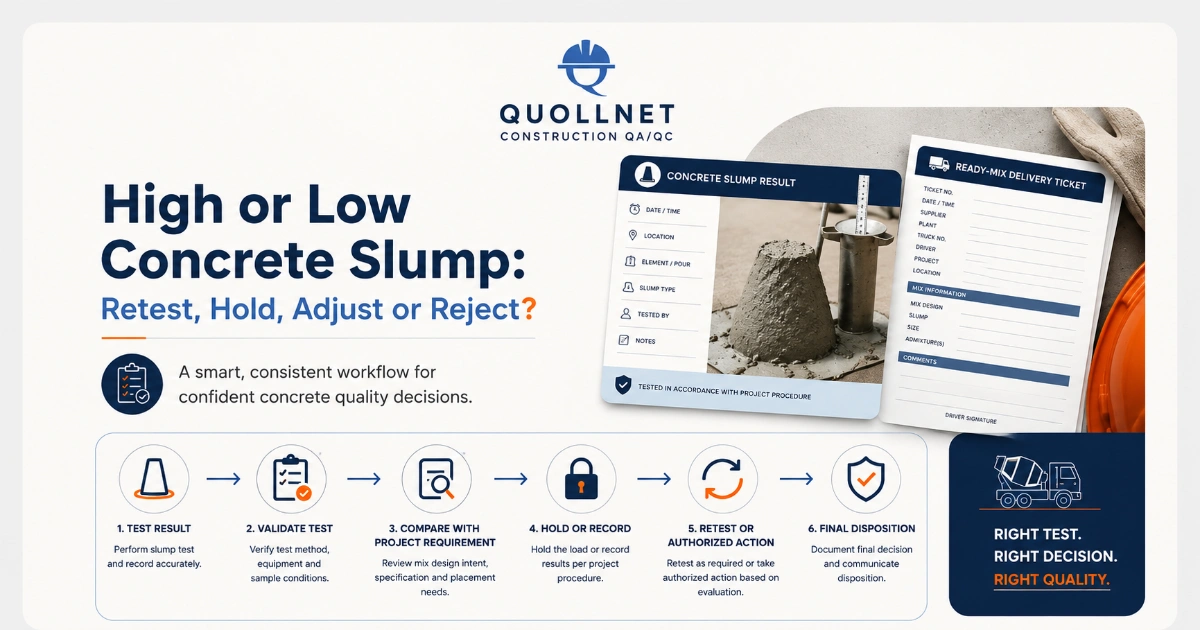
The technician or tester records the measurement. The person authorized by the contract, specification, ITP or project procedure determines the disposition of the affected concrete.
The form should therefore avoid turning the measured field into an automatic contractual decision. A practical disposition section can include:
- accepted;
- held for review;
- retested;
- accepted after authorized adjustment;
- returned; or
- rejected.
It should also provide space for the name or signature of the person making or confirming that decision and for any related NCR, rejection, instruction or corrective-action reference.
Who should sign the slump test report?
Signature requirements depend on the project. A useful template normally allows the project team to identify the people involved without implying responsibilities they do not have.
Common fields include:
- tester or laboratory technician;
- contractor or subcontractor QA/QC representative;
- consultant, engineer or client witness where required; and
- the person authorized to decide the load disposition.
A witness signature should normally confirm witnessing or review unless the project documents expressly give that signature a broader acceptance meaning.
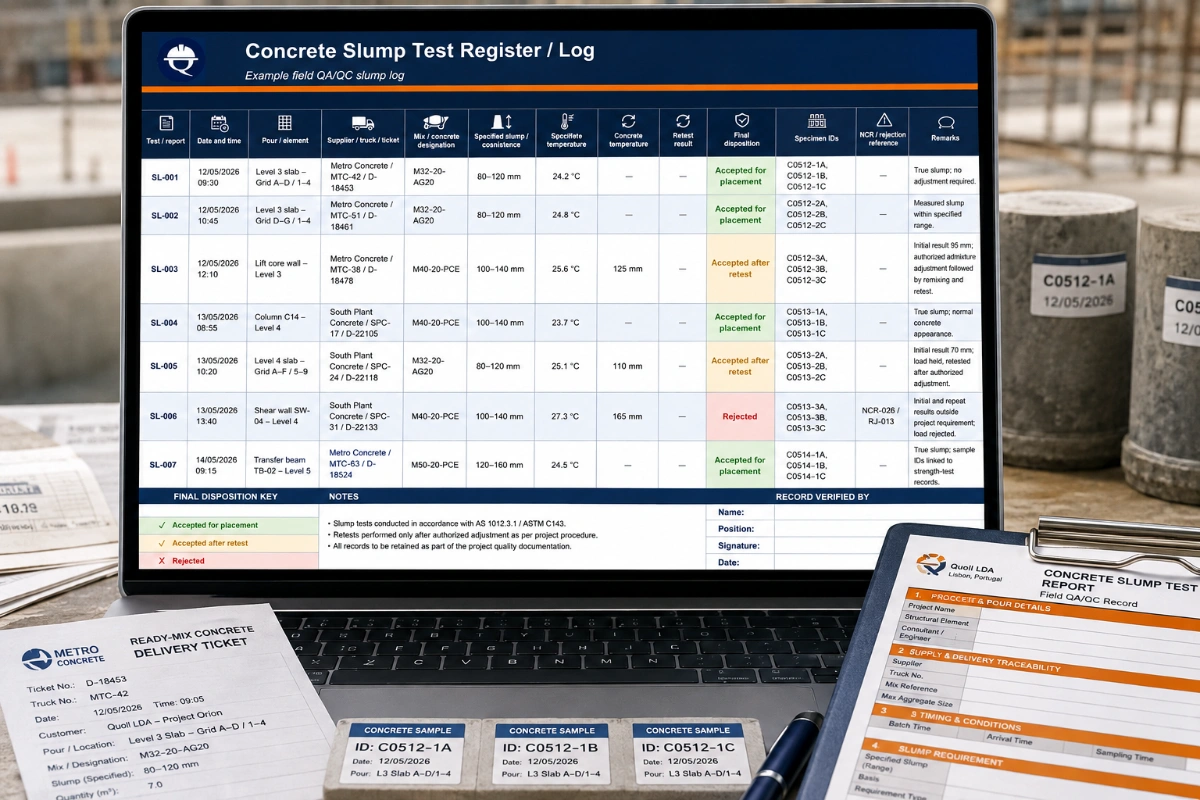
Concrete slump test report vs slump test register
These records serve different purposes.
- Slump test report: the detailed record for one test, sample or concrete load.
- Slump test register: a project-level summary of many slump tests, normally used for retrieval, tracking and trend review.
The register should point back to the detailed report; it should not replace it. Likewise, the individual report does not need to become a running project log.
How should the completed report be filed?
The completed report should be easy to retrieve from the other records for the same concrete placement. Depending on the project document-control system, cross-reference it to:
- the concrete delivery ticket;
- the approved mix design;
- the pour card or pour record;
- the inspection request or ITP record;
- temperature or other fresh-concrete test records;
- cube or cylinder set IDs;
- adjustment authorization;
- the project slump register; and
- any NCR, rejection or corrective-action record.
If slump testing is controlled through the project ITP, the report numbering and sign-off requirements should follow that approved inspection workflow. The ITP – Ready-Mix Concrete Point-of-Discharge Inspection and Testing is a concrete-specific example; Quollnet’s guide to the Inspection & Test Plan in construction explains the wider QA/QC context.
Common slump test reporting mistakes
- Recording only the measured slump and not the specified requirement.
- Omitting the units.
- Failing to identify the truck or delivery ticket.
- Using a vague pour description that cannot identify the concrete location.
- Overwriting the original result after a retest.
- Recording an adjustment without its quantity, time or authorization.
- Failing to link the test to cube or cylinder sample IDs.
- Using “pass” or “fail” without recording the project basis or authorized disposition.
- Using one detailed report as a substitute for the project slump register.
Standards to coordinate with the project report
The form should be adapted to the standard and specification stated by the project rather than attempting to combine different testing systems into one universal procedure.
As of August 2026, ASTM lists ASTM C143/C143M-26a as the active slump-test method and ASTM C172/C172M-25 as the active practice for sampling freshly mixed concrete. BSI lists BS EN 12350-2:2019 as current for slump testing and BS EN 12350-1:2019 as current for sampling and common apparatus.
The report should capture the project-required test information, but it should not reproduce the full copyrighted procedure. The tester should work from the applicable standard, approved method and project documents.
References
ASTM C143/C143M-26a – Standard Test Method for Slump of Concrete
ASTM C172/C172M-25 – Standard Practice for Sampling Freshly Mixed Concrete
BS EN 12350-2:2019 – Testing fresh concrete: Slump test
BS EN 12350-1:2019 – Testing fresh concrete: Sampling and common apparatus