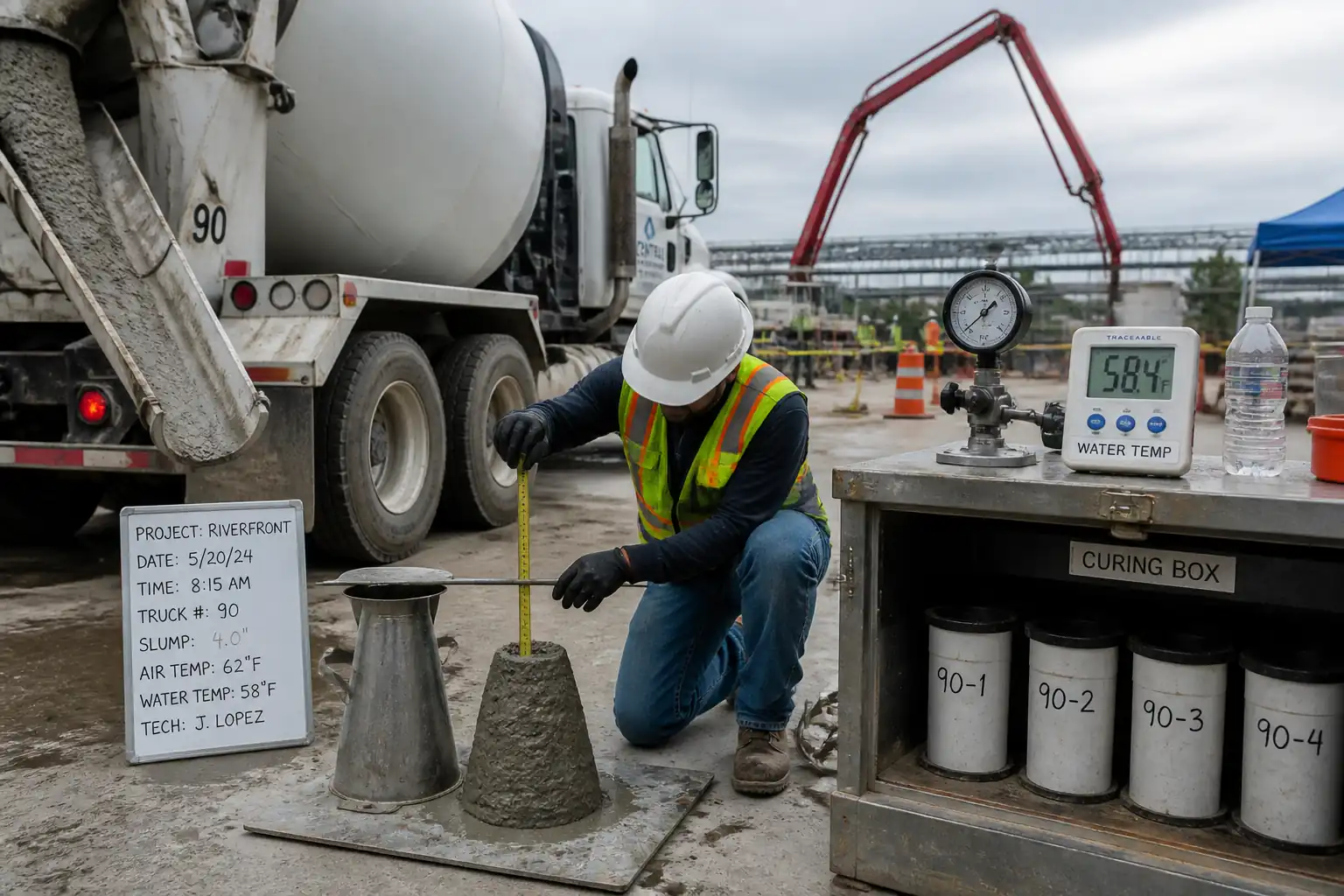

Method Statement: Receiving and Acceptance Testing of Ready‑Mix Concrete on Site – Method Statement
AI-assisted method statement with matching ITP, PDF download, and Excel export.
More than a static template
Unlike a downloadable Word or PDF template, this method statement is an AI-assisted editable starting point connected directly to a matching Inspection and Test Plan. Every section is structured, project-adaptable, and ready to export.
- AI-assisted drafting — Customize every section with AI for your specific project scope.
- Linked ITP — A matching inspection and test plan is generated alongside the method statement.
- Multiple export formats — Download as a formatted PDF or editable Excel spreadsheet.
- Editable starting point, not a final document — Review, verify, and adjust all content against your project requirements before use.
Static template vs. Quollnet workflow
| Feature | Static template | Quollnet |
|---|---|---|
| Project-specific content | Manual fill-in required | AI-assisted customization |
| Linked ITP | Separate document, no link | Matching ITP included |
| Export formats | Usually PDF only | PDF and Excel |
| Structured sections | Free-form layout | 13 standardized sections |
| Saved to your account | Local file only | Cloud-saved, reusable |
| Content accuracy | You verify everything | AI-assisted, you still verify |
| Cost | Often free but time-intensive | Free to customize and download |
What you can customize
When you save this method statement to your account, every section becomes editable. The following 13 sections are included:
- Scope — Defines the activity and its boundaries.
- References — Standards, specifications, and drawings.
- Responsibilities — Roles and accountabilities.
- Resources — Labour, plant, and equipment summary.
- Materials — Materials and compliance requirements.
- Equipment — Tools and equipment details.
- Prerequisites — Hold points and pre-conditions.
- Method sequence — Step-by-step construction sequence.
- Safety controls — HSE risk controls and PPE.
- Environmental controls — Environmental mitigation measures.
- QA/QC — Quality inspection and test requirements.
- ITP — Inspection and Test Plan table (has its own page).
- Attachments — Referenced drawings and documentation.
Why this method statement is used
This method statement is used to define and communicate the approved procedure for carrying out method statement: receiving and acceptance testing of ready‑mix concrete on site on site. It ensures the work is planned in advance, the correct resources and controls are in place, and all personnel understand responsibilities, sequence, quality requirements, and safety controls before work begins. It aligns site execution with the documented scope and acceptance expectations.
Who uses this method statement
This method statement is used by contractors, site supervisors, project engineers, QA/QC engineers, HSE officers, consultants, and client representatives. It serves as a shared reference for planning, execution, supervision, inspection, and approval of the activity on site.
When it is prepared and submitted
The method statement is prepared before the work activity starts and submitted as part of the pre-construction documentation package for review and approval.
Who reviews or approves it
The method statement is usually submitted to the client representative, consultant, resident engineer, or project management consultant for review and approval before the work commences.
Important approval note
This method statement is an AI-assisted editable starting point, not a pre-approved document. Before use on any project, all content must be reviewed and approved by the relevant parties (superintendent, principal contractor, or client representative) in accordance with your contract and project quality plan.
For example: if your specification requires a departure from a referenced standard, that departure must be documented and approved separately — this method statement will not capture that automatically. Always verify against your applicable drawings, specifications, and regulatory requirements.
Method statement content
Scope
Purpose
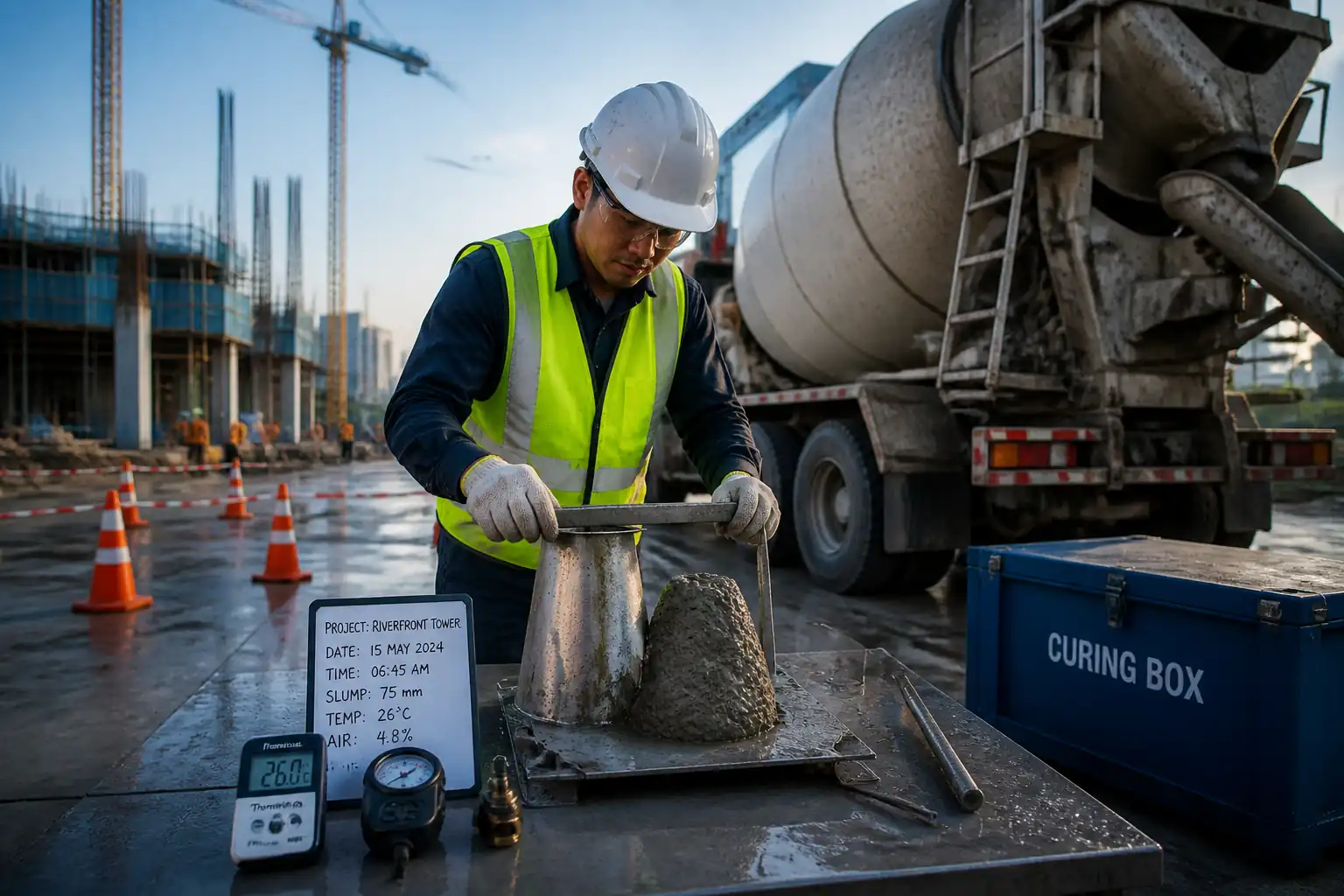
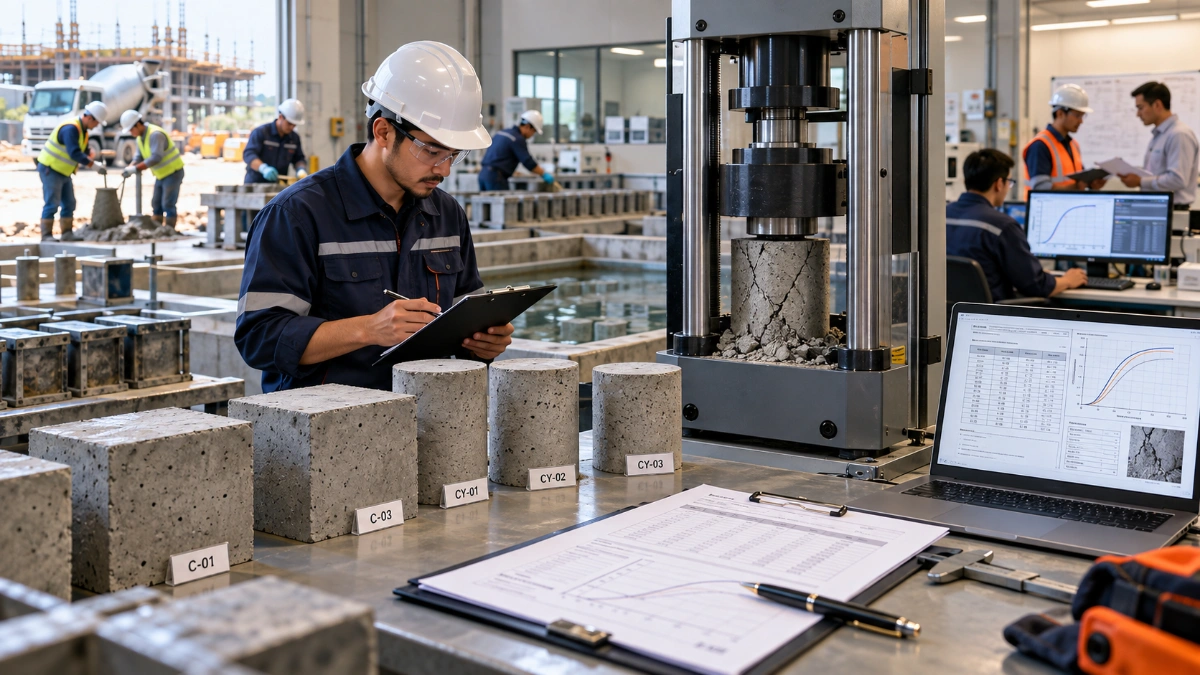
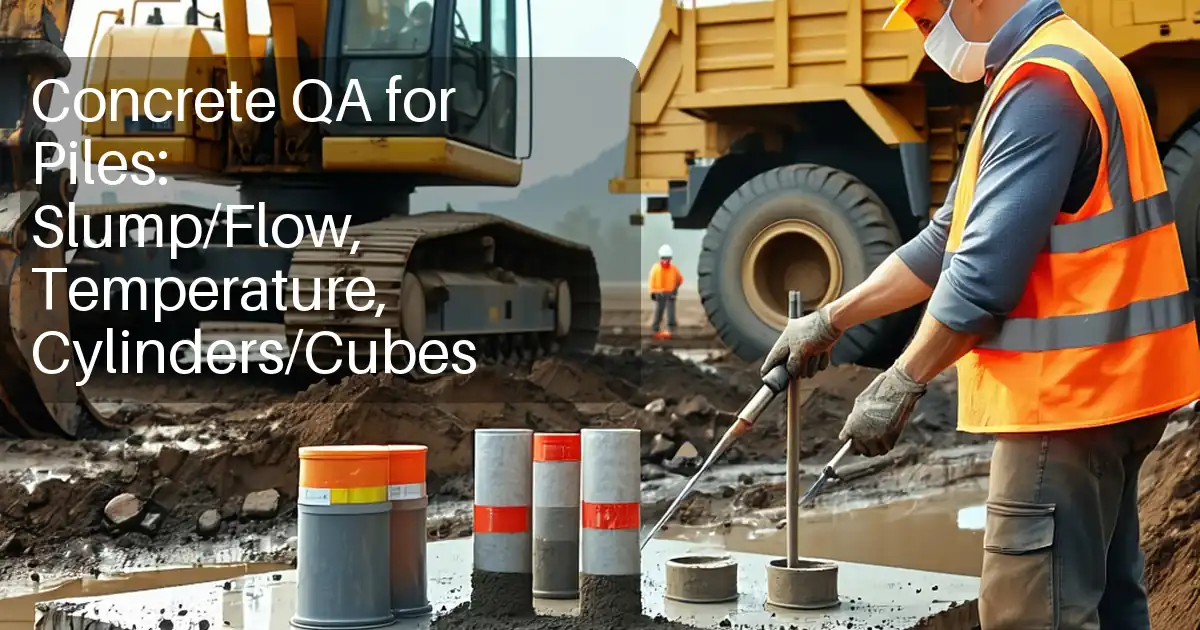
Define the controlled process for receiving ready‑mix concrete on site, verifying delivery documentation, performing field acceptance tests (temperature, slump or slump‑flow for SCC, air content, density/yield as required), casting and curing compressive strength specimens (cubes/cylinders), and applying acceptance/rejection criteria before placement.
Applicability
- All grades/classes of normal weight and lightweight ready‑mix concrete delivered by transit mixer to .
- Includes conventional vibrated concrete (CVC) and self‑consolidating concrete (SCC).
- Excludes batching operations at plant and structural placement methodology (covered in separate placement and curing method statements).
Objectives
- Ensure only compliant concrete is placed.
- Provide traceable, calibrated testing and documentation for conformity assessment.
- Protect personnel, environment, and works during the receiving and testing process.
References
| Document Type | Reference / Number | Revision | Notes |
|---|---|---|---|
| ASTM C94/C94M | |||
| ASTM C172/C172M | |||
| ASTM C1064/C1064M | |||
| ASTM C143/C143M | |||
| ASTM C1611/C1611M | |||
| ASTM C231/C231M | |||
| ASTM C173/C173M | |||
| ASTM C138/C138M | |||
| ASTM C31/C31M | |||
| ASTM C39/C39M | |||
| EN 206 / BS EN 206 | |||
| EN 12350 series | |||
| EN 12390 series | |||
| ACI 301 / ACI 318 | |||
| ISO 9001 / ISO 14001 / ISO 45001 |
Responsibilities
| Role | Responsibility | Name / Party |
|---|---|---|
| PM | Approval and oversight | Contractor |
| SE | Execution coordination | Contractor |
| QC | Inspection & testing | Contractor |
| Technologist | Technical support | Supplier/Contractor |
| Lab | Statutory/contract testing | 3rd Party |
| Supplier Rep | Supply conformity | Supplier |
| HSE | HSE compliance | Contractor |
Resources
| Resource Type | Description | Quantity | Remarks |
|---|---|---|---|
| Personnel | 2 technicians minimum during pours >50 m³/hr | 2–4 [Verify per pour size] | |
| Personnel | Specimen pickup within 24±8 h | As required | |
| Personnel | Coordinates acceptance release prior to placement | Per pour |
Materials
| Material | Specification / Grade | Quantity | Remarks |
|---|---|---|---|
| Concrete | Per EN 206/ASTM C94 and Project Specs [Verify] | Per pour | |
| Release oil | Low VOC [Verify] | As needed | |
| Tags | Durable, legible | Per specimen |
Equipment
| Equipment | Capacity / Type | Quantity | Inspection Required |
|---|---|---|---|
| Slump cone | 1–2 sets | Yes | |
| C1611 kit | 1 set | Yes | |
| ASTM C1064 compliant | 2 | Yes | |
| ASTM C231/C173 | 1 each | Yes | |
| ASTM C138 | 1 set | Yes | |
| EN/ASTM compliant | Sufficient for test frequency | Yes | |
| Field curing box | 1+ | Yes | |
| Placement equipment | As required | Yes | |
| Ancillary | As required | Yes |
Prerequisites
- Approved mix designs and supplier prequalification records on file.
- Latest IFC drawings, specifications, and acceptance criteria available at test location.
- ITP and checklists approved; QC personnel competent and certified [Verify per project requirements].
- Calibration certificates valid for slump/flow kit, thermometer, air meter, density measure, balance, and curing box.
- Identified and prepared sampling and testing area: flat, clean, within 1–2 m of discharge point, sheltered from sun/wind where possible.
- Traffic management plan and pump/truck maneuvering plan approved; banksman appointed for each truck.
- Pre-pour coordination meeting completed; hold/witness points agreed.
- HSE: Task-specific risk assessment briefed; PPE available; permits (hot work, night work, traffic, if applicable) approved [Verify per project HSE plan and local regulations].
- Weather/temperature plan agreed (use of ice/chilled water/hot water as applicable by supplier) [Verify].
- Field curing facilities energized and at temperature ≥12 h before pour; ice packs/heaters available if required.
- Forms for records prepared: Delivery Ticket Checklist, Field Concrete Test Report, Specimen Register, Curing Log, Nonconformance Report.
- Communication lines established with plant for any adjustment authorization and potential rejection/replacement.
Method Sequence
| Step | Activity | Description | Responsibility | Inspection / Hold Point |
|---|---|---|---|---|
| 1 | Pre-Delivery Confirmation | Confirm pour start time, mix ID, target slump/slump‑flow, air %, max w/c, delivery rate. Ensure site access and testing area ready. | Site Engineer/QC | Review delivery schedule and approved mix list |
| 2 | Truck Arrival & Staging | Direct truck to staging; set wheel chocks; engine at idle in neutral; confirm no wash water added since plant unless authorized. | Banksman/QC | Visual condition of load (no segregation, no set), drum revolutions counter read |
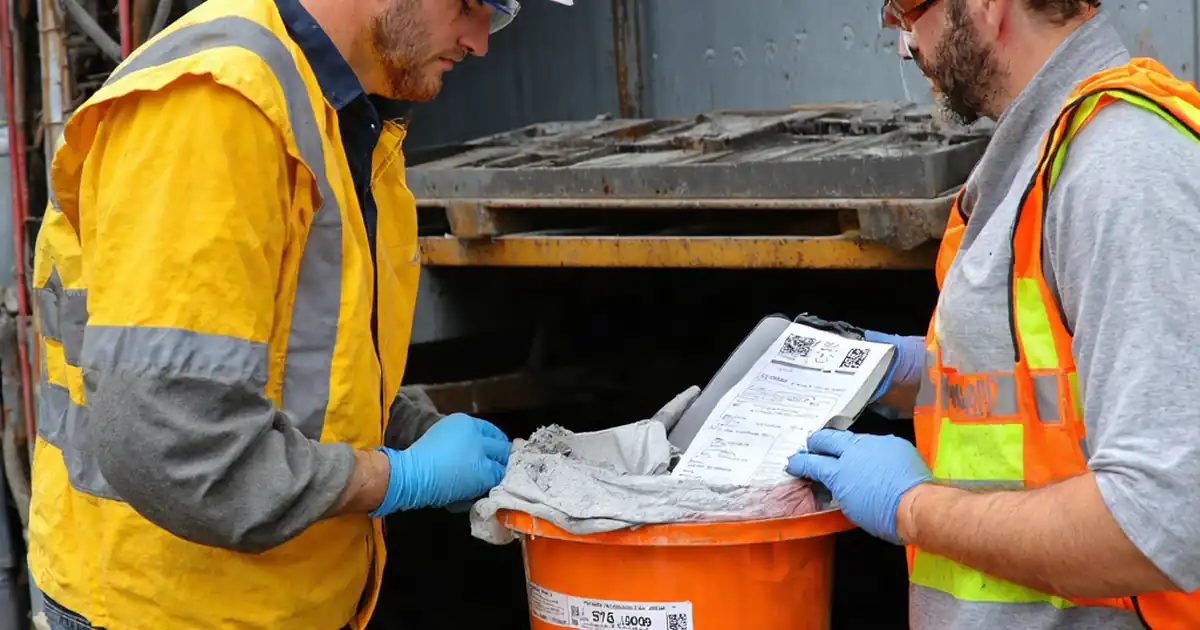
| 3 | Delivery Ticket Validation | Check ticket contains: supplier, project, truck ID, time of batching, mix ID, cement type, admixtures, target slump/flow, max w/c, aggregate size, quantity, corrective water/admixture added at plant, cumulative drum revs. Mark arrival/discharge start time. | QC | Ticket check per ASTM C94/EN 206 |
| 4 | Sampling (Composite) | Sample per ASTM C172/EN 12350‑1 from middle of load after ≥10–15 discharge revolutions; take at least two portions during discharge, combined and remixed. Avoid sampling from pump hopper. | QC Tech | Observe correct sampling location and mixing |
| 5 | Temperature Measurement | Measure immediately after sampling. Insert probe min 75 mm; avoid container sides/bottom. | QC Tech | Thermometer calibration/condition |
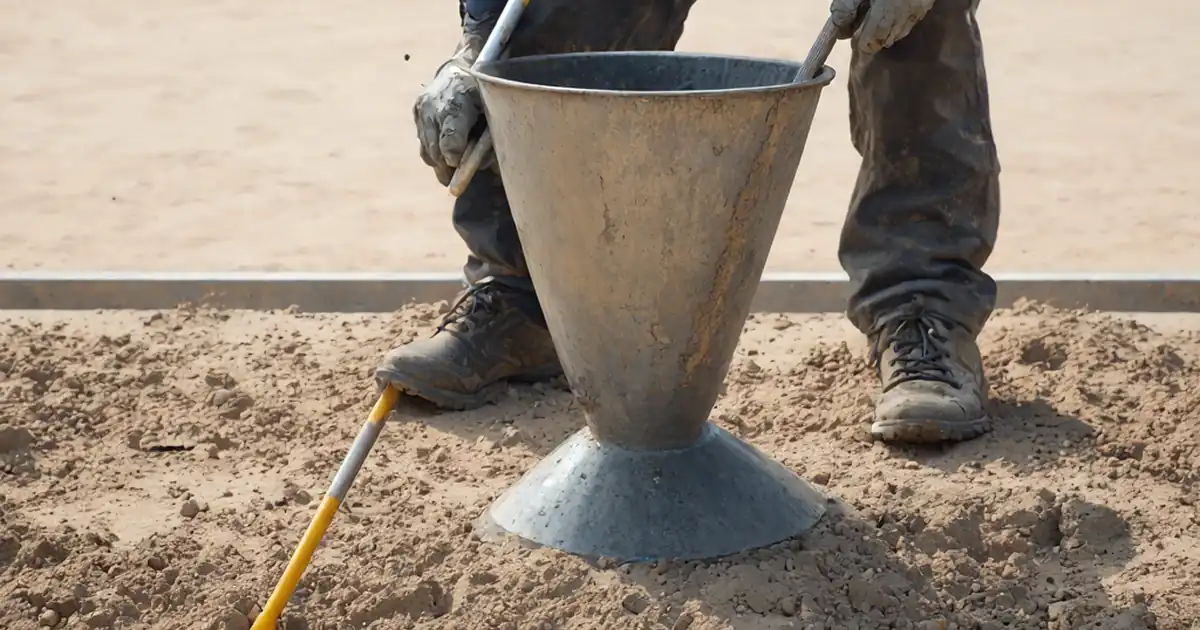
| 6 | Slump (CVC) or Slump‑Flow (SCC) | CVC: ASTM C143, 25 rod strokes per layer (2 layers for 100 mm cone height? – standard 3 layers), lift vertically in 5–10 s, measure to 5 mm. SCC: ASTM C1611 with smooth plate; record slump‑flow diameter (average of two orthogonal) and T500 time; assess VSI. | QC Tech | Level plate; cone clean; timing device |
| 7 | Air Content (if specified) | Normal weight: Type B pressure meter (ASTM C231). Lightweight or when required: Volumetric (ASTM C173). Correct for aggregate correction factor. | QC Tech | Gauge zero; no leaks; correct aggregate factor |
| 8 | Density/Unit Weight & Yield (when required) | Determine density using calibrated measure (ASTM C138). Calculate yield, cement content check if specified. | QC Tech | Volume verification; scale calibration |
| 9 | Acceptance Decision for Discharge | If all tests within limits and documentation complete, release load for placement. If out‑of‑tolerance, follow corrective actions: authorized admixture/water addition (if allowed), remix ≥30 revolutions, then retest; or reject. | QC Engineer | Review results vs limits |
| 10 | Specimen Making (Cylinders/Cubes) | Make specimens from accepted sample per ASTM C31 or EN 12390‑2. Consolidate: rods/vibration per standard. Finish, label with unique ID (date, truck, location, mix, test age). Protect from vibration, loss of moisture, and temperature shock. | QC Tech | Mold condition; ID traceability |
| 11 | Initial Curing (Field) | Store specimens 16–27°C, moisture ≥95%, away from vibration for 24±8 h. Record min/max temperatures. | QC Tech | Curing box temp log |
| 12 | Demolding & Transport to Lab | Demold at 24±8 h; transport in cushioned containers; maintain 23±2°C (or as specified). Handover chain of custody to lab for standard curing and testing. | QC/Lab Courier | Specimen integrity; IDs intact |
| 13 | Strength Testing (by Lab) | Test at specified ages (commonly 7 and 28 days) per ASTM C39/EN 12390‑3; report average of two for a strength test. Investigate any low results per code. | Third‑Party Lab | Machine calibration; cap/align per standard |
| 14 | Nonconformance & Corrective Action | If any field test or documentation fails, isolate the load, stop placement from that load, raise NCR, notify supplier, evaluate in‑place concrete if partial discharge occurred (cores, NDT) [Verify by spec]. | QC Engineer/PM | NCR review and disposition |
Safety Controls
Task-Specific Hazards and Controls
- Hazard: Transit mixer/pump movement and reversing.
- Likely consequence: Struck-by, crush injury.
- Engineering/procedural control: Segregated access route; banksman with radio; speed limit ≤10 km/h; wheel chocks; exclusion zone 3 m around truck; reversing alarm operational.
- Required PPE: High‑vis vest, safety boots, hard hat, gloves.
- Collective measure: Barriers and signage; dedicated marshaller.
-
Inspection/permit/supervision: Daily plant check; traffic management plan; banksman competency records.
-
Hazard: Pump hose whip/line burst during priming or blockage.
- Likely consequence: Impact injury, concrete spray to eyes/skin.
- Engineering/procedural control: Secure end hose with safety sling; steel‑ended hose for vertical drops; pressure relief before disconnect; no personnel under boom; follow OEM priming procedure.
- Required PPE: Face shield or wrap‑around goggles, alkali‑resistant gloves, long sleeves.
- Collective measure: Exclusion zone under boom and near hose.
-
Inspection/permit/supervision: Pre‑pour hose/pipe inspection; pressure test records; competent pump operator.
-
Hazard: Fresh concrete cement burn (high pH) and admixture exposure.
- Likely consequence: Chemical burns, dermatitis, eye injury.
- Engineering/procedural control: Avoid skin contact; wash stations within 10 m; immediate neutral rinse for eyes; no kneeling in fresh concrete.
- Required PPE: Nitrile/alkali‑resistant gloves, chemical goggles, long sleeves, waterproof boots.
- Collective measure: Barrier creams, safety shower/eyewash where required.
-
Inspection/permit/supervision: SDS available; HSE brief; spot checks.
-
Hazard: Manual handling of molds, meters, and filled measures.
- Likely consequence: Musculoskeletal strain, pinch injuries.
- Engineering/procedural control: Team lift for measures >20 kg; use trolleys; keep workbench at 700–900 mm height.
- Required PPE: Gloves, safety boots.
- Collective measure: Mechanical aids; clear walkways.
-
Inspection/permit/supervision: Manual handling training; housekeeping inspections.
-
Hazard: Trip/slip on wet surfaces, hoses, and test area clutter.
- Likely consequence: Falls, sprains.
- Engineering/procedural control: Non‑slip mat under test area; immediate cleanup; hose ramps; adequate lighting (≥200 lux at night).
- Required PPE: Slip‑resistant boots.
- Collective measure: Barricade testing station; cable management.
-
Inspection/permit/supervision: HSE walkdowns; lighting checks.
-
Hazard: Electrical equipment for curing boxes and vibrators.
- Likely consequence: Electric shock, fire.
- Engineering/procedural control: IP‑rated outlets; RCD protection; PAT testing; dry hands; cables off wet ground.
- Required PPE: Dielectric gloves where required.
- Collective measure: Lockable power distribution board.
-
Inspection/permit/supervision: Electrical permit if needed; monthly PAT; daily pre‑use checks. [Verify per project HSE plan and local regulations]
-
Hazard: Noise and vibration exposure (pumps, vibrators).
- Likely consequence: Hearing damage, hand‑arm vibration.
- Engineering/procedural control: Maintain equipment; limit exposure time; rotate operators.
- Required PPE: Hearing protection.
- Collective measure: Noise monitoring if >85 dB(A).
-
Inspection/permit/supervision: HAVS monitoring where applicable.
-
Hazard: Hot/cold weather testing area.
- Likely consequence: Heat stress or hypothermia; test result bias.
- Engineering/procedural control: Shade or heated enclosure; hydration plan; temperature‑controlled curing box.
- Required PPE: Weather‑appropriate PPE.
- Collective measure: Work/rest regimen; fans/heaters as required.
- Inspection/permit/supervision: Weather monitoring; HSE approval for extreme conditions.
Environmental Controls
- Concrete washout water (high pH 11–13):
- Control: Dedicated, lined, bunded washout pit or portable container with ≥110% capacity of anticipated washout; no discharge to storm drains.
- Monitoring: Visual checks each load; pH monitoring before disposal; waste contractor engagement.
-
Records: Washout log; disposal tickets.
-
Spill prevention (cementitious fines, admixtures, diesel):
- Control: Spill kits at pump and test station; drip trays under couplings; immediate containment and cleanup.
-
Monitoring: HSE inspections; incident reports.
-
Dust and residue from hardened concrete cleanup:
-
Control: Wet methods; no dry sweeping; segregate concrete waste for recycling where available.
-
Noise and idling emissions:
-
Control: Limit pump/truck idle; maintain equipment; schedule within permitted hours.
-
Water usage for cleaning/testing:
-
Control: Use potable/recycled water as allowed; minimize; collect rinse water to washout.
-
Waste segregation and records:
- Control: Separate molds’ packaging, broken specimens; label containers; maintain waste transfer notes.
[Verify controls per project environmental plan and local regulations]
QA/QC
Field Test Frequencies [Verify per project specifications]
- Slump or slump‑flow: At least 1 per truck at point of discharge.
- Temperature: Each truck.
- Air content (if specified): First three trucks, then 1 per truck or minimum 1 per 50 m³; increase frequency if adjustments made.
- Density/yield: When air content is disputed, for lightweight concrete, or at least 1 per 100 m³.
- Strength specimens: Minimum 1 set per 50 m³ per class of concrete per day; not less than 1 set per pour.
Specimen Numbers and Ages
- Cylinders: Typically 4 per set (2 for 28‑day acceptance, 1 for 7‑day informational, 1 spare) or as specified.
- Cubes: Typically 6 per set (2 at 7 days, 2 at 28 days, 2 spares) where EN testing regime applies.
Acceptance of Concrete (Guidance)
- ACI/ASTM regime: Each strength test = average of two 28‑day cylinders. Accept if average ≥ f’c; investigate if either specimen < f’c − 3.5 MPa or successive tests trend low. [Verify]
- EN regime: Conformity per EN 206 and EN 13670 using n‑test criteria and control charts. [Verify]
Rejection/Corrective Criteria at Receipt
- Documentation incomplete or time since batching >90 min (or >300 total drum revs) unless extended by set‑retarding admixture and Engineer’s approval. [Verify]
- Fresh concrete temperature outside allowable range (typ. 5–32°C) unless mitigation approved. [Verify]
- Slump outside target ±25 mm (CVC) after authorized single adjustment/retest. [Verify]
- Slump‑flow (SCC) outside specified band (typ. 650–800 mm) or T500 outside 2–7 s; VSI indicates instability/segregation. [Verify]
- Air content outside target ±1.5% for air‑entrained (or outside specified band). [Verify]
- Density/yield deviates beyond tolerances (typ. yield −1% to +3%). [Verify]
- Evidence of initial set, contamination, or segregation.
- Unauthorized water/admixture addition or failed plant approval.
Records and Traceability
- Delivery Ticket Checklist; Field Concrete Test Report; Specimen Register and IDs; Curing Log and temperature records; Lab Test Certificates; NCR/CAR where applicable; Calibration certificates; ITP checklists.
Calibration/Verification
- Slump/flow kit: visual condition pre‑use; dimensional check monthly.
- Thermometer: verify in ice/warm water bath; recalibrate if deviation >0.5°C.
- Air meter: leak test each use; full calibration 6‑monthly.
- Density measure and balance: volume/mass verification quarterly.
Training/Competency
- QC technicians trained to ASTM/EN methods; records maintained.
Communication
- Immediate notification to Engineer and Supplier on any nonconformance; document decisions on ticket and NCR.
Attachments
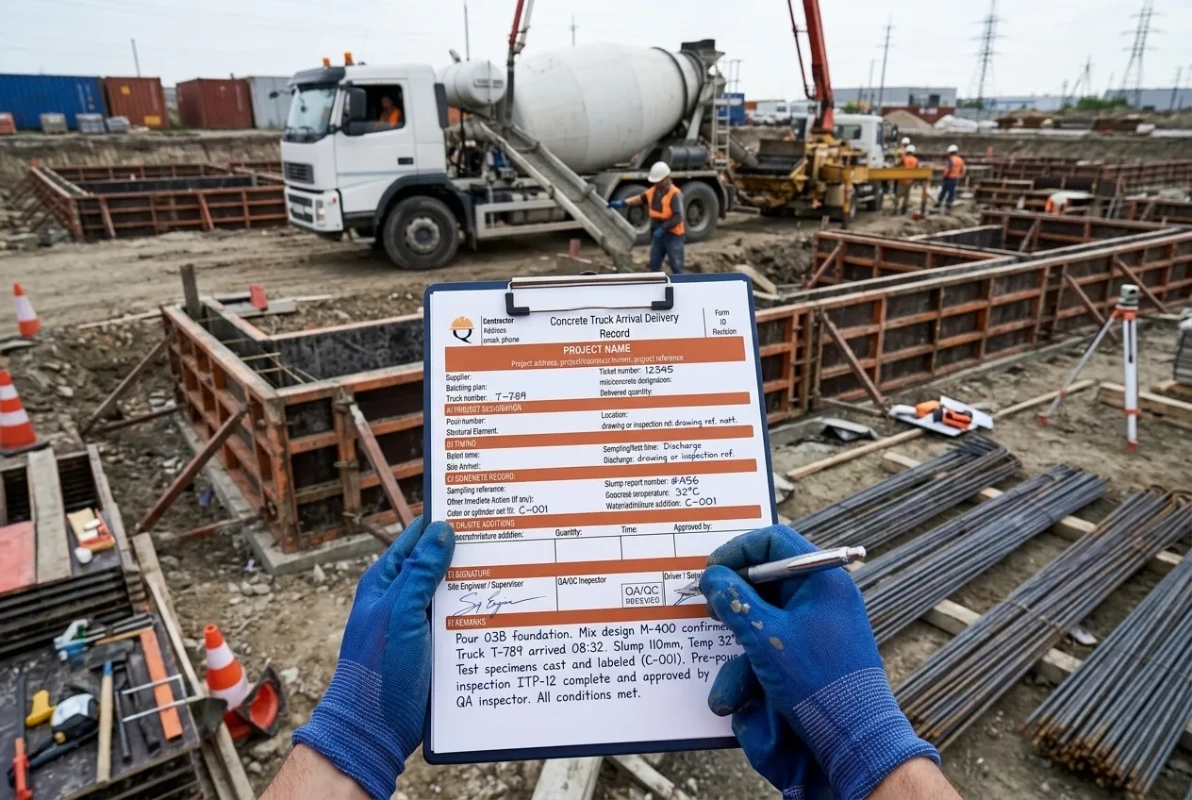
- Sample: Delivery Ticket Checklist (fields for time batched/arrived, revolutions, admixtures, w/c, quantity, signatures)
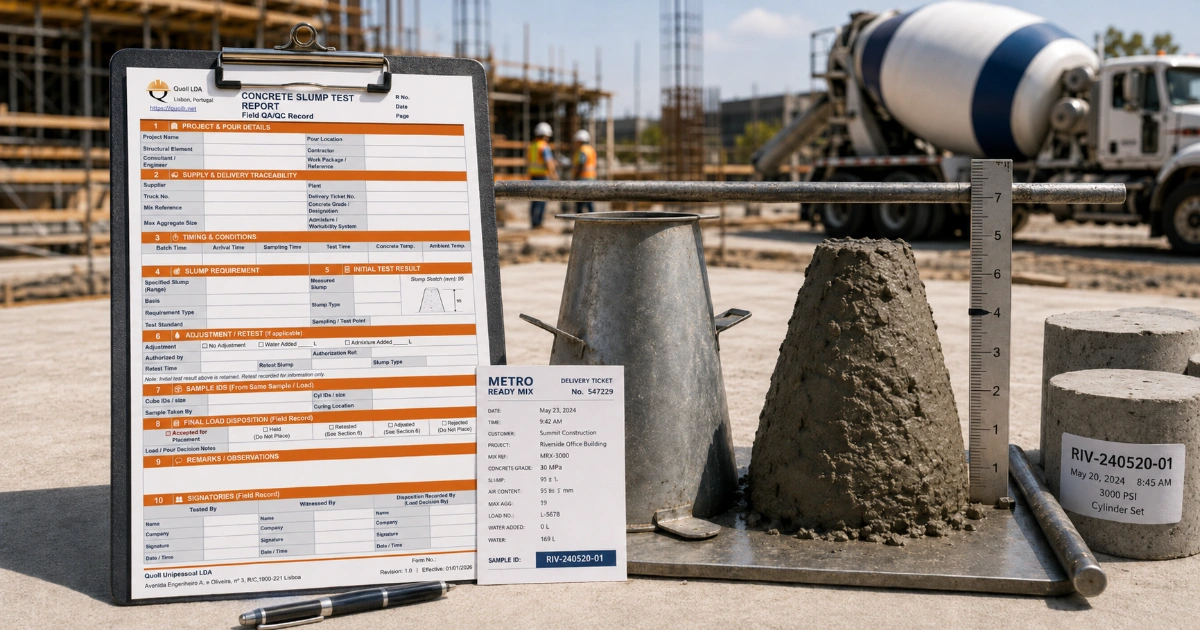
- Sample: Field Concrete Test Report (temp, slump/flow, T500, air %, density, adjustments, acceptance)
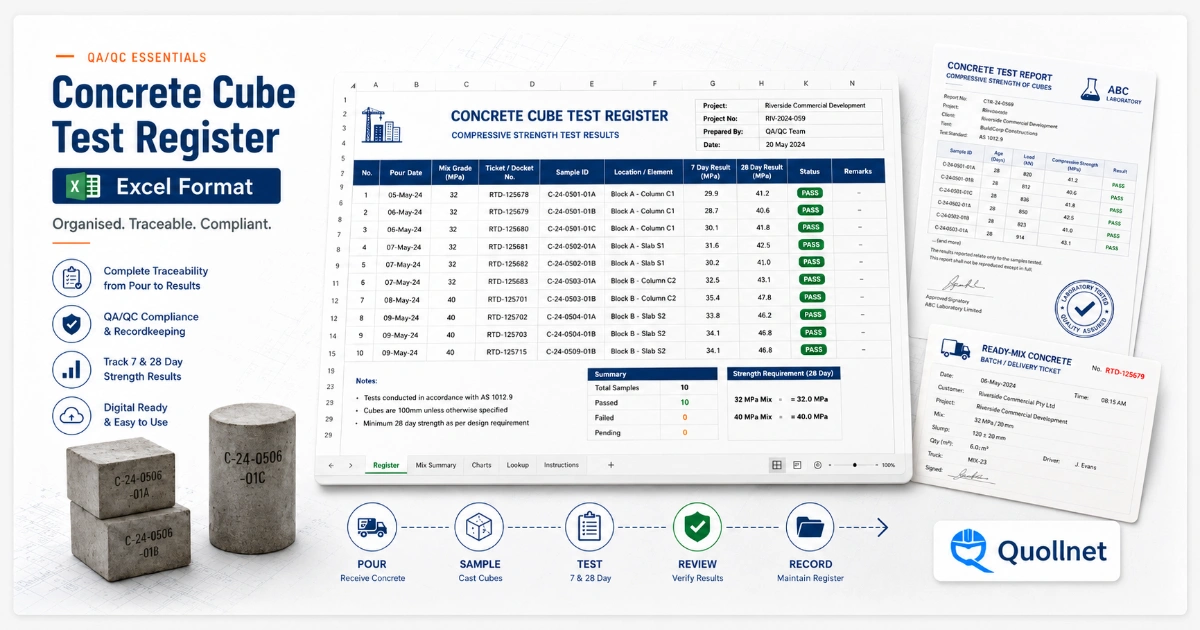
- Sample: Specimen Register (IDs, sizes, ages, curing type, location)
- Sample: Curing Log (min/max temps)
- Calibration Certificates (slump/flow kit, thermometer, air meter, density measure, balance, curing box)
- Mix Design Approval Letters and Supplier Certifications
- SDS for cement, admixtures
- ITP sign‑off sheet and NCR form
This content is a read-only public reference. Download or customize to get an editable version.
ITP preview
The first inspection activities from the linked ITP for Method Statement: Receiving and Acceptance Testing of Ready‑Mix Concrete on Site:
| Activity | Inspection / Test | Acceptance Criteria | Responsibility | Record |
|---|---|---|---|---|
| Supplier Prequalification | Plant certification, mix approvals | Approved supplier and mix designs on file | Contractor PM/QC; Engineer witness | Approval letter; Submittal register |
| Truck Arrival & Ticket Check | Ticket validation vs ASTM C94/EN 206 | Ticket complete; time since batching ≤90 min; revolutions within limit [Verify] | QC Inspector | Delivery Ticket Checklist |
| Sampling of Concrete | ASTM C172/EN 12350‑1 | Representative composite sample | QC Technician | Field Concrete Test Report |
Showing 3 of 13 inspection activities. View full ITP →
Related Inspection and Test Plan
An Inspection and Test Plan (ITP) is available for Method Statement: Receiving and Acceptance Testing of Ready‑Mix Concrete on Site. The ITP defines the inspection activities, acceptance criteria, hold and witness points, responsible parties, and records required to verify the work described in this method statement.
View the Method Statement: Receiving and Acceptance Testing of Ready‑Mix Concrete on Site ITP →Frequently asked questions
Continue with related Quollnet resources connected to this method statement.