
Method Statement: Pouring, Leveling, and Finishing Concrete for Suspended Structural Slabs and Beams – Method Statement
AI-assisted method statement with matching ITP, PDF download, and Excel export.
More than a static template
Unlike a downloadable Word or PDF template, this method statement is an AI-assisted editable starting point connected directly to a matching Inspection and Test Plan. Every section is structured, project-adaptable, and ready to export.
- AI-assisted drafting — Customize every section with AI for your specific project scope.
- Linked ITP — A matching inspection and test plan is generated alongside the method statement.
- Multiple export formats — Download as a formatted PDF or editable Excel spreadsheet.
- Editable starting point, not a final document — Review, verify, and adjust all content against your project requirements before use.
Static template vs. Quollnet workflow
| Feature | Static template | Quollnet |
|---|---|---|
| Project-specific content | Manual fill-in required | AI-assisted customization |
| Linked ITP | Separate document, no link | Matching ITP included |
| Export formats | Usually PDF only | PDF and Excel |
| Structured sections | Free-form layout | 13 standardized sections |
| Saved to your account | Local file only | Cloud-saved, reusable |
| Content accuracy | You verify everything | AI-assisted, you still verify |
| Cost | Often free but time-intensive | Free to customize and download |
What you can customize
When you save this method statement to your account, every section becomes editable. The following 13 sections are included:
- Scope — Defines the activity and its boundaries.
- References — Standards, specifications, and drawings.
- Responsibilities — Roles and accountabilities.
- Resources — Labour, plant, and equipment summary.
- Materials — Materials and compliance requirements.
- Equipment — Tools and equipment details.
- Prerequisites — Hold points and pre-conditions.
- Method sequence — Step-by-step construction sequence.
- Safety controls — HSE risk controls and PPE.
- Environmental controls — Environmental mitigation measures.
- QA/QC — Quality inspection and test requirements.
- ITP — Inspection and Test Plan table (has its own page).
- Attachments — Referenced drawings and documentation.
Why this method statement is used
This method statement is used to define and communicate the approved procedure for carrying out method statement: pouring, leveling, and finishing concrete for suspended structural slabs and beams on site. It ensures the work is planned in advance, the correct resources and controls are in place, and all personnel understand responsibilities, sequence, quality requirements, and safety controls before work begins. It aligns site execution with the documented scope and acceptance expectations.
Who uses this method statement
This method statement is used by contractors, site supervisors, project engineers, QA/QC engineers, HSE officers, consultants, and client representatives. It serves as a shared reference for planning, execution, supervision, inspection, and approval of the activity on site.
When it is prepared and submitted
The method statement is prepared before the work activity starts and submitted as part of the pre-construction documentation package for review and approval.
Who reviews or approves it
The method statement is usually submitted to the client representative, consultant, resident engineer, or project management consultant for review and approval before the work commences.
Important approval note
This method statement is an AI-assisted editable starting point, not a pre-approved document. Before use on any project, all content must be reviewed and approved by the relevant parties (superintendent, principal contractor, or client representative) in accordance with your contract and project quality plan.
For example: if your specification requires a departure from a referenced standard, that departure must be documented and approved separately — this method statement will not capture that automatically. Always verify against your applicable drawings, specifications, and regulatory requirements.
Method statement content
Scope
Description
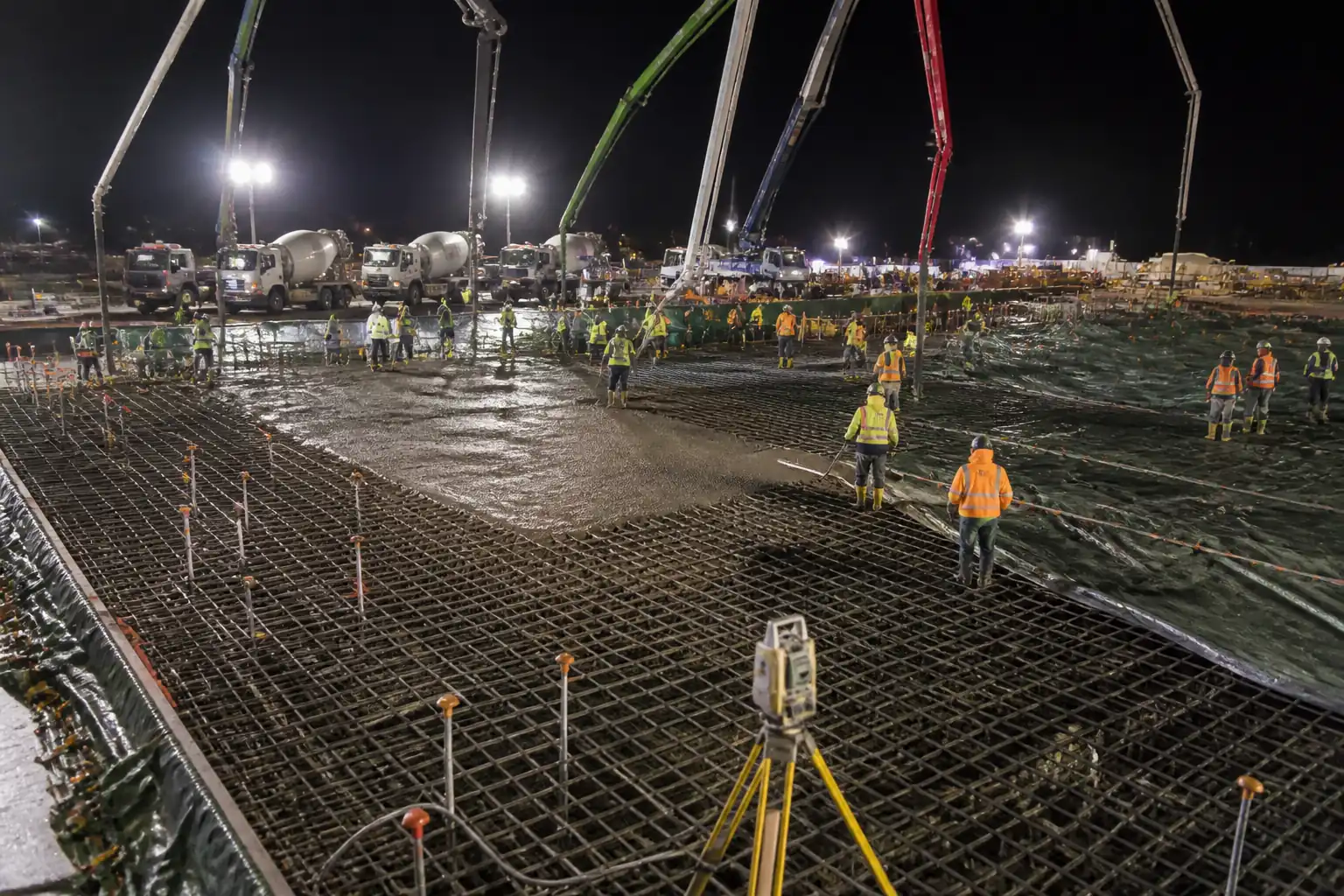
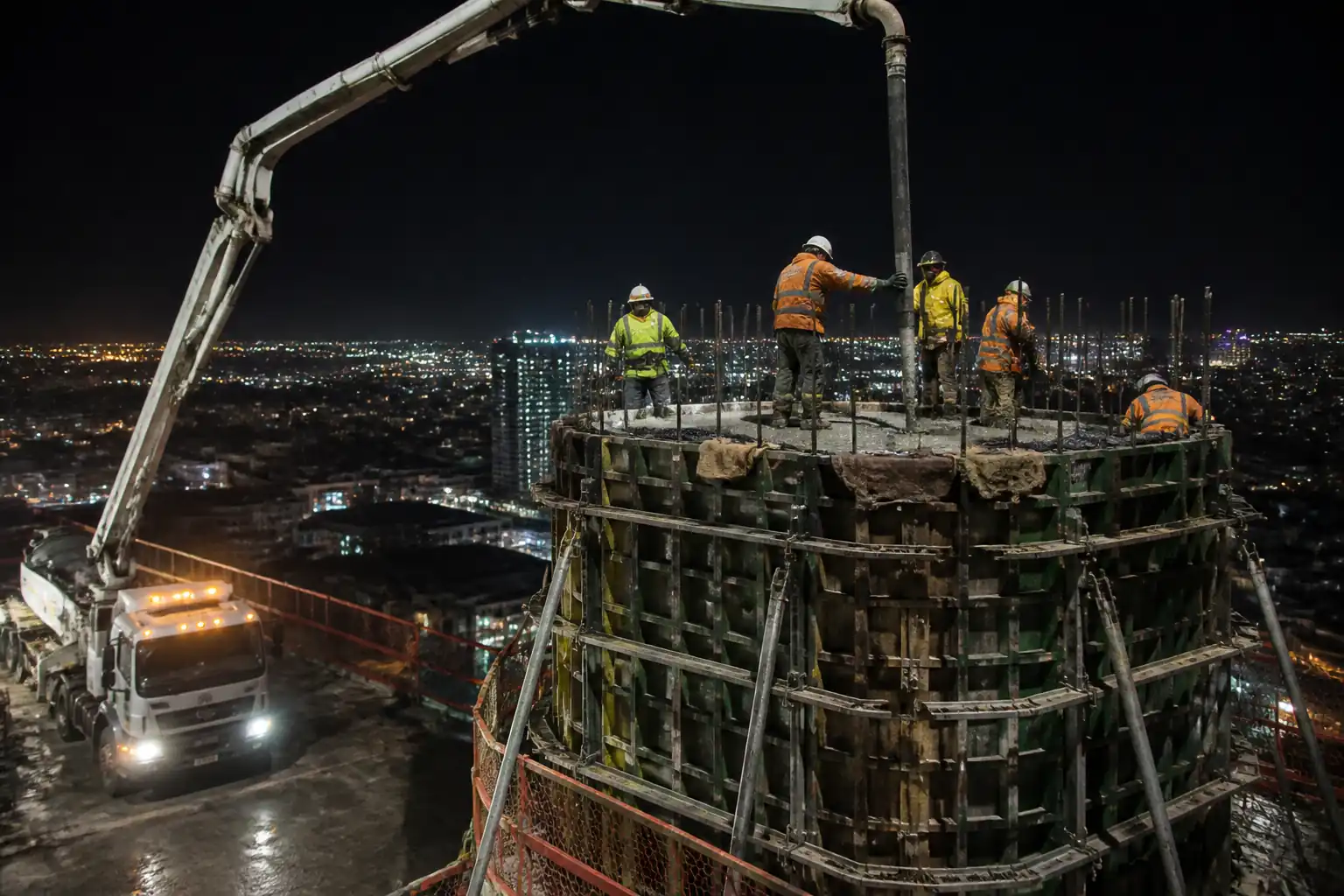
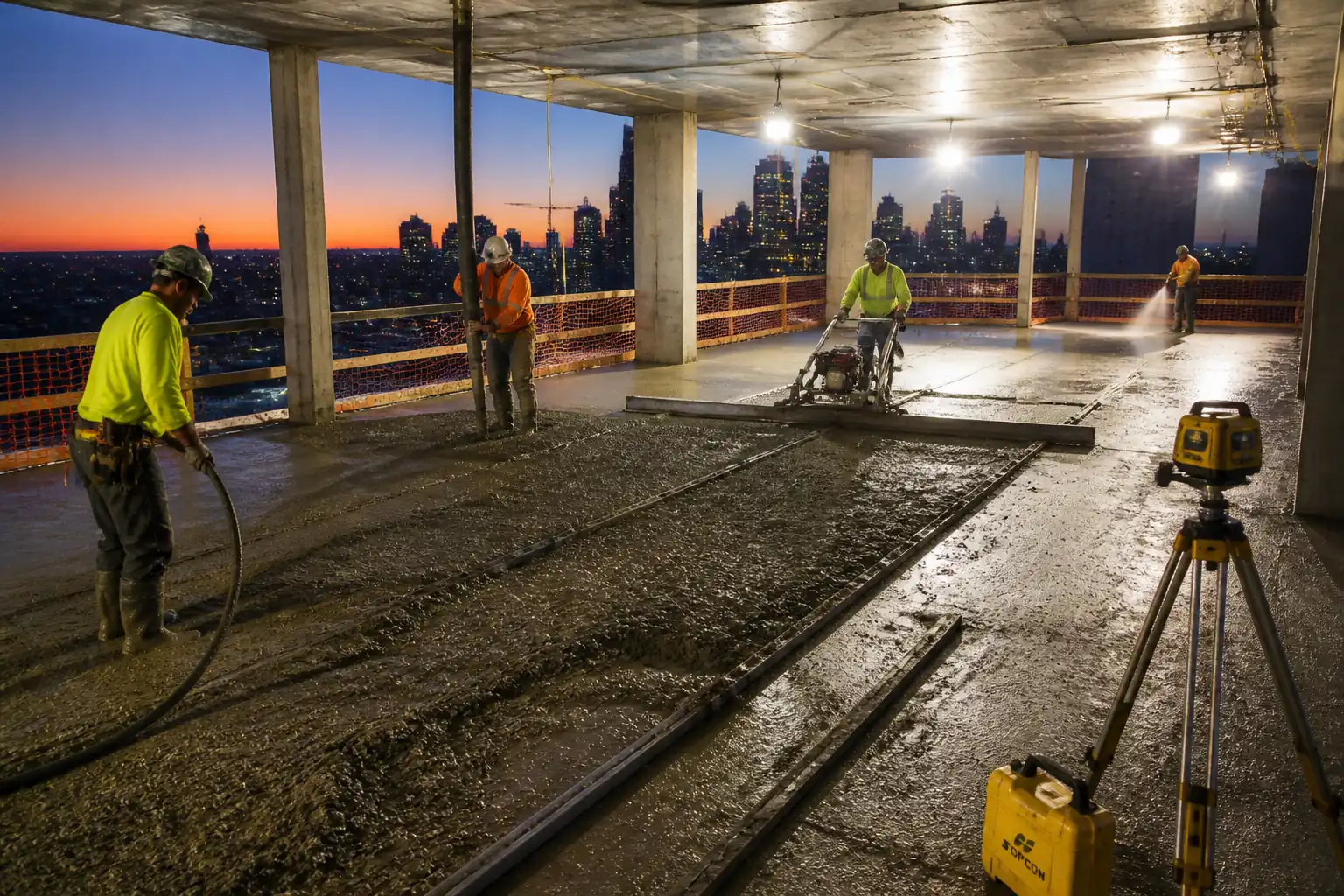
This method covers batching verification, delivery, pumping, placing, consolidation, leveling, finishing, and curing of cast-in-place reinforced concrete for suspended structural slabs and beams. It includes setting wet-screed leveling guides, laser level checks, use of surface vibrating screeds and mechanical bull floats, planned pour paths to avoid cold joints, and coordination with formwork, reinforcement, and embedded items.
Inclusions
- Formwork readiness verification and backpropping adequacy checks for suspended decks and beams.
- Pre-pour survey and elevation control using laser and wet-screed guide strips.
- Concrete placement by boom/line pump, internal vibration, surface vibrating screed, bull floating, and subsequent finishing operations as specified.
- Curing, early-age protection, and quality control testing (slump, temp, cylinders, flatness/levelness as applicable).
- Cold-joint prevention by calculated pour sequence and contingency measures.
Exclusions
- Formwork design calculations and rebar detailing (by others, inspected by this method).
- Post-tensioning stressing activities (if any) beyond protection of tendons/anchorage locations.
- Structural load testing.
Key Objectives
- Achieve specified structural performance and surface tolerances.
- Maintain continuity of pour to avoid cold joints and plastic shrinkage cracking.
- Ensure deck safety and environmental compliance.
References
| Document Type | Reference / Number | Revision | Notes |
|---|---|---|---|
| Standard | ACI 318 [Verify edition per project] | ||
| Standard | ACI 301 [Verify edition per project] | ||
| Standard | ACI 117 [Verify edition per project] | ||
| Guide | ACI 302.1R [Verify edition per project] | ||
| Guide | ACI 309 [Verify edition per project] | ||
| Guide | ACI 305R, ACI 306R [Verify edition per project] | ||
| Standards | ASTM [Verify editions per project] | ||
| Standard | ASTM E1155 [Verify edition per project] | ||
| Standards | BS EN 206; BS EN 13670 [Verify per project] | ||
| Contract |
Responsibilities
| Role | Responsibility | Name / Party |
|---|---|---|
| Project Manager | PM | Contractor |
| Engineer | Site Engineer | Contractor |
| Supervisor | Formwork Supervisor | Subcontractor |
| Supervisor | Rebar Supervisor | Subcontractor |
| QC | QC | Contractor |
| HSE | HSE | Contractor |
| Surveyor | Survey | Contractor |
| Supplier | Supplier | Supplier |
| Engineer | Engineer | Engineer |
Resources
| Resource Type | Description | Quantity | Remarks |
|---|---|---|---|
| Labor | Pump operator, hosemen, vibrators, screed operators, finishers, helpers. | As required | |
| Labor | Perform slump, temp, air (if specified), sampling and cylinders. | 2–3 | |
| Labor | Set elevations, wet-screed guide levels, laser checks, post-pour survey. | 1–2 |
Materials
| Material | Specification / Grade | Quantity | Remarks |
|---|---|---|---|
| Concrete | |||
| Admixtures | |||
| Curing compound | |||
| Mortar/rail | |||
| Accessories |
Equipment
| Equipment | Capacity / Type | Quantity | Inspection Required |
|---|---|---|---|
| Pump | As required | 1–2 | Yes |
| Vibrator | 3–5 incl. spares | Yes | |
| Screed | 1–2 | Yes | |
| Bull float | 2–3 | Yes | |
| Trowel | 1–2 | Yes | |
| Laser/TS | 1 | Yes | |
| QA kits | Sets as required | Yes |
Prerequisites
- Approvals: Mix design approval; material submittals (admixtures, curing compound); method statement and ITP approved by Engineer.
- Formwork and Backpropping: Verified by competent person; capacity and stability checked for wet concrete plus construction live loads, equipment loads, and impact; permit-to-pour issued.
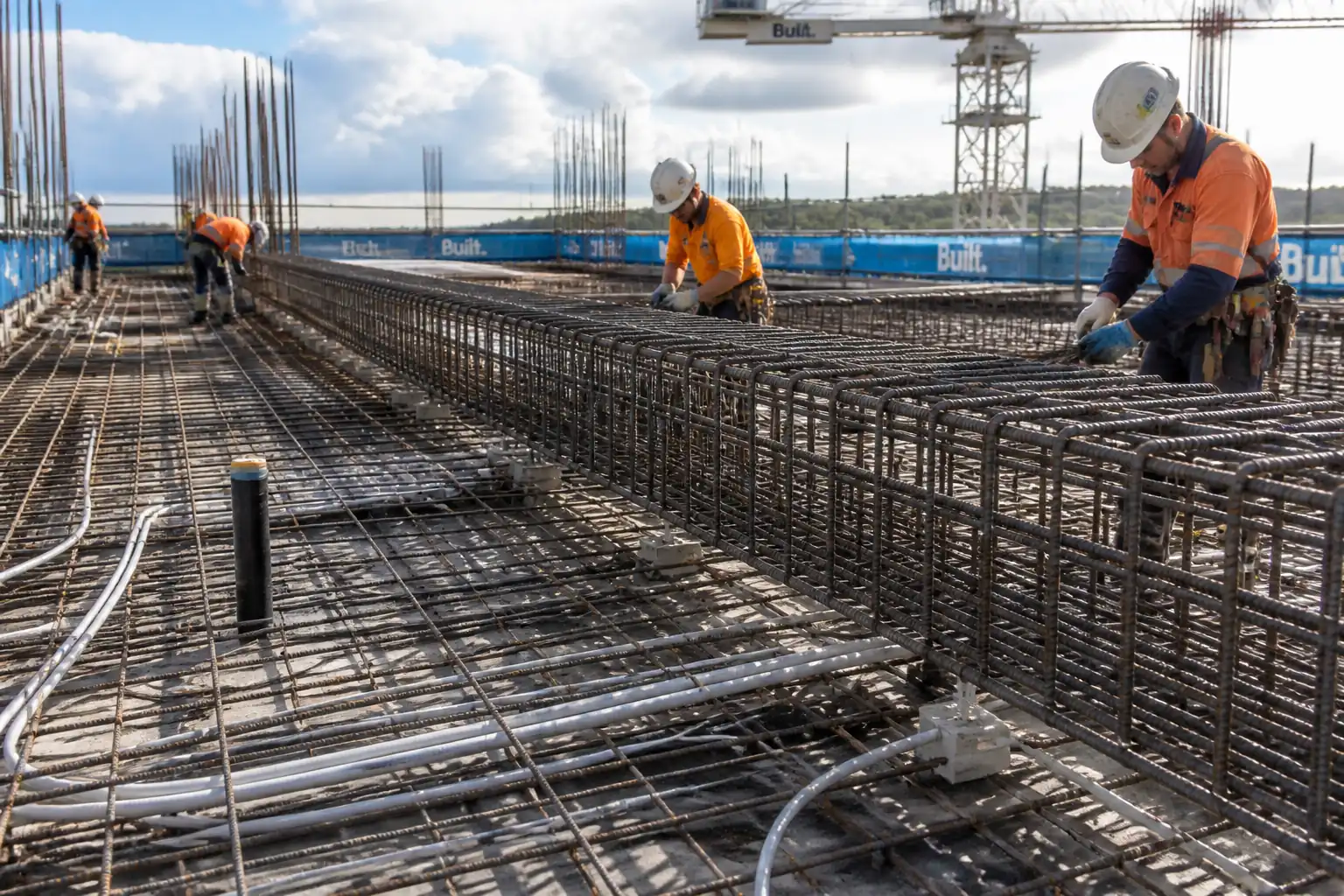
- Rebar and Embedded Items: Inspected and accepted; covers set; services, sleeves, blockouts, and edge forms fixed. Reinforcement securely tied to prevent float or displacement during vibration.
- Survey Control: Benchmarks transferred; pour elevation benchmarks set; laser calibration verified.
- Pour Sequencing Drawing: Issued showing strip widths, pour direction, breaks, pump location, access/egress, and contingency cold-joint locations with joint treatment details.
- Pre-Pour Meeting: Completed within 24–48 hours prior; attendees include PM, site engineer, HSE, QC, formwork, rebar, supplier, pump operator.
- Weather Plan: Check ambient, wind, temperature; implement hot- or cold-weather concreting per ACI 305/306; evaporation rate assessment (e.g., Menzel nomograph) and fogging/evaporation retarder ready if needed.
- Equipment Readiness: Pumps, vibrators, screeds, bull floats, trowels tested; spare vibrators and fuel available; lighting (if night operations) checked.
- Access and Safety: Edge protection in place; fall arrest prepared where required; exclusion zones under deck established.
- Testing Arrangements: QC staffing confirmed; molds, curing boxes/tanks, and transport to lab arranged.
- Permits/Notifications: Work at height permit, pump setup permit, concrete delivery scheduling with traffic plan [Verify per project HSE plan and local regulations].
- Housekeeping: Deck clear of debris, free water removed, formwork wetted or release agent applied as specified; no ponding on deck.
- PT/Embed Protection: If PT ducts present, ensure no damage; no finishing over anchorages not designed for exposure; mark all tendons/anchors to avoid vibrator impact.
- Emergency/Contingency: Backup power for trowels; alternate pump line routing; materials for cold-joint treatment on standby (e.g., roughening tools, bonding agent if specified).
Method Sequence
| Step | Activity | Description | Responsibility | Inspection / Hold Point |
|---|---|---|---|---|
| 1 | Final Pre-Pour Inspection and Permit-to-Pour | Complete formwork, rebar, embed, and survey checks; verify access, lighting, safety barriers, and backpropping. Record hold point release by Engineer. | Site Engineer / Consultant | Hold Point HP-1 |
| 2 | Set Wet-Screed Leveling Guides | Form continuous mortar/grout strips or set metal rails to finished elevation using laser. Spacing typically 3–5 m to suit screed length; confirm high/low points; set guide heads near columns and around beam perimeters. | Surveyor / Foreman | Laser level spot checks every 3–4 m. |
| 3 | Establish Pour Strips and Paths | Mark pour strips 6–8 m wide [Verify per crew and pump capacity]. Define direction from farthest point back toward pump exit, avoiding re-entrant corners and minimizing rehandling. Provide walk boards/kneeboards if access across fresh concrete is required. | Site Engineer | Supervisor review vs. pour plan. |
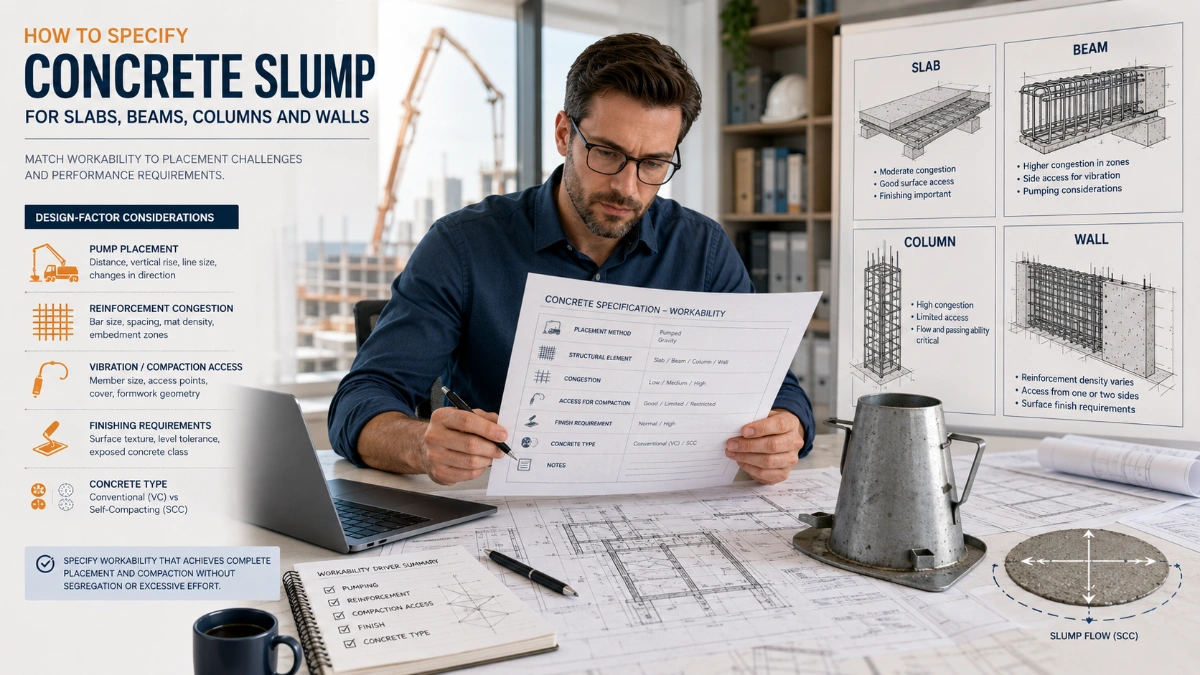
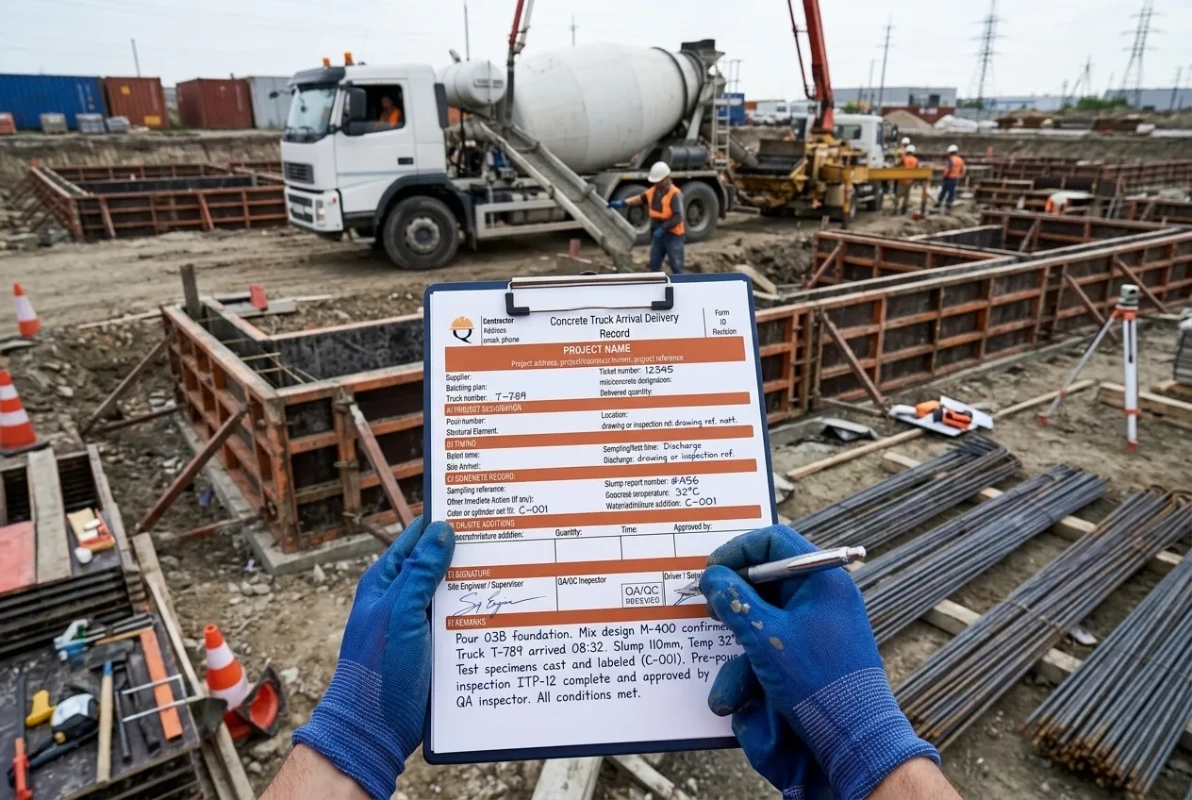
| 4 | Concrete Delivery Verification and Initial Testing | Receive batch tickets; verify time, mix ID, admixtures. Perform slump (target 75–120 mm unless specified), temperature (≤ 32 °C typical hot weather limit), air (if specified), and density as applicable. Make initial cylinder/cube set. | QC Technician | Witness Point WP-1 |
| 5 | Placement at Beams and Column Heads First | Place and consolidate concrete in beams/column strips to ensure support for slab; maintain head of concrete. Avoid segregation by minimizing free-fall (>1.5 m not permitted without chute). | Pump Operator / Foreman | Continuous supervision |
| 6 | Internal Vibration | Insert poker vertically, spacing ~8–10 times head diameter (typically 300–500 mm), penetrate 50–100 mm into previous layer, duration 5–15 seconds until air release ceases and surface sheen appears. Avoid over-vibration causing segregation. | Vibrator Operators | Foreman oversight |
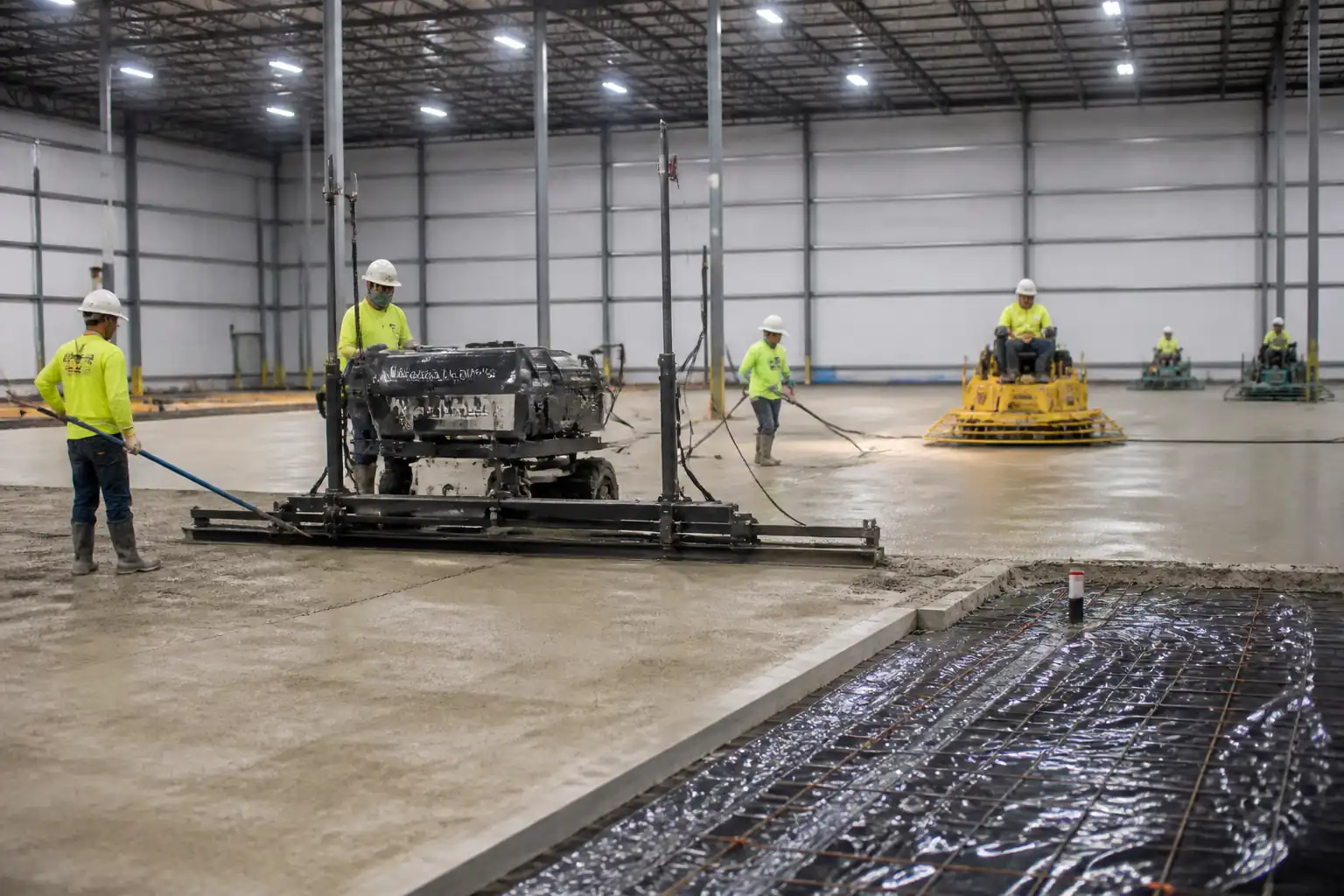
| 7 | Surface Vibrating Screed Over Wet-Screed Guides | Draw vibrating screed along guides to strike off to elevation. Keep blade in constant contact; avoid digging. Rescreed low spots with added concrete promptly. | Screed Crew | Laser spot checks post-screed. |
| 8 | Bull Floating (Mechanical) | Immediately after screeding and bleed water sheen reduction, pass mechanical bull float to embed coarse aggregate ~3–5 mm below surface and remove ridges. Use minimal passes to avoid bringing excess paste. | Finishers | Visual check |
| 9 | Intermediate Finishing (If Specified) | For steel-trowel or hard-trowel finishes, perform pan float then blade trowel passes as concrete stiffens; maintain joint edge quality at beams and edges. For broom/anti-slip finish (if exposed), apply after final floating once surface supports broom without tearing. | Finishers | Foreman oversight |
| 10 | Guide Rail Removal and Strip Patching | When concrete supports weight without surface damage, remove temporary metal rails. Fill grooves with fresh mortar of same mix proportions; re-float and close surface. | Screed Crew | Visual and level check |
| 11 | Curing and Early-Age Protection | As soon as final finishing allows, apply curing compound at manufacturer’s coverage (e.g., 5–7 m²/L) or commence wet curing (water ponding/soaker hoses and polyethylene) for minimum 7 days or as specified. Protect from wind, sun, and rapid moisture loss; install barriers to foot traffic until sufficient strength achieved. | Site Engineer / Finishers | Witness Point WP-2 |
| 12 | Flatness/Levelness and As-Built Survey | If FF/FL specified, perform ASTM E1155 within 72 hours using approved profiler. Survey finished elevations and beam soffit/top-of-slab benchmarks for compliance. | QC / Survey | Witness Point WP-3 |
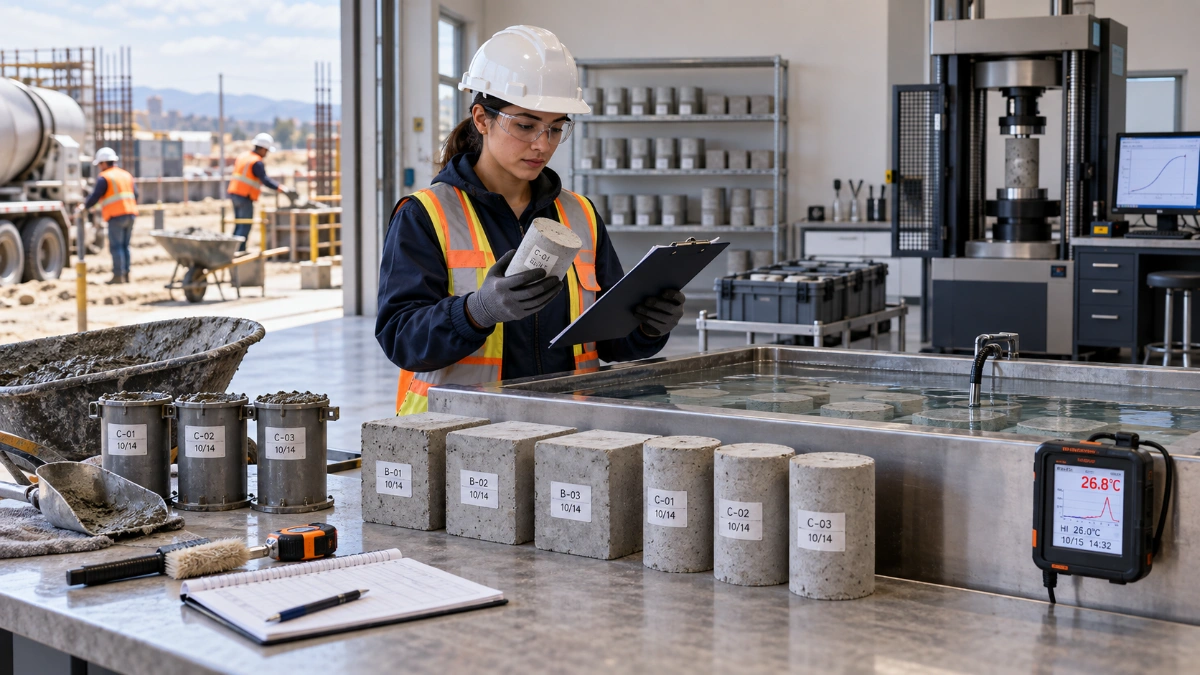
| 13 | Field Curing and Strength Testing | Cure and transport cylinders/cubes. Test at 7 and 28 days unless specified otherwise. Monitor early strength if required for formwork striking/backpropping transfer. | QC / Lab | Witness Point WP-4 |
| 14 | Defect Identification and Repair | Mark honeycombs, surface voids, and level deviations. Repair per approved procedure using compatible repair mortar; grind high spots only if permitted and does not reduce cover. | Site Engineer / QC | Inspection Request |
Safety Controls
Task-Specific Hazards and Controls
- Hazard: Working at height/leading edges on suspended decks.
- Likely consequence: Falls causing serious injury or fatality.
- Engineering/procedural control: Install edge protection (guardrails/toeboards) and temporary covers on openings; use travel restraint/fall arrest for workers within 2 m of edges; designate access routes and install visual barriers.
- Required PPE: Full-body harness with double lanyard when required, hard hat, hi-vis, gloves, safety boots.
- Collective preventive measure: Guardrails and safety nets where feasible.
-
Inspection/permit/supervision: Work-at-height permit; daily edge protection inspection by HSE; supervisor presence. [Verify per project HSE plan and local regulations]
-
Hazard: Formwork/falsework collapse or overload during pour.
- Likely consequence: Structural collapse, multiple injuries.
- Engineering/procedural control: Competent design and inspection; verify load paths and backpropping; monitor pour rates; restrict equipment loads on green concrete; install pour rate signage.
- Required PPE: Hard hat, boots, gloves.
- Collective preventive measure: Exclusion zone beneath deck; shore labeling and inspection tags.
-
Inspection/permit/supervision: Permit-to-pour; formwork release signed by competent person; periodic checks during pour.
-
Hazard: Concrete pump/boom failure or hose whipping.
- Likely consequence: Struck-by, pinch injuries, loss of control.
- Engineering/procedural control: Set pump on firm, leveled ground with mats; secure line couplings; use end-hose restraint; communications protocol between pump operator and crew; relieve line pressure before moving.
- Required PPE: Eye protection, gloves, helmets, long sleeves.
- Collective preventive measure: Exclusion zone around boom swing; tag lines for hose control.
-
Inspection/permit/supervision: Pump pre-use inspection; manufacturer operating limits; competent operator.
-
Hazard: Overturning loads on suspended deck (trowels, screeds, material stacks).
- Likely consequence: Local deck failure, falls of persons/equipment.
- Engineering/procedural control: Limit live loads; do not stockpile concrete; use spreader boards for equipment; adhere to pour sequence supporting beams first.
- Required PPE: Standard site PPE.
- Collective preventive measure: Load control signage; marshals managing equipment traffic.
-
Inspection/permit/supervision: Supervisor approval of equipment routes; inspect deck deflections during pour.
-
Hazard: Rebar impalement and trip hazards from screed rails.
- Likely consequence: Puncture wounds, trips/falls.
- Engineering/procedural control: Cap protruding bars; organize hose paths; keep rails flush or outside travel zones.
- Required PPE: Gloves, boots with midsole protection.
- Collective preventive measure: Housekeeping and material staging.
-
Inspection/permit/supervision: HSE inspection; toolbox talk before pour.
-
Hazard: Cement/concrete chemical burns and dermatitis.
- Likely consequence: Skin/eye injury, long-term dermatitis.
- Engineering/procedural control: Avoid skin contact; provide barrier cream and wash stations; immediate wash if contaminated.
- Required PPE: Alkali-resistant gloves, long sleeves, eye protection.
- Collective preventive measure: Welfare facilities with clean water and neutral soap.
-
Inspection/permit/supervision: HSE checks; SDS available on site.
-
Hazard: Noise and hand-arm vibration (HAV) from vibrators and trowels.
- Likely consequence: Hearing loss; HAVS.
- Engineering/procedural control: Rotate operators; limit exposure time; maintain equipment to reduce vibration; use low-vibration handles.
- Required PPE: Hearing protection; anti-vibration gloves (as supplementary measure).
- Collective preventive measure: Noise zoning and signage.
-
Inspection/permit/supervision: HAV monitoring; hearing conservation program.
-
Hazard: Struck-by from overhead operations/boom and falling objects to areas below deck.
- Likely consequence: Serious injury to persons below.
- Engineering/procedural control: Establish exclusion zones and catch decks/netting below as needed; signage and spotters.
- Required PPE: Hard hats.
- Collective preventive measure: Barricades and lookouts.
-
Inspection/permit/supervision: Daily check that exclusion maintained; permit for work below.
-
Hazard: Electrical contact with pump boom or equipment.
- Likely consequence: Electrocution.
- Engineering/procedural control: Maintain safe approach distances from overhead lines; use spotter; de-energize where feasible.
- Required PPE: Dielectric gloves if required; standard PPE.
- Collective preventive measure: Temporary isolation/barriers.
-
Inspection/permit/supervision: Permit-to-work near utilities; utility owner coordination.
-
Hazard: Musculoskeletal injuries from manual handling of screeds/hoses.
- Likely consequence: Strains, sprains.
- Engineering/procedural control: Team lifts; mechanical aids; job rotation; hose supports.
- Required PPE: Gloves, supportive footwear.
- Collective preventive measure: Manual handling training.
- Inspection/permit/supervision: Supervisor monitors lifting practices.
Environmental Controls
- Concrete Washout Management: Provide lined, contained washout pit for chutes, pump priming, and equipment; no discharge to stormwater. Monitor pH; dispose via approved contractor.
- Spill Prevention: Keep spill kits at pump and pour area; immediate containment of hydraulic oil or admixture spills; report per plan.
- Noise and Light: Schedule operations to meet local limits; use directional lighting to minimize light spill at night.
- Dust and Debris: Minimal during wet works; control dust from ancillary cutting/grinding using wet methods and vacuums.
- Water Use: Control curing water to prevent runoff; bunded hoses; no uncontrolled discharge from upper floors.
- Material Storage: Admixtures and curing compounds stored in bunded areas; SDS available.
- Waste Segregation: Collect empty bags/containers; dispose per waste management plan; recycle packaging when feasible.
- Air Quality/Volatiles: Use low-VOC curing compound where required [Verify per project].
- Transport/Traffic: Coordinate truck routes and staging to avoid idling; prevent tracking of material off-site by wheel-wash.
- Protected Areas: Maintain exclusion near drains; cover or isolate drains before pour; restore after works.
QA/QC
Controls and Records
- Concrete Acceptance (Strength): Per ACI 318 or Project Spec: average of any three consecutive 28-day strength tests ≥ f'c; no single test < f'c − 3.5 MPa [Verify]. Record pours linked to test sets.
- Workability and Temperature: Slump target typically 75–120 mm for pumped concrete unless SCC; temperature at discharge typically ≤ 32 °C hot weather; record each truck.
- Testing Frequency: Minimum 1 set of cylinders/cubes per 50 m³ per day, minimum 1 set per pour, plus additional for early striking/backpropping transfer [Verify per spec].
- Consolidation: Supervision to confirm vibrator spacing and technique; no segregation or rebar displacement.
- Surface Tolerances: Elevation tolerance typically ±10 mm for structural slabs [Verify]; local surface irregularities per 3 m straightedge typically ≤ 10 mm unless otherwise specified. FF/FL if specified per ASTM E1155.
- Beam/Slab Dimensions: Check beam top-of-concrete elevation; check soffit after form removal where accessible.
- Curing Compliance: Verify curing method start time and continuity; curing compound coverage rate per datasheet; wet curing maintained for ≥ 7 days or as specified.
- Cold-Joint Avoidance: Monitor placement continuity; if interruption exceeds allowable window, implement construction joint treatment as approved (roughen to 6 mm amplitude [Verify], clean, apply bonding grout/epoxy if specified) and document.
- Nonconformance and Corrective Action: Log deviations; root-cause and corrective measures; obtain Engineer approval before structural repairs.
- Calibration: Maintain certificates for laser/levels and QA equipment within validity.
Deliverables
- Pre-pour checklists, IRs, test reports (slump, temperature, air/density if required), cylinder logs and break reports, FF/FL reports (if any), curing logs, as-built survey, NCRs and CARs as applicable.
Attachments
- Pour sequencing drawings and strip layout (showing pump location, access, and cold-joint contingencies).
- Pre-pour checklists (formwork, rebar, embeds, survey).
- Mix design approvals and admixture data sheets.
- Equipment inspection/maintenance records; calibration certificates for laser/levels and QA instruments.
- Curing compound technical data sheet and MSDS.
- HSE permits (work at height, pump setup), risk assessment, and toolbox talk records.
- Traffic and delivery plan; washout management plan.
- Sample QA forms: Field test report, cylinder register, FF/FL report template.
- As-built survey report and markups.
This content is a read-only public reference. Download or customize to get an editable version.
ITP preview
The first inspection activities from the linked ITP for Method Statement: Pouring, Leveling, and Finishing Concrete for Suspended Structural Slabs and Beams:
| Activity | Inspection / Test | Acceptance Criteria | Responsibility | Record |
|---|---|---|---|---|
| Formwork and Backpropping Inspection | Visual inspection vs. drawings; capacity check records available | Formwork plumb, line and level within tolerance; release agent applied as specified; permits signed | Formwork Supervisor / Engineer | Permit-to-pour; IR; checklist |
| Rebar and Embedded Items Inspection | Covers, spacing, bar sizes, cleanliness, supports, embed locations | Per drawings/ACI 318; cover blocks secure; no fouling with screed rails | Rebar Supervisor / QC / Engineer | IR; rebar checklist |
| Setting Wet-Screed Guides | Laser checks at 3–4 m intervals | Guide elevation within ±3 mm; alignment true | Surveyor / Site Engineer | Survey log |
Showing 3 of 13 inspection activities. View full ITP →
Related Inspection and Test Plan
An Inspection and Test Plan (ITP) is available for Method Statement: Pouring, Leveling, and Finishing Concrete for Suspended Structural Slabs and Beams. The ITP defines the inspection activities, acceptance criteria, hold and witness points, responsible parties, and records required to verify the work described in this method statement.
View the Method Statement: Pouring, Leveling, and Finishing Concrete for Suspended Structural Slabs and Beams ITP →Frequently asked questions
Continue with related Quollnet resources connected to this method statement.