
Method Statement: Fixing Reinforcement for Suspended Concrete Slabs and Beams – Method Statement
AI-assisted method statement with matching ITP, PDF download, and Excel export.
More than a static template
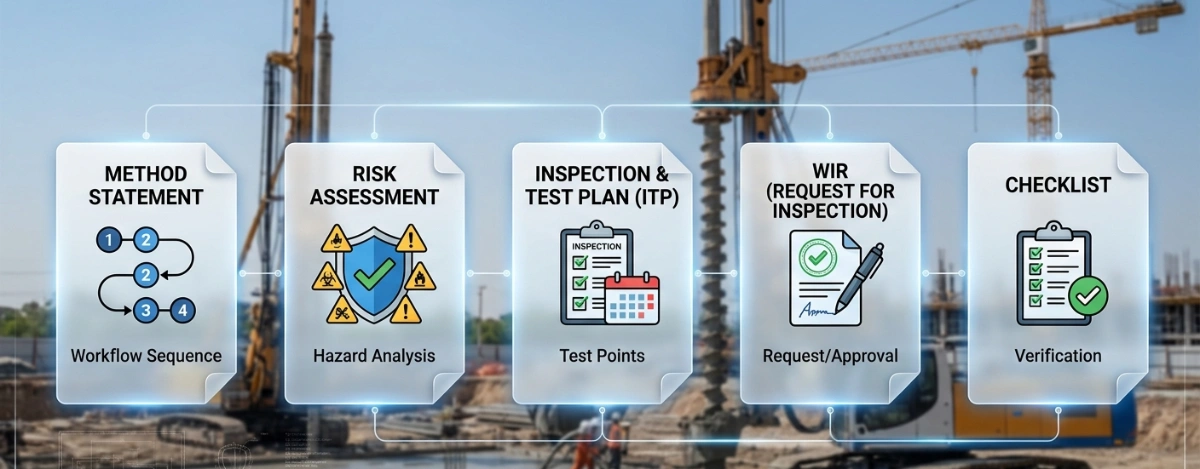
Unlike a downloadable Word or PDF template, this method statement is an AI-assisted editable starting point connected directly to a matching Inspection and Test Plan. Every section is structured, project-adaptable, and ready to export.
- AI-assisted drafting — Customize every section with AI for your specific project scope.
- Linked ITP — A matching inspection and test plan is generated alongside the method statement.
- Multiple export formats — Download as a formatted PDF or editable Excel spreadsheet.
- Editable starting point, not a final document — Review, verify, and adjust all content against your project requirements before use.
Static template vs. Quollnet workflow
| Feature | Static template | Quollnet |
|---|---|---|
| Project-specific content | Manual fill-in required | AI-assisted customization |
| Linked ITP | Separate document, no link | Matching ITP included |
| Export formats | Usually PDF only | PDF and Excel |
| Structured sections | Free-form layout | 13 standardized sections |
| Saved to your account | Local file only | Cloud-saved, reusable |
| Content accuracy | You verify everything | AI-assisted, you still verify |
| Cost | Often free but time-intensive | Free to customize and download |
What you can customize
When you save this method statement to your account, every section becomes editable. The following 13 sections are included:
- Scope — Defines the activity and its boundaries.
- References — Standards, specifications, and drawings.
- Responsibilities — Roles and accountabilities.
- Resources — Labour, plant, and equipment summary.
- Materials — Materials and compliance requirements.
- Equipment — Tools and equipment details.
- Prerequisites — Hold points and pre-conditions.
- Method sequence — Step-by-step construction sequence.
- Safety controls — HSE risk controls and PPE.
- Environmental controls — Environmental mitigation measures.
- QA/QC — Quality inspection and test requirements.
- ITP — Inspection and Test Plan table (has its own page).
- Attachments — Referenced drawings and documentation.
Why this method statement is used
This method statement is used to define and communicate the approved procedure for carrying out method statement: fixing reinforcement for suspended concrete slabs and beams on site. It ensures the work is planned in advance, the correct resources and controls are in place, and all personnel understand responsibilities, sequence, quality requirements, and safety controls before work begins. It aligns site execution with the documented scope and acceptance expectations.
Who uses this method statement
This method statement is used by contractors, site supervisors, project engineers, QA/QC engineers, HSE officers, consultants, and client representatives. It serves as a shared reference for planning, execution, supervision, inspection, and approval of the activity on site.
When it is prepared and submitted
The method statement is prepared before the work activity starts and submitted as part of the pre-construction documentation package for review and approval.
Who reviews or approves it
The method statement is usually submitted to the client representative, consultant, resident engineer, or project management consultant for review and approval before the work commences.
Important approval note
This method statement is an AI-assisted editable starting point, not a pre-approved document. Before use on any project, all content must be reviewed and approved by the relevant parties (superintendent, principal contractor, or client representative) in accordance with your contract and project quality plan.
For example: if your specification requires a departure from a referenced standard, that departure must be documented and approved separately — this method statement will not capture that automatically. Always verify against your applicable drawings, specifications, and regulatory requirements.
Method statement content
Scope
Purpose
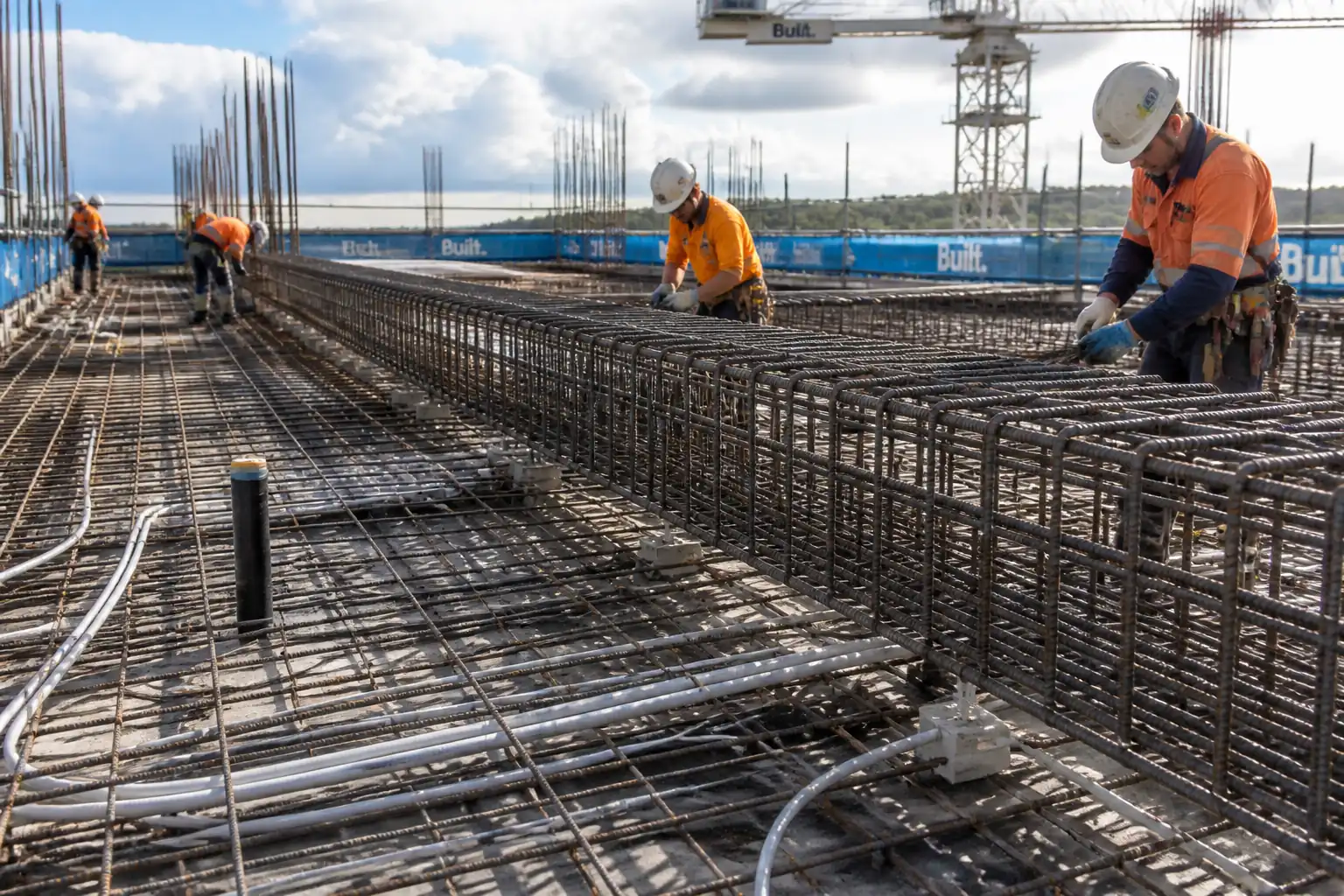
Define the method, sequence, quality controls, and HSE controls for fixing reinforcement for suspended reinforced-concrete (RC) slabs and beams, including:
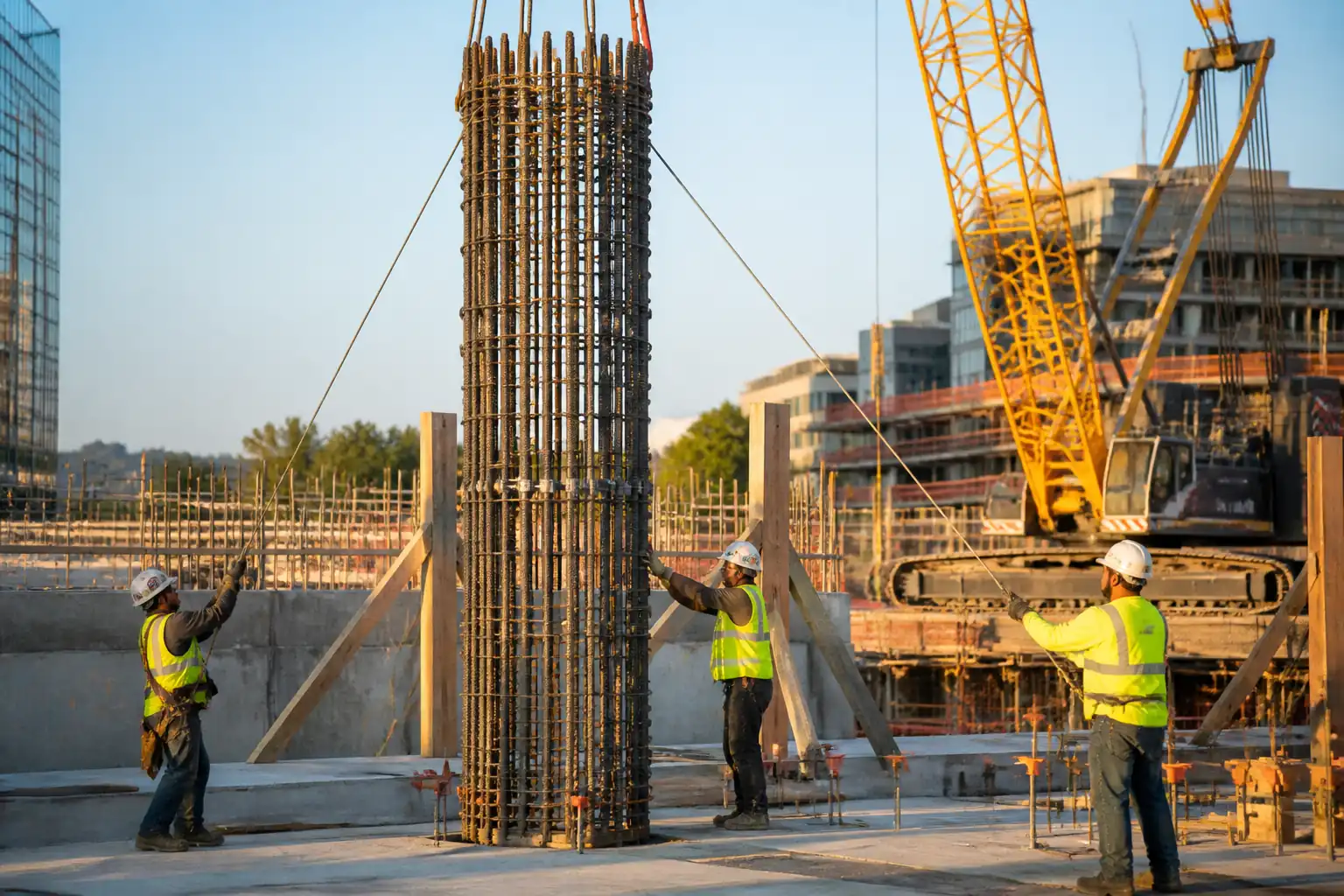
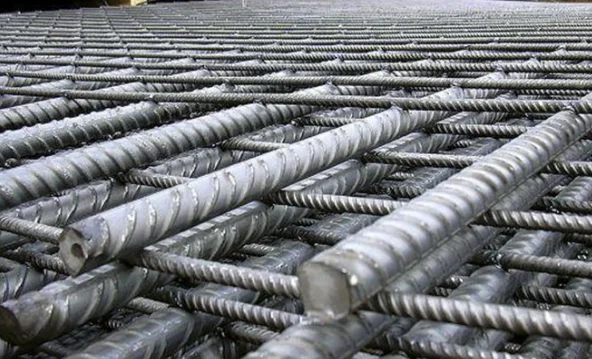
- Beam cage fabrication, lifting, placement, and fixing
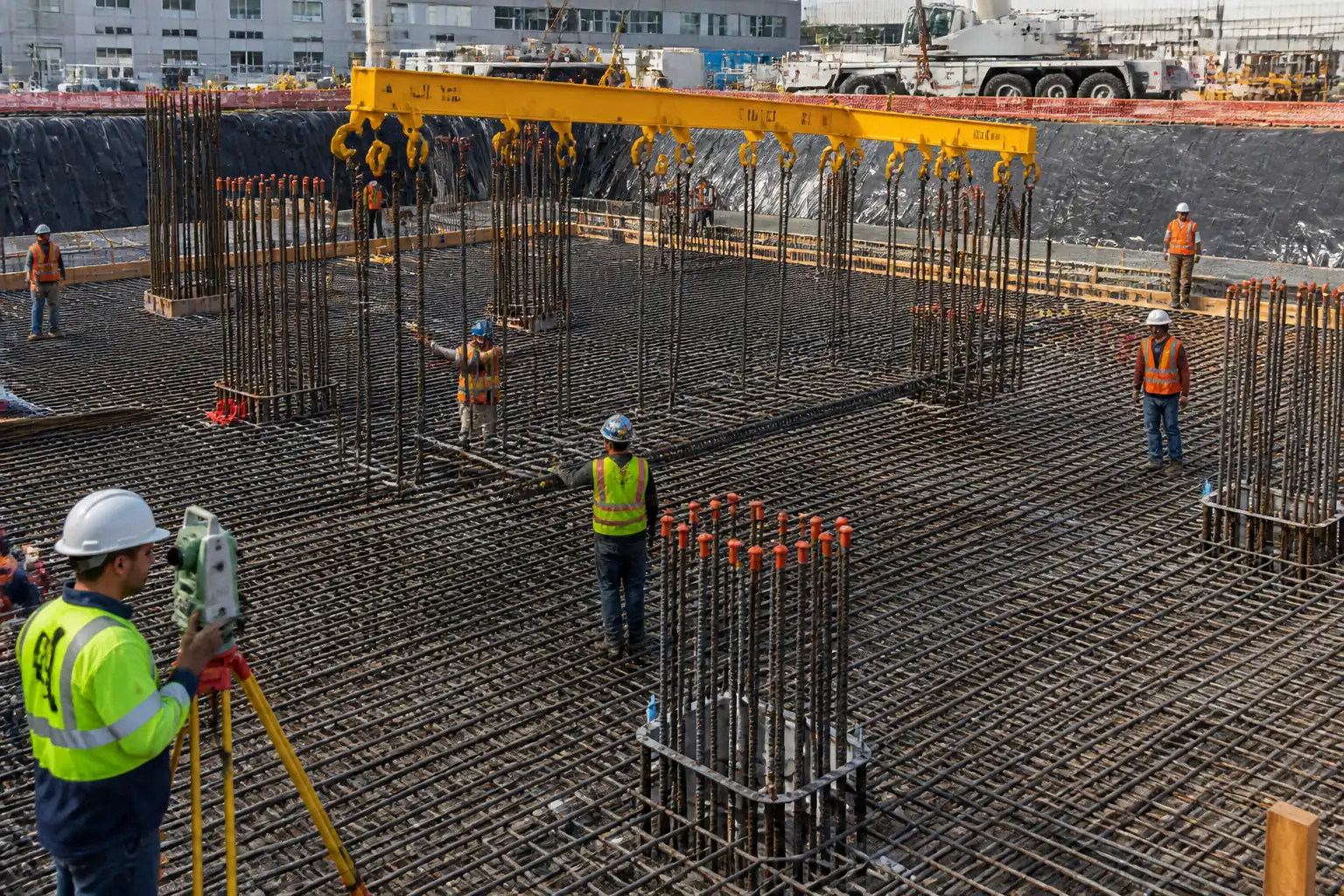
- Slab bottom and top reinforcement layout, tying, supports, and chairs/spacers
- Coordination with embedded services (conduits, sleeves, boxes, anchors)
- Installation of crack-control mesh and local trimming reinforcement around penetrations/openings
- Dimensional control, cover control, couplers (if used), and final pre-pour sign-off
Location
- All suspended slabs and beams within as shown on IFC drawings [Verify per project drawings].
Deliverables
- Installed reinforcement compliant with drawings, bar bending schedules (BBS), and project specifications
- Completed ITP inspections, checklists, and records
- Engineer’s pre-pour approval (Hold Point release)
Exclusions
- Post-tensioning works (if any) beyond reinforcement interface
- Concrete placement and curing (covered by separate method statement)
- Reinforcement welding (not permitted unless specifically detailed and approved)
References
| Document Type | Reference / Number | Revision | Notes |
|---|---|---|---|
| Standard | ACI 318 | ||
| Standard | ACI 117 | ||
| Standard | ACI 301 | ||
| Standard | BS EN 1992-1-1 | ||
| Standard | BS 7973 | ||
| Standard | ASTM A615/A706 or BS 4449 | ||
| Standard | ISO 15835 | ||
| Project | Specifications & IFC |
Responsibilities
| Role | Responsibility | Name / Party |
|---|---|---|
| PM | Approvals and coordination with Engineer. | Contractor |
| Engineer | Ensures drawings/BBS latest revision and ITP compliance. | Contractor |
| QA/QC | Raises WIRs, verifies holds/witness, maintains traceability. | Contractor |
| HSE | Permits, toolbox talks, daily audits. | Contractor |
| Foreman | Workface planning, quality of tying/supports. | Contractor |
| Surveyor | Instrument set-out and as-built spots. | Contractor |
| Coordinator | Clash resolution and approvals with Structural Engineer. | Contractor |
| Engineer | Witness/hold inspections and final pre-pour approval. | Engineer |
Resources
| Resource Type | Description | Quantity | Remarks |
|---|---|---|---|
| Manpower | 1 per pour front | 1–2 [Verify] | |
| Manpower | 1 shared | 1 | |
| Manpower | 1 per workface | 1 | |
| Manpower | Setting-out and checks | 1 | |
| Manpower | Skilled fixers and helpers | 6–16 per front [Verify] | |
| Manpower | Lifting operations | 1–2 |
Materials
| Material | Specification / Grade | Quantity | Remarks |
|---|---|---|---|
| Rebar | As per BBS | ||
| Couplers | As per drawings | ||
| Supports | As required | ||
| Consumable | As required | ||
| Mesh | As per drawings | ||
| Grout | As required |
Equipment
| Equipment | Capacity / Type | Quantity | Inspection Required |
|---|---|---|---|
| Cut/Bend machines | As needed | Yes | |
| Torque wrench | 1–2 | Yes | |
| TS/Level | 1 set | Yes | |
| Crane/blocks | SWL per lift plan | As required | Yes |
| Hand tools | Sets per crew | Yes | |
| Cover meter | 1 | Yes |
Prerequisites
Approvals and Information
- IFC structural drawings, latest approved shop drawings and BBS available at workface.
- ITP and this Method Statement approved.
- Material approvals/MIRs for rebar, mesh, chairs/spacers, couplers.
- Lift plan approved for any pre-assembled cages.
- MEP builder’s work drawings approved for embedded conduits/sleeves.
Site Readiness
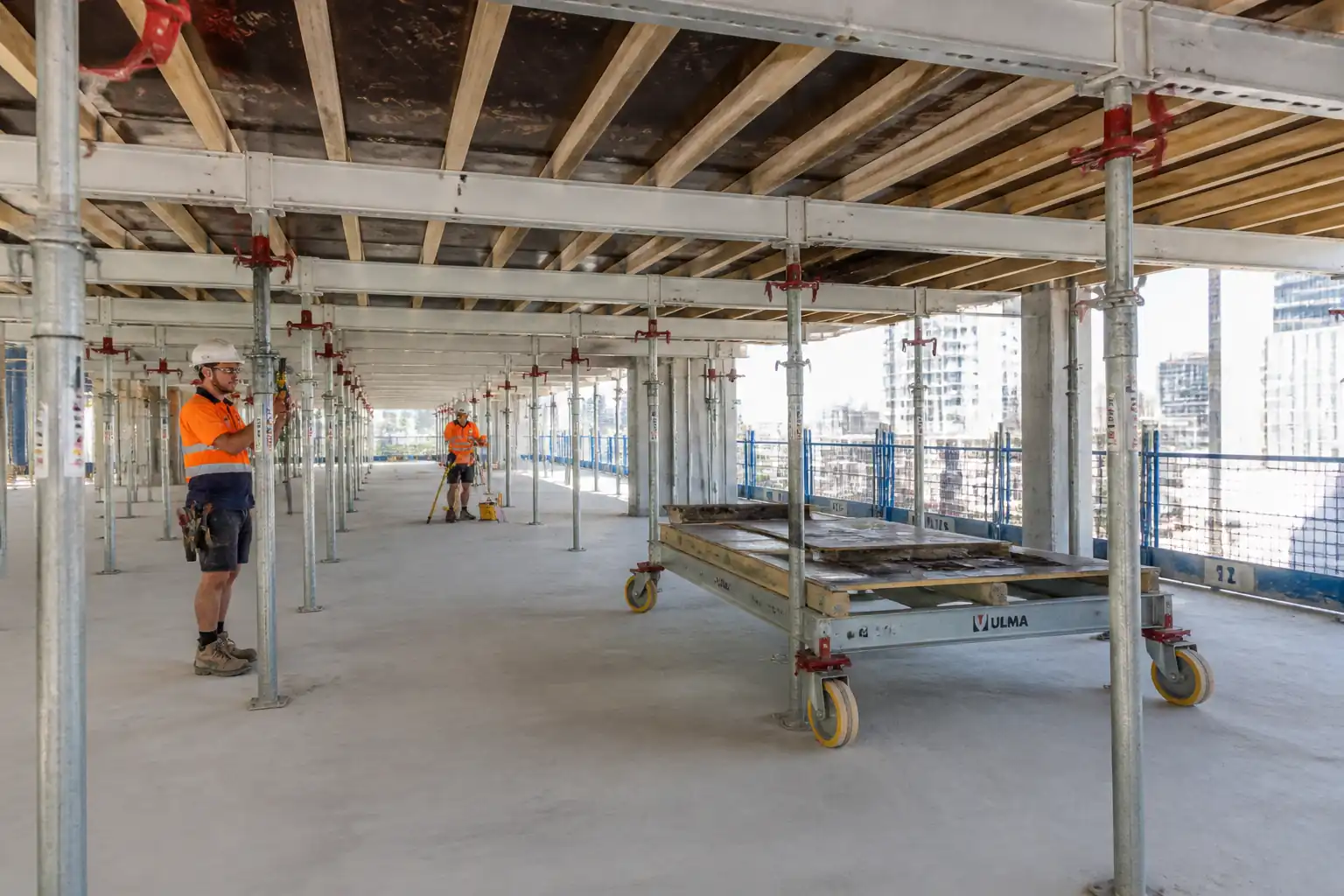
- Formwork/soffit and supports complete, plumb, and pre-inspected; soffit elevations set and surveyed.
- Access/working platforms and edge protection installed and inspected.
- Lighting adequate; housekeeping and debris removal complete.
Utilities and Permits
- Permits to Work: Working at Height, Lifting, Hot Work (if any welding/cutting), Electrical [Verify per project HSE plan and local regulations].
- Prestart coordination meeting and task-specific toolbox talk conducted.
Controls and Benchmarks
- Control lines and level marks snapped on forms; cover blocks prepared at required thickness.
- Coupler torque charts, calibration certificates, and HSE documentation available on site.
Method Sequence
| Step | Activity | Description | Responsibility | Inspection / Hold Point |
|---|---|---|---|---|
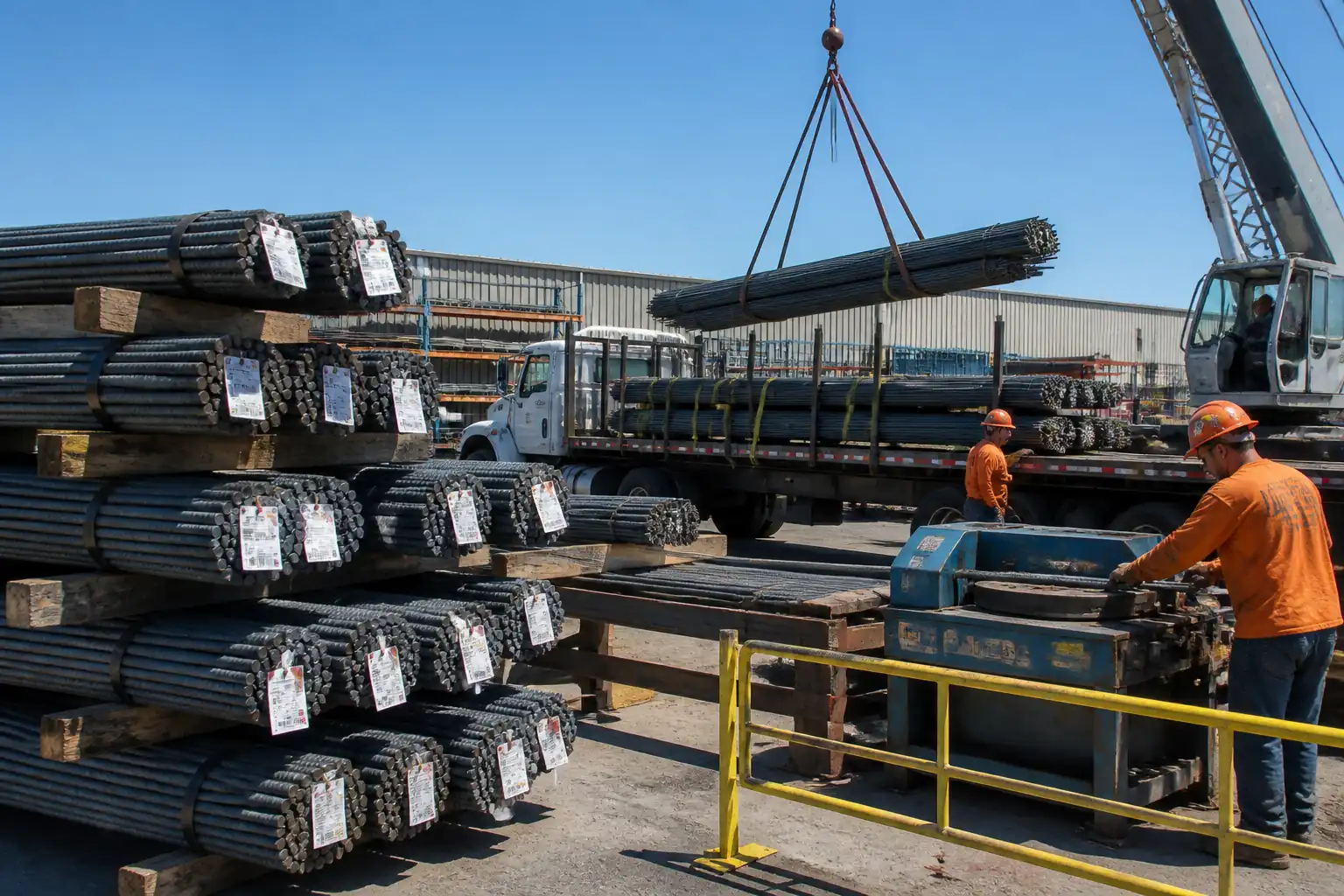
| 1 | Receipt, unloading, and storage of reinforcement | Check delivery against BBS; segregate by bar mark; store off ground on dunnage under cover; protect epoxy-coated bars (if any). | Storekeeper/Rebar Foreman | Visual check on receipt |
| 2 | Set-out and control for reinforcement | Transfer gridlines and slab/beam reference lines to formwork; mark bar start/stop, openings, and sleeves. Install cover blocks/spacers at required thickness. | Surveyor/Site Engineer | Dimensional check |
| 3 | Beam cage fabrication (bench assembly) | Assemble longitudinal bars and stirrups on flat bed. Maintain stirrup spacing and hook orientation per drawings. Pre-install couplers where detailed. Use assembly spacers to maintain internal clearances. | Rebar Foreman | In-process check |
| 4 | Lifting and placing beam cages | Lift cages per approved lift plan using certified gear and tag lines. Set on non-corroding spacers/chairs to achieve soffit/side cover. | Rigger/Foreman | Lift supervision |
| 5 | Fixing of beam longitudinal bars and stirrups in final position | Tie bars at every other intersection minimum; at laps and corners tie every intersection. Ensure lap/coupler zones as detailed and away from high-shear regions unless shown otherwise. | Rebar Fixers | QC check |
| 6 | Slab bottom layer installation | Place main bottom bars first (span direction) then distribution bars. Use chairs/spacers to maintain bottom cover on soffit. Avoid tying wires in cover zone near exposed faces. | Rebar Fixers | QC check |
| 7 | Embedded conduits, sleeves, and boxes coordination | Install MEP conduits/boxes after bottom mat and before top mat. Maintain structural bar continuity; do not cut primary bars. Provide trimming bars around penetrations as detailed. Ensure adequate clearance from bars and cover. | MEP Coordinator/Site Engineer | Joint inspection (Civ/MEP) |
| 8 | Slab top layer installation and chairs | Install high chairs/continuous bar supports; place top bars and tie to chairs. Increase chair density near walkways and congested areas to prevent sagging during concreting. | Rebar Fixers | QC check |
| 9 | Crack-control mesh installation (if specified) | Lay mesh flat; orient laps as per drawings; stagger laps. Secure to main reinforcement without lifting mesh out of cover. | Rebar Fixers | QC check |
| 10 | Openings and edges trimming reinforcement | Install U-bars/extra bars around openings, upstands, edges as detailed. Ensure anchorage/ development lengths within cover constraints. | Rebar Fixers/Site Engineer | QC check |
| 11 | Final pre-pour inspection and sign-off | Clean rebar; remove loose rust/dirt; ensure no tie ends protrude into cover. Complete self-checklist and raise WIR. Engineer to witness/hold-point release. | QA/QC Engineer | Hold Point |
| 12 | Protection prior to concreting | Maintain integrity until pour: restrict access, place temporary walkboards; re-verify critical areas immediately before pour. | Rebar Foreman | Pre-pour walkdown |
Health and Safety Controls
Principal Task-Specific Hazards and Controls
- Hazard: Working at height on suspended decks and near edges
- Likely consequence: Falls causing serious injury or fatality
- Engineering/procedural control: Fully installed edge protection (guardrails, toe boards), fall arrest systems at openings, secure working platforms and access ways; controlled access with signage and barriers.
- Required PPE: Full-body harness with double lanyard where required, hard hat with chin strap, safety boots, gloves.
- Collective preventive measure: Guardrails/netting; scaffold inspections.
-
Inspection/permit/supervision: Working at Height PTW; daily scaffold/edge protection inspection by competent person [Verify per project HSE plan and local regulations].
-
Hazard: Impalement on protruding rebar
- Likely consequence: Severe penetration injuries
- Engineering/procedural control: Fit robust mushroom rebar caps on all vertical/protruding bars; cap to meet impact standards; keep walkways clear.
- PPE: Gloves, long sleeves, safety boots.
- Collective measure: Exclusion zones; physical capping of groups of bars.
-
Inspection/permit/supervision: Daily HSE walkdown to verify capping, housekeeping.
-
Hazard: Manual handling of rebar bundles and cages
- Likely consequence: Musculoskeletal injury, crush injuries
- Engineering/procedural control: Team lifts for bars >25 kg; use mechanical handling (crane/chain blocks) for cages; pre-sling at balance points; limit bundle size as per lift plan.
- PPE: Gloves with cut resistance, steel-toe boots, back support (as required).
- Collective measure: Use mechanical aids; plan lifts.
-
Inspection/permit/supervision: Lifting plan approval; rigger/signalman supervision.
-
Hazard: Lifting operations with crane/hoists
- Likely consequence: Dropped loads, strikes, rigging failure
- Engineering/procedural control: Certified crane/rigging, tag lines, exclusion zones; lift only within SWL; weather/wind checks; no personnel under loads.
- PPE: Hard hats, high-visibility vests, gloves, safety boots.
- Collective measure: Barricaded lift zone and spotters.
-
Inspection/permit/supervision: Daily crane checklist; operator license; lifting permit.
-
Hazard: Power tools (cutters/benders/tying guns)
- Likely consequence: Lacerations, entanglement, eye injury
- Engineering/procedural control: Machine guards in place; lock-out for maintenance; keep hands clear; use only trained operators; maintain safe cords/batteries.
- PPE: Safety glasses/face shield, gloves, hearing protection as needed.
- Collective measure: Tool stations with barriers and signage.
-
Inspection/permit/supervision: Tool inspection log; supervisor authorization.
-
Hazard: Trip hazards from scattered bars/tie wire
- Likely consequence: Slips, trips, and falls
- Engineering/procedural control: Defined laydown zones; regular housekeeping; magnetic sweep for tie-wire offcuts.
- PPE: Safety boots with good grip.
- Collective measure: Clear walkways and temporary boards for access across reinforcement.
-
Inspection/permit/supervision: Housekeeping inspections at start/end of shift.
-
Hazard: Noise and vibration from cutting/bending
- Likely consequence: Hearing damage, hand-arm vibration
- Engineering/procedural control: Select low-noise tools, duty rotation, vibration exposure monitoring.
- PPE: Hearing protection.
- Collective measure: Noise maps and signage.
-
Inspection/permit/supervision: HSE monitoring records.
-
Hazard: Hot works (if any welding/cutting by torch is approved)
- Likely consequence: Burns, fire, fumes
- Engineering/procedural control: Hot Work Permit; fire blankets/screens; fire watch; fume extraction if enclosed; only weld A706 or designated weldable bars per approval.
- PPE: Welding shield, leather gloves/apron, respirator (if needed).
- Collective measure: Fire extinguishers and spill/fire kits at point of work.
-
Inspection/permit/supervision: Hot Work PTW; gas set inspections; competence records.
-
Hazard: Congested reinforcement areas causing entrapment during pour interface
- Likely consequence: Strain injuries, entrapment
- Engineering/procedural control: Temporary walkboards; pre-pour briefing to avoid stepping on top mats; designated access routes.
- PPE: Boots, gloves, helmet.
- Collective measure: Access boards secured to chairs where designed to carry load.
- Inspection/permit/supervision: Pre-pour checks by foreman and QA.
Environmental Controls
Environmental Aspects and Controls
- Steel waste and tie-wire offcuts
- Impact: Scrap accumulation and site contamination
- Control: Segregate scrap steel into designated bins for recycling; collect tie-wire offcuts via magnetic sweep at end of shift.
-
Inspection/records: Waste transfer notes and daily housekeeping log.
-
Noise from cutting/bending operations
- Impact: Nuisance to neighbors/workers
- Control: Schedule high-noise tasks during permitted hours; use quieter equipment; install temporary noise barriers where necessary.
-
Inspection/records: Noise monitoring where required [Verify per project HSE plan and local regulations].
-
Potential oil/grease drips from equipment
- Impact: Formwork/concrete contamination and runoff pollution
- Control: Drip trays under stationary equipment; immediate cleanup kits; prohibit oil-contaminated bars in pour area.
-
Inspection/records: Weekly equipment leak checks.
-
Epoxy-coated bar damage (if specified)
- Impact: Premature corrosion if coating damaged
- Control: Use nylon slings and padded dunnage; repair kits on hand; touch-up as per manufacturer before installation.
-
Inspection/records: Coating damage log and repair records.
-
Dust/particulate from on-deck cutting
- Impact: Air quality
- Control: Use bench cutters with collection; minimize on-deck cutting; pre-fabricate where possible.
- Inspection/records: Supervisor checks and TBT briefing records.
Quality Assurance / Quality Control
Controls
- Hold/Witness Points: As per ITP; key holds for beam rebar completion, embedded services coordination, and final pre-pour.
- Tolerances: Reinforcement spacing ±10 mm; bar location within ±10 mm; clear cover not less than specified (apply +tolerance only relative to minimum cover) per ACI 117/Project Specs [Verify].
- Cover Requirements: Typical minimum clear cover—internal slabs/beams: 20–25 mm; external/severe exposure: 40–50 mm [Verify per project specifications].
- Laps/Couplers: Lap lengths per drawings; mechanical splices per ISO 15835; torque to manufacturer’s values with calibrated wrench.
- Chairs/Spacers: Comply with BS 7973; non-corroding within cover zone; density adequate to prevent sagging/displacement (typ. ≤1.0 m grid; reduce to ≤0.8 m in heavy traffic) [Verify].
- Cleanliness: Rebar free from oil, mud, deleterious rust, and loose scale; clean prior to pour.
Inspection and Testing
- Material Verification: MTCs for each heat; visual check of marks vs. BBS—100% on receipt.
- Dimensional Checks: Random checks every 10 m² for slab mats and every 3 m length for beams; record on check sheets.
- Cover Checks: Physical gauges and spot electronic cover meter checks at minimum 1 per 20 m² (slabs) and 1 per beam; increase frequency in congested areas [Verify].
- Couplers: 100% visual; torque verification per lot/zone (typ. 100% where access allows) [Verify].
Records
- MIRs, MTCs, approved shop drawings/BBS
- WIRs with photos and punchlist closure
- Calibration certificates (torque wrench, survey/cover meter)
- NCRs/CCRs with corrective actions (if any)
- As-built markups for reinforcement changes agreed with Engineer
Nonconformance
- Identify, tag, and quarantine nonconforming areas; raise NCR; implement corrective actions (e.g., install additional bars, adjust cover using compliant spacers). Re-inspect and document closure.
Attachments
- Sample Rebar Installation Checklist (Slab/Beam)
- Bar Bending Schedule (BBS) – Template
- Coupler Installation and Torque Verification Sheet
- Lifting Plan for Prefabricated Beam Cages
- Daily HSE Checklist (Working at Height, Lifting, Hot Works)
- Cover Check Log and As-built Sketch Template
- Manufacturer Data Sheets: Chairs/Spacers, Couplers, Mesh
This content is a read-only public reference. Download or customize to get an editable version.
ITP preview
The first inspection activities from the linked ITP for Method Statement: Fixing Reinforcement for Suspended Concrete Slabs and Beams:
| Activity | Inspection / Test | Acceptance Criteria | Responsibility | Record |
|---|---|---|---|---|
| Material receipt – rebar, mesh, chairs, couplers | Verify grade/size vs. MIR/BBS; check coating (if any); review MTCs. | Materials as approved; free of damage/contamination; traceable heat numbers. | QA/QC Engineer | MIR, MTCs, inspection report |
| Formwork/soffit readiness for rebar placement | Check dimensions, levels, cleanliness, access, and edge protection. | Formwork within dimensional tolerances; safe access; soffit level as per set-out. | Site Engineer / QA/QC | Formwork inspection checklist |
| Beam cage fabrication quality | Check bar marks, stirrup spacing, hook orientation, bends. | Correct bars; spacing ±10 mm; bends per code; ties adequate. | QA/QC Engineer | Inspection report, photos |
Showing 3 of 8 inspection activities. View full ITP →
Related Inspection and Test Plan
An Inspection and Test Plan (ITP) is available for Method Statement: Fixing Reinforcement for Suspended Concrete Slabs and Beams. The ITP defines the inspection activities, acceptance criteria, hold and witness points, responsible parties, and records required to verify the work described in this method statement.
View the Method Statement: Fixing Reinforcement for Suspended Concrete Slabs and Beams ITP →Frequently asked questions
Continue with related Quollnet resources connected to this method statement.