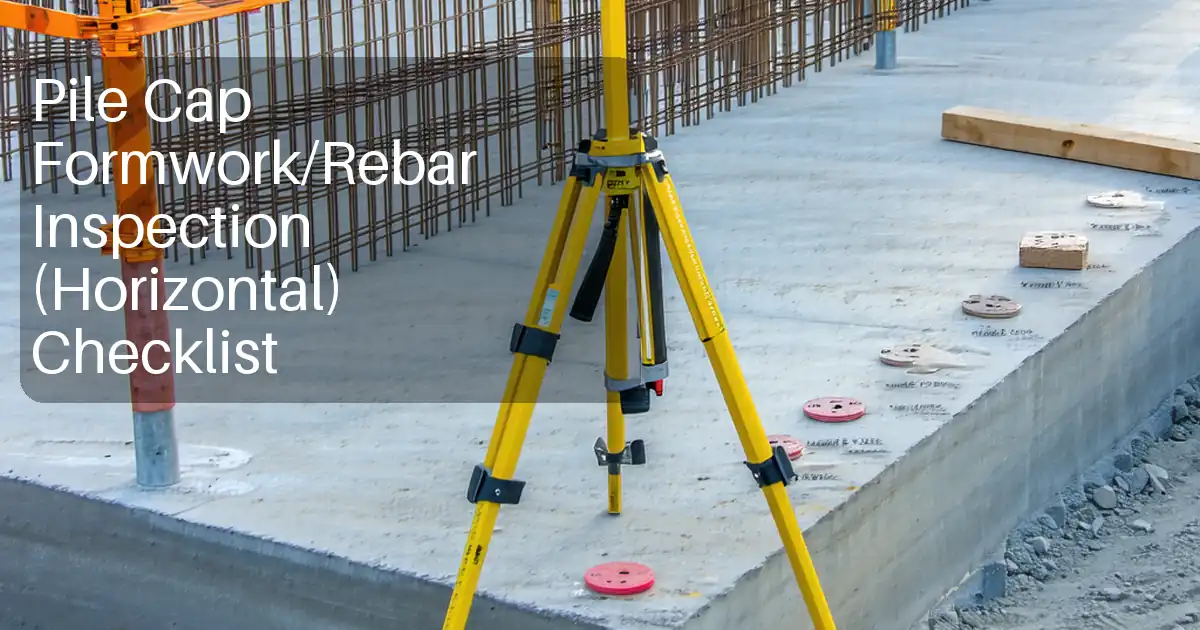
Raft Rebar Horizontal Inspection Checklist
Definition: Inspect raft rebar (horizontal) checklist for site engineers ensures correct cover, bar sizes, laps, spacing, openings, and embeds before concrete, preventing defects and costly rework.
- Verify cover, sizes, laps, spacing, openings, and embeds.
- Prevent corrosion, clashes, delays, costly rework, and nonconformances.
- Measure, tag, photograph, and record evidence against approved drawings.
- Interactive, commentable checklist with export and QR code traceability.
Inspect raft rebar (horizontal) sets a precise, pre-concrete scope for site engineers and inspectors to validate raft slab reinforcement before any pour. This focused foundation mat rebar QA process checks cover, bar sizes, lap splices, spacing, openings, and embedded items. By keeping the scope horizontal only (excluding vertical elements and any pouring activities), you reduce corrosion risk, honeycombing, congestion, and MEP clashes that drive rework and schedule slippage. The checklist emphasizes measurable methods—tape, caliper, cover meter, and total station—plus photographic evidence and approval references per approved project specifications and authority requirements. You’ll confirm stability under foot traffic, tidy laps and couplers, correct reinforcement around blockouts, and proper positioning of sleeves, plates, and starter bars at construction joints. The result is a documented, buildable raft rebar layout with traceable sign-offs. Use the interactive features to tick items, add comments with photos, and export your report as PDF or Excel complete with a secure QR code.
- Confirm rebar size, grade, and spacing against approved shop drawings and bar bending schedules using calipers and tape measurements. Validate cover with cover meters and spacer heights, and record all readings with time-stamped photos and drawing references for traceable compliance.
- Control lap splices, anchorage, and couplers with measurable checks: tape lap lengths, verify tie patterns, and record coupler model, lot, and torque. Ensure laps are staggered and free from clustering to avoid congestion and maintain structural continuity around edges and corners.
- Coordinate openings, blockouts, and MEP conduits early. Verify locations by total station, maintain required cover on all sides, and install additional trimmer and U-bars as detailed. Prevent unauthorized bar cutting by logging approvals and photographing every trimmed or re-anchored bar.
- Interactive online checklist with tick, comment, and export features secured by QR code.
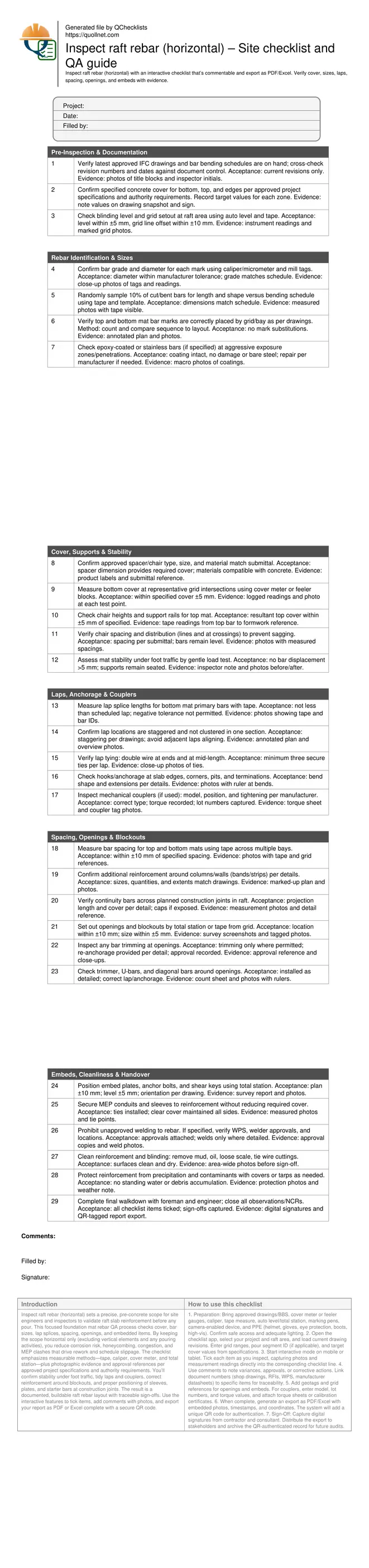
Pre-Inspection & Documentation
Rebar Identification & Sizes
Cover, Supports & Stability
Laps, Anchorage & Couplers
Spacing, Openings & Blockouts
Embeds, Cleanliness & Handover
What a horizontal raft rebar inspection covers and why it matters
A horizontal raft rebar inspection focuses strictly on the raft slab reinforcement before any concrete placement. Inspectors validate bar grades, diameters, and placement across top and bottom mats, then confirm concrete cover using spacers, chairs, and cover meters. Lap splices, hooks, and couplers are verified for length, positioning, and fixation, while bar spacing is measured across multiple bays for consistency. Openings and blockouts receive particular attention: authorized trimming, trimmer/U-bars, and re-anchorage are compared to details to maintain load paths. Embedded items, sleeves, and conduits are set out and tied so they do not compromise cover or cause clashes. Cleanliness and mat stability checks help prevent voids, segregation, and corrosion initiators. By capturing photos, measurements, and approval references per approved project specifications and authority requirements, teams create a defensible, repeatable quality record that reduces rework and schedule risk on deep foundations.
- Confirms cover, spacing, laps, and bar sizes pre-concrete.
- Prevents clashes and preserves required concrete cover.
- Documents evidence with measurements and photos.
- Keeps scope horizontal only; excludes pouring operations.
- Improves buildability and reduces rework risk.
Methods, tolerances, and practical cues you can rely on
Use a caliper to verify diameters on representative samples and photograph mill tags for traceability. Tape measures confirm spacing, lap splice lengths, and bar projections at construction joints; aim for consistent readings within the stated tolerances and project details. A cover meter or feeler blocks validate bottom cover at grid intersections and along edges, while chair height checks indicate top cover control. Where mechanical couplers are specified, record model, lot numbers, and torque values per manufacturer literature. For openings and penetrations, set out with a total station and log as-built coordinates to control location and size tolerances. Stability is equally important: distribute chairs and ties so mats don’t shift under foot traffic. Finally, ensure cleanliness—no mud, oils, or loose scale—so the bond interface remains reliable. These techniques create clear acceptance cues visible to the crew and verifiable during sign-off.
- Measure, photograph, and annotate against drawings.
- Use cover meters and chair height checks.
- Record torque and lot numbers for couplers.
- Survey openings for location and size control.
- Verify stability under typical foot traffic.
Coordinating openings, embeds, and MEP without losing cover
Openings and embedded items can quickly erode required cover or disrupt reinforcement continuity if left to late-stage coordination. Begin by extracting an opening and embed register from the latest drawings, then walk the mat to verify each location with a total station or grid-based offsets. Check that sleeves, conduits, plates, and anchor bolts are tied in place without displacing bars and that required cover is still achieved on all sides. If trimming is authorized, confirm re-anchorage or added trimmer/U-bars exactly as detailed, and capture the approval reference in your report. Keep couplers, laps, and hooks away from congested zones around penetrations to preserve bar spacing and allow concrete flow. A photo-rich, measurement-backed record limits disputes and prevents late clashes with MEP, while ensuring the raft remains buildable and structurally sound.
- Start from an updated opening and embed register.
- Survey and tag each penetration location.
- Maintain required cover on all sides of embeds.
- Log approvals for any bar trimming.
- Avoid lap clustering near congested penetrations.
How to Use This Interactive Raft Rebar Inspection Checklist
- Preparation: Bring approved drawings/BBS, cover meter or feeler gauges, caliper, tape measure, auto level/total station, marking pens, camera-enabled device, and PPE (helmet, gloves, eye protection, boots, high-vis). Confirm safe access and adequate lighting.
- Open the checklist app, select your project and raft area, and load current drawing revisions. Enter grid ranges, pour segment ID (if applicable), and target cover values from specifications.
- Start interactive mode on mobile or tablet. Tick each item as you inspect, capturing photos and measurement readings directly into the corresponding checklist line.
- Use comments to note variances, approvals, or corrective actions. Link document numbers (shop drawings, RFIs, WPS, manufacturer datasheets) to specific items for traceability.
- Add geotags and grid references for openings and embeds. For couplers, enter model, lot numbers, and torque values, and attach torque sheets or calibration certificates.
- When complete, generate an export as PDF/Excel with embedded photos, timestamps, and coordinates. The system will add a unique QR code for authentication.
- Sign-Off: Capture digital signatures from contractor and consultant. Distribute the export to stakeholders and archive the QR-authenticated record for future audits.
Call to Action
- Start Checklist Tick off tasks, leave comments on items or the whole form, and export your completed report to PDF or Excel—with a built-in QR code for authenticity.
- Download Excel - Raft Rebar Horizontal Inspection
- Download PDF - Raft Rebar Horizontal Inspection
- View Image - Raft Rebar Horizontal Inspection
Cite & Embed
“Raft Rebar Horizontal Inspection by Quollnet”
with a link to
this source page.

FAQ
Question: What cover tolerances should I apply for a raft slab rebar inspection?
Question: How do I measure lap splices accurately on congested raft reinforcement?
Question: What should I do if delivered bar sizes or grades don’t match the schedule?
Question: When are mechanical couplers preferable to lap splices in rafts?
Related Articles
Broader reading and guidance connected to this checklist topic.


Ncr Form Template (excel/pdf) – Non-conformance Report Format

High Or Low Concrete Slump: Retest, Hold, Adjust Or Reject?
Related Checklists
Keep the workflow moving with nearby templates chosen from similar checklist content.